






Abstract
Introduction
Approaches for monitoring psychosocial health in challenging environments are needed to maintain the performance and safety of personnel. The purpose of the present research was to examine the relationship between 2 candidate methods (self-reported and linguistics) for monitoring affective experience during extreme environment activities.
Methods
A single-subject repeated-measures design was used in the present work. The participant was a 46-year-old individual scheduled to complete a self-supported ski expedition across Arctic Greenland. The expedition lasted 28 days, and conditions included severe cold, low stimulation, whiteouts, limited habitability, and threats to life and limb. During the expedition, the participant completed a daily self-report log including assessment of psychological health (perceptions of control and affect) and a video diary (emotion). Video diary entries were subjected to linguistic inquiry and word count analyses before the links between self-report and linguistic data across the expedition period were tested.
Results
Similarities in the pattern of self-reported and linguistic assessments emerged across the expedition period. A number of predictable correlations were identified between self-reported and linguistic assessments of affective/emotional experience. Overall, there was better agreement between self-reports and linguistic analytics for indicators of negative affect/emotion.
Conclusions
Future research should build on this initial study to further test the links between self-reported affect and emotional states monitored via linguistics. This could help develop methods for monitoring psychological health in extreme environments and support organizational decision making.
Introduction
Many professions continue to require individuals to operate in extreme environmental conditions—for example, humanitarian and disaster relief workers, astronauts participating in long-duration space missions, those completing expeditions, and military and defense personnel operating in remote parts of the Earth. Organizations responsible for sending personnel into these isolated, remote, and potentially dangerous contexts have a duty of care to monitor health status and provide appropriate levels of support. As such, a current focus of research in extreme environments is to develop valid and reliable methods for monitoring indicators of performance and health. 1 Currently efforts are focused on developing low-burden, passive approaches that can be used to monitor individuals and teams operating under stress. Such developments are important for ensuring the safety and fitness for duty of individuals and teams living and working in such contexts.
Although attempts have been made to advance automated monitoring technologies related to performance and fatigue, 2 there is relatively little published work on methods for monitoring psychological and mental health in extreme settings. One indicator of psychological health that has received a good deal of attention in extreme settings is affect. Affect is an overarching term used to describe a person’s feelings, emotions, and mood. In the past, situational reports of affect during extreme environment expeditions have been captured in weekly 3 and daily self-reports. 4 Based on prior research, we would expect that chronic disruption to affect will have an effect on a person’s health status and may eventually lead to clinical health issues. Although self-reported assessments of affect and emotional states have demonstrated validity in extreme settings, alternative methods, such as linguistic analyses based on video diaries, may offer a more acceptable and lower-burden alternative to completing repetitive surveys and daily diaries to monitor affective state.
Linguistic analysis is related to the structure of language and what we can learn from the words that people use. In previous studies, text transcribed from voice accounts have been used to examine thoughts, feelings, and indicators of personality and motivation. 5 The aim of the present report was to examine the extent to which daily self-reported affect during an extreme environment expedition was associated with emotion metrics resulting from linguistic analysis of video data. To demonstrate validity, we would expect to see moderate to strong correlations between self-reported and linguistic assessments of affect (or emotion). As an external validity check, perceptions of control were also assessed during the expedition. Perceived control is fundamental to effective coping and shows consistent associations with self-reported affect. Relations between perceived control and linguistic analyses of emotion that are consistent with those observed for affect would be anticipated.
Method
Participant
The participant in this exploratory study was a 46-year-old man scheduled to complete a self-supported ski expedition across the Greenland ice cap. The participant had previously taken part in an expedition in the Arctic and was familiar with the demands of polar environments. It was anticipated that the expedition would last around 26 days (actually completed in 28 days), requiring the participant to ski over 580 km and endure challenging conditions, including severe cold, whiteouts, low stimulation, sleep disruption, and limited possibility for evacuation. The study received ethical approval from the University of Northampton in the United Kingdom, and signed informed consent was secured before the participant took part. Background information on the study aims was provided to the participant; however, he did not have intimate knowledge of the measures or analytical approaches used.
Measures
Self-report
During the expedition, the participant completed a daily diary log at the end of each day. The diary included a single item on perceived control and responses were provided based on a 5-point scale ranging from not at all (1) to very much so (5). To measure self-reported affect, the positive and negative affect schedule 6 was employed. The 20-item positive and negative affect schedule includes 10 items indicative of positive affect (interested, excited, and strong) and 10 for negative affect (distressed, upset, and hostile). A similar 5-point response scale was used, ranging from not at all/very slightly (1) to extremely (5).
Voice diary
At the end of each expedition day, the participant recorded a video diary. The video diary was recorded in private within his own tent using diary-room procedures followed in previous work.
7
Typically, data capture included having the participant sit inside the tent and hold the camera in front of his face. When completing the video recording, the participant was asked to respond to 3 questions: How do you feel? What were the best parts of the day? What were the worst parts of the day?
Video diaries ranged in length from approximately 30 s to 3 min. The material resulting from the video diaries was transcribed verbatim to conduct the linguistic analysis. Transcription resulted in 9 pages of text and 6391 words.
Data Analysis
In total, 28 self-reported daily diary logs and 25 video diaries were completed during the expedition. The participant chose not to record a video diary on 3 days. Analytical approaches were consistent with single-subject-design research. Mean and standard deviation scores were computed for all of the study variables. Temporal changes in positive and negative affect were then mapped against expedition days. We analyzed 25 video diary accounts using the Linguistic Inquiry and Word Count (LIWC; Pennebaker Conglomerates Inc, Austin, TX) software. The 2015 version of LIWC was employed; the software counts and assimilates the instances of approximately 4500 words across multiple dimensions representing different psychological processes. Within the present report, we were interested in the categories of positive (positive emotion-voice) and negative (negative emotion-voice) emotion that are extracted from the voice accounts via LIWC. Positive and negative emotion-voice results were then mapped according to expedition days. Bivariate correlations were computed to assess the extent to which self-reports and emotion-voice accounts were related. To provide an additional validity check, perceived control was correlated with both self-reported and linguistic positive and negative affect/emotion-voice scores. Effect sizes were interpreted based on guidelines as follows; r=0.10 is considered small, r=0.30 medium, and r=0.50 is large.
Results
The expedition was from East to West Greenland starting in Kangerlussuaq and finishing in Tasillaq. Distances covered ranged from 50 km in week 1 to 220 km in week 4. Air temperatures during the day could reach 15°C; however, there was a large degree of variability, and in weeks 2 and 3 temperature remained below 0°C and were as low as –30°C at times. The highest altitude reached during the expedition was 2500 m (8200 ft), feeling like 3700 m (12,140 ft) due to differences in air pressure.
Throughout the expedition, the participant reported a moderate perception of control, albeit with evidence of variability. Self-reported positive affect was more prominent than self-reported negative affect. However, fluctuations were observed throughout the crossing, demonstrated in Figure 1. A similar pattern was evident for voice analysis representing positive and negative emotion. Positive emotion-voice was consistently higher than negative emotion-voice, but again, there were fluctuations throughout the expedition, as represented in Figure 2.
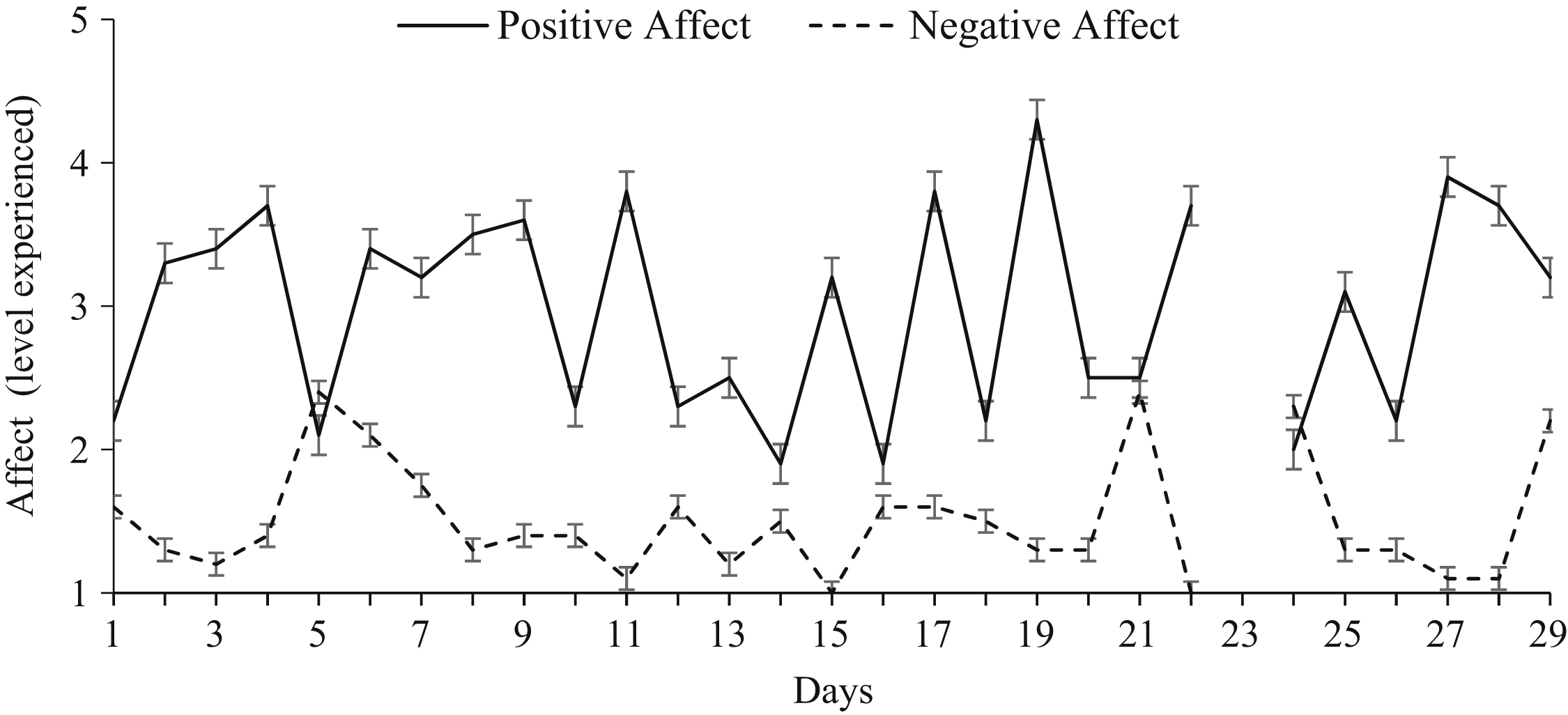
Self-reported emotion over expedition days. Data presented as mean±SD for each sample point of positive and negative affect.
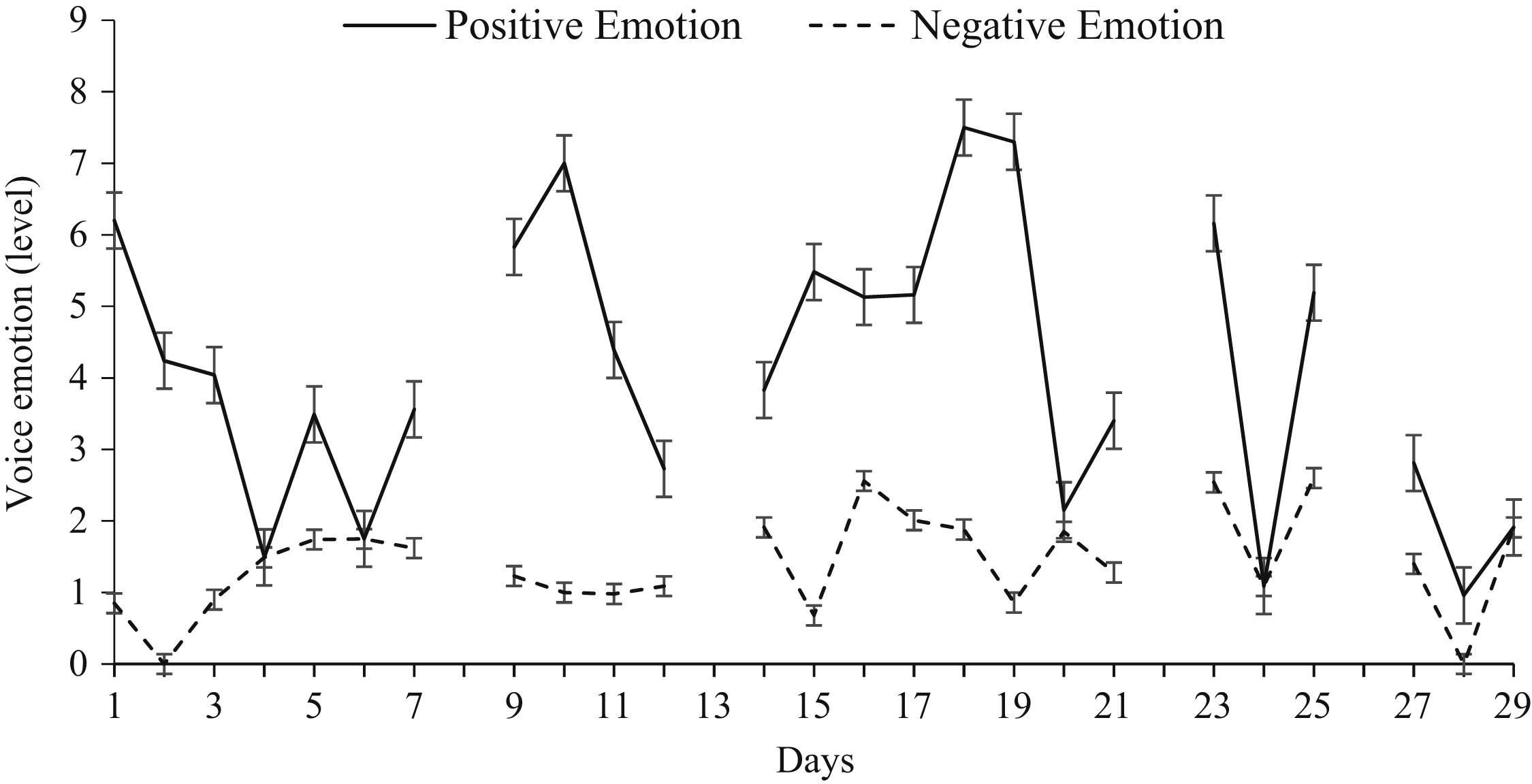
Emotion voice analysis over expedition days. Data presented as mean±SD for each sample point of positive and negative emotion.
Correlational analyses presented in Table 1 suggest that perceptions of control showed predictable associations with affect and emotion. There was a large association between perceptions of control and positive affect (0.60) and medium relation with positive emotion-voice (0.32). There was a large inverse relationship between perceptions of control and negative affect (–0.65) and medium relation with negative emotion-voice (–0.24). In terms of relations between affect and emotion-voice scores, self-reported positive affect was not associated with positive emotion-voice (–0.04), but showed a medium inverse relation with negative emotion-voice (–0.30). A medium inverse effect was found between self-reported negative affect and positive emotion-voice (–0.32) and medium associated with negative emotion voice (0.32).
Bivariate correlations between study variable
P<0.05.
Discussion
Findings suggest that both self-reported and voice assessments of affect/emotion follow a similar pattern when examined across the whole expedition period. Consistent with previous work relying on questionnaires, 3 ,4,8 positive affect/emotion scores were more prominent than negative affect/emotion for both daily self-reports and voice accounts. This is the first known study in an extreme and dynamic expedition setting to demonstrate that voice analytics targeting emotion can provide findings similar to those from self-reports. Interestingly, both self-reports and voice analytics suggest a rebounding effect, evidenced by the peaks and troughs in Figures 1 and 2. A similar pattern has been noted in other daily monitoring research focused on emotion. 4 This may represent someone demonstrating resilience and the capacity to overcome stressors faced in preceding days. 9 More attention should be focused on this issue and whether a different pattern would be observed for someone with lower stress resiliency. Indeed, such questions will be easier to address with low-burden and passive monitoring methods such as voice analytics. The opportunity to monitor such changes will also give mission control or those involved in providing support an evidence base to inform their decision making. 10
Correlations between self-reports and voice analytics tended to be moderate and in the expected directions (eg, negative affect was moderately associated with negative emotion-voice), although there was no link between self-reported positive affect and positive emotion-voice in this work. Initial assessment suggests that voice analysis may have utility, particularly for monitoring the emergence of negative emotional states. Further work needs to be done in other ecologically valid environments to determine whether voice analysis can be used to monitor the health of individuals operating under stress in extreme settings. 11
Limitations
It is important to acknowledge that the data in the present study are based on assessments from a single case. However, the findings are somewhat consistent with prior work and predictions, therefore offering promising avenues for future work in monitoring psychological health during extreme environment activities. In future studies, examining interindividual differences in the validity of voice analytics should be a priority. Such work would enable researchers to determine whether different patterns of functioning can be used to predict adaptive and maladaptive responses to extreme environments. In addition, although the video diaries completed during the expedition provide a more situational assessment of emotion, these were recorded at the end of each day and may reflect an emotional profile of the whole day. The process of transcribing and analyzing the video diaries is resource intensive and time consuming; therefore, methods for real-time linguistic analysis would be worthy of examination in extreme contexts. Developing the real-time capability to monitor linguistics resulting from video diaries would add value from a command and control point of view and for those wanting to use the evidence to inform decisions. To this end, it would also be beneficial to explore the utility of linguistic analysis on a moment-by-moment basis to examine whether acute changes in emotion can be captured and offer useful information for decision making and health status in extreme settings. Finally, the completion of video diaries is dependent on the engagement and motivation of the individuals operating in extreme contexts. Although video diaries may be less burdensome to complete relative to self-reports, if an individual chooses not to log a video, it is not possible to monitor their status.
Conclusion
Overall, the present exploratory work offers unique and novel findings related to health-monitoring approaches in extreme settings. Relationships between self-reported and voice analytic data provide initial evidence for the construct validity of linguistics as a method for capturing changes in emotion during extreme environment deployments. The findings related to negative affective/emotional states are particularly interesting. Ultimately, the development of health monitoring methods is pertinent to individuals working and living in extremes as well as the organizations responsible for them.
Author Contributions: Sole author contributed 100% to this article.
Financial/Material Support: None.
Disclosures: None.