






Abstract
Methoxyflurane is a volatile, fluorinated anesthetic agent with analgesic properties. Although no longer used as an anesthetic due to concerns regarding renal toxicity in high doses, it has enjoyed a resurgence as an inhaled analgesic in prehospital care and in the emergency department. The agent is nonflammable and leads to rapid, titratable analgesia without intravenous access. The Penthrox inhaler device is light, robust, and straightforward to administer. Consequently, it has been proposed as an ideal analgesic for the remote high altitude setting. We report its use for procedural analgesia during suprapubic aspiration for acute urinary retention at a remote rescue post at night, in cold winter conditions, at 4470 m altitude in Machermo, Nepal. We found that methoxyflurane provided rapid, effective analgesia for our patient’s visceral and procedural pain. The inhaler was easy to administer, and the patient remained responsive to voice, with satisfactory oxygen saturation and respiratory rate throughout. We also briefly review the administration, dosing, efficacy, and safety of methoxyflurane and its role in remote medical care.
Keywords
Introduction
Methoxyflurane (Penthrox, Penthrane) is a volatile fluorinated hydrocarbon, historically used as an anesthetic and still widely employed in Australasia as an inhaled analgesic. 1 It fell out of favor for anesthesia after reports of nephrotoxicity and was formally withdrawn from the United States by the Federal Drug Administration in 2005. In 2015, methoxyflurane regained its license in the United Kingdom for use as an emergency analgesic in adult trauma patients and is presently available in 11 countries and under review in 22 more (Table 1). It has been argued that methoxyflurane would be an ideal agent for remote high-altitude analgesia, but the authors noted there were no published reports of its performance in that setting. 2 In that light, we present a case of emergency suprapubic aspiration for acute urinary retention, using methoxyflurane for procedural analgesia, at a remote rescue facility at 4470 m.
Methoxyflurane licensing in adults and pediatrics
Methoxyflurane has been reviewed in an additional 22 countries within the European Union (plus Switzerland) by the respective regulatory bodies and is considered approvable. The national phase of approval for each of these countries is in progress. Methoxyflurane was submitted for review in Canada in June 2017. Indications are typically trauma and emergency pain relief, although extend to acute pain and minor surgical procedures in some territories. (Medical Developments International, e-mail communications, January 23, 2018 and February 8, 2018).
Case presentation
A 61-year-old Australian trekker presented at 0230 to the Community Action Nepal - International Porter Protection group rescue post at Machermo, Nepal, in acute urinary retention. He had experienced no problems voiding during the previous day, but on getting out of bed at 2200 he was only able to pass a small dribble of urine. By the time of his presentation, he was in considerable pain.
He had no symptoms of urinary tract infection or constipation, and his lower limb neurology was normal. Although this was his first presentation with retention, he recounted a 10-year course of gradually worsening lower urinary tract symptoms, including nocturia, poor flow, intermittent stream, hesitancy, and terminal dribbling. He had not sought treatment for these symptoms, and his only other medical history was hypertension, treated with lercanidipine. He was on day 6 of a trek from Lukla, had no symptoms of acute mountain sickness, was not taking acetazolamide, and had been to an equivalent altitude twice before.
His observations on admission were heart rate 101 beats·min-1, blood pressure 150/110 mm Hg, respiratory frequency 32 breaths·min-1, finger oxygen saturations 90% standing and 86% supine, and tympanic temperature 35°C. His bladder was palpable to 4 cm inferior to the umbilicus, and there were no signs of peritonism. He described his pain as “severe.”
With no access to urethral catheters, we elected to perform suprapubic bladder aspiration. However, with only a 10 mL syringe and 21G needle available at the post, it was to be a time-consuming and potentially painful process, necessitating procedural analgesia. We gave him 1 g of oral paracetamol (acetaminophen) and injected 4 mL of 1% lidocaine around the intended aspiration site, but he remained very uncomfortable secondary to visceral pain from his bladder and struggled to lie still. Our parenteral analgesic options were diclofenac, tramadol, or inhaled methoxyflurane. We were reluctant to give diclofenac for fear of renal dysfunction associated with the urinary retention, and we judged that the ability to titrate methoxyflurane inhalation made it safer than parenteral tramadol for this procedure. Our primary concern was that the ambient temperature, not measured but certainly below 0°C, would render the methoxyflurane less effective (see Discussion).
The patient held a Penthrox inhaler (Medical Developments International, Victoria, Australia), primed with 3 mL of methoxyflurane (Figure 1). Breathing the vapor, he described a rapid, significant reduction in his bladder pain and a feeling of being “blissed out.” Although aware of the sensation of the needle aspiration, he did not report pain during the procedure. His oxygen saturation fell to 86% on air after lying supine. It then remained between 83 and 86% while breathing the vapor. (For context, the mean oxygen saturation at our post in well trekkers standing upright was 87% [SD±4.1%].) His respiratory rate fell to 18 breaths·min-1 on breathing the vapor, likely due to the reduction in pain, and vocal contact was maintained throughout. Our oxygen supplies were limited at night, so we elected not to use supplementary oxygen unless demanded by his clinical condition.
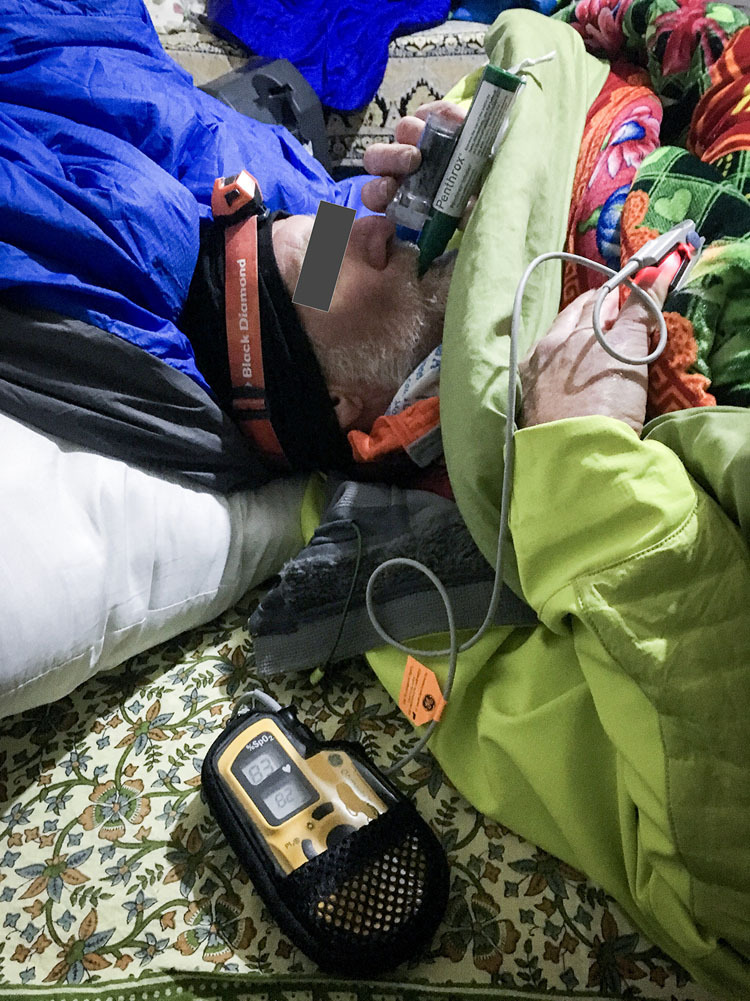
The patient using the methoxyflurane (Penthrox) inhaler during the procedure. He was covered by several blankets due to the low ambient temperature and had continuous oxygen saturation and heart rate monitoring. The inhaler was fitted with the activated charcoal filter to scavenge waste gases.
After the successful aspiration of 400 mL of straw-colored urine and the cessation of methoxyflurane inhalation, he was almost immediately able to stand unaided. Although conscious of a recurring mild urge to pass urine, he remained free from pain until his helicopter evacuation to Kathmandu the following morning. There, he was catheterized and investigations confirmed a normal renal tract and renal function. The cause of the retention was benign prostatic hypertrophy, and the patient was discharged from the hospital the next day.
Discussion
We report the successful use of methoxyflurane for procedural analgesia during suprapubic aspiration for acute urinary retention at a remote, high-altitude Himalayan rescue post. Methoxyflurane is supplied in 3 mL (4.12 g) screw-top vials and administered via a disposable inhaler (nicknamed the “green whistle” in Australasia). 3 The clinician opens the vial and pours the liquid into the base of the inhaler, saturating a polypropylene wick inside. The patient is asked to breathe in and out through the unidirectional mouthpiece (gently at first) until analgesia is achieved. They then breathe intermittently on the inhaler as required to maintain pain relief. The inhaler has a dilutor hole; at sea level, the inhaler delivers 0.1 to 0.2% methoxyflurane, but covering the hole will increase the concentration to 0.2 to 0.4%. 4 An activated charcoal filter, included with the inhaler, can be fitted to the dilutor hole to scavenge waste gas and reduce the cumulative occupational exposure of rescue personnel. 5 Supplementary oxygen can also be given via a distal port.
Onset of analgesia typically occurs within 10 breaths, and one 3 mL ampoule lasts 30 to 60 min. 3 The maximum recommended dose is 6 mL (2 ampoules) per day to a total of 15 mL (5 ampoules) per week. 3 Methoxyflurane at analgesic doses was thought to be safe and effective in the emergency department and prehospital setting in a 2009 narrative review. 5 In a 2014 multicenter randomized controlled trial of 300 patients with minor trauma in the emergency department, methoxyflurane significantly reduced pain intensity by 18.5 mm on a 100-mm visual analogue scale at 15 min compared with placebo (P<0.0001). Median time to pain relief was 4 min, with mild headache and dizziness being the most common side effects. 6 In the prehospital setting, a retrospective review of 1024 patients treated for visceral pain by the Australian Ambulance Service concluded that methoxyflurane offered significantly better analgesia at 5 min compared with intranasal fentanyl but that fentanyl provided better pain relief by the time of hospital arrival. Methoxyflurane was very marginally more hemodynamically stable than fentanyl and caused neither significant depression of respiration nor consciousness level. 7 There have been few head-to-head comparisons of methoxyflurane and nitrous oxide; efficacies were similar in a 2018 systematic review using bridging comparators, although increased pain relief at 15 min with methoxyflurane approached significance. 8 –10
Absolute contraindications to methoxyflurane use are a history of malignant hyperthermia or liver injury after inhalation of anesthetic gas; relative contraindications include renal or hepatic impairment, diabetes mellitus, concurrent enzyme-inducing medication, or tetracycline administration.3,5
The primary concern regarding methoxyflurane has always been dose-dependent, fluoride ion–mediated renal tubular damage. 11 This led to its withdrawal as an anesthetic agent in the mid-1970s as, in anesthetic doses, 2.5 to 5.0 minimum alveolar concentration (MAC)-hours are sufficient to cause renal dysfunction, 12 although doses below 2.0 MAC-hours have never been shown to be unsafe. 11 (MAC-hours is a measure relating concentration, depth of anesthesia, and time of exposure between volatile anesthetic agents.) Because a 3 mL methoxyflurane ampoule equates to approximately 0.3 MAC-hours, 11 it can be used in analgesic doses with a wide margin of safety. Methoxyflurane has been used successfully in children, although it could be deeply sedating in those less than 5 y of age.13,14 It has also been used to provide analgesia during labor,8,15 but there are insufficient data regarding its safety in breastfeeding. 3
Methoxyflurane in the remote setting
Methoxyflurane has several advantages for the remote practitioner. It is nonflammable, pleasant-smelling, and low in volume. It does not require intravenous access or accurate dilution of ampoules. The inhaler is light, robust, and easy to use, even with gloved hands, and requires minimal training for effective use. Analgesia is rapid and titratable, ideal for short procedures such as splinting before evacuation. As well as being lighter and cheaper than a cylinder of Entonox (a 50:50 mixture of oxygen and nitrous oxide), methoxyflurane does not separate at cold temperatures (risking the delivery of a hypoxic mixture to the patient) and allows supplementation of the inspired oxygen fraction. However, due to methoxyflurane’s high blood:gas partition coefficient (solubility in blood), the “washout” period after cessation of inhalation is longer than that for Entonox. This prolongs analgesia but can also delay a return to full alertness. 16 Furthermore, although methoxyflurane does not separate in the cold, it is a vapor, so there is a concern that the delivery of methoxyflurane might fall with the ambient temperature, leading to a reduced clinical efficacy due to a nonlinear fall in saturated vapor pressure. 17 Saturated vapor pressure is not affected by altitude. However, the response of a particular individual to altitude will vary depending on ascent profile, peak altitude, rate of acclimatization, and susceptibility to altitude illness. 18 Variations in (among other factors) tidal volume, respiratory rate, the position of the oxyhemoglobin dissociation curve, and hydration status may in turn affect the clinical response to methoxyflurane inhalation. 19 We cannot comment on this in a single case with no inspired or end-tidal gas analyses, beyond noting that our patient was satisfied by the quality and depth of his analgesia and we were able to complete the procedure he required. Practitioners should also exercise caution when administering methoxyflurane in the remote setting if a language barrier makes gathering medical history relevant to potential contraindications difficult.
In conclusion, we found that methoxyflurane provided rapid, effective analgesia for our patient’s visceral and procedural pain at an altitude of 4470 m, at night and in winter temperatures well below freezing. The process of administration was straightforward; the patient remained comfortable and responsive to voice with a satisfactory oxygen saturation and respiratory rate throughout. Future research should address the effects of cold on methoxyflurane delivery from the Penthrox device and comparison with other agents such as intranasal fentanyl and fentanyl lozenges in the remote, high altitude setting. 20
Acknowledgments: We are very grateful to the patient for allowing us to publish the details of his case and to the staff of the IPPG (UK) rescue post, Mr. Kanchha Kulung Rai and Mr. Basant Kulung Rai, for their assistance with his care and evacuation.
Author Contributions: Treating physicians (MW, EH); drafting of the manuscript (MW); critical revision of the manuscript (EH, NM); approval of final manuscript (MW, EH, NM).
Financial/Material Support: None.
Disclosures: None.