






Abstract
Introduction
Seasonal migration of people in search of Yarsagumba fungus creates a population of collectors that faces hardship and health risks in austere high-altitude settings.
Methods
In 2016, our 4-person team performed a 2-day health-needs survey of people collecting Yarsagumba fungus near the village of Yak Kharka (4020 m) in the Manang District of Nepal.
Results
There were approximately 800 people, both male and female, from age 10 to over 60, collecting Yarsagumba fungus. They had paid high prices for permits, hoping to recoup the cost and make a profit by selling specimens of Yarsagumba, but the fungus seemed scarce in 2016, resulting in a bleak economic forecast. Most collectors were living in austere conditions, walking long hours to the collection areas early in the morning and returning in the late afternoon. Most were subsisting on 1 daily meal. Health problems, including acute mountain sickness as well as respiratory and gastrointestinal illnesses, were common. Yarsagumba has become harder to find in recent years, increasing hardships and risk of injury. Medical care was almost nonexistent.
Conclusion
As abundance decreases and demand increases, there is increasing pressure on collectors to find Yarsagumba. The collectors are an economically disadvantaged population who live in austere conditions at high altitude with poor shelter and sanitation, strenuous work, and limited availability of food. Health care resources are very limited. There are significant risks of illness, injury, and death. Targeted efforts by government entities and nongovernmental organizations might be beneficial in meeting the health needs.
Introduction
Nepal is a developing country with a scarcity of jobs. Economic conditions worsened in most areas after the Great Earthquake of April 2015. For some lucky collectors, income from the sale of Yarsagumba fungus can be a financial bonanza. Yarsagumba collection has been called the “Himalayan Gold Rush.” As in most gold rushes, relatively few people benefit financially while many suffer and fall deeper into poverty. Seasonal migration of people in search of Yarsagumba fungus creates a population of collectors, who face hardship and health risks in austere high-altitude settings.
Yarsagumba (Ophiocordyceps sinensis) is a fungus that parasitizes the larvae (caterpillars) of “ghost moths” (Thitarodes spp). The fungus germinates in live caterpillars. Infected insects move from soil tunnels toward the surface with their heads upward. After the caterpillars die, fungal stromae grow from their mouths and protrude above ground. This allows dispersal of the ascospores. 1 The dead caterpillar becomes a sclerotium (mummified body) that might have a role in helping the fungus to survive the extreme cold of winter (Figure 1).
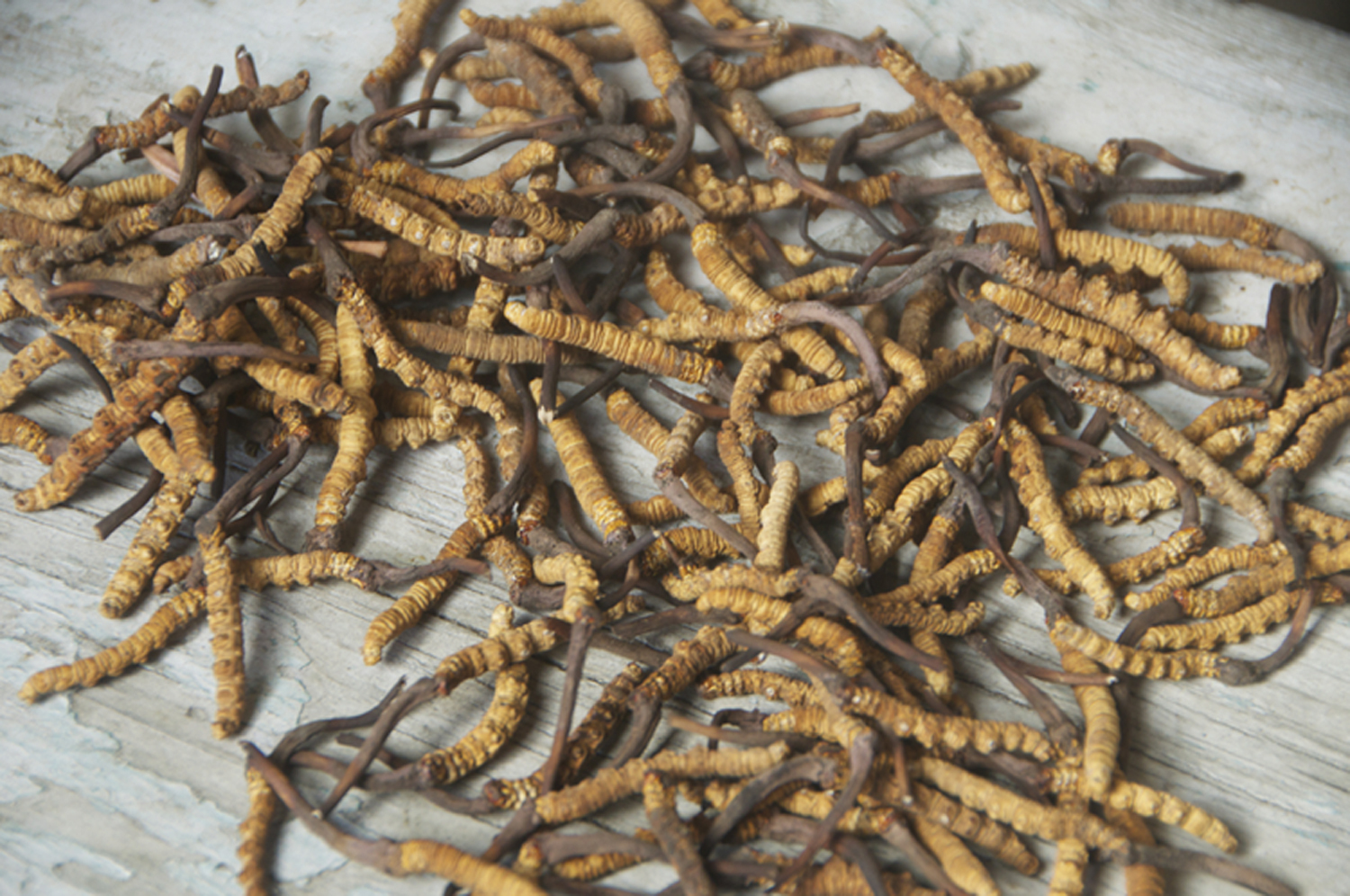
Yarsagumba collection at Yak Kharka. Photograph by Ken Zafren, MD.
Yarsagumba fungus, often called “Himalayan Viagra,” is found throughout the Himalayas and on the Tibetan plateau at altitudes of 4000 to 5000 m. It is used in Tibetan and Chinese medicine to increase energy and decrease fatigue, but its main commercial use is as an aphrodisiac. The earliest known description of Yarsagumba is by Nyamnyi Dorje, a Tibetan physician and lama who lived from 1439 to 1475. His text, An Ocean of Aphrodisiacal Qualities, characterizes Yarsagumba as a sexual tonic. 2 A literature search of PubMed found no evidence that consumption of Yarsagumba is effective for any of the claimed purposes nor that it confers any health benefit. In vitro studies have shown that Yarsagumba contains bioactive substances with immunomodulating, anti-inflammatory, and antitumor properties. 3 An animal study of a related fungus, Ophiocordyceps formosana, found that extract improved hyperglycemia and depression-like behavior in diabetic mice. 4
Most harvesting of Yarsagumba in Nepal occurs during the premonsoon season during the month of Jestha (May–June) when thousands of people travel to areas where Yarsagumba is known to occur. Prominent collecting areas include the Dolpo, Rukum, and Manang Districts. The most popular collecting area in the Manang District is above Yak Kharka (about 4020 m) on the Annapurna Trekking Circuit. Yak Kharka is a small collection of lodges with a few permanent inhabitants. The authors visited Yak Kharka about 1 week after the start of the collecting season to perform a health needs survey. Our plan was to observe living conditions and to make recommendations to the Himalayan Rescue Association, a Nepalese nongovernmental organization (NGO), for possible measures to improve the health and safety of the collectors.
Methods
On May 19 and 20, 2016 our 4-person team performed a health-needs survey of people collecting Yarsagumba fungus near the village of Yak Kharka (4020 m) in the Manang District of Nepal. We divided into pairs and interviewed collectors as they were returning in the evening and as they were sitting waiting for their evening meals. The interviews were unstructured. We also interviewed 4 policemen, 1 female community health worker, and a few of the buyers. We collated notes from the interviews. There was no formal data collection.
Results
We interviewed approximately 40 people over 2 evenings, some individually and some in groups. We informally assessed a few of the people we interviewed for acute mountain sickness (AMS) and examined 1 ill person who was identified by a person we interviewed.
Demographics
According the local Village Development Council, there were an estimated 800 people collecting Yarsagumba who were staying in and near Yak Kharka. Most came from elevations below 2000 m, primarily from the adjacent Gorkha District. Others came from local villages in the Manang district. Many of the collectors had spent more than 1 week walking from their homes to the Manang District to pick Yarsagumba.
The ages of collectors we encountered ranged from 10 years into the early 60s. There were at least 2 pregnant women. We heard that a pregnant woman had given birth 2 or 3 years before while in the area to collect Yarsagumba. There were a few women collecting Yarsagumba fungus while carrying young children on their backs. There were entire families, including young children and grandparents who all came to collect Yarsagumba.
Many Yarsagumba collectors come every year, although we also interviewed many first-timers. We met a 24-year-old man whose first trip to collect Yarsagumba was at age 10 and who had come every year since. Most of the collectors work as farmers when they are not collecting Yarsagumba.
Economics
The Manang District charges local residents NR8000 (8000 Nepal rupees = ∼$80 US dollars [USD]) per person for a permit to collect Yarsagumba. For people from other districts, the price is NR16000 (∼$160 USD) per person. The fees are ostensibly charged to limit the number of collectors. Most of the people who are picking Yarsagumba are poor. Many cannot afford these relatively large sums and take out loans in their home villages.
According to the buyers, the price they pay for Yarsagumba is NR200–500 ($2–5 USD) each. The price depends on the size. Small specimens fetch NR200 ($2 USD), medium NR300 ($3 USD), and large NR500 ($5 USD). The actual prices that the buyers paid the collectors seemed to be lower. According to the collectors, the amount they are paid varies among buyers and fluctuates during the season. The buyers are middlemen who resell their purchases to larger traders. The amount collectors receive is far less than the price of Yarsagumba in international markets. In late 2006, the cost for 1 kg of high-grade Tibetan Yarsagumba in the coastal cities of China, including Hong Kong, and in San Francisco was as much as $32,000 USD. 2 It is likely much higher in 2016. The number of Yarsagumba specimens needed to make up 1 kg depends on the region. Estimates vary from 2400 2 to over 5000. 5
This year the winter was dry and yields were consequently low. We found collectors who had not yet found Yarsagumba fungus or who had found only a few in the first week or so of the season. Anecdotally, it has been reported that 75% of collectors make a profit after recovering the cost of the permit, while 25% have a net loss. During a good season, many collectors can make significant profits. It seemed likely that fewer collectors than usual would make a profit this season.
Living Conditions
Although a few collectors can afford to stay in local lodges, the majority camp in tents or in primitive shelters that consisted of tarps held up by rock walls, many no higher than a meter inside (Figure 2). There are no toilet facilities. Open defecation was common.
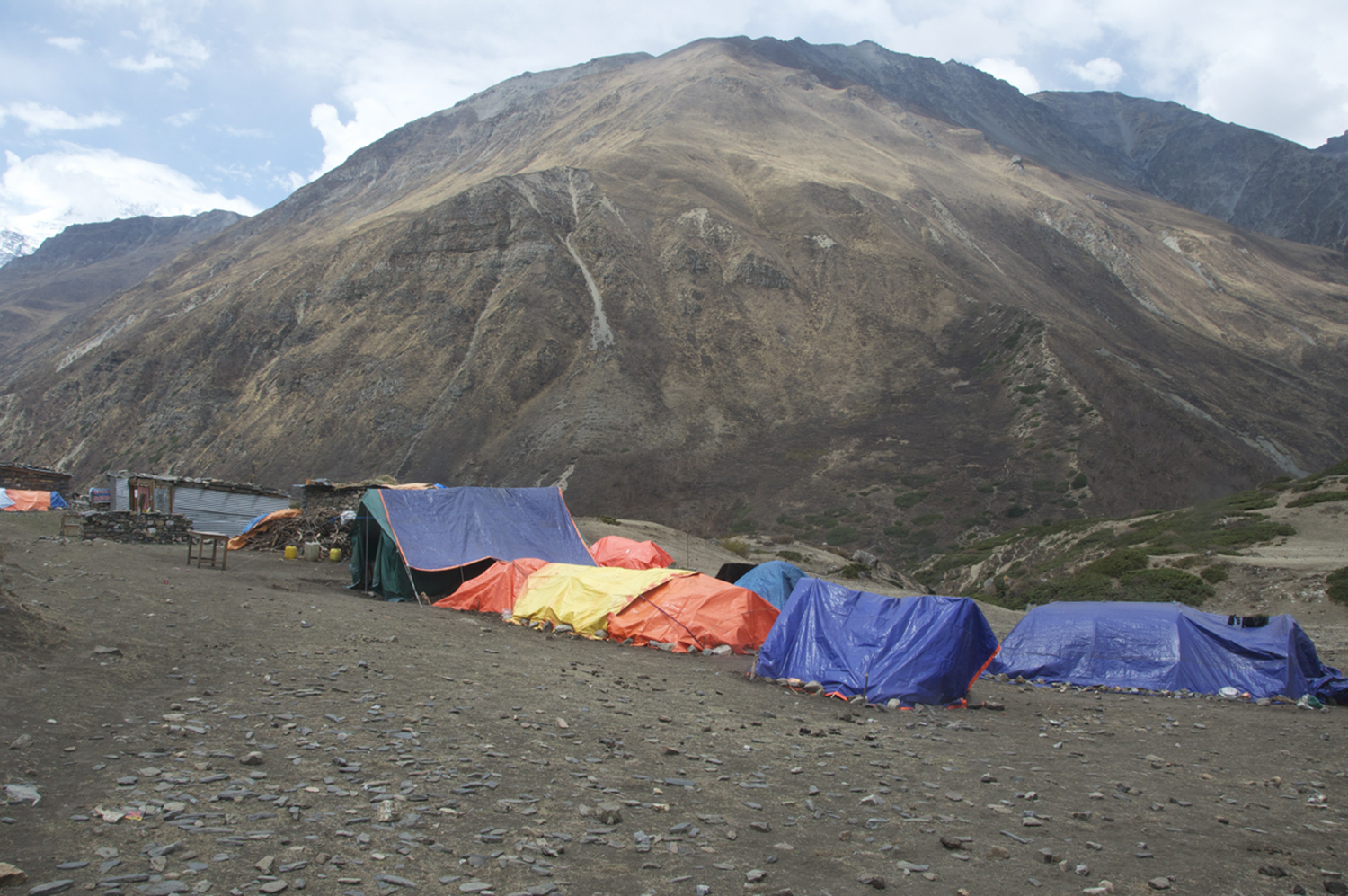
Shelters used by Yarsagumba collectors at Yak Kharka. Photograph by Ken Zafren, MD.
Many collectors, especially first-timers, did not have adequate clothing for the conditions found at 4000 to 5000 m, especially during windy and rainy conditions. Most were able to keep warm at night in sleeping bags or by using blankets.
Collectors typically start out very early, some as early as 5:00
Health Problems
AMS was common in collectors from low altitudes. One collector estimated that half of his colleagues had headaches during the day, when collecting at higher elevations. Some collectors had AMS that resolved after a few days, but some had persistent symptoms. We examined a young woman who had not been able to acclimatize after a week and who still had moderate AMS. She had been unable to collect Yarsagumba at all during the week she had been in Yak Kharka. This was her first time at high altitude. There have been deaths in previous seasons that were thought to be due to high altitude illness, but there are no available data.
AMS poses a dilemma to Yarsagumba collectors. Many would benefit by descent, but if they left, they would then be unable to recover the cost of the permits.
Upper respiratory symptoms and gastrointestinal symptoms were common. The prevalence of these illnesses may be related to crowded living conditions and poor sanitation.
Yarsagumba has become more difficult to find in recent years. The declining abundance has been attributed to a combination of overharvesting, premature harvesting, and habitat destruction.5,6 As Yarsagumba becomes more difficult to find, some collectors are using hazardous trails and collecting in dangerous areas. There was a death reported last year of a collector who sustained an open femur fracture and exsanguinated after a large rock fell from above.
Medical Resources
There is a temporary police post in a large tent that provides some aid to the collectors. All of the officers in spring 2016 were from lower altitudes and had limited knowledge of altitude illness.
The nearest health care facility is at Manang, about a 4-hour walk from Yak Kharka. There is a health post there that was closed at the time of our survey. The Himalayan Rescue Association (HRA) operates an aid post in Manang with doctors. The post closes on May 20 and had already closed during our survey.
There are 3 female community health volunteers (FCHVs) from Yak Kharka who have minimal medical training. They provide some aid to the Yarsagumba collectors. Normally they obtain basic medicines from the health post in Manang, but this year the post was closed and the FCHVs had no medications.
Discussion
The total number of Yarsagumba collectors in the Nepal Himalayas is in the thousands, but no statistics are available. There are many thousands more in Tibet, Bhutan, and India. It is clear from our study that many Yarsagumba collectors in Nepal face great physical hardships and have significant unmet health needs.
There are few obvious solutions to the problems we found. There may be a role for NGOs such as the Himalayan Rescue Association. Government assistance might also be helpful. Some measures that would be likely to help the collectors include publicizing the harsh environmental conditions in their home areas so that the first-timers are better prepared and providing warm clothes and rain gear for those who do not have adequate clothing. In addition to warm clothing, collectors could use better shelters and improved access to food and water. Providing hand sanitizer and pit toilets could improve sanitation. Education about sanitation and how to construct pit toilets is also likely necessary. FCHVs, lodge owner and staff, police, and the collectors themselves could all contribute to improving sanitation.
Providing a medical team during part or all of the Yarsagumba season might help reduce the burden of illness. This team could provide education about sanitation and could train FCHVs and police to recognize and treat altitude illness. The team could also provide medications for the FCHVs to treat altitude and other common conditions. The medical team could also consider providing a temporary clinic during the collecting season.
Our study had significant limitations. There were only 4 of us. We were able to survey only a tiny convenience sample of Yarsagumba collectors. Our informal survey took place for a few hours on 2 consecutive days early in the season. We interrupted some of our interviews to provide medical care, further limiting the time available for our formal survey. We did not visit the collecting areas in order to make sure that the collectors would not perceive the team as competing with them to find Yarsagumba fungi.
Conclusion
As abundance decreases and demand increases, there is increasing pressure on collectors to find Yarsagumba. The collectors are an economically disadvantaged population who live in austere conditions at high altitude with poor shelter and sanitation, strenuous work, and limited availability of food. Health care resources are very limited. There are significant risks of illness, injury, and death. Targeted efforts by government entities and NGOs might be beneficial in meeting the health needs of the Yarsagumba collectors.
Acknowledgments: We acknowledge Prakash Adhikari, Executive Director of the HRA; Dr. Buddha Basnyat, Medical Director of the HRA; and the HRA Board for their encouragement and support. We would also like to thank Binod Raj Poudyal and his team at Mountain Tiger Nepal for making excellent travel arrangements.
Author Contributions: Study concept and design (KZ): acquisition of the data (all); drafting of the manuscript (PK, BP, KZ); critical revision of the manuscript (all); final approval of the manuscript (all).
Financial/Material Support: None.
Disclosures: None.