






Abstract
Objective
Texas bull nettle (Cnidoscolus texanus) is covered in bristly hairs similar to stinging nettle. Contact with the plant may result in intense dermal pain, burning, itching, cellulitis, and allergic reaction. This study characterizes C texanus exposures reported to a large state-wide poison center system.
Methods
Cases were C texanus exposures reported to Texas poison centers during 2000−2015. The distribution of cases was determined for patient demographics, exposure circumstances, and patient outcome.
Results
A total of 140 C texanus exposures were identified. Twenty percent of the patients were aged ≤5 years, 21% were 6 to 12 years, 5% were 13 to 19 years, and 51% were ≥20 years; and 51% of the patients were male. Eighty-one percent of the exposures occurred at the patient’s own residence, 11% in a public area, 2% at another residence, and 1% at school. Seventy-eight percent of the patients were managed on site, 13% were already at or en route to a health care facility, and 6% were referred to a health care facility. Eighty-eight percent of the exposures resulted in dermal effects: irritation or pain (56%), erythema or flushing (31%), edema (27%), pruritus (24%), rash (19%), puncture or wound (19%), and hives or welts (11%).
Conclusions
C texanus exposures reported to Texas poison centers were most likely to be unintentional and occur at the patient’s own residence. The outcomes of the exposures tended not to be serious and could be managed successfully outside of health care facilities.
Keywords
Introduction
Texas bull nettle (Cnidoscolus texanus, synonym Jatropha texanus), also commonly known as bull nettle, tread-softly, spurge nettle, and mala mujer, is a member of the spurge family (Euphorbiaceae).1,2 C texanus is a perennial herb that grows 46 to 91 cm (18 to 36 inches) in height with several stems from a single taproot system. Its leaves are alternate, usually 5-lobed, and 5 to 10 cm (2 to 4 inches) in length. The plant produces white flowers composed of 5 to 7 bilobed petal-like sepals that bloom from March to July. The seeds of the C texanus are clustered in 4 compartments in a round seedpod. 2
The plant’s stem, branches, leaves, and seedpod are covered in hispid or bristly hairs similar to stinging nettle (Figure 1).2,3 The hairs have a hypodermic-like mechanism with a bladder-like base filled with an irritant with highly acidic pH and a protruding capillary tube. When the hair comes into contact with a person’s skin, the tip breaks off and penetrates the skin. The bending of the hair constricts the bladder-like base of the hair, forcing its contents up the tube and into the skin. A person coming into contact with C texanus may experience intense dermal pain, burning, itching, cellulitis, and allergic reaction. In addition, breaking a stem of the C texanus may release a milky sap that also may induce an allergic reaction. 2 Anecdotes on the Internet have suggested a treatment for contact with the plant’s nettles that involves removing the nettles and then applying a moderately basic substance such as a mixture of baking soda and water to neutralize the acidic secretions; however, review of the published literature failed to find mention of this suggested treatment.
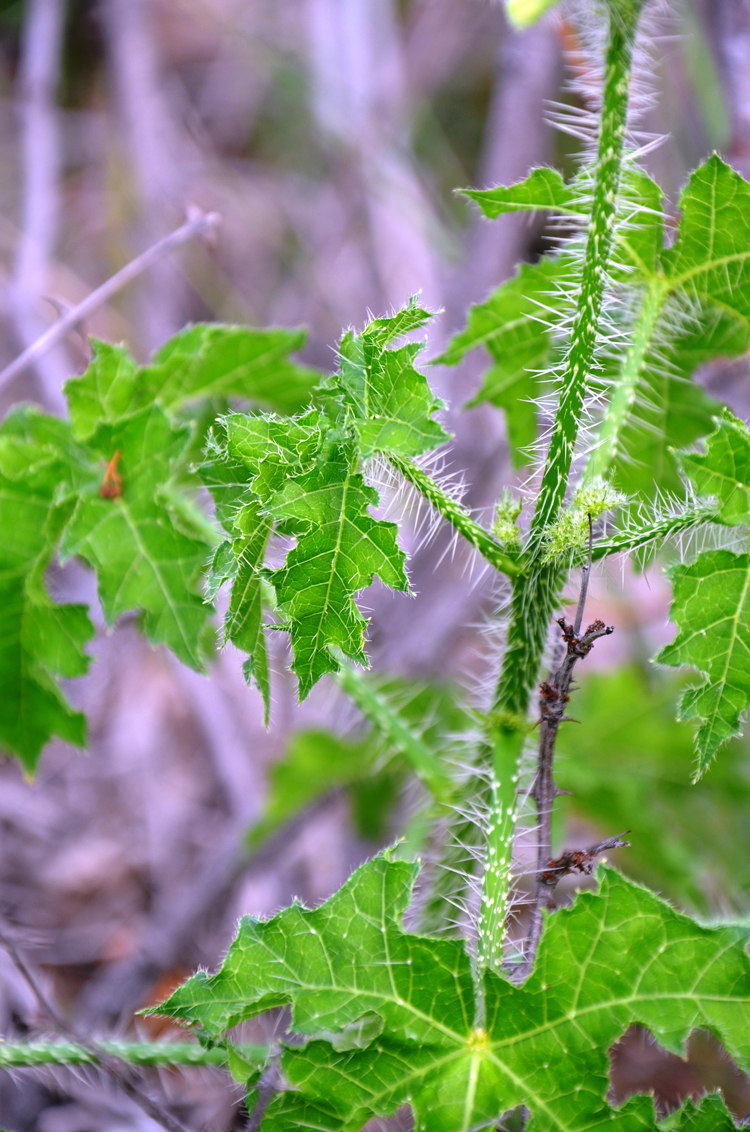
Texas bull nettle (Cnidoscolus texanus) stem and leaves. Photo courtesy of James D. Mauseth, PhD.
In spite of the potential hazard of coming into contact with C texanus, some individuals may actively seek it out because parts of the plant are edible. The seeds may be eaten raw or roasted, and the taproot may be baked. 3
C texanus is native to Arkansas, Kansas, Louisiana, Oklahoma, and Texas in the United States and Tamaulipas state in northern Mexico. 1 ,2,4,5 In Texas, the plant is reported to be native to at least 80 of the 254 counties, primarily in the eastern, central, and southern parts of the state.1,4
Review of PubMed/Medline failed to uncover information on actual C texanus exposures and the circumstances leading up to and consequences of these exposures. The intent of this investigation was to describe C texanus exposures reported in Texas. Texas has a current population of >26 million in an area of >694116 square km (268 000 square miles). Of the 254 Texas counties, 172 are classified as rural and 82 as urban. Texas has 54 state parks and 4 state forests, many of which are in counties classified as urban.
Methods
Cases for this retrospective descriptive study were obtained from the Texas Poison Center Network (TPCN). The TPCN is a telephone consultation service that assists in the management of potentially adverse exposures to a variety of substances, including plants. It comprises 6 poison centers that together service the entire state. All 6 poison centers use a single electronic database to collect information on all calls in a common manner. The data variables and coding in this database were standardized by the American Association of Poison Control Centers. 6
Cases were all exposures reported to the TPCN during 2000−2015 in which the substance involved in the exposures was listed as C texanus or bull nettle. (A search of the TPCN database failed to find exposures to any of the other common names for C texanus.) Exposures involving substances in addition to C texanus (n=2) and those not followed to a final medical outcome were included in the study. The distribution of exposures was determined for patient age and sex, month of the year, exposure route, body part(s) that contacted the plant, circumstances of (reason for) the exposure, exposure site, management site, medical outcome, adverse clinical effects, and treatments.
The TPCN does not have a data field specifically for recording the body part involved in an exposure. To obtain this information, the notes text field for each case was reviewed to determine whether the body part(s) that came into contact with the nettle was mentioned. Recording of such information is not required by the TPCN and was absent in 71 of cases.
The circumstances of (reason for) the exposure are grouped as unintentional (ie, accidental), intentional, adverse reaction, other (malicious, tampering), and unknown. The medical outcome or severity of an exposure is based on the observed or anticipated adverse clinical effects and classified as no effect, minor effect, moderate effect, major effect, death, not followed but judged as nontoxic exposure, not followed but minimal symptoms possible, unable to follow but judged as a potentially toxic exposure, and unrelated effect.
The TPCN electronic database contains checkboxes for recording specific adverse clinical effects and specific treatments or therapies. In addition, the clinical effects and treatments may be documented more thoroughly in the notes field. Analysis of the clinical effects was restricted to the checkboxes. Analysis of the treatments focused primarily on the checkboxes but also included a search of the notes field for references to removal of the nettle or use of baking soda.
The Texas Department of State Health Services institutional review board considers this analysis to be exempt from ethical review.
Results
A total of 140 C texanus exposures were reported to the TPCN during 2000−2015. Twenty-eight (20.0%) of the patients were ≤5 years old, 29 (20.7%) were 6 to 12 years, 7 (5.0%) were 13 to 19 years, 72 (51.4%) were ≥20 years, and 4 (2.9%) were of unknown age. Seventy-two (51.4%) of the patients were male, 67 (47.9%) were female, and 1 (0.7%) was of unknown sex.
Table 1 shows the distribution of C texanus exposures by month. There was a seasonal pattern with a peak in June and July. The majority (n=126, 90.0%) of the exposures occurred by dermal contact alone, 11 (7.9%) by ingestion alone, 1 (0.7%) by ocular route alone, 1 (0.7%) by dermal and ocular routes, and 1 (0.7%) by an unspecified other route. The body part that came into contact with the C texanus was reported in 69 (49.3%) of the exposures (Table 2). Slightly more than half of these cases involved the leg, with the next most common body parts being the hand, foot, and arm.
Monthly distribution of Texas bull nettle (Cnidoscolus texanus) exposures reported to the Texas Poison Center Network during 2000−2015
Body part that came into contact with Texas bull nettle (Cnidoscolus texanus) in exposures reported to the Texas Poison Center Network during 2000−2015
Each body part also was listed in each individual category.
All except one of the exposures were unintentional or an adverse reaction to the plant; the remaining exposure was intentional. The majority (n=114, 81.4%) of the exposures occurred at the patient’s own residence, 15 (10.7%) in a public area, 3 (2.1%) at another residence, 1 (0.7%) at school, 1 (0.7%) at an unspecified other location, and 6 (4.3%) at unknown locations.
Most (n=109, 77.9%) of the patients were managed on site (outside of a health care facility), 18 (12.9%) were already at or en route to a health care facility when the poison center was contacted, 8 (5.7%) were referred to a health care facility by the poison center, 3 (2.1%) were managed at an unspecified other location, and 2 (1.4%) were managed at an unknown location. The distribution of exposures by medical outcome is shown in Table 3. Eighty-four (60.0%) of the exposures were not followed to a final medical outcome. Of the 56 exposures followed to a final medical outcome, 5 (8.9%) resulted in no effect, 37 (66.1%) in a minor effect, and 14 (25.0%) in a moderate effect. No major effects or deaths were reported.
Medical outcome of Texas bull nettle (Cnidoscolus texanus) exposures reported to the Texas Poison Center Network during 2000−2015
Table 4 lists the specific adverse clinical effects reported with C texanus exposures. The most frequently reported clinical effects were dermal in nature: irritation or pain, erythema or flushing, edema, pruritus, rash, puncture or wound, and hives or welts. Few other types of clinical effects were reported.
Reported adverse clinical effects with Texas bull nettle (Cnidoscolus texanus) exposures reported to the Texas Poison Center Network during 2000−2015
An exposure may include >1 clinical effect.
The most frequent treatments were washing followed by administration of steroids and antihistamines (Table 5). Review of the record notes field found use of tape to remove the nettles mentioned in 30 (21.4%) cases and baking soda in 8 (5.7%) cases.
Reported treatments with Texas bull nettle (Cnidoscolus texanus) exposures reported to the Texas Poison Center Network during 2000−2015
An exposure may include >1 treatment.
Discussion
This investigation described C texanus exposures reported to Texas poison centers during a 16-year period. Contact with the plant may result in intense dermal pain, burning, itching, cellulitis, and allergic reaction. In addition to Texas, C texanus is native to Arkansas, Kansas, Louisiana, and Oklahoma in the United States and Tamaulipas state in northern Mexico. 1 ,2,4,5 The plant is not reported to be cultivated, so individuals are likely to encounter C texanus where it grows naturally such as wilderness areas, state parks, and other places where native plants may be found. A review of the literature failed to identify studies that provided information on the demographics of the people who experience adverse effects after C texanus exposures and the circumstances leading to and outcome of these exposures.
Most of the patients were adult, with the next greatest proportion being school-age children and only 20% being children ≤5 years old. Slightly more than half of the patients were male. The exposures were seasonal with 88% occurring from March to September. According to one information source, C texanus blooms from March to July, 2 which overlaps the months when most of the exposures occurred. However, the seasonal pattern may be related to people being more likely to be outdoors, and thus to come into contact with C texanus, in warmer weather.
The majority of the exposures occurred by dermal contact. This contact most often occurred on the person’s leg, followed by the hand, foot, and arm. Most of the exposures occurred at the patient’s own residence. Unfortunately, more specific information on the location or environment where an exposure occurs usually is not collected by the TPCN, and it cannot be determined whether these “own residence” exposures occurred in a garden or lawn or in a more “wild” area such as a field or forest. All except one of the exposures were unintentional, including the 11 exposures that involved ingestion of the plant. This suggests that, although parts of C texanus are edible, few exposures reported to poison centers are likely to occur as a consequence of consuming the plant. These unintentional ingestions may occur when a child puts the plant in their mouth (n=6) or the patient unintentionally misuses the plant (n=2). Although more details of an exposure may be documented in the record notes, this is not consistently done.
More than three-quarters of the patients were managed on site (eg, at home) with only 19% being managed at a health care facility. Of the latter, 13% were already at or en route to a health care facility when the poison center was contacted; a portion of these might have been managed outside of a health care facility had the poison center been contacted first. That most of the patients were managed outside of a health care facility might be expected considering that the majority of the exposures did not result in serious outcomes. Moreover, anecdotes on the Internet have suggested treatment for C texanus exposure by removal of the nettles followed by application of a moderately basic substance such as a mixture of baking soda and water to neutralize acidic secretions. In addition, the most frequently reported treatments in the study were washing, antihistamines, and tape (to remove the nettles). These recommended and observed treatments often can be administered outside of a health care facility.
The preponderance of reported specific clinical effects were dermal in nature: irritation or pain, erythema or flushing, edema, pruritus, rash, puncture or wound, and hives or welts, with few involving the other organ systems. This is unsurprising considering that the majority of the exposures occurred by dermal contact and that the clinical effects mentioned elsewhere with C texanus are dermal.
Limitations
There are limitations to this study. Reporting of C texanus exposures to the TPCN is not mandatory. Those exposures that are reported may not be representative of all such exposures that occur in Texas. In addition, C texanus involvement in an exposure was based on caller reports and not independently verified. The plant may have been another species or no plant at all may have been responsible for the patient’s symptoms. Also, 60% of the exposures were not followed to a final medical outcome.
Conclusions
C texanus exposures reported to Texas poison centers were most likely to occur by dermal contact, be unintentional, and occur at the patient’s own residence. The outcomes of the exposures tended to not be serious and could be managed successfully outside of health care facilities.
Financial/Material Support Statement: NoneDisclosures: None
Footnotes
Submitted for publication August 2016.
Accepted for publication January 2017.