In the order Hymenoptera, bees, hornets, and wasps are well-known stinging insects whose envenoming can be fatal. Their stinging attacks are common in rural and forested areas of Sri Lanka. However, fatal stinging by the large-bodied carpenter bees is unreported. We report the first known case of a fatal sting by the large carpenter bee, Xylocopa tranquebarica, in a forested area in Puttalam (North Western Province) in the dry zone of Sri Lanka. A 59-year-old healthy male manual laborer accompanied by a fellow worker had been fixing a fence on a coconut estate bordering a forested area when a flying insect emerged from a dead tree trunk and stung him on his face. His coworker, who was watching the incident, killed the insect. The victim complained of immediate intense pain in the face and collapsed on the ground just after resuming work after 10 minutes of resting. He was found dead on admission to the hospital 90 minutes later. Autopsy showed normal coronary arteries and heart, but the lungs were slightly congested and contained secretions in the bronchi. Acute anaphylaxis was the most likely cause of death. This case presents the habitat, morphology, attack pattern, and the medical importance of large carpenter bees.
In the class Insecta, members of the order Hymenoptera are best known for their role in pollination, biological control of insect pests, and as stinging insects. Of the Hymenoptera, bees, hornets, and wasps in particular are distinct and unique in having a modified ovipositor as a stinger that acts in association with a venom gland. Stinging attacks by bees and wasps on humans have become a common occurrence in Sri Lanka.1–3 In 2014, a fatal sting from a flying insect in Puttalam in the North Western Province of Sri Lanka gained much publicity in the local media. This incident, reported in the local newspapers and social media, prompted us to find the offending insect that was killed by the victim’s companion.
Bees of the world are classified into 7 families. Bees belonging to 4 of these families, namely, Colletidae, Halictidae, Megachilidae, and Apidae, occur in Sri Lanka. Sri Lanka is home to 148 species of bees in 38 genera that come under these 4 families.4 Family Apidae in Sri Lanka is represented by several subfamilies, genera, and subgenera. The large majority of bees that are classified under the 4 families are the little-known pollen bees. The taxonomy and natural history of temperate pollen bees is well documented.5
Family Apidae also includes the subfamily Xylocopinae, an assemblage of very diverse pollen bees, among which is the tribe Xylocopini, represented by the single genus Xylocopa. Michener defined the principal identifying characteristics of the Xylocopini and genus Xylocopa, which are usually large to very large robust bees easily confused with temperate bumble bees.6 Several subgenera of the genus Xylocopa occur the world over, both in the Western and Eastern hemispheres, but no subgenus is common to both hemispheres. One of the subgenera of Xylocopa is the subgenus Nyctomelitta (Cockerell, 1929), confined to the Eastern hemisphere. The subgenus is represented by 2 species, namely Xylocopa (Nyctomelitta) proximata (Ma, 1938) and Xylocopa (Nyctomelitta) tranquebarica (Fabricius, 1804). The former species is known from the Andaman Islands. The latter species, X. tranquebarica, is known to have a paleotropical distribution and occurs from Sri Lanka to India, Sumatra. and Borneo, and from Java to Thailand and Laos. Xylocopa species of the subgenus Nyctomelitta are nocturnal.
Case Report
Written consent for publication of this case history was obtained from the wife of the deceased patient.
We investigated the incident of a fatal case of insect stinging that appeared in a local newspaper in September 2014. The deceased was a 59-year-old man, a manual laborer by profession, from Puttalam, in the North Western Province of Sri Lanka. On the fateful day the victim, accompanied by a fellow laborer, had left at approximately 0730 hours to work on a coconut estate in a remote place called Adapana Willuwa, south of Puttalam. The site is located 2 km away from the nearest road that is accessible by automobile. Their task was to fix the fence bordering the estate and the adjoining forested area. At approximately 0830 hours, while clearing the bushes next to a dead tree trunk (later found to be inhabited by insects), he suddenly called for help, saying some insects were flying around his head trying to sting him. By the time the companion reached the victim, he had been stung on the face by the insect in the right malar region, and the bee remained attached to the skin. The companion slapped the insect with a piece of cloth and killed it. The victim complained of intense pain in the face and rested for approximately 10 minutes, then started to work again. After a few minutes, while he was cutting bushes, he felt faint and complained of shortness of breath, sat on the ground, and then collapsed. His companion called for help and sent a message to the patient’s wife, who arrived at the scene 30 minutes later. She found him on the ground and unresponsive. Helpers then carried him to the road from which he was transported by automobile to the Base Hospital, Puttalam. The patient was brought to the hospital at approximately 1000 hours, where he was pronounced dead on arrival. The spouse of the patient denied any history of allergies or past hymenoptera stings in her deceased husband. They had also taken the offending insect to the hospital and had handed it over to the Judicial Medical Office (JMO) who performed the postmortem examination of the deceased person. The JMO noted the stinging site, a punctum with fresh bleeding on the right malar area. The heart and all coronary arteries were normal. The upper airway was normal, but the lungs were slightly congested and had secretions in the bronchial tree. The rest of the organs were normal.
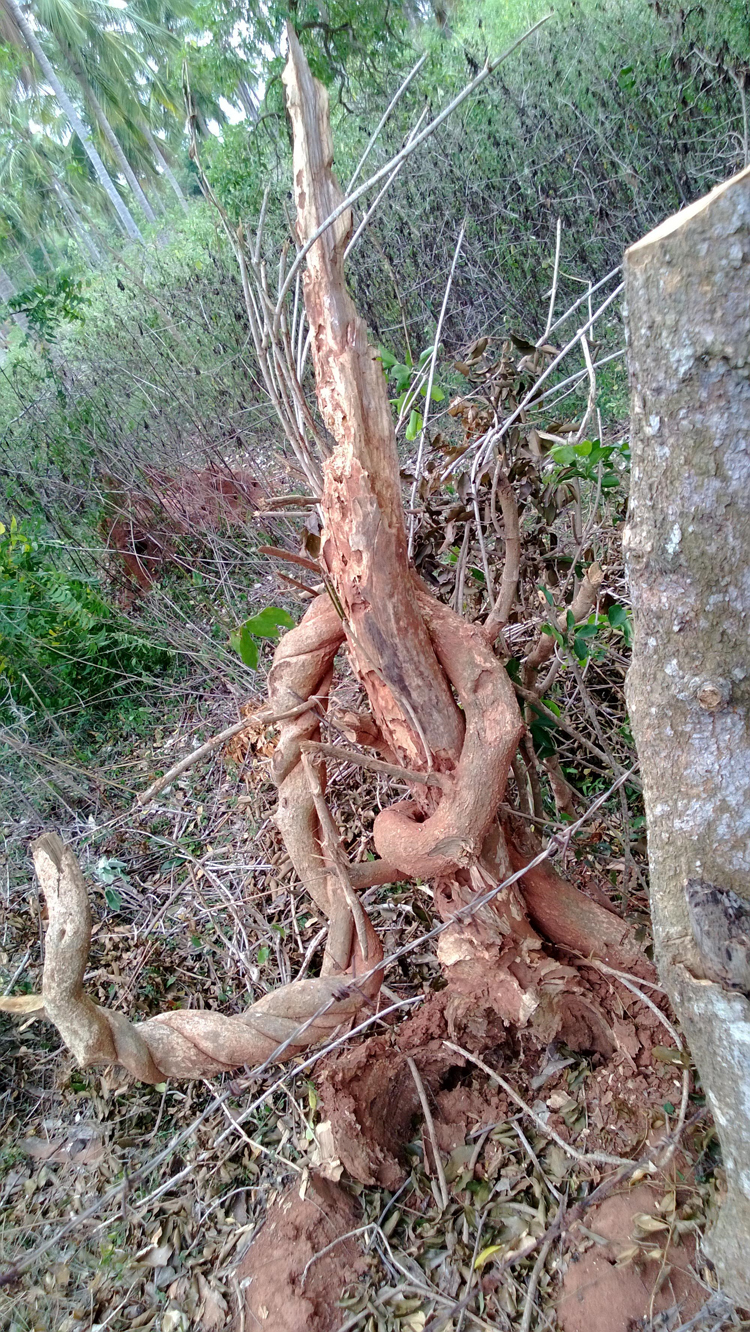
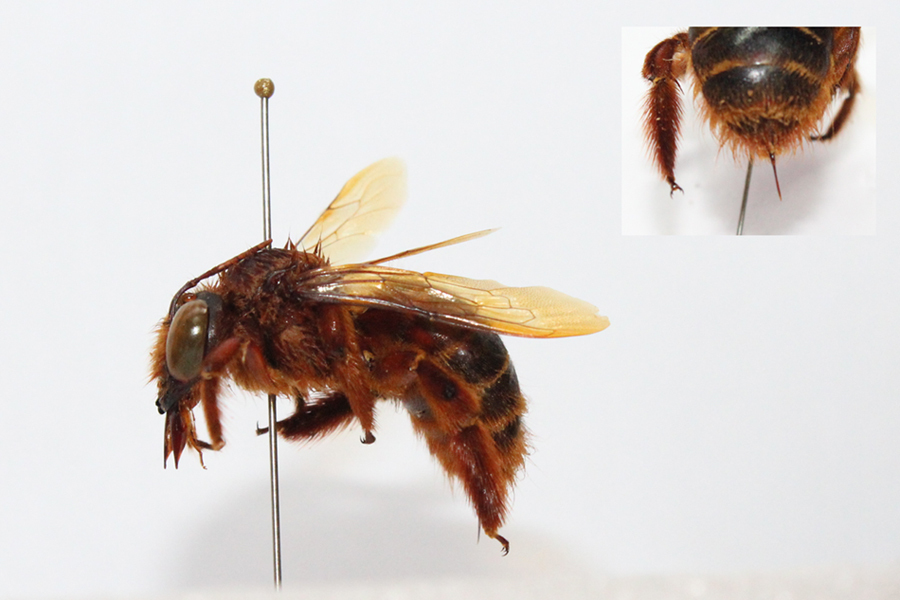
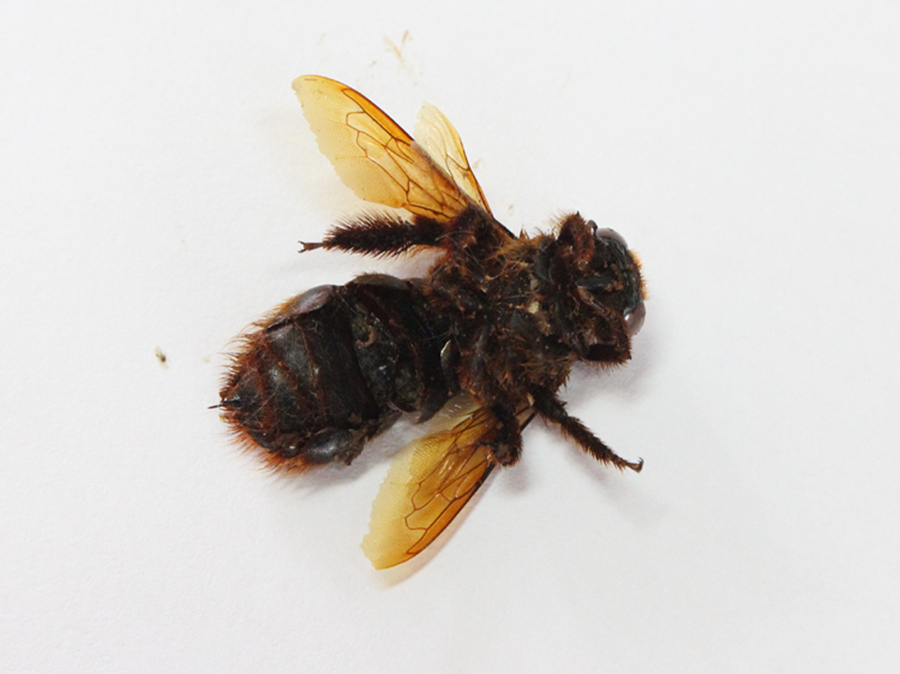
The offending insect was brought to the entomologist in the Department of Zoology, University of Peradeniya, for identification; it was curated, identified, cataloged, and deposited in the reference collection. At the request of the entomologist, the JMO visited the coconut estate where the stinging took place, a few days after the incident. He located the dead tree trunk, later found to be inhabited by the suspected insect (Figure 1). A team of workers cut open part of the trunk and found approximately 5 live insects inside the burrows. The insects were not aggressive at that time and were collected into a container and brought to the Department of Zoology for identification. The offending insect and those brought later from the same location were identified as X. tranquebarica and were sexed, measured (body length ranged from 25 to 27 mm), and photographed (Figure 2). At the time it was brought to the university, the offending X. tranquebarica was not in fresh condition to be mounted. It was a female with the stinging apparatus partly broken (Figure 3), most likely during removal from the skin of the victim.
Dead tree trunk with nest entrance holes from where the killer bee, Xylocopa tranquebarica, emerged.
Female Xylocopa tranquebarica collected from the nest site in Puttalam. Inset, Tip of the abdomen showing the stinger (length of the body, 25 mm).
The offending Xylocopa tranquebarica. Note the partly broken stinging apparatus at the posterior end of the abdomen (length of the body, 27 mm).
Discussion
We report a sudden fatal case after a sting by an insect previously not identified as being of medical significance. Such incidents, although common among the Apis bees (especially Apis dorsata, the giant Asian honey bee), have not been reported previously for carpenter bees of the genus Xylocopa. The victim was a healthy man, and the identity of the insect was established by leading experts. The autopsy finding of normal coronary arteries and heart excludes an acute coronary event, whereas evidence of congestion of the lungs and secretions in the bronchi support the possibility of an acute anaphylactic reaction as the immediate cause of death. As this was the first known case of fatal envenoming by this species of insect, the venom profile has yet to be determined. The stings of Apis bees and hornets in Sri Lanka are known to cause anaphylaxis,7 acute coronary events, and even profound pulmonary congestion, causing deaths, but reports of instantaneous deaths have not been reported.1–3 The pattern of allergy and anaphylaxis in humans has wide variations, and it is quite possible that the victim in this report might have severe hypersensitivity to some components of the venom of X. tranquebarica. Stinging insects of the Hymenoptera order are well reputed for allergy and anaphylaxis. Intramuscular administration of epinephrine is the first-line lifesaving treatment. In situations in which cardiovascular collapse does not respond to the intramuscular route, an intravenous slow bolus dose or continuous infusion of epinephrine is recommended. Antihistamines and corticosteroids remain as second-line medications.8
Bees of the subgenus Nyctomelitta are large bees and rather thickly covered with golden reddish-brown pubescence. Noteworthy characteristics seen in both sexes are the large eyes that converge above, and the ocelli that are larger than the antennal sockets. The night-foraging behavior of X. tranquebarica has been noted even in the 1890s9 and provides information on the night-flying behavior of X. tranquebarica in northern India. More recent studies in northern Thailand10,11 reported the nocturnal foraging flights, nest characteristics, and pollen species resources of foraging X. tranquebarica. Our exploration found the natural habitat and nesting site of this insect in a forested area devoid of human dwellings. It is likely that the insects nesting in the dead tree trunk were disturbed by the nearby clearing of the bushes and became aggressive. But by noon, they seemed very reclusive inside the burrows of the tree trunk.
According to surveys conducted in Sri Lanka11 (Smithsonian Sri Lanka Insect Survey, 1976) and the past literature on Sri Lankan bees,12 13 species of carpenter bees are known to occur on the island. Of them, X. tranquebarica is considered a rare species.13 To our knowledge, the first reported case of this species of bee in Sri Lanka was from the Northern Province in 1905 and thereafter in 1976 (through the Smithsonian Sri Lanka Insect Survey) from Ampara (in the Eastern Province). The reference specimens pertaining to these records are deposited in the Department of National Museums, Colombo (personal communication, Ms Goonatilake, Assistant Director, Entomology Division). The more recent record of this species is from Girithale (North Central Province of Sri Lanka), from where 4 female and 1 male specimens were recorded13 and deposited in the ISDF collection of the Department of Zoology, University of Peradeniya. Xylocopa tranquebarica is also the only nocturnal Xylocopa species thus far known to be from Sri Lanka.
Conclusions
We identified X. tranquebarica as the killer insect on follow-up of a widely publicized news item in Sri Lanka. This is the first case report identifying this species of insect as a “killer bee” and assumes a unique status among other killer bees and wasps of the world. Allergy and anaphylaxis after large carpenter bee stings should be anticipated, and intramuscular epinephrine administration is the lifesaving first-line treatment. From an entomological point of view, the finding of this species in the dry zone forests of the North Western Province of Sri Lanka and the observations on its aggressive behavior and nesting biology add to the existing knowledge on this rare bee species. It is important to raise public awareness about the potential dangers of this type of large-bodied carpenter bee and to avoid any encounters with them. As rural workers are at particular risk, they should be advised to take precautions when they notice carpenter bees inhabiting dead wood or nests in grasses, particularly in the early hours in the morning. We recommend further research into the venom chemistry of this species of bee to better understand its toxic effects. In future, large carpenter bees should be regarded as a potentially hazardous stinging insect that attacks under extreme provocation. Reporting cases of these stings should be encouraged to understand their medical importance and epidemiology.
Footnotes
Acknowledgments
We thank the hospital police of the General Hospital, Puttalam, the technical staff of the Department of Zoology, University of Peradeniya, Mr N. Samarasinghe (for bee images), and Ms V. Imbuldeniya (for specimen curation).
References
1.
KularatneS.A.GawarammanaI.B.de SilvaP.H.Severe multi-organ dysfunction following multiple wasp (Vespa affinis) stings. Ceylon Med J2003; 48, 146–147.
2.
BudagodaB.KodikaraK.KularatneW.et al.Giant Asian honeybee or Bambara stings causing myocardial infarction, bowel gangrene and fatal anaphylaxis in Sri Lanka: a case series. Asian Pac J Trop Med2010; 3, 586–588.
3.
KularatneK.KannangareT.JayasenaA.et al.Fatal acute pulmonary oedema and acute renal failure following multiple wasp/hornet (Vespa affinis) stings in Sri Lanka: two case reports. J Med Case Rep2014; 8, 188.
4.
KarunaratneW.A.I.P.EdirisingheJ.P.PaulyA.An Updated Checklist of Bees of Sri Lanka With New Records. in: MAB Checklist and Hand Book Series Publication No. 23. Colombo, Sri Lanka: National Science Foundation Sri Lanka, 2005.
MichenerC.Bees of the World. Baltimore, MD: Johns Hopkins University Press, 2000.
7.
WitharanaEWRAWijesingheS.K.J.PradeepaK.S.M.KarunaratneWAIPJayasingheS.Bee and wasp stings in Deniyaya; a series of 322 cases. Ceylon Med J2015; 60, 5–9.
8.
SingerE.ZoddaD.Allergy and anaphylaxis: principles of acute emergency management. Emerg Med Pract2015; 17, 1–19.
9.
BatraS.W.T.Bees of India (Apoidea) their behavior, management and a key to the genera. Orient Insects1977; 11, 289–324.
10.
BurgettD.M.SukumalanandP.Flight activity of Xylocopa (Nyctomelitta) tranquebarica: a night flying carpenter bee (Hymenoptera: Apidae). J Apic Res2000; 39, 75–83.
11.
BurgettM.SukumalanandP.VorwohlG.Pollen species resources for Xylocopa (Nyctomelitta) tranquebarica. A night-flying carpenter bee (Hymenoptera: Apidae) of Southeast Asia. ScienceAsia2005; 31, 65–68.
12.
BinghamC.T.The fauna of British India including Ceylon and Burma. In: BlanfordW.T. ed. Hymenoptera–Volume 1., London: Taylor and Francis, 1897, 407.
13.
KarunaratneWAIPTaxonomy and Natural History of Bees in Selected Areas of Sri Lanka (dissertation). Peradeniya, Sri Lanka: University of Peradeniya, 2004.