






Abstract
Stick insects are commonly known for their fascinating and functional shape, which allows them to blend with their surroundings. However, many may not be aware of another, more threatening protective feature, a toxic spray. Anisomorpha buprestoides, one of two stick insect types in the United States to use this defense, targets the eyes and can cause ocular injury, with cases ranging from conjunctivitis to corneal ulceration. We present the case of an older woman exposed to the walkingstick’s painful venom while in her home. The patient presented to an Orlando emergency department with conjunctival injection and tearing that improved with water irrigation.
Introduction
The devil’s riding horse, devil’s darning needle, prairie alligator, witch’s horse, and scorpion may seem like ominous aliases for the insect most commonly known by the nickname stick bug. 1 However, although this phasmid’s intriguing, elongated body shape makes its existence well known, most are unaware of its chemical defense mechanism for warding off predators. Anisomorpha buprestoides, a common walkingstick in the southeastern United States, has the ability to eject an offensive spray from its thorax with pronounced accuracy. Although birds, spiders, and reptiles are likely their main nemeses, they take no pity on threatening mammals, including reported cases involving canines and humans. The arthropods target the eyes and have caused documented ocular injury ranging from conjunctivitis to corneal ulceration. 1 –9 We present the case of an older woman exposed to the walkingstick’s irritating toxin while in her home.
Case Presentation
A 65-year-old woman presented to an Orlando emergency department for burning in her right eye after coming into contact with an insect in her laundry room. The patient reported that she had been reaching for detergent on a shelf above her washing machine. She then experienced the sensation of fluid being expelled into her eye and instantaneous pain with lacrimation. The patient denied photophobia or change in vision. Her son helped her irrigate the eye at home with water, resulting in some relief. She had not taken any medications for pain. The patient was quickly taken to the emergency department by her family and seen within an hour of the event. On arrival, the patient had the offending insect alive in a plastic bag (Figure). The bag was noted to have two similarly appearing insects, with one of them, roughly half the size of the other, attached to its larger counterpart. These were identified as the Southern twostriped walkingstick, Anisomorpha buprestoides. The managing physician found diffuse conjunctival injection and tearing of the right eye on examination. There was no fluorescein uptake or obvious foreign body on Wood’s lamp examination. The left eye was without any abnormal findings. Visual acuity testing was normal bilaterally. Symptoms resolved after the patient was cared for using copious irrigation of the eye with water. She did not require any analgesics or additional follow-up.
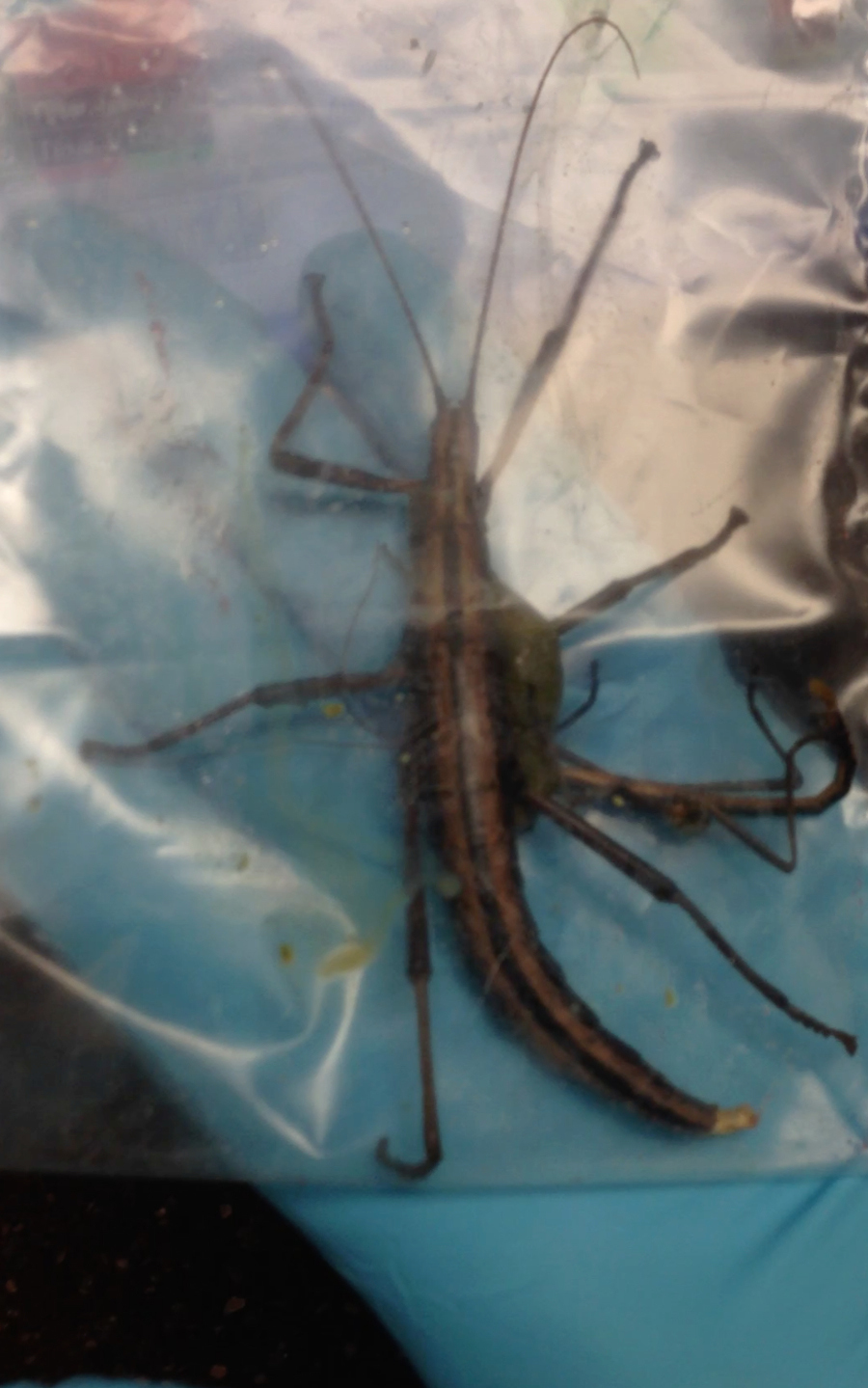
Southern twostriped walkingsticks brought in to hospital by patient. Smaller male insect is seen attached to larger female’s right side.
Discussion
More than 2500 species of walkingstick insects exist throughout the world. 2 Thirty-three of these are present in the United States, with only 2, A buprestoides and Anisomorpha ferruginea, discharging a protective, toxic spray. 3 The former, referred to as the Southern twostriped walkingstick, is most common in Florida but can also be found in Texas, Louisiana, Mississippi, Alabama, Georgia, and South Carolina. 1 ,3,4 Although they have been reported in the south, the Northern twostriped walkingstick, A ferruginea, is known to populate more northern states, including Delaware, Illinois, Indiana, Kentucky, North Carolina, Oklahoma, Pennsylvania, and Virginia. 1 ,3,4 Besides geographic location, the 2 species may be differentiated by their size, with A buprestoides being more slender but larger in overall size.1,4 Within this species, males are shorter and more slender than females, with an average length of 41.7 mm vs 67.7 mm. 1 ,3,5 The Northern walkingstick also differs in its appearance as it is more pale and lacks the distinct dorsal, lateral stripes that run along the Southern walkingstick longitudinally.1,4 These stripes may be brown, white, or orange and adorn a brown or black body. 2 ,3,4 One characteristic shared by both species is for the male to ride on the female, a behavior not limited to mating. 5
Southern twostriped walkingsticks are nocturnal herbivores that do not fly. 1 ,5,6 During the daylight the brown variety commonly hides among foliage, whereas the orange and white varieties rest in the open. Defense strategies also differ slightly; the brown insects climb up trees when encountering an enemy, whereas the others drop from tree branches. 4 This is only after all forms aim their spray into the eyes of their predator. The chemical is a terpene dialdehyde with at least 3 diastereomers.2,5 This is sprayed at all developmental stages by both males and females. 5 The insect has 2 saclike glands behind its head that it can use together or one at a time depending on the location of the stimulus.5,6 It most commonly secretes its spray after direct contact, but may also be triggered by an approaching threat.1,5 The female may eject 5 successive sprays and the male 1 to 2 before requiring a restoration period of 7 to 15 days. 1 ,5,7,8 The potent, malodorous spray can reach 30 to 40 cm and has been described as both a fine mist and milky fluid. 1 ,7,8
The walkingstick’s noxious secretions are painful when inhaled and cause tearing and burning of the eyes. This pain was described as “molten lead” in a Texas case dating back to 1932. 6 The fluid was released into the victim’s left eye after he attempted to uncover the insect. The patient soothed the pain with copious amounts of cool water but awoke the next morning with red conjunctiva, photophobia, and sensitivity to pressure. Sensitivity improved after 2 days and vision after 5 days, with no long-term effects. A similar case was later reported in 1993 when a 36-year-old man presented with burning and tearing that was controlled with irrigation and ibuprofen, which then ceased after 36 hours. 7 A more severe case was described 1 year earlier after the harmful spray was found to cause ulcerative keratitis in a dog. 9 The dog was treated with a 1% atropine sulfate ophthalmic solution and prescribed topical bacitracin-neomycin-polymyxin B sulfate ointment. There was significant improvement on rechecking the eye the following day. It was noted that this corneal ulceration might have been self-inflicted as the irritant caused the dog to rub its eyes. A 2001 case report confirmed that this risk exists with its description of an 8-year-old boy with a 30% corneal epithelial defect and 8- × 7-mm conjunctival epithelial defect on slit-lamp examination. 8 The eye was flushed with water and treated with 1% cyclopentolate. Symptoms resolved within 6 days with no residual findings. A second canine case of corneal ulceration was found in a dog who presented with mild corneal opacity, blepharospasm, and miosis of the right eye 20 hours after he approached the insect. 3 Clinical signs of injury resolved in 10 days after treatment with triple antibiotic ointment, 1% atropine ophthalmic solution, artificial tears, oral meloxicam, and cyclosporine ointment.
On review of these cases, signs and symptoms included burning pain, lacrimation, conjunctival injection and chemosis, blepharospasm, periocular edema, miosis, blurred vision, foreign body sensation, photophobia, pressure sensitivity, and corneal opacity. Diagnoses included chemical conjunctivitis, keratitis, epithelial conjunctival defect, and corneal ulceration. No reports included permanent ophthalmic findings, with injury lasting 2 hours to 10 days depending on severity. As documented cases are rare, there is no consensus for treatment. Management has been consistent with that of a chemical injury, including copious ocular irrigation to achieve a neutral pH level, oral and topical anesthetics, cycloplegic agents, and topical antibiotics. If more severe injury is present, such as severe corneal abrasion or ulceration, referral to ophthalmology is recommended.
Although these specific cases may not be commonly reported, it is helpful to recognize the dangerous effects of insect defense systems for improved management and patient education. Insect-related chemical injuries are not limited to the eyes, and ocular injuries are not always caused by chemical defenses. For example, beetles of the genera Lytta and Paederus are known to cause a painful, blistering contact dermatitis in addition to conjunctivitis. 10 –12 Moreover, caterpillars of the order Lepidoptera and tarantulas both have urticating hairs that cause an inflammatory reaction of the eye called ophthalmia nodosa.13,14 Patients should be advised to avoid crushing or touching unknown insects and to keep their eyes peeled but their faces distant.