






Abstract
Objective
Olfactory function, a cognitive impairment biomarker, was evaluated in mountain ultramarathon (MUM) runners during the Tor des Géants race (332.5 km with an overall altitude gain of 24,000 m; altitude range 330–3296 m above the sea).
Methods
An Odor Identification Test was administered before (T0; n = 53), at 148.7 kms (T1; n = 32) and after the race (T2; n = 28). The effect of dehydration and sleep deprivation on olfactory function was assessed. Olfactory function was also assessed in non-MUM athletes and sedentary controls (C) at rest.
Results
A majority of the athletes completed the olfactory test at all time intervals. Olfactory function decreased throughout the race (T0: 13.8 ± 1.9, T1: 13.7 ± 1.6, T2: 13.1 ± 1.8; T0 vs T2 P = .01). There was no relationship with race time or sleep deprivation on the sense of smell throughout the competition. However, there was a combined effect with decreased olfaction during the second half of the race, while a poor relationship was seen between olfaction and total body water at midterm (T1: rs = –0.427; P = .019), but not at baseline or after the race. MUM athletes had similar olfactory scores to C (13.8 ± 1.9 vs 13.7 ± 1.4) and non-MUM (13.8 ± 1.9 vs 13.9 ± 1.6) athletes.
Conclusions
This pilot study showed the feasibility of olfactory evaluation as a minimally invasive cognitive impairment assessment. The test can be used in logistically difficult environments, adding scientific value to this promising method. Although olfaction decreased after prolonged physical activity, further studies are warranted to make the relationship between cognition and external factors (eg, sleep deprivation, dehydration) more clear.
Introduction
Mountain ultramarathons (MUMs), which are longer than the classic marathon (42,195 m), have experienced a growing research interest due to their difficulty and the short- and long-term physical effects on the athletes’ health. The relationship between ultraendurance events and cognition is still uncertain. Positive effects of short-duration aerobic and anaerobic exercise on athletes’ cognition have been previously reported, but there is a lack of clarity in the case of intense anaerobic exercise and in steady-state aerobic exercise. 1 Long-duration activities probably produce cognitive decrements in attention and verbal memory, with serious consequences, possibly due to hypoxia or sleep deprivation. 1 -4 Altitude can cause cognitive detriment in relationship with the length of exposure. 5 Moreover, cognitive studies published involved complicated testing methodology, incompatible with the times required for evaluation during such competitions.
Olfactory impairment represents an early biomarker for neurodegeneration and, in some instances, neurological recovery. Olfactory deficits are correlated with several cognitive tasks including delayed verbal memory and neuropsychological performances. 6 The olfactory assessment is therefore considered a quick, unobtrusive method for overall cognitive impairment evaluation.
The aim of this study is to (1) evaluate the feasibility of olfactory testing as an innovative and unobtrusive application for monitoring the MUM athletes’ cognitive impairment status in an extreme environment; (2) assess the MUM athletes’ olfactory function; and (3) investigate the long-term effects of endurance training on the olfaction of MUM athletes compared with non-MUM athletes and sedentary controls.
Methods
In the Tor des Géants, athletes run 332.5 km with an altitude gain of 24,000 m (altitude range 330–3296 m above sea level) in the Aosta Valley, Italy, through the ancient Alta Via 1 and 2, with departure and arrival in Courmayeur in front of Mont Blanc.
The maximum time to complete the MUM is 150 hours with aid stations along the course at 48.6, 102.1, 148.7, 200.3, 236.3, and 283.5 km.
Subjects
Fifty-three experienced athletes (all Caucasians, 47 males, 6 females, mean age 44.4 ± 8.4 years) participated in this study that took place during 2 editions of the Tor des Géants (n = 29 in 2013, n = 24 in 2014). The exclusion criteria were the presence of conditions possibly affecting smell (eg, neurodegeneration, a history of head trauma, endocrine disorders, flu and/or nasal problems), use of medications, and unwillingness to give informed consent.
To compare the baseline olfactory performance of MUM athletes, a group of healthy sedentary controls (n = 53, all Caucasians, 47 males, 6 females, age 43.1 ± 8.6 years) and a cohort of non-MUM athletes (n = 43, all Caucasians, 32 males, 11 females, age 44.1 ± 7.5 years, more than 5 hours training and 30 km running/walking a week, at least a 5-year history of current sports activity, and no differences in training and life habits from the MUM runners) were selected. We employed a database previously populated for the sedentary controls who were physically inactive (less than 1 hour or 5 km running/walking a week) and had no history of competitive sports (at least 10 years since last sports activity). 7
A complete health assessment of participants was conducted by a structured questionnaire including questions on hypertension, hypercholesterolemia, diabetes, and smoking. All smokers were light smokers and were included for case-control matching. Individuals who smoked at least 3 cigarettes a day were considered smokers, while ex-smokers had stopped smoking at least 6 months before testing and nonsmokers had never smoked. In the questionnaire, the amount and duration of physical activity performed was included (Table 1).
Study population
Inclusion criteria in the “Controls” cohort.
Informed consent was obtained before testing. The study protocol was approved by the Ethics Committee of the Aosta Hospital.
Olfactory evaluation
Olfactory evaluation was performed by a simple, reliable and quick odor identification task, Sniffin’ Sticks (Burghart Medizintechnik GmbH, Wedel, Germany), which the athletes underwent once they had cleared their nostrils to avoid spurious responses. 8
Athletes were asked to identify the odor of 16 different felt tip pens. The athletes were provided a choice of 4 odors for each pen. The test score, 0 to 16, indicated the number of correct answers given.
Testing sessions
Athletes were assessed before the race (T0), after the first half of the race in Donnas (T1–148.7 km) and within an hour of finishing the race in Courmayeur (T2–332.5 km; Table 2), in a clean environment free from contaminants.
Hours of running, body composition, and sleep data
Data available for the entire race length.
Body composition analysis
Body weight, body mass index, and total body water (TBW) were measured using the bioelectrical impedance analysis (Tanita SC-331S Body Composition Analyzer; Tanita Inc., Arlington Heights, IL). The subjects evaluated had no drink restrictions during the race.
Sleep deprivation monitoring
Total kilometers and sleep/wake cycles were estimated by the FitBit Flex (FitBit Inc., San Francisco, CA), worn on the participants’ wrist during the competition. This lightweight sensor was used to estimate the athletes’ total sleep time (TST) and the normalized total sleep time (NTST), taking into consideration the race duration of the single athlete.
Statistical analysis
Statistics were performed using SPSS 17 software (SPSS Inc, Chicago, IL). We applied the Shapiro–Wilk test to evaluate the normality of variables. Because the variables had a nonnormal distribution, we used a nonparametrical multivariate repeated measure analysis of variance (Friedman’s test). The Wilcoxon signed-rank test for paired samples was carried out to compare olfaction in the different phases of the race for post hoc analysis. The Mann-Whitney U test was employed to compare study groups (2013 vs 2014 runners). Differences between MUM athletes and the 2 control groups were evaluated using the Kruskal-Wallis test. The Spearman’s rank test was used to correlate olfaction with sleep parameters, effort duration, and body composition. Finally, to correlate olfactory decrease and sleep time, MUM runners were stratified into 2 groups; below and above the median NTST. A 2-tailed Mann-Whitney U test was also carried out to check for intergroup differences. Results were considered significant for P < .05.
Results
The mean temperature throughout the race was 13.25°C with mostly rainy weather in 2013 and 15.12°C with mainly sunny skies in 2014 (P = .03). The sniff test was performed at T0 by all 53 athletes and at T2 by all finishers (28 subjects) (100%), while 32 of 34 (94.1%) completed the test at midpoint. The mean time for test administration was 6.5 ± 1.8 minutes. Two “dropout” runners at midpoint declined the test for personal reasons, independent from the test. The olfactory performances are reported in Figure 1.
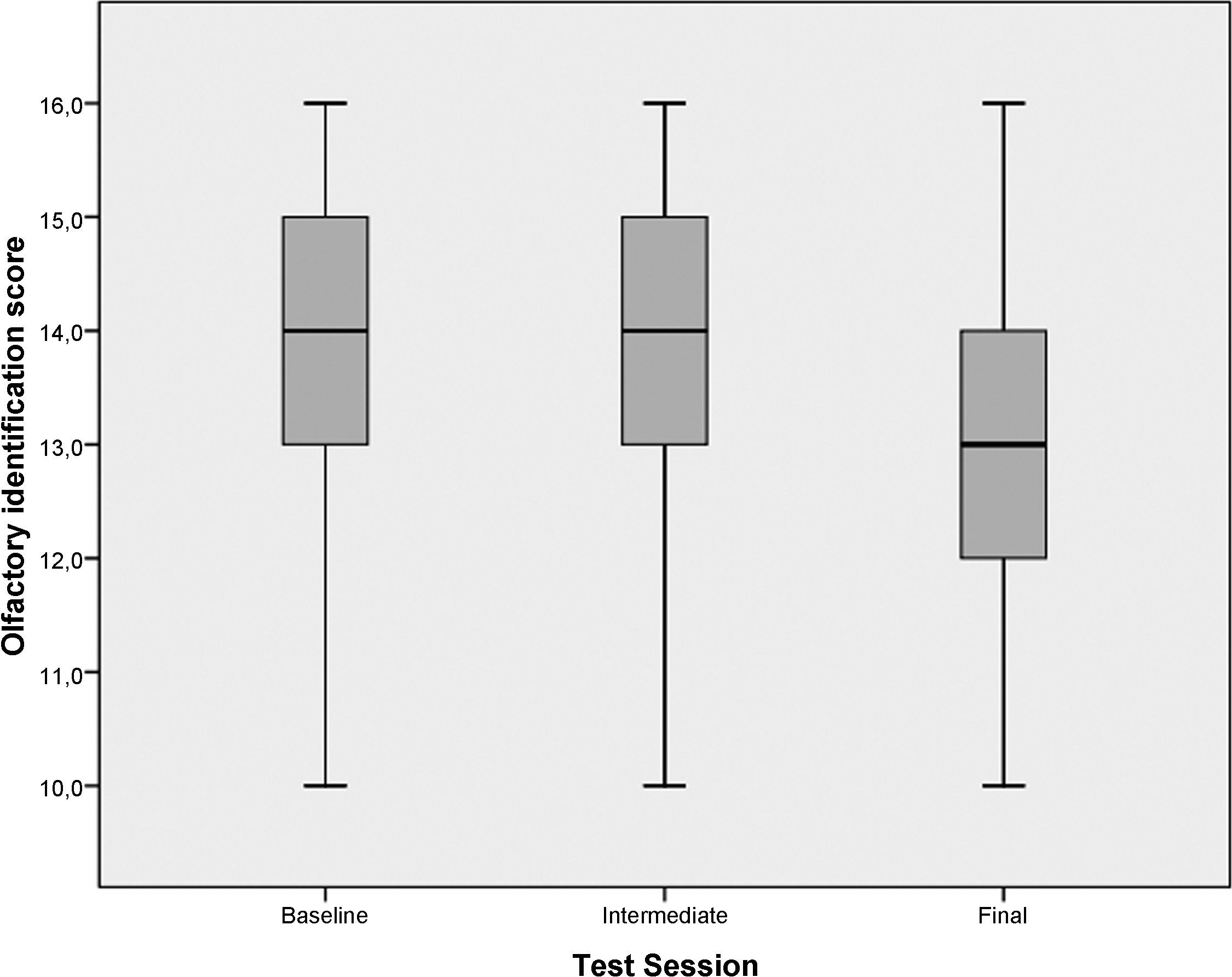
Olfactory performances throughout the competition.
A significant olfactory decrease was seen throughout the race (P = .036; χ2 = 6.649 for combined samples), while the differences between T0, T1, and T2 sessions were not significant (T0 vs T1: z = –1.337, P = .181; T1 vs T2: z = –1.432, P = .152). Conversely, T0 and T2 performances were significantly different (z = –2.583, P = .010). No effect on olfaction was found with regard to gender (T0: z = –0.075, P = .943; T1: z = –0.660, P = .538; T2: z = –0.982, P = .351, comparing the samples one against the other), age (T0: rs = –0.223, P = .116; T1: rs = –0.037, P = .841; T2: rs = –0.206, P = .292), or running time (T0: rs = –0.161, P = .259; T1: rs = –0.274, P = .129; T2: rs = –0.152, P = .439). There were no differences in olfactory trends between the 2013 and 2014 races.
Correlation between olfaction and sleep deprivation
The olfactory score at T2 and their deltas were correlated with both TST and NTST. The population was stratified according to the median NTST (group 1: n = 10, range 0.034–0.065 hours slept/race time; group 2: n = 9, range 0.065–0.132), and differences were found between the 2 groups considering the olfactory variation within the second half of the race (z = –2.405, P = .021).
Correlation for olfaction with TBW and change in body mass
A moderate correlation was found between olfactory scores compared with TBW at T1 (rs = –0.427, P = .019) but not at baseline and T2 (rs = –0.100, P = .491 and rs = –0.311, P = 0.194, respectively). No correlations were otherwise found between olfactory scores and changes in body mass at any time.
Training adaptation assessment by olfactory testing
Athletes had similar olfaction at baseline compared with controls (Table 3).
Statistical comparison in the olfactory function of the athletes at baseline and a control population
Discussion
We investigated changes in olfaction due to participation in the MUM. In addition, we compared olfaction in MUM athletes, non-MUM athletes, and sedentary controls.
This was the first assessment in this context evaluating the cognitive effects of strenuous physical exercise, sleep deprivation, and altitude. Our approach showed good acceptance and employability in a logistically complex setting. The olfactory function clearly decreased after the race. This was independent from race duration or resting time and was similar to findings in a previous study. 2 Moreover, no changes were shown at T1 compared with the baseline, as already seen for muscular fatigue, possibly due to intersubject variability and race management. 9 Sleep deprivation was felt less in the first half of the race, run more quickly than the second half, which was characterized by a marked olfactory decrease. This last effect was correlated with normalized sleep time, demonstrating a likely influence of sleep deprivation, linked to cognitive detriment, on olfaction.3,10 A moderate correlation was found between olfaction and TBW at midpoint, possibly suggesting a link between cognitive detriment and total body weight during extreme efforts. 4 Conversely, body mass index, age, gender, and training variables were not related to olfaction, although the assessment of the relationship to gender may be limited by the small number of female subjects. No difference in the olfactory decay in 2013 and 2014 was found, suggesting that weather did not have any effect on olfaction. Finally, MUM athletes, non-MUM runners, and controls showed the same level of olfactory performances at baseline, which does not differ significantly from the normative data. 8 This is probably due to the positive effect of physical conditioning on the cognition of athletes, masking the potentially negative effects of environmental factors to which MUM runners are exposed.
Limitations
The subjects enrolled (n = 53) were a subgroup of participants (around 700 per year) and were not necessarily a “representative sample” of the overall athlete population, despite being age- and gender-matched with the overall competitors. Evaluation took place over 2 years to maximize the sample size; the weather variability could have represented a confounding factor for our analysis, as discussed. The main study limitations are the bioelectrical impedance analysis for evaluating TBW, sleep time calculated with the FitBit Flex, not including habits prior to the competition, and absence of insomnia evaluation scales.
Conclusions
MUM represents one of the most strenuous endurance activities. This pilot study used, for the first time, olfactory evaluation as an unobtrusive and objective method for investigating the cognitive impairment of MUM runners. This could form the basis of a study on the possible acute fatigue and endurance training adaptation effects on the athletes’ psychological state. The identification of such impairment could be important in subjects at risk of cognitive detriment due to stressful physical efforts, as with soldiers. This could lead to athletes adopting stress management strategies to improve their cognitive and physical performances, reducing the overall risks for themselves both during and after the competition.
Footnotes
Acknowledgments
We would like to thank the organization of the Tor des Géants for having allowed us to carry out the testing sessions, the Municipality of Courmayeur for their kind hospitality, the Aosta Valley Regional government, and Bridget Walker for revising the English. Finally, we are indebted to the subjects for their participation and exceptional effort.