






Abstract
Ultraendurance open water swimming presents unique physiological challenges. This case study aimed to describe cardiovascular and perceptual responses during a successful solo channel swim. Investigators followed a female swimmer’s Catalina Channel (32.2 km) crossing, monitoring water temperature (Twater) and air temperature (Tair), distance remaining (DR), average velocity, and heart rate (HRswim) at regular intervals. Every 24 minutes, the swimmer reported perceived pain (on a scale of 0–10), rating of perceived exertion (RPE [scale of 6–20]), perceived thermal sensation (scale 0–8), and thirst (scale 1–9). Data are presented as mean ± SD where applicable. The participant finished in 9 hours, 2 minutes, and 48 seconds; Twater averaged 19.1 ± 0.4°C, and Tair averaged 18.6 ± 0.9°C. Her HRswim ranged from 148 to 155 beats/min, and thermal sensation ranged from 3 to 4. Pain inconsistently varied from 0 to 5 during the swim. The RPE remained between 12 and 14 for the first 8 hours, but increased dramatically near the end (reaching 18). Thirst sensation steadily increased throughout the swim, again reaching maximal values on completion. Physiologically and statistically significant correlations existed between thirst and DR (r = −0.905), RPE and HRswim (r = 0.741), RPE and DR (r = −0.694), and pain and DR (r = −0.671). The primary findings were that, despite fluctuations in perceptual stressors, the swimmer maintained a consistent exercise intensity as indicated by HRswim; and during ultraendurance swimming, pain, RPE, and thirst positively correlated with distance swum. We hope these findings aid in the preparation and performance of future athletes by providing information on what swimmers may expect during an ultraendurance attempt and by increasing the understanding of physiological and perceptual responses during open water swimming.
Introduction
Open water ultraendurance swimming presents unique physiological and perceptual stressors including exhaustion, hypothermia, strong ocean currents, and unpredictable weather. 1 –5 Long-distance channel swims (in or across open water between land masses or islands) require extensive preparation and acclimatization as durations can exceed 24 hours in water temperatures as low as 11°C (52°F). 2 ,5–8 Notwithstanding these challenges, race performances continue to improve, 9 and new amateur and professional athletes attempt ultraendurance swims every year. 10 For example, the number of English Channel swimmers (arguably the most recognizable channel swim in the world) has increased exponentially in recent years, with more than 1800 successful swims from 1875 to 2013. 11 Female athletes have recently gained attention in ultraendurance sports as their peak performance times progress closer to those of men, 12 especially in long-duration cold water swims for which women may possess favorable physiological advantages over men (eg, smaller body size and greater body fat percentage resulting in less drag and increased buoyancy). Diana Nyad’s recent completion of the US-Cuba crossing (180 km) without a shark cage has brought even more public attention to the sport.
Despite the sport’s growing popularity, long-distance open water swimmers still represent a relatively small population. 7 Moreover, studying race situations proves difficult as strict rules forbid contact with swimmers during sanctioned events. 13 This combination makes ultraendurance channel swimming an under-researched sport, leaving many unanswered physiological and psychological questions. Most open water swimming research has focused on athlete characteristics, 2 ,14,15 training,3,16 performance times, 9 ,10,12 and body temperature responses to cold water, 1 ,4,5,17 but little physiological or psychological information exists that was obtained during actual events.
Of the few case studies involving channel swimmers,
2
,3,8,16,18 none reported heart rate response, perceived pain, perceived exertion, thermal sensation, or thirst sensation during an event. Therefore, the purpose of this case study was to describe the cardiovascular and perceptual responses of a female ultraendurance swimmer during a successful solo crossing of the Catalina Channel (32.2 km [20 miles]) in Southern California. This renowned swim stands as an event in the Triple Crown of Open Water Swimming (
Case Presentation
Participant and Ethics Approval
One competitive female swimmer (aged 24 years, height 158 cm, mass 58.2 kg, body mass index 23.2 kg/m2, body fat 25.0%) participated in the channel swim. The participant reported specifically training and acclimatizing over a 1-year period for this event (Table 1), swimming 6 to 9 times a week (11 to 20 hours per week), enduring cold water (temperature as low as 11°C [52°F]), rough seas, night swimming, or overnight sleep deprivation. This study conformed to the requirements of the Declaration of Helsinki, and the work reported was approved by the Institutional Review Board at California State University, Fullerton. The participant read and signed informed consent and medical history forms before data collection.
General outline of the participant’s yearlong swim training preparation before the Catalina Channel swim
The participant had 15 years of year-round swim training experience (age group, high school, Master’s) with a 1.5 year hiatus approximately 4 years before the Catalina Channel swim.
For 10 weeks before the event, the participant completed weekend (Saturday and Sunday), long ocean swims, progressing from 2 to 8 hours.
Anthropometric Measures
Investigators measured height with a stadiometer (model 210; SECA Corp., Hamburg, Germany), body mass by electronic scale (model ES 200L; OHAUS, Pinebrook, NJ), and calculated body mass index (BMI) as mass (kg) divided by height (m2). 19 One trained researcher conducted a 3-site skinfold assessment (triceps, suprailiac, thigh) 20 to estimate body fat percentage, pinching a tissue fold (nearest millimeter) with a calibrated skinfold caliper (Harpenden; British Indicators, West Sussex, UK) and averaging 3 measurements at each site (within 2 mm of each other).
The Channel Swim
The participant swam 32.2 km (20 miles) from Doctor’s Cove (Catalina Island) to Palos Verdes (mainland California), wearing only a swimming suit, cap, and goggles. She observed Catalina Channel Swimming Federation Rules, which prevent 1) the use of insulating or buoyant material (eg, wetsuits); and 2) unnatural assistance to the swimmer (eg, drafting, touching a kayak).
13
She started at 2353 hours (11:53
Cardiovascular Measures and Swim Intensity
Investigators measured resting heart rate (HRrest) before the swim and recorded swimming heart rate (HRswim) at 5-second intervals throughout the event by telemetric monitoring (E600; Polar Electro, Woodbury, NY). Researchers developed an estimation equation for age-predicted maximum heart rate (APMHR) during swimming (APMHRswim = [206 − 0.88 (age)] − 13) by subtracting 13 beats/min (as swimming elicits a lower HRmax compared with running) 21 –23 from a maximum heart rate (HRmax) equation used specifically for healthy females. 24 The Karvonen formula (HRreserve = APMHRswim − HRrest) was used to calculate the swimmer’s heart rate reserve. 25 Finally, investigators determined the participant’s swim intensity (ie, work rate) during the channel crossing as a percentage of HRreserve: swim intensity (%HRreserve) = ([HRswim − HRrest] / [HRreserve]) · 100. 26
Perceptual Measures
During each rest period, investigators documented the participant’s perceptual responses using 4 scales, shown in Table 2. To evaluate perceived pain, researchers utilized the numeric rating scale. 27 The Borg scale, commonly used in exercise physiology, assessed rating of perceived exertion (RPE). 28 Perceived thermal sensation gauged how hot or cold the participant felt. 29 Finally, an adapted thirst sensation scale measured perceived thirst. 30 Researchers familiarized the participant with perception scales during several training sessions before the event to ensure comfort with these measures.
Perception scales
RPE, rating of perceived exertion.
Statistics
Investigators conducted Pearson product moment correlations (r) to determine linear dependence between each variable. Significance for r values was set at P < .05. Data are presented as mean ± SD where applicable. Researchers performed statistical analyses with the PASW Statistics 18 (SPSS Inc., Chicago, IL) computer program.
Results
The participant swam the Catalina Channel in 9 hours, 2 minutes, 48 seconds, at an average velocity of 1.0 ± 0.1 m·s−1, starting at 2353 hours (11:53
Cardiovascular Response and Swim Intensity
The participant’s HRrest, APMHRswim, and HRreserve were 48, 172, and 124 beats/min, respectively. Her HRswim remained consistent during the event, ranging from 148 to 155 beats/min, with a mean of 152 ± 2 beats/min (Figure 1). The participant’s swim intensity remained between 81% and 86% HRreserve throughout the swim.
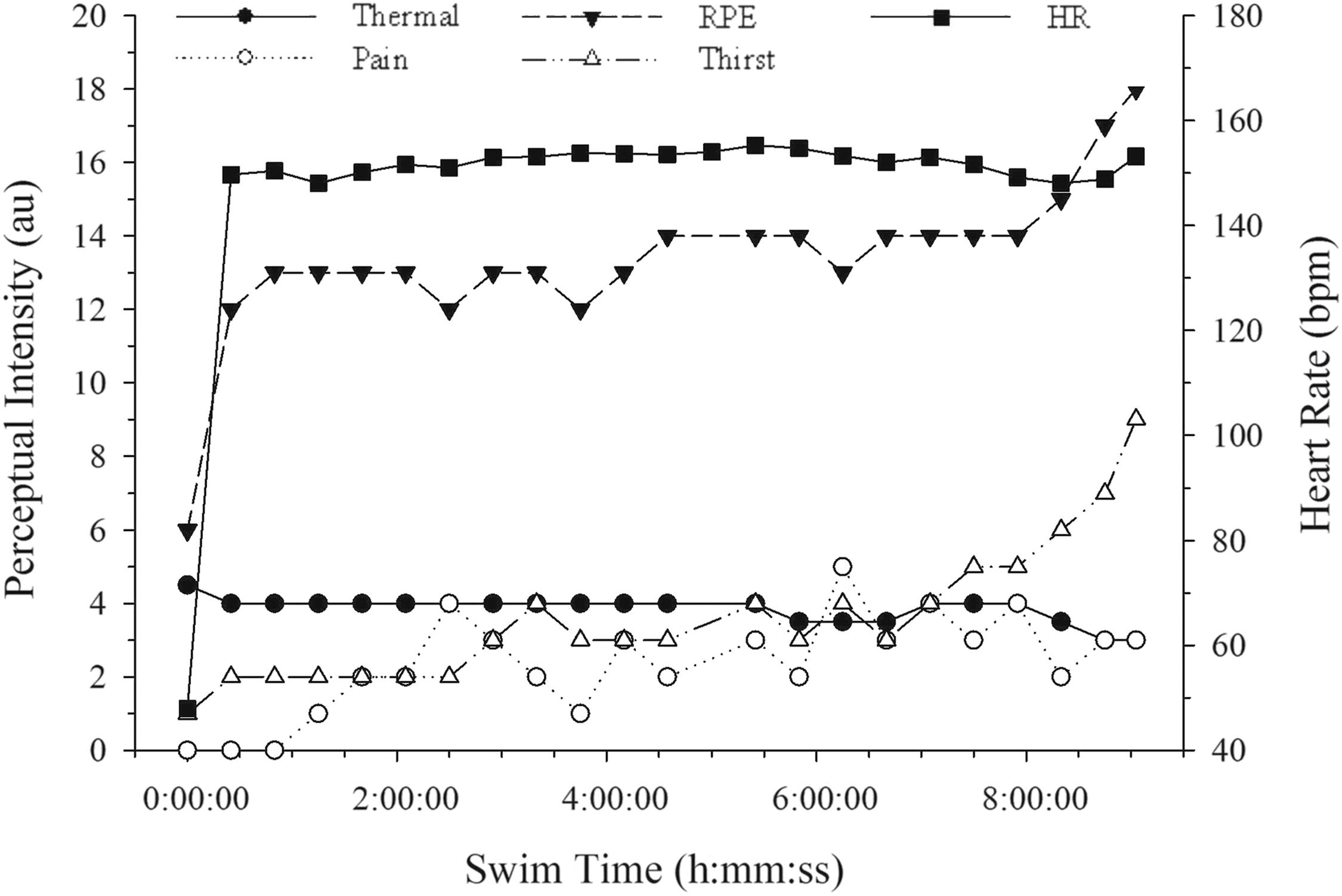
Perceptual and heart rate (HR) responses during the channel swim. Perceptual intensities, in arbitrary units (au), are based on scales in Table 2, and HR is shown as beats/min (bpm). Solid circles indicate thermal perception; open circles, pain; solid triangles, rating of perceived exertion (RPE); open triangles, thirst; and solid squares, HR.
Perceptual Responses
Figure 1 also displays perceived pain, RPE, thermal sensation, and thirst responses over time. Thermal sensation ranged from 3.0 to 4.5 (cool to comfortable). Pain inconsistently varied from 0 to 5 (no pain to moderate pain) during the swim. Her RPE remained between 12 and 14 (from slightly less than to slightly greater than “somewhat hard”) during the first 8 hours, but increased dramatically in the final 40 minutes, reaching 18 (“very hard” to “very, very hard”) at the finish. Thirst sensation steadily increased throughout the swim, again reaching maximal values on completion. Table 3 shows correlation coefficients (r values), describing relationships between all measured variables. Of these, physiologically and statistically significant correlations existed between DR and thirst (Figure 2A), RPE (Figure 2B), and pain (Figure 2C).
Correlation matrix of dependent variables
Values are Pearson product moment correlations (r).
RPE, rating of perceived exertion; HR, heart rate; Tair, air temperature; Twater, water temperature; DR, distance remaining.
indicates a significant relationship between variables (P < 0.05).
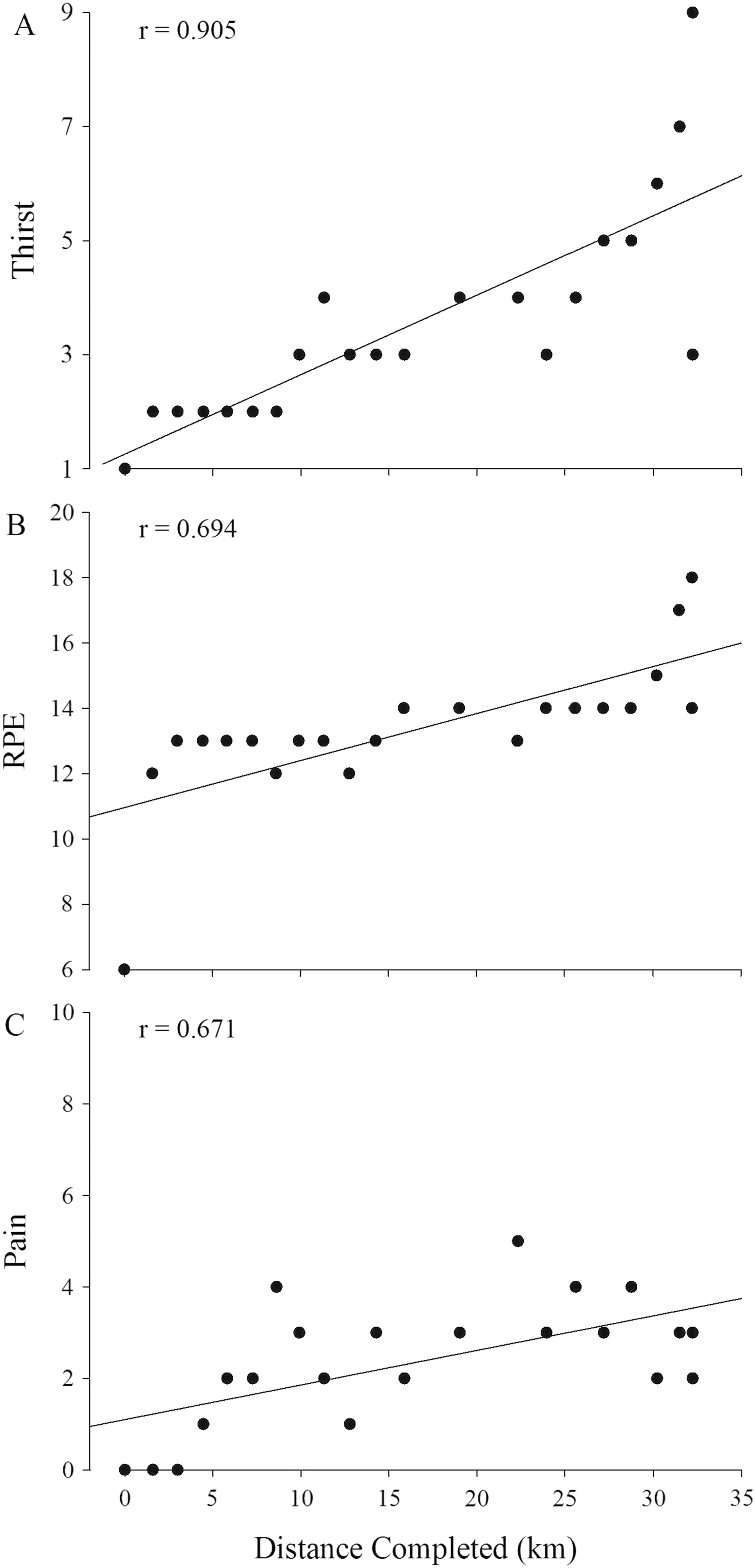
Physiologically and statistically significant correlations. To improve visual clarity, these figures plot distance completed (as opposed to distance remaining) versus (A) thirst, (B) rating of perceived exertion (RPE), and (C) pain.
Discussion
The participant swam the Catalina Channel (32.2 km [20 miles]) in 9 hours, 2 minutes, and 48 seconds, making her one of fewer than 200 successful solo swimmers at the time of this event (
Cardiovascular Response, Swim Intensity, and Velocity
Monitoring heart rate provides valuable information regarding exercise intensity during training and performance, closely relating to oxygen consumption at intensities between 50 and 90% V
The participant’s swim velocity averaged 1.0 ± 0.1 m·s−1, which was similar to female swimmers in a previous channel swimming study. 8 The ability to maintain relatively high swim speeds over a long distance may relate to an ultraendurance swimmer’s increased mechanical efficiency and high stroke rates (stroke/min). 8 Counterintuitively, average swimming velocity failed to correlate with most variables, demonstrating only one logical significant relationship (thermal sensation, r = 0.621) and two unexpected significant relationships (RPE, r = −0.564, and thirst, r = −0.544). Unfortunately, the swim velocity calculation (ie, change in nautical position/elapsed time) does not account for ocean currents (velocity and direction). These factors are independent of exercise intensity and may strongly influence resultant swimming velocity.
Pain, RPE, and Thermal Sensation
Perceived pain and RPE correlated moderately (r = 0.447), indicating a possible interrelationship. Expected significant associations between DR, pain, and RPE (Figure 2B and 2C) might have resulted from swim duration or the swimmer’s conscious effort to increase velocity near the finish.
Hypothermia (core temperature [Tcore] ≤35°C) diminishes physical and mental abilities, increasing the risk of accident. “Likely death” by hypothermia has been reported after 3 to 9 hours of submersion in 15°C water; 34 however, it can occur in water temperatures of 21.1°C (70.0°F) or less. The time to development of hypothermia differs widely based on water temperature, age, sex, fitness level, acclimatization, body composition, exercise intensity, and so forth. Previous research has shown women’s capacity to acclimatize to cold water over time, 35 possibly because of increased subcutaneous fat stores 1 –3 or enhanced ability to decrease peripheral circulation. 36 Our participant endured 19.1 ± 0.4°C (66.4 ± 0.7°F) water temperature for more than 9 hours, suggesting she became acclimatized during her yearlong training. Although Tcore was not measured during this event, research suggests thermal sensation correlates with Tcore during exercise in cold water. 32 Our participant’s perceived thermal sensation remained steady (cool to comfortable) during the entire swim duration. Swimming in cold water increases the rate of heat loss through convection, while simultaneous muscle contraction produces heat production. 37 That makes ultraendurance swimming a unique model to study the etiology of hypothermia in cold water, and future studies should investigate long-distance ocean swimmers to determine specific training strategies for acclimatization to the cold.
Conclusion
These observations indicate that with proper training, acclimatization, and intermittent feedings, an ultraendurance swimmer can safely maintain elevated exercise intensities for long durations while enduring considerable perceptual challenges. The distance remaining best relates to markers of perceptual stress during prolonged open water swimming. We hope these findings aid the preparation and performance of future channel swimmers, provide information on what swimmers may reasonably expect during a channel swim attempt, and increase understanding of physiological and perceptual responses during ultraendurance channel swimming.
Footnotes
☆
Presented at the Annual Meeting of the American College of Sports Medicine, June 2–5, 2010, Baltimore, MD.