






Abstract
Objective
Hikers and campers are exposed to risks while in the wilderness. One of these risks is the possibility of contracting an illness, including infectious diarrhea. This project tested for coliform bacteria in water samples taken near popular Appalachian Trail shelters.
Methods
Water was collected from access points within the Great Smoky Mountains National Park. Samples were collected in sterile bottles and inoculated on a commercially available coliform detection kit for quantitative determination of total coliform and
Results
Water samples were taken during summer and fall seasons. During summer, 7 of 10 samples were positive for coliform bacteria and 6 of those 7 for
Conclusions
Environmental Protection Agency drinking water standards set the standard of 0 CFU/100 mL to be considered safe. This analysis of water samples along the Appalachian Trail emphasizes that the majority of water access points require treatment during the summer season. Coliform burden was not as high through the fall months. These data suggest one infectious disease risk for wilderness travelers.
Introduction
Many Americans enjoy spending time outdoors. The National Survey on Recreation and the Environment estimated that during the 12 months before the survey, 24.5 million people age 16 or older backpacked once or more. 1 The number of those enjoying hiking within the United States is increasing. 2 One of the most popular hiking trails in the nation is the Appalachian Trail, especially the segment within Great Smoky Mountains National Park (GSMNP). In 2011, the US Department of Agriculture deemed the use of the entire Appalachian Trail in 2007 was 1,948,701 visitors. 3
Hikers generally understand the risks of venturing into the wilderness, including potential musculoskeletal, skin, and gastrointestinal problems. Few studies regarding health risks and the overall healthcare of hikers have been conducted. 2 With the growing public health implication, investigating the water quality of Appalachian Trail shelters is of interest.
Methods
To determine the current infectious risk of water along the Appalachian Trail in the GSMNP, a total of 10 evenly distributed shelters were selected. Appalachian Trail shelters may provide a piped water source from a creek or spring similar to the one at Davenport Gap in the Figure. During May and June (summer) and again in October and November (fall) of 2012, samples were collected directly into 500-mL sterile bottles without disturbing the surroundings (National Park Service Approval GRSM-2012-SCI-1112). The water was allowed to pour directly into the bottle without touching the pipe, and the bottle was not dunked within the collection of water under the source. All of the bottles were labeled and then transported at ambient temperature to the microbiology laboratory at the University of Tennessee Medical Center in less than 4 hours.
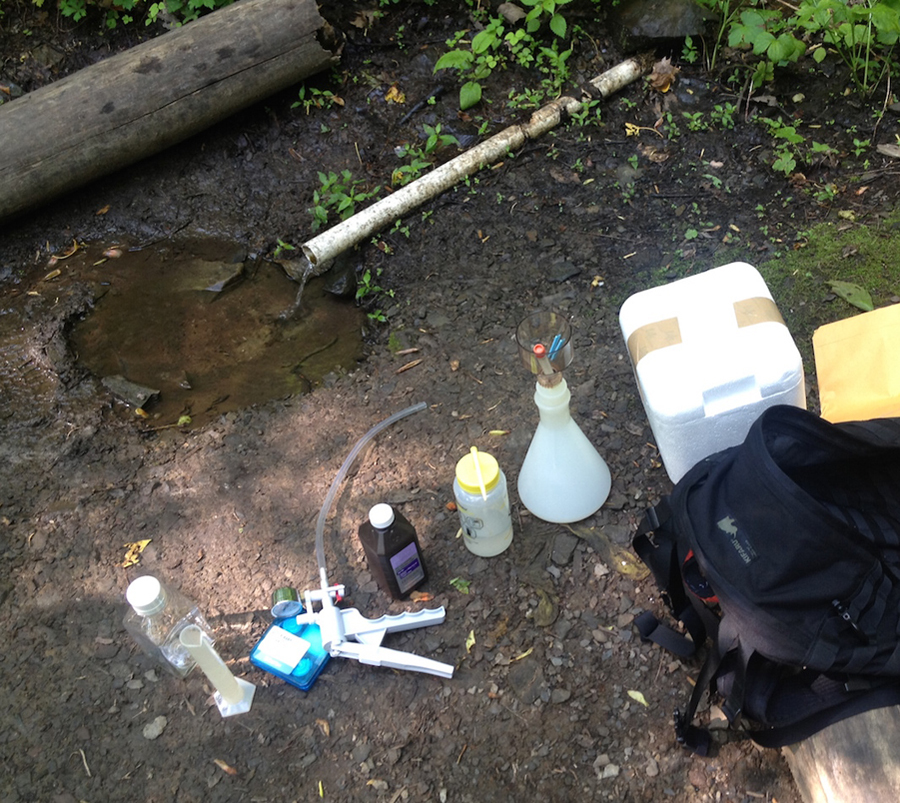
Water source at Davenport Gap.
On arrival at the laboratory, the water was poured directly onto commercially available culture plates that specifically select for coliform bacteria (Coliplate, Bluewater Biosciences, Inc, Mississauga, Ontario, Canada). Enough sample water was poured over the culture plate to fill every well, with some unmeasured water remaining. These plates were incubated for 24 hours at 37°C. After incubation, the number of wells seen under visible and ultraviolet (UV) light was counted. These media allowed detection of coliform bacteria based on a green to blue coloration within the wells under visible light. The addition of a UV light source provided identification of
Results
Seven of 10 samples were positive for coliform bacteria, and 6 of those 7 were also positive for
Results from summer (May/June) and fall (Oct/Nov) collection
CFU, colony-forming units; MPN, most probable number.
Mileage from Springer, GA.
Discussion
A large and increasing number of Americans enjoy spending time in the outdoors. 2 Hikers are exposed to health dangers while in the wilderness. Greater exposure to untreated, contaminated water increases a hiker’s risk of acquiring a diarrheal illness. The prevalence of undifferentiated gastrointestinal illness among hikers of the Long Trail in Vermont from 1986 through 1998 was 7% (11 of 155 persons). 4 A study on medical problems during expedition activities at various National Outdoor Leadership School courses determined the risk of gastrointestinal illness as 113 of 478 (23.6%) cases of illness. 5 A study in the late 1980s by Crouse and Josephs 6 queried 224 hikers who completed the entire 2100-mile Appalachian Trail regarding any health consequences. Of the 82% of hikers who responded to the query, 63% reported diarrhea. A prospective study with 280 of 334 interviewed revealed diarrhea had the highest incidence of reported illness at 56%. 2
Previous evidence has shown that the majority of those who contract a gastrointestinal illness do not practice proper hygiene or do not treat their water adequately.
7
Drinking untreated water significantly increased the risk of diarrhea (odds ratio [OR], 7.7; 95% CI, 2.7–23;
Previous studies have also demonstrated water contamination in the GSMNP, but most recently in 1982. 9 Contamination of water with coliform bacteria can be from numerous sources, such as fecal contamination from humans or other animals adjacent to the water, or runoff from agriculture, storms, or sewage upstream. Given the open water source at shelters, it is possible contamination can occur from hikers with contaminated hands themselves grasping the pipe.2,9
There are efforts to inform the public of the need to treat water before consumption, such as signage at most Appalachian Trail shelters within the GSMNP and a Centers for Disease Control and Prevention publication. 10 Treating contaminated water before imbibing may prevent illness. 7 There are numerous methods of treating contaminated water, including iodine tablets, boiling water, filters, and UV light. This study again demonstrates the importance of water treatment for those who adventure outdoors.
Limitations
There were limitations to this study, which include a single sample per shelter and the inability to sample water at 3 sites during the fall months. This was because 1 site was without water from the source, and 2 were unreachable owing to an early season snowstorm. Additionally, we were unable to specify pathogenic strains, only the total
Conclusions
Estimating water contamination by testing for an indicator organism such as coliform bacteria can be beneficial and is a standard means to estimate water pollution. 11 Environmental Protection Agency drinking water standards require 0 coliform CFU/100 mL as the maximum contaminant level goal.11,12 It was established that multiple water sources along the Appalachian Trail in the GSMNP exceeded this level during both rounds of sample collection. In addition, 1 shelter exceeded recreational water safety standards (>100 CFU/100 mL) during the summer sample (Silers Bald).
The reason for the coliform activity within the watershed is unclear. Regardless, this investigation confirms the need for water treatment practices in the wilderness and suggests waterborne infection risk for wilderness travelers. Diarrhea and gastrointestinal upset is a major inconvenience to hikers and more likely to spread, given the risk of contamination to water, existing water supplies, and person-to-person spread from food preparation without adequate sanitation. For this reason, it is important to educate outdoor enthusiasts on water purification as well as hygiene.
Footnotes
Acknowledgments
We would like to acknowledge the Physician’s Medical Education and Research Foundation of the University of Tennessee Medical Center, Knoxville, which graciously provided a grant to fund this project. In addition, the National Park Service approved these sample collections (Approval GRSM-2012-SCI-1112) and provided invaluable advice to assist with sample collection and study design. This study was approved by the University of Tennessee Graduate School of Medicine’s Institutional Review Board.
☆
Presented in part at the American College of Physicians Annual Meeting, 2013, San Francisco, CA, and the Tennessee American College of Physicians Meeting