






Abstract
Background
Ski helmet use has steadily increased worldwide over the last 10 years in part as a result of preventive helmet campaigns but also in part as a result of increased media coverage after fatal injuries involving celebrities. However, a commonly reported reason for nonuse is impaired vision.
Objective
The aim of this pilot study was to investigate whether ski helmet use affects reaction time to peripheral stimuli.
Methods
A randomized controlled trial using the Compensatory-Tracking-Test (CTT) was conducted in a laboratory situation. This test measures reaction time to peripheral stimuli during a tracking task and was carried out by 10 males and 10 females (age: 22.1 ± 2.5 years) during 4 conditions in a randomized order: (A) with a ski cap; (B) with a ski helmet; (C) with a ski cap and ski goggles; and (D) with a ski helmet and ski goggles.
Results
Friedman-tests revealed significant differences in reaction times (ms) between the 4 conditions (p = .031). The lowest mean reaction time (± standard error) was measured for cap only use (477.3 ± 16.6), which was not different than helmet-only use (478.5 ± 19.1, p = 0.911). However, reaction time was significantly longer for cap + goggles use (514.1 ± 20.8, p = 0.005) and for helmet + goggles use (497.6 ± 17.3, p = 0.017) when compared to cap-only use.
Conclusion
Our results showed that ski helmet use did not increase reaction time to peripheral stimuli. This information should be implemented in future preventive campaigns to increase helmet use in skiers and snowboarders.
Introduction
Fatal head injuries in downhill skiers, involving celebrities in Canada and Austria during the winter 2008 to 2009 season, evoked a considerable public discussion about whether or not to use ski helmets and whether to make ski helmet use mandatory for children. 1 Head injuries account for 9 to 20% of all skiing injuries reported by ski patrols and emergency departments.2,3 A recently published meta-analysis showed a reduction of general head injury risk by 35% when using a ski helmet. 2 Although ski helmet use has increased in past years in the Alps to greater than 60%, 4 common reasons reported for nonuse are an increased level of risk taking, impaired hearing, and impaired vision. 5 –7 Whereas we concluded that ski helmet use is not necessarily associated with riskier behavior on slopes, 6 Tudor and colleagues 7 reported that ski helmets could raise the hearing threshold of characteristic frequencies that alert skiers to the hissing caused by a skier or snowboarder passing by closely or braking close behind. Although about one quarter of interviewed ski patrollers felt that ski helmets interfere with vision, 5 we are not aware of any study that has investigated the potential impact of ski helmet use on vision. Therefore, the aim of this pilot study was to investigate whether ski helmet use affects reaction time to peripheral stimuli.
Materials and Methods
After obtaining Institutional Review Board approval, a randomized controlled trial using the Compensatory-Tracking-Test (CTT)8,9 was conducted in a laboratory setting. In a dark room, a video projector fixed to the ceiling was used to project the test on a 200 × 156 cm wall screen. Subjects were seated at a table 250 cm from the wall and were required to respond to a stimulus presented in the peripheral visual field, while simultaneously attending to a tracking task with a computer mouse. Subjects track the horizontally moving grey dot with the mouse cursor (displayed as a green cross) and immediately press the mouse button when the yellow dot appears in one of the 4 corners of the screen (Figure 1). The test is frequently used in within-subject comparisons assessing peripheral reaction time as a dimension of car-driving ability and has shown satisfying validity and reliability. 9 Subjects were familiarized with the study procedure and trained on the test in order to preclude learning effects. The test was carried out during 4 conditions in a randomized order: (A) with a ski cap; (B) with a ski helmet; (C) with a ski cap and ski goggles, and (D) with a ski helmet and ski goggles. In total, 10 male and 10 female voluntary sport students (age: 22.1 ± 2.5 years) were recruited for this pilot study. All participants used their own equipment to guarantee optimal fitting, which was verified by the study authors. All helmets were approved by the EN 1077 norm that provides a horizontal field of view of at least 105°.

Screen of the CTT: Subjects track the horizontally moving grey dot with the mouse cursor (displayed as a green cross) and immediately press the mouse button when the yellow dot appears in one of the 4 corners of the screen.
Statistical Analysis
Differences in reaction time (ms) between the 4 conditions were evaluated by the Friedman test. Additionally, conditions were compared to the condition with the lowest reaction time using the Wilcoxon signed-rank test. All P-values were two-tailed, and values ≤ .05 were considered to indicate significance. P-values were Bonferroni corrected.
Results
The Friedman tests revealed significant differences in reaction times (ms) between the 4 conditions (P = .031). The lowest mean reaction time (± standard error) was measured for cap only use (477.3 ± 16.6), which was not different from helmet only (478.5 ± 19.1, P = .911). However, reaction time was significantly longer to cap + goggles use (514.1 ± 20.8, P = .005) and to helmet + goggles use (497.6 ± 17.3, P = .017) when compared to cap only use (Figure 2).
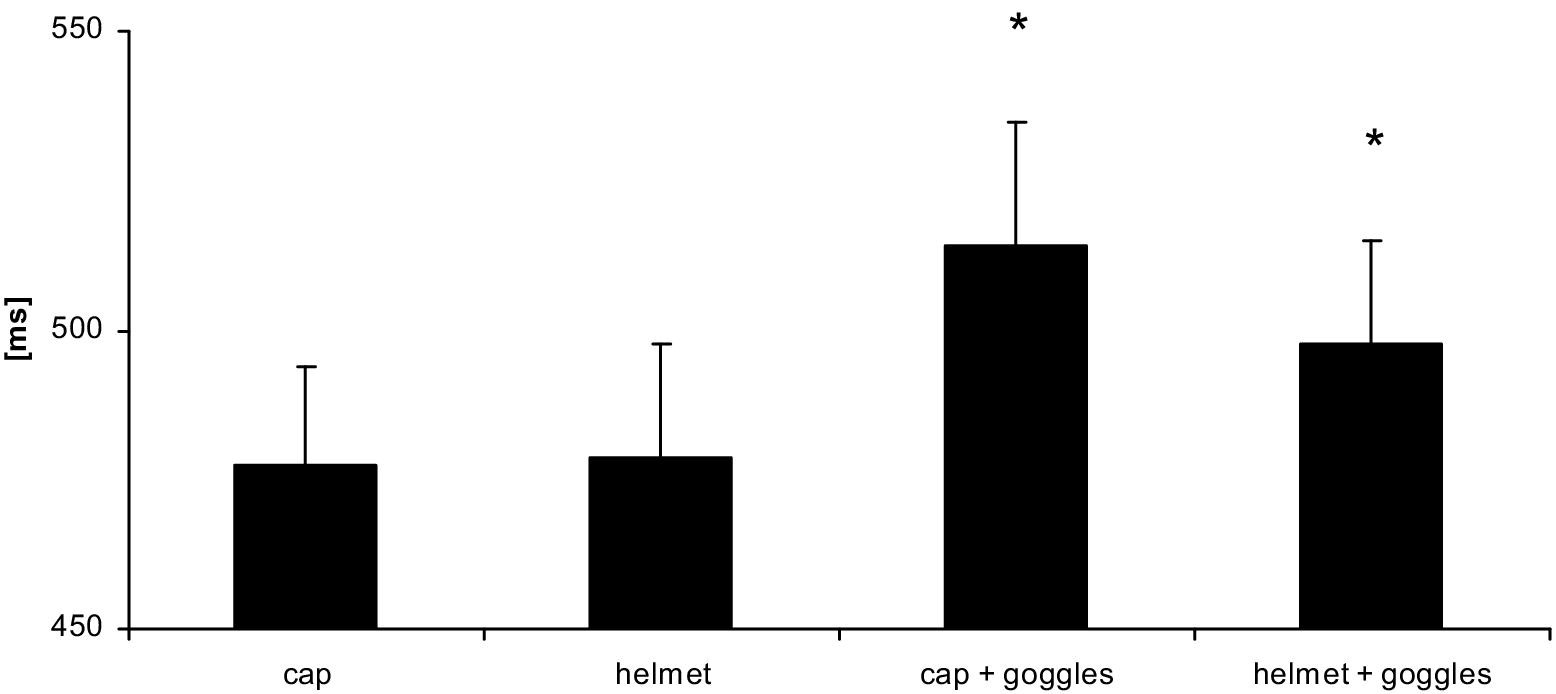
Mean reaction time to peripheral stimuli when using different headgear; * denotes a significant difference to the condition with the lowest value.
Discussion
The main result of our pilot study was that ski helmet use did not increase mean reaction time to peripheral stimuli when compared to ski cap only use. Although arguments against ski helmet use include impaired vision, 5 well-fitting ski helmets seem to be constructed in a way that the margin of the helmet is out of the field of vision. In contrast, our results indicate that ski goggles increased mean reaction time to peripheral stimuli. At least 1 limitation of our pilot study is the use of a laboratory situation, which must be considered when interpreting our results.
Peripheral vision is an essential factor for safety in alpine skiing. 10 Skiers are advised to moderate speed on visibility considering the rules of the International Ski Federation to avoid collisions with other skiers. Collisions frequently lead to polytrauma and are likely to involve the head. 11 Victims of collisions are injured more frequently and severely than those who are at fault (93% vs. 25%), because they are usually hit unexpectedly. 11 Especially in these critical incidents, helmet use decreases the risk of head injury significantly. 2
Information that reaction time to peripheral stimuli is not negatively affected by the use of a ski helmet, according to the EN 1077 norm, should be implemented in future preventive campaigns to increase helmet use in skiers and snowboarders.