






Abstract
Objective
Bouldering is a discipline of rock climbing completed at low height. Despite its popularity, scientific description of this sport remains sparse. This study aims to characterize the athletic profile of highly accomplished boulderers.
Methods
Twelve male highly accomplished boulderers (age 25.3 ± 4.9) were matched for age (± 5 yr), height (± 5 cm), and body mass (± 5 kg) to 12 nonclimbing aerobically trained controls. Body composition was determined by dual energy x-ray absorptiometry. Handgrip and climbing specific finger strength were assessed by dynamometry. Shoulder girdle and abdominal muscle endurance were assessed by isometric tests. Data were mostly analyzed by t-tests with an adjusted alpha level for multiple comparisons. Ethical approval was received from the School of Sport, Health and Exercise Sciences, Bangor University, Bangor, UK.
Results
Body composition was similar between the groups, apart from increased bone mineral density in climbers' forearms (1.1 ± 0.1 vs. 1.0 ± 0.1 g · cm2, t(22) = 2.798, p = 0.010). Hand grip strength and climbing specific finger strength were greater in climbers (eg, finger strength: 494 ± 64 vs. 383 ± 79 N, t(22) = 3.740, p = 0.001), but handgrip and abdominal endurance were similar between the groups. In contrast, endurance of the shoulder girdle was substantially greater in boulderers (58 ± 13 vs. 39 ± 9 s, t(22) = 4.044, p = 0.001).
Conclusion
Highly accomplished boulderers were characterized by handgrip and finger strength better than that of nonclimbing controls and superior to that of previously investigated elite climbers. In contrast, boulderers' body composition and core endurance were similar to that of controls (who were aerobically trained). These characteristics provide an athletic profile of highly accomplished boulderers, and hence identify possible targets that with further investigation may aid athlete selection and training program design.
Introduction
Bouldering is a discipline of rock climbing that involves completion of short climbing tasks termed “boulders” or “problems.” These are performed close to the ground on either natural rock or artificial walls. With a minimal chance of serious injury and no requirement for extensive technical equipment and knowledge, bouldering is the most accessible of climbing disciplines, in which the most difficult climbing techniques are realized.
Participation in bouldering is substantial and escalating. 1 Bouldering competitions are organized at regional, national, and international levels, and are completed on artificial walls where steepness and hold spacing and size are varied to alter difficulty. In International Federation of Sport Climbing competitions, bouldering generally consists of 3 rounds: qualification (consisting of 5 boulders), semifinal (4 boulders), and final (4 boulders). Each boulder is normally compromised of 4 to 8 handholds, and a successful ascent typically requires 1 minute or less to complete. Multiple attempts are allowed within a 4 or 5 minute period, and 4 to 5 minutes of rest are allowed between each boulder. 2
Whether climbing for competition or recreation, it is necessary to determine the athletic profile of elite performers to optimize physical performance in this emerging sport. This information may identify possible physiological targets that future studies may confirm are useful for athlete selection and to guide training program design. 3 Data obtained from the related discipline of sport climbing suggest that the ideal athletic profile for rock climbing is small stature, low body mass, low body fat, high upper body strength to body mass ratio, high dynamic and isometric muscular endurance, high upper body power, and moderate to high aerobic fitness.3,4 However, sport climbing is characterized by longer climb ascent times of 2 to 7 minutes, and route length up to 18 m. In contrast, bouldering routes are shorter, and in competitions have a maximum height of only 3 m. 2 Natural and artificial bouldering routes are also described as being more strenuous, powerful, 5 and require intense intermittent effort. 6 Thus the activity profile of bouldering is different from that of sport climbing, and boulderers may possess a different athletic profile. At present, scientific description of the participants of this climbing discipline is sparse.
The aim of this study was to characterize the physiological profile of highly accomplished boulderers. Specifically, body composition, muscular strength, and isometric endurance were determined to describe this population. Results were compared prospectively to similarly active but non-climbing controls. Based on observations made of climbers from other disciplines,3,4 we hypothesized that, when compared to aerobically trained athletes, highly accomplished boulderers would: (1) possess enhanced forearm strength relative to body mass; (2) be more resistant to forearm fatigue; (3) have similar body fat; and (4) posses enhanced shoulder girdle and trunk endurance.
Methods
Following institutional ethical approval (School of Sport, Health and Exercise Sciences, Bangor University) and with informed consent, 12 male highly accomplished boulderers, defined as achieving an outdoor bouldering grade of Fontainebleau 7b (on a scale from 4 to 8c+, equivalent to Union Internationale des Associations d'Alpinism metric scale ∼grade 10) on at least 5 occasions including once within the last 2 months were case-control matched to 12 non-climbing controls (Table 1, upper half). All boulderers had taken part in the sport of bouldering regularly for at least 4 years, and bouldering was their primary (> 90% of climbing time) climbing discipline. Controls participated in non-upper-body dominant aerobic sports including running, cycling, and football.
Demographic, anthropometric, and body composition data of highly accomplished boulderers and non-climbing controls (mean ± s)
Statistical significance refers to results from independent t test; effect size refers to Cohen's d; activity level refers to time spent on primary activity; BMD, bone mineral density;
statistically significant difference between groups. The Bonferroni adjusted alpha level for the 2 bone measures = 0.025.
During the winter season, participants presented rested, hydrated, and 2-hour fasted. Body composition was determined by technician-blinded dual energy x-ray absorptiometry (QDR 1500, Hologic Inc, Bedford, MA, USA). After warm up, maximal hand grip strength of both hands was assessed using a Takei handgrip dynamometer (5001 Grip-A, Takei Scientific Instruments, Tokyo, Japan). Climbing specific finger strength of the dominant hand only was also determined using a novel finger flexor dynamometer. A simple base plate was designed and manufactured from wood to stabilize a standard handgrip strength dynamometer (5001 Grip-A, as above) in a horizontal position (see
Shoulder girdle endurance was assessed by timed bent arm hang. Core endurance was assessed by a battery of measures including the Kraus Weber test for trunk flexors; a timed isometric leg lift; and a back extension (Sorensen) test.
All data were expressed as means ± standard deviation. After checking relevant assumptions, data were analyzed for statistical significance (p < 0.05 before familywise error rate principle Bonferroni adjustment) on a statistical computer package (Version 17, SPSS Inc, Chicago, IL, USA) with independent t-tests and analysis of variance. Effect size for t-tests (d) was calculated as Cohen's d [interpreted as no effect (< 0.2), small (0.2 to 0.5), medium (0.5 to 0.8) or large effect (> 0.8)]; effect size for analysis of variance (η 2 ) was calculated as partial eta squared [no effect (< 0.05), small (0.05 to 0.1), medium (0.1 to 0.2), or large effect (> 0.2)].
Results
Body composition of boulderers was not different to that of aerobically trained controls (Table 1, lower half), except for arm bone density, which was 12% increased in the boulderers. Handgrip strength of the dominant and non-dominant hands was 7% greater in the boulderers (562 ± 69 N) than the controls (521 ± 69 N) (F(1,44) = 6.717, p = 0.013, η 2 = 0.133), although, when expressed relative to body mass, a 12% greater result in boulderers failed to attain Bonferroni adjusted significance (Figure 1). In contrast, finger strength (494 ± 64 vs 383 ± 79 N, t(22) = 3.740, p = 0.001, d = 1.22) and finger strength relative to body mass (Figure 1) were both significantly increased in boulderers vs controls by 22% and 25%, respectively.
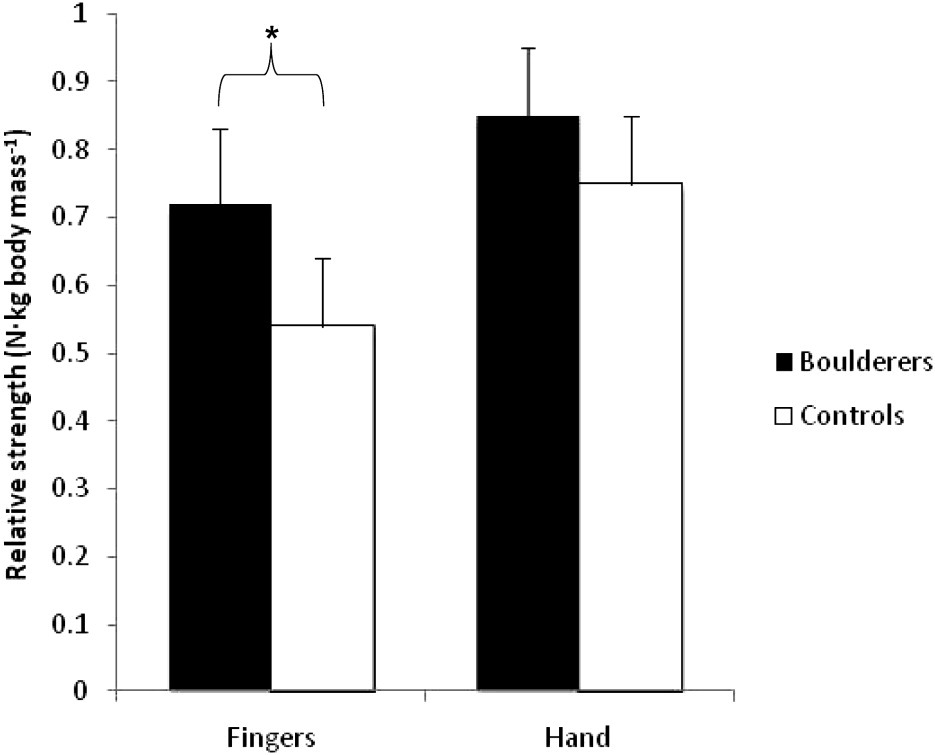
Strength dominant side, (relative to body mass) of highly accomplished boulderers and non-climbing controls. * Statistically significant difference between groups by independent t-test. Fingers: t(22) = 4.248, p = 0.000, d = 1.31. The Bonferroni adjusted alpha level for the 2 finger strength measures = 0.025. Hand: t(22) = 2.394, p = 0.026, d = 0.89. The Bonferroni adjusted alpha level for the 3 handgrip tests = 0.017.
During the handgrip resistance to fatigue test a lack of an interaction suggested resistance to fatigue was similar between the 2 groups (Figure 2), a result confirmed when data were expressed as percentage of baseline (data not shown). However, a main effect of group (before Bonferonni adjustment) suggested boulderers had increased absolute strength throughout. Core endurance was not significantly different between boulderers and controls (p = 0.086–0.985), but shoulder girdle endurance was 33% greater in boulderers (58 ± 13 vs 39 ± 9 s, t(22) = 4.044, p = 0.001, d = 1.28).
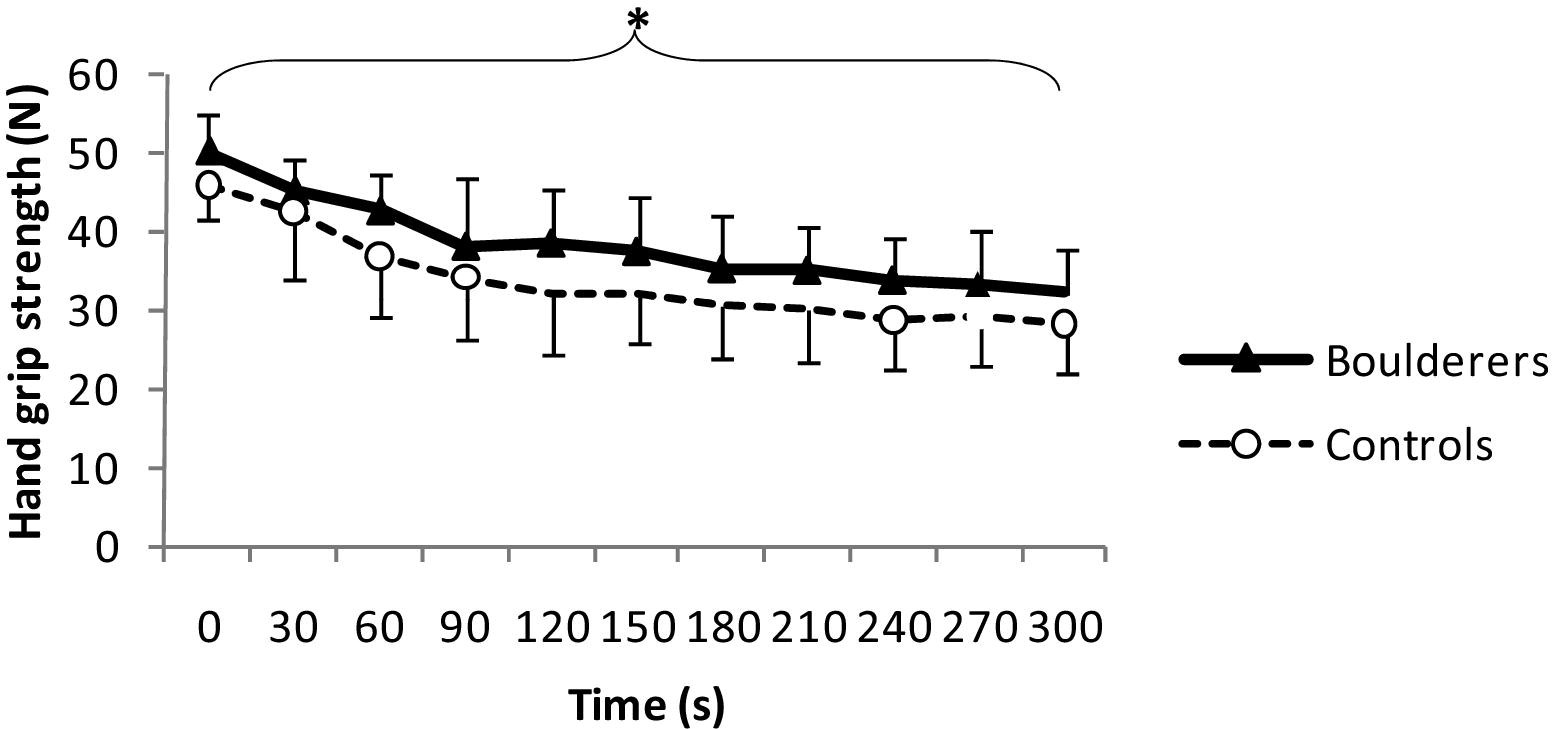
Resistance to fatigue in highly accomplished boulderers and non-climbing controls. * Significant main effect of time by analysis of variance (F(10,200) = 42.294, p = 0.000, η2 = 0.679). There was also a trend for a main effect of group (F(1,20) = 4.436, p = 0.048, η2 = 0.182), but there was no significant interaction (F(10,200) = 0.382, p = 0.953, η2 = 0.019). The Bonferroni adjusted alpha level for the fatigue measures = 0.025.
Discussion
The aim of this study was to characterize highly accomplished boulderers to provide information for athletes wishing to attain high performance in this discipline. A commonly assessed parameter in climbing studies is absolute handgrip strength, and in the present study this parameter was significantly greater in boulderers compared to non-climbing controls. Although it is generally believed that absolute handgrip strength is not particularly high in rock climbers, 3 our result is consistent with recent findings in boulderers. 7
In contrast to absolute strength, handgrip strength relative to body mass is consistently shown to be greater in rock climbers.3,4 Highly accomplished boulderers were coherent with this observation, in fact showing the highest recorded values of any climbing study so far. Climbing specific finger strength is also accepted as being greater in climbers than non-climbing controls, again a finding replicated herein, with boulderers showing high values compared to previous literature (494 vs 446 N), 8 albeit different finger strength testing protocols may account for some of this difference.
Despite increased strength, no difference in fatigue resistance between boulderers and controls was observed. It is possible that the shorter duration of bouldering as compared to rock climbing may result in isometric endurance being less developed in boulderers. However, as fatigability was assessed at 100% of MVC absolute strength, this result may also be due to the greater absolute workload in the boulderers.
The significantly increased shoulder girdle endurance observed herein in boulderers was hypothesized: as rock climbing difficulty and terrain become steeper, the relative importance of upper body strength increases. 4 However, shoulder girdle endurance was only marginally increased compared to values reported in the literature for rock climbers (58 vs 53 s). 8 In contrast to shoulder endurance, very high core endurance seems of less importance to performance as abdominal crunch, leg lift, and back extension endurance were not increased in boulderers compared to nonclimbing controls.
Finally, the boulderers' body composition was largely similar to controls, suggestive that boulderers have similar fat content to those who participate in regular aerobic exercise. Previous studies suggest elite climbers posses very low body fat percentages of less than 6%, 3 although these values may be underestimated. 9 The only study to also use dual energy x-ray absorptiometry suggests a body fat of 13.3%, 9 remarkably similar to the 12% herein. Also note that boulderers are within the 15th percentile as compared to a normal population 10 for fat mass index. Interestingly, lean mass index was also similar between the groups, dispelling the myth that climbers always have large muscles.
The above discussion must be interpreted with acknowledgement of this study's cross-sectional observational design and investigation of only a selection of physiological factors potentially important to rock climbing. Notwithstanding these criticisms, this study provides important information on the characteristics of highly accomplished participants in the new climbing discipline of bouldering.
Footnotes
Previously presented at the British Association of Sport and Exercise Sciences Annual Conference, Brunel, 2008. Associated abstract: Macdonald J, Callender N, Nattrass A. Physiological characteristics of elite boulderers. J Sports Sci. 2008;26:S131.