






Abstract
This study examines whether classroom ethnic diversity is related to citizenship outcomes of ethnic minority and majority students. Hypotheses, derived from the social capital literature, are tested using the Dutch nationally representative data of the International Civic and Citizenship Education Study of 2016 (2812 students, from 123 classrooms at secondary schools). The association between classroom ethnic diversity and five aspects of citizenship are examined: citizenship knowledge, support for gender equality, support for ethnic equality, institutional trust, and voting intentions. Results of multilevel analyses show that classroom diversity is related to stronger support for gender equality as well as support for ethnic equality, but negatively related to institutional trust, and not related to citizenship knowledge and voting intentions. These effects remain when controlling for socio-economic aspects of the school environment (educational track, classroom SES, urbanization, classroom climate) and are the same for both ethnic minority and majority students.
Introduction
The last decades have been marked by increased ethnic diversity in the vast majority of Western countries (Eurostat, 2021). This is reflected in the composition of the school-aged population, which in many countries is more ethnically diverse than ever before. Alongside this demographic trend, in an increasing number of countries, schools are obliged by law to invest in students’ citizenship competences (Eurydice, 2017) partly due to concerns about social cohesion in society. This means that schools in many countries are expected to equip students with competences to function in an increasingly diverse society, which entails that students learn to deal with diverse perspectives, and have the skills, knowledge and values to participate and contribute to an open, democratic society, of which equality, tolerance and freedom are fundamental characteristics.
Research on the outcomes of citizenship education informs us about civic inequalities in society by showing that students’ citizenship competences differ by gender, social-economic status and migration background (see e.g., Hoskins et al., 2017; Schulz, Ainley, et al., 2018). It is insufficient, however, to investigate these student background differences only on the student level. Research on whether classroom and school diversity is related to citizenship outcomes, gives insight in the consequences of segregation between schools, which in many schools limits opportunities for students to meet peers with different backgrounds (Frankenberg et al., 2019). This raises the question of whether the school’s ethnic composition affects how well students are prepared to take part in a democratic and pluralistic society. In recent years, studies showed that school ethnic diversity is mostly positively related to aspects of citizenship related social outcomes like intercultural competences (Schwarzenthal et al., 2019), intergroup attitudes and relations (Thijs & Verkuyten, 2014), ethnic intolerance (Janmaat, 2012) and being able and willing to deal with differences (Sincer et al., 2021). Research on whether school or classroom diversity is related to other aspects of citizenship (like support for democratic values and societal participation) is still scarce (see for exceptions: De Schaepmeester et al., 2021; Sincer et al., 2022) and results are inconclusive. Additionally, one of the issues that needs more attention is whether classroom ethnic diversity affects citizenship outcomes differently for ethnic minority and majority students, because being part of an ethnic minority or majority group may affect how students experience the ethnic make-up of the school population (see Yip et al., 2019), especially their classroom composition.
This study focuses on secondary school students’ citizenship competences. We examine whether classroom ethnic diversity is related to the citizenship competences of ethnic minority and majority students. Research questions are: (1) Is classroom ethnic diversity related to students’ citizenship competences? And (2), is classroom ethnic diversity differently related to citizenship competences for ethnic minority and majority students?
Investigating citizenship competences
In general, citizenship competences refer to the capacities that are necessary to be part of, and contribute to, society, democracy, and the communities in which young people take part (now and in the future). Students’ citizenship competences are important for both individuals and society. At the individual level, these competences add to personal development, to people’s chances on the labor market, and to opportunities to participate in and contribute to a democratic society (Ten Dam & Volman, 2007). On a collective level, citizenship competences contribute to prosperity and well-being in society through greater social participation, social trust or political involvement (Dijkstra et al., 2014). As such, citizenship competences are important for a strong and resilient democracy in which all citizens, and all groups in society, can live their life according to their own preferences and participate in various domains of social, cultural and political life.
Regarding citizenship competences, the literature distinguishes between knowledge, attitudes, and skills. Combined, these are labelled citizenship competences, but its multifaceted nature does not allow for one single measure of competence (Hoskins et al., 2012). The approach adopted by most studies assessing citizenship competences is therefore to assess the different components separately. For example, the International Civic and Citizenship Study (ICCS) measures students’ citizenship competences by up to 25 different scales and a knowledge test (Schulz et al., 2016). Other major citizenship education studies, like the CivEd study (Amadeo et al., 2002), the British CELS (Keating et al., 2010), and the Dutch Cool5-18 study (Ten Dam et al., 2011), followed the same approach. The current study focusses on five aspects of citizenship, which can be seen as being central to participation in, and for the functioning of, a democratic society: civic knowledge, trust in civic institutions, expected electoral participation, and support for democratic values. Regarding the latter, we focus on support for equal rights for all ethnic groups, and support for gender equality. In what follows, the first aspect is referred to as citizenship knowledge, and the latter four aspects combined are referred to as citizenship attitudes.
Studies on differences in citizenship competences between societal ethnic minority and majority students focus on students’ migration background, as an analytical category (cf. Erasmus, 2010). In general, the findings of these studies at the individual level show that ethnic minority and majority students’ differ in how they score on different components of citizenship competences. On average, for example, ethnic majority group students have more citizenship knowledge than ethnic minority students in the Netherlands (Geijsel et al., 2012) and in the countries that participated in ICCS 2016 (Schulz, Ainley, et al., 2018), but ethnic minority students report being more interested in politics according to CELS and ICCS (Cleaver et al., 2005; Schulz et al., 2010). However, when it comes to students’ ethnic backgrounds as a feature of the school or classroom composition, the body of knowledge on how this is related to citizenship competences is still limited and shows contradictory findings for both citizenship knowledge and attitudes.
Concerning knowledge, Kokkonen et al. (2010) examined the association between school ethnic diversity and civic knowledge among a nationally representative sample of older high school students in Sweden using the CivEd data. Their results show that a larger percentage of foreign-born students in school was related to less citizenship knowledge (after controlling for migration background and parental educational level at student and classroom level). In contrast, research among younger students (age 11-12, grade 6) in the Netherlands reports that the school’s ethnic diversity (Herfindahl Index) was positively related to students’ citizenship knowledge while controlling for ethnic backgrounds and parental education at individual and school level (Dijkstra et al., 2015). Similarly, the results of Azzolini (2016) show among 13-14 year-old students (grade 8) in Italy, that students in classes with low proportions of immigrants exhibit higher civic knowledge compared with students in classrooms with no immigrants at all (after controlling for cognitive skills). Among students in Dutch secondary schools (age 14-15, grade 9), Sincer et al. (2021) found no association between school diversity (Herfindahl Index) and civic knowledge (regarding dealing with differences) while controlling for urbanization, educational track and school SES composition.
Regarding citizenship attitudes, Kokkonen et al. (2010) found that a large percentage of foreign-born students in Swedish high schools was related to higher institutional trust. Next to that, the percentage of foreign born students in school was not related to ethnic tolerance among native born students, and positively related to ethnic tolerance among foreign born students. The study of Dijkstra et al. (2015) among grade 6 pupils from primary schools in the Netherlands shows, on average, no association between school ethnic diversity and citizenship attitudes. The longitudinal CELS study in England among 11-18 year old students found that school percentage of White British students was generally not related to aspects of community cohesion (i.e., interpersonal trust, intolerance, civic participation, attitude towards civic participation, community attachment and community embeddedness; Keating & Benton, 2013). Also using CELS panel data, Janmaat (2015) investigated the effect of the proportion of minority students in a school grade on social trust and inclusive attitudes towards immigrants among native British students in lower secondary education. After controlling for sociodemographic background variables (e.g., SES, gender), the proportion of minority students appeared to have a negative impact on trust but not on inclusiveness. The Italian study of Azzolini (2016), however, contradicts this finding by showing among natives that, compared to students without immigrant classmates, students with low and medium proportions of immigrant classmates reported more trust in institutions. Based on the international dataset ICCS 2009, Isac et al. (2012) also found a small positive relation between the classroom percentage of ethnic minority students and the attitudes of native students towards equal rights for immigrants, which did not change substantially in classrooms with a higher proportion of minority students. Recently, studies among primary school students in Flanders (De Schaepmeester et al., 2021, 2022), and a study among Dutch secondary school students (Sincer et al., 2021), showed that students in more ethnically diverse schools reported more positive attitudes towards differences (i.e., desiring to learn about other opinions and lifestyles, and positively value differences between people). And with the same sample, Sincer et al. (2022) found that on the one hand school ethnic diversity was positively related to citizenship competencies regarding acting democratically, acting in a socially responsible manner, and dealing with differences. On the other hand, school ethnic diversity was negatively related to knowledge regarding acting in socially responsible manner and dealing with conflicts.
To summarize, findings of previous studies on the association between classroom or school diversity and citizenship outcomes are inconclusive, with several studies showing that ethnic diversity is related to more citizenship knowledge and better citizenship attitudes of students. This is contradicted by studies showing that diversity is related to less citizenship knowledge and worse citizenship attitudes. Yet other studies find no support for the association between ethnic diversity and students’ citizenship knowledge and attitudes. For almost all studies conducted to date, little attention is paid to how diversity may be related differently to citizenship outcomes for societal ethnic minority versus majority students.
Theory and hypotheses
Diversity and citizenship knowledge
Social capital theory (Coleman, 1988; Coleman & Hoffer, 1987) can shed more light on the divergent and sometimes contradictory empirical findings regarding the relation between school ethnic diversity and citizenship knowledge. According to social capital theory people have access to resources (e.g., knowledge, information, norms) stored within the communities or groups they belong to (Dijkstra & Peschar, 2003). Distinguishing between different types of social capital (Morgan & Sorenson, 1999; Putnam, 2000, 2007), bonding social capital refers to within-group ties. Such ties reinforce the flow of group-internal information. Bridging social capital concerns relationships between groups (i.e., outgroup ties). These bridging ties give access to external resources, expanding the availability of, for instance, information or new perspectives. Thus, regarding citizenship knowledge, particularly bridging capital is likely to provide new information, and bonding social capital to a smaller extent. When ethnic diversity is defined by the number of and the balance between ethnic groups in a social context (following Simpson, 1949), which represents the chance of two given students having a different background, then classrooms with higher diversity are classrooms with more bridging capital and hence a greater information-flow (due to differences in knowledge). Therefore, we hypothesize that higher classroom diversity will be related to more citizenship knowledge on average (Hypothesis 1a).
Research on group differences shows however, that students with a minority background generally have less citizenship knowledge than majority group students (e.g., Dijkstra et al., 2021). This means that the information-flow between minority and majority students regarding this specific topic may be unbalanced. Consequently, ethnic minority students are likely to benefit more from bridging capital, in terms of gaining citizenship knowledge, than majority students. Hence, we hypothesize that higher classroom diversity is related more strongly to citizenship knowledge among ethnic minority students than among ethnic majority students (Hypothesis 1b).
Diversity and citizenship attitudes
Compared to citizenship knowledge, citizenship attitudes are of a more affective nature. As such, diversity may be related differently to citizenship attitudes than to knowledge. Whereas many scholars investigated how diversity affects relations between ethnic groups specifically (Thijs & Verkuyten, 2014), Putnam’s 2007 work suggests that diversity is related to aspects of lower social solidarity in general. That is, Putnam (2007) claimed that in ethnically diverse contexts people would “. . . hunker down—that is, to pull in like a turtle” (Putnam, 2007, p. 149). As such, increased diversity would reduce social solidarity and social capital both between and within ethnic groups. In support of this claim, Putnam showed that residents of more ethnically diverse neighbourhoods in the U.S. reported, amongst other things, lower trust in the local government, lower political efficacy, and lower reported voting registrations (but more interest and knowledge about politics). Interestingly, these outcomes were not restricted to the local domain. In a similar way, students who reside on a daily basis in ethnically diverse classrooms, may retreat from civic engagement in general. Along these lines, we hypothesize that classroom diversity is negatively related to students’ citizenship attitudes (Hypothesis2a), regarding trust in civic institutions, support for democratic values (equal rights), and voting intentions.
In line with social capital mechanisms as proposed by Putnam (2007) and the functional community hypothesis set out by Coleman and Hoffer (1987), we therefore also assume that heterogeneous groups could enhance the probability of norm-diversity within the group, weakening the production of pro-social attitudes. Reasoning along these lines, a higher degree of ethnic diversity is assumed to lead to erosion of social trust, following from low-intense intergroup contacts, as a result of the subcultural barriers to cross in interaction across group boundaries (e.g., divisions along the lines of religion, language and group specific codes and norms). In highly diverse ethnic classrooms, students retreat like ‘a turtle’ into their own known and trusted environment. Van der Meer and Tolsma (2014) elaborate on two different pathways leading to such assumingly negative effects. First, higher ethnic diversity increases feelings of threat due to competition between ethnic groups over scarce material and immaterial resources such as jobs, housing, power, safety, morality, and identity (of which the latter three may be more prominent in schools). This undermines interethnic relations, also weakening the capacity for building general trust (Pathway 1). Second, higher ethnic diversity can also induce feelings of exclusion and anomie. In this pathway, blocked communication and a lack of reliable knowledge about shared social norms reduce trust (Pathway 2). Research findings indicate that both pathways are more likely to occur among majority group members. Regarding Pathway 1, research shows (in line with ethnic threat in conflict theory, which focuses on majority group members), that particularly ethnic majority students/members perceive ethnic threat in ethnically diverse contexts (Kaufmann & Goodwin, 2018). Regarding exclusion (Pathway 2), research showed that classroom diversity was related to more friendships and attachment to friends in more diverse secondary schools in Flanders among minority group members, but to less (attachment to) friends among majority group members (Demanet et al., 2012). Taken together, both pathways seem more likely for majority group members. Therefore we hypothesize that the expected negative association between classroom diversity and citizenship attitudes is more strong for majority group members than for minority group members (Hypothesis 2b).
The present study
The goal of this study is to examine how classroom diversity is related to citizenship competences of ethnic minority and majority students. Hypotheses are tested among secondary school students in the Netherlands. Like many other Western countries, the last decades have been characterized by increasing ethnic diversity in Dutch society (Jennissen et al., 2018), and among Dutch youth (aged zero to 25). Between 2000 and 2020 the share of youth with a migration background in the Netherlands increased from 21 to 28 percent (Statistics Netherlands, 2020).
Several important potential confounding factors are taken into account. Firstly, the Dutch educational system is characterized by early tracking. In the last year of primary school, at the age of 12 on average, students are selected into one of the secondary school tracks: pre-vocational education (vmbo), or one of the levels of general secondary education which prepares for higher education or university (havo or vwo). Previous studies documented differences in school composition, citizenship education and citizenship competences between the educational tracks (Sincer et al., 2019; Ten Dam & Volman, 2003). Therefore, we control for educational track in the analyses. Secondly, previous studies (e.g., Ekman & Zetterberg, 2011) showed that socioeconomic school composition affects citizenship outcomes too. In order to tease effects of ethnic and socio-economic background at the individual and collective level apart, the current study takes socio-economic backgrounds both at individual and classroom level into account. Thirdly, students’ perception of the pedagogical classroom climate is taken into account as a control variable because research on citizenship education showed that classroom climate plays an important role in the promotion of citizenship competences (Conrad et al., 2022; Geboers et al., 2013). Fourth, to take into account the role of the school environment, urbanization is included.
Method
Sample
This study uses the Dutch data from the International Civic and Citizenship Education Study (ICCS) 2016, conducted by the International Association for the Evaluation of Educational Achievement (IEA). The ICCS data provides cross-sectional information on citizenship competences of secondary school students (grade 8, i.e., second year of Dutch secondary school) as well as aspects of citizenship education in 24 countries (for detailed information about the framework and procedure see: Schulz et al., 2016; 2018b). Participating countries had the freedom to decide on the specificity of the countries of birth as a proxy for diversity in terms of migration background. The Dutch data includes specific information on the countries of birth not only of the students but their parents as well, allowing a detailed measure of diversity (Munniksma et al., 2017). A total of 2812 students of 123 schools participated. Per school the students of one randomly selected grade 8 classroom took part in the study. The overall Dutch sample consisted of 64 pre-vocational track, 55 general track, and 4 mixed track (pre-vocational and general combined) classrooms. Based on power considerations, the four mixed-track classrooms (with in total 109 students) were excluded from the analyses in this study. Next, 138 students for whom values were missing, were excluded in order to conduct the different sets of analyses with the same sample for comparing results. This resulted in a final sample of 2565 students of which 18 percent had a migration background, in 119 schools (and classrooms).
Procedure
The ICCS data collection was conducted following strict guidelines to warrant nationally representative and internationally comparable data. More information on these guidelines and response rates can be found in the ICCS 2016 technical report (Schulz, Carstens, et al., 2018). The Dutch data collection for ICCS was approved by our departments’ ethical committee (reference: 2014-CDE-3765). Data collection took place from February to April in 2016. Parents and students were informed about the study, and given the possibility not to participate in the study. Students completed a cognitive test, an international student questionnaire, and a European student questionnaire. For the current study, data from the cognitive test and international student questionnaire are used.
Dependent variables
Citizenship knowledge. ICCS assessed citizenship knowledge using a test including questions about the functioning of democratic society, its underlying principles, and its application. ICCS uses a planned missing values design (see Schulz, Carstens, et al., 2018). The source of the knowledge test was a battery of 87 items, covering four content and two cognitive domains, divided into eight clusters. Each student test consisted of three of these clusters, of in total 33 questions. Based on the outcomes of these tests, five plausible values for each students’ citizenship knowledge were calculated (Schulz, Carstens, et al., 2018). The presented estimates of the models predicting citizenship knowledge are the average of the five models. The scale for citizenship knowledge was standardized in the earlier ICCS 2009 cycle to have an international mean of 500, and a standard deviation of 100.
Trust in civic institutions. Students’ reported on their trust in civic institutions by indicating to what extent they trusted six institutions such as the national government, courts of justice, and the police. Students answered on a scale from 1, completely, to 4, not at all. The six items formed a reliable scale (Cronbach’s a = 0.86). The scale was coded so that a higher score indicates more trust. The scale was standardized in ICCS 2009 to have an international mean of 50, and standard deviation of 10.
Attitudes towards gender equality. Students indicated to what extent they support equality for men and women by indicating to what extent they agreed with six statements, like “men and women should get equal pay when they are doing the same jobs”, and “women should stay out of politics” (reserve coded). Students answered on a scale from 1, strongly agree, to 4, strongly disagree. The six statements formed a reliable scale (Cronbach’s a = 0.80). The scale was coded so that a higher score means more support for equality. The scale was standardized in ICCS 2009 to have an international mean of 50, and standard deviation of 10.
Attitudes towards ethnic equality. Students indicated their support for equal rights for all ethnic groups by answering to what extent they agreed with five statements, such as “all ethnic groups should have an equal chance to get a good education in the Netherlands”, and “members of all ethnic groups should have the same rights and responsibilities”. Students answered on a scale from 1, strongly agree, to 4, strongly disagree. The six items formed a reliable scale (Cronbach’s a = 0.83). The scale was coded so that a higher score means more support for equality. The scale was standardized in ICCS 2009 to have an international mean of 50, and standard deviation of 10.
Expected electoral participation. Students indicated to what extent they expect, when they are an adult, to participate in local and national elections, and the extent to which they expect to “get information about candidates before voting in an election”. Students answered on a scale from 1, I would certainly do this, to 4, I would certainly not do this. The three items formed a reliable scale (Cronbach’s a = 0.83). The scale was coded so that a higher score means students are more likely to participate. The scale was standardized in ICCS 2009 to have an international mean of 50, and standard deviation of 10.
Individual level independent variables
Ethnic background was measured following the definition of Statistics Netherlands (2019). Students were classified as native Dutch when they indicated that both their parents were born in the Netherlands. Students who indicated that at least one parent was born outside the Netherlands, were assigned the ethnicity of that parent. Students with both parents born in another country than the Netherlands were assigned the ethnicity of the mother. Because for many ethnic groups the number of students was low, we created the following overarching categories: (1) native Dutch, (2) Turkish, (3) Moroccan, (4) Surinamese, Antillean, Aruban (5) Other European, and (6) Other non-European. Based on this categorization, we constructed a dichotomous ethnic status variable, in which category 1 was labelled as ‘majority student’ and categories 2-6 were coded as ‘minority student’. Gender was measured by self-report, and coded as zero for boys and one for girls. Socioeconomic Status (SES) was measured by a composite of three indicators: number of books at home, highest educational level of parents, and highest occupational status of parents (ISCO coded). The composite was constructed to have a national average of 0 and standard deviation of 1 (Schulz, Carstens, et al., 2018).
Perceived openness of classroom climate. Students reported their perception of how open the classroom climate for discussion was by indicating for six statements how often this occurs when political or societal issues are being discussed during regular lessons. Example statements are “teachers encourage students to make up their own minds”, and “students express opinions in class even when their opinions are different from most of the other students”. Students answered from 1, never, to 4, often. This scale was also part of ICCS 2009 and standardized to have an international average of 50, and standard deviation of 10. A higher score means a more open perceived climate in classroom discussions.
Classroom level independent variables
Ethnic diversity. Based on ethnic backgrounds of the students (six categories) the Simpson Diversity Index (DC; also known as the reversed Herfindahl index or the fractionalization index; Simpson, 1949) was computed per classroom. This index is specified by DC = 1 –
Average classroom SES. Based on the SES composites of all students in a classroom, the average SES per classroom was calculated.
Average openness of classroom climate. Based on students’ reports of perceived openness in classroom discussions, the classroom average was calculated.
Urbanization. As a measure of the degree of urbanization, the number of inhabitants for the municipality in which the school is located was used from the national statistical office (Statistics Netherlands, 2017). This number ranged from 14 thousand to 834 thousand, with a mean of 110 thousand.
Educational track. The tracks can be divided in two overarching tracks: pre-vocational and general. The sample of schools included in ICCS was stratified according to these two categories; 64 classrooms were classified as pre-vocational, and 55 as general track. This was dummy coded to 0, pre-vocational, and 1, general track.
Analytic strategy
First, preliminary analyses provide comparisons between ethnic minority and majority students’ citizenship competences, and correlations between all variables in this study for these two groups. Second, hypotheses were tested using weighted multilevel analyses because of the nested structure of the data: students within classrooms. Furthermore, multilevel analyses allowed including both individual and classroom level variables. To account for bias due to non-participation by schools or students, student level and school level weights were included in all models (cf. Schulz, Carstens, et al., 2018).
The multilevel analyses were conducted separately for each dependent variable. Multilevel models were specified using the forward stepwise procedure. Each analysis started with the null model, providing information on the individual and school level variance of the dependent variable. The null models showed an intraclass correlation of.56 for citizenship knowledge,.07 for trust in civic institutions, 0.13 for support for gender equality, 0.10 for support for equal rights for all ethnic groups, and 0.16 for expected electoral participation. In subsequent models, classroom diversity (Model 1), individual level control variables (Model 2), classroom level control variables (Model 3), and the interaction effects (Model 4a, 4 b, 4c) were introduced.
Results
Preliminary analyses
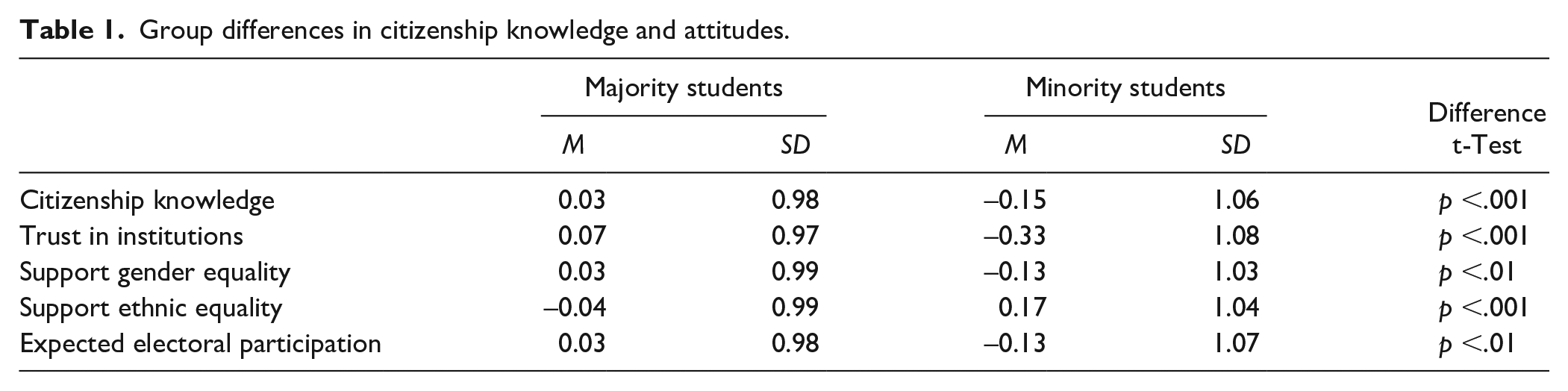
Descriptive statistics for the main variables in this study are presented in Table 1, for ethnic minority and majority students (and see Supplement A for descriptive statistics of all study variables). Analyses of measurement invariance were conducted for all scales of citizenship attitudes in order to investigate whether ethnic minority and majority students interpreted questions on their citizenship attitudes similarly. These analyses show configural and metric invariance (p >.05) for all four scales. It can therefore reasonably be assumed that the measures of citizenship attitudes are equivalent for both ethnic minority and majority students. Next, differences in citizenship outcomes between ethnic minority and majority group students were examined by two sample weighted t-tests. Findings of these tests show that majority students on average had more civic knowledge than minority group students (Mdiff = –17.34, t (623.62) = –3.50, p <.001). Regarding attitudes, minority students indicated lower institutional trust (Mdiff = –3.68, t (611.38) = –7.32, p <.001), lower support for gender equality (Mdiff = –1.56, t (637.02) = –3.03, p <.01), and lower intentions to vote than majority group students (Mdiff = –1.48, t (620.15) = –3.03, p <.01). In contrast, ethnic minority students reported stronger support for equal rights for all ethnic groups than majority group students (Mdiff = 2.01, t (631.91) = 3.86, p <.001).
Group differences in citizenship knowledge and attitudes.
Univariate correlations between the main variables in this study for ethnic minority and majority students (see Table 2) indicate that for ethnic minority students classroom ethnic diversity was related to less civic knowledge and less trust in institutions. For ethnic majority students classroom ethnic diversity was related to less trust in institutions, more support for gender equality, and more support for equal rights for all ethnic groups. In the main analyses we further examined the hypothesized relations, while taking the multilevel structure and possible confounders into account.
Correlations between all main study variables.
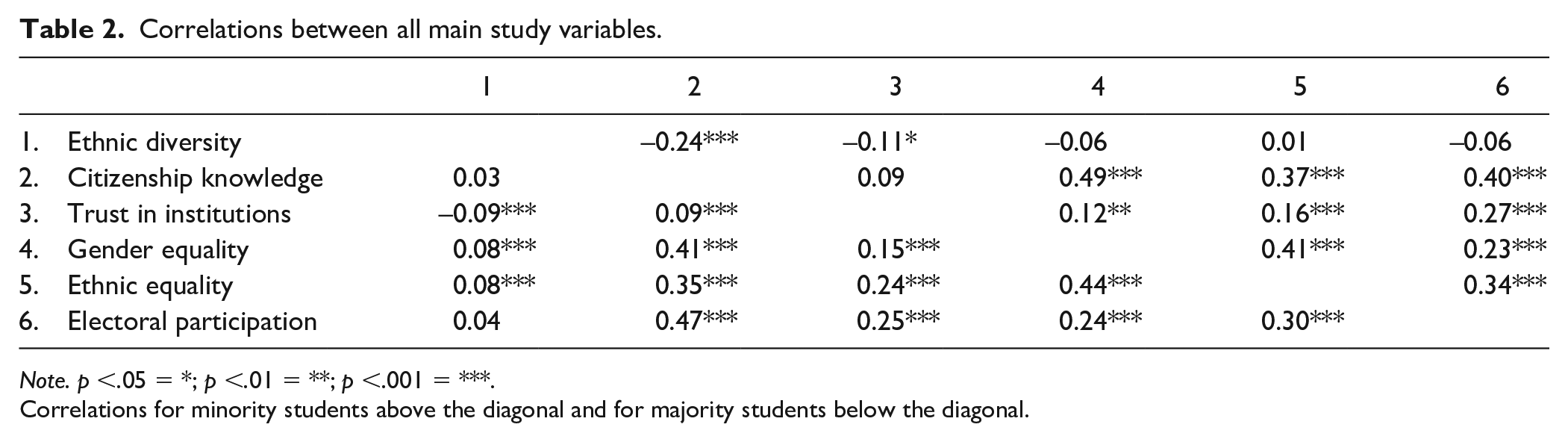
Note. p <.05 = *; p <.01 = **; p <.001 = ***.
Correlations for minority students above the diagonal and for majority students below the diagonal.
Main analyses
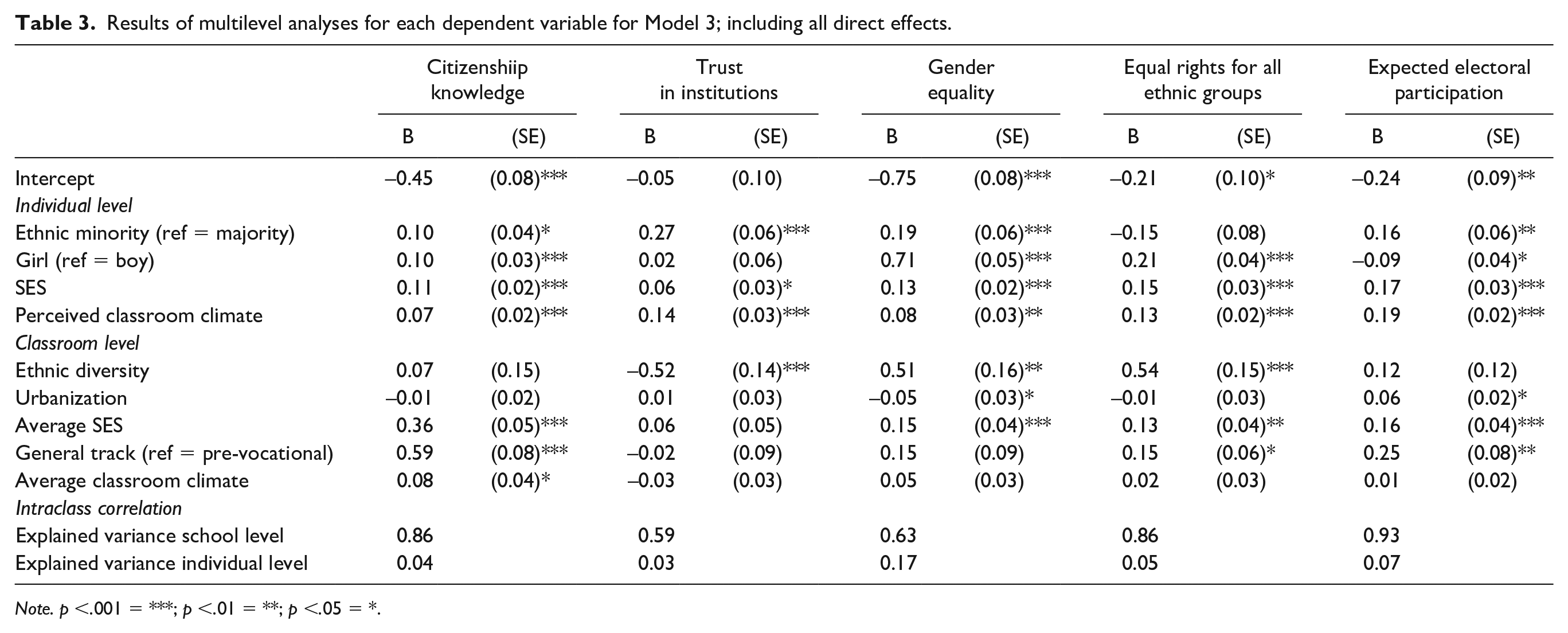
The results of the multilevel analyses are presented in Table 3. This table shows the results per dependent variable for the model including all direct effects. Outcomes for all models can be found in Supplement B. The results are discussed per hypothesis. First, we hypothesized that less classroom ethnic diversity would be related to more civic knowledge (Hypothesis 1a). Contrary to this hypothesis, the results in Table 3 show that classroom ethnic diversity is not related to students’ citizenship knowledge. To examine whether this association was more pronounced for minority group students (Hypothesis 1b), an interaction term of classroom diversity with migration background was included in the subsequent model. This too turned out non-significant (see Supplement B), indicating that the association between classroom diversity and citizenship knowledge does not differ between ethnic minority and majority students. Hypothesis 1b is thus also rejected.
Results of multilevel analyses for each dependent variable for Model 3; including all direct effects.
Note. p <.001 = ***; p <.01 = **; p <.05 = *.
Concerning the effects of classroom diversity on citizenship attitudes it was hypothesized that classroom ethnic diversity would be negatively related to citizenship attitudes (Hypothesis 2a), and that this negative association would be stronger for majority group members (Hypothesis 2b). Results differed between the outcome variables. Classroom ethnic diversity was negatively related to students’ institutional trust (Table 3, B = – 0.52, SE = 0.14, p <.01). In contrast, classroom ethnic diversity was related to stronger support for gender equality (Table 3, B = 0.51, SE = 0.16, p <.01), and to stronger support for equal rights for all ethnic groups (Table 3, B = 0.54, SE = 0.15,p <.01). Classrooms ethnic diversity was not related to students’ voting intentions. In sum, for three (out of four) of the indicators of citizenship attitudes significant associations were found, one negative (as predicted in Hypothesis 2a) and two positive. This leads to the conclusion that Hypothesis 2a is partly confirmed by our data, with regard to institutional trust. The results for support for equality, however, were opposite to our expectation. Last, interaction effects of classroom ethnic diversity by migration background were not significant (see Supplement B, Models 4a), which means that there is no support for differential effects as predicted in Hypothesis 2b.
Importantly, the associations between ethnic diversity and students’ citizenship competences did not disappear when covariates were included. Regarding covariates at the student level, the results show that ethnic minority students scored higher on four of five citizenship outcomes when controlling for student background characteristics. Students with higher SES scored higher on all outcomes, as did students who perceived the classroom climate as more open. Girls particularly scored higher on support for gender equality, and also scored higher on citizenship knowledge and support for equal rights for all ethnic groups. Boys scored higher on expected electoral participation. At the student level Model 3 explained 3 to 17 percent of differences between students.
At the classroom level, beside the associations with ethnic diversity, classrooms with higher average SES scored higher on citizenship knowledge, support for gender equality, support for equal rights for all ethnic groups and expected electoral participation. General track classrooms scored higher on citizenship knowledge, support for equal rights for all ethnic groups and expected electoral participation. Classrooms in more urban areas scored lower on support for gender equality, and higher on expected electoral participation. Finally, when classmates on average perceived the classroom climate as more open, they scored higher on citizenship knowledge. At the classroom level Model 3 explained 59 to 93 percent of differences between classrooms.
Conclusion
Growing ethnic diversity is considered one of the causes for the emphasis on citizenship education in many countries (Banks, 2017). However, while the overall school population is more ethnically diverse, most students meet a limited number of peers with different backgrounds within their classrooms, as a result of school segregation. This raises the question of the benefits and challenges of ethnic diversity within classrooms, specifically relating to citizenship competences which are essential for a resilient democracy. Adding to previous studies on the association between classroom ethnic diversity and citizenship outcomes, the current study gives insight in how classroom ethnic diversity is related to the citizenship knowledge and attitudes of ethnic minority and majority students in the Netherlands.
Hypotheses in this study were derived from the social capital literature. With regard to citizenship knowledge, it was hypothesized that greater classroom diversity would be related to more citizenship knowledge on average (and even stronger so for ethnic minority students). The findings of our study did not support this, and found no such association. This also holds for another recent large scale Dutch study of Sincer et al. (2021) that found no association between school diversity and citizenship knowledge among students of about the same age. This indicates that this finding, of no association between classroom ethnic diversity and civic knowledge, is quite robust for Dutch secondary school students.
One explanation for a lack of an association of classroom diversity with civic knowledge may lie in the fact that students in the Dutch educational system are selected into classrooms of different educational tracks. As a result, the citizenship knowledge of students within one classroom is at a more similar level compared to students in comprehensive classrooms (i.e., without tracking). When classmates have more similar levels of knowledge on a given subject, they are less likely to pass on new knowledge to each other, even in ethnically diverse classrooms. Support for this line of thinking is given by previous studies that did find a positive association between classroom diversity and citizenship knowledge. These studies took place in schools without tracking (Azzolini, 2016; Dijkstra et al., 2015). It may thus be that there is a limited knowledge-exchange among students in the Dutch tracked educational system, because differences in citizenship knowledge within tracked classrooms are smaller.
One other explanation for no association between classroom diversity and civic knowledge, may be because of two opposing mechanisms being at work: Whereas bridging capital is likely to provide new information and might expand the students’ horizon, bonding social capital reinforces norms and might strengthen the production of the goals within the community (cf. Coleman & Hoffer, 1987). Provided that the transfer of citizenship knowledge is also a function of classroom learning, and assuming school enforcing norms being the dominant norm, particularly homogeneous classrooms (i.e., classrooms with more bonding capital) may be beneficial to gain citizenship knowledge. So although, on the one hand, bridging capital (and therefore classroom diversity) is expected to be beneficial for citizenship knowledge because it is horizon-expanding, bonding capital (and therefore classroom homogeneity) on the other hand may in particular foster the development of citizenship knowledge because it may benefit school learning, and thus strengthen the effect of education on knowledge acquisition.
Turning to citizenship attitudes, based on Putnam’s (2007) constrict claim it was expected that classroom diversity would be negatively associated with citizenship attitudes. The current study supported this claim regarding students’ trust in institutions. Whereas Putnam examined a variety of social outcomes related to social capital and civic engagement, his analyses also pointed out that neighborhood diversity was most strongly related to lower trust (e.g., in persons and institutions). Putnam, however, also showed that neighborhood diversity was related to registration to vote. This contradicts our finding. Even though diversity was related to lower trust in institutions, this did not translate into expected electoral participation.
Furthermore, in contrast with the constrict claim/theory, the findings of this study show that classroom ethnic diversity was related to more support for gender equality, and support for equal rights for all ethnic groups, which has also been termed political tolerance (Maurissen et al., 2020). To understand this unexpected effect of diversity on support for equality the work of Morgan and Sorenson (1999) about bridging capital being horizon-expanding can be helpful. Ethnic diversity in schools, connects students from varying backgrounds, which can enhance the exchange between the different value systems (Albada et al., 2021). In such classrooms, students become more familiar with different perspectives, and sensitive to the benefits and pitfalls of heterogeneous groups, and experience plurality as well as resemblance. We see similar results in research on contact theory, which shows that intergroup contact promotes positive intergroup attitudes, because it offers the opportunity to exchange group-specific information, to reduce intergroup anxiety, and promote empathy and perspective taking (Allport, 1954; Pettigrew & Tropp, 2008). This alternative perspective can explain why compared to homogeneous classrooms, students in ethnic diverse classrooms will be more familiar to attitudes regarding equality and solidarity, and the need for social arrangements to deal with diversity and balance conflicting interests (Albada et al., 2021).
In general, this study adds to previous studies because it is one of the few studies that examines how classroom diversity is related to citizenship outcomes, and specifically investigates differences between ethnic minority and majority students. Our analyses were conducted on a representative sample of students and schools in the Netherlands. The combination of a highly differentiated school system with an unequal distribution of students by ethnic background over classrooms, provided a fruitful case to study classroom ethnic composition effects. Also, a differentiated school system, with resulting inequalities, makes it essential to take aspects related to stratification into account. Even when controlling for educational track, individual and classroom SES, and school climate, classroom diversity was related to lower trust in institutions and more support for democratic values/equal rights. Such insight in how classroom ethnic diversity is related to citizenship outcomes is important because it sheds light on the benefits and challenges of diverse classrooms.
When reflecting upon the results of this study, several limitations should be taken into account. The cross-sectional nature of this study does not allow to draw conclusions with regard to causality. Also, the Dutch system in which the effects of diversity were studied, limits to what extent findings can be generalized to different countries (particularly countries without early selection). Hence it would be interesting for future research to replicate this study in non-tracked school systems. This is particularly relevant because integrated classrooms provide a richer arena to practice to deal with differences, and to learn from differences (e.g., in political interests, citizenship knowledge and diverging perspectives). Another limitation lies in the use of country of birth of students and their parents, as an indicator of ethnic diversity. This ignores how students perceive their own ethnic identity and how they interpret that of others in a specific context (cf. Erasmus, 2010). Whereas at one school, in one class, there may be a sharp social distinction between students based on migration background, at another school this may play a much less important role in the interaction between groups of students. At the same time, there is a generally negative image of migrants in the Netherlands. For future research, it is nevertheless relevant to also consider the specific interpretations of ‘ethnicity’. However, the use of the ICCS data did not allow for such contextualization.
This study joins previous studies that have also been inconclusive about the association between classroom or school ethnic diversity and citizenship outcomes. Based on the current study it can be concluded that classroom ethnic diversity is related in different ways to different aspects of students’ citizenship competences, but similarly for ethnic minority and majority students. The benefits of ethnically diverse school classes are most clearly found in the function of interethnic contact which offers the opportunity to learn to deal with differences and learn about the importance of social arrangements to deal with diversity and balance conflicting interests (Sincer et al., 2021). To get a grasp on how positive outcomes of classroom ethnic diversity can be encouraged also regarding citizenship knowledge and institutional trust, electoral participation, and support for democratic values, an important avenue for future research would be to examine which mechanisms underlie the links between diversity and citizenship outcomes. Particularly important is to study the role education can play in creating pedagogical opportunities that enhance positive outcomes of diversity, which ultimately strengthens citizenship in contemporary multicultural society.
Footnotes
Declaration of competing interest
The authors declare that they have no known competing financial interests or personal relationships that could have appeared to influence the work reported in this paper.
Funding
This work was supported by the Dutch Research Council (NWO) under grant #405-13-341, and the Dutch Ministry of Education OCW.
Ethics approval statement
The Dutch data collection for ICCS was approved by our departments’ ethical committee (reference: 2014-CDE-3765).
