




Abstract
The topic of citizenship education and the promotion of democratic citizenship in schools has risen to the top of educational policy agendas in Europe over the past three decades. This rise in attention, however, appears to be accompanied by an apparent lack of attention to the specific manner in which citizenship, education and the assumed relationship between both are currently conceptualised and understood in this policy context. The currently dominant notions of citizenship education centre around a concept of citizenship-as-competence, illustrating a certain assumption of equivalence between citizenship and formal education in schools, without further elaborating on this assumption. By means of a critical re-reading of key European educational policy texts referring to citizenship education, and their use of the key concepts of citizenship and education, our analysis shows how the competence-based approach to citizenship education in European educational policymaking entails tensions with its own assumptions, therefore falling short of its own proclaimed purpose of emancipating young people in Europe to become autonomous, engaged and critical democratic citizens.
Introduction
Citizenship education (CE) in schools has been receiving increased attention and has gained a priority status on the educational policy agendas in Europe over the last three decades. Throughout Western history, the school has always been considered as one of the main contexts where young people learn to become citizens (Heater, 2002). In recent years, a renewed surge in educational programmes and policy initiatives promoting European citizenship by the European Union (EU) institutions and Council of Europe has placed CE in schools at the top of educational agendas. Often, these calls for CE refer to a certain sense and discourse of crisis (Hodgson, 2016), identifying major social and political threats to the security, stability and growth of our democratic societies at local, national and European levels. CE is thus promoted as a key contribution to ‘building’ Europe by safeguarding and promoting fundamental democratic values and social cohesion in Europe. This building metaphor of CE, however, also extends to an economically driven goal of making Europe a/the strong(est) competitor in the global knowledge economy (Hummrich, 2018). In this context, CE is presented as a solution to both societal and economic concerns, displaying a conviction by policymakers that the health and stability of the European democratic project depend to a large extent on the civic engagement and capacity of European citizens (Bîrzéa et al., 2004) and specifically identifying young people in schools as in need of such education (Naval et al., 2002).
Citizenship and CE, in this context, are increasingly viewed in terms of developing young people’s civic competences: knowledge, skills and attitudes, values and dispositions (European Commission/EACEA/Eurydice, 2017; Keating, 2014). Citizenship, and CE as a ‘means’ to acquire citizenship, is not (only) considered a status, but also a competence or even a lifestyle (Naval et al., 2002). This lifestyle seems to be constituted mainly by a particular attitude to learning, entailing the acquisition of numerous competences. This competence-based approach to education focuses on common ‘educational abilities’ for the development of good citizenship in young Europeans that need to be pursued and adopted by member states’ formal education systems, since ‘states will understandably put more resources into the form (of education) they can most influence and fund, that is, formal education’ (Council of Europe, 2010: 28). More specifically, compulsory schooling and schools are appointed a crucial part in creating a competent citizenry, next to the family and broader society. The rise of a competence-based approach to CE in policy language is in itself no new finding (Keating, 2014; Simons and Hodgson, 2012). It has long been promoted as part of a strategy for the harmonisation of educational outputs with standardisation and labour market demands at the EU level (Telling and Serapioni, 2019), which originally seems to have been mainly oriented towards higher education but has gradually permeated compulsory education as well. Citizenship, in this approach, seems to be more than ever closely linked to (formal) education, suggesting it is now education that equips young people with the required ‘toolkit’ of competences and thus governs the access to citizenship in our contemporary knowledge society (Keating, 2014).
However, since ‘competence(s)’ is a ubiquitous but, by nature, nebulous and context-dependent concept (Telling and Serapioni, 2019), this abundant attention to CE as promoting competence acquisition appears as ambiguous: the more policy calls for citizenship competence(s) in and through education in schools, the less it seems to pay attention to making explicit what is meant by these concepts. This contribution therefore presents a critical re-reading of a selection of recent ‘key’ European CE policy texts that build on this competence-based approach, and their use of the concepts of citizenship, education and their relationship. What implications does this policy language have on how young people, their education and their citizenship are being portrayed and promoted?
Citizenship and education: more equivalent than ever?
Whereas both education and citizenship have, traditionally, been considered as matters related to and under the authority of the nation-state, policy on these matters has been increasingly shifting towards supranational policy formation at the level of the EU and its (related) institutions over the last two decades (Ioannidou, 2007), now considering European-level policymaking as complementing, influencing and co-existing with national policies (Keating, 2009; Walkenhorst, 2008).
This evolution is often perceived as a shift of scale, linked to the broad category of effects of globalisation, internationalisation and Europeanisation (Hummrich, 2018) that surmount and blur national boundaries and identities in a seemingly ever more interconnected Europe, and, by extension, world. In this context, established, national concepts of democracy, citizenship and CE have been challenged as being limited or narrow-minded (Hummrich, 2018) since they no longer meet the demands of the current global order (Löden et al., 2014). Education, and specifically citizenship education, at a European level is now considered of crucial importance for building Europe by helping young people to become active, engaged, informed and responsible citizens. Recent (educational) policies have therefore been embracing supranational, cosmopolitan and global concepts of citizenship, embracing multiple, multi-level and fluid sources of identity and citizenship. Both citizenship discourses and related (educational) policies are therefore not necessarily coherent, consistent, nor static (Keating, 2014). According to Dimitrov and Boyadjieva (2009), neither citizenship nor education can thus be taken for granted in any given society.
What seems consistent, however, is how, throughout Western history, education in schools has always been considered one of the main contexts where young people learn to become democratic citizens (Heater, 2002). The role of schools in promoting citizenship is never questioned, but the specific approaches, curricula and programmes of CE are considered in need of seemingly constant change and evolution (Naval et al., 2002). In recent years, the predominant focus has been on ‘learning by doing or experience’ through democratic school governance and the creation of a democratic school climate (Maurissen et al., 2018) in policies and research of CE. This contemporary ideal of democratic school organisation in the context of CE reflects what McCowan (2009) describes as seamless enactment: an ideal of harmony and unification between the ends and means of CE, arguing for the embodiment of democratic values in every step of their translation into policies, curricula, pedagogical relations and processes of CE in schools.
This idea of seamless enactment seems to build on and add to what Fischman and Haas (2014) call a ‘historically untested symbolic equivalence’ of education and citizenship: the coupling of schooling and citizenship, building on the assumption that more formal education (automatically) expands and improves young people’s (future) citizenship. They elaborate on how this implies a belief that no one is born with what it takes to be a good citizen: we all need to learn how to become one. The association of education with citizenship is long since assumed, but where its ‘proof’ comes from is made less clear (Emler and Frazer, 1999). In other words: this belief in the relationship between citizenship and education and the stressing of their importance in policy language seems to be paired with a self-evident manner of using the concepts. The more calls are being made for citizenship in and through CE, the less the concepts and their implied relationship seem to be made explicit or be defined. Analysis of the ways in which the terms are used seems to have been ‘squeezed out’ (Pykett et al., 2010). Given that educational initiatives at a European level can indeed be considered as increasingly steering and influencing national policymaking towards European politico-economic goals (Walkenhorst, 2008), this article therefore re-turns the attention to the terms used in European policymaking by analysing a selection of key policy texts referring to CE. In what follows, ‘European policy’ will refer to policy documents from both EU and non-EU institutions (Council of Europe). While the topic of European citizenship is mainly connected to the EU, since this is the new ‘level’ of community membership that has been called into life with the Maastricht Treaty, we also include policy from the non- (but closely related to) EU Council of Europe, given the calls for more cooperation and ‘synergies’ between both bodies on CE in recent years (Council of the European Union, 2018; European Commission, 2015) .
Moving beyond equivalence: what education for what citizenship?
Rather than accepting and adopting a self-evident manner of speaking of CE, this undertaking centres around the questions: what is meant by citizenship? Education? And how is the relationship between both understood and conceptualised in recent CE policy at a European level? By explicitly moving beyond an assumed equivalence between citizenship and education in European policy documents, investigating this relationship, and focusing on the specific context of compulsory schooling, we consider this paper a contribution to the field of critical policy studies. It builds on the idea that policies are always normative, intended to codify certain values, project images of an ideal society and establish practices in accordance with those values (Bîrzéa et al., 2004). Translated to the context of EU-level policymaking on CE, this means we start from the assumption that policymaking always implies normative choices and selections about what (not) to include when talking about CE, its goals and purposes, even though these may be presented as ‘obvious’, without making these choices explicit.
Investigating (the assumptions of) CE policy is in itself not new. Existing research has often, and in different manners, focused on the conceptualisation of citizenship and education in the context of CE policy. Historical studies, for instance, have sketched the evolutions and different ways in which states have defined citizenship and, accordingly, have established programmes of civic or citizenship education (Heater, 2002). Specifically within the European context, there has also been a focus on how the fostering of citizenship through education has been conceptualised differently throughout time in the policies of EU institutions (Keating, 2009, 2014). Within this historical approach, we see an adherence to the ‘symbolic equivalence’ between citizenship and education: changes in their assumed relationship are traced, but the relationship in itself is not conceptualised or further explored.
Current, empirically oriented, comparative and cross-national CE research is focussed on the operationalisation, monitoring, measuring and comparing of CE in both national and regional (policy) contexts of CE. It focuses on young people’s civic knowledge, engagement and attitudes (Schulz et al., 2018) and the importance of ‘learning by doing or experience’ through democratic school governance and the creation of a democratic school climate (Maurissen et al., 2018). Research in this approach, such as the International Civic and Citizenship Education Study, offers abundant and rich information on the state and effects of CE as an evidence base to policymakers, but rarely addresses the underlying assumptions in its concepts of citizenship, education and their relationship (Joris and Agirdag, 2019).
Finally, recent critical studies, often inspired by critical social and educational theories, aim to make explicit what such large-scale, comparative studies measure and present as important in CE (Joris and Agirdag, 2019; Olson, 2012; Zurstrassen, 2011); or the ways in which the measurements are intertwined with EU policy on CE as combining ‘hard measures with soft power’ (Rutkowksi and Engel, 2010). This critical research is embedded in a broader, critical strand that discusses the contemporary discourses of CE in policymaking: exploring their limitedness and attempting to open up these discourses, and entailing practices of civic engagement (Nicoll et al., 2013); or discussing the way education policies frame European citizenship as a specific form of subjectivity in the current European ‘learning society’ (Hodgson, 2016; Simons and Hodgson, 2012). These studies mainly pay explicit and elaborate attention to the ways in which citizenship is conceptualised, or what is considered citizenship for young people as an ‘outcome’ of education (Lawy and Biesta, 2006), but little to the way(s) in which the relationship between education and citizenship is conceptualised. Moreover, existing critical studies have often focussed on the context of higher education (Biesta, 2009b; Biesta and Simons, 2009; Gifford et al., 2010; Lock and Martins, 2009; Masschelein and Simons, 2009; Wihlborg, 2019).
This contribution, however, focuses on the context of CE in compulsory education in schools, which now seems to be taking centre stage in EU education policy. Whereas institutions of, for instance, higher education are more explicitly recognised as having academic freedom (Council of Europe, 2010) and being more autonomous from government steering (while also being more closely connected to the economic sphere and labour market), schools appear to be considered as more designable and adaptable to societal needs and policy steering. Connecting this to the notions of seamless enactment and symbolic equivalence of citizenship and education, we believe further exploration of the role of the competence-based approach to CE in this specific context is called for, starting with a conceptualisation of citizenship and education.
Conceptual framework
What is citizenship?
The normative discussion on concepts and models of citizenship in political theory has a long history and is constantly evolving, with different conceptualisations and agendas of citizenship co-existing, competing with and influencing each other (Pykett et al., 2010). Nowadays, the apparent consensus seems to be that citizenship is a fluid, complex and multi-layered concept that can mean many different things to different people, in different contexts (Joppke, 2007). Following the aforementioned, commonplace belief that more formal education (automatically) expands and improves citizenship, or the ‘symbolic equivalence’ as described by Fischman and Haas (2014), Schugurensky (2005) therefore claims it is pertinent to ask the question ‘what is citizenship?’.
Given this multiplicity of the concept of citizenship, its specific use in European policy texts implies certain normative choices connected to what is considered ‘good’ citizenship. In order to discuss these normative choices, we take into account the distinction between national models and post-national concepts of citizenship. The main classical, national models of citizenship can be summed up as (political) liberalism, communitarianism and (neo)republicanism (Delanty, 1998; Heater, 1999; Keating, 2014). While these theoretical traditions of citizenship, and many variations in between, accord certain general characteristics to ‘good’ citizenship at a national (state) level, now, upcoming concepts of supra- or post-national, cosmopolitan or global citizenship consider citizenship as not to be conceived in terms of either of these models, because of new (global) conditions for citizenship that transcend the boundaries of the national. Regarding European citizenship specifically, it has been argued that its specific character as a complementary citizenship, depending on the mainly regulatory character of EU-level governing and policies, makes it fall beyond traditional, national models of citizenship (Delanty, 1998) or falling short of them, as not being able to establish the same strong ties between individual citizens and their citizenship-assigning state (Bellamy, 2008).
Rather than clinging to traditional, national models of citizenship, scholars have therefore distinguished different analytical dimensions of citizenship (see for instance Siim, 2013), which also applies to thinking and speaking about the concept in contemporary European CE policy: equal status, rights and obligations, political participation and citizens’ voice; identities and belonging, etc. Along the lines of these analytical dimensions, Schugurensky (2005) identifies the dimensions of citizenship as status, identity, virtues and agency. Citizenship as status or legal citizenship is equated with the (formal, legal) membership of a nation-state, and increasingly of supranational political entities, such as the EU, which is accompanied by a particular set of rights and duties or obligations. Citizenship as identity refers to issues of belonging and meaning, feeling like a member of a community. This identity is rooted in such factors as a common history, language, religion, values, traditions and culture. Citizenship as civic virtues encompasses the values, attitudes and behaviours that are expected of ‘good’ citizens. Citizenship as agency, finally, refers to citizens’ state of being in action or exerting power, their willingness to ask difficult questions, and confidence in one’s own and the collective capacity of people to influence changes by confronting power structures. Agency deals with citizens as social actors in concrete, power-mediated, relations and power structures: the actions of citizens are always occurring in an interplay of autonomy and domination, of liberating or equalising and controlling forces, possibilities and limits, but always leaving people with the possibility and power to establish change (Schugurensky, 2005).
What is education, and its relation to citizenship?
Given this fluid and multidimensional nature of citizenship, and the ways in which it is often self-evidently linked to education, we believe that, in the context of CE, the question: what is education? is equally pertinent. This question in and by itself deserves inquiry and articulation well beyond the scope of this (or, for that manner, any single) article. Here, we limit the description of the concept to education in the formal context of primary and secondary education. That is, education taking place in the specific context of schools.
Keating (2014) describes how schools and educational policies play a dual role in what she calls citizenship-formation: schools should function both as a provider of political information, cognitive capacities, resources, qualifications and human capital, and as a ‘key site of socialisation’: ‘through participation in the formal education system, students are expected to be inculcated with the values, attitudes and behaviours that are expected of “good” citizens in their community” (Keating, 2014: 147).
We link this description of education to Biesta’s (2009a) theoretical approach to the different ‘ultimate values’, or the aims and purposes of education. 1 Biesta makes a distinction between qualification, socialisation and subjectification, which, depending on the context, functions as a descriptive analytical scheme ascribing all three with equal educational value, or implies a normative distinction which gives more weight to subjectification, assigning it the status of the essential characteristic of education (Rømer, 2020). This threefold frame is based on multiple philosophical and pedagogical authors and ideas, presenting the idea that good upbringing and education should never limit themselves to forms of learning that solely contribute to reproducing existing socio-political orders, or to the adaptation or insertion of individuals into these orders. This vision adheres to the idea that in democratic societies, education’s goals can (and should) both support and sustain existing society, and help create critical citizens aiming for change, while acknowledging that there is always a tension between these goals (Nordensvärd, 2014).
Biesta (2009a) describes qualification as the purpose of education of providing young people with the knowledge, skills, understandings, dispositions and forms of judgement that allow someone to do/be something. It concerns the content and explicit systems of learning (Rømer, 2020). The second general purpose of education is that of socialisation and encompasses the ways in which education helps young people in becoming a member and part of particular social, cultural and political ‘orders’ and reproducing these, through the transmission of norms and values. Socialisation is thus education’s function of introducing young people into existing ways of knowing and doing. These two purposes of education align with the dual role of schools as described by Keating. However, Biesta also describes a third educational purpose, namely the purpose of subjectification. Subjectification encompasses education’s role of helping young people in becoming an autonomous subject, becoming emancipated and independent from the existing socio-political order(s), as a process through which new ways of being and doing can come into existence: an existential, reflective event (Rømer, 2020) through which young people appear as unique subjects in relation to others and otherness.
Starting from the foundations laid out by this framework, we believe, however, that answering the question ‘what is education?’ asks for more than only the purposes of education, since these already seem to imply specific characterisations of education from without, from a societal stance and its expectations. Solely describing education in terms of its purposes described above might thus be too narrow to encompass all important and inherent characteristics of education. We include the different purposes of education described above as an indication of the way(s) in which the relationship between citizenship and education can be conceptualised (‘what for’) (see Figure 1). Next to the purposes, we also look at the processes that make up education itself (‘what’), its objectives or what is being taught and learned (‘for what’ of educational processes), and practices (‘how’, or specific approaches and methods of educational processes).
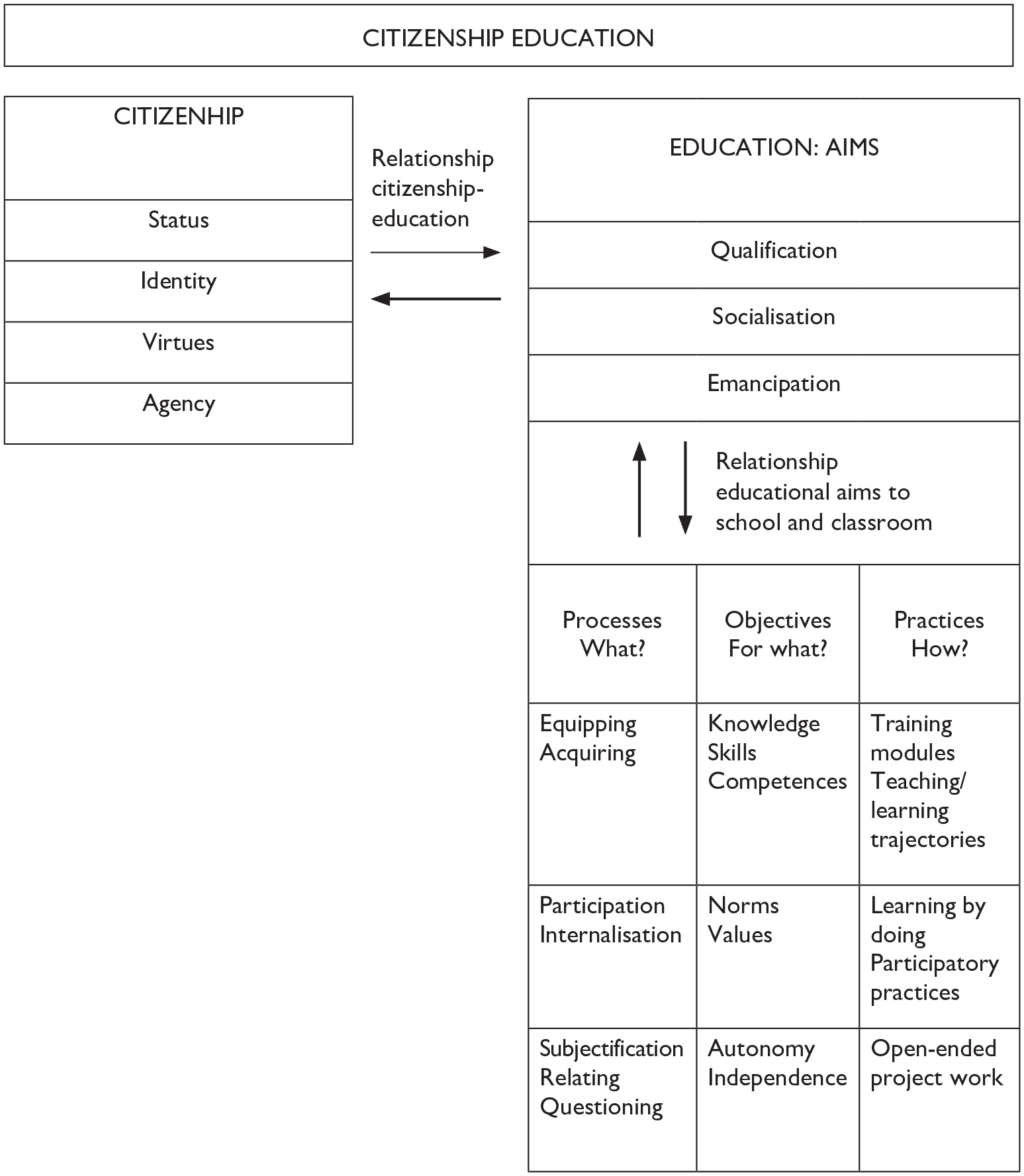
Conceptual framework based on Schugurensky (2005) and Biesta (2009a).
Following Biesta’s description of qualification, we would describe its main accompanying processes of teaching and learning as equipping and acquiring. The discourse of knowledge, skills and competence(s) reflects the ‘what’ of this educational function, since what young people are expected to acquire or develop covers mainly both general dispositions (for instance, nowadays, towards lifelong learning) and concrete knowledge and skills for performing certain tasks and roles in life. Practices or approaches in schools coupled to this idea of qualification and the acquisition of competences and skills are for instance working with training modules or teaching and learning trajectories: instructional units that cover both content or knowledge and specific training activities, aimed at gradually mastering a certain subject or topic and consisting of concrete steps, goals, and points of assessment.
Socialisation is reflected in a focus on school education as providing young people with opportunities for processes of participation and internalisation. In accordance with the purpose of helping young people (students) in becoming a member and part of particular social, cultural and political ‘orders’, education in schools is considered a time and space for the transmission of norms and values, which need to be internalised and embodied by students. Coupled to this purpose of socialisation as introducing young people into existing ways of knowing and doing are practices that enable young people to learn by doing, by participating in practising or exercises of later, societal life that mimic adult behaviours and activities. For instance, the installing of school parliaments, student councils, an open climate in classrooms, leaving room for debate and discussions, etc. are seen as practices that help young people to learn by participating (Maurissen et al., 2018). Schools are thus approached as a sort of ‘rehearsal societies’ that introduce young people to attitudes and behaviours deemed important in adult life.
Since, in Biesta’s (2009a) understanding, subjectification indicates bringing something new into the world, we argue it could be ascribed a different status than qualification and socialisation. Before describing the processes, objectives and practices coupled to the third purpose of subjectification, this, in our view, first asks for further elaboration.
Education does not, however, only contribute to qualification and socialisation but also impacts on what we might refer to as processes of individuation or, as I prefer to call it, processes of subjectification – of becoming a subject. The subjectification function might perhaps be best understood as the opposite of the socialisation function. It is precisely not about the insertion of newcomers into existing orders, but about ways of being that hint at independence from such orders (. . .). (Biesta, 2009a: 40)
Coupling this reference to processes of subjectification to Simons and Masschelein’s (2010) indication of the need to distinguish between different forms or framings of subjectification (or subjectivation) that can take place at schools (namely: governmental, political and pedagogical), we consider subjectification as processes characteristic and inherent to education and upbringing, rather than being one clearly delineated purpose similar to qualification and socialisation. We would rather opt for emancipation as describing the larger purpose that encompasses subjectifying educational processes of young people, shaping the ways they relate to themselves and the world, question, and possibly change these. We adhere to Rancière’s understanding of emancipation, as it has been quoted by Biesta himself as a ‘rupture in the order of things’ (Rancière in Biesta, 2010: 46). Emancipation, contested and ambiguous as it may be as an educational concept because it relies on an aspect of freedom and of confirming one’s equality (Säfström, 2011), is important to include precisely because it is just that. In being ambiguous and contested/contesting, and promoting the importance of equality and freedom, it can be set apart from the purposes of qualification and socialisation. In view of the objective of gaining autonomy and independence, this purpose is coupled with educational practices where aspects of the world and society become topics for study and exploration, for instance, through open-ended project work in schools, introducing a certain theme, topic or problem to students, which they can explore, question and learn to relate to in their own, new way.
Figure 1 summarises these different dimensions of citizenship, education and their relationship. The following sections present an exploration of these dimensions of citizenship in recent policymaking on CE.
Method
By focussing on the specific context of a competence-based approach to CE in schools, this study aims to complement the existing body of critical research on European-level policy of CE described above. By explicitly moving beyond an assumed equivalence between citizenship and education in EU and Council of Europe policy documents, and by focusing on the specific context of compulsory schooling, we consider it a contribution to the field of critical policy studies: a re-reading and de-familiarisation of the current ways in which key policy texts set CE agendas for schools, the problems they aim to tackle, and the solutions they present (Simons et al., 2009). Through this re-reading, and bringing to attention the specific conceptions of citizenship and education these policy texts present, we aim to open up this current language of CE by investigating the specific use of the concepts of citizenship, education and their assumed relationship. We support our analysis with references to specific elements of the policy texts.
This analysis considers a selection of six European (EU and non-EU) policy texts related to the topic of CE in schools, spanning the timeframe between 2010 and 2018. The selection of texts was oriented at including key policy texts and the programmes, viewpoints and agendas that they set and promote (Simons et al., 2009). We consider ‘recent’ policy as (approximately) spanning the last decade; thus the decision was made to only include texts dating from 2010 or more recently. A second point was to attempt to include the key policy actors in the context of European (citizenship) educational policymaking, namely the EU bodies concerned with education, and the Council of Europe. We did not limit our scope to solely EU institutions, since the Council of Europe has a significant role to play when it comes to European educational policy, and the EU and Council of Europe have pledged to significantly increase their cooperation concerning education and culture over recent years (Council of the European Union, 2018; European Commission, 2015; European Commission/EACEA/Eurydice, 2017).
The first text is the Council of Europe’s Committee of Ministers (2010) Charter on Education for Democratic Citizenship and Human Rights Education. The Charter was adopted by all member states of the EU, thereby appointing this text the status of a key ‘symbolic’ policy text, which has considerably influenced or set the agenda concerning CE. The next text included in our analysis, for instance, the European Commission’s Education, Audiovisual and Culture Executive Agency (EACEA) 2012 Citizenship Education in Europe Report, refers to its own role of giving impetus to the Charter’s process, supporting its implementation and offering valuable and comparable European data by reviewing national policies and strategies for (reforming) citizenship curricula (European Commission/EACEA/Eurydice, 2012). The third text concerns a declaration made by the Education Ministers of the EU and the Commissioner for Education, Culture, Youth and Sport (European Commission, 2015), also referred to as the Paris Declaration, on ‘Promoting citizenship and the common values of freedom, tolerance and non-discrimination through education’. This declaration was published as a direct response to the terrorist attacks in France and Denmark earlier that same year, and stresses the need to support and safeguard the fundamental values of the EU by passing them on to future generations through teaching and education. It presents key action points and indicates how EU-level cooperation is key in addressing the common challenges Europe faces. As one element in this cooperation, the declaration mentions the need to explore ‘synergies’ with the work done in the Council of Europe in the area of civic (citizenship) education. Part of this work is presented in the Council of Europe’s report (2017) on the state of citizenship and human rights education in Europe, titled ‘Learning to live together’. This report opens by referring to the 2010 Charter and its status as a focus and catalyst for action, and presents the achievements, gaps and priorities for action in the area of citizenship and human rights education at the European level as a result of a survey that received responses from 40 countries. It presents education as a tool for successful integration and tackling radicalisation and disenchantment with democracy and the rise of populism throughout Europe. The fifth text included in the analysis concerns the 2017 Eurydice Report, which refers amongst others to both the Paris Declaration and the Council of Europe’s reference framework, and which presents qualitative data on official regulations and recommendations on CE at school in Europe, collected through interviews with key actors, combined with academic literature (European Commission/EACEA/Eurydice, 2017). Finally, referring to the context of recent extremist and terrorist acts committed by young Europeans, and to the importance of the Charter published in 2010, the Council of Europe published a Reference framework of competences needed for a democratic culture (2018). The text describes the competence model, its context and concepts, expected to be acquired by European learners to learn how to live together in diverse, democratic societies.
The selected texts are treated as a whole in the sense that we believe they can indicate the manner in which the key terms related to CE are conceptualised in recent European-level policy, while acknowledging the specific origins and agendas of the different institutions (EU and non-EU), the differences between the documents in terms of their context, objectives and status and possible ensuing conceptual differences. The central aim is to make explicit what concepts of citizenship, education and their implied relationship are being promoted in these texts; and what implications this policy language has on how young people, their education and their citizenship are being portrayed and promoted.
Analysis
Citizenship-as-competence: competent citizens and their toolkit
In general, the selected CE policy documents all present a similar concept of citizenship. All documents consider the active or effective participation of citizens as essential to citizenship in Europe, based on the notion that effective or responsible participation depends on the competence(s) of citizens (Council of Europe, 2010, 2018; European Commission, 2015; European Commission/EACEA/Eurydice, 2012, 2017). The central notions of competence(s) and participation, while not included as (a) separate dimension(s) in the model of Schugurensky (2005) described above, appear to link the citizenship dimensions of status, identity, virtue, and, partially, agency.
The European Commission defines citizenship as ‘that set of practices (juridical, political, economic and cultural) which define a person as a competent member of society’ (European Commission/EACEA/Eurydice, 2017: 19). Inspired by the definitions used by the Council of Europe in earlier CE initiatives, the Commission advocates the need for an ‘evolved conception’ of active citizenship that goes far beyond the simple legal relationship between people and the state. This conception of citizenship, which extends to citizens’ participation in the political, social and civil life of society, is based on respect for a common set of values at the heart of democratic societies. (European Commission/EACEA/Eurydice, 2012: 8)
The texts present similar notions of competences as central to citizenship, as the equipping of young people with or them acquiring a cluster or even ‘toolkit’ of knowledge, skills and attitudes for participating in life in democratic societies (Council of Europe, 2010), focusing on practical skills and (complex) learning outcomes (European Commission/EACEA/Eurydice, 2012). The framework developed by the Council of Europe (2018) distinguishes ‘competence’ from ‘competences’. Whereas competence is defined as the ability to mobilise and deploy relevant values, attitudes, skills, knowledge and/or understanding in order to respond appropriately and effectively to the demands, challenges and opportunities presented by democratic situations, competences are the specific psychological resources (values, attitudes, skills, knowledge and understanding) that are mobilised and deployed in the production of competent behaviour or competence (in the singular) for actively exercising citizenship (European Commission/EACEA/Eurydice, 2012) or as enabling the effective engagement of citizens (Council of Europe, 2018).
Connecting this notion of participation or active citizenship to the different citizenship dimensions described above, participation appears to include status mainly when the texts refer to the need for young people, and citizens in general, to become informed about and know their rights and duties connected to their citizenship status, and be able to claim and exercise them effectively and responsibly. Citizenship understood as legal status, as mentioned above, is thus no longer considered as ‘full citizenship’. This knowledge and ability are part of the competence(s) young people are expected to acquire in order to become active, democratic citizens (Council of Europe, 2018; European Commission/EACEA/Eurydice, 2012, 2017).
A second central element of the concept of citizenship in the policy documents under study is the importance they attach to the aspect of values. These values are described both as the foundation of citizenship (European Commission, 2015) and as a crucial part of citizenship competence(s): as the moral beliefs guiding citizens’ action (Council of Europe, 2018). References are made to a set of ‘common democratic values’ such as freedom, tolerance and non-discrimination (European Commission, 2015; European Commission/EACEA/Eurydice, 2012); to the ‘core mission’ of building Europe by promoting the principles of democracy, human rights and rule of law in Europe (Council of Europe, 2010); or to the central values of democratic culture: respect for human rights, rule of law, diversity, etc. (Council of Europe, 2018). The importance attached to shared values in the texts can be related to the dimension of civic virtues that Schugurensky (2005) describes as the values, attitudes and behaviours expected of good citizens. These values are described in the texts as in need of understanding, promotion and protection by European citizens in their ideas, knowledge and actions; thus: of translation to citizens’ virtues and their ways of participating.
The European policy texts attach great importance to helping young people realise that they are part of a set of communities (European Commission/EACEA/Eurydice, 2017) in which they are expected to participate. These communities encompass different spheres of society: the political, social, economic and civil spheres (European Commission/EACEA/Eurydice, 2012) or, even more elaborate: the civic, political, social, economic, legal and cultural spheres of society (Council of Europe, 2010). Participation is also seen as taking place at different levels: local, national, European and international (European Commission/EACEA/Eurydice, 2017). Citizenship is furthermore considered not only as participating in these communities, but also as developing a sense of belonging to these communities (Council of Europe, 2018). This can be connected to Schugurensky’s citizenship dimension of identity, or citizenship as a sense of belonging and membership of a (political) community. Both Schugurensky (2005) and Keating (2009) relate this dimension to factors such as (references to) a common history, language, religion, traditions, culture and values. While the policy documents refer to these elements, the (foundation of a) sense of belonging is now increasingly seen as constructed by citizens themselves, as part of their civic/citizenship competences (Council of Europe, 2018; European Commission/EACEA/Eurydice, 2012).
These competences are presented as necessary to empower young people, to exercise and defend their rights and responsibilities (Council of Europe, 2010) and to equip them with the readiness to take (appropriate) action in society, in defence of human rights, democracy and the rule of law (Council of Europe, 2010). Amongst these competences, the importance of critical thinking (Council of Europe, 2018; European Commission, 2015; European Commission/EACEA/Eurydice, 2012) and the willingness to participate actively and constructively (European Commission, 2015; European Commission/EACEA/Eurydice, 2012, 2017) are emphasised. The European Commission recognises that ‘children and young people represent the future and must have the opportunity to shape that future’ (European Commission, 2015: 2) and that we must build on young people’s sense of initiative and their contributions through their participation. These elements connect to Schugurensky’s description of agency as the willingness of citizens to ask difficult questions and as having confidence in one’s capacity to influence change.
However, when it comes to, arguably, the most active, critical and change-oriented elements of the dimension of agency, and citizenship in general, there is a significant difference between the texts in the way these are mentioned or promoted as important aspects of democratic citizenship in Europe. Concretely, while critical thinking skills, active participation and ‘appropriate’ action are generally emphasised as crucial elements of competent citizenship by most texts, only the two most recent texts by the Council of Europe (2017, 2018) seem to recognise explicitly how citizens’ competences are interdependent with power relations and structures, and how these both enable and impede citizens to actually practise their competences and establish change. The Council claims that competences, democratic institutions and actions against structural inequalities and disadvantages are all essential for a culture of democracy (Council of Europe, 2018) and that the broader environment always has an impact on citizens’ attitudes and beliefs (Council of Europe, 2017). Moreover, the Council recognises that it takes time, political commitment and governments taking their responsibility to create consistency between what we say about democracy and what we put into practice (Council of Europe, 2017). If this is not the case, citizens are entitled to make use of ‘alternative democratic action’ to make their voices heard when these structures do not provide them with the necessary possibilities to do so (Council of Europe, 2018). This is a significant difference in tone to the other texts, which do take notice of existing power relations, inequalities and patterns of discrimination, violence and disadvantage that must be addressed or combatted (Council of Europe, 2010; European Commission, 2015; European Commission/EACEA/Eurydice, 2012) but rarely refer explicitly to the importance and responsibility of political, structural and institutional contexts in doing so, thus leaving out how these enable or impede citizens to actively and critically participate and establish these changes.
Even so, although the latter Council of Europe texts stress the importance of structures and power relations, they still adhere to a definition of competence(s) as the tools or ‘psychological resources’ that need to be acquired and deployed dynamically by citizens in order to meet the needs and opportunities of specific situations, for instance to promote social cohesion (Council of Europe, 2017, 2018). This aligns with the EACEA’s idea (European Commission/EACEA/Eurydice, 2017) that the ‘right’ competences vary according to time and space, and thus that the understanding of what (good) citizenship is, and what competences are expected from citizens to enact, may change rather rapidly.
Though acknowledging this tendency for change, in effect, the European competence-based language of citizenship thus tends to conceptualise citizenship as predefined and clearly delineated: it focuses on ‘equipping’ young people with a specified set of psychological tools consisting of the ‘right’ values, knowledge, skills and attitudes that are considered crucial for appropriate participation and action, which subsequently will spur socially and politically desired and envisioned outcomes of peace, democracy and welfare. The individual citizen thus seems to be held responsible for collective, social outcomes, while his/her actual opportunities for agency, change and action are being left out of the picture. This tension, we believe, builds on a specific understanding of education taking place in schools, its relation to society as a whole, and more specifically: to citizenship.
All-purpose education? Learning about, through and for democracy
Connected to their concept of citizenship-as-competence, the selected CE policy documents all presented (a) similar idea(s) of what education is and should do, discussed here in relation to the dimensions of education described above: its purposes, processes, objectives and practices. In general, education is described as consisting of teaching, learning and assessment processes (European Commission/EACEA/Eurydice, 2012) that aim at developing young people’s knowledge, skills, attitudes and values, and take place in formal, non-formal and informal educational contexts throughout the lifespan (Council of Europe, 2010, 2018). While acknowledging the different contexts in which education takes place, the policy texts focus on the formal context of education (systems) and the importance of school and classroom practices (Council of Europe, 2010, 2017, 2018; European Commission/EACEA/Eurydice, 2012, 2017). The central notions of education seemingly encompass the different purposes of qualification, socialisation and emancipation, by emphasising, for example, that ‘the outcome of such [citizenship] education being not simply knowledge but empowerment, leading to appropriate action’ (Council of Europe, 2010: 26).
Screening the European policy texts for their understanding of the purposes of education, and how they portray the relationship between citizenship and education, the Council of Europe (2018) sums up the central elements all texts seem to support and promote: learning about, through and for democracy. Learning about democracy aligns with one central element that all texts include, namely the idea that education in schools has a crucial role to play in equipping young people with, or ensuring they acquire the knowledge, skills, values and attitudes to participate actively in and contribute to society (Council of Europe, 2010, 2018; European Commission, 2015; European Commission/EACEA/Eurydice, 2012, 2017). In other words: the competences needed to become qualified active, democratic citizens. This qualification consists, amongst others, of political literacy (European Commission/EACEA/Eurydice, 2012), developing ‘sound’ knowledge and understanding of democratic concepts, processes and structures, skills and attitudes concerning communication, dialogue and critical thinking, and respect for democratic values (Council of Europe, 2010, 2018; European Commission, 2015; European Commission/EACEA/Eurydice, 2017).
This qualification purpose promotes CE as a subject area (European Commission/EACEA/Eurydice, 2017), albeit different from other, more traditional subjects (Council of Europe, 2010). It is seen as a lifelong learning trajectory that is dynamic and consists of gradual levels of proficiency. The competence-based approach to CE thus adheres to the idea of educational practices consisting of ‘modules’ or trajectories: the gradual acquiring of citizenship knowledge and skills in stages, according to different criteria. The most illustrating example of this line of thinking is presented in the Council of Europe’s (2018) competence framework for democratic culture. Informally referred to as the ‘butterfly’ or ‘four-leaf clover’ model, it consists of 20 competences, categorised as three sets of values, six attitudes, eight skills and three bodies of knowledge and critical understanding. The model identifies three levels of proficiency for these competences: basic, intermediate and advanced, and includes sets of descriptors for each of the competences, according to level of proficiency, described in terms of learning outcomes (Council of Europe, 2018). The EACEA (European Commission/EACEA/Eurydice, 2017) also distinguishes between competences promoted mostly in primary schools (creativity and personal development), at lower secondary education (critical thinking) and upper secondary level (learning how to act democratically).
Increasing the level of student participation by level of education is also promoted (European Commission/EACEA/Eurydice, 2012). This notion of increasing participation connects to the idea of learning through democracy, which we believe links to the purpose of socialisation. All texts stress the importance of instilling in young people a set of attitudes and norms, in order to pass on and safeguard democratic values at the heart of the EU (European Commission, 2015). Also, education is expected to prepare young people to become engaged citizens who participate actively in political and social life and practices (European Commission, 2015; European Commission/EACEA/Eurydice, 2012), further alluding to the purpose of introducing young people into existing ways of knowing and doing. Furthermore, all texts included in the analysis expressed the expectation that education should lay the foundations for more inclusive societies (European Commission, 2015), counter or remedy societal and political problems such as conflicts, violence, discrimination and apathy, and promote positive values such as equity, social cohesion and tolerance. Education is thus seen to have an impact on both individuals and their social contexts, at all levels: their communities and society as a whole (Council of Europe, 2017; European Commission, 2015; European Commission/EACEA/Eurydice, 2017).
This purpose is further promoted by stressing the need for schools to introduce young people to democratic practices and opportunities for participation in and beyond the classroom. Schools are considered a microcosm where young people learn how to be active and responsible citizens through their daily experiences (European Commission/EACEA/Eurydice, 2012). The texts stress that schools are young people’s first introduction to the public realm (Council of Europe, 2018) and how, because of their function as a ‘passage’, it ‘makes no sense for educational institutions on the one hand to teach respect for democratic principles and human rights and on the other to be run in a totally undemocratic way’ (Council of Europe, 2010: 28). All texts stress that young people should learn to behave democratically by participating in democratic situations: learning by doing is a central idea to what education should do. The class and school are considered the first communities students are active members of, and they should reflect the democratic process and provide young people with the skills and abilities for ‘real’ community life (European Commission/EACEA/Eurydice, 2012). In other words: schools should practise what they preach concerning democracy and citizenship by letting young people participate. We relate this to the educational process of internalising. Classroom practices, the broader classroom climate and school culture should embody and reproduce democratic values and procedures, allowing students to experience and participate in them through democratic governance, for instance in practices such as class or student councils, or a classroom climate that allows room for debate (Council of Europe, 2010; European Commission, 2015; European Commission/EACEA/Eurydice, 2012, 2017). This focus on learning citizenship by doing aligns with the idea of schools as miniature or practice societies (Print et al., 2002) and the ‘seamless enactment’ of ends and means in CE, as discussed in the introduction.
Another central aspect of education according to CE policy, in line with the reference to learning for democracy, is the promotion of the idea that young people, by acquiring the necessary competences, will be empowered, become autonomous, think critically and take action in order to contribute to democratic principles such as the rule of law (Council of Europe, 2010), combat injustice, inequalities and intolerance (European Commission, 2015) and protect or strengthen democracy (Council of Europe, 2010, 2018; European Commission/EACEA/Eurydice, 2012), social cohesion (Council of Europe, 2017) and a spirit of freedom (European Commission, 2015). Education systems should empower young people, so they can function as ‘autonomous social agents capable of choosing and pursuing their own goals in life’ (Council of Europe, 2018: 65). This seems to promote the educational purpose of emancipation, and the objectives of autonomy and independence. References to educational processes or practices of young people developing their own ways of relating to others, the world or otherness in general; to questioning existing orders; or to open-ended educational or classroom practices such as projects, are rather scarce. The European Commission (2015) and Council of Europe (2018) do refer to the importance of promoting critical thinking, specifically in reference to media literacy and strengthening young people against indoctrination, propaganda and hate speech, for instance towards refugees on the internet, but without giving concrete examples of practices or methods. The Council also emphasises the importance of experience-based learning in this respect, for enhancing young people’s critical thinking ‘by opportunities and encouragement to engage with the different aspects of a subject matter and different interpretations’ (Council of Europe, 2018: 15). The European Commission (2017) delivers the most concrete elements, by identifying ‘maximal’ approaches to CE, covering methods that are activist, process-led, interpretative and participatory; and including non-formal learning aspects in schools, such as volunteering, arts projects and sports events.
All three educational purposes of qualifying, socialising and emancipating thus seem to be addressed when it comes to describing how young people can and should become democratic citizens who have the possibilities of deciding on new directions and transformations in society through education. However, we believe that, as with the concept of citizenship, the concept of education in the European competence-based language of CE only superficially emphasises the importance of emancipating and making young people critical and autonomous, by focusing on competence(s). By describing the future in terms of the world we want to prepare for the generations to come or young people’s ‘positive contributions’ such as their participation within arts or sports projects in schools, the openness for change is solely interpreted in terms of adding to the blueprint that has already been laid out for them by the existing political powers-that-be and orders of society, and takes no further notice of actual institutional contexts’ opportunities for democracy outside of education. Specifically, adding adjectives such as ‘appropriate’ action (Council of Europe, 2010) and ‘harmonious’ development or ‘effective’ participation (European Commission/EACEA/Eurydice, 2017) suggests a certain immunisation of the transformative potential that comes with the concept of emancipation or subjectification. The change expected from education is thus in service of the protection of democracy and society, coming from the lifelong learning processes of competence development that (future) citizens engage in, and not in relation to broader contexts and institutions, or in pursuit of change, (more) equality or justice. As with citizenship, the concept of education as it is deployed in European CE policy contains a tension: societal, emancipatory and change-oriented purposes are attributed to education at first glance, while at the same time reducing it to individual, conservative and continuity aims.
Discussion and implications
Limitations and suggestions for further research
While the foregoing re-reading is the result of a thorough analysis of CE policy documents according to the different dimensions of citizenship and education as presented in the conceptual framework, few references to and suggestions for concrete processes, objectives and practices of CE were discussed. Because of the limited number of documents included in the analysis, and because statements about concrete practices are rather limited in these documents, we cannot conclude from the foregoing whether the focus on competences is also dominant at more practical levels of (national or regional) implementation, curriculum development and educational practices of CE. Further research should be done on the national, regional and local translations, interpretations and ‘enactment’ inspired by these policy documents and their specific understandings of citizenship, education and their relationship in CE. The framework presented in Figure 1 could provide a lens for such future analysis.
Furthermore, it could be argued we have only scraped the surface in our effort to analyse and understand the use of the concepts of citizenship and education in the context of CE. In order to deepen our understanding, we believe it is necessary to ‘dig deeper’ and also investigate the underlying concept of democracy from which the concepts of CE are derived. Lastly, we believe a reverse approach to the ideal of seamless enactment (McCowan, 2009) can be a very valuable contribution of further research into CE policy and its normativity. We believe taking schools’ institutional realities as a point of departure might be the ultimate ‘check’ to see if the assumptions and values of democratic CE are (and can) truly be translated in all steps of policymaking and educational practices. Future research could, for instance, start from the current gap between general and vocational education concerning the attention that is awarded to curricula and practices of CE (Council of Europe, 2017, European Commission/EACEA/Eurydice, 2017). More generally, the ways in which schools and curricula of CE seem to function as confirming inequalities, disadvantages and the existing ‘status quo’, rather than promoting equality, dissent, or emancipation (Merry, 2020), deserve further investigation in order to improve policymaking concerning CE.
Implications of a competence-based approach to CE
A specific form of equivalence between citizenship and education seems to be assumed in the studied policy texts’ competence-based approach to CE. Both the concepts of citizenship and (its relation to) education are presented in these texts, specifically the most recent texts by Council of Europe (2017, 2018), as including dimensions and elements that leave room for critical, autonomous action, emancipation and societal change to achieve the proclaimed goal of helping young people to become active, critical and engaged democratic citizens. However, a closer re-reading indicates how this competence-based approach to CE in EU policy might actually be short-circuiting its own potential to achieve this goal, losing the importance of context and change in the translation to these same policy texts’ language of reproducing, enforcing and sustaining existing citizenship and society in terms of competences. This framing of citizenship as an individual ‘toolkit’ obfuscates the interdependency of structures and institutions, and the individuals that act within them, and promotes a depoliticised and privatised idea(l) of citizenship that is mainly oriented at preserving the existing order (Biesta, 2009b; Lawy and Biesta, 2006). Likewise, a closer look at the texts’ citizenship-as-competence language shows how the promoted processes and practices of (citizenship) education actually mainly promote conformity and support for the societal and political status quo (Merry, 2020), by describing (citizenship) education in terms of qualification and socialisation. The emancipatory, questioning and change-oriented potential of CE thus seems to be tamed. This re-reading of the concepts of citizenship and education, placing them in a larger context and beyond conformity, also extends to the Council of Europe’s (2018) ‘innocent’ CE imagery of change and hope by presenting this set of competences as a ‘four-leaf clover’ or ‘butterfly’: one could argue that a butterfly only furnished with wings will surely fly, but will be unable to navigate and thrive in its surroundings without antennae. Similarly, a four-leaf clover will only ever be viable when it has a stem and roots in the soil to provide it with nutrition.
Conclusion
Our analysis indicates how this competence-based approach to CE, while campaigning for political, collective and democratic purposes, actually tends to promote rather narrow, individualistic and arguably limited conceptions of democratic citizenship and CE. If embedding fundamental democratic values in every step of their translation into policies, curricula, pedagogical relations and processes of CE in schools (McCowan, 2009) is truly a guiding principle for CE policy in Europe, the current competence-based approach to CE thus shows room for improvement in the very first step(s) it itself promotes. In and by itself, this finding that the proclaimed purposes and actual effects or prescriptions of CE policymaking do not align is not new. However, by explicitly investigating the concepts of citizenship and CE in this set of recent European policy texts, we hope to have offered a clearer insight into this ‘gap’, and how a self-evident use of the terms loses sight of how not only the individual and his/her competence development, but also the broader societal and institutional contexts and openness for change matter in order for young people to truly be able to become independent, active and engaged citizens. While this is being explicitly acknowledged and addressed in the most recent Council of Europe texts, apparently indicating a shift in tone in comparison to the other texts, it is still not translated accordingly to a further conceptualisation of the European institutions’ own role in citizenship and CE processes and practices.
The main conclusion drawn from our reading of the current language of CE in European policy is then how, instead of ‘just’ assuming equivalence between citizenship and education or the seamless enactment of citizenship values in CE in schools, policy concerning CE might do better by leaving room for the nature of citizenship, education and their relationship as including inequivalence and disruptions. Acknowledging that CE cannot be fully captured in terms of citizenship competences, and allowing room for both citizenship and education to be and achieve more than the existing, is what we might want to think and talk about, when we talk about the importance of democratic CE in schools. That is, if we take both the aims of contributing to societal change and of young people becoming active and critical democratic citizens, seriously.
Footnotes
Declaration of conflicting interests
The author(s) declared no potential conflicts of interest with respect to the research, authorship, and/or publication of this article.
Funding
The author(s) received no financial support for the research, authorship, and/or publication of this article.
