



Abstract
Citizenship education is an important tool for strengthening democratic values. Therefore, it is important to develop better conceptual understanding of the citizenship competences of young people. Previous research points to a relationship between personality traits and citizenship competences. The current study focuses on the question: To what extent is there a relationship between personality traits and citizenship competences of secondary school students? Data from 1032 students in the Netherlands were used. Through questionnaires, information was gathered on the Big Five personality traits and the citizenship attitudes and knowledge of students. A relationship was found between personality traits and citizenship competences, where the relationship with citizenship attitudes was the strongest. The personality traits openness and agreeableness had the strongest relationship with citizenship attitudes. Further research on the role of personality traits in the acquisition of citizenship competences might enhance our knowledge about the formation of these competences in education.
Keywords
Introduction
Following a growing desire to strengthen democracy and social cohesion, education throughout Europe is increasingly focused on fostering citizenship competences in schools (Eurydice, 2017). Citizenship education aims to strengthen students’ competences necessary to actively participate in a pluriform and democratic society (Schulz et al., 2023). Students appear to develop these competences at different rates (Geboers et al., 2015). This development is assumed to be influenced by student characteristics, social contexts and school efforts (e.g., Schulz et al., 2023). Regarding student characteristics, research often links general background characteristics of students, such as age, gender, socioeconomic status or migration background, to civic outcomes (ibid). However, personal characteristics of students such as personality traits are rarely considered.
Understanding how personal characteristics affect citizenship competences is instrumental in exploring how these competences are developed among students. In this paper, personality traits refer to consistent patterns of thoughts, feelings, motives, and behaviors that an individual displays in different situations (Weisberg et al., 2011). Distinctions between different personality traits are often made based on the so called “Big Five” (Goldberg, 1992). This model distinguishes between five traits: neuroticism (i.e. the tendency to experience stress), extraversion (activity, assertiveness), openness to experience (curiosity, creativity and imagination), agreeableness (helpfulness, cooperative attitude, goodness), and conscientiousness (orderliness, responsibility, perseverance; John and Srivastava, 1999). These traits have been extensively researched, providing insights into interpersonal behavior across many domains, such as academic performance, loneliness and parenting (Buecker et al., 2020; Mammadov, 2022; Prinzie et al., 2009).
Citizenship competences and personality traits might be related and seem to share conceptual similarities, as both involve behavioral mechanisms of personal development regarding the relation between ego and alter. Research on citizenship competences stems from different disciplines and different definitions have been put forward (Council of Europe, 2018). Citizenship research from a social competences’ perspective, distinguishes between intrapersonal, interpersonal, and societal competences, the last two of which refer to citizenship (Ten Dam and Volman, 2007). Intrapersonal competences focus on personal functioning (e.g. self-respect, self-control, self-regulation), while interpersonal competences involve relationships with the “known other,” and societal competences deal with the “collective other,” meaning the latter two focus on the relation between people. From this perspective, citizenship competences thus encompass not only knowledge of and adherence to democratic principles, but also the ability to form and maintain interpersonal relationships.
Given these distinctions in citizenship competences, it is worth exploring how personality traits, particularly those related to interpersonal and societal behaviors, might relate to and even influence citizenship competences. Looking at the big five personality traits, the trait agreeableness seems to align with altruism and reflects tendencies toward cooperation, social harmony, and consideration for others (Weisberg et al., 2011). Similarly, citizenship involves getting along with others, contributing to the common good, and managing diverse perspectives (Ten Dam et al., 2013). The apparent relationship between these concepts suggests that citizenship, like agreeableness, has an altruistic dimension. This raises the question to what extent personality traits and citizenship competences are related and might influence one another.
A relation between citizenship competences and personality traits also raises the question of the changeability of citizenship competences. Research suggests that personality traits are relatively stable over time, and individual differences in traits might persist over decades (e.g., McCrae and Costa, 2008). However, trends have been observed as well: people generally show decreases in neuroticism, extraversion, and openness as they age, while agreeableness and conscientiousness tend to increase (Bleidorn et al., 2022; McCrae and Costa, 2008). Research also suggests people can change their personality traits in line with their goals (Hudson et al., 2020). Personality traits have been found to be most susceptible to change during specific life stages, particularly in young adulthood and, to a lesser extent, in old age (Bleidorn et al., 2022). Similarly, the development of citizenship competences points to the importance of the “impressionable years,” with social and political orientations solidifying during (early) adolescence (Abdelzadeh and Lundberg, 2017; Eckstein et al., 2012; Rekker et al., 2015). The relative stability of both personality traits and citizenship competences over the life course, as well as the expectation that interventions might be effective especially during adolescence, underlines the need to understand their relationship.
Previous cross-sectional research suggests a relationship between personality traits and democratic citizenship for adults (Dinesen et al., 2014), with openness and agreeableness relating to trust, citizenship norms and organizational involvement. Gender differences in citizenship competences and personality traits could support this link. Research shows girls tend to score higher on citizenship competences and act more prosocial and are more orientated toward good relations (Geijsel et al., 2012; Rose and Rudolph, 2006). The difference in prosocial behavior between boys and girls could explain differences in citizenship competences, as prosocial behavior and orientation toward good relations may be considered key components of citizenship competences (Council of Europe, 2018; Ten Dam et al., 2013).
Studying the relationship between citizenship competences and personality traits enhances understanding of the nature and formation of citizenship competences and, as such, directs future research and educational improvement concerning how citizenship competences can best be fostered in schools. In the next section, the key constructs of citizenship competences and personality traits, as well as the relationship between these concepts, are further elaborated upon.
Citizenship competences and personality traits
Citizenship education aims to foster the competences students need to participate in a pluriform and democratic society. Citizenship competences can generally be considered to refer to the resources (e.g., knowledge, attitudes, skills) employed by individuals in order to participate in society (Ten Dam et al., 2011; cf. Council of Europe, 2018; Schulz et al., 2023) In defining young people’s citizenship competences, we consider their role as young citizens, rather than education preparing them to become “good” adult citizens (Amnå et al., 2009; Lawy and Biesta, 2006). Young people already engage in social tasks that can be considered exemplary for being (young) citizens: acting democratically, behaving in a socially responsible manner, and in dealing with conflicts and differences between people (Ten Dam et al., 2011). These social tasks are strengthened by prosocial attitudes, because they are predominantly focused on behavior toward others and society, such as taking responsibility for a shared community and listening to each other’s opinions (Ten Dam et al., 2013). The tendency to behave prosocially could partly be related to one’s personality. People who score high on agreeableness are said to be helpful and cooperative (cf. Dinesen et al., 2014). The prosocial nature of both citizenship and certain personality traits underlines questions about their conceptual and empirical link. We consider these for each of the big five personality traits.
Agreeableness
Agreeableness reflects the degree to which people strive for cooperation, social harmony and consideration for others (Weisberg et al., 2011). It can be considered to relate to traits deemed important for citizenship, such as altruism. Citizenship competences concern, among others, getting along well with others, contributing to the common good, participating in society and dealing with differences in culture, religion, beliefs and otherwise. Especially treating others well and contributing to the common good are notions relevant to citizenship competences that have an altruistic approach and relate to the personality trait agreeableness.
Several studies have suggested a link between agreeableness and various aspects of citizenship. For example, agreeableness was found to strongly relate to prosocial behavior in both correlational and experimental studies (Habashi et al., 2016; Hilbig et al., 2014; Thielmann et al., 2020). In addition, cross-sectional studies indicate individuals with higher scores on agreeableness to be more tolerant and less likely to have negative sentiments toward immigrants (Freitag and Rapp, 2015; Oskarsson and Widmalm, 2016). Agreeableness seems to be related to positive political attitudes but negatively to political participation, as shown in another survey study (Lindell and Strandberg, 2018). As mentioned before, agreeablenes related to dimensions of democratic citizenship in Dinesen et al. (2014). Finally, cross-sectional research found agreeableness to be strongly related to “good” citizenship, where “good” citizenship was defined, among other things, as paying taxes, staying politically informed and buying sustainable products (Pruysers et al., 2019). The social tasks for citizenship competences used by Ten Dam et al. (2011) further support this link. For example, there is an alignment between “dealing with conflicts” and characteristics like agreeableness, as this task focuses on treating others well, listening to each other and resolving arguments. In addition, “acting socially responsible” seems to be reflected in the definition of agreeableness, as this task focuses on “taking shared responsibility for the communities one belongs to”; something that agreeableness and prosocial behavior align with. In sum, it is arguable that agreeableness relates positively to citizenship competences.
Openness to experience
The personality trait openness is characterized by open-mindedness, tolerance, creativeness, curiosity and having a positive attitude toward new experiences and ideas (Weisberg et al., 2011). These traits may be relevant to aspects of citizenship, such as dealing with differences. This task includes being curious about and seeking contact with other cultures and people different from yourself (Ten Dam et al., 2011). Research suggests that openness is related to positive political attitudes and political participation (Lindell and Strandberg, 2018). In addition, openness (like agreeableness) was found related to democratic citizenship (Dinesen et al., 2014). Openness was also positively related to tolerance toward immigrants (Oskarsson and Widmalm, 2016) and the belief that immigrants should have more equal rights (Freitag and Rapp, 2015). On this basis, openness is likely to have a relationship with citizenship competences.
Extraversion
Extraversion is defined by sociability, assertiveness and positive emotionality (Weisberg et al., 2011). Possibly, a person who is more likely to help others, cooperate and engage in a community, would do so for social reasons, which might relate to an extravert disposition. Research shows that introversion has been associated with having less negative sentiment toward immigrants (Freitag and Rapp, 2015). Extraversion was found to negatively relate to tolerance toward immigrants (Oskarsson and Widmalm, 2016) and positively relate to political participation (Dinesen et al., 2014) and to Pruysers et al.’s (2019) understanding of “good” citizenship. Thus, the links between extraversion and citizenship found in previous research seem to vary and differ depending on the aspect of citizenship being measured. Hence, we refrain from specifying further expectations concerning this relationship.
Neuroticism and conscientiousness
Neuroticism is characterized by anxiety, worry and vulnerability. Individuals who score high on conscientiousness are described as having strong impulse control and being dutiful (Weisberg et al., 2011). Previous research concerning the relation between citizenship and conscientiousness was inconclusive. Although it was found to be related to political participation (Dinesen et al., 2014), another study reported no relationships (Lindell and Strandberg, 2018). Conscientiousness was found to be negatively related to political tolerance (Oskarsson and Widmalm, 2016). In addition, Pruysers et al. (2019) found that emotionality (corresponding to neuroticism) and conscientiousness were both related to “good” citizenship. Neuroticism was in several other studies not related to different aspects of citizenship (Dinesen et al., 2014; Lindell and Strandberg, 2018). Because of these inconclusive findings, we do not specify expectations concerning the relationship between conscientiousness, neuroticism and citizenship competences.
The present study
Although different conceptualizations of citizenship are possible, in this study we examine to what extent personality traits relate to citizenship competences pertaining to four social tasks (Ten Dam et al., 2011): acting democratically, acting socially responsible, dealing with conflicts and dealing with differences. Based on previous research, we expect agreeableness and openness to be most strongly related to citizenship competences. Specifically, agreeableness seems to align with the social tasks acting socially responsible and dealing with conflicts, and openness is expected to relate to dealing with differences. Furthermore, both agreeableness and openness show similarities with the social task acting democratically. Democratic action concerns contributing to democracy and taking into account values such as equality and freedom of speech. Listening to the opinion of others is considered an important part of this task as well (Ten Dam et al., 2011). Personality traits relating to agreeableness and openness, such as listening to each other, getting along well with each other and being curious about other people, seem to align with this task. Evidence for relations between extraversion, neuroticism and conscientiousness and citizenship competences is inconclusive, which is why we don’t have specific expectations about their relations.
Against this background, this paper will focus on the following question: “To what extent is there a relationship between secondary school students” personality traits and citizenship competences?’ We distinguish between knowledge and attitudes as important components of the competences people need to navigate in an open, pluralistic and democratic society, contributing to the common good as well as realizing individual goals in the personal and public domains of life. Citizenship knowledge concerns factual knowledge, understanding and insight regarding societal and democratic issues, arrangements, institutions and norms (e.g. knowing how the city council is chosen). Citizenship attitudes point to beliefs, desires, thoughts and willingness to act in a prosocial, democratic way (e.g. taking the other seriously when there is a conflict, or wanting to learn about other cultures; Ten Dam et al., 2011).
We hypothesize a relationship between personality traits and citizenship knowledge and attitudes. This relationship between personality traits and citizenship attitudes is expected to be stronger compared to citizenship knowledge. Furthermore, openness and agreeableness are expected to relate more strongly to citizenship knowledge and attitudes than the other traits.
Method
A cross-sectional survey design was used to answer the research question. Questionnaires were administered in secondary schools through the online survey program Qualtrics. The link to the questionnaire was emailed to teachers, who oversaw the administration of the questionnaire in the classroom.
Participants
All participants were students enrolled in five secondary education schools in the Netherlands. Participants were sampled in two stages. First, we employed a convenience sample to recruit secondary schools. Participating schools were recruited by e-mail, LinkedIn and intermediaries. The schools were mostly located in the larger metropolitan area of Amsterdam. Second, all classes in the first, second and third year of secondary education (grade 7 through 9) were invited to participate. The contact person and teachers at the schools were responsible for administering the survey in class.
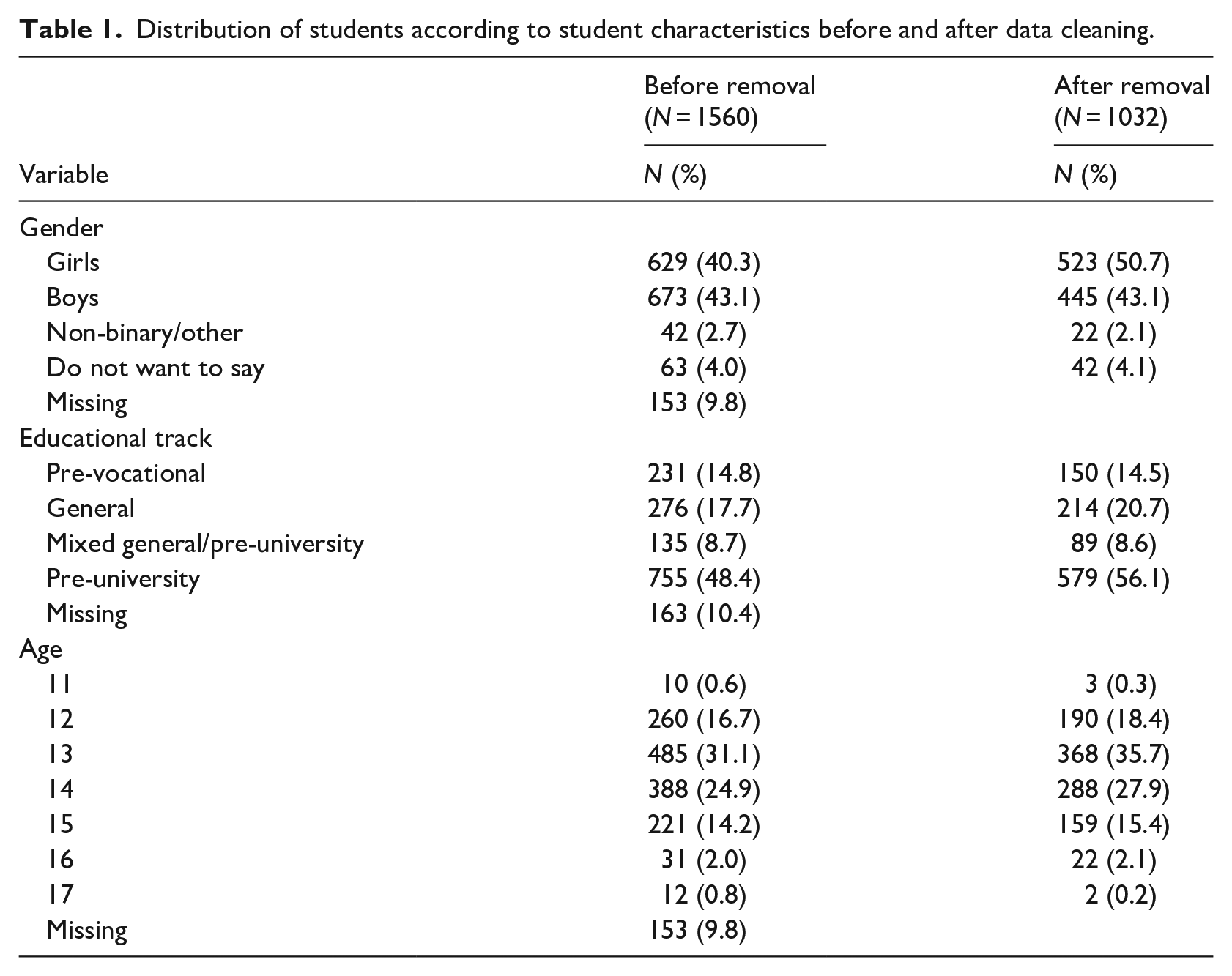
Participants were aged 11–17 (M = 13.47, SD = 1.05) and were in pre-vocational education, general education, pre-university education or mixed tracks, with most students in a pre-university track.All 1560 responses were checked for various criteria: whether the questionnaire was completely filled in and open questions answered seriously, how long a student took to fill in a single page, and how long a student took to complete the entire questionnaire. Incomplete answers or answers that could not be processed (like entering a fake school name) were omitted. In addition, answers from students who took less than 300 seconds (i.e., 5 minutes) to complete the questionnaire were taken out. For students who took between 300 and 500 seconds to complete the questionnaire, the time spent on a single page was additionally examined. A respondent was taken out if the respondent stayed on a page for less than 10 seconds several times. To arrive at these criteria, a normal distribution was made of the time in seconds students spent filling in the questionnaire. These data cleaning procedures lead to the omission of 568 responses, resulting in a final sample of 1032 usable responses. Given the large number of excluded responses, we investigated possible effects in representativeness. Table 1 shows a comparison of the data before and after removal. The selection resulted in some changes in the distribution of respondents included in the final analyses (relatively more girls, students in pre-university tracks and older students), however, the changes in distributions of students’ characteristics are within reasonable limits.
Distribution of students according to student characteristics before and after data cleaning.
Procedure
Schools were recruited by approaching them directly via email and through an appeal on LinkedIn. Upon completion of the survey, participating schools received a brief report detailing the average levels of citizenship competences for each class at their school. For this reason, all students were also asked to indicate which school and class they were in. The questionnaire was administered during school time by a teacher in the classroom. Data collection took place between April and July 2022. Students completed the questionnaire online via Qualtrics on a laptop, phone or tablet. Participation in the study was voluntary. Prior to administration, parents were provided with an information letter that included the choice to opt out. Students were also given the opportunity to opt out at any moment. All responses were pseudonimized and no individual scores were reported to schools or otherwise. The study was approved by the Ethics Committee (reference 2022-CDE-14551).
Instruments
Personality traits
To measure personality traits, the Big Five Inventory-NL (BFI-NL; Denissen et al., 2008) was used, which was translated into Dutch and validated by Denissen et al. from the original version (John and Srivastava, 1999). In the version of Denissen et al. (2020), all scales had a reliability higher than 0.70, and the mean reliability came to α = 0.76. The Big Five is divided into five different dimensions of personality: extraversion vs. introversion, neuroticism vs. emotional stability, openness (to experiences) vs. closed-mindedness, conscientiousness vs. carelessness and agreeableness vs. antagonism. Denissen et al. (2020) also examined the relationship of the Big Five scales to the International Personality Item Pool (IPIP) scales to gain information on the convergent validity. The convergent validity was considered good as well. The instrument consisted of 44 items. Participants could indicate on a 5-point Likert scale the extent to which they agreed with certain statements, ranging from “highly disagree” to “highly agree.” Scores of 14 reverse items were recoded and scale scores were calculated by dividing the maximum number of points on the scale by the number of items. Sample items from this questionnaire are: “I see myself as someone who is talkative” (extraversion), “I see myself as someone who is gloomy” (neuroticism), “I see myself as someone who is original, comes up with new ideas” (openness), “I see myself as someone who is thorough” (conscientiousness), and “I see myself as someone who is forgiving” (agreeableness).
Citizenship competences
To measure citizenship competences, we used the Citizenship Competences Questionnaire (CCQ; Ten Dam et al., 2011). The CCQ is consistent with the conceptualization of citizenship discussed in the theoretical framework. The reliability of the instrument was found satisfactory: almost all scales have a Cronbach’s alpha higher than 0.80 (Egberink et al., 2015). The measurement of citizenship competences is structured around the four social tasks discussed in the previous section, with items measuring knowledge and items measuring attitudes. For the component attitude, the social task acting socially responsible was not included in our instrument due to an error.
For the knowledge questions, participants chose the correct answer from three alternatives. A sample item is: “All children have a right: (a) to pocket money, (b) to choose who you live with, (c) to education.” For citizenship knowledge, a score of “1” was given for a correctly answered item and a “0” for either of the incorrect options. These scores were added and z-standardized into scale scores. For the attitude questions, participants could indicate on a four-point Likert scale the extent to which the statement fits them, ranging from “that does not fit me at all” to “that fits me completely.” A sample item is: “I like to know about different types of religion.” The average scores were z-standardized into scale scores. The segment on citizenship attitudes also included two items that measured social desirability, which were also averaged and z-standardized.
All in all, the questionnaire consisted of 6 items on students’ background, 24 items on citizenship knowledge, 18 items on citizenship attitudes, 2 items on social desirability and 44 items on personality traits. The items on citizenship attitudes, social desirability and personality traits are reported in Appendix 1. Participants took on average about 18 minutes to complete the questionnaire.
Analyzes
Multilevel regression analyses were carried out in the statistical computer program R version 4.4.1 using the lme4 package version 1.1.35.5. To account for the nested structure of the data (i.e., students, within classrooms, within schools), we conducted multilevel analyses with three levels. Separate models were run for the dependent variables citizenship knowledge and citizenship attitudes. For citizenship attitudes, analyses were also run for each of the three social tasks as dependent variable.
First, empty models for citizenship knowledge and citizenship attitudes were run to estimate variance at each level. Next, three models were run. In Model 1, the Big Five personality traits were each added separately to estimate the effect of an individual predictor on the dependent variable. In Model 2, all five personality traits were entered into the analysis simultaneously to examine the effect of the personality traits in unison. In Model 3, the control variables (i.e., social desirability, age, gender and educational track) were simultaneously added as predictors. This shows the extent to which the Big Five characteristics predict differences in students’ citizenship competences after controlling for student background.
The explained variances (R2) that emerged from the analyses show the extent to which a given predictor explains the variance in the dependent variable. Thus, in this study, the explained variance shows how well each of the five personality traits can explain differences in citizenship competences among students. In addition, the β-coefficients were examined, which show the degree of change in the dependent variable. These β-coefficients were contrasted to examine which predictor has the greatest effect on the dependent variable. Before conducting the analyses, the dependent variables citizenship knowledge and citizenship attitudes were examined to check for normality, multicollinearity and heteroscedasticity. Normality was also examined for the five personality traits. We concluded that the assumptions for multilevel regression analyses were not violated (see Appendix 2 for details on the assumption checks and for descriptive statistics).
Results
Citizenship knowledge
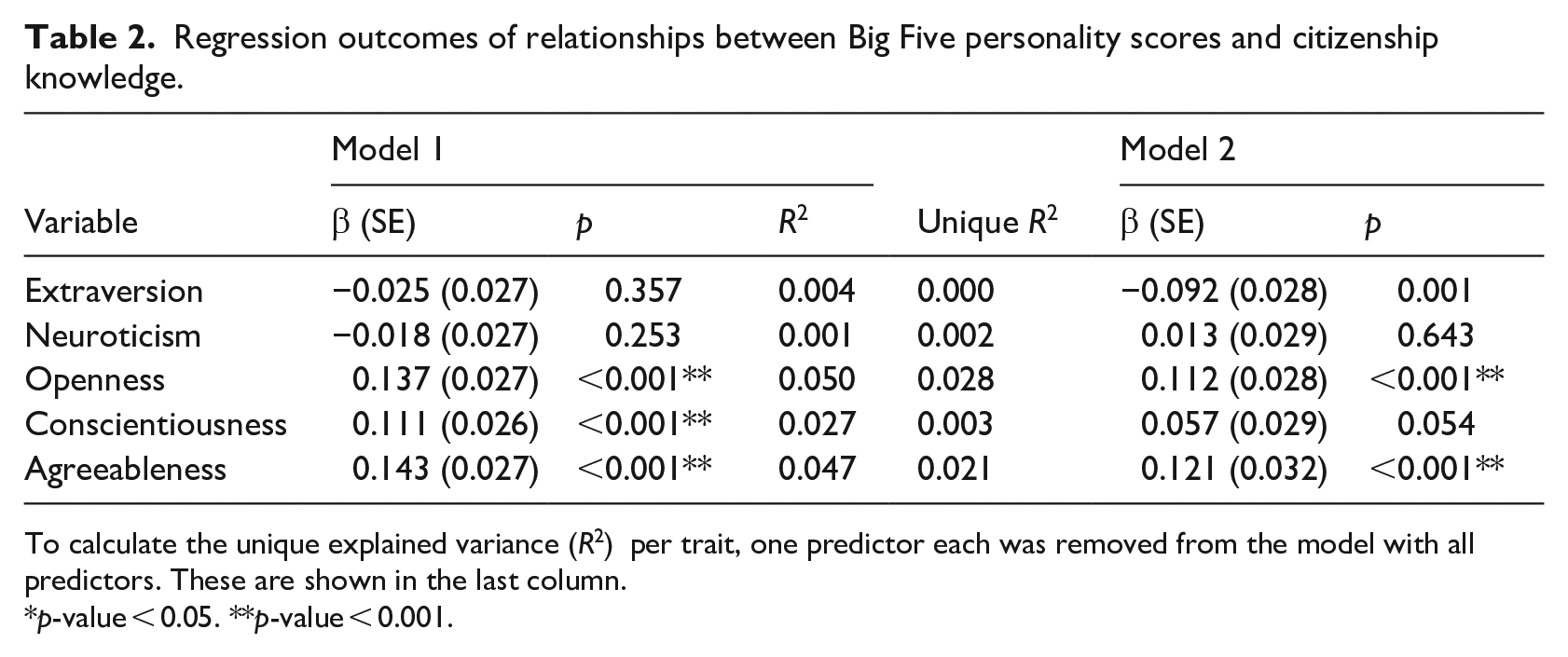
To examine the extent to which there is a relationship between personality traits and citizenship knowledge, multilevel regression analyses were conducted with personality traits as predictors and citizenship knowledge as the dependent variable. First, the extent to which each predictor affects the dependent variable was analyzed separately (Model 1), and then the influence of all variables on citizenship knowledge was examined (Model 2). Afterward, the unique variance of each predictor was calculated. Table 2 shows the results of these analyses.
Regression outcomes of relationships between Big Five personality scores and citizenship knowledge.
To calculate the unique explained variance (R2) per trait, one predictor each was removed from the model with all predictors. These are shown in the last column.
p-value < 0.05. **p-value < 0.001.
The first column of Table 2 shows the β-coefficients and standard errors for each personality trait as a separate predictor of the model. The β-coefficients are standardized averages that show the degree of change in the dependent variable. A positive β-coefficient means that an increase in the predictor variable is associated with an increase in the dependent variable, and vice versa. The third column (R2) shows the explained variance of each predictor. In the fourth column of Table 2, uniquely explained variances for each predictor are presented. For example, to calculate the uniquely explained variance of extraversion, the R2 of the model without extraversion (not shown in table) was subtracted from the R2 of Model 2 (0.081).
For the predictors as part of the entire model (Model 2), the β-coefficient was also reported for each predictor. Table 2 shows that the β-coefficients per personality trait are generally larger when the personality trait is added to the model as a separate predictor than when looking at the predictor in the model together with other predictors. This means that for each unit of change of the independent variable, the dependent variable changes more with Model 1 than with Model 2. Model 2 gives an R2 of 0.081 for all five predictors combined, meaning that 8% of the differences in scores on the knowledge items can be explained by the model. A Chi-square test was used to test whether the model proved a significant improvement to the Null Model: χ2 (5) = 57.38, p < 0.001. This test is significant, meaning that with all traits combined, the model is predictive of differences in citizenship knowledge.
As shown in the last column of Table 2, the predictors openness and agreeableness are significant predictors of citizenship knowledge (p < 0.05). These predictors explain 2.8% and 2.1% of the unique variance in scores on the knowledge items, respectively. As can be seen, openness and agreeableness account for the largest change in knowledge scores, even though the effects are small.
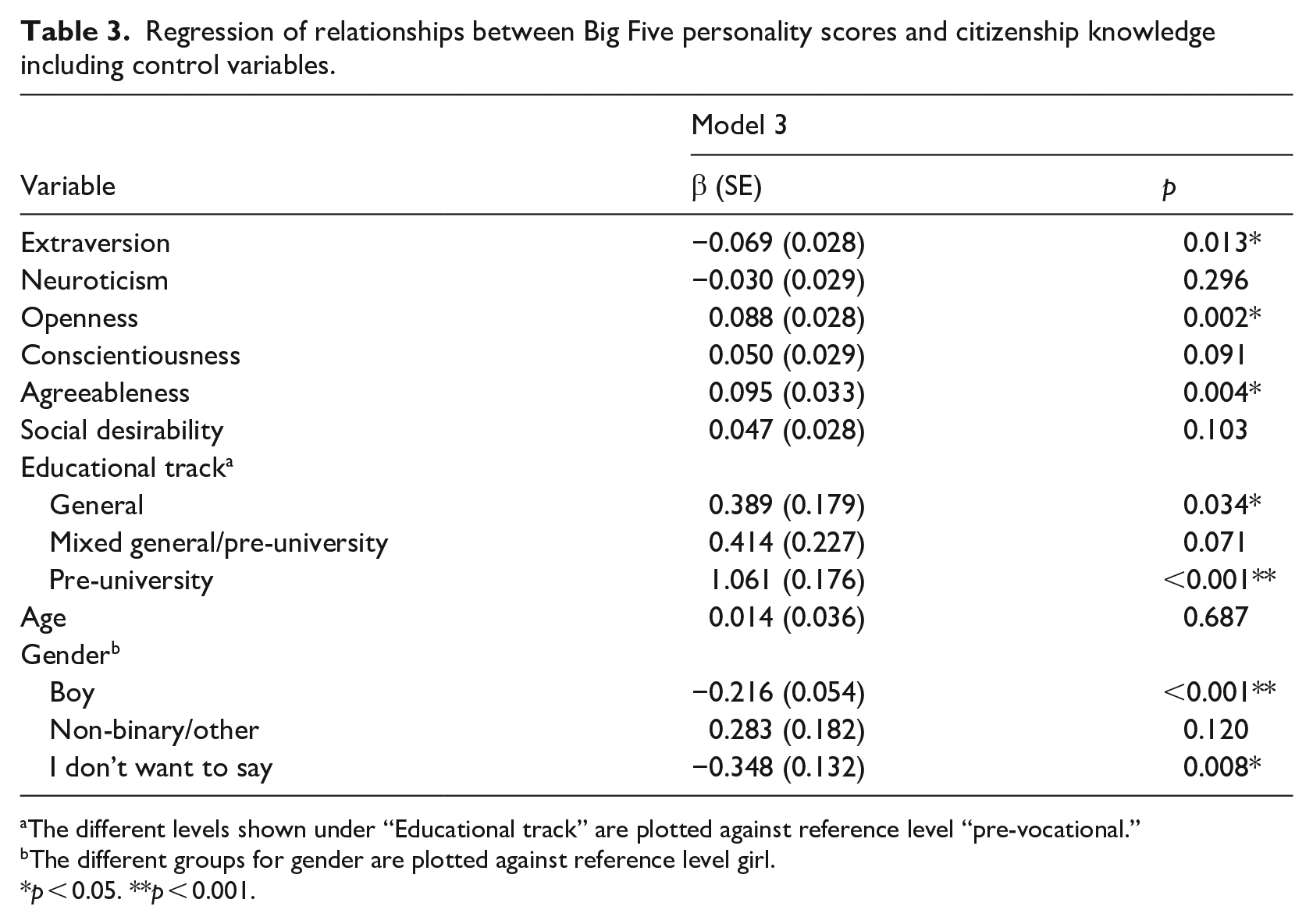
To control for the influence of social desirability, educational track, age and gender on citizenship knowledge, control variables were added in Model 3 (see Table 3). Because educational track and gender are categorical variables, dummy variables were created. A Chi-square test of model fit shows Model 3 is a significant improvement to Model 2: χ2 (8) = 68.08, p < 0.001. When adding the control variables, the R2 increases from 0.081 to 0.329. The β-coefficients of openness (β = 0.088) and agreeableness (β = 0.095) become smaller. However, these predictors (including the predictor extraversion) are still significant after adding the control variables. Deriving from these results, personality traits seem to predict citizenship knowledge to a small extent.
Regression of relationships between Big Five personality scores and citizenship knowledge including control variables.
The different levels shown under “Educational track” are plotted against reference level “pre-vocational.”
The different groups for gender are plotted against reference level girl.
p < 0.05. **p < 0.001.
Citizenship attitudes
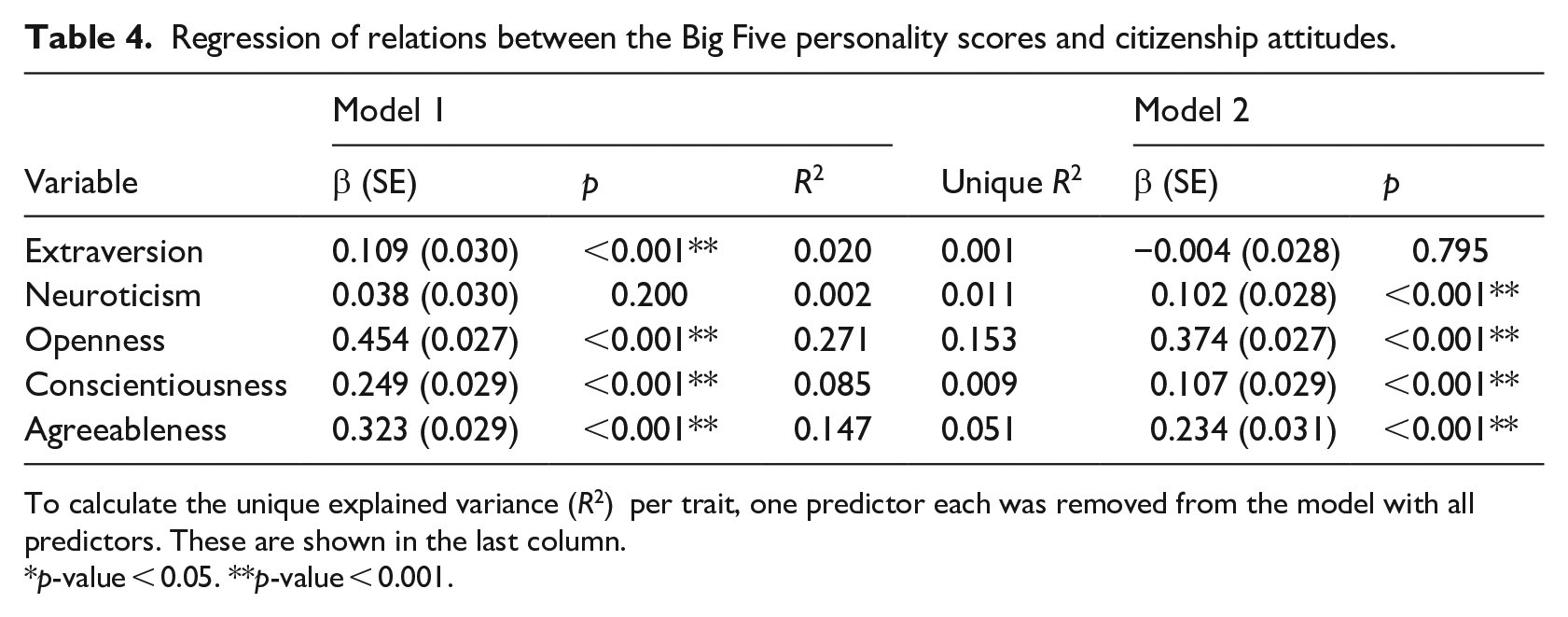
Multilevel regression analyses were also used to examine the relationship between personality traits and citizenship attitudes. The analysis was conducted similarly to citizenship knowledge: Model 1 includes one of the five predictors each time, Model 2 includes all predictors simultaneously and Model 3 includes control variables. Tables 4 and 6 show the main results.
Regression of relations between the Big Five personality scores and citizenship attitudes.
To calculate the unique explained variance (R2) per trait, one predictor each was removed from the model with all predictors. These are shown in the last column.
p-value < 0.05. **p-value < 0.001.
Table 4 shows that when included separately (i.e. Model 1), four out of five personality traits show a significant effect on citizenship attitudes. The magnitude of the effects is considerably larger than for citizenship knowledge. The β-coefficients for four of the five predictors become smaller in Model 2 (where they are added to the model simultaneously); extraversion is no longer a significant predictor whereas the effect of neuroticism is only significant when all five traits are included in the model.
From both the β-coefficients and explained variance in Model 2, it is noticeable that openness causes the largest change in attitudes scores, followed by agreeableness, neuroticism and conscientiousness. These four predictors explain 15.3%, 5.1%, 1.1%, and 0.9% of the variance in attitude scores, respectively. Model 2 has an R2 of 0.360, meaning that 36% of the variance in scores on the attitude items can be explained by the model (χ2 (5) = 347.42, p < 0.001). This model is significant, meaning that with all traits combined, the model is predictive of differences in citizenship attitudes. The proportion of explained variance is furthermore considerably larger for citizenship attitudes than for citizenship knowledge. Model 2 gives an R2 of 0.081 for variance in knowledge scores and an R2 of 0.360 for variance in attitude scores.
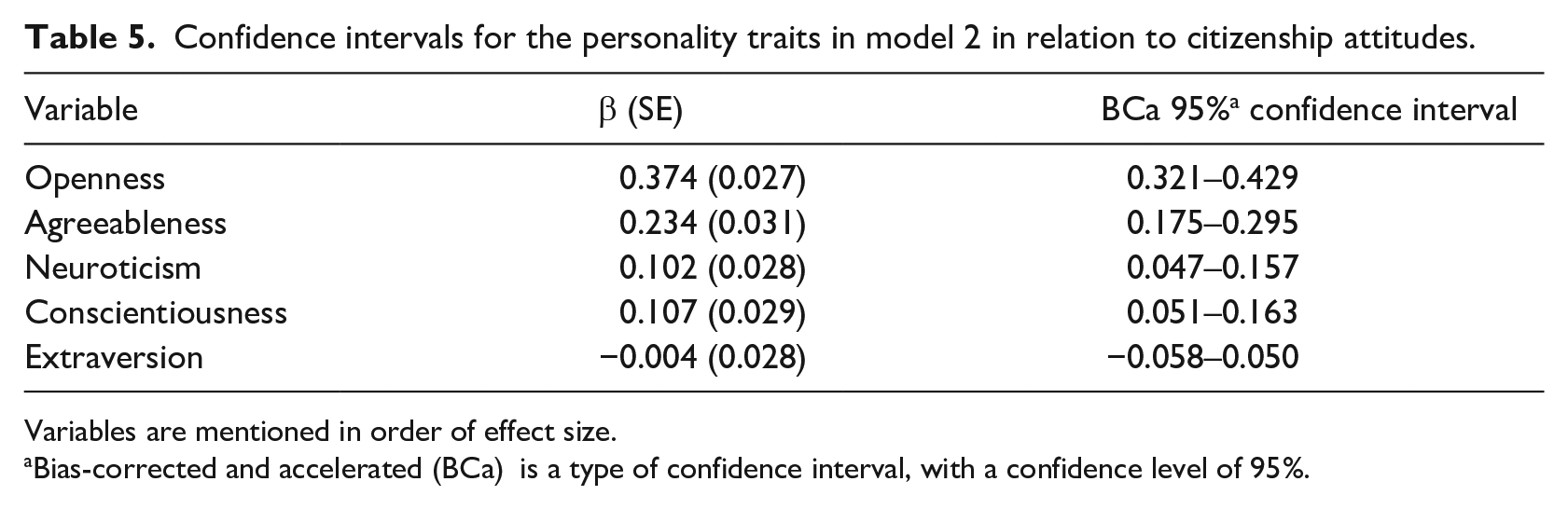
Primarily, openness seems to explain much of the variance in attitude scores. To test whether the β-coefficients of openness and agreeableness are actually significantly larger than the coefficients of the other traits, the corresponding confidence intervals were calculated by bias-corrected bootstrapping (1000 re-samples). When the confidence intervals overlap less than 50%, the β-coefficients can be seen as significantly different from each other (Cumming, 2009).
Table 5 reports the β-coefficients (from largest to smallest effect), and shows that the openness coefficient is indeed significantly larger than the β-coefficient of agreeableness: the confidence intervals do not overlap. Also, the β-coefficient of agreeableness is significantly larger than the one of neuroticism: these confidence intervals do not overlap either. However, the β-coefficients of neuroticism and conscientiousness are not significantly different from each other; Table 5 shows that they largely overlap.
Confidence intervals for the personality traits in model 2 in relation to citizenship attitudes.
Variables are mentioned in order of effect size.
Bias-corrected and accelerated (BCa) is a type of confidence interval, with a confidence level of 95%.
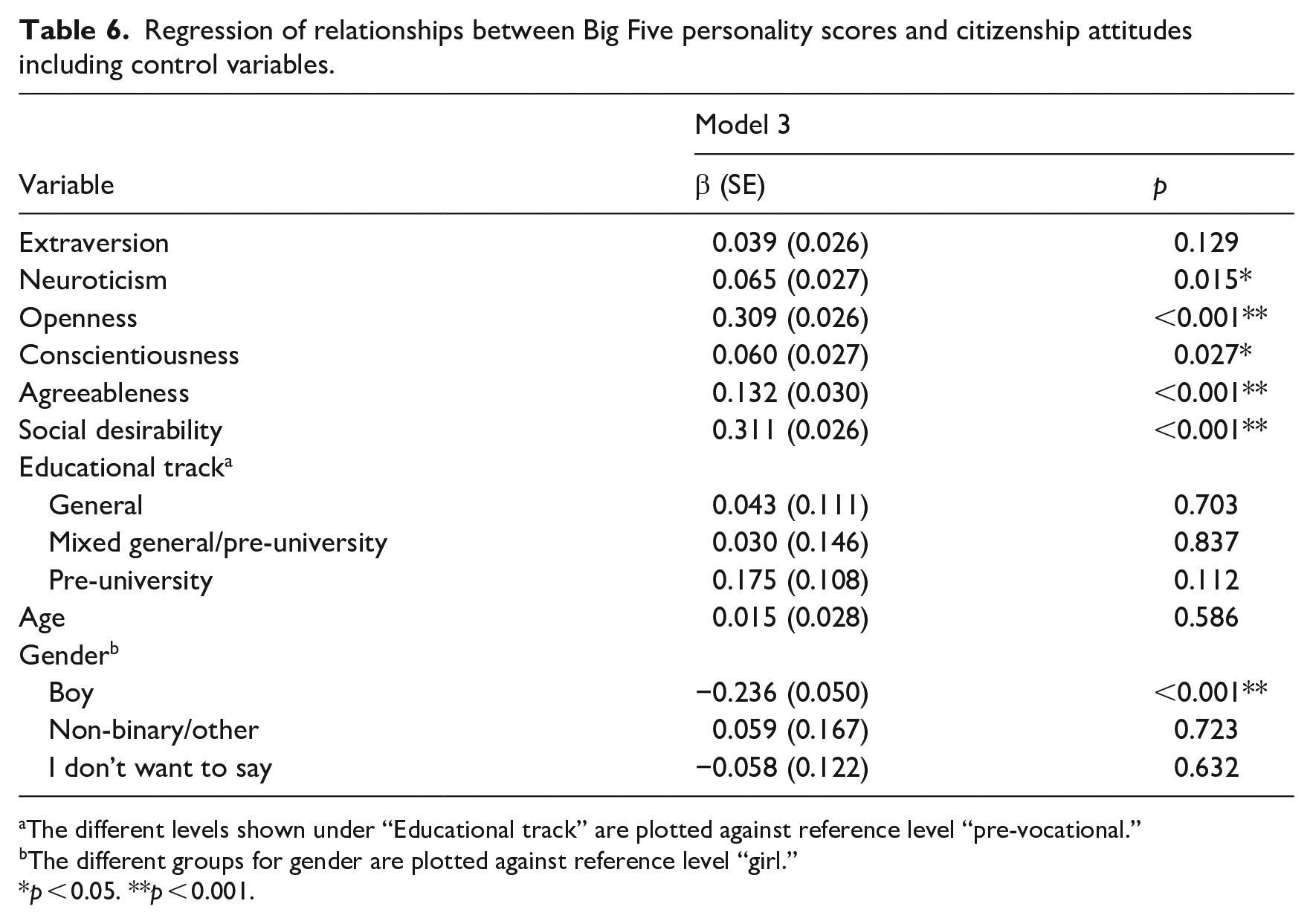
Table 6 shows the results for Model 3, which includes the control variables. Model fit is significantly improved compared to Model 2: χ2(8) = 163.97, p < 0.001. The results show that by adding the control variables, the R2 increases from 0.360 to 471. The β-coefficients of the predictors neuroticism, openness, conscientiousness and agreeableness decrease, but remain significant (β = 0.065; β = 0.309; β = 0.060; β = 0.132, respectively). The fact that there are still three significant predictors after controlling for social desirability, educational track, age and gender confirms our expectation that personality traits predict citizenship attitudes. Also as expected, openness and agreeableness have the largest effect on citizenship attitudes, also after adding the control variables.
Regression of relationships between Big Five personality scores and citizenship attitudes including control variables.
The different levels shown under “Educational track” are plotted against reference level “pre-vocational.”
The different groups for gender are plotted against reference level “girl.”
p < 0.05. **p < 0.001.
To easily compare the models, Figure 1 shows the β-coefficients of the predictors in all three models for citizenship attitudes. Figure 1 indicates that the effect of openness remains large when adding more variables. The control variables affect the effect of agreeableness, but even this effect remains larger than the effects of conscientiousness, neuroticism and extraversion.
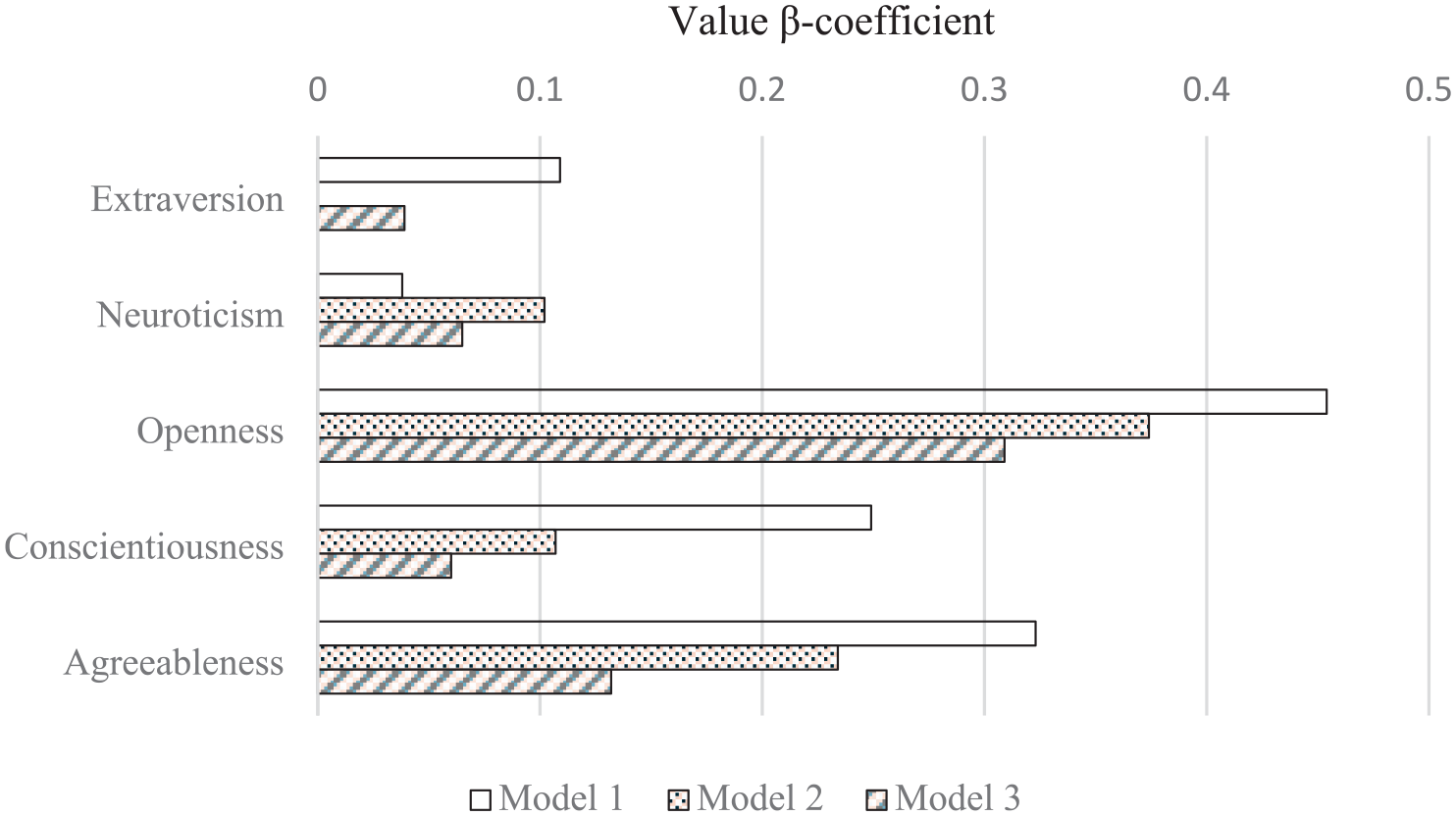
Comparison of the effect of different predictors on citizenship attitudes.
Comparison of the social tasks
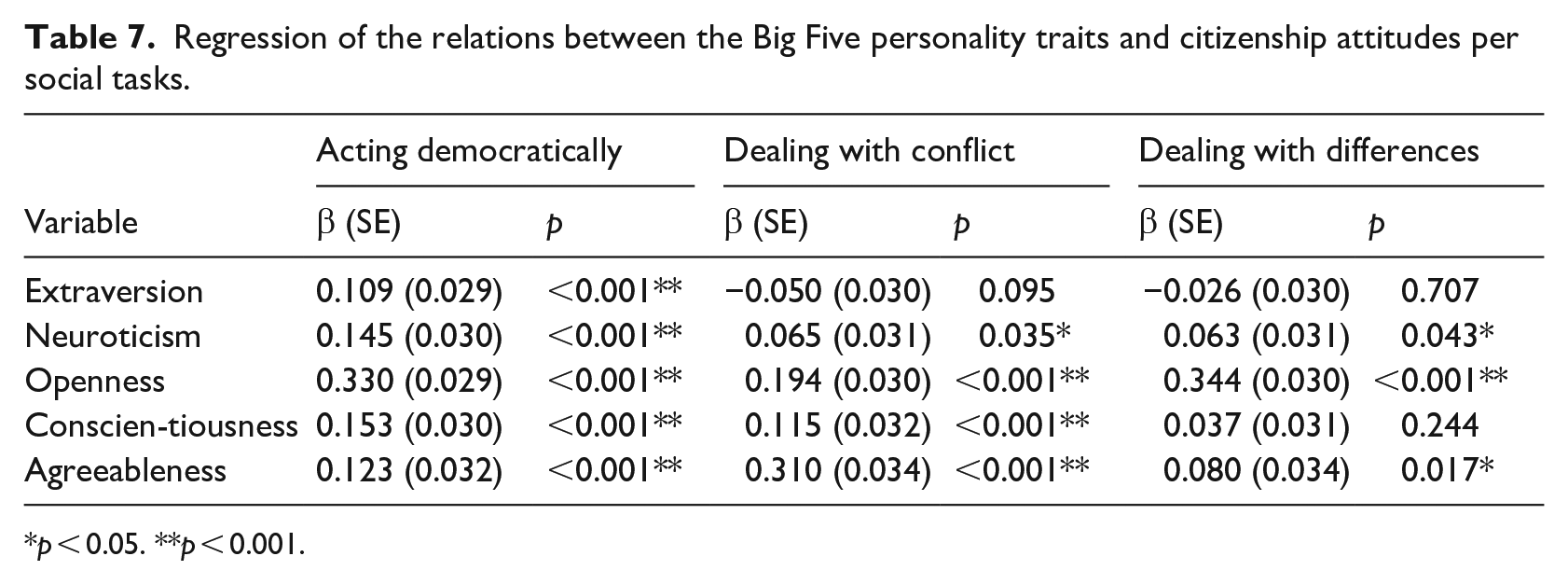
Finally, analyses were conducted looking at the difference in the effects of the predictors on attitudes toward the different social tasks. Table 7 reports the main results. When looking separately at the relationship of the personality traits with the social tasks, there do not seem to be many differences and all three models are significant improvements over their respective Null Models (R2 = 0.283; χ2 (5) = 281.28, p < 0.001 for the Big Five as predictors for acting democratically; R2 = 0.214; χ2 (5) = 215.00, p < 0.001 for the Big Five as predictors for dealing with conflict; and R2 = 0.191; χ2 (5) = 168.16, p < 0.001 for the personality traits as predictors for dealing with differences). For openness, the strongest relationship is seen in the social tasks “dealing with differences” and “acting democratically.” Agreeableness has the strongest relationship with “dealing with conflicts.” All five traits, including extraversion, are significant for the relationship with the social task “acting democratically.”
Regression of the relations between the Big Five personality traits and citizenship attitudes per social tasks.
p < 0.05. **p < 0.001.
Conclusion and discussion
Acquiring citizenship competences is essential for students’ participation in a democratic, pluriform society. Research highlights differences in citizenship competences based on students’ characteristics, like gender, age and social status. Beyond these general factors, personal characteristics may also play a role, with specifically personality traits in relation to student citizenship competences being largely underexplored. To gain insight into how citizenship competences among students can be fostered, the current study examined the extent to which there is a relationship between citizenship competences and Big Five personality traits of secondary school students in the Netherlands.
The findings show a relationship between personality traits and citizenship competences among students in secondary school. It was expected that personality traits would relate more strongly to citizenship attitudes than to citizenship knowledge, and that openness and agreeableness would be most closely relate to citizenship attitudes. The results confirm these expectations. It can be concluded that personality traits are related to both citizenship knowledge and citizenship attitudes, but have the strongest relationship with citizenship attitudes. For citizenship knowledge we found a relationship with extraversion, openness and agreeableness. However, the results show rather small effects.
Looking at the relation between personality and citizenship attitudes in more detail, this study also examined the relationship between personality traits and social tasks derived from the conceptual framework of citizenship competences by Ten Dam et al. (2011). In this respect, the findings point out that agreeableness relates most closely to the social task of “dealing with conflicts.” For both concepts, prosocial behavior plays a large role: people who score high on agreeableness are seen as cooperative, altruistic and prosocial (Dinesen et al., 2014). Dealing with conflicts is conceptualized as being about listening to each other, being able to see something from someone else’s perspective and reaching solutions together (Ten Dam et al., 2011)—actions that correspond with agreeableness. There are also similarities in the ways both concepts are operationalized into measurement instruments: for dealing with conflicts, students are asked to think of situations of (small) conflicts in which they played a role and, subsequently, indicate the extent to which they are willing to take others into account, try to take others seriously and are willing to seek a solution that satisfies all involved. Similarly, the items measuring agreeableness focus on helping others and dealing with arguments. The relationship between agreeableness and trust in other people as found in previous research (Dinesen et al., 2014) seems to be consistent with these results.
The findings also demonstrated that openness (to experience) seems to be most closely related to the social tasks of “dealing with differences” and “acting democratically.” For dealing with differences, students are asked to indicate the extent to which they think it is good to learn about other cultures, to know something about different beliefs, and to what extent they are curious about how people in other countries live. These statements are closely consistent with the items used to measure openness, where students indicated whether they see themselves as someone who is “curious about many different things.” Curiosity about new things and other cultures seems to be a shared component. Previous research also supports the relationship between openness and tolerance toward immigrants (Oskarsson and Widmalm, 2016), and between openness and the belief that immigrants should have more rights (Freitag and Rapp, 2015). For acting democratically, students are asked, for example, if they listen to each other’s opinion and like sharing their opinion with others. Listening to each other and thinking about each other’s opinion is something which also seems to be part of the items used to measure openness.
The relationships found in this study could indicate a similarity in the conceptualization of citizenship competences and personality traits. Here, citizenship attitudes are defined as the thoughts, feelings, and willingness of young people toward various social tasks, such as dealing with differences and dealing with conflicts (Ten Dam et al., 2011). Students who score high on citizenship attitudes, also seem to score high on prosocial attitudes. These prosocial attitudes appear related to personality traits such as openness (e.g., being curious) or agreeableness (e.g., being helpful). At the same time, the relationship between personality traits and citizenship competences as indicated by our findings raises questions concerning the nature of these concepts. There are several different viewpoints concerning this matter; we restrict ourselves to two.
An important premise for interpreting the relationship between citizenship competences and personality traits are their definitions. If personality traits are seen as more stable dispositions, it might imply that personality traits are predictive of certain types of human behavior. If citizenship competences are seen as something you acquire during life, it could mean that the acquisition of citizenship competences is influenced by possessing a certain set of personality traits, which is also reflected in our data. However, citizenship can also be considered to encompass a set of certain virtues, such as agreeableness and openness, which would mean that the concepts of citizenship competences and personality traits are familiar and might overlap to a more or lesser extent (cf. Council of Europe, 2018). This highlights the need of a clear definition of citizenship competences, including the conceptual boundaries to where citizenship competences become personality traits, to further study the relation between citizenship competences and personality traits and how prosocial behavior could play a role in their assumed underlying mechanism.
Another perspective is about the malleability of personality traits and citizenship competences. Personality is seen as fairly stable (Weisberg et al., 2011). Even though personality can change over time, mainly due to age and major life events, the changes appear to be mostly gradual (Klimstra, 2013; Specht et al., 2011). The acquisition of citizenship competences is influenced by different factors and differs per student, depending on their characteristics and background (Geijsel et al., 2012). Looking at the results of this study, this implies personality traits might be seen as a relevant predictor of citizenship competences and could influence the extent to which students acquire these competences. Another implication is that students with certain personality traits might experience more ease or difficulties in acquiring citizenship competences, posing a challenge to organizing citizenship education in such a way that all students benefit optimally.
When interpreting the results, it is important keep in mind other factors influencing the acquisition of citizenship competences. Many factors, such as socioeconomic background, migration background and religion, were not included in this study but may be influential. In line with this, control variables in our analyses (i.e. educational track, age and gender) explained substantial proportions of variance in both citizenship knowledge and attitude. Thus, future research could explore relations and interactions between personality traits, citizenship competences, and more general student and school characteristics (e.g. migration background, socioeconomic status, teacher characteristics and pedagogical and didactic approach). Such a holistic approach may help gaining insight into acquiring citizenship competences, and explaining differences in competences between (groups of) students.
In sum, depending on the extent to which personality traits precede the acquisition of citizenship competences, the acquisition of citizenship competences might be easier or more demanding, depending on the personality traits of the student. To come to a better understanding of the underlying mechanisms, further research is essential, for both the conceptualization of citizenship and citizenship competences, the malleability of citizenship competences during the school career (and beyond) and for the relative contribution that education can make to their acquisition.
Footnotes
Appendix 1
This Appendix reports the items and scales used to measure citizenship attitudes and personality traits in our questionnaire. The items are taken from the Big Five Inventory-NL (BFI-NL; Denissen et al., 2008) and the Citizenship Competences Questionnaire (Ten Dam et al., 2011). The items here are translated; the questionnaire was administered in Dutch.
Scale: Attitudes towards acting democratically
Stem: About listening and participating. How well do the following statements apply to you?
Answer categories: (1) does not apply at all to me, (2) does not apply much to me, (3) applies a fair amount to me, or (4) applies completely to me.
Scale: Attitudes towards dealing with conflicts
Stem: What do you think about arguments? The following statements are about small arguments. (So an argument where you disagree with the other. Or an argument where you both want something different. But not a serious argument, such as fighting or teasing.) How well do the following statements apply to you? When I have an argument then. . .
Scale: Attitudes towards dealing with differences
Stem: About differences between people. How well do the following statements apply to you?
Scale: Social desirability
Stem: About listening and participating. How well do the following statements apply to you?
Stem: The following statements relate to your opinion of yourself in different situations. On a scale from completely disagree to completely agree, indicate to what extent you agree with each statement. For each statement, select the answer that best describes you. Take your time and think carefully about each answer. I see myself as someone who. . .
Answer categories: (1) highly disagree, (2) disagree, (3) neutral, (4) agree, (5) highly agree.
Scale: Extraversion
(1) . . . is talkative.
(6) . . . is reserved.*
(11) . . . is full of energy.
(16) . . . generates a lot of enthusiasm.
(21) . . . is usually quiet.*
(26) . . . stands up for himself.
(31) . . . is sometimes shy, inhibited.*
(36) . . . is warm-hearted, sociable.
Scale: Neuroticism
(4) . . . is gloomy.
(9) . . . is relaxed, can handle stress well.*
(14) . . . can be tense.
(19) . . . worries a lot.
(24) . . . is emotionally stable, not easily upset.*
(29) . . . can be moody.
(34) . . . remains calm in tense situations.*
(39) . . . gets nervous easily.
Scale: Openness
(5) . . . is original, comes up with new ideas.
(10) . . . is curious about many different things.
(15) . . . is sharp, a thinker.
(20) . . . has a vivid imagination.
(25) . . . is resourceful.
(30) . . . values artistic experiences.
(35) . . . prefers work that is routine.*
(40) . . . likes to think, plays with ideas.
(41) . . . has little interest in art.*
(44) . . . knows the ins and outs of art, music or literature.
Scale: Conscientiousness
(3) . . . is thorough.
(8) . . . can be a bit nonchalant (giving the impression that you don’t think things are important).*
(13) . . . is a dependable worker.
(18) . . . tends to be sloppy.*
(23) . . . tends to be lazy.*
(28) . . . perseveres until the task is done.
(33) . . . gets things done efficiently.
(38) . . . makes plans and follows through on them.
(43) . . . is easily distracted.*
Scale: Agreeableness
(2) . . . is inclined to criticize others.*
(7) . . . is helpful and selfless (when you help people without self-interest) towards others.
(12) . . . is quick to argue.*
(17) . . . is forgiving.
(22) . . . generally trusts people.
(27) . . . can be cold and distant.*
(32) . . . is considerate and kind to almost everyone.
(37) . . . is sometimes rude to others.*
(42) . . . likes to collaborate with others.
Note. *items are reverse coded
Appendix 2
For the multilevel regression analyses, the conditional assumptions were checked. The linear line in the P-P Plot shows that both knowledge scores and attitude scores are normally distributed. There is no multicollinearity, the VIF scores are between 1 and 2. A VIF score of 1 shows that the independent variables are not correlated with each other, where a VIF score of 10 shows that the independent variables have very high correlations with each other (Field, 2013). When the independent variables have very high correlations with each other, this is a problem because the change in one variable, could cause change in the other variable. The Durbin-Watson is a statistic to test for autocorrelation and gives a value between 0 and 4, where with a value that’s close to 2 it can be assumed the residuals are independent (Field, 2013). For both citizenship knowledge and citizenship attitudes, the Durbin-Watson is around 2, which is desirable.
The graph of standardized residuals shows that there is heteroscedasticity: the points are in a cloud-like shape (Field, 2013). This means that the residual does not change much when the predictor changes. Finally, we checked with Cook’s distance that there are no individual data points that could affect the regression. When the values of Cook’s distance are above 1 it indicates data points that can influence the regression (Field, 2013). For our sample, this is not the case.
We also examined whether the independent variables, the personality traits, are normally distributed. Table 2.1 and Figure 2.1 show the distributions of these variables. As can be seen, all five traits are normally distributed. Tables 2.2 and 2.3 report the results for the three models predicting citizenship knowledge and citizenship attitudes respectively.

Funding
The authors received no financial support for the research, authorship, and/or publication of this article.
Declaration of conflicting interests
The authors declared no potential conflicts of interest with respect to the research, authorship, and/or publication of this article.