






Abstract
Over a 3.5-year period, fecal samples from 1322 cats from two shelters and affiliated foster homes in upstate New York were processed for parasite detection by both 1.18 spg zinc sulfate and 1.3 spg sugar double centrifugal flotation. In 50.9% of the samples at least one parasite was detected. Overall, 18 different parasites ranging in prevalence from 0.2% to 21% were recovered. The most prevalent parasites of foster and shelter cats in this study were Cystoisospora species and Toxocara cati (21% prevalence, each). In order of percentage of positive samples, other findings were: Giardia species (8.9%), Aelurostrongylus abstrusus (6.2%), taeniid eggs (3.9%), Cryptosporidium species (3.8%), Aonchotheca species (3.7%), Eucoleus species (2.3%), Ancylostoma species (2.2%), Cheyletiella species (2.0%), Dipylidium caninum (1.1%), Otodectes species, Toxoplasma-like oocysts and Sarcocystis species (0.8% each), Demodex and Spirometra species (0.4% each), and Alaria species and Felicola subrostratus (0.2% each).
Over a 3.5-year period (August 2006–January 2010), a total of 1629 feline fecal samples from two shelters and affiliated foster homes in Cortland and Tompkins counties in the state of New York were submitted as teaching material for parasite detection to the Community Practice Service (CPS) clinical rotation. Third and fourth year veterinary students at Cornell University's Veterinary College processed these samples as part of a clinical diagnostic parasitology course. These samples corresponded to 1322 individual cats. Of these, 307 samples represented resubmissions, ie, for these cats more than one fecal sample was examined. Shelters housed 1272 of these cats, while the remaining 50 were in foster care. No information on source of cat prior to arrival, age, gender, housing (ie, whether singly or in groups), history of parasite control products used (if any), length animals had been in custody, or signs of disease, is submitted along with the fecal samples, but both apparently-healthy and ill cats can shed parasites in their feces. 1,2 Collected samples were stored at 4°C and processed within 5 days of collection. All samples were processed by both 1.18 spg zinc sulfate and 1.3 spg sugar double centrifugal flotation. 3 Slides were examined under 100× or 400× magnification using bright field microscopy. Parasites were identified based on morphology alone, thus, in many instances identification beyond the genus level may not always be accurate. All samples were processed under the supervision of the principal author; all samples were examined by the principal author.
In just over half the samples (50.9%) at least one parasite was detected. Eighteen different parasites ranging in prevalence from 0.2 to 21% were noted (Table 1). The most prevalent parasites of foster and shelter cats in this study were Cystoisospora species and Toxocara cati (each had a prevalence of 21%). This trend seems to be consistent with the findings of other surveys (Table 1). 4–23 As individual Cystoisospora species are not always recorded on our forms, and mixed infections of Cystoisospora species are often present, these infections are grouped in our data. Giardia species cysts were detected in 8.9% of all fecal samples. The cat lungworm, Aelurostrongylus abstrusus, was present in 6.2% of samples examined. When taken together, the next most prevalent parasites were the capillarids (2.3% of samples contained Eucoleus species and 3.7% contained Aonchotheca species; mixed infections are common); Eucoleus aerophilus can cause coughing and wheezing due to bronchiolar disease and Aonchotheca putorii has been reported as a cause of gastritis in cats in Europe. 24 The remaining parasites were each found in less than 4% of samples: taeniids (3.9%), Cryptosporidium species (3.8%), Ancylostoma species (2.2%), Cheyletiella species (2.0%), Dipylidium caninum (1.1%), Otodectes species, Toxoplasma gondii, and Sarcocystis species (0.8% each), Demodex and Spirometra species (0.4% each), and Alaria species and Felicola subrostratus (0.2% each). Oocysts of size and shape consistent with T gondii were recorded as ‘T gondii’, although by microscopic examination alone, they cannot be differentiated from Hammondia or Besnotia species. While the techniques used in this study cannot determine Giardia species assemblages or Cryptosporidium species, the authors believe Giardia intestinalis assemblage F and Cryptosporidium felis are most likely; neither of which are considered to be a major source of zoonotic infections. 25–27
Parasite prevalence in cats reported in surveys between 1948 and 2009

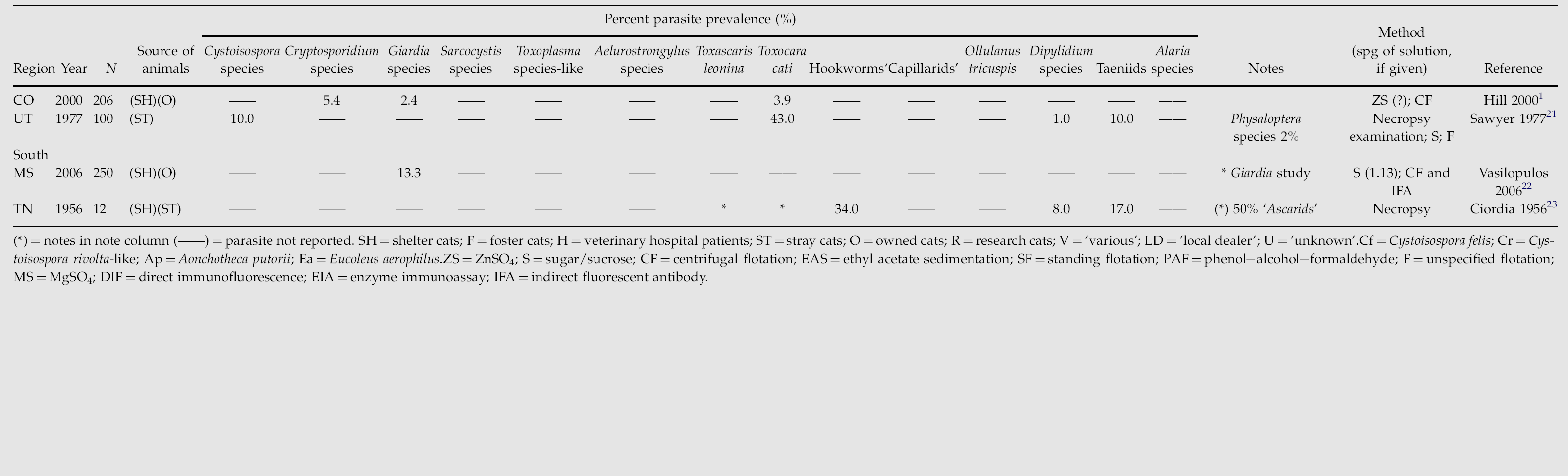
(*)=notes in note column (—)=parasite not reported. SH=shelter cats; F=foster cats; H=veterinary hospital patients; ST=stray cats; O=owned cats; R=research cats; V=‘various’; LD=‘local dealer’; U=‘unknown’. Cf=Cystoisospora felis; Cr= Cystoisospora rivolta-like; Ap= Aonchotheca putorii; Ea= Eucoleus aerophilus. ZS=ZnSO4; S=sugar/sucrose; CF=centrifugal flotation; EAS=ethyl acetate sedimentation; SF=standing flotation; PAF=phenol–alcohol–formaldehyde; F=unspecified flotation; MS=MgSO4; DIF=direct immunofluorescence; EIA=enzyme immunoassay; IFA=indirect fluorescent antibody.
Prevalence determination based solely on fecal examination is likely to underestimate the true prevalence of infection in the population. Animals may have non-patent or latent infections that cannot be detected by the methods employed here, or animals may have been treated with anti-parasitic drugs prior to sample submission. In addition, tapeworm infections are more readily diagnosed by observing segments (as was sometimes the case with these samples) rather than by egg recovery in fecal flotation. Likewise, fecal flotation is not the method of choice for detection of fluke infections or ectoparasite infestations. Detection of larvae can be accomplished by the methods used here, as evidenced by the recovery of A abstrusus larvae in 6.2% of samples; however, Baermann sedimentations of all samples may have increased our ability to detect infections with this parasite.
The methods used here are considered by many, including the authors, to be the gold standard for routine fecal diagnostic testing for parasites. 28–31 The results obtained are generally within the range of those previously reported in other surveys (Table 1). There appears to be only one other survey 19 reporting the prevalence of Sarcocystis species in cats; our prevalence was four times greater than that reported by Christie et al. 19 The prevalence of T gondii-like oocysts in fecal samples in our study (0.8%), falls in the range of what is to be expected; it is believed at any point in time only about 1% of cats are shedding oocysts of this type. This is reflected by the data from other surveys as well (Table 1).
With regards to helminth infections, only two other surveys have reported Aelurostrongylus species prevalence in fecal samples 7,9 ; these studies found a prevalence of 0.2% and 1.1%. The 6.2% prevalence found in our survey is quite a bit higher, even though, as mentioned above, this is still expected to be an underestimate of the true prevalence. It may be that the previous studies used standing flotation procedures, which are known to generally have poorer parasite recoveries, 30,31 or the discrepancy may be due to seasonal or geographical differences. Toxascaris leonina was not reported in any of the three surveys conducted in New York State (including this one). The highest prevalence of T cati, hookworms, capillarids, Dipylidium species and taeniids has been reported in surveys that have included necropsy examinations, as would be expected (Table 1). This survey is the only survey reporting the prevalence of Spirometra (0.4%) and Alaria species (0.2%).
Many of the parasites detected in these cats are acquired through predation, (eg, Cystoisospora, Toxoplasma, Toxocara, Ancylostoma, Aelurostrongylus, Taenia species, etc). Cats of any age with access to prey species can be infected, including owned cats that have access to the outdoors and those in homes that have the potential for visits from mice, vole or other transport hosts. The findings of this study support the recommendation that all pets, even those under regular veterinary care, should have at least one annual fecal examination and should be placed on year-round prevention for internal and external parasites.