






Abstract

The rise of feline hyperthyroidism
Since five cases of feline hyperthyroidism (FH) were reported at a veterinary medical conference in 1979, 1 an increased incidence has been reported worldwide. 2–9 Feline hyperthyroidism is now considered to be epidemic in many countries and is a commonly diagnosed disease of cats over 6 years of age. 9
Criteria for the diagnosis of FH include an elevated serum thyroxine (T4) concentration and clinical signs similar to those of thyrotoxicosis in humans, including weight loss with polyphagia, tachycardia, polyuria and polydipsia, nervousness or agitation, alopecia or unkempt coat, increased vocalization, heat intolerance and, less often, vomiting, anorexia and lethargy (Fig l). 6 Most cats also have a palpable thyroid nodule. 6
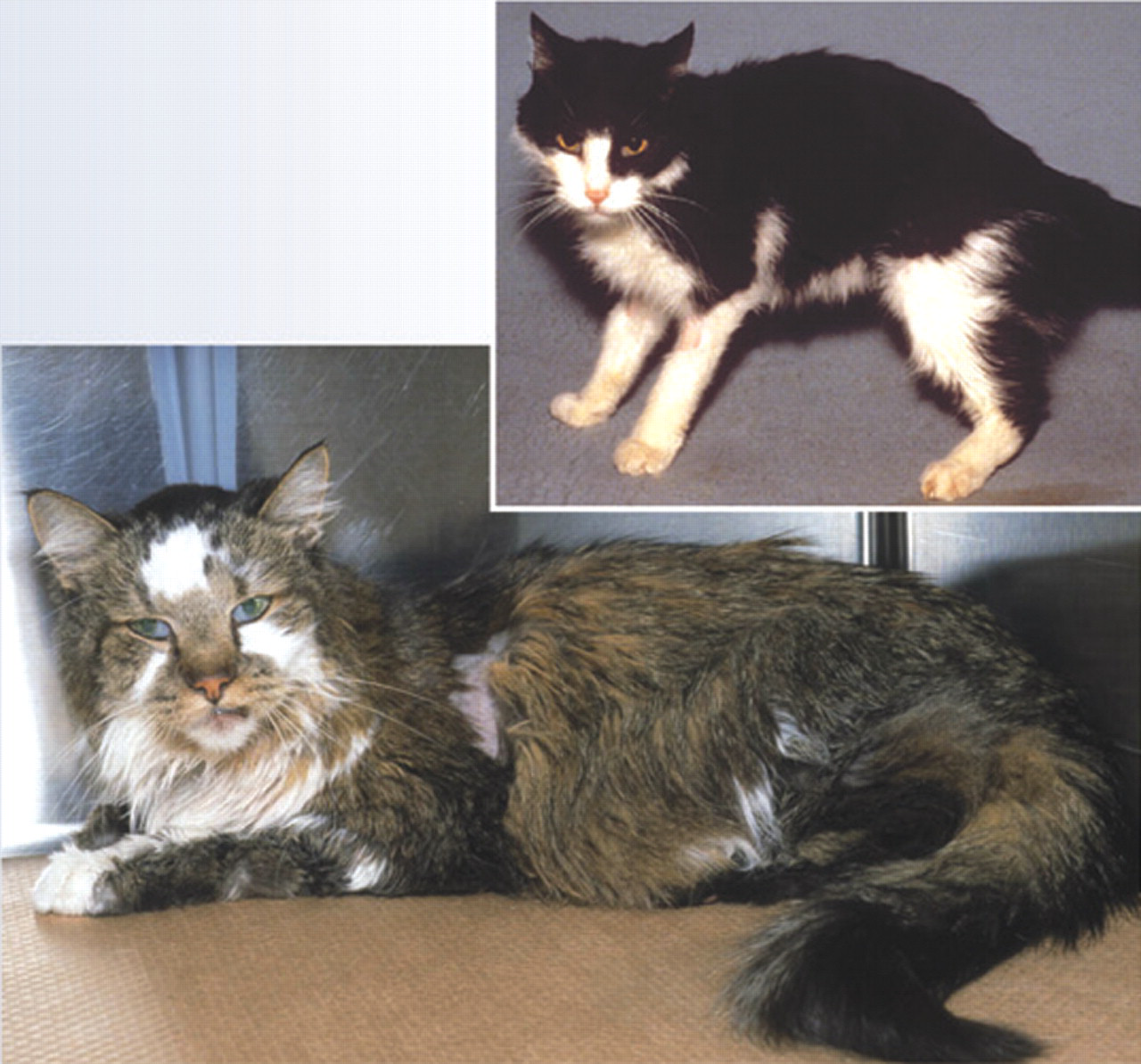
Hyperthyroid cats, showing weight loss and an unkempt coat. Courtesy of Dr Scott-Moncrieff
Similarities with thyroid disease in humans
The etiology of FH is unknown, but likely includes host (age, sex) and environmental factors, including diet. 10 The histological appearance of FH resembles toxic nodular goiter (TNG) of humans, 11,12 with discrete foci of benign adenomatous hyperplasia. 13 Toxic nodular goiter is typically diagnosed in humans 50–70 years of age, is more common in women than men, and is characterized by an asymmetrical goiter with an insidious onset that rarely resolves spontaneously. 14 Feline hyperthyroidism generally develops in cats 6 years of age or older and is more prevalent in females than males. 9 The onset of FH is also insidious and a goiter is usually palpable on clinical presentation. The etiology of TNG includes iodine deficiency 15–17 and consumption of or exposure to goitrogens in food, water and the environment. 18
Four US and three additional case-control studies have identified host, dietary and environmental risk factors for FH (Table 1). 8,9,19–25 Iodine content of the diet has been suggested as a likely etiologic factor in FH. 26 In a recent case-control study, cats consuming commercial foods without iodine supplementation, according to listed ingredients, were more than four times as likely to develop hyperthyroidism compared with cats that ate iodine-supplemented foods. 23 To date, however, the presence of iodine deficiency or excess in the diet of hyperthyroid cats has not been documented.
Risk factors for feline hyperthyroidism identified in case-control studies

This was not explicitly reported but apparent from the context
In humans, thyrotoxicosis has been linked to excess iodine consumption through food, water or milk following periods of iodine deficiency, especially in people with thyroid disease such as TNG. 15,17,27 Iodine-induced thyrotoxicosis has been described as an iodine-deficiency disorder. 27 Feline hyperthyroidism resembles iodine-induced thyrotoxicosis in humans and rabbits: those with no underlying thyroid disease have tolerated a large quantity of iodine added to their diets, while those similarly fed but with underlying thyroid disease and/or iodine deficiency have demonstrated clinical signs of hyperthyroidism. 17,28–30 Overt hypothyroidism has been reported in cats, including lions and domestic cats fed laboratory diets comprised of all meat and low iodine. 31–33 Healthy cats tolerated 5000 μg iodine/day in laboratory diets, while hypothyroid cats supplemented at this level showed clinical signs of hyperthyroidism including weight loss, fever and tachycardia. 34
Iodine supplements
Nearly all commercial cat foods today are supplemented with some form of iodine (see box below). 35 In a feeding study of cats, renal excretion of iodine was approximately 100%. 36 However, the bioavailability of individual supplements has not been determined for cats. In cattle feed, the bioavailability of calcium iodate was reported to be 88–95% that of potassium iodide for supplementation, while the bioavailability of EDDI was 105% that of potassium iodide. 37
Common supplements
The most common iodine supplements are potassium iodide, calcium iodate and, to a lesser extent, ethylenediamine dihydriodide (EDDI). Iodine supplements may also include dry kelp, iodized salt or sea salt. One molecule of potassium iodide with a molecular weight of 166 contains 76.5% iodine, while one molecule of calcium iodate with a molecular weight of 390 contains 65% iodine. Thus, on a per gram basis, calcium iodate contains 85% of the iodine of an equivalent weight of potassium iodide, and 15% more calcium iodate would be required in the diet to achieve the same iodine intake.
History of iodine supplementation recommendations
1960s
The National Research Council (NRC) published dietary iodine requirements for cats in 1962. 38 These guidelines — Nutrient Requirements of Laboratory Animals — contained recommendations for cats based on studies of kittens fed all-heart (low iodine) diets and control diets (iodine content 200–300 μg/day) that contained primarily potatoes, cereals and fish. 38–42 These studies were designed to determine calcium requirements in growing kittens. It was reported that kittens fed a heart-only diet with a low calcium: phosphorus ratio and no iodine supplementation developed thyroid hyperplasia followed by atrophy, compared with kittens on long-term heart-only diets supplemented with 100 μg iodine/day, for a total iodine concentration of between 105 and 140 μg/day. Some thyroid hyperplasia occurred in kittens on the heart-only diet supplemented with calcium carbonate and 50 μg iodine daily, for a total iodine concentration of between 55 and 90 μg/day. Kittens on the control diet did not develop thyroid hyperplasia. The authors concluded that iodine supplementation of a heart-only diet, at 100 μg iodine daily, prevented thyroid hyperplasia. One of the authors later concluded that supplementation of cat foods with 150–400 μg iodine/day was satisfactory. 34
1970s and 1980s
In the next two NRC editions of Nutrient Requirements of Cats, 43,44 the iodine requirement was stated as 1400–4000 μg/kg dry diet, and a minimum iodine level of 350 μg/kg dry diet for growing kittens was recommended. An adjustment factor of 1.3 times was advised for minimum values of iodine and certain other minerals to account for varying levels of bioavailability in formulated diets. 44
1990s
In 1991, the Feline Nutrition Expert Subcommittee of the Association of American Feed Control Officials (AAFCO) set the iodine minimum for cat foods for all life stages (growing, reproduction, adult maintenance) at 350 μg/kg dry weight for a diet with 4 kcal/g metabolizable energy (ME). 45,46 This minimum value was part of the cat food nutrient profile meant to replace the NRC recommendations for formulated diets. 46 In contrast, the AAFCO standard for iodine for dogs was 1500 μg/kg dry diet minimum and 5000 μg/kg dry diet maximum for a diet with 3.5 kcal/g ME. 45 This minimum value for dogs was nearly four times as great as for cats at an equivalent ME level. In comparison, the human adolescent and adult recommended daily allowance of iodine is 150–200 μg/day. 47
2000 and beyond
In 2006, the NRC published updated recommendations for cat and dog nutrient concentrations. 48 Iodine supplementation recommendations cited feeding trials conducted in the mid-1990s and early 2000s, 36,49 and are now stated in units of μg/1000 kcal ME. 48 The recommendations increased the daily iodine concentration for kittens and adult cats, but the concentration may remain insufficient compared with early feline and current human recommendations.
The published daily iodine recommendations for cats are summarized in Table 2.
Summary of recommended daily iodine requirements for cat foods
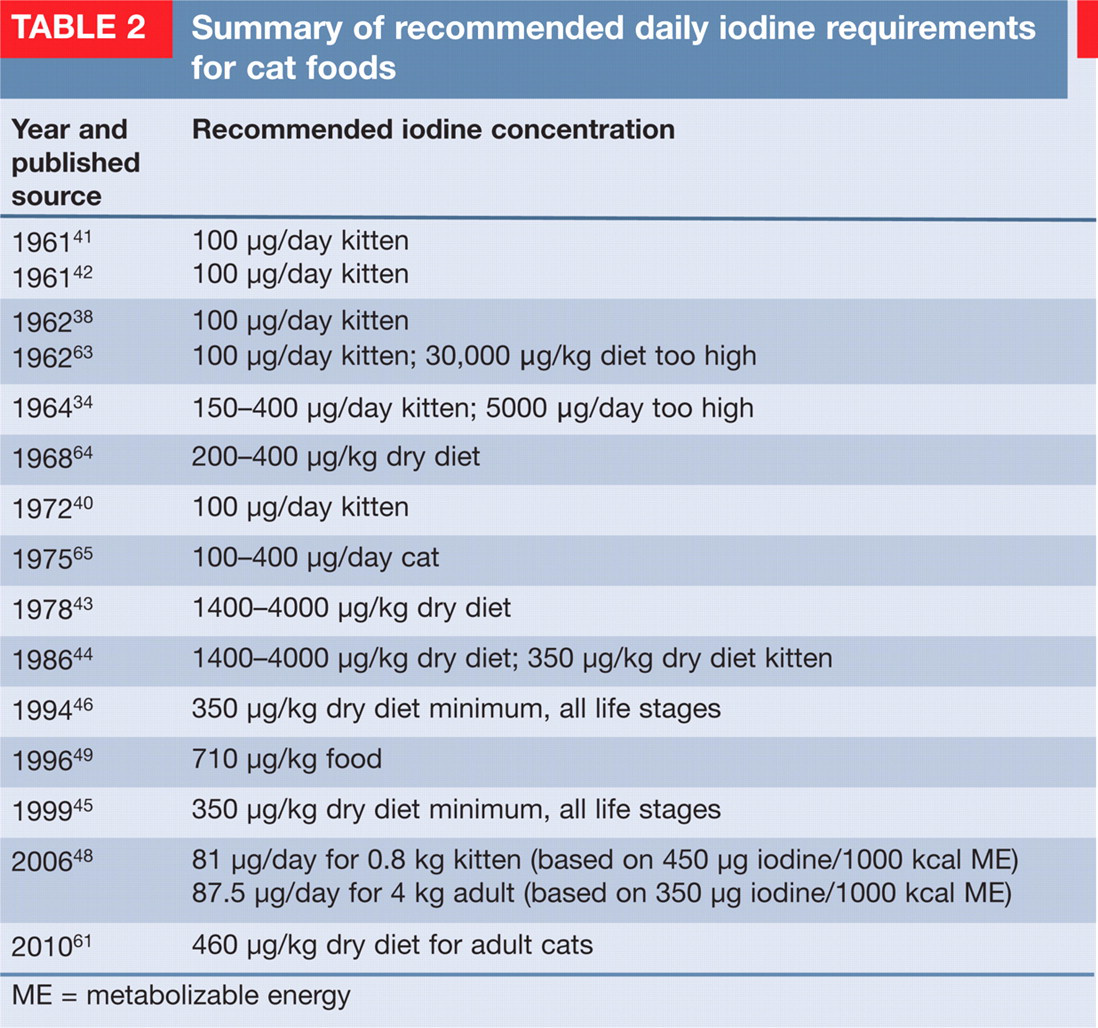
ME = metabolizable energy
Equivalent iodine concentration in cat foods
The iodine recommendations on a per cat basis are not convertible to a per weight of dry food basis. However, the amount of iodine consumed by a cat on a daily basis can be estimated from its daily energy requirements (DER) and manufacturers' label feeding instructions. The DER is defined as the activity constant k multiplied by the resting energy requirement (RER). RER is 70(BW)3/4, where BW is a cat's body weight in kg, and the activity constant for an adult cat is 1.3 for maintenance. 50 Therefore, for a 4 kg (8.8 lb) cat, RER is 198.0 kcal/day and DER is 257.4 kcal/day. The amount of canned or dry food a 4 kg (8.8 lb) cat must eat daily to meet its DER, illustrated using canned and dry foods produced by two major pet food manufacturers, is shown in Table 3. The difference in volume fed reflects the difference between dry and canned foods in terms of caloric density.
Volume and weight of representative canned and dry foods to meet daily energy requirement of a 4 kg (8.8 lb) cat based on label feeding recommendations

Friskies Mixed Grill;
Eukanuba Chicken and Rice Formula Cat Food;
Coffman (1997) 35 ;
Daily energy requirement;
For a 4 kg (8.8 lb) cat;
Based on 78% moisture;
On a dry matter basis;
Based on 10% moisture;
5.5 oz/3 kg (6.5 lb) BW
The daily amount of iodine provided to a 4 kg (8.8 lb) cat fed at its DER or according to these manufacturers' labels has been calculated using the iodine supplementation recommendations of the most recent NRC editions 43,44 and the superseding AAFCO publication 45 (Table 4). Compared with the early NRC iodine recommendations of 100 μg/day, 38,40 the diet of a 4 kg (8.8 lb) cat is likely to be deficient in iodine if its food is supplemented according to the minimum iodine supplementation recommendations of the later NRC or AAFCO publications. The most recent NRC recommendations suggest that a 4 kg (8.8 lb) cat would have an iodine intake of 87.5 μg/day if it consumed 250 kcal ME/day of food containing 350 μg iodine/1000 kcal ME. 48 This corresponds to 21.9 μg iodine/kg BW per day.
Estimated iodine consumed, on a dry matter basis, by a 4 kg (8.8 lb) cat based on daily iodine recommendations, daily energy requirements and representative dry and canned food label feeding recommendations

NB These values should be compared with recommendations of 100 μg/day from earlier NRC editions. 38,40 Using the 2006 recommendations, 48 a 4 kg cat consuming 350 μg iodine/1000 kcal ME would consume 87.5 μg iodine/day. Thus, as of 1978, cats consuming foods supplemented with iodine at the minimum recommended concentration would be iodine deficient
The iodine concentration recommended by the NRC for kittens may also be deficient. A kitten weighing 0.8 kg and consuming 180 kcal ME/day of food containing 450 μg iodine/1000 kcal ME would have an iodine intake of 81 μg/day. 48
Iodine in commercial diets
In one study, performed in the mid-1980s, the iodine content of seven of 13 commercial cat foods exceeded the maximum iodine recommendations (range 1000–36,800 μg iodine/kg dry diet). 26 Most of the sampled cat foods contained added iodine in synthetic form. In another study of 28 varieties of commercial canned and dry cat food, reported in the early 1990s, 51 two canned food varieties had iodine concentrations that greatly exceeded the upper limit of recommended iodine concentrations for adult cats at that time, 44 while the iodine concentration in six others was below the limit of detection (range non-detectable to 21,200 μg iodine/kg dry diet). 51 The widest variation in iodine content was in canned food. In a study of 92 commercial canned and dry foods in Germany, the iodine concentrations varied by a factor of 30 (canned food range 220–6400 μg iodine/kg dry diet; dry food range 470–3200 μg iodine/kg dry diet). 36
Thus, between the 1980s and early 2000s, iodine concentrations appeared to range between non-detectable levels and excessive levels in a variety of tested commercial cat foods.
Assessing the impact of changing iodine concentrations
A number of feeding trials have been performed in cats specifically to assess the impact of changing iodine concentrations.
The thyroid's response to iodine deficiency or excess
The response of the feline thyroid to iodine deficiency or excess has been extrapolated from other species. In iodine deficiency, chronic stimulation of the thyroid to produce sufficient thyroid hormones leads to hypertrophy and eventual nodular hyperplasia. 47 During periods of iodine excess, iodine transport into the thyroid is temporarily inhibited, and stimulation of the thyroid to release thyroid hormones is decreased through negative feedback to the anterior pituitary. 55–60
Dietary trials were conducted with canned and dry foods of ‘low’, ‘medium’ and ‘high’ iodine content (101.5, 2220.7 and 13,768.7 μg/kg dry matter, respectively), 52,53 and ‘low’ and ‘high’ iodine content (111.7 and 21,141 μg/kg dry matter, respectively). 53,54 When the diets were changed every 2 weeks, the serum free T4 concentrations responded inversely to the dietary iodine concentration, 52 but when low and high iodine diets were fed for 5 months, there were no significant differences in free T4 levels between the diet groups. 54
Conclusion: It was hypothesized that the cat's ability to respond or adapt to long-term changing levels of dietary iodine (see right) may contribute to the development of hyperthyroidism. 52–54
In a 9-month feeding trial, 49 a dietary iodine concentration below 0.52 ppm (or 520 μg iodine/kg food) was found to be deficient, a diet containing a concentration of 1570 μg iodine/kg food was marginally sufficient, and a diet with at least 2440 μg iodine/kg food was sufficient, based on thyroid radioiodine uptake. The T4 concentrations remained within the reference range for all cats throughout the trial. 49
Conclusion: A minimum dietary concentration of iodine of at least 710 μg iodine/kg of food was recommended. 49
A 54-day feeding trial was conducted in Germany during which iodine supplementation increased every 7 days. 36 Daily iodine concentrations in food ranged from 40.8–190.8 μg iodine/kg BW. 36 Fecal and urinary iodine excretion concentrations were determined, and the authors suggested that daily iodine supplementation at 20 μg iodine/kg BW would maintain cats in zero iodine balance and that iodine in food was approximately 100% bioavailable. 36 In this trial, urinary iodine concentration correlated well with dietary intake. 36 As iodine concentration increased every 7 days, concentrations of T4, free T4, T3 and free T3 decreased. 7 This decrease was significant for the highest concentration of 190.8 μg iodine/kg BW per day. 7
Conclusion: The authors concluded the decrease in thyroid hormone concentrations reflected autoregulation in the face of rising iodine concentration. 7 This is similar to the internal regulation of thyroid function described for rats. 55,56
In a 1-year feeding study, diets based on corn gluten meal and corn were supplemented at seven concentrations of potassium iodide, ranging from 17–880 μg/kg dry matter, to determine the appropriate dietary iodine concentration for cats. 61 The concentration was determined using the plotted regression of the ratio of technetium pertechnetate in the thyroid to the salivary glands with respect to iodine intake at 1 year and iodine balance at 9 months. 61 Other biomarkers, including serum, fecal and urinary iodine concentrations, were measured at specified intervals. 61 Further, the authors discussed the methodology of feeding studies, suggesting that earlier study diets were not appropriately balanced to specifically discern the impact of varying dietary iodine concentrations in study cats, were not fed over a sufficient time period, did not contain sufficiently different iodine concentrations, did not account for other nutritionally important elements, and did not assess relevant biomarkers of nutritional status. 61
Conclusion: The authors estimated the minimum dietary iodine concentration for cat food should be 460 μg/kg dry matter. 61
In a study of cats with urinary iodine concentrations sampled between 1994 and 2007, untreated hyperthyroid cats excreted decreased concentrations of iodine in urine compared with euthyroid cats, after controlling for renal disease, though considerable intra-cat variation in urinary iodine concentration was observed. 62 In the 2–6 weeks following treatment for hyperthyroidism, urinary iodine concentration increased significantly. 62 Iodine concentration in food was not measured but the median iodine intake per day was estimated to be 41 μg/kg BW for euthyroid cats without azotemia. 62
Conclusion: The authors suggested that hyperthyroid cats had a pool of stored iodine that was excreted in the weeks following treatment. 62 They suggested that if the urinary iodine concentrations of the hyperthyroid cats in their study reflected iodine intake while the disease was developing, inadequate iodine intake may be a risk factor for hyperthyroidism. 62
Food labels and feeding choices
Explicit labeling of iodine supplements may not guarantee that a given food contains sufficient iodine to meet a cat's requirements; equally, the lack of such labeling does not imply that iodine content is deficient in packaged food. Flavor names may also not correlate with labeled ingredients and so may not provide sufficient information for consumers about the iodine concentration of commercial foods. Thus, veterinarians and owners may not be able to determine from commercial cat food labels whether foods contain adequate concentrations of iodine.
However, as more commercial cat foods are adequately supplemented with iodine, and providing iodine content is clearly indicated on the label, owners and veterinarians can reduce the risk of cats developing FH by referring to these labels when selecting foods for cats.
KEY POINTS
Acknowledgements
This work was supported by a fellowship in Epidemiology and Animal Welfare to Dr Edinboro from the Kenneth Scott Charitable Trust, and presented in part at the 76th Annual Meeting of the American Thyroid Association, Vancouver, BC, Canada, in 2004. The authors wish to thank Dr Fionna Mowat, Dr Lisa Eastep, Patti Warden and Nadine Russell for assistance with the manuscript. The picture of a cat with a thyroid nodule was provided by Dr Andy Sparkes.