





Abstract


The cat is somewhat unusual!
While the cat shares some individual aspects of its reproductive physiology with other domestic species, overall it can be considered as somewhat unusual.
Cats enter puberty from 4–12 months of age — depending on season, day length, body weight and breed; in longhaired breeds puberty may be delayed up until 11–21 months of age. The queen is seasonally poly-oestrus and an induced ovulator, with mating triggering ovulation (Fig 1). 1 Receptors in the vagina are stimulated during coitus, resulting in a release of luteinizing hormone (LH). Repeated matings ensure adequate LH release for ovulation. However, spontaneous ovulation may occur in up to 60% of queens. 2 A simplified description of the neuroendocrine regulation of reproduction in the cat is given on page 540.

Several matings are normally necessary to induce ovulation. During mating, the torn mounts the female and grasps her neck. Vocalisation of the queen during coitus is common
The duration of oestrus varies depending on whether the cat is mated and ovulates, with or without subsequent pregnancy. The interoestrous interval is 9.0 ± 7.6 days in queens that are not mated and about 45 (35–76) days in queens that are mated but do not get pregnant. 1,3 Following a successful mating, conception is observed 12–64 h after ovulation and implantation occurs on about day 13. The duration of pregnancy is approximately 66 (52–74) days. 3 Pregnancy and pseudopregnancy result in an interruption in the periodic release of oestradiol, and instead progesterone is produced by the corpora lutea.
Neuroendocrine control of reproduction in the cat

The breeding queen
Induction of oestrus
Oestrus induction may be requested by a cat owner wishing to breed at a specific time. Although not available in every country and not licensed in cats, several protocols using equine chorionic gonadotropin (eCG) and human chorionic gonadotropin (hCG) have been published, with variable efficacy. 4 The injection of 100 IU eCG (Intergonan; Intervet, Germany) intramuscularly (IM) is easy and successful in most cases. On day 2 of induced oestrus, 100 IU hCG (Ovogest 1500; Intervet, Germany) should be injected IM before mating. Note, however, that any illness or reproductive pathology (eg, progesterone-producing ovarian cysts), inadequate animal husbandry and nutrition, and sexual immaturity are contraindications to medical induction of oestrus and ovulation.
Induction of ovulation
Induction of ovulation may be necessary in the case of permanent oestrus, for induction of pseudopregnancy to prolong the inter-oestrous interval, or when artificial insemination is to be performed. Ovulation can be induced by injection of 100 IU hCG (Ovogest 1500) IM or GnRH agonists (eg, 0.8 μg buserelin, Receptal, Intervet, Germany) IM or subcutaneously (SC) when the queen is in oestrus. Alternatively, the vaginal mucosa can be stimulated by gently rubbing with a cotton swab, mimicking mating by a tom, to induce an LH surge. It may be necessary to repeat this procedure several times to achieve sufficient LH concentrations to induce ovulation.
Unwanted pregnancy — what to do and when
Unwanted and unobserved reproduction is common in sexually mature pet cats with outdoor access, with pregnancy usually being detected quite late on in gestation. Fetal parameters could be measured by ultrasound to estimate the date of parturition. 5 However, if a cat is presented immediately after an observed unwanted mating, it should first be checked for evidence of mating (ie, signs of scratching and biting, spermatozoa in a vaginal smear).
The use of oestrogens, causing closure of the uterotubal junction and therefore inhibiting the transport of the embryo, is very effective, but due to the risk of side effects (especially pyometra), these injections are not recommended. 6 Repeated injection of prostaglandin (PG) F2α for induction of abortion in the last trimester has been described, with significant side effects (salivation, vomiting, diarrhoea) and variable success rates (25–75%, n=4). 7 Dopamine agonists (cabergoline) have been used for induction of abortion from day 30 onwards to reduce pregnancy-maintaining prolactin concentrations, but results are contradictory so far. 7–9 Combined treatment with PGF2α and cabergoline was more successful and side effects were significantly reduced, but still observed. 9,10
A newer alternative is the use of antiprogestins that are registered in Europe for termination of pregnancy in the bitch from day 0–45 after mating. As progesterone is necessary for maintenance of pregnancy, its withdrawal (ie, by blocking progesterone receptors with antiprogestins) results in opening of the cervix and allows spontaneous contractions of the myometrium. Aglepristone (Alizin; Virbac, Germany) treatment has also been proven to be safe and effective for early, midterm and late pregnancy termination in the queen. Reported success rates range from 100% for treatment on days 5/6 after mating, 11 through 87–88.5% for treatment on days 25/26 12 or 33.3 ± 4.2, 13 respectively, to 67% for treatment on days 45/46. 14 Two injections on consecutive days are recommended; in studies, the author has always successfully used a dose of 10 mg/kg, while the manufacturer's off-label recommendation is 15 mg/kg. Due to variable success rates following mid-term or late termination of pregnancy, an ultrasound examination should be performed to ensure that abortion is complete. In the author's opinion, the use of aglepristone is the current method of choice for the prevention of implantation and mid-term termination of pregnancy, due to the low risk of side effects and high efficacy.
Reproduction control — alternatives to surgical contraception
Given that surgical contraception is not always the owner's wish, and that ethical principles and animal welfare legislation in various countries are increasingly imposing restrictions on this ‘classical approach’, there is a need for alternative approaches that may also preserve future reproductive potential. A variety of methods have been studied, which in general are based on interference with endocrine regulatory mechanisms. These include:
Application of progestins, causing a negative feedback effect on the pituitary;
Immunisation against endogenous GnRH or LH;
Application of GnRH agonist implants, leading to downregulation of the hypothalamo-pituitary-gonadal axis;
Use of melatonin implants.
What effect do progestins have?
The administration of progestins is the traditional alternative to surgical removal of the gonads in female cats. 15 They act by inhibiting the release of gonadotropins through a negative feedback mechanism on the pituitary gland. It is highly recommended that treatment is started in anoestrus, to reduce the risk of uterine disease. Recognised contra-indications to progestin use are immaturity (ie, pre-pubertal administration), pregnancy, coexistent reproductive pathologies and mammary tumours.
Without sufficient care, progestin treatment may induce severe and sometimes even life-threatening side effects 5 such as cystic endometrial hyperplasia-pyometra complex, 16 mammary tumours and fibroadenomatosis, 17,18 and insulin resistance causing diabetes mellitus. 5 Other, common side effects associated with treatment are lethargy, depression, increased appetite resulting in weight gain, polyuria/polydipsia and coat changes at the injection site. 19 Epidermal atrophy and cutaneous xanthomatosis have been described. 19 The risk of side effects is significantly higher in animals already predisposed to specific diseases (eg, with subclinical diabetes mellitus or cystic endometrial hyperplasia), or undergoing long-term (ie, several years) treatment. 20 Another factor leading to side effects is the use of fixed dosages per cat, as opposed to a dosage based on the individual animal's weight; however, reliable data for dosing according to body weight are not actually available. 20
Aglepristone (Alizin) treatment protocol

Whereas in Great Britain, Australia and the USA megestrol acetate (MA) is predominantly used, proligestone (PRG) and medroxyprogesterone acetate (MPA) products are registered in some other countries, including Germany. Treatment with PRG in interoestrus may be more effective than treatment with MA, according to the results of one study (see right). 21 In the same study, the risk of side effects was significantly lower when PRG was used compared with MA. 21 However, this might be related to the high dosage of MA used; another study found that oral administration of 5 mg per day MA for 16 consecutive days resulted in adrenocortical insufficiency. 22 Treatment during oestrus is not routinely recommended.
How do different progestins compare for oestrus suppression in queens?
Treatment with PRG (30 mg SC) in interoestrus appears to be more efficient compared with treatment with MA (25 mg SC). In one study, no further oestrous signs were observed after 2.85 ± 0.75 days (PRG) compared with 2.93 ± 1.35 days (MA); and the duration of effect was 8.0 ± 2.2 months (PRG) versus 3.3 ± 1.01 months (MA). 21 Treatment during oestrus resulted in suppression of oestrus for 7.57 ± 2.35 months (PRG) and 4.9 ± 2.65 months (MA), respectively. 21
Experimental implantation of six rods of levonorgestrel (Norplant, one rod contains 36 mg) in cats resulted in at least 30 days' suppression of ovarian activity commencing after 7 days; following removal of the implant, the next oestrus was observed 11–79 days later. 23
Is immunisation against GnRH or LH efficacious in cats?
Active immunisation against LH and GnRH has gained widespread acceptance as a means of controlling reproduction and associated behaviours in farm animals (eg, Improvac; Pfizer Animal Health, is an anti-GnRH vaccine used in pigs). 24 However, until now the efficacy of these vaccines has been shown to be limited in companion animals, especially cats.
To increase the low immunogenicity of the decapeptid GnRH it has to be bound to an immunogenic compound (eg, Freund's adjuvant, tetanus toxoid or parts of distemper virus). Additionally some species differences seem to exist. Whereas a vaccine against luteinizing hormone-releasing hormone (LHRH) conjugated to tetanus toxoid was highly effective in reversibly blocking steroidogenesis and spermatogenesis in male dogs, antibody titres in toms showed high individual variation among treated animals and did not correlate with testosterone concentrations or fertility. 25 Bovine LH receptor implants (day 0) and LH receptor protein as repeated injections (days 98, 139, 160, 193) were used for immunogenic stimulation in another study in female cats. 26 Hormone concentrations in treated animals were significantly lower than those of control animals, with a duration of effect of about 501 days as indicated by a significant decrease in LH antibody titres. However, currently no GnRH or LH vaccine is registered for use in companion animals.
A discussion of the effect of immunocontraception against sperm antigens, zona pellucida proteins, and so on, is outwith the scope of this article. For a review see Kutzler and Wood. 15
How do GnRH antagonists and agonists affect the feline reproductive cycle?
GnRH antagonists reversibly block the action of GnRH by binding to the pituitary GnRH receptors. Two injections of 6 mg antide, a GnRH antagonist, within 15 days have been shown to suppress ovarian activity within 17–56 days. 23
GnRH agonists can be used for short-term suppression of oestrus. One study demonstrated induction of ovulation, leading to a prolonged interoestrous interval, in 84.2% of queens within 3 days of a single injection of 50 μg of buserelin. 21
Continuous exposure to a GnRH agonist, and thus long-term contraception, can be achieved via a slow-release implant. Following initial stimulation of LH and FSH secretion, these implants act by downregulation of pituitary GnRH receptors and negative feedback. 27 The successful use of GnRH agonist implants for temporary suppression of ovarian function has been described in queens. 15,28,29 The injection of a 6 mg deslorelin implant suppressed oestrus, following an initial stimulatory effect as indicated by an oestradiol increase, in 10/10 cats. 28 An oestradiol peak was measured in one cat 155 days after initial treatment and, therefore, 5/10 cats were implanted again. The end of efficacy (determined by the first oestradiol peak >20 pg/ml) was observed 11.1 ± 2.9 months after one implant and 11.0 ± 2.3 months after two implants. 28 Rubion and Driancourt 29 found that following the use of an implant containing azagly-nafarelin (Gonazon; Intervet Pharma, France), 6/6 treated queens showed effective hormonal contraception with cessation of oestrus signs for 3 years. However, clinical signs of oestrus may initially be induced by treatment (2/6 cats). 29
Use of GnRH agonist implants
Queens
The mean duration of effect of GnRH agonist implants for oestrus suppression in queens (deslorelin, Suprelorin; Virbac) is about 11 months. Some owners might decide that they want to breed from their cat within this period of time, necessitating a return to normal oestrus. Usually implants are injected between the shoulders (Fig 2) and anaesthesia is not necessary. As in the dog, implantation in the umbilical area, instead of the neck, makes removal of the implant possible should this become necessary. Normally, the implant can be easily palpated at the umbilical area; the hair coat is clipped, the area is disinfected and following local anaesthesia (eg, with 2% procaine hydrochloride) and incision of the skin, the implant can be removed. Due to the fact that all effects of downregulation are fully reversible, the queen will soon return to oestrus. Care has to be taken that the implant is removed completely, because the consistency of the lipophilic matrix means that the implant sometimes breaks in situ. Flushing with warm 0.9% saline is advised following removal.

Implantation of a GnRH agonist implant containing deslorelin (Suprelorin; Virbac) in a cat. General anaesthesia is not necessary if the cat is easy to handle
Toms
Implantation of slow-release GnRH agonists for reproduction control in toms results in initial stimulation, with increased testosterone levels. Hormonal downregulation (identified by basal testosterone concentrations, <0.1 ng/ml), with effects similar to castration, is achieved 4–8 weeks, or in some cases 12 weeks, after treatment. Clinical experience suggests the duration of effect is between 6 and 18 months. Removal of the implants after implantation in the umbilical area offers the opportunity to shorten this duration of effect.
Until now, no data about reversibility have been published. Rubion and Driancourt 29 reported that none of the queens studied conceived 6 months after removal of the implant, although ovarian weight and diameter of the uterine horns were shown to be similar to those of the controls. The author's own unpublished observations, restricted to some clinical cases, have been that queens that have mated in naturally occurring oestrus following GnRH agonist treatment conceived and delivered healthy kittens.
The 4.7 mg deslorelin implant Suprelorin (Virbac, France) is registered for use in male dogs to induce temporary infertility. Currently, this is the only GnRH agonist that is commercially available in Europe.
Melatonin implants — a new short-term alternative in queens?
The cat is a seasonal (‘long-day’) breeder, with cyclicity influenced by daylight hours and, in turn, melatonin concentrations, and decreasing sexual activity associated with a decreasing photoperiod. Exogenous melatonin may mimic this effect and has, therefore, been described in cats for intravenous (IV), SC and oral (PO) administration.
Oral administration of melatonin for 30–35 days (given 3 h before ‘lights-off’) effectively and reversibly suppressed oestrus in cats without any side effects. 30 However, because permanent oral administration is impractical as a daily routine and clinical practice, melatonin implants have been tested for their efficacy in controlling feline reproduction and seem to offer a promising new alternative for short-term oestrous cycle control in the queen, preserving future reproduc-potential (see left). All effects on fertility are fully reversible and, in one study, mating at the end of treatment resulted in pregnancy rates of 75%. 31 Whereas in an earlier study one cat suffered from uterine pathology after treatment, 32 no side effects were observed in the investigation by Gimenez and colleagues. 31 Further studies with more animals are necessary to better evaluate the risk of side effects.
Efficacy of melatonin implants
Whereas melatonin implants containing 12 mg suppressed oestrus in 3/4 cats only, Gimenez et al 31 showed that 18 g implants (Melovine; CEVA Santé Animal, France) were highly effective (9/9 cats). Treatment in interoestrus resulted in a prolonged duration of effect compared with treatment in oestrus (113.3 ± 6.1 days vs 61.1 ± 6.8 days). Initial oestrus induction for 2–3 days was observed in 3/9 (33.3%) cats in interoestrus and 7/9 cats (7.8%) in oestrus.
What about the tom?
Treatment with progestins is also the traditional alternative to gonadectomy in male cats, 15 reducing sexual behaviour including mounting and mating, urine marking and aggression. The effect on spermatogenesis has not been published to date. In male dogs, it is known that daily treatment with MA (2–4 mg/kg PO or 4–10 mg/kg SC) has no influence on sperm quality. Adverse effects were only observed after experimental use of 20 mg/kg SC, which is 10 times the pharmacological dose in dogs. However, severe side effects, as reported in queens, are also observed in toms (fibroadenomatosis, mammary tumours and diabetes mellitus).
Case notes
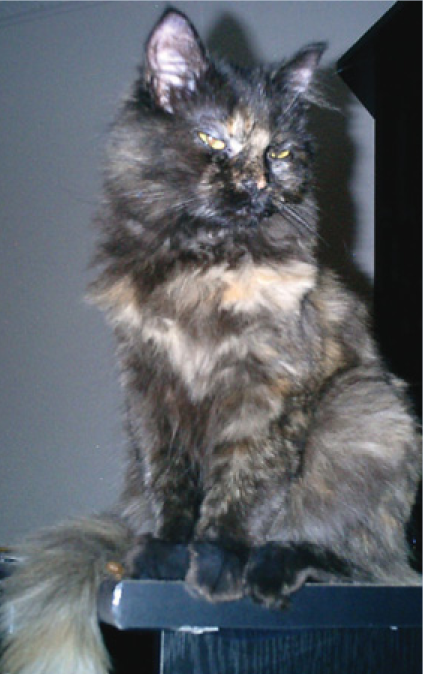
Progestin treatment, because the risk of side effects is low.
Immunisation using Improvac, because this has been shown to be highly effective in the cat.
GnRH agonist implants (Suprelorin), because suppression of oestrus for >1 year has been requested.
Melatonin implants, because of their duration of effect when administered in interoestrus.
Suprelorin is registered for use in the dog only.
Side effects, such as diabetes mellitus, are common following Suprelorin treatment.
Induction of oestrus following implantation is possible.
GnRH antagonists and progestins have to be combined with GnRH agonist implants to make sure that no oestrus induction occurs.
(c) Long-term, but not permanent, suppression of oestrus is required. Progestins cause side effects, especially with long-term use. GnRH vaccines, like Improvac, have not been successfully tested in cats yet. Injection of a melatonin implant would be possible; however, due to the duration of effect of about 3–4 months when administered in interoestrus, repeated treatment will be necessary. GnRH agonist implants containing deslorelin have a longer duration of effect, with a mean of 11 months, which is suitable for this owner and cat.
(a, c) The registered use for Suprelorin is implantation in male dogs for non-surgical castration. However, limited experience of its use in males and females of other species has been published. In females, as in the male, implantation may be followed first by initial stimulation, as observed by oestrus induction. Thereafter, cessation of gonadotropin secretion and basal sex steroid concentrations are observed in the queen. Other than initial induction of oestrus, no side effects have been reported in the queen following implantation of GnRH agonists. Normally the induced oestrus is temporary, but it may be fertile. It is important to make the owner aware of this in order to avoid an unwanted mating.
Seven weeks after Suprelorin implantation, Ayleen has shown no more signs of sexual cyclicity.
Hormone concentrations: progesterone 0.47 ng/ml (1.5 nmol/l), oestradiol-17β 8.0 pg/ml (29.4 pmol/l). Note that hormone testing to check for efficacy of treatment may be interesting in special cases, but is not necessary in daily practice when clinical symptoms reveal no more oestrous signs, indicating successful treatment.
GnRH agonists have been used successfully for the control of reproduction in toms (see box on page 543), without any observed adverse sequelae. 33 Treatment produces similar effects to those seen in the dog, 33 including a decrease in testes size (Fig 3), and reversibility regarding breeding capability has been demonstrated in one tom. 33
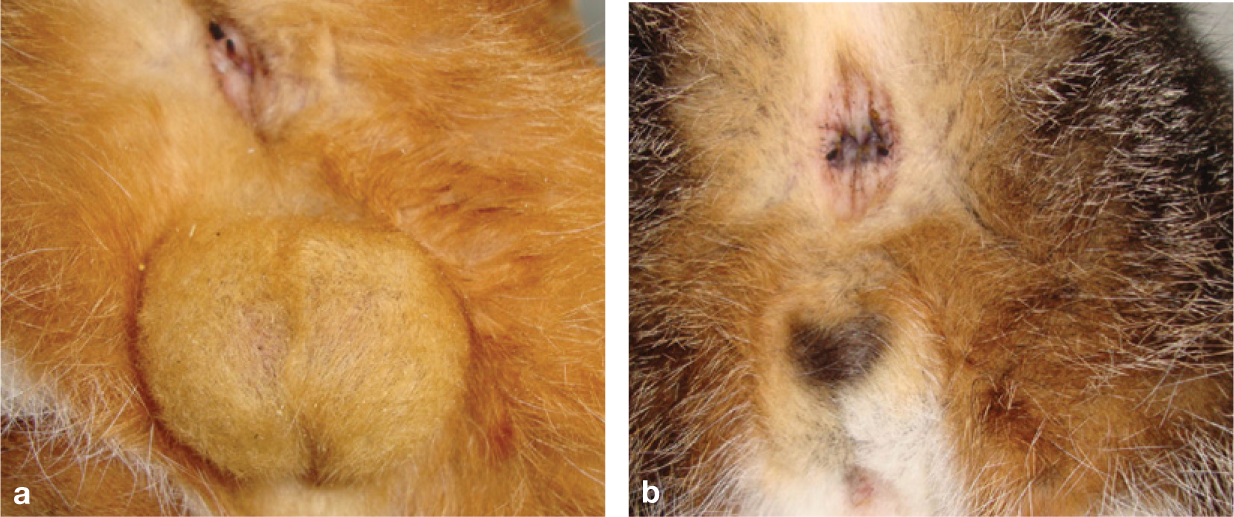
Testes of (a) a normal, intact male, and (b) a tom after implantation of a GnRH agonist implant containing 4.7 mg deslorelin at full downregulation (testosterone below detection limit, ie, <0.1 ng/ml)
KEY POINTS