






Abstract
This study investigated the thyroidal response to administration of recombinant human thyroid stimulating hormone (rhTSH) by means of serum total thyroxine (TT4) concentration and pertechnetate uptake by the thyroid gland in six healthy euthyroid spayed female cats. A pertechnetate scan was performed on day 1 to calculate thyroid/salivary gland (T/S) uptake ratio. On day 3, 25 μg rhTSH was injected intravenously. Six hours later the thyroid scan was repeated as on day 1. Blood was drawn for serum TT4 measurement prior to injection of rhTSH and performance of the pertechnetate scan. Statistically significant differences in mean serum TT4 concentration, T/S uptake ratio before and 6 h after rhTSH administration and T/S uptake ratio between left and right lobes were noted. We can conclude that 25 μg rhTSH increases pertechnetate uptake in the thyroid glands of cats, this should be taken into account when thyroid scintigraphy after rhTSH administration is interpreted.
Evaluation of thyroidal reserve with thyrotropin stimulation (thyroid stimulating hormone, TSH) in cats has gained interest in veterinary medicine, because development of iatrogenic hypothyroidism after treatment of hyperthyroidism with radioiodine (131I) can occur in 6–30% of cases. 1–5 The combination of basal serum total T4 (TT4) and endogenous TSH concentration, possibly combined with free T4 (fT4) analysis, is recommended when diagnosing hypothyroidism. Measurement of fT4 is expensive and no feline specific TSH assay is available. 6 Stimulation with recombinant human TSH (rhTSH) could be a simple way to diagnose iatrogenic hypothyroidism in cats. Hyperthyroidism is the most common endocrine disorder in cats and 131I treatment is the treatment of choice. 7–9 Another possible application of rhTSH in cats is administration prior to 131I treatment of hyperthyroidism to enhance uptake of 131I and allow a decrease in effective therapeutic dose.
The diagnosis of hypothyroidism cannot be made solely based on a low serum TT4 concentration alone, because a variety of non-thyroidal diseases can result in low serum TT4 concentrations. 10 A dynamic thyroid function test may be required when non-thyroidal illness cannot be eliminated. Several protocols for thyroid stimulation have been described in cats using bovine TSH (bTSH) which is no longer commercially available. 11–15
RhTSH is a synthetic form of TSH obtained from a line of recombinant Chinese hamster ovary cells. 16 Several studies have evaluated use of rhTSH in dogs. 17–20 To date, only one in vivo study has described the use of rhTSH in cats: administration of 25 μgrhTSH to euthyroid cats was safe and led to an increase in serum TT4 concentration with a maximum value observed 6 h after administration. 21
Metabolic activity of the thyroid gland can be measured with technetium as pertechnetate (99mTcO4−) uptake. Pertechnetate is actively trapped by the sodium-iodide symporter (NIS) and concentrated in the thyroid in a similar way as iodine, but not incorporated in thyroid hormones. Pertechnetate has ideal imaging characteristics, is readily available, relatively inexpensive, and concentrated in the thyroid and salivary glands which are visible on the scintigraphic thyroid scan. With computer software, regions of interest (ROI) can be drawn around thyroid lobes and salivary glands. The calculated thyroid/salivary gland (T/S) uptake ratio using pertechnetate is the most commonly used parameter to determine functional status of the thyroid and is significantly correlated with serum TT4 concentration in hyperthyroid cats although not in euthyroid cats. 22,23
When different methods of thyroidal reserve assessment such as TSH stimulation and thyroid scintigraphy are being evaluated in cats, it is important to know the influence of rhTSH on thyroid scintigraphy. The influence of rhTSH on T/S uptake ratio as part of the evaluation of thyroidal reserve has not yet been investigated in cats. These preliminary data can add value to the interpretation of thyroid scans after rhTSH administration in cats evaluated for thyroidal reserve. Moreover, this would give information whether this parameter of functional status is correlated to serum TT4 concentration in euthyroid cats stimulated with rhTSH in a similar way as in hyperthyroid cats. The objective of this study was to investigate the change in serum TT4 concentration and T/S uptake ratio in euthyroid cats, following administration of 25 μgrhTSH intravenously.
Materials and Methods
Animals
This study was conducted according to guidelines for animal care, with consent of the Ethical Committee of the Faculty of Veterinary Medicine from Ghent University, Belgium. Six healthy euthyroid female spayed cats, with an average age of 2 years and body weight (BW) range of 4.0–5.2 kg (mean±standard deviation [SD], 4.7±0.4), were included. To assess the health of the cats, initial screening included physical and routine laboratory examinations (complete blood count, biochemistry and serum TT4 concentration) and urinalysis (dipstick tests, microscopic analysis, protein/creatinine ratio and urine specific gravity). Cats were included in the study when these examinations showed no abnormalities.
Experimental design
A prospective study design was used to investigate the influence of rhTSH administration on serum TT4 concentration and pertechnetate uptake. A pertechnetate scan was performed on day 1. A dose of 74 MBq (2 mCi) pertechnetate was injected intravenously and static images with a set number of 200,000 counts were acquired 30 min after injection, with a gamma camera (Toshiba GCA 901A, Exalto SA/NV, Saintes, Belgium) equipped with a low energy high resolution (LEHR) collimator. Cats were fasted for at least 10 h before the thyroid scan. Cats were held under light anaesthesia with propofol (PropoVet, propofol 10 mg/ml, Abbott Logistics BV, Zwolle, The Netherlands) and placed in ventral recumbency over the camera. ROI were manually drawn over the left and right thyroid lobes and ipsilateral salivary glands by the same co-author (E Vandermeulen) to calculate the thyroid/salivary gland (T/S) uptake ratio in both left and right thyroid lobes. On day 3, 25 μgrhTSH (Thyrogen, Genzyme corporation, Naarden, The Netherlands) was administered intravenously, which corresponds to a mean dose of 5 μgrhTSH/kg BW in the six healthy cats. The rhTSH had been dissolved in sterile water, divided in aliquots containing 25 μgrhTSH and frozen at −20°C for a maximum of 8 weeks as described by De Roover et al. 24 Aliquots were allowed to thaw at room temperature shortly before injection. Six hours later, the pertechnetate scan was repeated as on day 1.
Two blood samples were taken by jugular venepuncture, before injection of the rhTSH and before the pertechnetate scan, respectively. Serum was collected after centrifugation, aliquoted and frozen at −20°C until radioactivity had decayed for measurement of TT4 (nmol/l).
Statistical analysis
Effect of rhTSH administration on serum TT4 concentration was evaluated by a fixed effects model with period (0 versus 6 h after rhTSH administration) as fixed effect. Effect of rhTSH administration on the T/S uptake ratio was evaluated by a mixed model with cat and lobe as random effects, and rhTSH administration, side (left versus right) and the interaction between rhTSH administration and side as fixed effects. Correlation between the difference in serum TT4 concentration and difference in T/S uptake ratio was quantified by the Pearson correlation coefficient. Results were expressed as mean±SD. The statistical analysis was done with SAS version 9.1 (SAS Institute, Cary, USA) at the 5% significance level.
Results
Serum TT4 concentration ranged from 12.90–25.80 nmol/l before to 49.02–65.79 nmol/l (reference values 14.19–45.15 nmol/l) after rhTSH administration, and increased significantly (P<0.0001) from 0 h (19.14±4.65 nmol/l) to 6 h (54.40±5.91 nmol/l) after rhTSH administration. The ratio between serum TT4 concentration post TSH and baseline serum TT4 concentration was 3.0±0.6.
There was a marginal but significant effect of rhTSH administration (P=0.013) and a significant effect of side (P=0.039) on T/S uptake ratio. There was no significant interaction between the effect of rhTSH administration and the effect of side on T/S uptake ratio (P=0.925). In the left lobe, the T/S uptake ratio increased from 1.12±0.21 nmol/l to 1.27±0.22 nmol/l from 0 to 6 h after rhTSH administration. In the right lobe, the T/S uptake ratio increased from 0.97±0.10 nmol/l to 1.13±0.17 nmol/l from 0 to 6 h after rhTSH administration. The increase in T/S uptake ratio for the left and right lobes separately in six healthy cats is presented in Figs 1 and 2.
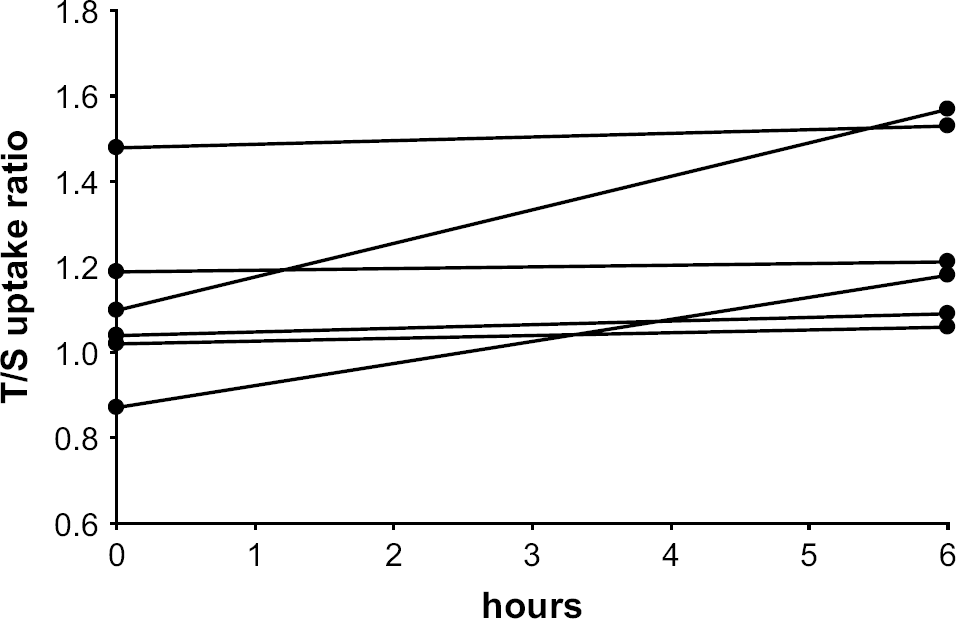
T/S uptake ratio before (0 h) and 6 h after administration of 25 μgrhTSH intravenously in six healthy cats in the left lobe.
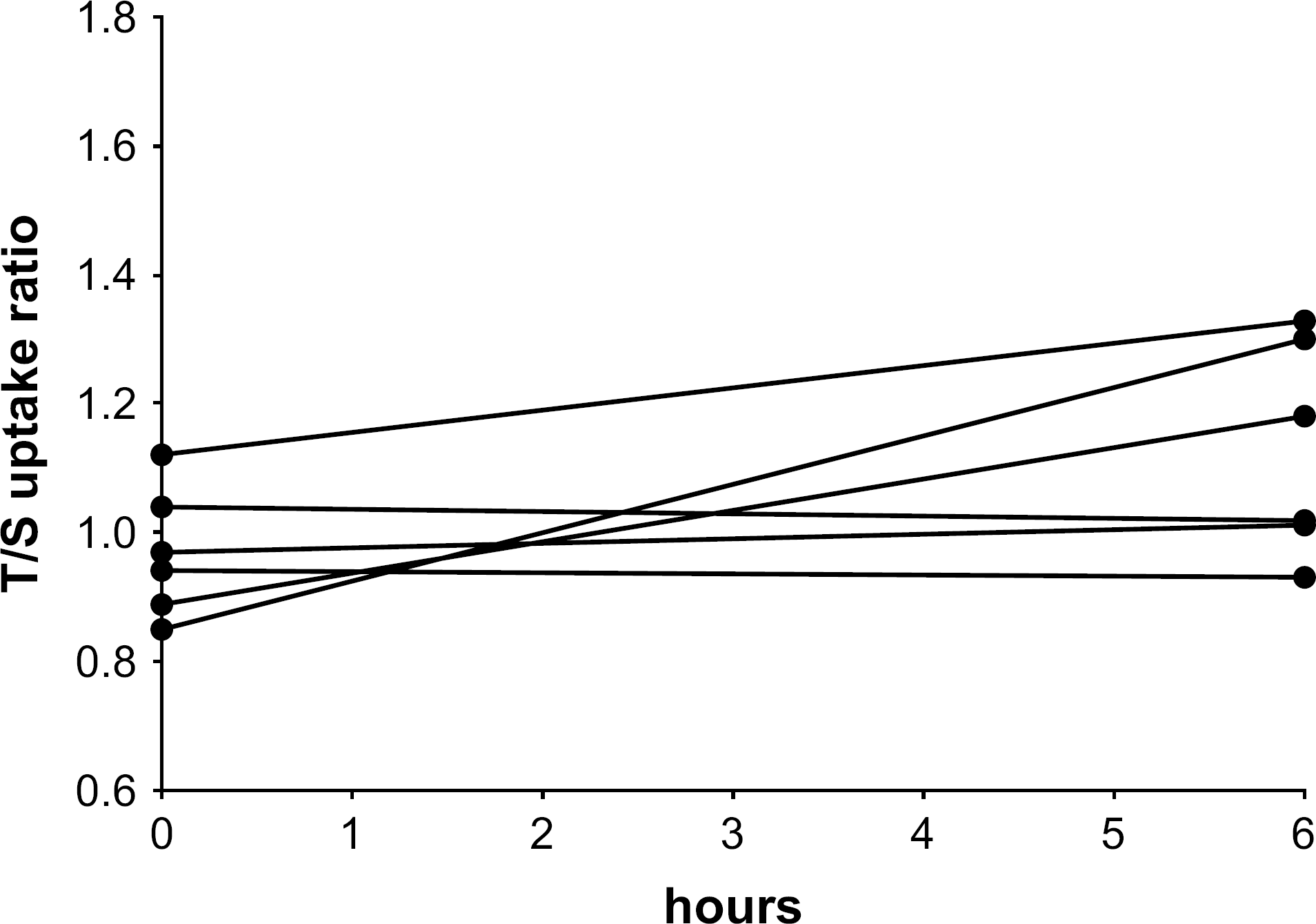
T/S uptake ratio before (0 h) and 6 h after administration of 25 μgrhTSH intravenously in six healthy cats in the right lobe.
The correlation between difference in serum TT4 concentration and T/S uptake ratio before and after rhTSH administration was −0.28 and did not differ significantly from zero (P=0.59). The correlation between the difference in serum TT4 concentration and difference in T/S uptake ratio before and after rhTSH administration in six healthy cats is presented in Fig 3.

Correlation between difference in serum TT4 concentration and difference in T/S uptake ratio before (0 h) and 6 h after administration of 25 μgrhTSH intravenously in six healthy cats for the left (x) and right (▪) lobes in six healthy cats.
Discussion
We investigated the influence of 25 μgrhTSH on serum TT4 concentration and pertechnetate uptake by the thyroid glands of six healthy euthyroid cats. The effect of TSH on circulating thyroid hormones has been investigated using bTSH and rhTSH in cats. 11–15,21 In this study, a dose of 25 μg of rhTSH caused an increase in serum TT4 concentration 6 h after administration, which is similar to the findings of Stegeman et al. 21 The 6-h period after rhTSH administration in the study by Stegeman et al 21 and our study is also comparable to TSH stimulation protocols in cats that use bTSH. 11,15
Follicular cells respond initially to binding of TSH to the TSH receptor by increased endocytosis of colloid and release of preformed thyroid hormone from the colloid in the blood. 25,26 When TSH stimulation persists, there is an increase in expression and functionality of the NIS and an increased organification of iodine into thyroid hormone. 25,27 The effect of rhTSH on the NIS can be measured by the NIS mRNA level correlating to the NIS protein level in the cell. In vitro stimulation of TSH on iodine transport activity in thyrocytes, previously starved from TSH, is partly due to a rapid increase in NIS gene expression after 3–6 h with a maximum after 24 h. The gene expression is followed by a relatively slow NIS protein synthesis after 36 h, which parallels the increased iodine uptake, reaching a maximum after 72 h. 28 The increased serum TT4 concentration after rhTSH administration can be caused by either an increased release of stored hormone or an upregulation in the production level of thyroid hormones. The time-related effects of TSH on thyroid cells described above make the latter less likely. Moreover, the thyrocytes in the in vitro study were starved from TSH which is not the case in the euthyroid healthy cats used in this study. Therefore, the response in thyrocytes not starved from TSH can be expected to be related to an upregulation of newly formed thyroid hormones and, therefore, prolonged.
A previously used index of TSH stimulation is the post-TSH/pre-TSH TT4 concentration ratio (post-/pre-TT4 ratio). 11,29 The post-/pre-TT4 ratio had an approximate value of 3 for the dose of 25 μgrhTSH in the study by Stegeman et al 21 which is comparable to the mean value of 3.0±0.6 in this study.
Several studies evaluating the use of rhTSH in euthyroid dogs or dogs suspected of hypothyroidism 17–20 use doses of 50, 75 or 100 μgrhTSH. However, when the dose per kg BW is calculated using the mean BW of the dogs, the doses of rhTSH range from 3 to 5 μg/kg BW in these studies. The post-/pre-TT4 ratio in these studies had an approximate value higher than 1.5 (3 or 5 μg/kg BW) 19 or an approximate value of 2 (3 or 4 μg/kg BW) 17,20 or 2.7 (5 μg/kg BW). 20 The cats in this study received a mean dose of 5 μg/kg BW rhTSH which is comparable to doses/BW used in dogs, although the post-/pre-TT4 ratio had a mean value of 3 in this study and the study by Stegeman et al 21 which suggests a higher biological activity of rhTSH in cats compared to dogs. The species specific β-subunit of TSH differs in exact amino acid sequence among species, however, biological cross-species reactivity allows TSH of a certain species to stimulate thyroid glands of other species, accompanied by species specific biological differences. 30 The sequence homology of α- and β-subunits from feline TSH are 96 and 94% compared to canine TSH, and 68 and 88% compared to human TSH. 31 However, a homologue glycohormone of a specific species can have lower receptor affinity compared to a heterologue glycohormone. 32 This can be caused by differences in glycosylation which alter bioactivity of the hormone. 30,33 The above mentioned reasons could explain the difference in biological effect of rhTSH in dogs and cats, however, controlled studies with rhTSH dosed per BW in dogs and cats are needed to evaluate a difference in biological reactivity between these species.
This study is the first report in veterinary medicine showing a marginal effect of rhTSH on T/S uptake ratio by the thyroid. Possibly, at first, the stored TT4 is released from the thyroid and pump mechanisms are only mildly affected, because the dose of rhTSH is possibly insufficient to reach a larger intracellular response. Also, the time interval between injection of rhTSH and image acquisition could be not optimal. Use of the isotope 123I as a tracer would have allowed us to perform measurements of functional activity post-rhTSH administration for a longer period after administration of the radio-tracer, because 123I has a half-life of 13 h opposed to 6 h for pertechnetate.
The time between the scan on day 1 and 3 was more than 60 h (10 physical half-lives of pertechnetate), therefore, less than 0.01% of radioactivity was left which is too small to be of influence. Thyroid imaging was performed 30 min after administration of pertechnetate. Nieckarz and Daniel 34 showed that the time from injection to imaging is not critical if performed within a period of 20 min to 2 h after pertechnetate administration. The LEHR collimator allowed a low dose of 74 MBq pertechnetate with a good thyroid to background distinction, compared to higher doses of 111–148 MBq described in the literature where a low energy all purpose (LEAP) collimator is often used. 23,35
Sodium-iodide symporters are also present in salivary glands. NIS gene expression and NIS protein are found in salivary glands. 36,37 Cells in the salivary gland that express NIS can accumulate though not organify iodide, and TSH exerts no regulatory influence on non-thyroid iodide accumulation. 38 It is, therefore, not expected that TSH administration influences pertechnetate uptake in the salivary gland nor that this is a reason for the marginal increase in T/S uptake ratio. Moreover, Nieckarz and Daniel showed an increased T/S uptake ratio in euthyroid cats made hypothyroid with methimazole, expected to be caused by the increased serum TSH concentration. 34
No correlation between the difference in serum TT4 correlation and the difference in T/S uptake ratio before and after rhTSH administration could be demonstrated. In the study by Daniel et al 23 there was a significant difference in T/S uptake ratio between euthyroid and severely hyperthyroid cats, but not between euthyroid and mild hyperthyroid cats. The euthyroid cats in the study reported here showed a mild increase in serum TT4 concentration, which could possibly explain the lack of correlation between the increase in T/S uptake ratio and the increase in serum TT4 concentration in this study.
There was a significant effect of side on the T/S uptake ratio. This difference in T/S uptake ratio between the left and the right thyroid lobes is, however, of limited influence in this study, because the effect of rhTSH on T/S uptake ratio is the same in the left and right thyroid lobes. Asymmetric thyroid lobes on pertechnetate scintigraphy 39 and differences in volume measured with ultrasonography have been described in euthyroid cats but not in euthyroid dogs. 40,41 It is known that in euthyroid humans, the right thyroid lobe is usually larger and more vascularised, 42 and this is suggested to be associated with functional asymmetries related to the immune system, hypophysiotrophic neurohormones, neural pathways or a combination of the latter two factors. 43,44
The study described here could open doors to further research. In humans with nodular goitre the administration of rhTSH has gained major application because administration of rhTSH increases the uptake of 131I in the thyroid and changes the regional distribution of 131I. 45,46 This results in lower therapeutic doses needed and less irradiation to extra-thyroidal tissue. 47–49 A lower efficacious dose of 131I in cats with hyperthyroidism will reduce the surface dose-emission rate, urine radioactivity and the duration of isolation for cats treated with 131I, thereby respecting the ‘as low as reasonably achievable’ (ALARA) principle. 50,51
We can conclude from this study that the uptake of pertechnetate by the thyroid of euthyroid cats is marginally though significantly increased 6 h after administration of 25 μg rhTSH, and that this increase is not correlated to the increase in serum TT4 concentration.
Footnotes
Acknowledgements
This work was funded by a BOF-grant from Ghent University, Belgium.