






Abstract
N-butyl-cyanoacrylate tissue adhesive was evaluated as a skin closure material in a population control programme. Fifty-two female cats underwent ovariohysterectomy: skin closure of 25 of those cats was undertaken with nylon (3–0) and in 27 with the adhesive. Twenty-three cats spent the postoperative period confined in cages and 29 were free within a 50-square-metre fenced area. The parameters used for evaluation were: dehiscence or secretion and presence and extension of erythema at the surgical site. It was observed that the time required for closure of the surgical site with the adhesive was shorter than with nylon, saving approximately 1 min per animal. The adhesive or conventional suture allowed similar healing, and independent of material used for skin closure or the postoperative exercise, there was no statistical difference in wound cicatrization. As the adhesive eliminates the need for suture removal and decreases surgery time, without additional risk to the cat, it may be indicated for surgical population control programmes.
Thousands of unwanted animals are born daily due to the lack of efficient population control, resulting in overpopulation, spread of pathogenic organisms and frequent animal mistreatment. In Brazil, thousands of animals are trapped and euthanased in an inefficient attempt to control overpopulation (Corrêa et al 1998). The urban centres around the world that have abolished this practise have adopted surgical sterilisation. This requires optimisation of time and financial resources. The purpose of this study was to identify an affordable and safe alternative for skin closure that also reduces time and postoperative problems.
The cyanoacrylates were first synthesised in 1949; it was not until 10 years later that their adhesive properties were described and suggested for use in surgical procedures (Coover et al 1959). These substances are liquids that polymerise in the presence of moisture to form an adhesive film (Leonard 1968). Initially short-chain cyanoacrylates, such as methyl and ethyl-cyanoacrylate, were developed, but proved to be extremely toxic to tissue. Subsequently, longer-chain cyanoacrylates were synthesised (Toriumi et al 1990) and have been shown to be more flexible and less toxic. N-butyl-cyanoacrylate has bacteriostatic activities (Jandinski and Sonis 1971), low toxicity (Toriumi et al 1990) haemostatic properties (Pelissier et al 2001), eliminates the need for suture removal (Penoff 1999, Sinha et al 2001) and allows less manipulation of the skin, when compared to conventional closure materials (Bruns et al 1996). Cyanoacrylates have been successfully used in veterinary medicine to treat skin and corneal ulcers (Galil et al 1984, Bromberg 2002), urethral anastomosis (Jackson et al 1980), tracheal injury (Shaff 1963), onychectomy (Tobias 1998) and enteroplication (Nash and Bellenger 1983). When used for wound repair, the wound must be recent, clean and superficial, with flat, well apposing edges. When using the adhesive to unite these edges, care must be taken to avoid the material leaking into the wound, as this may impair cicatrization (Frye 1996).
As the adhesive presents characteristics that may turn into advantages in massive sterilisation programmes, the possibility of replacing traditional skin sutures with cyanoacrylate tissue adhesives was studied.
Materials and methods
Fifty-two female cats (Felis catus) (49 domestic shorthair and three Siamese) with different weights (1.5–4.2 kg; x: 2.70; sd±: 0.55), and estimated ages (6–24 months) were used. They were either privately owned (15/52) or shelter animals (37/52). Owners and shelter directors consented with the protocol. Volunteers adopted all 37-shelter cats after they completed the study. All cats were clinically examined before inclusion and no cat showed evidence of pre-existing disease.
Cats were transported in fibre cat cages (Vari-kennel − 0.4 m×0.45 m×0.35 m) and transferred to cages (0.6 m×0.4 m×0.3 m) at the hospital. After 12 h of food abstinence and 4 h of water abstinence, the animals were sedated using a combination of ketamine (Vetsed; Fort-Dodge) at a dose of 10 mg/kg with xylazine (Rompum; Bayer) at a dose of 2 mg/kg, mixed in the same syringe and administrated intramuscularly. Differently coloured plastic collars were used to identify the individual animals.
A form was filled out for each cat displaying the animal's identification number, origin, particular features such as, colour and fur type and estimated age. For control of infectious diseases, each cat received a dose of vaccine (panleukopenia, calicivirus, rhinotracheitis and rabies) and a topical dose (40 mg/animal) of imidacloprid (Advantage; Bayer). A single dose of 2 mg/kg of ketoprofen (Ketofen; Merial) and 30,000 IU/kg of penicillin (Pentabiótico; Fort-Dodge) were both administered subcutaneously before the surgical procedure. After clipping the hair in the lumbosacral and abdominal regions, surgical preparation of the lumbosacral region was performed using a 2% alcohol and iodine solution, after which epidural anaesthesia with lidocaine (Xylestesin Cristália) was performed using a 7 mg/kg dose in the L7-S1 space. All sterile surgical team members performed a hand and arm scrub before entering the surgical suite. The surgeon and the assistant wore scrub clothes and disposable shoe covers, gowns, gloves and masks. Gloves were changed before each animal and surgical procedure. The animals were then placed in dorsal recumbency; the antisepsis of the abdominal region was carried out using 2% alcohol and iodine solution and classical aseptic methods were adopted in order to prepare the surgical area (Fossum 1997). A 3 cm ventral midline skin incision commencing 2 cm caudal to the umbilicus was done. The surgical procedure was performed according to Slatter (1993). The abdomen was exposed, and the right uterine horn was located by the index finger. A clamp was placed on the proper ligament of the ovary and was used to retract the ovary. Two clamps were placed on the ovarian pedicle, and the pedicle was severed between these clamps. The pedicle ligature was placed cranial to the proximal clamp. The clamp was removed and the pedicle inspected for bleeding. The same procedure was repeated on the opposite ovarian pedicle. A suture through the uterine body was placed near the cervix. A clamp was placed distal to the ligature and the uterine body was transected between them. The uterine stump was inspected for bleeding. A Ford interlocking suture closed the linea alba layer and subcutaneous tissue was closed by a simple continuous suture. All ligature and internal suture levels were done with coated polyglactin 910 (Vicryl – Ethicon).
All surgical procedures were performed by a single surgeon, and occurred under the same environmental conditions. Patients were randomly sorted into one of two groups for choice of skin closure method. The skin closures were done either using 3-0-monofilament nylon (Mononylon; Ethicon) with four simple interrupted sutures or N-butyl-cyanoacrylate tissue adhesive (Vetbond 3M). Skin closure time was measured using a digital timer (Chrono; Casio) and registered for further statistical analysis (Student's t test for independent samples). To apply the adhesive, a disposable 22 G hypodermic needle was placed at the tip of the 3 ml N-butyl-cyanoacrylate plastic vial instead of the applicator supplied by the manufacturer and, to avoid contamination, was replaced between patients (DeBono 1997). During the closure, the wound edges were approximated with a soft-tissue forceps and a thin layer of the adhesive was applied to the incision. The animals were sorted randomly into two recovery environments for the postoperative period: confined and semi-free. (1) Confined cats (23) were individually kept in cages (0.6 m×0.4 m×0.3 m) and (2) semi-free cats (29) were kept within a 50-square metre area with water and food bowls on 1 m high platforms to encourage the animals to jump. Food and water were also available on the floor. Consequently, four groups were formed: (a) skin closure using nylon in confined postoperative environment (12 animals); (b) skin closure using adhesive in confined postoperative environment (11 animals); (c) skin closure using nylon in semi-free postoperative environment (13 animals) and; (d) skin closure using adhesive in semi-free postoperative environment (16 animals).
The cats were observed daily for behaviour changes in grooming, appetite and physical activity. The nylon sutures were removed on the seventh day after the surgery. Surgery wounds were evaluated and graded on the seventh (26 animals) and 14th (26 animals) postoperative days as complete cicatrization or unsatisfactory cicatrization (signs of dehiscence or secretion). When erythema was absent or less than 2 mm in width, it was graded as satisfactory, and when it was larger than 2 mm it was graded as unsatisfactory. The χ 2 test and Fisher's exact test were used for comparative statistical analysis of cicatrization and erythema among different groups.
Results
Total surgery time ranged from 15 to 20 min and the average time spent on the skin closures using nylon sutures was 107.12±25.90 s, while the average time using the cyanoacrylate adhesive was 33.15±15.72 s, indicating an average reduction of 73.97 s per animal. The difference in skin closure time was statistically significant (P<0.001).
When the wound healing achieved with the use of the two different synthesis materials was compared, either at seven or 14 days after surgery, no significant difference could be observed (seventh day: cicatrization, P=0.652 and erythema P=1.00; 14th day: cicatrization P=0.48 and erythema P=1.00). Whenever an animal showed an erythematous area larger than 2 mm, it would also show unsatisfactory cicatrization (Tables 1 and 2). When secretion was observed it was always serous.
Number of female cats submitted to ovariohysterectomy using skin closure with N-butyl-cyanoacrylate adhesive or 3–0 nylon, in confined or semi-free postoperative environment, seven days after the surgery, according to the evaluation of the surgical wounds
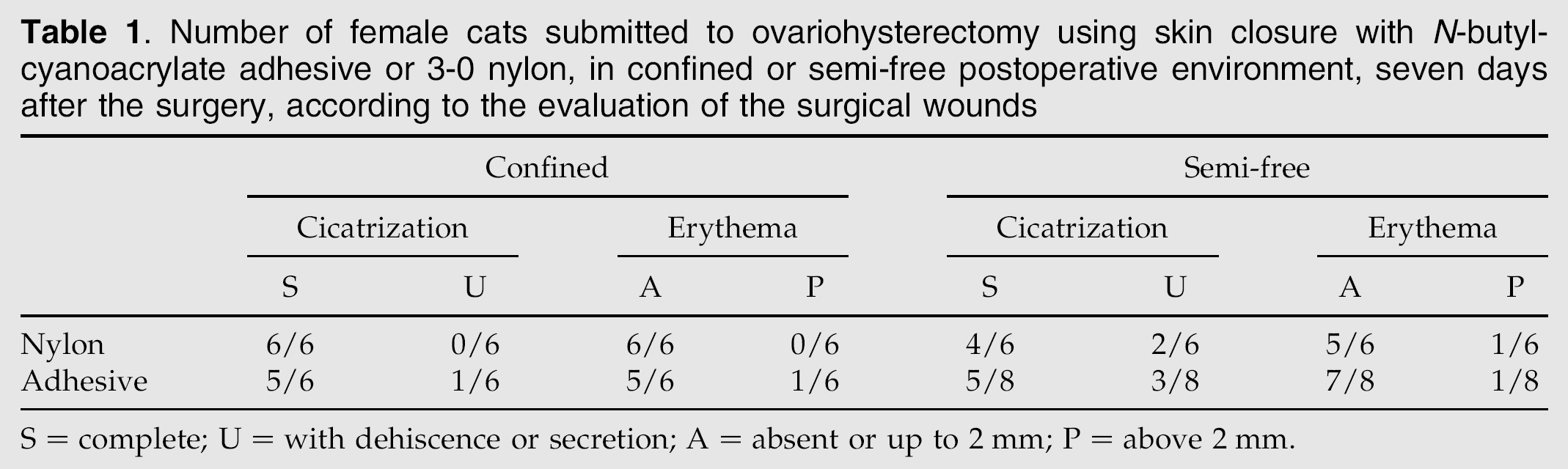
S=complete; U=with dehiscence or secretion; A=absent or up to 2 mm; P=above 2 mm.
Number of female cats submitted to ovariohysterectomy with skin synthesis using N-butyl-cyanocrylate adhesive or 3-0 nylon, in confined or semi-free postoperative environment, 14 days after the surgery, according to the evaluation of the surgical wounds

S=complete; U=with dehiscence or secretion; A=absent or up to 2 mm; P=above 2 mm.
As the two different synthesis materials allowed similar wound healing efficiency, postoperative environments were compared independently of the synthesis material used. Although the number of unsatisfactory outcomes was higher in semi-free than in confined animals, the difference was not statistically significant (seventh day: cicatrization P=0.17 and erythema P=1.00; 14th day: cicatrization P=1.00 and erythema P=1.00) (Table 3).
Number of female cats submitted to ovariohysterectomy, in confined or semi-free postoperative environment, seven and 14 days after the surgery according to the evaluation of the surgical wounds
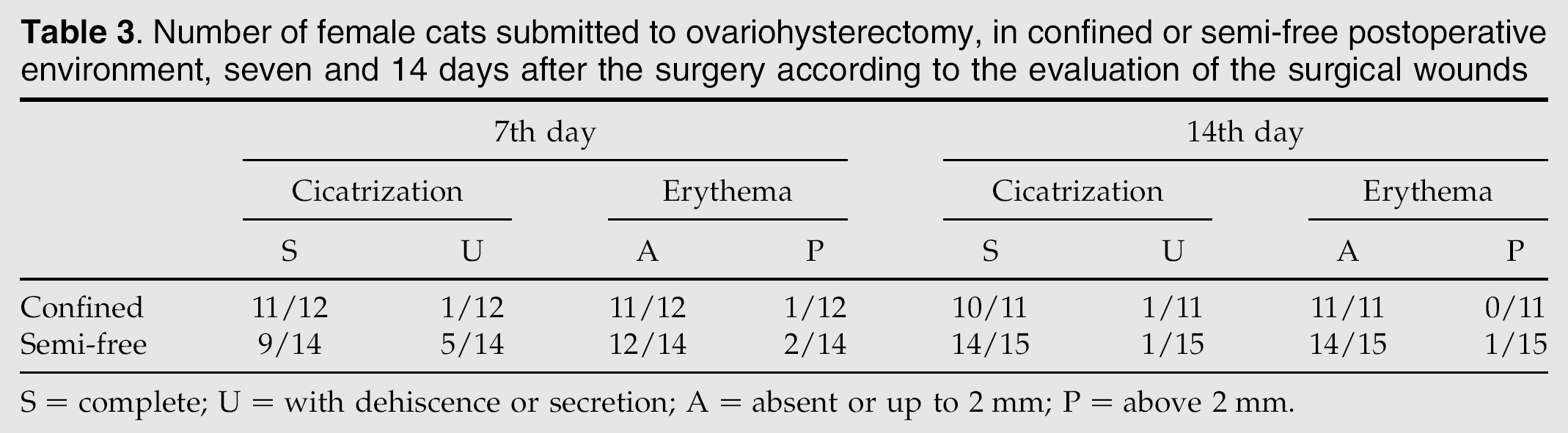
S=complete; U=with dehiscence or secretion; A=absent or up to 2 mm; P=above 2 mm.
Discussion and conclusions
According to the results, the time spent on the skin closure using the adhesive was shorter than using nylon suture, which may indicate an advantage in the use of adhesives. This advantage was observed previously on human abdominal surgeries and lacerations in which the average time reduction was even more remarkable (Quinn et al 1993, 1997, Bruns et al 1996, Gorozpe-Calvillo et al 1997, 1999, Pelissier et al 2001) as well as in skin lacerations in cats (Queiroz et al 2001). The time reduction in the skin closure was significant, therefore it may be inferred that the reduction of at least 1 min per animal would be meaningful in massive sterilisation programmes, which may handle over 100 animals daily.
The results indicate that nylon sutures may be replaced by N-butyl-cyanoacrylate without harm to the cats, as there was no statistical difference in the evaluated parameters between adhesive and suture groups, as have been studied before in humans and rodents (Quinn et al 1993, Borba et al 2000, Bruns et al 1996, Sinha et al 2001, Matin 2003). Unfortunately, these encouraging results were not achieved when ovariohysterectomy was performed in the paralumbar area in a previous study if subcutaneous sutures were not used (Queiroz et al 2001). Subcutaneous sutures have the function of eliminating dead space, decreasing wound tension and facilitating skin-edge eversion (Toriumi and Bagal 2002). Besides being harmless, adhesives seem to avoid pain and allow less tissue manipulation resulting in a better cosmetic outcome (Quinn et al 1993, Bresnahan et al 1995, Matin 2003).
It was observed that there was no statistical difference in wound healing of cats held in semi-free environment as compared to that seen in the confined animals, despite the fact that 36% of the semi-free and 8% of the confined cats showed unsatisfactory healing. This discrepancy may be due to the small sample size.
Grooming is a normal feline behaviour, especially of wounds (Overall 1997). This could impair the healing of surgical incisions, especially those with adhesive closure, however, regardless of the closure material used, the quality of healing was similar, both on the seventh and 14th days.
The results indicate that when nylon sutures were removed at the seventh postoperative day, wound healing was satisfactory. As nylon is a foreign body, if sutures are not removed, they will elicit an inflammatory reaction that may play an important undesirable role in enhancing infection and dehiscence (Fossum 1997). As most population control programmes see each animal only once at surgery time, suture removal is not feasible, therefore, adhesives or subcuticular closure using absorbable sutures must be chosen in order to eliminate the need for suture removal. Subcuticular closure eliminates suture removal, however, it also eliminates the clinical advantages of the adhesive use such as the occlusive waterproof dressing with haemostatic and bacteriostatic properties (Quinn et al 2000, Ferlise et al 2001). Therefore, the use of adhesives for skin closure is suggested to be included in standard protocols for those population control programmes.
Population control programmes deal with a large number of cats, therefore, time and financial funds savings with favourable surgical outcomes are imperative for a successful programme. When protocols' improvements are implemented, the number of surgeries is increased, resulting in better population control. Most programmes release cats after recovery from anaesthesia, therefore, the skin synthesis material must allow a safe wound healing environment. The semi-free group simulated a free environment allowing cats to jump and run whenever they felt like it. Results showed that both adhesive and standard skin closure allowed wound healing under those circumstances, suggesting that adhesives should be preferred when cats are to be released before the seventh postoperative day.
Footnotes
Acknowledgement
Thanks go to TecNew Veterinary Products, for their support.