






Abstract
Electronic laboratory notebooks are becoming an increasingly popular tool for research and routine laboratories as part of a way to optimize workflow and minimize cost while realizing time-saving benefits. The number and variety of available solutions are quickly increasing; making selection of the right notebook a cumbersome process. To allay some of the strain associated with an exhaustive search through notebook technologies, this paper details some key features from a pool of 35 electronic notebooks available today. This review effectively classifies these notebooks into five categories based on market audience as follows: notebooks suited for a Quality environment can be found within the Quality Assurance/Quality Control pool. Notebooks suited for specialized tasks in Biology or Chemistry can be found within the Biology or Chemistry pools, respectively. Notebooks that are suitable for general science functionalities can be found under either the Research and Development or the Multidiscipline pools. Lastly, notebooks that are designed and developed for the spectrum of stringent Quality laboratories to free-form research laboratories can be found within the Multidiscipline pool. The guidelines put forth in this paper eliminate the need to perform an exhaustive search for a suitable notebook.
Introduction
In a fast-paced, technology-based world, innovation drives performance. This is true even for the most strictly regulated laboratory environments. Walk into any good lab practices (GLP) environment and some type of laboratory notebook can be found. Whether GLP, or Research and Development (R&D) labs; the paperbound laboratory notebook (PLN) has always been the natural choice for documenting day-to-day lab work. But with the advent of new technologies, the days of the PLN are coming to a close as the days of the electronic laboratory notebook (ELN) are beginning to dawn.
In the not too distant past, ELNs were facing an almost insurmountable opposition from industry regulators. In the 1980s, “The FDA [Food and Drug Administration], the federal courts, and the USPTO [United States Patent and Trademark Office] were not really aligned to adoption of electronic records for NDA [New Drug Application] submission or for patent purposes.” 1 Increasing pushback from industry leaders brought about a regulatory response that dealt a blow to the exclusivity of PLNs and opened the door for the ELN. “In 2000 the US government and other worldwide governments and authorities (e.g., UK government, European Central Court) issued new laws stating that all electronic records have the same validity and are subject to the same rules of evidence as paper records.” 1 From that time forward, the number of available ELNs quickly multiplied.
In 2006, MEDRAD's Electronic Lab Notebook Project Final Report identified an “ELN market of 28 different vendors.” 2 Within this market, the “size and scope of each of the ELN solutions varied,” resulting in a diversified vendor landscape. 2 Today, “There are over 30 suppliers of ELN technology,” 3 and as of 2008, “year over year growth is still above 20 percent, making ELN one of the fastest growing informatics technologies.” 3 This market flood of ELN technology has brought about both positive and negative effects.
Positives
Companies now have the ability to choose from a wide variety of vendors.
Competition leads to lower market prices per seat and for concurrent use.
Quality of product is continuously improved to stay ahead of the competition.
Negatives
The search for the right solution can be exhausting.
ELN upstarts can lack stability and go out of business or get bought out by others.
This paper reviews a pool of ELN solutions available in the market today with respect to their primary market audience, and touches upon the evolution of the vendor landscape from 2006 to 2008, to assist in the exhausting search for the right solution.
Methods
For the purposes of this paper, an ELN is defined using the Collaborative Electronic Notebook Systems Association, or CENSA, definition. CENSA defines an ELN as, “a system to create, store, retrieve and share fully electronic records in ways that meet all legal, regulatory, technical and scientific requirements.” 4 From this definition, 35 potential ELNs were selected for review. The pool of potential ELNs was found using Scientific Computing World's 2008 Laboratory Informatics Guide, 5 as well as a Google search using the phrase “electronic lab notebook.” The pool of companies, as well as their solutions, is listed below:
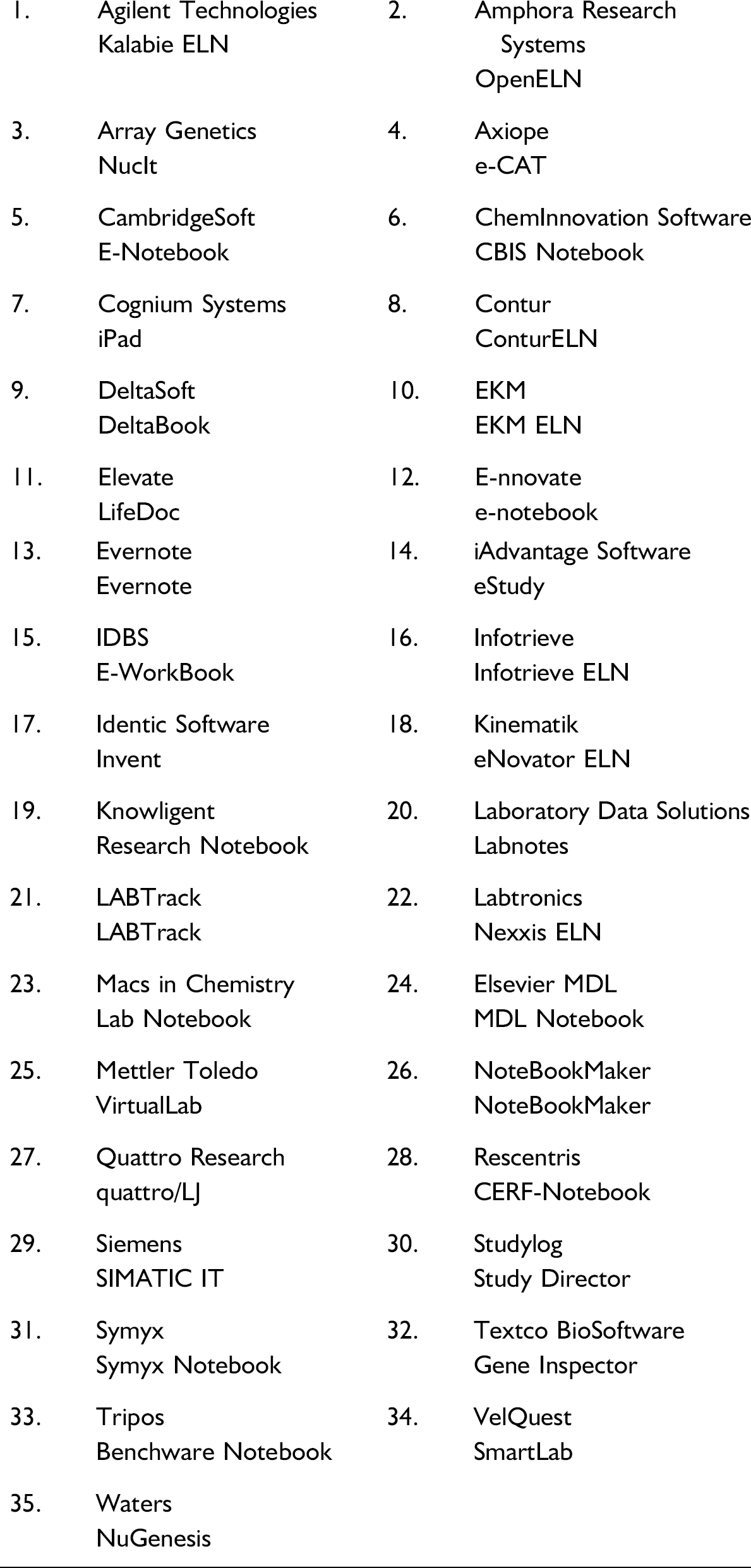
Each of these solutions was reviewed using vendor information as well as each company's Web site and outside data sources. Review of these ELNs focused on their primary market audience and a set of each solution's key features as described below.
Primary Market Audience
Primary market audience choices are shown in Figure 1.
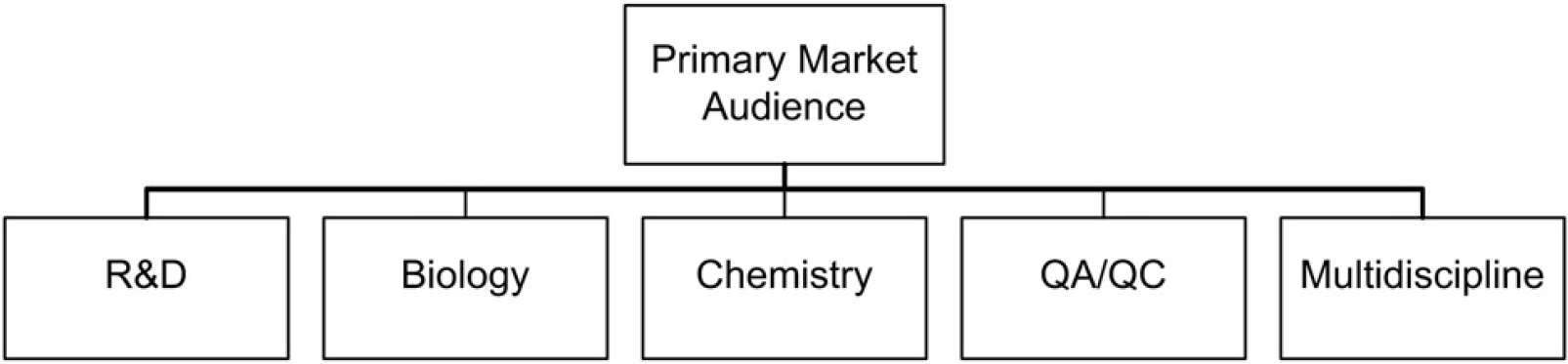
Primary market audience choices.
Categorization of the reviewed ELNs was done as follows: For an ELN to be considered tailored for R&D; the company had to indicate general research note-taking capabilities. This category was used for ELNs that, upon review of the Web site, showed no specificity for use, that is, not designed specifically for Biology, Chemistry, or Quality Assurance/Quality Control (QA/QC). Those companies that were considered tailored for Biology or Chemistry indicated domain-specific solutions within biological or chemical fields, respectively. For an ELN to be considered tailored for QA/QC, the company had to list built-in compliance with regulatory requirements. Each of these choices was also considered in combinations when an ELN indicated cross-functional capabilities. For example, one ELN may have the ability to toggle between R&D and QA/QC functionality; an ELN with such functionality options is placed under the Multidiscipline category included in the Results section.
Key Features
A set of key features is included from each company's Web site. When a bulleted section of features was available, these were considered first for inclusion in the review. When no bulleted section was available, a judgment call was made as to which features to include for review. Each ELN was divided for review by its primary market audience and further divided by its unique capabilities. A discussion of these divisions is included in the Results section.
Results
Seven potential ELNs listed in the pool were not reviewed because of the following: Array Genetics' NucIt, 6 Evernote's Evernote, 7 and Mettler Toledo's VirtualLab 8 did not meet the CENSA definition of an ELN; Infotrieve's Infotrieve ELN 9 and E-nnovate's e-notebook 10 have discontinued their solutions; Elevate's LifeDoc 11 has merged with Contur; 12 and Elsevier MDL's MDL Notebook 13 has merged with Symyx. 14 The remaining ELN solutions are divided by their primary market audience as shown in Figure 2.
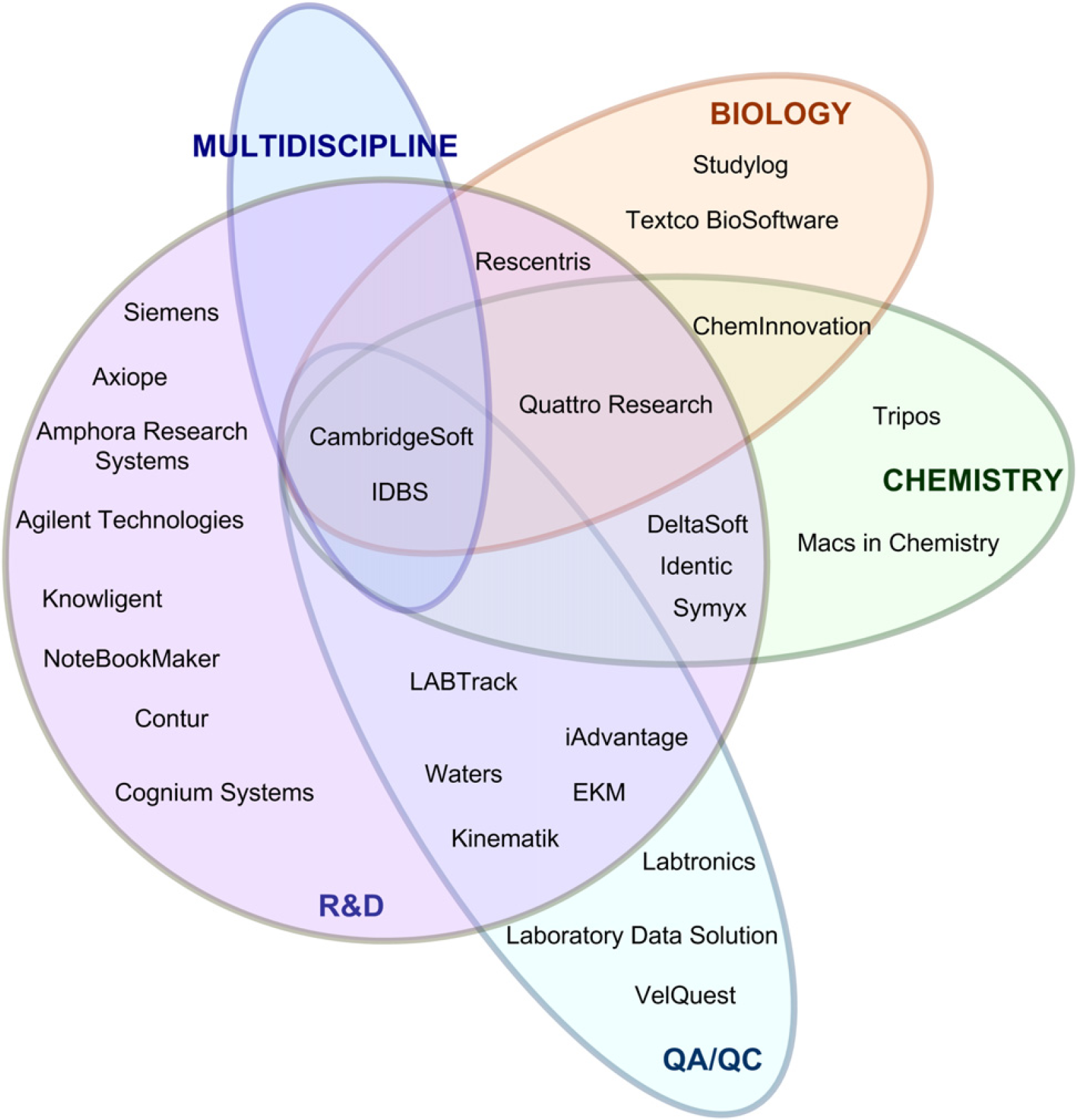
Electronic laboratory notebook primary market audience.
Discussions follow for each ELN individually under its respective subsection. Every ELN reviewed in this paper has some commonalities such as compliance with the U.S. Food and Drug Administration's 21 CFR Part 11, purported time-saving benefits, collaboration capabilities between users, and touted cost-efficient implementation. These types of commonalities are not discussed further; instead each ELN is reviewed by citing some novel key features.
The review order follows the alphabetical order found in each table and is not intended to imply rank. Awards for specific ELNs are included in their review as indicated on their Web sites.
R&D
Companies, as well as the solutions they offer, that are considered to be tailor made for R&D are included in Table 1.
Research and Development electronic laboratory notebooks (ELNs)
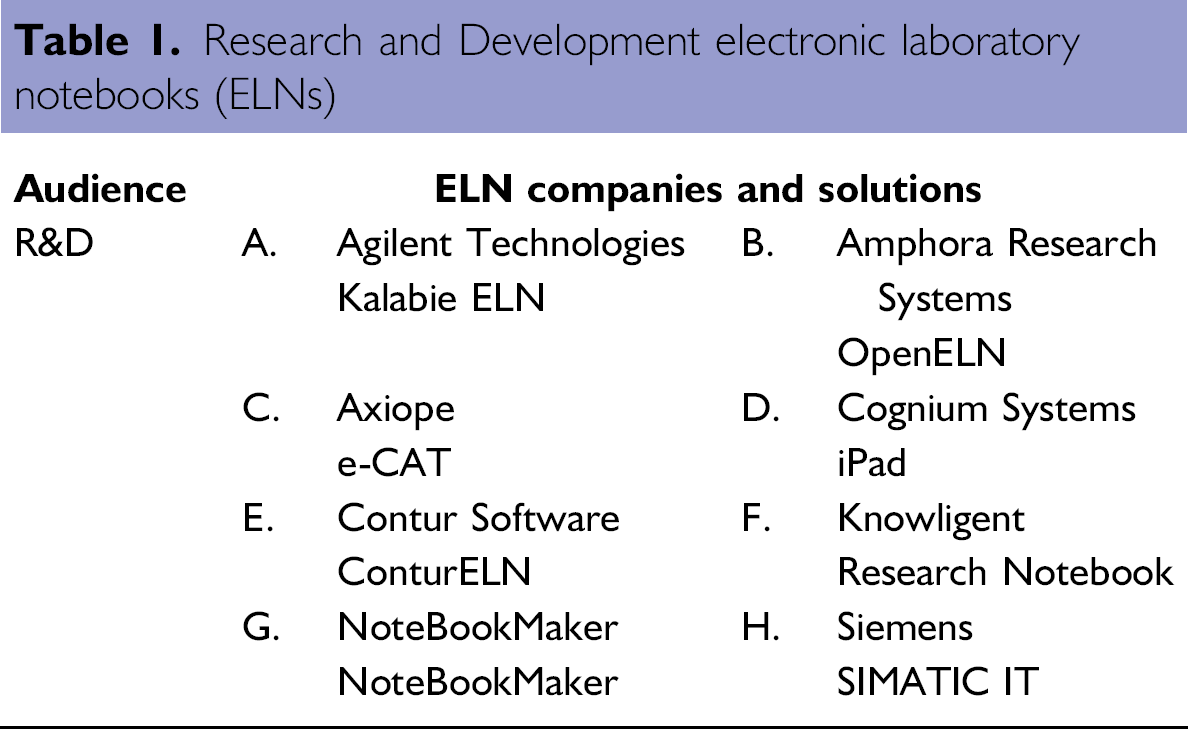
These companies represent solutions that are generic in their functionality. A review of those companies that offer a combination of R&D, as well as other market audiences, is included in the subsection entitled Multidiscipline.
Agilent Technologies' Kalabie ELN received a Gold rating in Scientific Computing's 2008 Readers' Choice Awards. 15 This ELN allows use of predefined experiment templates, includes copy/paste functionality between experiments, gives system alerts for signatories, organizes experiments in topic folders, and contains enriched text manipulation and multimedia functions. 16 For more information on Kalabie ELN, see www.agilent.com.
Amphora Research System's OpenELN received a Frost and Sullivan Market Penetration Leadership award in 2007. 17 This ELN provides an open, modular solution, which allows customers to pick and choose which parts they need. It allows storage, search, and retrieval of documents, and has witnessing by PatentSafe. 17 For more information on OpenELN, see www.amphora-research.com.
Axiope's e-CAT is a browser-based ELN currently undergoing beta testing. Commercial release of e-CAT was set tentatively for the first quarter of 2009. The commercial e-CAT includes flexible, user-configurable database design and restructuring, search capabilities, image management for an extensive range of commonly used scientific file formats, fully integrated barcoding, automated support for check-in and check-out of samples, and event notification. 18 For more information on e-CAT, see www.axiope.com.
Cognium Systems' iPad helps researchers easily organize and share their laboratory notes; it provides the ability to preserve work logs, attach labels and tags to parts of notes, and improves usability through diverse work-flows. 19 For more information on iPad, see www.cogniumsystems.com.
Contur Software's ConturELN received an award for Highest Creditworthiness by Sweden's UC agency. 12 This ELN contains a page oriented experiment editor, supports most data formats, includes a powerful search tool for free-text searching, works by user-created and user-maintained templates with full traceability and access control, built-in digital signatures with workflow reminders, and experiment cloning capabilities. 12 For more information on ConturELN, see www.contur.com.
Knowligent's Research Notebook provides verifiable proof of inventorship, quick retrieval of key information and knowledge through search capabilities, continuous indexing of results that are printable, brings a unified standard for note taking, and the ability to attach electronic files to notes. 20 For more information on Research Notebook, see www.researchnotebook.com.
NoteBookMaker's NoteBookMaker is a simple, secure, electronic notebook that looks and prints like a bound paper-based notebook. NoteBookMaker encompasses all the benefits of an electronic, searchable laboratory notebook. The sections of each page are divided by vital information for experimental identification, the text field for data input, and the graphical input section. From the top level of NoteBookMaker, the researcher can easily navigate to create new pages, witness other work, or simply browse through the notebook. 21 For more information on NoteBookMaker, see www.notebookmaker.com.
Siemen's SIMATIC IT includes targeted functionality to capture all data or reporting in electronic format; has complete flexibility for annotations; configurable handling of raw data, experimental details, and test results; provides data validation capabilities for process security and allows fixed or modifiable forms for data entry based on user profile. For more information on SIMATIC IT, 22 see www.siemens.com/simaticit-rd-suite.
Biology or Chemistry
Companies, as well as the solutions they offer, that are considered to be tailor made for Biology or Chemistry are included in Table 2.
Biology or Chemistry electronic laboratory notebooks (ELNs)
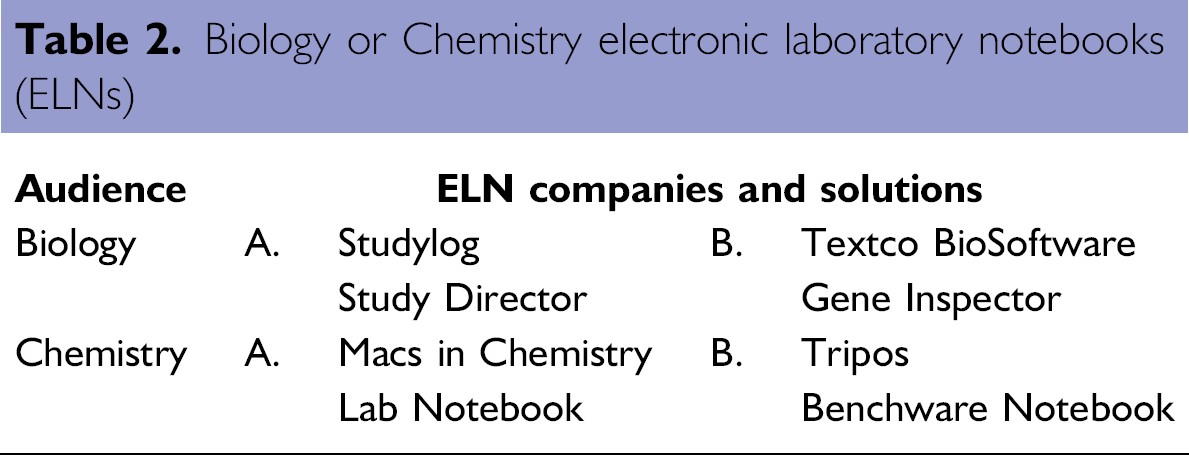
These companies represent solutions for specific areas within Biology or Chemistry alone. A review of those companies that offer general Biology and Chemistry solutions combined is included in the subsection entitled Multidiscipline.
Biology
Studylog's Study Director is the first fully integrated data collection, analysis, and storage solution for managing research animal studies and processes. This ELN is able to collect data directly from instruments, generate graphs and reports, and query and access all study data based on user authorization. 23 For more information on Study Director, see www.studylog.com.
Textco BioSoftware's Gene Inspector is designed for molecular biologists and received a Macworld four star rating in 1997. 24 This ELN allows input of sequence analysis with experimental results, has built-in “hot-linking” to connect a sequence to a set of analysis routines, enables automatic updates when a sequence is changed, contains analysis suites to create a collection of routines and associated parameters, provides over 60 different nucleic acid and protein analyses, and makes use of bookmarks and aliases for easy navigation. 24 For more information on Gene Inspector, see www.textco.com.
Chemistry
Macs in Chemistry's Lab Notebook consists of two databases; the notebook using Filemaker and a reagents database. The reagents database contains over 13,000 reagents. Database searching is available by structure, functional groups, chemical names, formulas, or chemical abstracts service (CAS) numbers. This ELN leverages ChemDraw. Lab Notebook is also available for free but with functional limitations. 25 For more information on Lab Notebook, see http://www.macinchem.fsnet.co.uk/.
Tripos' Benchware Notebook is designed for discovery chemists and improves planning by eliminating experiment duplication, facilitates quick and easy data capture through autocalculation, cut and paste, and page cloning functionality; enforces standardized and legible data capture, creates a database of research activity for patent and compliance issues, and facilitates integration with legacy and third-party informatics systems. 26 For more information on Benchware Notebook, see www.tripos.com.
QA/QC
Companies, as well as the solutions they offer, that are considered to be tailor made for QA/QC are included in Table 3.
Quality Assurance/Quality Control (QA/QC) electronic laboratory notebooks (ELNs)
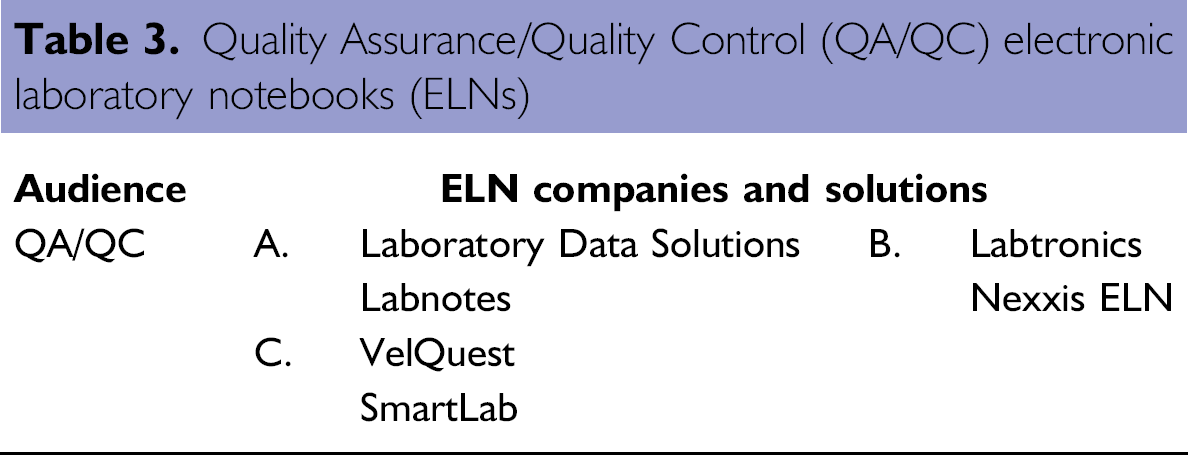
These companies represent solutions specifically designed to meet QA/QC needs. A review of those companies that offer QA/QC solutions in combination with R&D, Biology, or Chemistry solutions is included in the subsection entitled Multidiscipline.
Laboratory Data Solutions' LabNotes enables inclusion of structures, spectra, chromatograms, pictures, and text when a preconfigured form is less appropriate. It can directly link to laboratory equipment, allows data to be interrogated, tabulated, checked, approved, stored, and archived in compliance to regulatory needs; includes a scheduling option for equipment calibration and study timelines; has user-configurable forms to meet in-house GxP requirements; offers full document version control and revision management control with required built-in security for all data acceptance and audit trails; and contains access restrictions based on user functionality. 27 For more information on LabNotes, see www.labnotes.com.
Labtronics' Nexxis ELN received three awards, the Data Management 2006 Product of the Year; the Chromatography 2006 Product of the Year; and the Data Acquisition 2006 Product of the Year; from Scientific Computing. 28 Nexxis ELN is a web-based notebook for routine analyses. This ELN uses rapid eForm development and implementation to create forms from paper worksheets, documents, or standard operating procedures (SOPs) in minutes; is able to collect data from instruments, contains an instrument library with over 500 popular instruments, allows real-time integration with other informatics systems, automates calculations, limit checks and workflows; and automatically saves all completed forms as PDF. 28 For more information on Nexxis ELN, see www.paperlesslab.com.
VelQuest's SmartLab received a 2005 Breakthrough Product of the Year by Processing Magazine; and a 2005 Product of the Year in the Laboratory Informatics—Data Management category by Scientific Computing. 29 This ELN integrates seamlessly with existing IT infrastructure, acquires all instrument data, dynamically links primary data with compliance metadata, connects procedures to SOPs, assesses the compliance state of all materials and chemicals used in a method, contains data checks and flags for limit exceeding data, offers a commercial off-the-shelf solution, and uses standard technology applications. 29 For more information on SmartLab, see www.velquest.com
Multidiscipline
Companies, as well as the solutions they offer, that are considered to have cross-functionality for R&D, Biology, Chemistry, or QA/QC are included in Table 4
Multidiscipline electronic laboratory notebook (ELN) companies
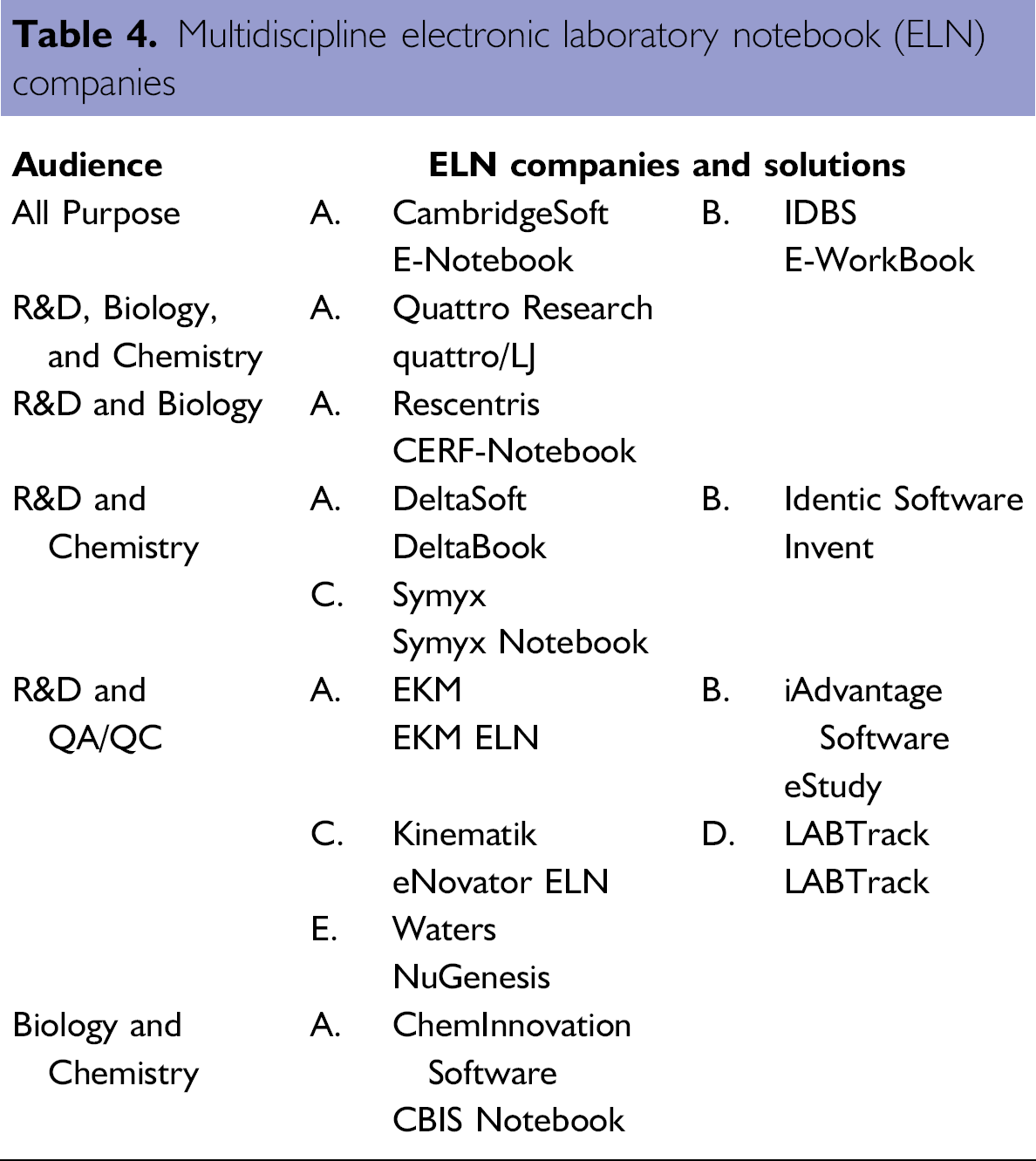
It should be noted that the ELN solutions discussed previously may also have some cross-functionality. Those ELNs were categorized within R&D, Biology, Chemistry, or QA/QC because of their ability to meet specific requirements within each field. The ELNs discussed in this section offer more of a well-rounded approach to market needs.
Not all companies that are listed in Table 4 are suitable for all market audiences. The following subsubsections divide and review these multidiscipline ELNs based on their suitable audiences.
All Purpose
CambridgeSoft's E-Notebook received a Silver rating in Scientific Computing's 2008 Readers' Choice Awards, 15 a Frost and Sullivan Technology Leadership Award in 2004, as well as another 2004 award for the leading web portal accessed by Chemists. 30 This ELN provides a web-based interface able to create forms using Word, Excel, PowerPoint, PDF, ChemDraw, or any combination of these. Its R&D capabilities include free-form workflows and search by text, structure, or reaction. Its Biology capabilities include drag-and-drop functionality for genomic maps, DNA, RNA, and protein sequences; direct sending of sequencing results from instruments; and the ability to collect, store, and interpret in vivo results. E-Notebook's Chemistry capabilities are able to satisfy needs in synthetic, analytical, and process chemistry. Reactions are drawn with in-place editing; a stoichiometry grid fills with formulas, molecular weights, and chemical names; reagents can be imported from other systems; analytical data are stored and transported from scientist to scientist; and designed workflows are supported for process needs. This ELN's QA/QC capabilities include integration with SOPs, management of sample lifecycles, and highly structured forms for regulated data entry. 30 For more information on E-Notebook, see www.cambridgesoft.com.
IDBS' E-WorkBook was the winner of the 2008 Select Science Scientists' Choice Award for Best Drug Discovery Product, as well as the 2008 Frost & Sullivan European Bioinformatics Service Differentiation Innovation Award. 31 This ELN is considered application neutral and is able to integrate with existing workflows and interface with applications and file types. Its R&D capabilities include a configurable taskflow, form flexibility, and the ability to accept data from any applicable source. Its Biology capabilities are able to satisfy needs in late stage discovery and early preclinical research. E-WorkBook includes data pivoting and filtering; data knockout, knock in, and blinding; dynamic curve fitting; and advanced statistical analysis. Its Chemistry capabilities include reaction drawing, stoichiometry calculations, definable structure rendering options (e.g., bond lengths, stereochemistry), the ability to link and search any data source, inventory, virtual store or web resource; and parallel synthesis library enumeration. E-Work-Book's QA/QC capabilities include the ability to control access and issue task requests; create procedure-based experimentation; and integrate with SOPs. 31 For more information on E-WorkBook, see www.idbs.com.
R&D, Biology, and Chemistry
Quattro Research's quattro/LJ is used like a standard word processor with all information entered either directly or by copy and paste. Its R&D capabilities include management of raw data files, the ability to use object linking and embedding (OLE) (e.g., charts, images, tables) as well as rich text format (RTF) MIT design language (MDL) SQL database file (SDF) and PDF. Its Biology capabilities include searching via text and metadata, tools to annotate results, and storage of original images and data. Quattro/LJ's chemistry capabilities include an integrated chemistry engine, synthesis planning, searches by substructure, Tanimoto, and tautomers; direct editing of reactions in the system; and stoichiometry calculations. 32 For more information on quattro/LJ, see www.quattroresearch.com.
R&D and Biology
Rescentris' CERF-Notebook received the Best of Show Award at the 2007 Bio-IT World Conference & Expo, a 2006 TechColumbus Outstanding Service TopCAT Award, and a Best Knowledge Management Platform for Biological R&D award from CENSA in 2006. 33 This ELN is built on ontologies allowing easy to customize scientific data models, templates, and business policies. Its R&D capabilities include a highly interactive graphical interface used for creating, viewing, analyzing, and annotating research records; protection of intellectual property; and integration with existing systems and data. Its Biology capabilities include searching based on full-text content, metadata, and controlled vocabularies; user compliance with templates and forms for protocols and data capture; and SOP management. 33 For more information on CERF-Notebook, see www.rescentris.com.
R&D and Chemistry
DeltaSoft's DeltaBook is accessed via web browser to record, organize, and report data and conclusions. Its R&D capabilities include configurable forms with the ability to record reactions, structures, data, and images; duplication abilities for notebook pages with similar reactions, query by form options, and extensive list handling. Its Chemistry capabilities include automatic stoichiometry calculations, access to reagent inventory information and material safety data sheets (MSDS) and support of chemistry formats such as Accelrys, ChemAxon, Daylight, and MDL. 34 For more information on DeltaBook, see www.deltasoftinc.com.
Identic Software's Invent allows the creation of custom tables for projects with each project having its own chronological log of all relevant activities, as well as automated history recording. Its R&D capabilities include integration of data throughout the network for use by all researchers, the ability to view up-to-the-minute project lists; powerful reporting tools; and records that follow the experimental method. Its Chemistry capabilities include management of products, raw materials, formulas, and test methods; and a supplier database containing all outside contact information for quick referencing. 35 For more information on Invent, see www.identicsoftware.com.
Symyx's Symyx Notebook received a 2005 Frost & Sullivan Technology Leadship Award. 36 This ELN offers domain-specific notebooks or a mix of specificity with generic functionality. Its R&D capabilities include creation of custom templates for experiments, cloning of repeatable data, full-text searching, the ability to use drag-and-drop for files and images, and configurable out-of-the-box reporting templates. Its Chemistry capabilities include use of a graphical form designer to create and manage data forms by incorporating controlled vocabulary, calculations, data validation, and scripting; integration with third-party software; computing of quantities; and identification of reactants and products. 36 For more information on Symyx Notebook, see www.symyx.com.
R&D and QA QC
EKM's EKM ELN received the IBM Lotus Division Prestigious Beacon Award for a Knowledge Discovery Solution in 2003. 37 This ELN acts as a Word processor and provides an interface for data capture, recording, manipulation, analysis, collaboration, and warehousing. Its R&D capabilities include an integrated laboratory information management system, notary service, customizable forms, fields and rules, and instrument data capture. Its QA/QC capabilities include procedures analogous to paper, use of bio-metric and nonbiometric electronic signatures, storage of all data; workflows, content management, templates and calculations, witness approval, archiving, SOP adherence, and supervisory review. 37 For more information on EKM ELN, see www.ekmco.com.
iAdvantage Software's eStudy allows users to define and control study design, notebook design, data collection, analysis, and reporting. Its R&D capabilities include open architecture for simplified customizations, interfacing with third-party software, Word processing functionality, and comprehensive querying. Its QA/QC capabilities include study designs defining test articles, treatments, test systems, samples, observations, and test sites; role and permission-based security; sample number and label generation with barcoding; template creation, report generation using PDF, and embedded statistical analysis. 38 For more information on eStudy, see www.iadvantagesoftware.com.
Kinematik's eNovator ELN captures all data, information, and knowledge generated and provides full searching capabilities across all previous experimentation. Its R&D capabilities include free-form experimental recording, drag-and-drop functionality, full integration with Microsoft Office, as well as integration to external databases and web applications, and automatic report generation. Its QA/QC capabilities include use of standard experimental templates, integration with SOP, resource management, sample tracking, version control, and automated e-sign workflows. 39 For more information, see www.kinematik.com.
LABTrack's LABTrack received a Bronze rating in Scientific Computing's 2007 and 2008 Readers' Choice Awards; 15 and a Scientific Computing Data Management Product of the Year award in 2006. 40 This ELN follows a Word processor design and allows an unlimited number of users to share notebooks and files concurrently. Its R&D capabilities include free-form data entry, built-in e-mail and Automatic Hacker Dectection for use as legal evidence; storage of any file type; and the ability to link to external documents. Its QA/QC capabilities include template creation for enforcing rules and required data; storage of SOP; integration with third-party software; data archiving with comprehensive searching; and data validation by review. 40 For more information on LABTrack, see www.labtrack.com.
Waters' NuGenesis is classified as a scientific data management system that integrated its eLab ELN. NuGenesis received a Bronze rating in 2008 and a Gold rating in 2006 for the best-in-class Data Management category of Scientific Computing's Readers' Choice Awards. 41 This management system stores all types of scientific data using “file and print capture” technology. Its R&D capabilities include protection of intellectual property, searching with filters; inclusion of graphs, texts, and tables; annotation of analytical data with texts, lines, arrows, and bitmaps; attachment of chemical structures; and hyperlinked access to source data. Its QA/QC capabilities include seamless integration with existing IT infrastructure, limited access based on a privilege matrix, incorporation of metadata, archiving, report generation, organization according to protocols and projects; automatic notification for review; and workflows following SOP. 41 For more information on NuGenesis, see www.waters.com/sdms.
Biology and Chemistry
ChemInnovation Software's CBIS Notebook uses Chem4D to create pages of text, structures, and graphics. Its Biology capabilities include management of databases for proteins, plasmids, phages, and data; links to compounds and assay data; has tools for sequence analysis and searching; support of restriction enzyme mappings, open reading frames, primer design, sequence alignment, and property calculations; and management of bioassays. Its Chemistry capabilities include assigning international union of pure and applied chemistry (IUPAC) names, tracking inventory, barcode labeling, searching by structure, management of reactions, tracking of reactants, products, conditions, and progress; linkage to vender databases; management of reports; and maintenance of MSDS. 42 For more information on CBIS Notebook, see www.cheminnovation.com.
Conclusion
Within the past 2 years, the overall landscape of available ELN solutions has evolved toward a new ideology; that of multidiscipline. By comparing the ELN solution breakdown figure found within MEDRAD's 2006 Electronic Lab Notebook Project Final Report, 2 and Figure 2 of this paper; it becomes apparent that available ELN solutions today are dipping into market audiences previously untapped by these vendors. This escalates the daunting task of finding the right market solution to the levels of exhaustive searching.
Invariably, every ELN will have its pros and cons when trying to select which solution best fits a customer's needs; but inherent in each solution are the novel key features that make a primary market audience review possible. This kind of ELN breakdown enables customers to focus in on a much simplified pool of ELNs by adhering to the following guidelines: In the case where a company is looking to implement ELN technology into a Quality environment alone, it is advisable to look first at those solutions which are listed under the QA/QC section. This principle holds less true for the other market audiences listed. Implementation of an ELN into Biology or Chemistry laboratories can be well accommodated by any ELN found within the R&D and the Multidiscipline sections. Of course, if specialized functionalities are desired, then the solutions reviewed should primarily include those found under Biology or Chemistry. Lastly, when a single solution is desired across multiple departments, it is reasonable to review those ELNs found within the Multidiscipline section first. These will provide the most flexibility of fit for cross-functional needs.
Acknowledgments
The authors thank Thomas Franceschini and Harbhajan S. Dhillon for their contributions in editing this article, as well as all the vendor representatives who assisted in providing clear and concise information about their respective ELNs.
Competing Interests Statement: The authors certify that they have no relevant financial interests in this manuscript.