Abstract
The potential of stem cells to help fill the pipeline with safe and effective drugs is a very real and exciting application of the phenomenal stem cell science to come from the University of Wisconsin-Madison and other institutions.
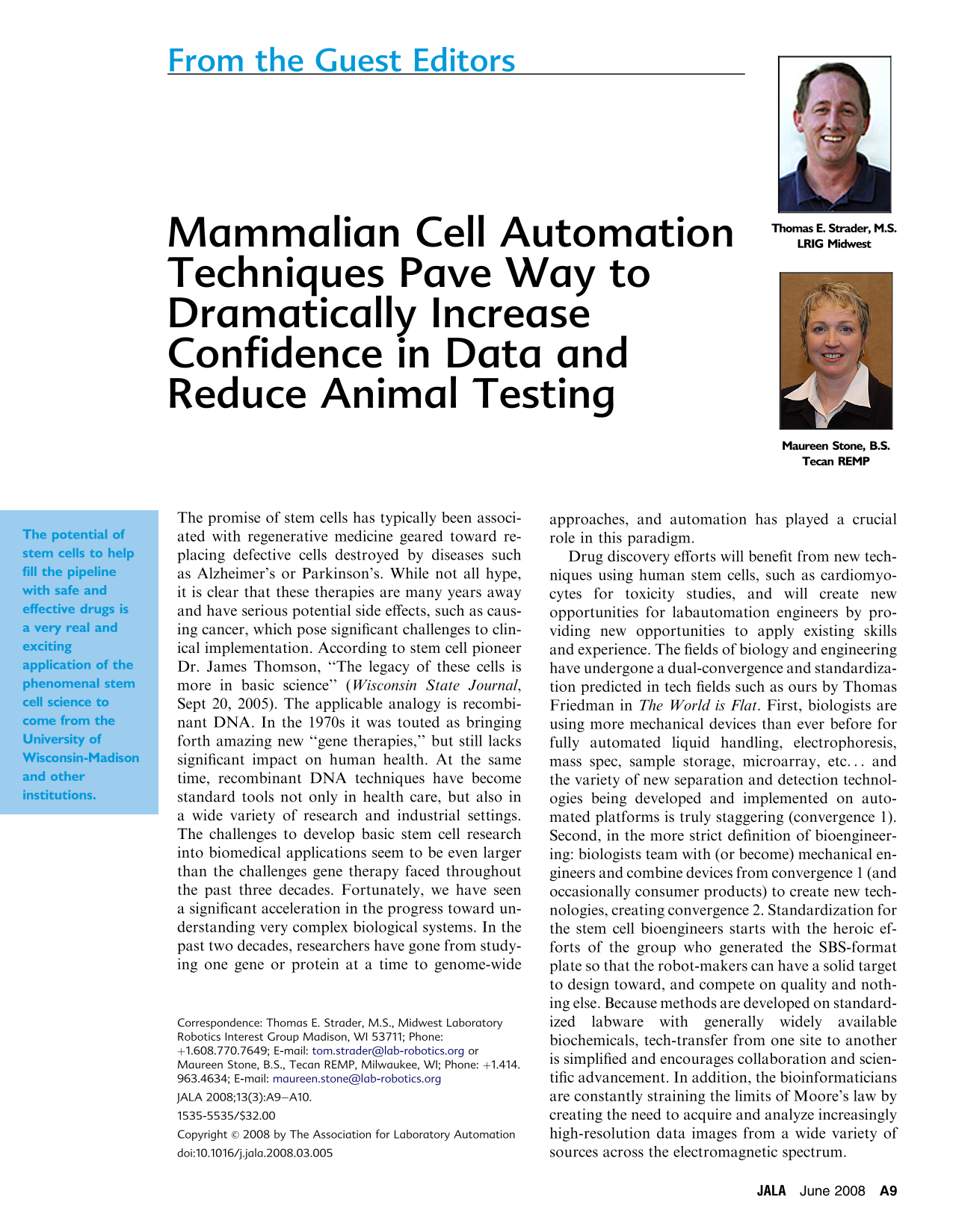
Thomas E. Strader, M.S. LRIG Midwest
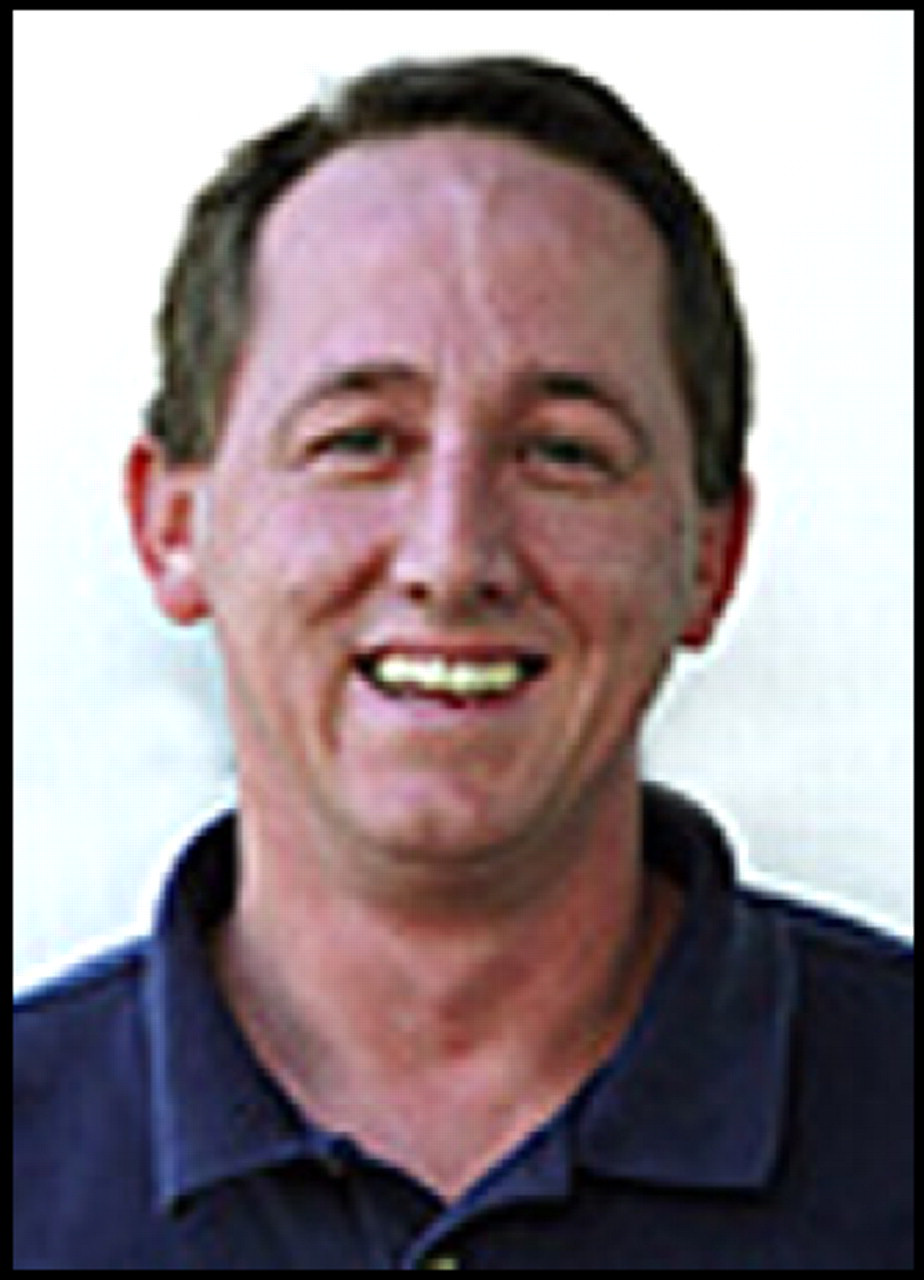
Maureen Stone, B.S. Tecan REMP
The promise of stem cells has typically been associated with regenerative medicine geared toward replacing defective cells destroyed by diseases such as Alzheimer's or Parkinson's. While not all hype, it is clear that these therapies are many years away and have serious potential side effects, such as causing cancer, which pose significant challenges to clinical implementation. According to stem cell pioneer Dr. James Thomson, “The legacy of these cells is more in basic science” (Wisconsin State Journal, Sept 20, 2005). The applicable analogy is recombinant DNA. In the 1970s it was touted as bringing forth amazing new “gene therapies,” but still lacks significant impact on human health. At the same time, recombinant DNA techniques have become standard tools not only in health care, but also in a wide variety of research and industrial settings. The challenges to develop basic stem cell research into biomedical applications seem to be even larger than the challenges gene therapy faced throughout the past three decades. Fortunately, we have seen a significant acceleration in the progress toward understanding very complex biological systems. In the past two decades, researchers have gone from studying one gene or protein at a time to genome-wide approaches, and automation has played a crucial role in this paradigm.
Drug discovery efforts will benefit from new techniques using human stem cells, such as cardiomyocytes for toxicity studies, and will create new opportunities for labautomation engineers by providing new opportunities to apply existing skills and experience. The fields of biology and engineering have undergone a dual-convergence and standardization predicted in tech fields such as ours by Thomas Friedman in The World is Flat. First, biologists are using more mechanical devices than ever before for fully automated liquid handling, electrophoresis, mass spec, sample storage, microarray, etc … and the variety of new separation and detection technologies being developed and implemented on automated platforms is truly staggering (convergence 1). Second, in the more strict definition of bioengineering: biologists team with (or become) mechanical engineers and combine devices from convergence 1 (and occasionally consumer products) to create new technologies, creating convergence 2. Standardization for the stem cell bioengineers starts with the heroic efforts of the group who generated the SBS-format plate so that the robot-makers can have a solid target to design toward, and compete on quality and nothing else. Because methods are developed on standardized labware with generally widely available biochemicals, tech-transfer from one site to another is simplified and encourages collaboration and scientific advancement. In addition, the bioinformaticians are constantly straining the limits of Moore's law by creating the need to acquire and analyze increasingly high-resolution data images from a wide variety of sources across the electromagnetic spectrum.
How will automated stem cell research accelerate drug discovery? Current drug discovery techniques are highly dependent on HTS of drug candidates, like so many high-schoolers taking the SAT to see if they'll be the next Lipitor. This has been a good paradigm and has produced some excellent drugs, but a more focused approach is now available.
After growing embryonic stem (ES) cells into defined tissue, a researcher can directly compare the effects of a drug on phenotypically representative human tissue before that drug is ever in a clinical trial. It will be done in a more defined environment than possible with animal models. The studies would be done in a system autologous to its destined recipient—human cells. The big advantage over primary cells is that ES cells will provide tissue with identical genetic background, improving the ability to compare results during studies done in larger scale. Furthermore, they can provide the same advantage along with the quantities of material required to carry out larger studies. Once we have learned to produce the tissues and assays that represent the pharmacological behavior of cells in the human body, pre-clinical toxicity can be determined at a level that was never before achievable. Animal testing is typically used for this purpose, but the heart and liver of a mouse or dog are sufficiently different from human that possibly lethal effects on humans can be missed with animal testing. Additionally, there are no moral or ethical dilemmas when working with nonembryonic stem cells growing in a well, and the cost associated with buying, certifying, housing, feeding, and disposing of laboratory animals is eliminated.
Additionally, a researcher can put a stem cell in a defined system, watch it grow, and compare the growth patterns from a normal stem cell to one that is treated to express a disease state to see where the metabolic pathway diverges from normal state to disease state; then test for drugs that will delay onset. If a researcher wants to study toxicity on individuals from a particular ethnic group, he or she can simply grow up stems cells with those characteristics and test them. There are no animal models to account for the well-known metabolic differences displayed across the globe, so stem cell screening can help identify ways to personalize medicines for those groups. A realization is that, although we may not be able to cure many diseases with genetic predisposition, we may be able to affect the environment to delay onset for a dramatically long time if diagnosed early enough.
The potential of stem cells to help fill the pipeline with safe and effective drugs is a very real and exciting application of the phenomenal stem cell science to come from the University of Wisconsin-Madison and other institutions. Recent news stating elimination of the need for embryonic cells to make pluripotent stem cells has removed any opposition to pursuing cures with this technology.
There is still work to do. You probably noticed the claim to reduce animal testing, not eliminate it. There are always systemic interorgan interactions that will only show up when testing in live animals with a genetic structure similar to humans. The closer the genetic structure, obviously, the better. Some compounds are metabolized in the liver and make other compounds that are toxic to the kidney, for instance. Until complex computer (AKA in-silco) models are made to completely and efficiently map all of the biochemical pathways, and model in real-time how they interact with each other in the human body, we will have to rely on animal testing to keep drugs safe and effective.
This issue of JALA is dedicated to Automation of Mammalian Cell Culture. The authors have spent many hours developing products and procedures designed to take the fickle art of growing mammalian cells and, within the limits possible when working with living things, make it into a science. This pioneering work undoubtedly will be the basis for future scientific advances.
This special issue is an extension of the Madison Automation and Stem Cell Conference (MASCC), which is hosted by Midwest LRIG (Laboratory Robotics Interest Group). MASCC is an annual conference that started in 2005 to highlight and build on the truly remarkable accomplishments of Dr. James Thomson. A senior scientist from the Thomson laboratory in charge of automation at Stem Cell Products, Inc., Veit Bergendahl has been in attendance or on the agenda each year; and Junying Yu, famous for reprogramming adult human skin cells to become pluripotent stem cells, was featured at the 2008 conference. Wisconsin-based companies and institutions such as Cellular Dynamics International, Invivosciences, Roche NimbleGen, Stemina and Wicell have all been enthusiastic supporters of the event, which keeps us leading the way to innovative new drugs and therapies by providing researchers with cutting edge bio-tools to drive the next generation of drug discovery.
We would like to extend a special thanks to former and present Midwest LRIG Board Members and other key committee members for their commitment to promoting automation through LRIG: Joyce Boadt, Bob Cline, Steve Glass, Shari Harrison, Glen Jourdan, Derek Hook, Bill Lipton, Pete Nelson, Tia Smallwood, Randy Vogt, Alice Wernicki, Mike Williams, Bob Williamson, and James Young.
Sincerely,