






Abstract
The strain of manual, automated, and semi-automated tasks in high-throughput chemical screening procedures offer new challenges for occupational and preventive medicine. Therefore, field inquiries need to measure several physiological parameters to determine amounts of strain. These include blood pressure, heart rate, and breathing parameters. These parameters can be registered by specialized mobile devices and sensor systems, but before they can be evaluated, it is essential to understand the activity patterns that represent the workloads. Activity status is gathered by those being tested with the help of a Nokia 3660 cell phone. A self-developed software module runs on the mobile phone and allows users to enter an activity setting and any subjective conditions via a short questionnaire. All data are stored together with a time stamp. After finishing an experiment (i.e., completing a working day), the collected data are transmitted to a central data server. Activity data and physiological data are stored in a central database in a merged data set. Access is provided via an Intranet or Internet connection. A graphical visualization tool, which can be shared from any location via Internet, helps to analyze the experimental data. Occupational medicine field studies in the working environment of chemical laboratories benefit from the data acquisition system and especially from the semiautomated self-monitoring.
Introduction
Changes from manual to semiautomated and fully automated workplaces in chemical and biotechnological laboratories present new challenges for preventive and occupational medicine. Workload inquiries and any resulting physiological strain reactions are needed to determine work stress. Understanding these cause and effect factors can help create healthy and efficient workplaces. 1
Labor studies need to be conducted with all pertinent physical and psycho-mental load factors in mind. The aim of a labor trial is the experimental analysis of a standardized workload in simulated workplaces. The advantage is the isolation of single load situations and the systematic comparison of these different types of load. Insight to the load-strain-behavior in typical chemical workplaces enables efficient, goal-oriented load arrangements.
Ergospirometry investigations are used to detect physiological capability and to simulate physical load. To induce a psycho-mental strain reaction, a psycho-mental test battery such as the Wiener TestSystem 2 is deployed. All physiological parameters that are significant or selected for a certain situation are measured at the same time. With these labor trials, an objective analysis of field investigation becomes possible. The measurement of physiological data provides an opportunity to estimate the impact of a specific workload.
One disadvantage of field inquiries is how difficult it is to reliably describe different load situations. As a result, work content as well as conditions of work has to be registered. 3 Usually simple to measure, physiological parameters are recorded (e.g., heart rate, blood pressure, and heart rate variability). Recent technical advancements enable continuous measurements with high accuracy rates using mobile devices. In addition, stress hormones, skin conductance responses, 4 or other parameters can help assess levels of strain in the work process. Most often, a single physiological parameter is not selective or specific enough, and single parameters can be influenced by multiple effects such as movement, ingestion, circadian rhythm, and more. Therefore, it is essential to record time-accurate specifiable activities, work steps, and external influences.
The registration of work steps and notable events can be performed by an observer, or by the employee himself using a self-monitoring system. Self-monitoring is most often without drawbacks, and can integrate subjective physical and psycho-mental strain assessments with the help of short questionnaires.
The efficient evaluation of trials requires central data storage and data processing, and because it is convenient to display strain parameters together with situation factors, exact time synchronization to workload and strain parameters is needed.
Method
Physiological Strain Parameters
To detect and measure strain reactions, multiple physiological parameters must be measured. Specialized mobile devices enable flexible field investigation. Blood pressure signals are measured with a 24-h blood pressure monitor. We use a BOSO-TM-2430 device based on the oscillometric principle, 5 which compensates for motion sensitivity, especially of the arm, because the pumping of the blood pressure cuff might create additional stress for the person. The BOSO-TM-2430 makes it possible to record a person's blood pressure for 24 h, and capture up to 300 measurement values. After a trial, all data are transferred via a serial RS-232 connection. Heart rate and heart rate variability can be measured by different devices. Generally applied are full resolution electrocardiogram (ECG) and heart rate monitors (HRM). ECG gives investigators more information about the inner heart beat behavior. HRMs are easier to use, but the information content is less. We use two HRMs from different manufactures: S810i from Polar 6 and T6 from Suunto. 7 Both devices consist of a chest belt for detection and transmission of the heartbeats, and a “watch” for collection and storage of the data. The heartbeat detection is performed with an accuracy of 1 ms. Every heartbeat is transmitted and stored in the flash memory of the “watch.” The Polar S810i can store up to 5 h of beat-to-beat data, and in average mode (5, 15, or 60 s), for up to several days. The Suunto T6 can store about one day of beat-to-beat information. Besides different storage capacities, the main difference between these two devices is the radio transmission. Both systems use a different frequency, and therefore, they can be used alternatively in areas with a certain electro magnetic disturbance. After completing a trial, the data are transferred via serial infrared (Polar S810i) or serial cable (Suunto T6) connection to a PC. Both software tools can store the data and allow a first graphical evaluation. It is possible to export the raw data via an ASCII file interface module.
For certain work situations (e.g., hard physical work), it is worthwhile to collect respiratory parameters. For this, we use a mobile ergospirometry system (MetaMax 3B from Cortex 8 ). Parameters such as breath frequency, ventilation, oxygen uptake, and carbon dioxide loss can be measured, and data are sent directly via radio transmission to a data acquisition system. If this system is out of range, data can be stored in the device's built-in flash memory for several hours. After the trial, the data can be stored via serial connection to a local PC. The full-featured software tool assists users with a wide range of graphical and statistical evaluation help. The software provides an ASCII export function of the raw data.
The different physiological parameters are measured by specialized mobile devices. In addition to particular evaluation tools and proprietary data formats, an export function can make ASCII-based raw data available.
Self-Monitoring
Current settings and subjective conditions are registered in a log by the employees who are being studied. The main advantage of this approach is that it eliminates the need for additional personnel. Registration can be very extensive and detailed, and uncertainty is reduced by the accuracy, motivation, and sincerity of the people being tested.
In contrast to paper-based, self-monitoring systems, special software running on a mobile phone (Nokia 3660) acts as a mobile agent for data acquisition. A computer-aided system has many advantages over paper-based systems. 9 Time stamps are generated automatically, and are more accurate. All displayed signs and textual items can be updated easily for different workplaces and assignments. Registration requires minimal amounts of time and attention, enabling real-time logging, interactive monitoring, and improved accuracy. 10 Because the mobile phone device can be controlled single-handedly, it is less reactive. As a result, the feedback effects on the process and the employee are reduced to a minimum, and the system can be used to log work environments effectively. 11
In addition to the advantages a computer-aided system offers during trials, data management and storage also is simplified. Data storage in the internal flash memory of the mobile phone and its automatic transmission to a central database server reduce manual data acquisition of the log. Paper-based monitoring systems require that all data be entered into a database after completion of a test.
Registration of current settings includes activity, exogenic factors, troubles, and more. A special setting profile based on a workplace analysis is compiled for every workplace and assignment. Every profile includes a list of different items. Every item is a combination of a short textual description and an icon. It is essential to include all relevant activities. Usually, profile lists consist of about 20 items. Depending on the work assignment, monitoring is either time- or event-triggered. Time-triggered means that the employee must complete an activity status questionnaire in a certain or random time pattern. Event-triggered means that any change in activity should be monitored.
The subjective condition of the employees is logged by the use of questionnaires. Depending on the type of workload, questionnaires for physical, psycho-mental, or combined emphasis are used. The software includes a framework for universal use of questionnaires, and new items can be adapted easily. Most often, these questionnaires are available on paper, and the graphical and textual appearances are as similar to the original as possible. In this manner, compatibility with other survey questionnaires is ensured.
The first stage of development begins with a short questionnaire for subjective strain (KAB-Questionaire for registration of strain 12 ). This questionnaire is designed to detect short-term changes in subjective strain as a subdimension of current conditions. The KAB is one-dimensional and bipolar, with six opposing adjective couples arranged on a six-step scale. Employee strain is measured from minimal (1) to maximal (6).
System and Software
The semiautomated logging software for self-monitoring was developed in C++ for the mobile operating system Symbian OS. 13 The software runs on all Series 60 devices, which at present is about 25 mobile phones from different manufactures. Their main qualities are easy handling and usage. Activity items and questionnaires are understandable and responsible. A direct TCP/IP connection via GPRS/GSM enables the automatic transfer of all collected data to the database server. Therefore, manual data processing is reduced and evaluation as well as conclusion requirements become much less expensive. The implemented framework allows the addition of new work assignment lists, new activity items, and new questionnaires without programming knowledge or the need to recompile. Updates can be accessed via an Internet connection to the database server. New lists and questionnaires can be created by text editors or graphical tools, and stored directly on the database server for transfer to the mobile devices. This feature allows long time field investigation even with changing content.
The use of the mobile phone in combination with the software for self-monitoring has some advantages.
less manual data processing
fewer assistants for field trials
time accurate and exact monitoring
single-handed, less retroactivity
easy upgrade of items and questionnaires
Data Management
All recorded data and physiological parameters are stored in the same database. Therefore, all different parameters are converted into a universal data format. Manual converting is too time consuming.
All mobile physiological parameter measurement devices read out separately with the manufacturer's software. A specifically developed software tool, DATACON, reads all data, converts it into a universal data format, and stores it in a database. An identifier system based on test numbers is used to identify items.
The database can be accessed via a secure Internet connection to the central database server. A certain data file is transmitted, converted, and stored. An Internet connection and a standard browser system are the only additional components needed. The database system we use is MySQL, and its main features include high performance and good Internet accessibility. For static and dynamic Web sites, an Apache Web server is used. All dynamic Web pages (DATACOM) are developed in PHP. The combination of Apache, MySQL, and PHP is well known for stable and effective performance (Fig. 1).
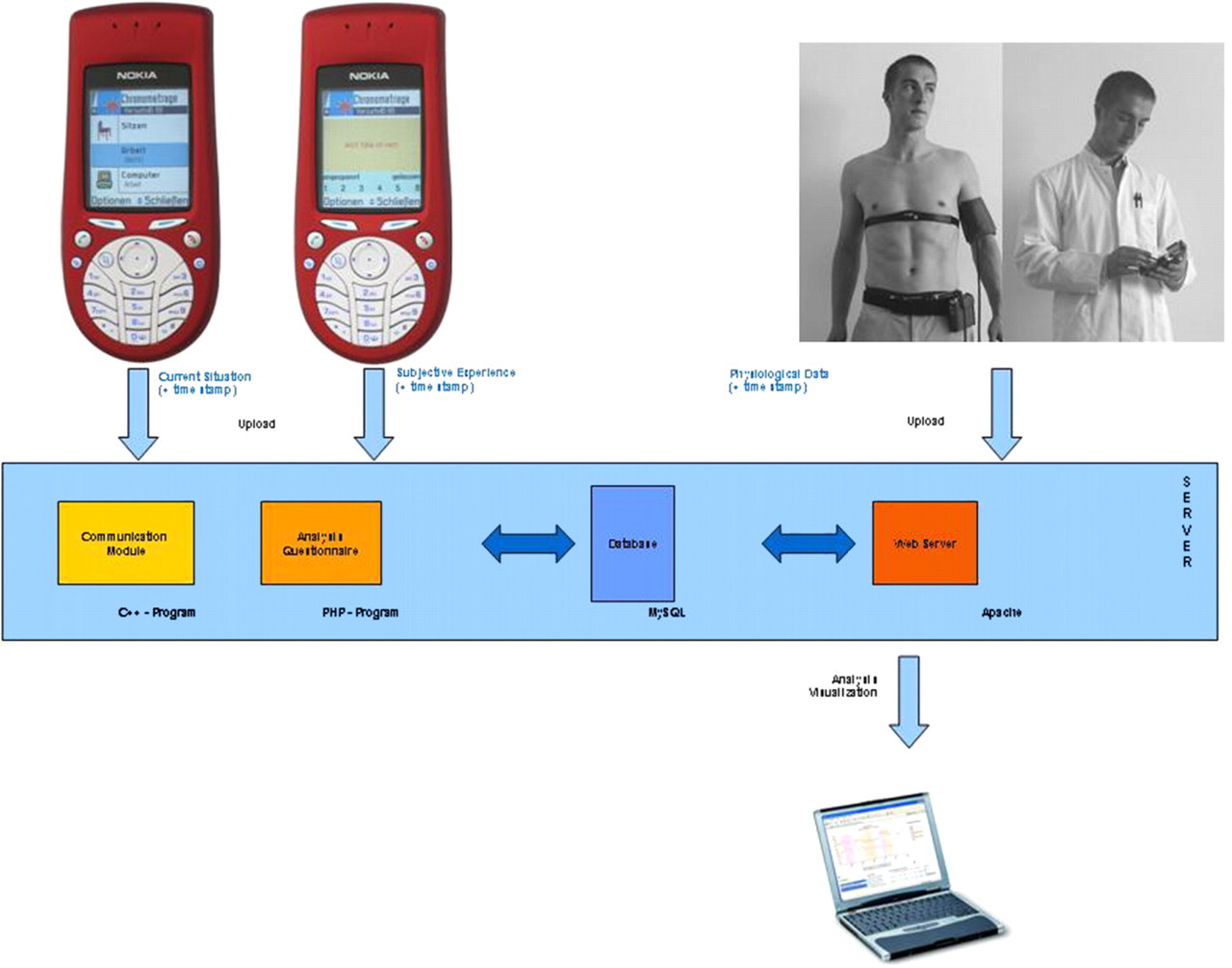
System for flexible measurement of physiological data of labworker working in automated laboratories with sensors, protocolling device and client for visualization.
Results
The system described in this article was successfully tested in about 100 trials. Initial trials were conducted with students in their everyday life. Continuative trials were done in semiautomated chemical screening processes. In addition to the current situation, workload, and strain reaction, it is important to know about recovery and regenerative phases. Therefore, for occupational medicine reasons, it is sometimes necessary to monitor physiological parameters for a full day, including both work and spare time activities. To date, 20 people completed a 24-h registration. Blood pressure registration was performed every 15 min during the day, and in 60 min intervals at night. Heart rates were recorded continuously. During special physical loads (most often endurance sports), a registration of breath parameters was possible. Activities were logged by each test person. Figure 2 shows a typical (up to 24 h) test graph.
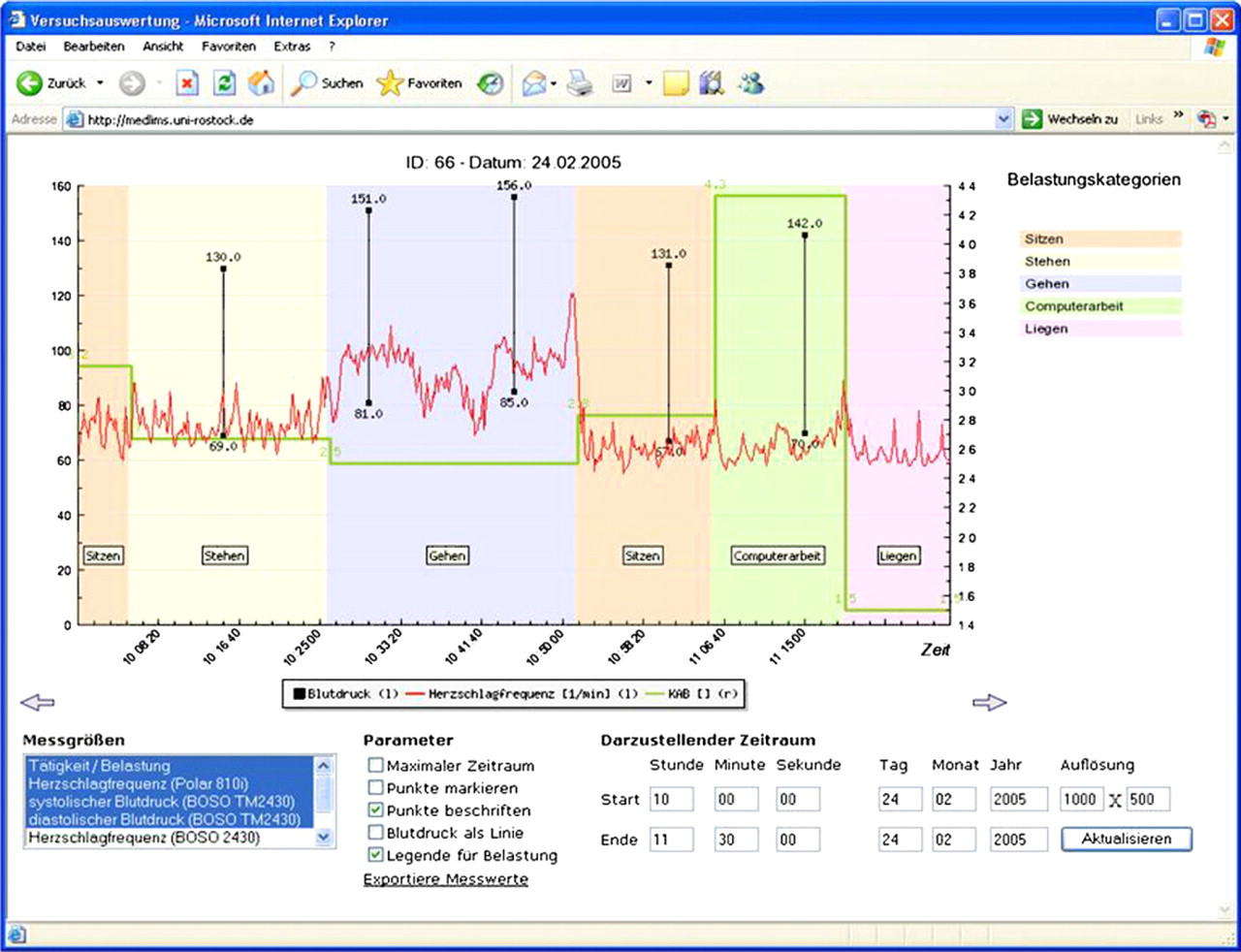
Visualization example for load/strain data in lab test.
The visualization tool enables investigators to evaluate the test data. Curve progressions show all physiological parameters in different colors. The different background colors represent different activities or workloads. The caption gives the textual information about the different activities. A user can choose a timeframe and the appropriate physiological parameters. Data access is provided via Internet connection and standard browser software. The visualization tool was developed in PHP and uses the JPGraph library.
Conclusion
The system composed of mobile physiological measurement devices, data converter tools, central database, and central evaluation tools is appropriate for occupational preventive medicine and helps in optimization of chemical and biotechnological workplaces dealing with different levels of laboratory automation. Semiautomated, self-monitoring with the help of a mobile phone allows for efficient and accurate logging of activities, workload levels and settings. The activity pattern is exact and is time confidential. Integrated questionnaires enrich the registration of physiological parameters with information about the level of subjective strain sensing. This information is needed for the evaluation of workload and workplaces. The evaluation procedure is simplified and supported by the use of visualization tools.
The technology can be applied in real world work situations, including chemical and biotechnological laboratory environments, to study the effects of changes from manual to automated workplaces. It also can be used in other industries. To develop a standardized output describing workloads, physical and psycho-mental strain reactions must be analyzed. A normalized output can be performed by an n-dimensional fuzzy model based on the workload types and strain parameters. Next steps in the development start with the approach discussed in this article, and designing a fuzzy-based model for data processing.
In the future, a network of all necessary physiological sensors coupled to the mobile cell phone agent by Bluetooth will be developed.
Acknowledgment
The scientific work was funded by the State Mecklenburg-Vorpommern (Germany) and the European Union. We thank our partners North Carolina State University; Raleigh, Dr. Kaber, Chow, Dr. St. Amant, for continued collaboration in the joint ITR-PEO research program.