






Abstract
HyperStak is a new microplate stacker, which can be integrated onto most robotic systems without the need for costly software integration. It was developed to minimize the downtime and cost associated with microplate handling errors made by robots within passive microplate stackers and to maximize microplate storage space by decreasing the workspace often required by other microplate stackers. The “when-you-need-it” design of the HyperStak always has a microplate ready for use, which translates into a reduced robotic access time and an increased overall throughput of the system.
Introduction
To understand why the HyperStak was developed, it is important to know the different options available for microplate automated storage. There are principally two different access modes currently used in the storage of microplates: random access and stacker-based systems. Random access modes usually require either a tray- or a carousel-based storage system. With tray-based storage, each location is designed to handle a number of different consumables; in comparison, carousel racks are often designed for specific consumables. To use different consumables within the same carousel, different carousel racks, each specific for a particular consumable, are required. Tray-based systems provide access to a number of items at once, whereas carousel-based systems present a desired consumable concurrent with a robotic action. Both random access storage devices contain a large number of samples in a comparatively small space, are difficult to manually load and unload, and require a higher level of integrated software control for seamless operation within a robotic system.
Stacker-based storage devices provide samples serially to the robotic system and are easy to manually load and unload. The passive stacker (i.e., used by Caliper on Twister/TwisterII and Thermo Electron on Catalyst Express) must be replicated numerous times to increase a robotic system's storage capacity. This significantly increases the footprint of the system. Passive stackers must be arranged appropriately to permit a robot to enter the stacker from the top and reach down to all positions within a stack. This limitation means that these stackers cannot be placed directly in front of one another because this would inhibit the robot from reaching all of the samples within each of the stackers. An advantage of these systems is that little is needed in the way of hardware control of the stacker, because the robot performs all manipulations. A common error with this type of stacker occurs when a microplate is knocked out of the robot's hand during its movements through the stacker. Stacker-based systems that present consumables mechanically from the bottom of the stack (i.e., Tecan TeStack and Velocity 11 VStack) virtually eliminate the errors associated with micro-plate flipping. These bottom-access systems require software for hardware control and subsequent integration into a robotic system, increasing the cost of this device.
The HyperStak is designed to correct a number of issues described here and commonly seen with both the random access and stacker-based systems. First, the HyperStak's small footprint provides the user with the means of having multiple HyperStaks on a system without using a significant amount of workspace. Second, no software integration is required. This provides the opportunity to use HyperStak on most robotic systems without the need for custom software integration. Third, HyperStak is designed with a single access point, which is serviced by a feeding mechanism that minimizes the number of microplate flipping errors seen with most passive stackers. This mechanism permits the “when-you-need-it” concept allowing the microplate to be waiting in the access position without any instruction from the software controlling the robotic system. Further, the single access point reduces the number of positions to teach in comparison to other robotically accessed stackers. In addition, the HyperStak presents microplates to the robot from the top of the stacker, allowing for dense packing of the storage device and increasing capacity without a significant space reduction.
Methods and Materials
The HyperTask HyperStak (Fig. 1) consists of two pieces: a removable tower for holding consumables and a motor-driven platform including the base. The base consists of a programmable logic controllers for controlling movements of the platform, an optical sensor for edge detection of the microplate, and two toggle switches. The first toggle allows the user to jog the platform up or down as needed. The second toggle sets the initial operational mode of the HyperStak, which is either the input or output. If an output mode is selected, the platform drives up until the edge detection sensor detects a microplate and then moves a defined distance to place the microplate into position for robotic access. Input mode will move the platform up until either the edge of a microplate or nothing is detected. At this point, the HyperStak prepares to receive microplates from the robot. Once a microplate is detected on the platform, the HyperStak will move down until the top edge of the microplate is detected. At this point it will then await the next incoming microplate.
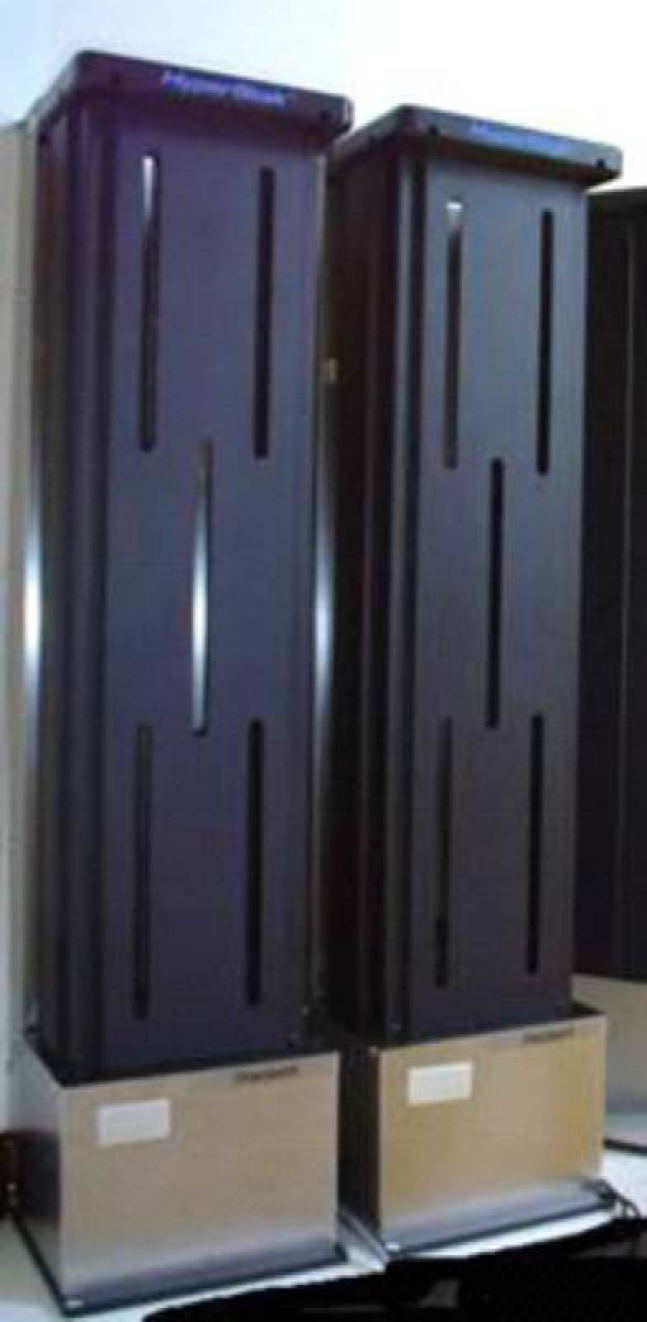
Each of the two HyperTask HyperStak™ stackers shown contains a maximum of 39 microplates housed in a 16× 17.8×66 cm footprint.
The Thermo Electron Catalyst Express system was used for the HyperStak integration project. The HyperStak was designed to hold 39 microplates within a 16×17.8×66 cm footprint (see Fig. 2) to meet the height requirements of the Thermo robot. Because no external control was required for this device, no software drivers were necessary to control the HyperStak.
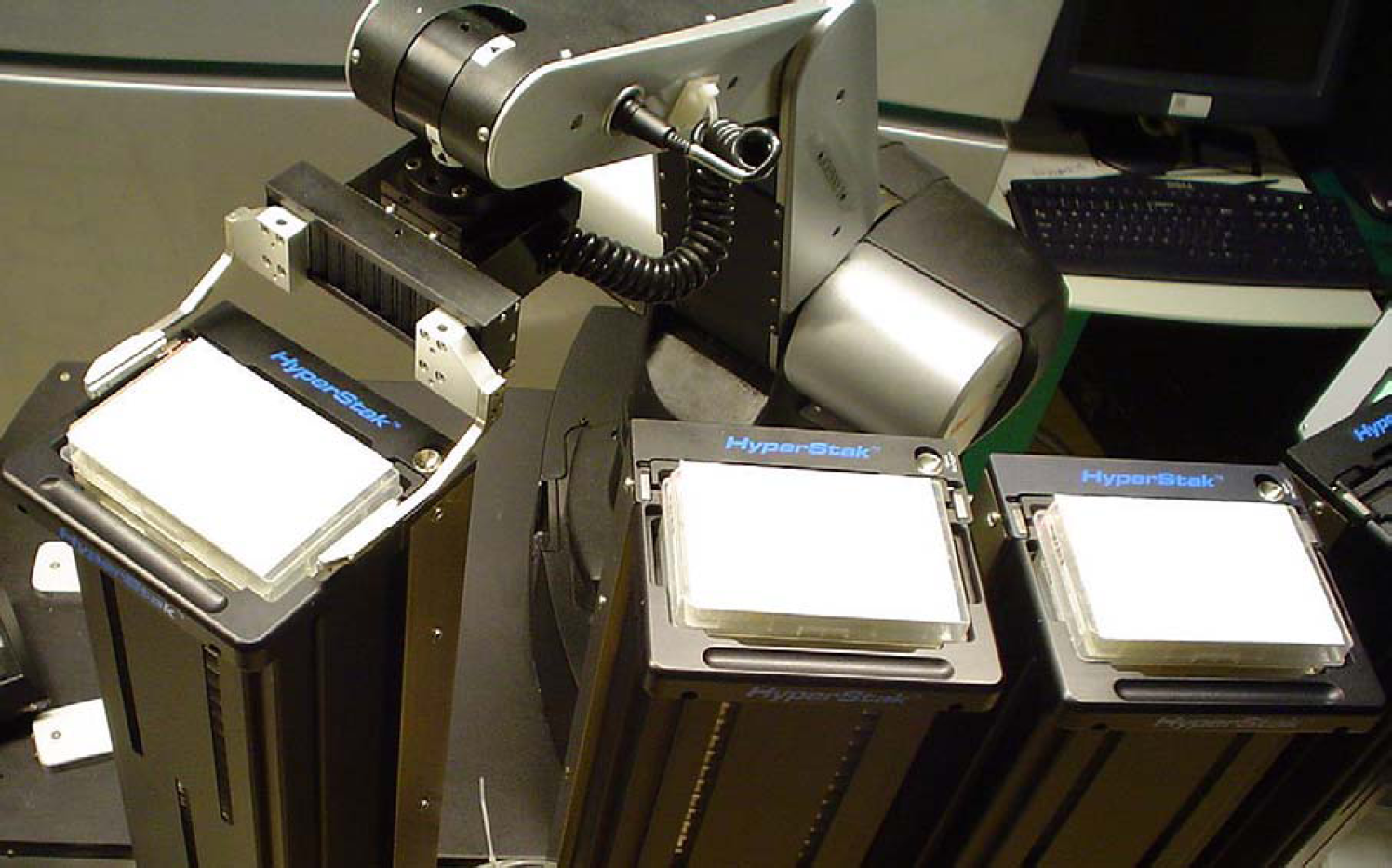
The HyperStak is pictured integrated with a Catalyst Express with one being an input position and the others as output positions.
Results
The fully automated stacker was installed on the Thermo Electron Catalyst Express system. Because one of the objectives of the HyperStak was its ability to run without any software integration, the HyperStak was fully operational within 30 min on the system. Using the Thermo Electron Polara software, the single access point per stack was taught, a method and sequence were generated, and the robot began accessing the stacker. Three different 384-well microplate types were initially tested: black polystyrene, white polystyrene, and clear polypropylene. The black polystyrene microplate worked without incident. Both the white polystyrene and clear polypropylene microplates exhibited some initial problems when the stacker was in the output mode. This problem was resolved by correcting a timing-related issue with the optical sensor located at the presentation point. Three hundred clear and white microplates were then run without incident. All three microplate types were then intermixed and run without issues.
Conclusion
One of the most important aspects of the HyperStak is its ability to automatically switch between output and input modes. When the HyperStak is running in output mode and the last microplate is removed, the HyperStak will detect the absence of microplate on the platform and automatically switch into input mode and wait for an incoming microplate to be placed onto the platform. This is helpful in allowing multiple stacks to be used on a system. For example, in a system with three stacks, the second and third stacks may be filled with microplates and the first stack remains empty. The robot can take the microplates from the second stack, perform some operation and then place the microplates into the first stack. Once the second stack is empty and the first stack is full, the system can pull microplates from the third stack and put them into the second stack.
Microplates are presented serially to a single use point at the top of the stacker. The robotic handler can access all the microplates in the stack from this position, which decreases robotic access time and eliminates traversing errors by the robot commonly experienced with most general stacker racks. This design also speeds the teaching of the positions for a robot because only one position needs to be taught per stack to access all the consumables. The HyperStaks were designed to work together with one stacker handing out (output) and the other receiving microplates (input). The 3-s pause built into the logic of the HyperStak provides sufficient time for the robot to move clear of the access point before the HyperStak motor-driven platform is engaged. It takes less than 2 s for the platform to move into position, which occurs while the robot is moving the previous sample onto its next position.
The HyperTask HyperStak successfully achieved the primary project tasks. The HyperStak39, described here, has a capacity of 39 microplates. Because it was built around the Society for Biomolecular Screening standard, it is also capable of working with deepwell and midwell microplates, two-dimensional tube racks, and tip boxes. The rapid, single point accessibility of the stacker combined with its ability to automatically switch between output and input modes makes the integration of this device into a robotic system a simple and worthwhile addition to increase sample capacity and throughput without significantly increasing workspace or requiring additional integration cost. The single access point also removes the need to leave access room for a robotic arm to get from the lowest nest position of a stack, thereby permitting dense packing of the units (see Fig. 3). In this orientation, which starts with three HyperStaks full of microplates and one empty, 90 microplates would be available from a 30×38 cm space.
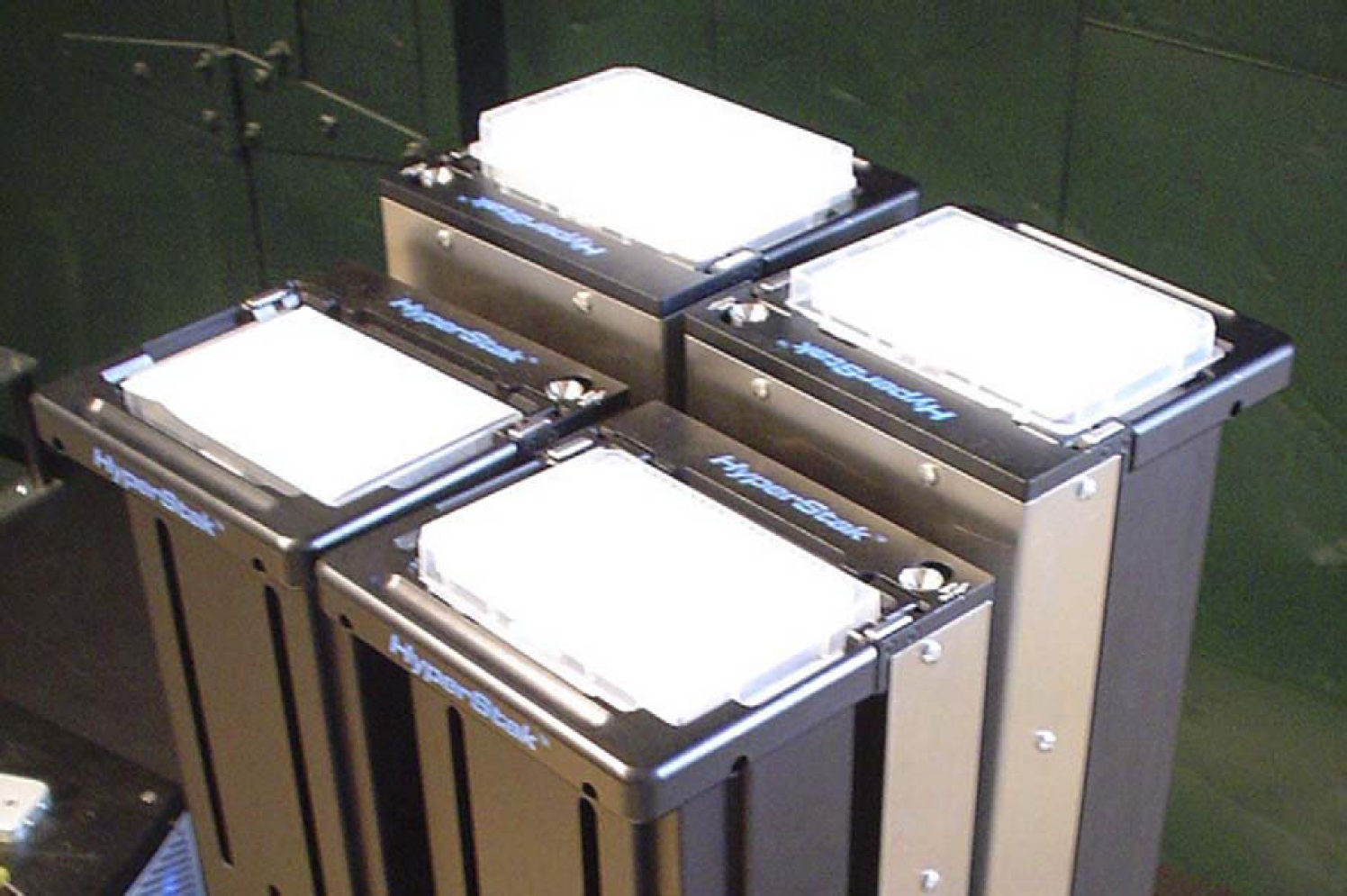
Four HyperStak towers in a dense pack formation occupy 30×38 cm of workspace.
In the near future, plans for the HyperStak involve a higher level of software control using either RS232 or RS485 communications via an ActiveX control if desired by the user and adding an adjustable mounting bracket, which would permit the HyperStak to be recessed within a work-table yielding access to the robot at whatever height the user/integrator might see fit. In this recessed mode, a removable insert has been considered which could aid in the loading and removing of consumables from the HyperStak towers.
Recently, the Matrix Trakmate two-dimensional tube racks were successfully run using the HyperStaks, and each tower was capable of holding up to 10 racks. The Hyper-Stak39 and a larger capacity 50-microplate unit (Hyper-Stak50) are currently available from HyperTask.