






Abstract
The obvious utility of microarray technology is its incredibly high feature density. An entire genome can be assayed in a single experiment. However, this same strength creates difficulties. First, what does one do with the transcription data of a gene whose function(s) are unknown? Second, in most applications, hundreds—not hundreds of thousands—of genes are regulated. Why collect replicate data on thousands of genes not involved in the problem at hand? In one sense, a high-density microarray is a fishing expedition that identifies the important players. Subsequently, efforts may be focused on the complete, albeit smaller set of regulated elements.
Keywords
Nunc has developed a series of chambered products that incorporate the high density features of microarrays with the throughput strengths of welled microplates. With these formats it is possible to print an array of nucleic acid or protein features at useful densities. The chambered nature of the products (16 and 96 wells) enhances the ability to perform replicative samples in a short period of time.
DNA and protein arrays are made possible by a combination of readily available sequence data and solid-state chemistry upon which to fix those sequences. DNA arrays are highly ordered matrices of spots all having a defined sequence. Fluorescently labeled targets, which are derived from mRNA, may be hybridized to the bound probe. The relative level of fluorescence between spots is a semiquantitative measure of the concentration of that transcript in the original sample. Two types of DNA arrays are available. cDNA arrays are printed from nucleic acids longer than 50 or so nucleotides and oligonucleotide arrays from smaller molecules. Technology has progressed to the point where arrays with 100,000 or more features can be printed in a 1-in. x3-in. glass lide.
The high feature density of nucleic acid micro-arrays has made it possible to scan the entire genome for patterns of expression associated with a particular physiologic state including cancer, 1 cardiovascular disease, 2 lipid metabolism, 3 asthma, 4 multiple sclerosis, 5 and endocrinology. 6,7
Profiles of expression from diseased and control states are compared on the same array in what is essentially a large differential display experiment. Once the set of differentially expressed transcripts is defined, the response of that set can be observed through repeated experimental manipulation (i.e., drug therapy, aging, etc.). In order to make the data usable, it must be organized into useful groups. A number of mathematical strategies group sets of genes, including self-organizing maps and hierarchical clustering algorithms. Once these clusters are identified, the members can be scanned for common features. For example, conserved sequences within a group might represent common structural or regulatory regions. Likewise, the association of a particular transcript might infer a function on its protein product which was previously unknown.
However, microarray data alone do not necessarily imply anything about the physiologic state of the cell. One must be careful in how much is inferred from genome-scale measures of relative transcription. Transcription is only one level of regulation in the cell; genes are frequently not expressed in direct proportion to their level of mRNA. Further, protein functions have levels of regulation of their own. Expressed protein may not be active, or may have an activity different from the one generally assigned to it in the literature.
More extensive techniques must be applied in order to assign physiological relevance to microarray data. For example, a number of questions arise when analyzing micro-array data that cannot be answered by doing more high-density microarrays. Such questions might incude: What is a significant change in relative expression and what is just ordinary background noise? Is the level of transcription linked to the level of expression? If expressed, where is the translation product localized? What activity does it have? Does it require post-translational modification?
These are traditional biological problems with well defined techniques for addressing them. Techniques such as RT-PCR, Northern blots, Western blots, ELISA, in-situ hybridization, immunochemistry, and replicative sampling will eventually be applied. The advantage of high-density micro-arrays is speed. You can now learn in one day where to focus your efforts where before it might have taken years.
Nunc has designed some solutions to assist in attaching relevance to genomic data. ArrayCote™ glass slides and plates are designed to generate replicate sampling of the set of regulated genes derived from high-density microarray experiments. Their chambered format allows multiple samples to be screened against the same arrays multiple times. Because the arrays are printed on the same piece of glass and performed simultaneously, the data is more comparable than experiments performed on different pieces of glass over multiple days. Further, because every feature costs money, replicate samples are obtained at a lower net cost—irrelevant features will not be included on the array.
Three functionalized glass surfaces—Aminopropylsilane (APS), Aldehyde, and Epoxy—have been characterized in a chambered format suitable for microarray use. All three surfaces demonstrate increased binding capacity for both DNA and protein over ordinary glass (see Figures 1 and 3). Excellent spot morphology and signal saturation are achievable with DNA arrays on the APS surface (see Figure 2).
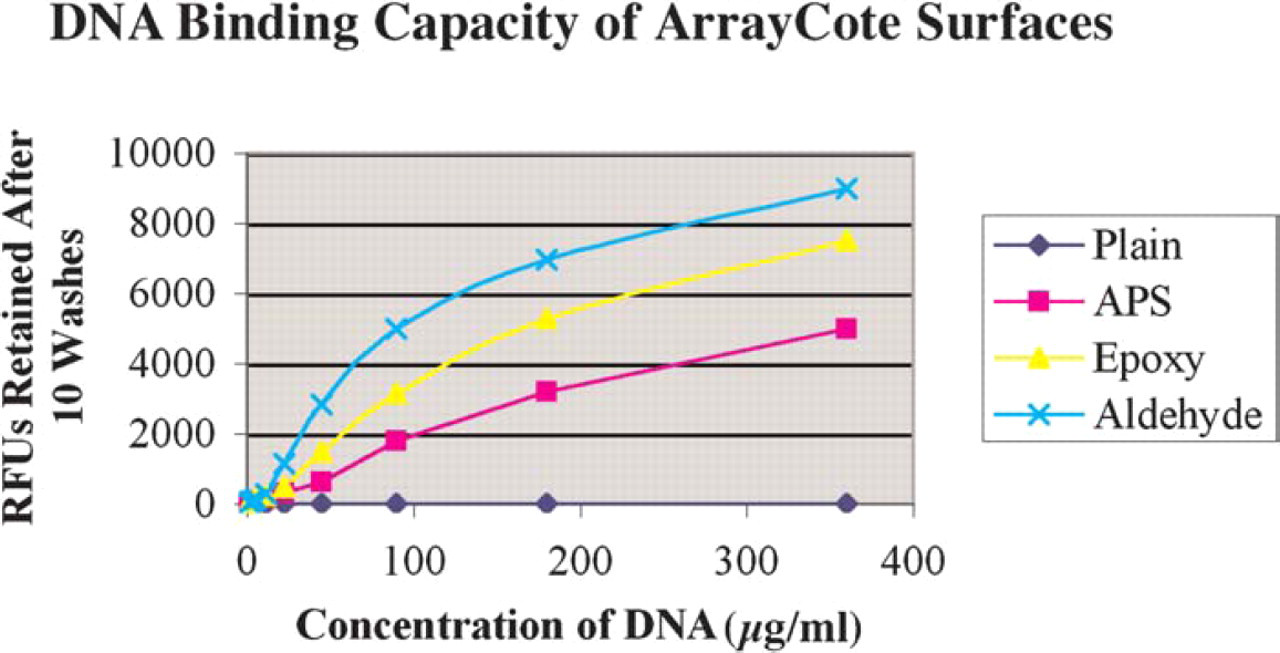
Enhanced DNA binding capacity on ArrayCote surfaces spotting: 1 μl drops of Cy3 labeled 20 bp oligonucleotides in 50% DMSO/dH2O (concentrations as noted) were spotted onto the center of wells of 96 well ArrayCote and plain glass plates. Spots were allowed to dry for 24 hours in a vacuum desicator, fixed for 2 minutes at 302 nm., and washed 10x in dH2O. Fluorescence intensity was measured with an excitation filter of 550 nm and emission filter of 570 nm using a Wallac VICTOR™ fluorescence plate reader.
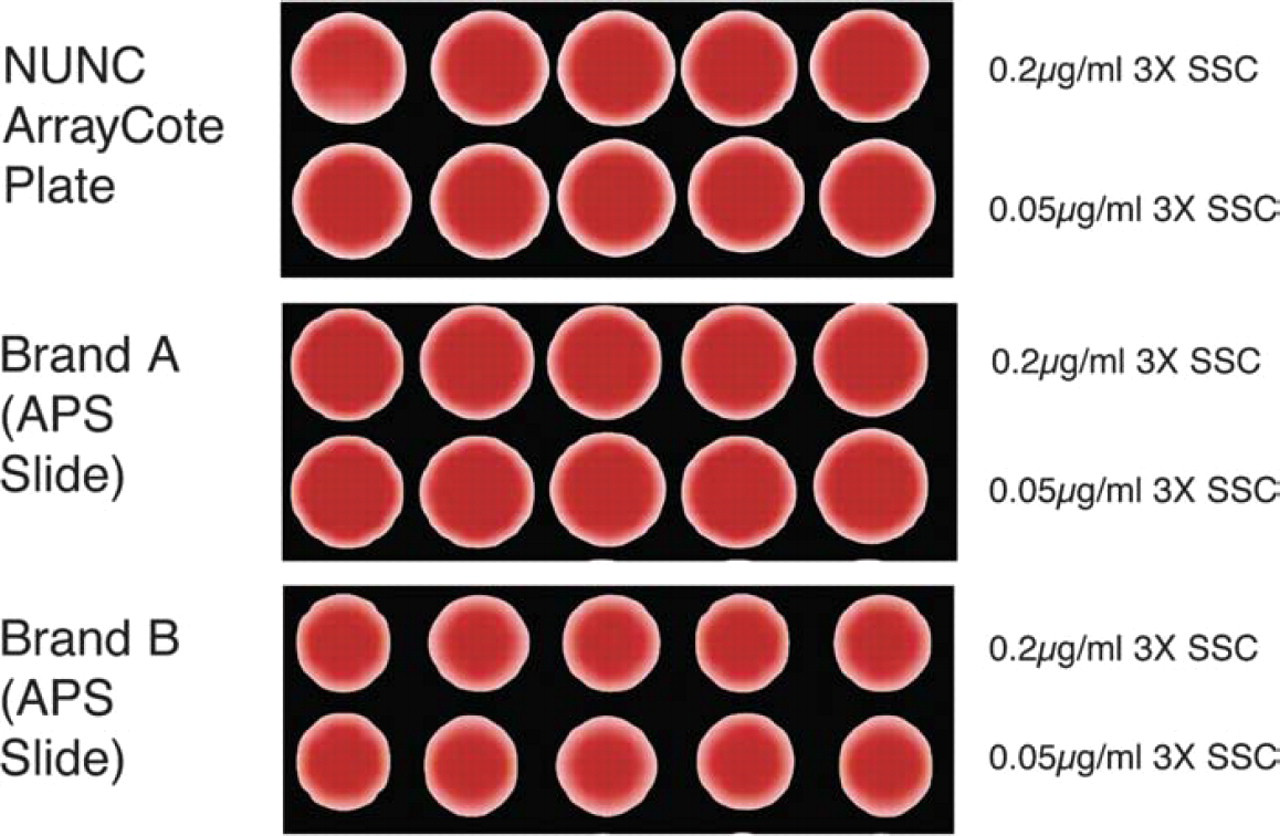
Spot quality on NUNC ArrayCote APS surface relative to competitor's slides.
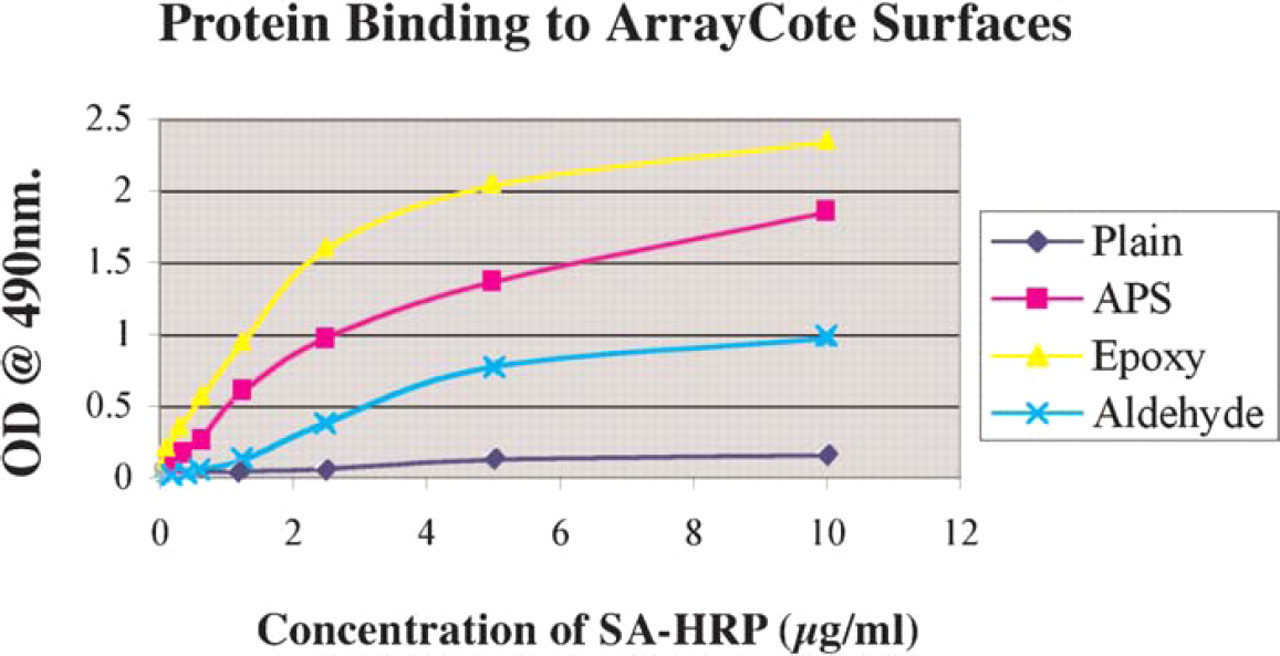
Enhanced protein binding capacity on ArrayCote surfaces binding: Serial dilutions from a 10 μg/ml solution of streptavidin-HRP conjugate (SAHRP) (Pierce) were prepared in PBS+0.1% Tween-20. 50 μl were dispensed by columns into 96 well Epoxy, Aldehyde, and plain 96-well plates. The solutions were incubated in contact with the glass for one hour and then washed 5x with PBS+0.1% Tween-20. Plates were developed with OPD.