






Abstract
Objective/Background
Occupational therapy that focuses on servicing clients demands motivated workers for quality service delivery. The objectives of this study were: (a) to determine the level of work motivation among occupational therapy graduates in Malaysia and (b) to determine if there is a difference in work motivation among these graduates based on work sector, job position, length of work experience, and gender.
Methods
This cross-sectional study recruited occupational therapy bachelor's degree graduates using an online survey. The Work Extrinsic and Intrinsic Motivation Scale (WEIMS) was used to measure level of work motivation.
Results
Responses from 82 (60.3%) graduates (male: 26.8%; female: 73.2%) were analysed. Sixty-two (75.6%) graduates worked locally and 20 (24.4%) worked in foreign countries. The average Work Self-Determination Index (W-SDI) score for WEIMS is +11.38 with 78 (95.1%) of graduates demonstrated a self-determined motivational profile and 4 (4.9%) demonstrated a nonself-determined profile. Graduates in the private sector (13.10 ± 6.47) show significantly higher W-SDI score compared to those in the public sector (9.40 ± 6.06), p = 0.01. W-SDI scores appeared higher among clinician (11.67 ± 6.40), case manager (13.33), and others (14.90 ± 8.23); and those with work experience of 5–6 years (13.11 ± 6.90) and less than one year (12.65 ± 7.12). Male (10.29 ± 6.86) and female (11.79 ± 6.39) graduates shared equally high score. There is no significant difference in W-SDI score based on job position, length of work experience, and gender.
Conclusion
Occupational therapy graduates have high work motivation as evident by their self-determined profile. Only work sector imposes difference in work motivation among these graduates. Copyright © 2017, Hong Kong Occupational Therapy Association. Published by Elsevier (Singapore) Pte Ltd. This is an open access article under the CC BY-NC-ND license (http://creativecommons.org/licenses/by-nc-nd/4.0/).
Introduction
Work motivation is said to be linked to the delivery of quality of service by enhancing workers' performance as well as directing them towards personal and cooperation goals (
There are two major types of motivation, i.e., intrinsic motivation (IM) and extrinsic motivation (EM) (
Investigating work motivation specific to occupational therapy is important because it links closely to the effort that they put to improve the quality of care and client's safety (
Malaysia has enjoyed rapid expansion in both public and private healthcare sectors since the past decade. For instance, in 2012, there were 225 private hospitals in Malaysia and by 2018, the number is projected to increase to 239 (
Work motivation may be related to demographic variables such as gender (
Given work motivation is very important and yet there is no solid information relevance to the field of occupational therapy, the objectives of our study were: (a) to determine the level of work motivation among occupational therapy graduates in Malaysia, and (b) to determine if there is a difference in work motivation among occupational therapy graduates in Malaysia based on work sector, job position, length of work experience, and gender.
Methods
Design and participants
This cross-sectional study was conducted through an online “Survey Monkey”. The study surveyed occupational therapy bachelor's degree graduates of one of the higher learning institutions in Malaysia. This institution was selected because: (a) it offered the first occupational therapy bachelor's degree in Malaysia in 2004, and (b) it accepts students from different racial and religious backgrounds, reflecting the actual social characteristics of Malaysian society. The list obtained from this institution showed at the time of the study, a total of 136 students had been successfully graduated.
Instrumentation
We used Work Extrinsic and Intrinsic Motivation Scale (WEIMS) (see

The possible W-SDI score of this WEIMS ranges in between ±36. The total score reflects individuals' relative level of self-determination. A positive score indicates a self-determined profile and a negative score suggests a nonself-determined profile. In terms of construct validity, WEIMS has an item-to-total correlation above 0.50 for all the subscales and for internal consistency of its six subscales, it has Cronbach's alpha coefficients ranging from 0.64 (AMO) to 0.83 (INTEG) (
No translation was performed to the WEIMS in the study because: (a) all graduates have good English proficiency –scoring at least Band 2 in the Malaysian University English Test (MUET) is the graduation requirement of this institution, and (b) throughout the entire curriculum, most of the courses were conducted and examined in English. No adaptation was performed to WEIMS because: (a) this was the first study that attempted to explore the work motivation among occupational therapy graduates in Malaysia, and (b) the need of adaptation to suit Malaysian cultural context is not substantiated. We believe maintaining the WEIMS in its original version was a more realistic option. Demographic data collected include graduate's work sector, job position, and length of work experience.
Data Analyses
Statistical analyses were done using IBM SPSS software (version 21.0) with level of significance set to .05. We used descriptive statistics to analyse demographics of graduates as well as distributions of WEIMS subscales and W-SDI. For differences in work motivation based on work sector and gender, we used independent samples t-test. For differences in work motivation based on job position and length of work experience, we used One-Way Analysis of Variance (ANOVA).
Results
We received responses from 92 (67.6%) graduates out of the 136 graduates (or 91.1% of needed response of 101). Only responses from 82 (60.3%) graduates were included in the final analyses because eight graduates had incomplete responses and two were unemployed at the time of study. Table 1 shows the demographics of the 82 graduates that had completed the study. Graduates were predominantly female (n = 60, 73.2%) and worked in a private sector (n = 44, 53.7%). Majority of them worked locally (n = 62, 75.6%) especially in the rapidly developed and highly populous Central Region of Malaysia (n = 36, 43.9%). There were 15 (18.3%) graduates working in Singapore and other countries (n = 5, 6.1%). Clinician (n = 59, 72%) was the biggest group, followed by educator (n = 11, 13.4%). There were five graduates who hold other job positions such as operation officer, auditor, and contractor etc. The five of them were included in all analyses because we believe that they do require application of occupational therapy knowledge and skill for work performance.
Demographics of the responded graduates.
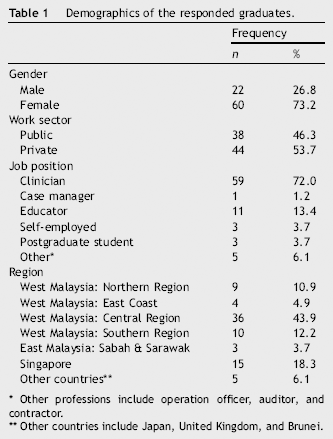
Other professions include operation officer, auditor, and contractor.
Other countries include Japan, United Kingdom, and Brunei.
Table 2 shows the distributions of all the six subscales of WEIMS and the W-SDI. All subscales of WEIMS have high mean scores except for the subscale of AMO. Graduates have good work motivation with +11.39 W-SDI average score. Among them, 78 (95.1%) demonstrated self-determined profile and only 4 (4.9%) demonstrated nonself-determined profile.
WEIMS and W-SDI.
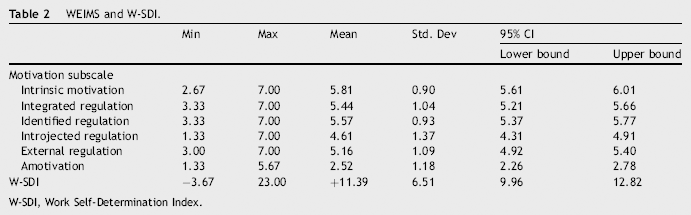
Table 3 shows that on average, graduates from a private sector have higher W-SDI score (13.10 ± 6.47), signifying higher self-determined profile compared to those in the public sector (9.40 ± 6.06), t(80) = 2.66, p = 0.01. Clinician (11.67 ± 6.40), case manager (13.33), and others (14.90 ± 8.23) have relatively higher W-SDI scores, but difference between them is not significant, F(5, 76) = 0.60, p = 0.70. Graduates with 5–6 years of work experience displayed the highest W-SDI score (n = 12, score = 13.11 ± 6.90), followed by those with less than one year of work experience (n = 22, score = 12.65 ± 7.12). No significant difference is noted based on length of work experience F(6,75) = 0.66, p = 0.68. Similarly, there is no significant difference in W-SDI score based on gender (male: 10.29 ± 6.86; female: 11.79 ± 6.39), t (80) = −0.92, p = 0.36. Both genders show self-determined profile.
W-SDI based on job position and length of work experience.
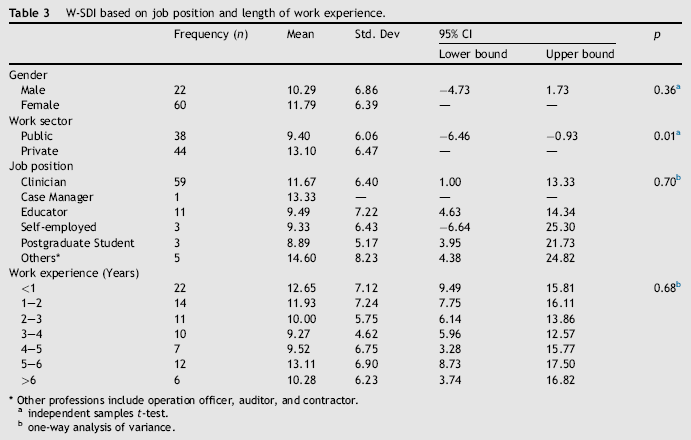
Other professions include operation officer, auditor, and contractor.
independent samples t-test.
one-way analysis of variance.
Discussion
We obtained considerably high response rate in our study (67.6%). This rate is higher than the 33.0% obtained by most online survey (
Because the sources of motivation differ among people and may affect people differently (
Our study encores report by
Our study found no difference in motivation among graduates holding different job positions. We speculate that graduates actually have chosen the type of job that well suits their personality, interest, and goal as reflected through their high scores in subscales of IM, INTEG, and IDEN. A collision between personality and work can lead to certain behaviours that promote work motivation (
Results of our study are potentially generalisable to graduates holding equivalent degree from other countries in the Southeast Asia and East Asia regions. Our results were mainly contributed by graduates working in the Central Region of Malaysia (including Kuala Lumpur) and Singapore. These places share many similarities with other larger cities or urban areas in these regions in terms of having rapid infrastructural development, robust economic support, and strong population growth. Graduates in these places or cities may demonstrate similar level of work motivation due to urbanisation. Generalisability of our results is further enhanced by recruiting graduates from different racial and religious backgrounds. This is in line with the fact that Southeast Asia and East Asia regions have unique and rich racial and religious compositions.
Limitations and Recommendations
There were three limitations in our study: (a) a minimum responses of 101 was not achieved despite allocation of extra time by extending the deadline. This may subject our results of no difference in work motivation based on job position, length of work experience, and gender to Type II errors; (b) our results may only be generalised to occupational therapy graduates holding at least a bachelor's degree. Work motivation of diploma graduates needs to be investigated separately as they are likely to experience and to react on issues related to various characteristics of work differently; and (c) there may be other important factors that affect work motivation and this demands a more specific investigation. Interviewing graduates using semi-structured or in-depth formats may provide us with greater insight on issues related work motivation.
Conclusion
In general, Occupational therapy graduates have high work motivation with self-determined motivational profile. Graduates that work in the private sector have higher work motivation than those in the public sector. Work motivation does not vary among graduates based on job position, length of work experience, and gender.
Footnotes
Acknowledgements
The authors would like to thank Professor Maxime A. Tremblay for granting the permission of using the WEIMS for this study as well as featuring it as an appendix of this publication. The authors would also like to thank occupational therapy graduates for their participation.
Work extrinsic and intrinsic motivation scale (WEIMS)
Using the scale below, please indicate to what extend each of the following items corresponds to the reason why you are presently involved in your work.