






Abstract
Background/Objective
Mindfulness-based intervention has received more clinical interest and empirical support for individuals with ADHD especially to improve attention. However, no systematic review has been done to analyze and compare the effectiveness of mindfulness-based intervention on individuals with ADHD in different age groups. This review examined its effectiveness for individuals (children, adolescents and adults) with ADHD to improve attention.
Methods
In 7 databases, totally of 152 studies were identified; 9 met the inclusion and exclusion criteria and were reviewed. Five of the studies recruited adults as the participants, two recruited adolescents as the participants, one recruited both adults and adolescents as the participants and one recruited children as the participants.
Results
It was found that mindfulness-based intervention was comparatively more popularly used in adults with ADHD to improve attention, and the improvement was significant.
Conclusion
It is still unclear whether mindfulness-based intervention is effective for children and adolescence with ADHD due to limited studies available and the limitations of the study design in the reviewed studies. Therefore, more research in the future is required to answer the question.
ADHD is a neurobiological disorder described by symptoms of inattention, hyperactivity and/or impulsivity (
Among the treatment approaches for improving attention in people with ADHD, pharmacotherapy, such as stimulant medication, is the mainstay choice as it is associated with a remarkable response rate, though many patients still suffer from the impairing residual symptoms despite treatment (
Nonpharmacological treatment options are therefore increasingly preferred. However, there has been insufficient research on the effectiveness of nonpharmacological treatment options which treat inattention in adults with ADHD (
Mindfulness-based intervention has been widely used and shown benefits in adults who suffer from stress, depression, pain and illness (
Recently, MBI becomes increasingly accepted as an intervention approach to individuals with ADHD, especially concerning the symptoms of inattention. There are some potential reasons. The first reason is MBI involves focused attention on a selected object (e.g. Breath sensation), and subsequently broadens the attention towards a steady monitoring of anything that arises from sensory, mental or emotional states (
There are various types of MBI used in ADHD. However, one common component among them is the practice of self-regulation of attention. For examples, mindfulness-based cognitive therapy (MBCT) is the combination of cognitive behavioral therapy and mindfulness. It emphasizes sustained attention training and believes that if someone is able to control his/her internal state, it can enable insight and adaptation of maladaptive cognitions and behaviors underlying psychiatric symptoms (
ADHD is a neurobiological disorder which is not only found in children but also in adolescents and adults. Clinical findings show that the pattern of ADHD symptoms would change with age, with hyperactivity-impulsivity is more significant than inattention in childhood but inattention would become more evident than hyperactivity-impulsivity in adulthood (
Methodology
Literature Search
Literature review was done to locate published papers and research studies investigating mindfulness training for children, adolescents and adults with ADHD. The keywords search for the literature was performed from seven electronic databases, including PubMED, ScienceDirect, Medline, PsyclNFO, CINAHL, Frontiers and SAGE. The keywords used were Attention Deficit Hyperactive Disorder, ADHD, mindfulness, meditation and attention. Boolean operators ‘OR’, ‘*”, ‘AND’ were also used to capture potential studies. In addition, hand search of the reference lists of included articles was done by the review team which consisted of five postgraduate students and one faculty member in the field of rehabilitation. The search process was presented in
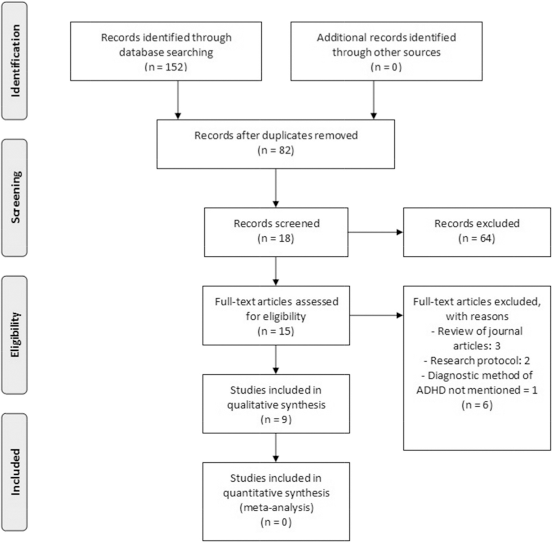
Flowchart of search strategy based on PRISMA flow diagram
Inclusion and Exclusion Criteria
Studies were included when they met the following criteria:
Participants: individuals with ADHD diagnosed by DSM-IV (
Intervention: Mindfulness-based training, such as Mindfulness Based Cognitive Training (MBCT), Mindful Awareness Practices (MAP), Mindfulness-Based Stress Reduction (MBSR), etc.
Outcome measures: outcomes in attention performance/inattention symptom
Study design: rated as level 3, single case control or studies, or higher levels such as randomized control trials, according to the Centre for Evidence Based Medicine (
Studies were published in recent 10 years between 2007 and 2016.
Studies were excluded if full text was not available or they were not published in English.
Data Extraction
The review team screened and selected the included literature based on the title, publication year, methodology, types of participants, outcome measures and the intervention of the studies together. Disagreement on the decision between team members was resolved through discussion. In addition, the reasons for excluding studies were recorded. After selecting the relevant literature, two group members were responsible for classifying the studies into three categories based on the age of the participants (i.e., children, adolescents, and adults) – a person older than 19 is classified as an adult; a person aged from 10 to 19 is classified as an adolescent; a person is classified as a child if under 10 (
Results
Study Identification
The initial search identified 152 articles for review. Based on the inclusion and exclusion criteria, nine studies examining mindfulness-based interventions with the outcome measures including attention performance/inattention symptom were included. This process is specified in
Summary of Study Details
Out of the nine included studies, five articles involved adults as the participants, one article involved both adults and adolescents as the participants, two articles involved adolescents as the participants and one article involved children as the participants. Table 1 summarizes study details including (a) study design; (b) research objectives; (c) number of participants; (d) age of participants; (e) gender; (f) outcome measures; (g) intervention and; (h) intervention outcomes.
Summary of the study details.
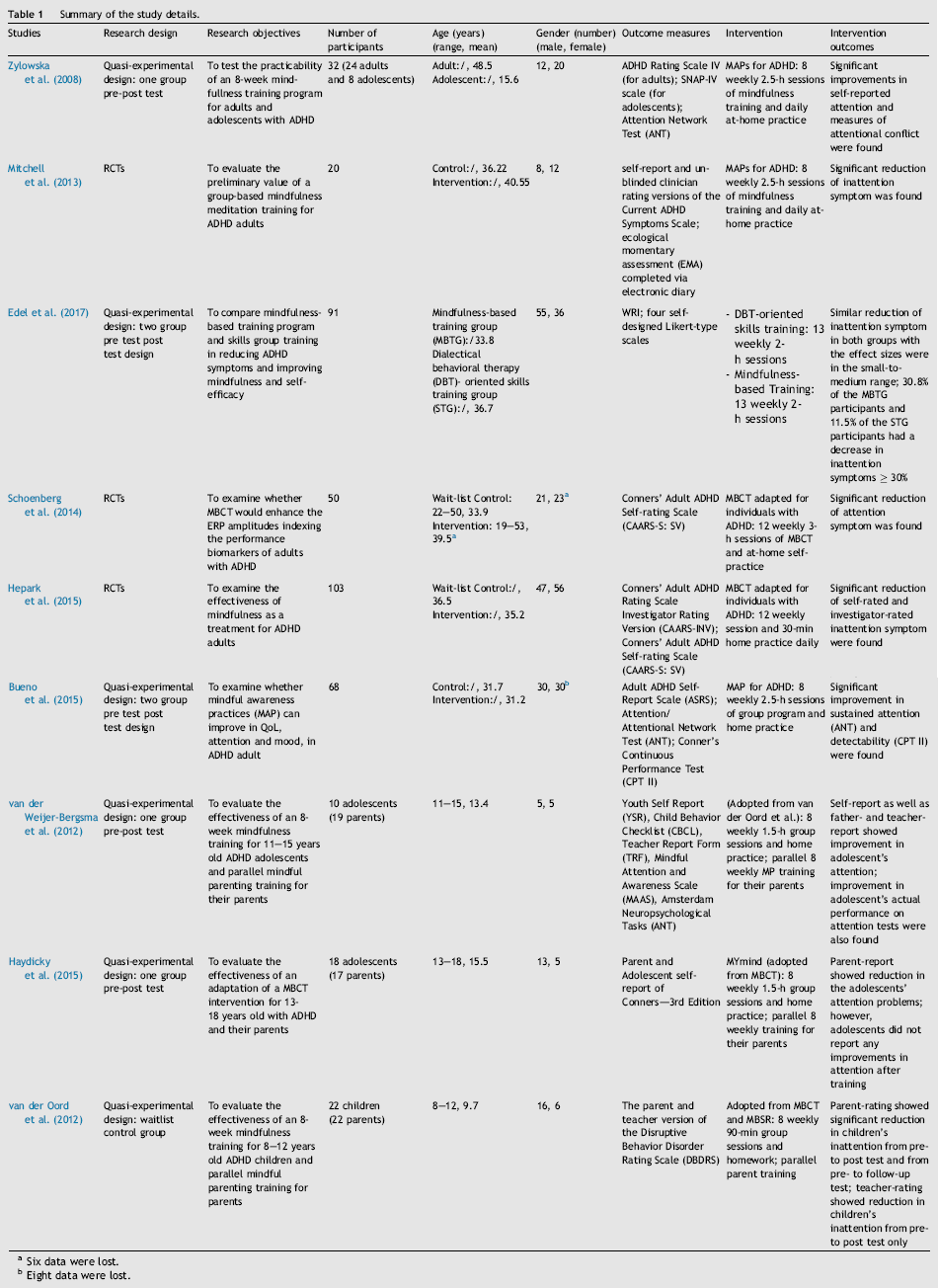
Six data were lost.
Eight data were lost.
Participants
All together 400 participants were involved in these nine included studies. Among them, 342 were adults, 36 were adolescents and 22 were children. Besides, about half of the adults, 58% of the adolescents and 73% of the children were male. For the details of the demographics of the participants refer to Table 1 .
Qualitative Summary of the Studies
Due to the small number of identified studies in this review as well as these studies were substantially heterogeneous in terms of study design, a quantitative data synthesis was not possible. Therefore, a narrative, qualitative summary based on the three age groups was done.
Adults
There were six studies using MBI to improve inattention symptoms in adults with ADHD. While three of them were Randomized Control Trials (RCTs), the rest were two-group pre-posttest design without randomization. Three variants of mindfulness-based training, MBCT, MAP and MBSR, were used in these studies. The results of the two RCT studies which used MBCT as an intervention showed significant reduction in attention problems (
Adolescents
In totally, three articles were found which included adolescents as participants and one of them included both adults and adolescents as participants (
The findings of these three studies revealed that although there were no differences in their attention between pre- and post-training in adolescents in
Children
Only one article targeting children with ADHD was included in this review. In
Discussion
An appropriate behavioral intervention approach is important for improving the attention deficits in individuals with ADHD. As mindfulness-based training has become widely used recently, there is a need to examine whether this type of training is effective in improving attention deficits for individuals with ADHD, in particular whether this kind of intervention would have similar training benefits for ADHD individuals at different developmental stage.
This systematic review examined clinical evidence on the effectiveness of mindfulness-based interventions on improving attention in children, adolescents, and adults with ADHD. Nine studies, including three RCTs, four one-group quasi-experimental designs, one two-group quasi-experimental design and one one-group wait-list control quasi-experimental design, were included in this review.
There were six studies concerning adults with ADHD. The results all showed significant improvement in attention in this age group. Moreover, three of the studies were randomized control trials, posing a strong evidence that the positive results were due to treatment effect. This result echoes with the previous systematic review by
This systematic review supported that MBI has clinical value for individuals with ADHD regardless of their developmental stages, however, some considerations should be taken before a conclusion can be drawn.
Apart from the above-mentioned three issues, there are some other areas that future studies should consider. ADHD has various subtypes and the severity of different ADHD symptoms would be different among these subtypes. Although it appears that MBI has benefits for ADHD individuals, it is unclear whether any ADHD subtypes would benefit more from MBI. In order to know the answer for this issue, future studies should consider investigating the training effect of MBI on the various ADHD subtypes. MBI was originally used in adult populations, it is a relatively new treatment approach for children. Because of this background, majority of the identified studies in this systematic review focused on adults and only one study is on children. Under this condition, it is premature to make any conclusions on the clinical application of MBI in children with ADHD. There is no doubt that more studies are needed to test the effectiveness of MBI on improving attention in children with ADHD. However, more specifically, as MBI involves high cognitive demands, studies on investigating whether MBI is a “child-friendly” treatment approach is also indicated.
Finally, it is noteworthy that there were some limitations in this review. First, one of the participant selection criteria was participants in the reviewed studies should fulfil the DSM-IV diagnostic criteria of ADHD. This criterion excluded those individuals who had the diagnosis based on other DSM editions (e.g., DSM III or DSM lll-R), leading to a smaller number of studies that could be identified during the literature search process, in particular those studies on adults. Although a negative consequence on the total number of identified studies was induced, if the same diagnostic criteria were used for different age groups, a relatively more consistent clinical characteristics profile of participants can be warranted and helped controlling the confounding effect of mixed participants' characteristics. Second, only articles published in English were included in this review, this criterion might restrict the number of relevant studies identified, lowering the power of generalization of the study results. Third, one of the selection criteria set for the literature search was “outcomes in attention performance/inattention symptoms”. As many studies used ADHD symptoms, depressive and anxiety symptoms, and/or mindfulness skills as the outcome measures, outcomes in attention performance/inattention symptoms may be too focused and restrict the quantity of studies that can be identified. However, inattention is a major symptom in ADHD individuals and the essence of MBI is to practice self-regulation of attention, improvements in attention should be more direct and explicit than other outcome measures. Moreover, it may also provide further information about the associations between the underlying mechanisms of intervention and the treatment outcomes. Therefore, attention is preferred as the primary outcome measure in this systematic review.
Conclusions
This systematic review examined the evidence for effectiveness of mindfulness-based interventions in children, adolescents and adults with ADHD. For adults with ADHD, mindfulness-based intervention improves attention deficits significantly, however, due to limited research studies, it is hard to make conclusion for adolescents and children with ADHD. Moreover, for the small quantity of references papers, it is hard to conclude that whether mindfulness-based interventions are more effective in a particular age group.
It is recommended that future studies should consider using attention as the primary outcome and other variables as the secondary outcomes and consider the quality of home-based mindfulness practice for the children and adolescents.