






Abstract
Objective
This pilot study examined the internal consistency, test—retest reliability, construct validity, and discriminant validity of the Activity Participation Assessment (APA) for school-age children in Korea.
Methods
The construct validity of the APA was first established by factor analysis on the response of 134 nondisabled children. Internal consistency was evaluated for each of the factors. A test—retest study was conducted on 22 nondisabled children. Discriminant validity was established by comparing the participation of 56 nondisabled children and 56 children with intellectual disabilities and examining sex differences of 61 boys and 61 girls.
Results
Analysis of the APA revealed five factors, which were labeled as instrumental activities of daily living (IADL), sports and outdoor activities, hobbies and school activities, social activities, and personal care. The factors showed acceptable levels of internal reliability (Cronbach's alpha = .63–.89). The intraclass correlation coefficient (ICC) for the five factors were all in the good range (ICC = .86–.92). We found statistically significant difference between nondisabled children and children with intellectual disabilities in five factors. We also found that girls participated in significantly more IADL, hobbies and school activities, and social activities. However, boys participated in significantly more sports and outdoor activities.
Conclusion
The APA shows good internal reliability, test—retest reliability, discriminant validity, and construct validity. However, evidence of psychometric properties was limited by a small sample size. Psychometric properties such as interrater reliability as well as concurrent validity and construct validity need to be tested using a larger sample size with representative demographics.
Introduction
Participation is defined as a person's “involvement in life situations” and is viewed as resulting from the interaction of individuals with their social and physical environments (
Maintenance of performance and participation in activities is currently a paradigm of the time for occupational therapy (
Recent research on the participation of children has been concerned with the differences in participation between nondisabled children and children with disability (
Although there are available foreign assessment tools, the tools measuring participation reflect each nation's unique culture, environment, language, and regional characteristics (
Most prior Korean research on children's participation measured participation of leisure activities using questionnaires generated by the researchers in accordance with their specific study purposes. Such questionnaires cannot be considered representative of the activity of Korean children because activity was not assessed in a large population, and each questionnaire's reliability and validity has not been verified. Therefore, the aforementioned questionnaires cannot be used as assessment tools.
The ICF has stressed that successful rehabilitation needs to be measured via activity and participation level (
Methods
This study examined the reliability and validity of APA, which was developed to measure the participation of school-age children via 83 activity items. This study includes two phases: development of the APA and analysis of its reliability and validity (Figure 1).
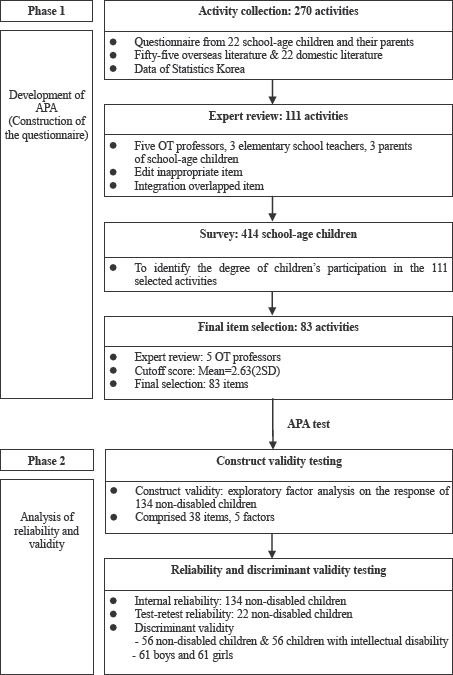
Flow diagram of reliability and validity of Activity Participation Assessment (APA).
Phase 1: development of the APA
The APA was developed to measure the activity participation of school-age children in Korea. The APA was developed across four steps. First, activity list has been collected on the basis of the child and parental questionnaires, review papers, and time use survey data of Statistics Korea. Data on activities were collected by listing children doing activities during a day in every 30 minutes by 22 school-age children and their parents. Activity lists were also collected by reviewing overseas and domestic papers related to child participation assessment searched from Medline, CINAHL, ERIC databases, Google, Research Information Sharing Service, Korean Studies Information Service System, and the DBpia databases. Finally, we used the time use survey data for school-age children of
In the second step, 111 activities were selected from 270 activities through a panel meeting, which involved professors of departments of occupational therapy, elementary schoolteachers, and parents of elementary school students. In the third step, a survey was conducted on 414 nondisabled children aged 7—12 years to measure the children's participation in the 111 listed activities. The proportion of 7—12-year-old children sampled from urban versus rural areas and by province was set according to the population and housing census survey data of
Significant features were found from the development process of the APA. First, the final list of 83 activities was not entirely equivalent to those of foreign countries: 59.04% of APA activities were consistent with activities in foreign participation assessment tools. Second, the APA has 14 activities that were not included in foreign assessment tools such as the PACS and the Singapore version of PACS. Activities such as “going to a public bath or Korean sauna with family,” “doing workbook exercises,” “going to extracurricular academy,” “playing with marbles/five stones,” and “playing Korean chess/game of go” reveal unique Korean cultural characteristics and environment. This confirmed the need to develop the APA for Korean children. Third, the APA for Korean children has a smaller number of sports activities (playing dodge ball, playing baseball, playing soccer, playing badminton, sledding, and running), and a larger number of activities related to learning (attending after-school class, doing workbook exercises, going to art/sports academy, going to an extracurricular academy, writing a diary, doing homework, writing a book report) than participation tools of foreign countries. These unique items show Korean's notable concern with academic education, even for young children.
The development of the APA represented the first study that developed a tool for measuring participation by collecting representative activities performed by elementary school students from all over the country.
Phase 2: analysis of reliability and validity
Once the final version of the questionnaire was established, which consisted of 83 items rated via a 6-category scale, the next phase involved the preliminary determination of the reliability and validity of the APA. First, exploratory factor analysis was conducted to determine the factor structure of the APA, and then we assessed the internal consistency, test—-retest reliability, and discriminant validity of each domain.
Participants
Nondisabled children and children with intellectual disability were recruited for the reliability and validity test. The age of the participants ranged from 7 to 12 years. Nondisabled children were students who had never been diagnosed with a disability and had no difficulties with academic performance due to physical and psychological problems. They were recruited randomly from eight elementary schools in Seoul, Gyeonggi, and Jeonla provinces in Korea, which represented the proportion of 7- to 12-year-old children in urban versus rural areas (80% vs. 20%) of
The children with intellectual disability were recruited from three special schools in the same provinces as the nondisabled children. Prior to data collection, all participants and their parents were informed about the purpose of the study and gave written, informed consent to participate.
Instruments
The 83 APA items were used for reliability and validity testing. Prior to conducting the survey, the first author operationally defined the 83 activities based on lexical and activity definitions in the time use survey report (
The researcher recorded responses for the 83 activities by coding “never” as 1, “rarely” as 2, “sometimes” as 3, “frequently” as 4, “often” as 5, and “very often” as 6. The level of activity participation (%) was calculated as the arithmetic mean of the 83 activities using the statistical program IBM SPSS Statistics for Windows, Version 20.0 (IBM Corp., Armonk, NY, USA).
Procedure
All of the participants' data were included in the investigation of internal consistency, test—-retest reliability, construct validity, and discriminant validity. The data were gathered by four trained research assistants. The first author trained each assistant on how to complete the questionnaire. The first author and the four trained research assistants administered APA testing first to the 134 nondisabled children, and then to the 22 nondisabled children 2 weeks later. On average, it took about 20 minutes for nondisabled children to complete the APA testing. To minimise variations during the test—-retest study, the testing environment was kept constant. A 2-week interval was considered a reasonable period to minimise potential learning and practice effects for the tool.
To compare the participation of nondisabled children and children with intellectual disability who are not capable of completing the APA test, researchers administered the APA to the parents of 56 children with intellectual disabilities and 56 age-matched, nondisabled children in Korea.
Statistical analysis
Cronbach's alpha was calculated to examine the internal consistency of the APA. Test—-retest reliability was estimated using the intraclass correlation coefficient (ICC), a reliability coefficient that accounts for both degree of correspondence and agreement among ratings (
Factor analysis is a statistical method used to describe variability among observed, correlated variables, and to determine whether multivariate data are affected by some factors (
Results
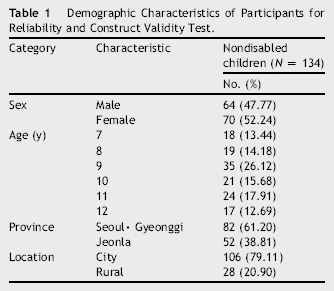
A total of 134 nondisabled children were recruited to test the APA's construct validity and internal consistency. Their mean age was 9.19 ± 1.57 years. More than 79% of these nondisabled children were living in urban areas (Table 1).
Demographic Characteristics of Participants for Reliability and Construct Validity Test.
Construct validity and internal reliability
The factor analysis of nondisabled children's data revealed five factors with an eigenvalue > 1, which comprised 38 items (Table 2). The first factor accounted for 13.54% of the variance, the second factor 10.32%, the third factor 9.90%, the fourth factor 6.85%, and the fifth factor 6.47%. Overall, the five principal factors explained 47.08% of the total variance.
Factor Loading for Each of the 38 Items Regarding the Participation Frequency in Nondisabled Children.
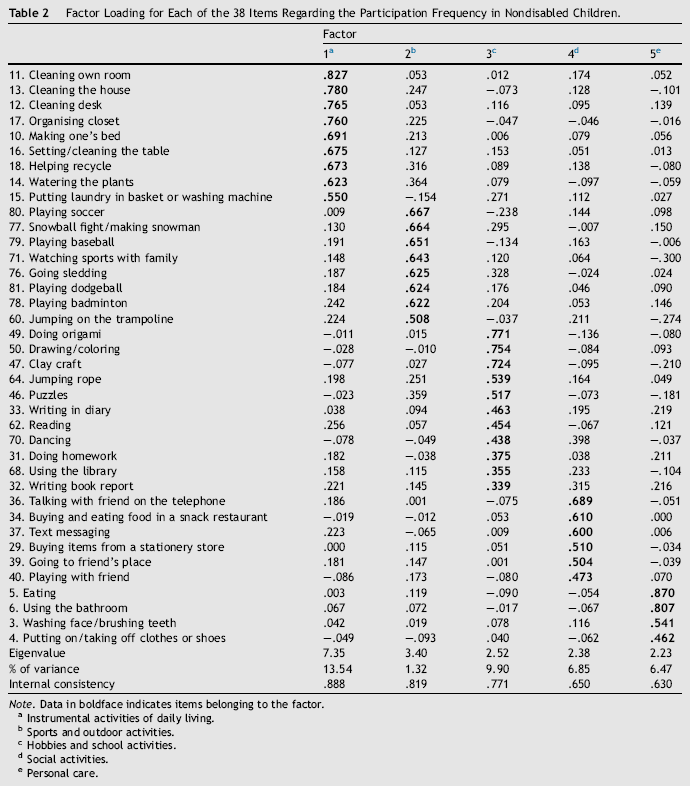
Note. Data in boldface indicates items belonging to the factor.
Instrumental activities of daily living.
Sports and outdoor activities.
Hobbies and school activities.
Social activities
Personal care.
The first factor was composed of instrumental activities of daily living (IADL; 9 items), the second was sports and outdoor activities (8 items), the third was hobbies and school activities (11 items), the fourth was social activities (6 items), and the fifth was personal care activities (4 items). Cronbach's alpha was calculated to quantify each factor's internal reliability. Internal reliability was .89 for factor 1, .82 for factor 2, .77 for factor 3, .65 for factor 4, and .63 for factor 5 (Table 2). The other 45 activities, which had low loading values (<0.40), were eliminated from the questionnaire and hence do not appear in the table.
Test—retest reliability
The data of 22 nondisabled children were used to assess test—retest reliability. The average age of the 22 children in the study was 9.3 years (SD = 1.24). Table 3 shows the descriptive data for the pretest and posttest scores and ICCs. The ICCs for the five factors were all acceptable (ICCs = .86—.92). When interpreting the coefficient, coefficient values of .75 and above are considered good to excellent (
Test—retest Reliability of the Activity Participation Assessment.
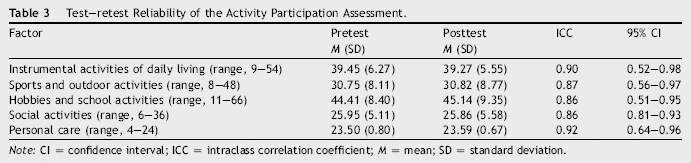
Note: CI = confidence interval; ICC = intraclass correlation coefficient; M = mean; SD = standard deviation.
Discriminant validity
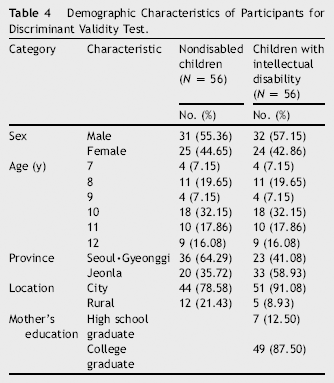
Fifty-six nondisabled children (31 male, 25 female; Mage = 9.82 years, SD = 1.23) and 56 children with intellectual disability (32 male, 24 female; Mage = 9.84 years, SD = 1.17) took part in the discriminant validity test (Table 4). No significant differences were found between nondisabled children and children with intellectual disability in terms of age or sex.
Demographic Characteristics of Participants for Discriminant Validity Test.
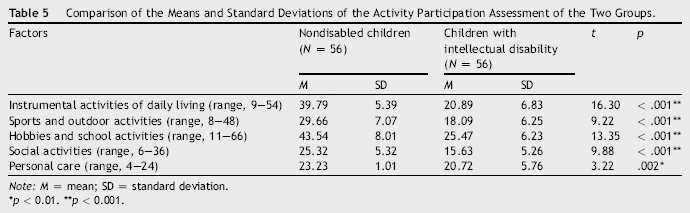
To compare the participation of nondisabled children (n = 56) and children with intellectual disability (n = 56), we calculated a mean score and performed t tests over all 38 items. The mean score of nondisabled children was higher than that of children with intellectual disability for all factors. There were significant differences between the two groups for IADL (t = 16.30, p < .001), sports and outdoor activities (t = 9.22, p < .001), hobbies and school activities (t = 13.35, p < .001), social activities (t = 9.88, p < .001), and personal care (t = 3.22, p = .002) factors (Table 5).
Comparison of the Means and Standard Deviations of the Activity Participation Assessment of the Two Groups.
Note: M = mean; SD = standard deviation.
p < 0.01.
p < 0.001.
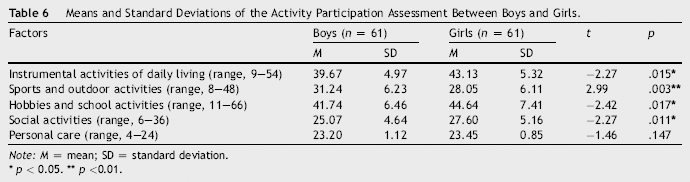
To establish additional validity, two age-matched groups of 61 boys and 61 girls were formed from the sample described previously. No significant differences were present between the two groups with respect to age (boys: M = 9.42, SD = 1.02 years; girls: M = 9.39, SD = 1.21 years; t = 0.75, p = .37). To compare the participation of girls and boys, we calculated a mean score for each factor separately (i.e., IADL, sports and outdoor activities, hobbies and school activities, social activities, and personal care). We then performed t tests to compare the scores of the two groups (boys and girls) on the five factors. There were significant differences between the two groups for IADL (t = −2.27, p = .015), sports and outdoor activities (t = 2.99, p = .003), hobbies and school activities (t = −2.42, p = .017), and social activities (t = −2.27, p = .011). We found no significant difference for the personal care (t = −1.46, p = .147) factor (Table 6).
Means and Standard Deviations of the Activity Participation Assessment Between Boys and Girls.
Note: M = mean; SD = standard deviation.
p < 0.05.
p <0.01.
Discussion
The development of the APA addressed the lack of a reliable and valid tool for measuring activity participation in Korean culture, especially among school-age children. The validity and reliability findings of this study support the APA as an assessment tool to measure activity participation for school-age children in Korea.
The five principal factors of the APA explained 47.08% of the response total variance, and their internal reliability values were acceptable (Cronbach's alpha = .63—.89). The test—retest reliability findings also showed that the tool was stable over a reasonable time frame (
Our findings are consistent with the five types of activities identified by
Unlike
The second factor, sports and outdoor activities, consisted of four sports and four outdoor activities. Bowman classified outdoor activities such as snowball fights/making a snowman, sledding, and trampolining as hobby activities, whereas we combined sports and outdoor activities into one construct, which conveys that sports are generally carried out with others and involve rules and activities. Sports and outdoor activities can be differentiated from hobby activities that are performed individually. School-age children's play is based on rules, and peer groups are a major medium for socialisation. Sports and outdoor activities reflect children's attempts to build their self-confidence and to prove their talents (
The APA was composed of 38 items after 45 items were removed because of low loading values. The activities reflecting cultural relevance such as playing Korean chess and playing with marbles/fivestones were deleted from the final items. These activities were removed because of the differences among children in participation frequency, which confounded each item's reliability; however, removing items because of low loadings in the exploratory factor analysis might not be good in developing a culture-specific APA. Therefore, one should not rely solely on the current results.
To verify the discriminant validity of APA, we compared the APA scores of nondisabled children and children with intellectual disability. The nondisabled children's participation levels were significantly higher than those of children with intellectual disability. This result shows the appropriate discriminant validity of the APA, that is, the APA was able to differentiate between children with different levels of intelligence. This is similar to the result of
Further discriminant validity of the APA was evident from the sex distinction found across the factors of the APA. A comparison of two age-matched groups of 61 boys and 61 girls showed that girls participated significantly more frequently in IADL, hobbies, and school and social activities than boys, whereas boys participated in more sports and outdoor activities than girls. These findings are supported by the literature, in which girls are generally reported to participate more in skill-based, social, and self-improvement activities, and boys participate more in sports than girls (
APA is a tool that evaluates participation. Some items—for example, putting laundry in a basket, trampolining, and text messaging—however, appeared to be an engagement in activity rather than participating in a life situation. For example, putting laundry in a basket is operationally defined as activities involving laundry; trampolining and text messaging are play activities carried out for fun and to communicate with friends. These items appeared as simple actions because they are included in the list of participation activities; therefore, it would be necessary to modify the names of the above items in future studies.
By providing the APA and its psychometric properties, we have facilitated the measurement of the participation of school-age children, and the APA may expand the range of occupational therapy intervention possibilities in Korea. The current study suggests that occupational therapists could use the APA during an initial interview when communicating with a child and parent(s) about occupation focused on daily activities. If a child does not participate in typical activities, the occupational therapist would explore the reason for this from the perspective of the child, family, or environment, and use the results in subsequent occupational therapy. The various activities of the APA may also be used to guide and assist a child and parents to identify treatment goals beyond activities of daily living or fine motor skills.
Limitation and future research
The current study has several limitations. First, the results of factor analysis are confounded by the small sample size of this preliminary study, which limited the generalization of the study results. Future studies should use larger sample sizes, with demographic representation of different geographical areas. Second, the APA questionnaire consists of 38 items selected via factor analysis. Some items of cultural relevance were deleted from the final items because of their low loading values. Therefore, further research is needed to determine the structure of the tool by conducting the questionnaire for children to separate the domain of APA items. In addition, activities with low loadings were removed because differences among children in participation frequency of such activities would have reduced the reliability of the APA. Accordingly, further studies are needed to configure the assessment by adding preference and enjoyment rather than frequency (
Conclusion
The APA was developed because of the lack of a reliable and valid tool for measuring activity participation that reflects Korean culture. The APA measures participation across major life domains of school-age children, including IADL, sports and outdoor activities, hobbies and school activities, social activities, and personal care. The purpose of current study was to examine the reliability and validity of the APA for school-age children in Korea. We used the APA to characterise nondisabled children and children with intellectual disability to investigate its reliability and validity. We found good internal consistency and test—retest reliability. Moreover, validity was demonstrated by its five domains and its distinction between nondisabled children and children with intellectual disability and sex patterns of participation. The results support use of the APA to measure the level of activity participation of school-age children in Korea.