






Abstract
This paper aims to explain why parental informal payments emerge and then spread in different manners in Kyrgyzstani schools and to examine their interaction as informal institutions with the school as a formal one. It is argued that the main reason behind informal payments is the survival of the schools; parents’ acceptance of them was a result of necessity. In a small percentage of experiences where marketization of public schools was successful, there was a socioeconomic segregation of pupils, advancing toward a de facto privatization of public schools. Then, while the key logic behind informal payments was the upgrading or elitization of schools, the nature of the engagement of givers and receivers was by choice rather than by necessity. Finally, following Helmke and Levitsky (2004), I link the survival strategy to a substitutive relationship to formal public school outcomes, and to the elitization strategy, a competing nature with the formal logic of Kyrgyzstani basic education. Special attention is given to the social function approach toward informal economy practices, and to the significance of social stratification on how those informal practices work. The paper focuses on the comparison of informal payments in two schools representing the two strategies previously described: an elitnaya school from the center of Bishkek, the 13th Gymnasium School; and the conventional 21st Middle School in the novostroika (new settlement) of Enesay, the capital's periphery. The fieldwork of this research was developed in two stays during the months of July/August and October/November in 2011.
Introduction
After the disintegration of the USSR and the Soviet system, Kyrgyzstan experienced a sharp decline in state funding of education. Public spending on education was cut in half, from 7.9% of total public spending in 1990 to 3.7% in 2000 (Mertaugh, 2004, 172). Simultaneously, a package of reforms was implemented, aimed at introducing market mechanisms into public education that would permit self-financing through the introduction of additional pay services and the creation of donor funds and commercial classes, an enclave of mixed public–private funding within public schools. Starting in the mid-nineties it became apparent thatschools were underfunded and parental informal payments 1 became an extended and institutionalized practice.
“Informal payments” are all kind of payments not officially sanctioned and/or collected by the state or local government as a prerequisite for school attendance. Such payments may include admission, private family costs for learning materials, class supplies and transportation; special activities such as field trips and tutoring services (both legal and illegal/extra-legal); renovations, equipment, utilities, supplementary payments to teachers and principals’ wages and regular education services which are underfunded by the state, among others (definition modified from ESP/NEPC, 2010, 19).
The general objectives of this paper are twofold. First, the author aims to explain why parental informal payments emerge and then spread in different manners. To do so, we examine their relationship to formal mechanisms of marketization in education. In doing so, special attention is given both to theoretical perspectives supporting a social function approach (Cassidy, 2011; Morris & Polese, 2014; Stenning, Smith, Rochovská, & Swiatek, 2010) toward informal economy practices 2 and to the significance of social stratification when analyzing how those informal practices work (Williams, 2011). This paper argues, on the one hand, that the primary reason for the importation of informal payments from higher education and health sectors to Kyrgyzstani elementary and secondary schools was the insufficient funding schools received in a context of declining public funds and a general breakdown of new legally marketed services. With the main reason behind informal payments being the survival of the schools, parents’ acceptance of them was a result of necessity. Unlike the transitional discourse of neo-liberal scholars, parental informal payments are not a Soviet legacy bound to disappear. Formal public and private funding are still insufficient, and state and economic institutions are still dominated by informal practices. On the other hand, while formal education marketization mechanisms have not provided solutions for the lack of either funding or transparency in cost-sharing tools, they have reinforced the use of parental informal payments quantitatively and qualitatively. In particular, in the small percentage of experiences where marketization was successful, school directors discovered a path to the greater commodification of education oriented toward generating the socioeconomic segregation of pupils. This process was possible by expanding market logic to informal payments and, thus, advancing toward a de facto privatization of public schools. That is, while the key logic behind informal payments was the upgrading or elitization of schools, the nature of the engagement of givers and receivers was by choice rather than by necessity.
The informal economy can be viewed as the production and sale of goods and services that are licit in every sense other than being unrecorded by, or hidden from, the state for tax, benefit and/or labor law purposes (European Commission, 2007; International Labour Organization, 2002). This category does not include goods or services which are illegal in themselves, such as illegal drug or arms sales.
School managements’ solution of promoting the elitization of the school by increasing the informal payments demanded from parents has also affected the nature of the interaction between informal payments and the formal institution (the public school) that receives them. Thus, building upon the literature of informal institutions, the second objective of this paper is to examine the interaction between formal and informal institutions. Following the framework created by Helmke and Levitsky (2004), I complete the criteria that divide the main categories of parental informal payments by adding to the survival strategy, the substitutive relationship to formal public school outcomes, and to the elitization strategy, a competing nature with the formal logic of Kyrgyzstani basic education. Therefore, the relevance of social stratification on how parental informal payments are analyzed leads to three questions. Do parents engage in this informal economic practice by necessity or by choice? Is the strategy behind parental informal payments the school's survival or its upgrading and elitization? Finally, is the relationship of interaction that informal payments have with the formal logic of the Kyrgyzstani state either substituting or competing?
This introduction is followed by an examination and discussion of the main theoretical approaches to this research. The second part provides a general assessment of the motivations behind parental informal payments and a typology of them. The third part is dedicated to comparing informal payments in two schools representing the two strategies previously described: informal payments as part of an elitization strategy/competing interaction and informal payments as part of a survival strategy/substituting interaction. Thus, one school is an elitnaya (elite) school from the center of Bishkek, the 13th Gymnasium School also known as Trinashka; and the other is the (conventional) 21st Middle School in the novostroika (new settlement) of Enesay, the capital's periphery. By focusing on these two schools at the beginning of the nineties, before parental informal payments existed, we have the opportunity to isolate the effects of the presence of marketization mechanisms and different management strategies through a process–tracing paired comparison (Tarrow, 2010). The two schools were selected randomly as examples of two school types, elitnaya and conventional.
The fieldwork of this research was developed in two stays during the months of July/August and October/November in 2011. The data collection methodology includes semi-structured interviews with parents, teachers and director of studies from several schools and also 5-parents discussion groups from the Schools No.13 and No.21. I looked for two main types of empirical information. On the one hand, the narratives of both parental and school personnel engaged in informal payments either in survival or elitization strategies. On the other hand, I searched for quantitative data concerning the amount and the frequency of payments as well as qualitative descriptions of the process behind this informal economy practice. The data gathered in interviews and discussion groups allowed me to contrast information provided in other reports and papers, and also to assess to what extent the Trinashka and the School No.21 were representatives of the group of schools they belonged. In addition, the research includes semi-structured in-depth interviews to near twenty local experts on education, government officials from the education sector, MPs of the Jogorku Kenesh (Parliament) and other representatives of political parties, education sector trade unionist, and members of both local NGO (ErEp, Door Eli, El Pikir) and international agencies of cooperation (USAID) which have developed projects focused on the education and the issue of parental informal payments. Finally, the data collection has been supported by a deep review of local press and parliamentary and NGO reports.
This paper tackles two relevant theoretical debates in the study of informal economy practices, and informal payments in particular: how and why parental informal payments emerge and persist over time, and the nature of the interaction between formal and informal institutions. Both these questions are analyzed within the context of the stratified nature of Kyrgyzstani society, and as a consequence, the impact of the social class to which the involved population groups belong is emphasized.
A key cleavage among competing explanations for the emergence and the persistence of informal economy practices appears between the so-called formalization or modernization thesis (Massey, 2005; Williams, 2011, 26) and certain other theoretical efforts that have abandoned a binary and hierarchical understanding of the relationship between formal and informal economy practices. In the formalization thesis, the informal economy is a residue of an old mode of production and consumption, which, as a sign of backwardness, is bound to disappear as a logical and inevitable progression toward the formation of a formal economy (Geertz, 1973; Latouche, 1993, 49). In the field of informal payments in post-socialist countries there are two main theoretical strands that maintain this view along with a strong rejection of what they consider a morally unjustifiable and economically ineffective example of corruption. On the one hand, the policy-oriented scholarship promoted by international organizations such as Transparency International regards informal payments as only provoking state and market inefficiency (Morris & Polese, 2014). On the other hand, the neo-liberal school (De Soto, 1989; Minc, 1982) blames the over-regulation of the market for most economic shortcomings and considers the informal economy as a legacy that will disappear with the expansion of the free-market, economic growth and globalization (Åslund, 2007).
In contrast, in recent decades there has been widespread recognition that the informal economy not only generates growth (Hart, 1973, 61), but also mitigates the failings of the formal economy and ensures social reproduction (Stenning et al., 2010). A growing group of scholars depict the informal economy as a persistent and even growing realm. This body of knowledge includes critical, post-colonial, post-structuralist and post-capitalist theorists (e.g. Escobar, 1995; Gibson-Graham, 1996, 2006; Leyshon, Lee, & Williams, 2003; Morris & Polese, 2014; Williams, 2005, 2011). The discipline of economic geography provided the first wave of seminal works critical of the transition and its “unintended consequences” (Burawoy & Verdery, 1999, p. 1), or studies challenging market-centered neo-liberal approaches by emphasizing the existence of “diverse economies” (Gibson-Graham, 1996, 2006). Furthermore, a number of ethnographic accounts of post-socialism belonging to “survival strategies” (Bridger & Pine, 1998) explored the broad range of community responses to the socioeconomic challenges, which involved practices such as self-provisioning, exchange and barter. Regarding informal payments, the debate between law based approaches that understand all payments as corruption and socially-embedded, and diverse economies scholarship has generated enough examples of literature revealing the social function of certain informal payments (Kotkin & Sajó, 2002; Morris & Polese, 2014). In Kyrgyzstan, it is mostly in rural areas where parental informal payments and contributions to the survival of the schools can be understood as a collective and non-capitalist alternative. The stronger community involvement allows us to identify a genuine survival strategy since individuals’ perceptions of being engaged in a broader social goal is sharper. In Bishkek and other urban areas, even most of the honest management survival strategies are deeply individualized.
The subjugation of the post-socialist state to the neo-liberal agenda led to deep changes in its infrastructural capacities. As Morris and Polese (2014, 8) assess, state–society relations were compelled to adapt to marketized relations, as a rapid reduction in public resources from welfare institutions and of social protection of the most disadvantaged took place. Buisson (2007) accurately referred to the 1990s as a period of state-dismantling rather than state building. Analyzing that context, the literature mentioned in the previous paragraph tracks the strategies followed by real people to solve their problems in a period where the explosion of social inequalities coincides with a decline in social services. Informal practices that do not fulfill Western political correctness have ensured social reproduction by mitigating the failures of the state (Stenning et al., 2010). In particular, informal payments in sectors such as health and education provided – and provide – key resources for the survival of these institutions as universal public services, allowing a further re-construction of the welfare state from below (Kordonsky, 2012; Morris & Polese, 2014).
Notwithstanding the benefits of informal economy practices in some contexts, we need to recognize that there are many forms in which informal economy practices, and specifically informal payments, produce damaging impacts (Kordonsky, 2012; Morris & Polese, 2014). Informal payments become plain corruption when they are linked to rent-seeking behavior, regardless of the flows being vertical or horizontal. Additionally, the impact of informal payments on the society has its darker side, establishing an inequitable access to fundamental services such as healthcare or education. The standardization of informal payments correlated to rent-seeking behavior supports the consolidation of that inequality. In my own fieldwork for this paper I was able to test how informal admission fees and other ‘gatekeeping’ payments were at the same time key for the survival of the schools, but on occasion an insurmountable barrier for poor households whose children ultimately remained outside the educational system.
Moreover, variations in the nature of informal economy practices and in their relationship to formal institutions depend on which social classes are involved. The influence of social stratification on the ontological divides within informal economy practices is a field that should be researched further. In one of the few examples, Williams (2011) shows in his study on informal work in Moscow that different relationships between formal and informal spheres apply to different population groups, i.e. deprived or affluent populations. In his view, the nature of the informal work matches with the by-product thesis (Amin, Cameron, & Hudson, 2002; Castells & Portes, 1989) that depicts this practice as a substitute for formal work, with marginalized populations engaged in this domain as a necessity rather than a choice. In contrast, affluent populations get involved by choice in informal works that act as complements to their formal activities. Williams’ approach indicates a clear distinction for why people engage in informal economy practices – either by necessity or by choice – that is also applicable to informal payments in basic education. In Kyrgyzstan during the 1990s, structural adjustment policies meant that most communities had to confront state dysfunction by implementing survival strategies to save essential services, such as education. The reason behind parental informal payments was the necessity to contribute financially to ensure the survival of schools. But in a smaller number of schools, the most prestigious ones during late socialism, parental informal payments were developed by choice to upgrade the schools. Consequently, up to now I have presented two criteria that divide the categories of parental informal payments based on the general objective behind them and the nature of the engagement between the giver and the receiver. However, there remains another criterion to distinguish them: their interaction with the logic of the formal institution.
Informal institutions interact in different manners with the formal institutions with which they have relations, substituting or competing with them (Helmke & Levitsky, 2004; Lauth, 2000). Helmke and Levitsky's (2004) framework is based on four patterns of formal–informal institutional interaction: complementary and accommodating (when formal institutions are effective), and competing and substitutive (with ineffective formal institutions, as is the case of Kyrgyzstan). If ineffective formal institutions and informal institutions share outcomes, then the latter substitute for the former, carrying out their alleged functions. In contrast, if outcomes are divergent, the relationship is competitive.
The socioeconomic context and the management strategy of a school influences not only the nature of the commodification of education, but also the relationship of interaction that parental informal payments have with the formal logic of the Kyrgyzstani state providing public education. Since the Kyrgyzstani state is openly ineffective in this regard (Dobretsova & Gaybulina, 2011; UNDP Kyrgyzstan, 2010), two main types of interaction can be identified. On the one hand, while most common schools receiving informal payments are mostly moved by a strategy of survival, I suggest that they are not only substituting state functions but sharing outcomes. On the other hand, some schools has a management strategy profit oriented, in which the informal payments are higher and aimed both to upgrade the academic level provided and to attract pupils from upper-middle and upper classes. This strategy has led to an elitization of the schools that openly opposes the constitutional principles of equal quality and accessibility to basic education. Hence, this de facto privatization of schools (Osipian, 2009a, 2009b; Polese, 2006) can be regarded as a competing interaction with formal public education.
Parental informal payments in Kyrgyzstani schools: From survival to elitization
Parental informal payments were not prevalent during the Soviet period. The only widespread form of exchanging favors was giving gifts to teachers and – in a lesser degree, private lessons (Rasanayagam, 2011, 689). Uniforms, in-kind contributions for making repairs and cleaning subotnikis were the other “private” costs at school. Although it was not a practice on a mass basis, the most influential practice within basic education in that time was the use of blat 3 connections (Ledeneva, 1998, 28–29) to get access to a better school (elitanaya) or kindergarten. A key differentiation between late socialism and post-socialism in this regard is that in the former, period exchanges were non-monetary while in the latter monetary exchanges dominate.
“Blat is the use of personal networks and informal contacts to obtain goods and services in short supply and to find a way around formal procedures” (Ledeneva, 1998, 13).
Anyway, many informal transactions imported into public school after independence were already strongly embedded in the higher education (Drummond & DeYoung, 2002; Osipian, 2009a, 2009b; Sanghera & Ilyasov, 2008) and healthcare sectors (Falkingham, Akkazieva, & Baschieri, 2010). In late socialism, an informal economy that functioned in parallel to the official centralized planned system emerged, which is based on elements strategically located within the system of bureaucratic management of economic production and distribution in Central Asia. The relationship between the formal and informal was one of full and mutual interdependence (Rasanayagam, 2011, 688). Today, the informal economy covers 50% of the total production (OECD, 2010, 33) and is equivalent to more than 50% of the Kyrgyzstani GDP (UNDP Kyrgyzstan, 2006, 4). Inside informal economy is the 70% of workforce (ILO, 2011, 7; Nasritdinov, Rayapova, Kholmatova, Damirbek, & Igoshina, 2010).
On the road that was to lead Kyrgyzstan to supposed modernity, the neo-liberal agenda implemented as a result of pressure from international donors had highly negative consequences on the Kyrgyzstani state's capacities as well as on social equality. The post-socialist education reform package was imbued with the vocabulary of neo-liberalism (Amsler, 2009; DeYoung, 2007; Steiner-Khamsi, 2004), and established mechanisms and bodies for public–private co-financing and marketization. The model for Central Asian countries was the “New Zealand Curriculum Framework” (Steiner-Khamsi, 2004, 222) and was put into practice following donors’ interests rather than local needs (Silova & Steiner-Khamsi, 2008). As a result of the combination of these reforms with the proliferation of parental informal payments, the “education system has become one of the prime sites in which ‘the market’ is encountered” (Reeves, 2005, 11).
The consequence of these reforms is a less equitable system (Hallak & Poisson, 2007; Heyneman, Anderson, & Nuraliyeva, 2008). The insufficient funding of public schools was not resolved by the combination of public spending and formal and informal private co-financing. According to a recent study, 45% of the needs of rural schools and 28% of the needs of urban schools are not fulfilled (Dobretsova & Gaybulina, 2011, 8–9). The right to a quality education is affected by the lack of schools (only in Bishkek an extra 20% out of the total number of schools is still required, Kim, 2010); the shortage of repairs, class supplies and equipment; and finally by the state's incapability to update the teaching contingent and its poor working conditions (Komitet po Obrazovaniyu, Nauke, Kulture, Informatsionnoy i Religioznoy Politike Jogorku Kenesha Kyrgyzskoy Respubliki, 2011; OECD, 2010, 157; UNICEF Kyrgyzstan, 2011, 47–56; UNDP Kyrgyzstan, 2010, 146). Nevertheless, the most pressing problem facing public education in Kyrgyzstan is the deficit in teachers. A UNESCO study places that the system is missing 23% of teachers it needs, and states that 56% of all schools do not have enough teachers (UNICEF Kyrgyzstan, 2009). Therefore, the Kyrgyzstani public education does not offer free access, nor equal opportunities and also does not guarantee a quality education. All of them recognized principles by the Kyrgyzstani legislation in the provision of basic education (The Constitution of the Kyrgyz Republic art. 1–2, art 3.2, art.16, 32 and 45, the Law on Education art. 3, 4, 5, 7, 16 and 17).
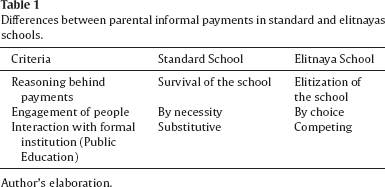
Hence, the manner in which systemic change took place favored the growth of informal practices in public schools, as parents, teachers and administrators were forced to find alternatives to ensure their survival. During a period in which the state has ceased to effectively fund public education, parental payments intended to support schools’ basic needs (which may include non-compulsory extracurricular activities), that is, substituting the state to allow the “social reproduction” (Stenning et al., 2010). As seen in Table 1 these kinds of payments are oriented toward the survival of the school; the engagement between the giver and receiver is by necessity and follows a substitutive logic of interaction with formal public education objectives. The other principal type of parental informal payments tackled are those payments or contributions whose objective is to increase the status of a school through financing certain services; in this case, engagement is by choice and outcomes have a competing relationship with the state's aim of providing universal basic education. The emergence of this form of informal practice was connected to schools where the legal paid educational services were implemented. For instance in Bishkek, 23 out of 93 schools did, but these services were only significantly consolidated in less than the half of them. They were officially required to provide free education to the children living in their areas. Basically, the management's solution was to promote the elitization of the school by increasing the informal payments demanded from parents.
Differences between parental informal payments in standard and elitnayas schools.
Author's elaboration.
Making a distinction between informal payments that are used to guarantee a public school's survival and those that are unmistakably aimed at its unofficial stratification and elitization, also involves distinguishing when the payment of a fee becomes a bribe. People involved in the transaction do not necessarily fall into the corruption category neither when they collect money to provide services nor even when they receive some goods or money as ‘gifts’, in an action of thankfulness with no obligation of reciprocity, since most of the people are aware of the meager salaries of teachers. The key point to distinguish bribery has to do with the obligation of reciprocity to receive a preferential treatment (Polese, 2008, 58). When parents are paying fees directly related to the survival of the school, they do not necessarily receive preferential treatment. In contrast, when parents affiliated to an elitnaya school are aware that by paying they obtain preferential treatment, they do partake in an act of bribery.
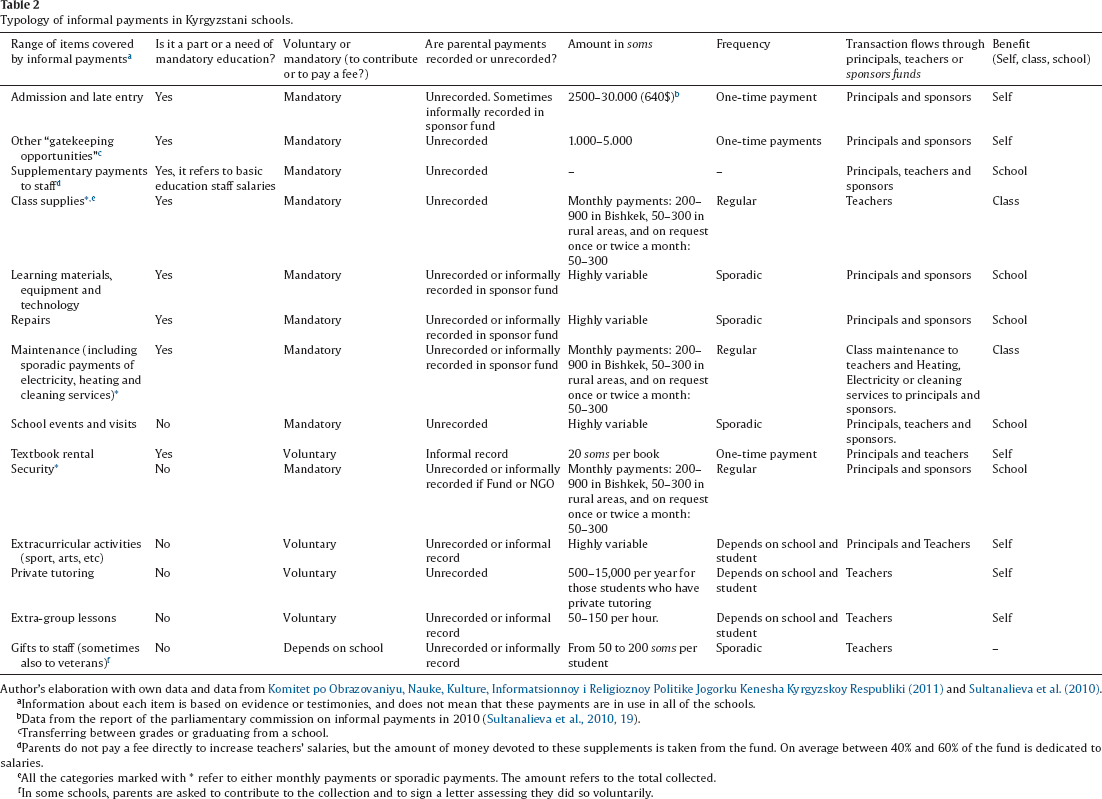
Revenues from informal payments are used for multiple purposes as it can be seen in the typology of expenditures present in Table 2. There are payments that only generate private benefit. Hence, a third kind of motivation related with informal payments may result from education professionals making use of what Hart terms “informal income opportunities” (Hart, 2006, 23–26): the possibility they have of providing informal services for money thanks to their role in the formal sector (licit such as organizing events or illicit such as private tutoring). The fourth and final type of payments is fees imposed on parents by teachers and administrators whose only objective is personal enrichment. They do not generate any benefit for the school or provide any extracurricular services to the student, but support corrupt bureaucratic structures.
Typology of informal payments in Kyrgyzstani schools.
Author's elaboration with own data and data from Komitet po Obrazovaniyu, Nauke, Kulture, Informatsionnoy i Religioznoy Politike Jogorku Kenesha Kyrgyzskoy Respubliki (2011) and Sultanalieva et al. (2010).
Information about each item is based on evidence or testimonies, and does not mean that these payments are in use in all of the schools.
Data from the report of the parliamentary commission on informal payments in 2010 (Sultanalieva et al., 2010, 19).
Transferring between grades or graduating from a school.
Parents do not pay a fee directly to increase teachers’ salaries, but the amount of money devoted to these supplements is taken from the fund. On average between 40% and 60% of the fund is dedicated to salaries.
All the categories marked with * refer to either monthly payments or sporadic payments. The amount refers to the total collected.
In some schools, parents are asked to contribute to the collection and to sign a letter assessing they did so voluntarily.
In comparison with the rest of the country, parental informal payments have had the greatest impact in Bishkek. Quantitatively, they are found in a higher percentage of schools, and the types of expenditures are more numerous. Qualitatively, the number of reasons behind the payments are higher as coexist survival and elitization strategies, and the penetration of this practice in formal sponsorship bodies is much greater. In addition, nowhere else in the country have informal payments increased the costs of education and the stratification of schools as much as in Bishkek. Comparing the 13th Gymnasium School and the 21st Middle-School (Srednaya Shkola) provides two different perspectives on the issue, two different realities within the same city: survival versus elitization strategy, engagement by necessity versus choice; and substitutive interactions with formal institutions versus competing interactions.
Historical and socio-economic background of the schools
Located in the center of the city, the 13th Gymnasium School was founded in 1938, and during the late Soviet period it was known as the school where the children of the nomenklatura studied English. In 1996 the Bilim National Education Program was approved with the objective of introducing pupil-centered education, and among other schools, gymnasiums and lyceums (vocational training) were included within the program. Gymnasiums (of which there were 111 in Kyrgyzstan in 2010) are specialized schools which enjoy privileges as additional public funding, including 15% extra for staff salaries, and a license to offer paid education services (DOPU). Run by Gulayym Alieva since 1990, the so-called Trinashka was one of the first gymnasium schools to specialize in English. This granted it great prestige, allowing the administration to demand high informal payments from parents and, in 1999, to set up a fund to support the school, called OF Oy Bulak, which will be the main instrument used by the management to collect and distribute the parental informal payments.
At that time Trinashka already was an elitnaya, an unofficial status that distinguished the state schools where the children of the upper-middle class and even the upper class went. The presence of ethnic Russians and Russian speaking Kyrgyz among parents, and also among school personnel, is much higher than the national average. 4 Within the Trinashka's parents are businessmen, senior officials within the administration and employees of banks and multinationals. They are the strongest link within the Kyrgyzstani society. Their incomes range from $600 to $4000. Many of the school's graduating students enter the “commercial” (contracted) branch (kontraktniyie) of the public university system, the most prestigious and expensive private universities, such as the American University of Central Asia, or even belong to the select group that study abroad.
As the per capita income of the ethnic Russian community and in a lesser degree the Russian speaking Kyrgyz are well above the Kyrgyzstani average, the relevance of this ‘cultural’ reference should be understood more as a class distinction rather as an ethnic or a cultural one.
The School No.21 was founded in 1989 as a nursery school opened due to the establishment of the Enesay novostroika on Bishkek's northeastern periphery. Novostroikas are new settlements that have been established since 1989. From 1989 to 1991, their construction was part of the General Housing Plan. Since then, the massive influx of migrants, particularly from the south, was not met with adequate urban planning effort. In 1998 new land ownership rights made the number of unauthorized land occupations skyrocket. 5 Houses were built overnight to avoid eviction, and dozens of shantytowns sprung up all around Bishkek in what is known as the Adobe Belt. Currently it is estimated that between 250,000 and 300,000 people live in the novostroikas of Bishkek. Hence, although the schools No.13 and No.21. are urban in terms of their location, they still represent an urban–rural divide in terms of their population. Nevertheless, when explaining the different strategies of the schools, class and economic status are more important as a social cleavage than the urban–rural one.
In Russia, illegal developments are called nakhalstroi, meaning nakhal'naya zastroika. The term novostroika refers primarily to new developments which can be legal too. The high degree of unauthorized constructions in new development areas has provoked the use of the term to both mean new and illegal.
There are 48 novostroikas and many of them, especially the most recent ones, do not have public utilities (electricity, gas, water, sewage systems, waste collection and paved roads) or offer basic social services such as healthcare and schools. The main problems in terms of education are the lack of schools and daycare centers (there are only 18 schools in all of the novostroikas), the distance to available schools, residents’ socioeconomic conditions (37% of students that drop out of school do so because they cannot afford the most basic necessities such as shoes and clothing, or they cannot pay the fees, USAID Kyrgyzstan, 2010, 6) and the discrimination that internal migrants suffer because of their origin, social and economic status and because they lack the propiska, the resident registration that grants access to the full rights of citizenship (Nasritdinov, 2008). There are 2000 school-age children in the novostroikas who are not in school (USAID Kyrgyzstan, 2010).
Living conditions differ from one novostroika to another. While Enesay has all the essential utilities and services, including a school, many of the students that attend live in more disadvantaged novostroikas such as Dordoy 1 (established in 2000), Dordoy 2 (2004), MTF, Almatynskaya and Leninskaya. In the School No.21 most students are first or second generation internal migrants. About 200 students out of a total of 1130 (17%) are migrants from other novostroikas of the Adobe Belt. Around 80% of these families come from the southern oblasts and many of them do not speak Russian (Sultanalieva, 2011, 9). Most of the parents work informally in the Dordoi bazaar with low wages, no job security and in temporary jobs (the men working as taxi drivers, tachkisty (longshoremen)) and laborers; the women as street vendors, waitresses, seamstresses and sex workers; and the children as waste and bag collectors, street vendors and tachkisty. With workdays of 12 hours, 6 or 7 days a week, an adult earns between 7000 and 9000 soms ($150–190) a month. None of the interviewees for this study has the propiska, as only 5% of internal migrants are registered. Overall, it is estimated that 25% of Bishkek's residents are not registered (Azimov & Azimov, 2009, 23). These parents and their children are the weakest link.
School No.13 and School No.21 represent paradigms for informal payments motivated by different objectives – elitization versus survival – where engagement of givers in informal payments is either by choice or by need, and where the interaction with the formal institution is competing or substitutive.
Elitization strategy and engagement by choice
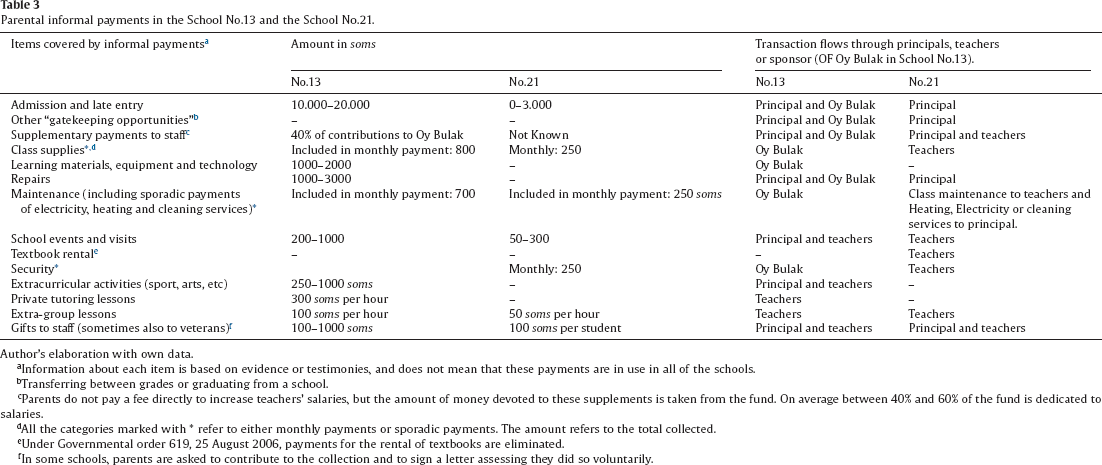
At the Trinashka, the transaction is associated with the acquisition of a better than average education, better facilities and higher social status. In terms of supply, the specific purposes of the informal payments differentiate the two schools in two fundamental aspects. First, in the services they offer – as seen in Table 3; the quality and number of services and the amount spent on them are much greater in the 13th Gymnasium School. The principal herself confirms the interrelation between fees and the quality and services of the school: “if we are forced to suppress the enrollment fees we would have to consider compensating by reducing English classes”. 6 Secondly, two factors contribute to the quality of the teaching staff, as this is another distinctive element which the 13th School offers. On the one hand, the school attracts the teachers with the best resumes because it offers higher wages. According to the school's Zavuch, after the 2011 wage reform the average teacher's salary is now 7500 soms ($158) a month, although there are those who make only 5000 ($105). At the 13th School the average is 20,000 soms ($422), depending on the number of hours worked, seniority and the subjects taught. Without counting the greater access school staff has to informal income opportunities through private lessons or organizing events, 10,000 of those 20,000 soms are extra payments resulting from the school's ability to generate revenue. One teacher admitted that she would not come to work if there were no extra payments.
Parental informal payments in the School No.13 and the School
No.21.
Parental informal payments in the School No.13 and the School No.21.
Author's elaboration with own data.
Information about each item is based on evidence or testimonies, and does not mean that these payments are in use in all of the schools.
Transferring between grades or graduating from a school.
Parents do not pay a fee directly to increase teachers’ salaries, but the amount of money devoted to these supplements is taken from the fund. On average between 40% and 60% of the fund is dedicated to salaries.
All the categories marked with * refer to either monthly payments or sporadic payments. The amount refers to the total collected.
Under Governmental order 619, 25 August 2006, payments for the rental of textbooks are eliminated.
In some schools, parents are asked to contribute to the collection and to sign a letter assessing they did so voluntarily.
Interview with 13th School's principal in KNEWS, available at: <http://m.knews.kg/ru/society/11247/> (Last accessed 11 July 2014).
On the other hand, the problem the School No.21 has keeping new teaching staff is unheard of at the Trinashka. The Enesay Zavuch confirmed that the majority of new teachers complete their mandatory three years to obtain their degrees and then leave; there are near-permanent vacancies in specific subjects such as mathematics, the sciences and computer science. In contrast, the Trinashka's Zavuch's story is the opposite: “Our teachers only leave to emigrate to Russia, but that's fairly uncommon. They know that they can prosper here. Furthermore, here everyone teaches their own subject, we don't have PE teachers doing math classes”. 7
Interview with the School No.13 Zavuch, November 2011.
Among the residents of the Trinashka school's micro district, there are those who choose to pay the enrollment fee, those who enroll their children in other, cheaper schools, and those (a minority) who, after threatening to sue the school, have managed to have their children admitted without paying the fee. Out of a total of 375 children residing in the Trinashka micro district, only 202 are enrolled in the school when their classrooms receive more than 1500 students (Sultanalieva et al., 2010, 6–7). Hence, there are 173 students out of 375 who have moved to other districts’ schools, allegedly because School No. 13 demands it. For them, higher enrollment fees and other informal payments are a barrier to get access to Education.
In contrast, much more affluent parents are attracted by the academic prestige and the social credential (Collins, 1979) attached to the Trinashka. There, the number of applicants each year vastly outnumbers the number of available places. As a result, many parents offer to pay the enrollment fee to try to guarantee their children's admission. The existence of such a fee was confirmed by the school's Zavuch, who explained that “there is a fee of between 5000 and 20,000 soms depending on the family's resources. Those who cannot pay are given the possibility of offering books or technology instead”. 8 The parents consulted in this study speak of paying between 10,000 and 20,000 soms, quantities which have been in place for years as admission in 2002 cost 15,000 soms ($326 dollars at the exchange rate of the time).
See footnote 7.
The monthly fee at the Trinashka averages between 500 and 800 soms depending on the grade. At the elitnaya school, the money is deposited directly in the bank and goes to the OF Oy Bulak fund. The money is spent on renovations, standard repairs (heating, elevators, roofing, fire alarms, etc.), to complement staff salaries and on other fixed expenses, such as security, books and material for the media library. The largest portion is dedicated to salaries, between 40 and 60% depending on the year, while another 40% is dedicated to renovations and repairs. Other expenses are covered with what remains.
Although a first filter is already done when paying enrollment fee, students’ parents still have differences of opinion regarding the informal payments. Those who live in the school's micro district, whether from wealthy families or not, cannot legally be denied admission to the school and are generally critical of the high informal payments, whereas those who live in other areas and send their children to the Trinashka because of its prestige, are usually more compliant. They constitute the majority and engage by choice in informal payments oriented to upgrading and de facto privatizing a public school. One parent, a businessman by profession, stated his view as follows: “I don't mind paying; we know that education here is very good. Our daughters already speak two other languages, which would be impossible elsewhere, and studying here opens many doors”. Indeed, the major division among parent's views is not directly related to informal payments, but indirectly because of the opaque management of the budget by the school's principal that concluded in the opening of an investigation by the Attorney General and the Financial Police (Finansovaya Politsya or FIN Politsy) (Shabdanova, 2012).
Kyrgyzstan has a policy of decentralizing budget authorities, but the financial resources of general education are formed centrally, with 65% of the funds for this sector coming from national budget revenues and only 35% coming from local budget revenue. It is important to note that while in Bishkek 100% of the budget depends on local revenues, there are individual oblasts where this amounts to no more than 4 to 7% of education funding. Schools in these oblasts face serious difficulties in finding teaching staff and gathering resources to maintain good conditions. More difficult conditions and greater community involvement explain why the purest survival strategy paradigm is found in rural areas, where individuals’ perception of being engaged in a broader social goal is sharper.
At the Enesay School, the public financing does not cover all the common needs of a standard school according to Kyrgyzstani law. At the 21st School, funds are invested – as explained to the parents – on different items, such as minor repairs (plumbers and electricians), purchasing class supplies, and hiring a security guard or equipment (among which a television would typically be the most expensive). 9 The school personnel require some financial help from parents in the form of fees as well as voluntary and non-voluntary informal payments. As it happened at the Trinashka, a sector of the parents agrees with the idea of supporting financially the school to see that the basic conditions have been established, but not to upgrade them over the average. They accept informal payments by necessity but also with the perception that they are supporting a social goal. A second group of parents that do not support the idea of making an effort for the survival of the school still pay because they do not want their children to be excluded or disadvantaged. Parental informal payments at School No. 21 have favored the survival of a welfare institution but have also confronted the parents with a much more glaring dilemma than at the Trinashka: pay for your children's schooling or accept that they will probably not go to school. According to a study conducted by the NGO ErEp in Dordoy 2 and 10 other novostroikas, 65% of parents interviewed claimed to have paid fees for their children's enrollment in school, 10 while a study of all the novostroikas found this percentage to be 47% (Sultanalieva, 2011, 10).
Regarding security, after denying that the school paid for private security, the Zavuch said that security only received a salary from the state; however, the deputy director of Bishkek's education department said that the state does not cover the costs of private security and that “if a school has security the parents have paid for it”. Interview to Natalya Sukhodubova, Deputy Manager of the Education Department of the city of Bishkek, November 2011. Interview with School 21st Zavuch, November 2011.
The data were provided by Mirzad Adzhlev, director of ErEP, during an interview in November 2011. The study by ErEp is part of the USAID Sapattuu Bilim project.
For many poor families from Dordoy 1 and 2, the sum of the informal payments and other costs (clothing, transportation, food, etc.) makes schooling either unaffordable or so difficult that education is treated as an extra cost. This leads to the non-schooling of children and their integration into the most vulnerable segments of the labor market. 11 As an alternative measure there are some parents from Dordoy-1 and 2 who enroll their children in boarding schools for children with disabilities, such as the Chuyskaya Shkola-internat: “A friend told me about the boarding school and I was able to leave my children there from 2003 to 2007 without having to pay. When they entered they were 6 and 8 and had never been to school”. 12
Among similar statements, one single mother of three children explained that “after arriving in Bishkek I didn't send my two older children (born in 1986 and 1990) to school. They've never gone to school. Between what I had to pay for them to go and what we needed it was too expensive. It was better that they earned money for food and to help me take care of the youngest one. We took turns, and now they work as tachkisty”.
Interview with a mother of two children with residence in Dordoy 1, 24 October 2011.
At the Trinashka the enrollment process is organized in a methodized and marketed manner. On the contrary, at the School No.21 improvisation is the rule as there are all kind of cases given for the pairs non-admittance or admittance and the requirement of informal payment and no requirement of payment. A peddler from Dordoy 1 said that her son was denied enrollment without being asked to pay, because of a lack of available places: “I think if I had paid they would have accepted him, but they didn't ask”. This was not the case in other instances, such as that of a seamstress from a barak in Dordoy-1, who the school administration asked for “3000 soms ($64) for admittance; as I didn't have the money my girl didn't go to school for the rest of the year”. Several mothers said that although they paid monthly fees and other occasional expenses they did not have to pay an enrollment fee. There are other cases where parents did have to pay, and the payments were not made by bank deposit or transfer as in the 13th School, but following much more traditional methods. A Dordoy bazaar bag seller describes the situation: “In 2008 a friend and I went to talk to the principal to sign up our children and she asked us pay 1500 soms for each child. She told us we needed to make an appointment to hand in the necessary documents and at that time we should bring the money. They didn't tell us if there were places or not, only how to make the payment”. 13
Interviews carried out in October and November 2011 in the Dordoy 1 and Dordoy 2 novostroikas.
The 21st School's Zavuch was initially reluctant to acknowledge any kind of informal payments at the school or that students soliciting admission were rejected. However, after hearing about the testimony of mothers who claimed to have paid because they were told that if they did not there might not be a place available for their children, she conceded “if that is the case you may be right but I can't confirm it because I'm not responsible for student enrollment”. She did not defend the school or its administration very fiercely. Another teacher said that the school tries not to turn any families away, but that sometimes there are not enough places. In short, in contrast with the standardization of the process and the marketed planning of revenue and expenses at the Trinashka, at the Enesay School, the constraints (number of students, the economic needs of the school and its personnel) condition the administration's actions regarding payments, which are not pre-established. Thus, whereas parents whose children go to the 13th School know they will have to pay and know the quantities of the fees beforehand, at the 21st School everything is contingent.
Survival of the school, among other payments, is also supported by a monthly fee of between 150 and 250 soms at the School No.21. At the elitnaya school the money is deposited directly in the bank and goes to the OF Oy Bulak, but at the Enesay School the children bring the money to class and it is collected by the starosta klasa (class president) and given to the teacher, who then passes it on to the school administration.
Applying the theoretical categories established by Helmke and Levitsky (2004) to analyze the interaction between formal and informal institutions, two distinct types of interaction are useful in this research: substitutive and competing. Most schools requiring parental informal payments are guided by the principle of survival. In the absence of sufficient public funding they look for self-financing alternatives to mainly substitute state functions while sharing their formal outcomes. However, while private contributions allow schools to survive, they also produce serious consequences for poor households, the most tragic being the exclusion of poor children from the education system. As a result, access to education may be at the mercy of school personnel who occasionally apply exemptions or discounts, assessing payments on a need–means basis. These evaluations of personhood are also present at the elitnayas schools. Schools such as the Trinashka operate under a market strategy aimed at generating profit. Here, informal payments are higher and aimed at both improving the academic level of the school and as a tool of social stratification to secure the recruitment of pupils from the upper-middle and upper classes. The elitization and de facto privatization of public schools produce a competing interaction with formal public education outcomes.
Competing interaction and the commodification of education at Elitnayas schools
The logic of the internal functioning, management and setting of institutional goals at the Trinashka is absolutely dependent on an understanding of the school as a business and students as customers. This can be seen in the enrollment procedures and in the management of private contributions, which are quantitatively equivalent to the amount of money received from the state.
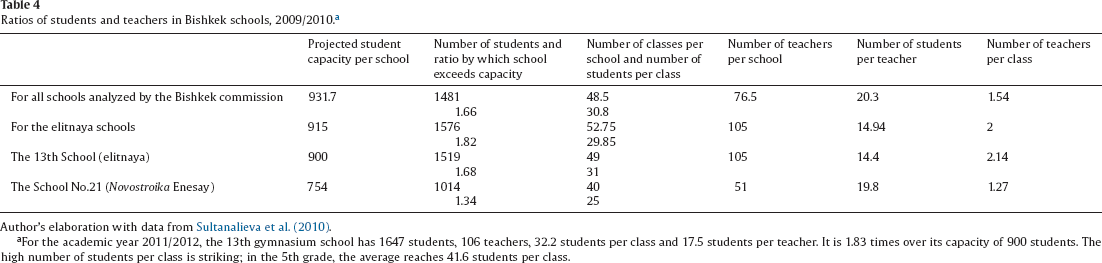
As shown in Table 4, the ratio of students per teacher is higher in the School No.21 (19.8) than in the 13th (14.4), although paradoxically, the opposite is true in number of students per class (25 vs. 31), and in how much the schools are over their purported capacity (1.68 times for Trinashka vs. 1.34 for Enesay). This difference in ratios is also present in the aggregate values for all elitnaya schools compared to other schools. A likely explanation is that the demand for places in elitnaya schools is much higher than the supply, establishing a favorable relationship between revenue and expenditure per student. This leads these schools to increase the number of students per class; however, they are unable to increase the number of classes because of lack of space so their response is to hire more teachers. In other words, the lack of space in Bishkek's public schools is a structural problem and both schools respond by duplicating shifts, but the 13th School has an additional economic incentive to apply market criteria to revenue (accepting more students) and costs (hiring more teachers), resulting in an increase in the ratio of students to school capacity, while the School No.21, which does not have “clients” with resources, has very little or no incentive to do so.
Ratios of students and teachers in Bishkek schools,
2009/2010.
f
Ratios of students and teachers in Bishkek schools, 2009/2010. f
Author's elaboration with data from Sultanalieva et al. (2010).
For the academic year 2011/2012, the 13th gymnasium school has 1647 students, 106 teachers, 32.2 students per class and 17.5 students per teacher. It is 1.83 times over its capacity of 900 students. The high number of students per class is striking; in the 5th grade, the average reaches 41.6 students per class.
In addition, the enrollment method is modeled to allow the selection of customers. Although it is illegal, the 13th School tests students newly enrolled in the first grade as a pressure mechanism; in fact, this practice is included in the school's statutes, in article 3.2 (Sultanalieva et al., 2010, 7–8). As many parents offer donations to the school or provide information about their incomes and business activity, this mechanism gives the school managers the capacity to accept or reject new pupils based on their future as customers as well as bestow the chance to incorporate brilliant students who will back the image of the institution as a prestigious one.
The depth, degree and complexity of the commodification of a school affect the organization and functioning of informal payments. In this sense, the greatest contrast between the schools I am examining is the presence at the 13th Gymnasium School of a sponsoring organization or fund, like the OF (Obshestveny Fond, Social Fund) Oy Bulak of the 13th Gymnasium School, which serves as an intermediary in the transactions between the parents and the school. 14 According to Guljamal Sultanalieva, a member of the 2010 parliamentary research commission, the OF Oy Bulak had an annual budget equal to the school's official budget. In the period between 2008 and 2011 the OF Oy Bulak collected more than 48 million soms (around $1 million dollars). 15 In comparison with the School No.21, the presence of a fund has eased the management of large sums of money, it has fostered the standardization of payment amounts and payment terms and it has modernized payment methods by including bank deposits.
Interview with Guljamal Sultanalieva, November 2011.
Shavdanova, Asel, “Direktor shkoly No. 13: My ne mogli oboytis bez pomoshi roditeley”, Vecherny Bishkek 12.10.2012, Available at: <http://www.vb.kg/202616> (Last accessed 11 July 2014).
Additionally, because of the fund, transactions take place outside the classroom and the students are not involved, avoiding the psychological pressure on children whose parents are late with their payments or unable to pay. 16 This does not mean that payments in the 13th School are voluntary or that parents are not pressured into paying; however, the manner in which parents are coerced into paying differs from the School No.21, where pressure and harassment, when it exists, is directed at both parents and students indiscriminately and could take place within the classroom. At the Trinashka students are usually excluded from the process, but their parents are not only urged to comply with the regular payments but also to put their children in private classes or even take them to other schools to free up places so that additional admission fees may be collected.
There are recordings with hidden cameras in Bishkek schools which show teachers pressuring the students whose parents are late with their payments; in some cases teachers insult the students or use physical violence. One example is a recording from the 91st School, in which the teacher insults and hits students while asking them how she is going to explain to the principal that she has not collected the money from all of the students in the class. Available at: <Svodka.akipress.com>, V shkole No.91 uchitelya rugayut shkolnikov, kotorye ne prinesli dengi, 9th December 2011, <http://svodka.akipress.org/news:105041> (Last accessed 11 July 2014).
It is clear that parental involvement in the management of payments has not been one of the objectives of the OF Oy Bulak. The principal herself and some of the teachers have confirmed that the fund was set up by the school in 1999 mainly to provide economic support for the staff. 17 Thus, the administration maintained control over the fund and the handling of issues such as setting admission fees and monthly payments, what money is spent on, and which companies are contracted to provide specific services. All of this is acknowledged by the principal, who says the fund's functions are limited to controlling and accounting for the collection and expenditure of money, although she also mentions that expenses proposed by the school must be approved by the assembly. 18
The principal's opinion in: Direktor Kompleks-litseya No.13: Uchitelya gotovy obyavit zabastobku, esli obvineniya v adres shkoly ne prekratyatsya, KNEWS 20 February 2012, <http://www.knews.kg/ru/society/11247/> (Last accessed 11 July 2014). Teacher's testimony in: Pedagogi bishkekskoy shkoly No.13 zayavlyayut, chto “ataka” na direktora i kollektiv neobosnovanna, OTRK, 27 February 2012, <http://ktrk.kg/rus/index.php?newsid=3625> (Last accessed 11 July 2014).
Direktor Kompleks-litseya No.13: Uchitelya gotovy obyavit zabastobku, esli obvineniya v adres shkoly ne prekratyatsya, KNEWS 20 February 2012, <http://www.knews.kg/ru/society/11247/> (Last accessed 11 July 2014).
There is no doubt that in Kyrgyzstan parental informal payments have been a key source of funding for the survival of the schools, acting as a substitute for the state. However, in a time of rapid decline in public resources, it was not the only social and informal response that helped guarantee social reproduction in the education sector. Especially in rural areas, behaviors such as teachers continuing to teach after retirement, making repairs for free or providing transport for students at no charge, were also everyday practices that substituted for the state and made the survival of basic education possible. However, in urban areas where community life is not as pervasive and the isolation of poor families is greater, the same parental payments that allow teachers to improve their meager salaries, to buy new equipment and so on, can lead to children from disadvantaged households remaining outside of the education system. Sometimes the impact of these two faces of parental informal payments regarding access to education is mediated by school personnel who assess informal contributions on a needs–means logic, introducing exemptions and discounts. Nevertheless, the perverse effects of informal payments cannot be ignored, not only because of the number of children out of school but also because of the vulnerability of poor pupils facing psychological pressure and unequal treatment.
In fact, when talking about basic education in Kyrgyzstan, the most important informal payments are gatekeeping fees, the standardization of which in urban areas leaves little space for reciprocity between school personnel and parents. Hence, while parental informal payments “mitigate the failing of the state by providing resources”, it is not so clear that they mitigate the failure of the state to provide access to education by “making decisions” [of street level bureaucrats], as it has been pointed out by Morris and Polese regarding higher education (Morris & Polese, 2014). Reciprocity and evaluations of personhood are essential concepts to understand the cultural embeddedness of diverse economies (Caldwell, 2004; Clarke, 2002; Morris & Polese, 2014); both emphasize the importance of assessing payments on a needs–means interrelationship between the giver and the receiver. This kind of interrelationship is present in many types of payments in Kyrgyzstani schools, but is stronger when the relationship between parents and personnel has already been established. That is, evaluations of personhood are not as decisive in the instances when access to education is at stake. There, where evaluations of personhood are more needed, that is, in the novostroikas, the lack of schools in most of the micro districts and the huge unregistered population place school principals in a difficult position, wanting to be compassionate toward the children from other novostroikas. While principals have no obligation to enroll students from other micro districts, they can be tempted to take advantage of the context and ask for informal contributions.
Notwithstanding the foregoing, both the School No.13 and the School No.21 offer a range of exemptions and discounts in the gatekeeping and monthly payments. Regarding the Trinashka the parliamentary research commission even collected a list called “Release of parents from voluntary payments”, which detailed the beneficiaries and the categories of persons entitled to a 50% or a 100% discount: orphans, children from single parent families and the children of teachers. In the 2009/2010 academic term 46% of the beneficiaries were children of teachers (Sultanalieva et al., 2010, 17). At the School No.21 there are also waivers for widows, as one widowed mother explained “when my husband died I asked them to waive my fees and I had to show them the certificate proving I was a widow”. At both schools, there are also discounts for the number of children enrolled: “I paid 20,000 soms for my first child, 15,000 for my second and 12,000 for my third” 19 ; “I had to pay for my first two sons but the principal allowed me not to pay for the enrollment of my third soon”. 20
Interview with a School No.13 parent, August 2011.
Interview with a School No.21 parent, November 2011.
Regarding monthly payments, according to the Trinashka's Zavuch, “poor families or those who are unable to pay for a time must write a request for the fees to be forgiven (…) there are few who have done it, usually they simply catch up with their late payments when they are able to (…) this might happen with approximately 100 of the 1600 students in the school, about two per class”. 21 This statement shows that the payment is not voluntary, and that in fact, it is treated as if it were a market transaction: if the client is unable to pay he/she is required to request authorization to delay payment or an exemption. At the 21st school, several parents admit to having borrowed money to make payments because if they had not done so “the teacher tells the children in front of the whole class and it's an uncomfortable situation”. Parents know who has not paid, although it is not common for them to pressure others because of it, although there are cases of parents who suggest paying more to improve conditions in the school. At Enesay, parents can pay the whole year at once and they are also invited to make additional contributions. According to a couple of mothers, “the teachers treat the children of these parents better. They sit at the front of the class, near the teacher, and they get more attention”. Therefore, how exemptions are decided upon and administered exemplifies not only that payments are not voluntary, but also that they have more impact in the household, which are already familiar to the school personnel.
See footnote 7.
According to the transitional discourse, parental informal payments are a product of the Soviet legacy destined to disappear. The introduction of mechanisms to formalize the co-financing and commodification of public education has been justified as a means of providing greater transparency in the raising of revenues and their management. However, these informal practices have shown great capacity to adapt to institutional vehicles supporting the neo-liberal transformation of public education, and eventually, have facilitated the informal elitization of a select number of schools. The fact that formal public and private funding are still insufficient has contributed to this, as has the fact that state (Ruiz Ramas, 2013) and economic institutions (Nasritdinov et al., 2010; UNDP Kyrgyzstan, 2006) are still dominated by informal practices that not only protect petty interests but also fulfill social functions that are not successfully covered by the legal realm.
The resilience of informal practices in the public school is due to, above all, the place these practices have in the functioning and survival of this formal institution. When the state fails to respect its obligations, the administration delegates the carrying out of the financing of the school to staff and parents. The state only takes responsibility for the salaries of teachers, principals and other staff, their contributions to social security and the costs of building new schools, generally omitting other fixed costs without which a school cannot function. The state has relied on informal funding to meet the objectives of legislation regarding education (Dobretsova & Gaybulina, 2011). Paying for equipment, school renovations, educational and office material, maintenance and external services, as well as complementing teachers’ low salaries, have been left to individual schools, which, for the most part, have been unable to successfully market their services in the context of an economic crisis. The relationship of mutual dependence between formal and informal funding has been vital in maintaining the education system.
This panorama of mutual need between the school and the parents reveals one side of the interconnection between the formal and the informal, where the latter ‘substitutes’ for the former as it does not function efficiently. There is another side driven by a market and profit oriented strategy that competes with the institutional logic of universal public education. There are two models of parental informal payments, which we have differentiated into three different theoretical categories: survival versus elitization strategy behind school's self-financing, engagement in informal payments by need versus engagement by choice, and a substitutive interaction with a formal institution versus a competing one. Nevertheless, there is still a shadow side to parental informal payments in Kyrgyzstani schools. According to the [anonymous] testimony of various experts and practitioners, this shadow side reveals the creative participation of senior officials in the education sector in designing and activating informal payment systems in Bishkek's schools during the second half of the 1990s. These systems, apart from fostering informal self-financing in schools under parents’ responsibility, also sustained complex structures of corruption and extortion through which money was transferred from the schools to the officials themselves with the collaboration of school principals, who it is safe to assume, also took a share. Unfortunately, corruption schemes reached both the strongest and the weakest links, as a director of an NGO with experience in the novostroikas stated “corruption affects not only the elite schools; even in the slums a substantial amount of money paid by parents does not pay for materials or teachers, but goes to the department of education”. 22
Anonymous interview with an NGO leader, November 2011.