





Abstract
Recent debates on informal economic activities have partially switched away from a pure monetary logic towards a more complex one, embedded in long term relations and reckoning with non materialistic paradigms. The role of informality in certain aspects of people's lives has however, remained largely unexplored. This article uncovers what happens when the state retires from (providing benefits and social services to) a geographic area and what kind of mechanisms, practices and institutions are created to make up for this. We suggest that, in the face of de facto abandonment by state welfare, and the absence of a private sector alternative, a myriad of transactions and actors can make up for this by replacing these forms of welfare informally. Our case study focuses on the nuclear landscapes around the Chernobyl Exclusion Zone in north–central Ukraine as we reveal the ways the excluded and abandoned, which we frame as post-nuclear “bare life” (Agamben, 1998), have created a mechanism of social security that is independent from the state and yet complements it. Informal, local and unofficial understandings of nuclear spaces are central to survival in this marginalised and risky environment.
Introduction
In post-socialist spaces, beneath the shadows of the neon-lit signs of marketization, the informal economy remains acknowledged and vital, yet largely ‘invisible’. Beyond the more obvious street-level traders and the like, most informal activity – for a variety of reasons – occurs beyond the ‘panoptic gaze’ of the state (Foucault, 1977). The seemingly invisible nature of this economy is suggested in the various names it is given; from ‘shadow’, to ‘underground’, to ‘hidden’ or ‘black’. This underlying assumption that informal activity is unseen, that it takes place in ‘other worlds’ (Gibson-Graham, 2008: 1), is often contrasted with the Western world where, it is assumed, visibility of the economy is secured by the fact that market forces have penetrated almost every sphere of modern society (Hann & Hart, 2009; Williams, Nadin, Rodgers, Round, & Windebank, 2011; Williams & Martinez, 2014). This has been reflected in the wide literature on social transformation starting from either Polanyi (1944) or from developmentalist approaches suggesting the next alignment of new emerging powers with standards set in industrialised countries (Haller & Shore, 2005; Pieterse, 2010).
On the uphill struggle through post-socialism, however, there is an emerging school of thought suggesting that the route is no longer planned by neo-liberal ideas of ‘transition’ from a to b, nor mapped out teleologically by ‘one size fits all’ Washington-consensus cartography; in fact there is no ‘route’ at all (Burawoy, 2002; Ledeneva, 2004; Stenning, 2005). Coping mechanisms such as informal work (Stenning, 2005; Williams & Round, 2007), economies of favours (Kuehnast & Dudwick, 2004; Pavlovskaya, 2004; Polese, 2008), ‘social acknowledgement’ (Morris, 2012, 2011: 629), gift exchange (Mauss, 2002; Polese, 2014a), memory (Buyandelgeriyn, 2008), and social/kinship networks (Grabher & Stark, 1997; Lonkila, 1997, 1999; Walker, 2010) have not only helped navigate the post-Soviet ‘every-day’ (Bruns & Migglebrink, 2012; Morris, 2012; Polese, 2006a; Round & Williams, 2012; Sasunkievich, 2014). They have also, and possibly more importantly, pointed to the existence of a persistent and complete system in which ‘informality is here to stay’ (Morris & Polese, in press, 2014b: 1).
Whilst initially relegated to particularistic and empirically-grounded case studies, unlikely to provide normative or universalistic value to further studies, the growing amount of research and its progressive theoretical engagement has pointed to the social significance, persistence and size of informal activities (Morris & Polese, in press, 2014b; Round, Williams, & Rodgers, 2010). Indeed, such is the prevalence of these behaviours that one could argue that ‘formality’ could safely be concluded as an exception and ‘informality’ the rule (Routh, 2011: 212).
Studies on informality have rapidly grown out of their initial framework that saw an informal economy (Hart, 1973) or resistance (Scott, 1984) originating among the poor, the marginalised and the excluded (Gupta, 1995). New directions in the study of informality have suggested that it is also a significant phenomenon in richer countries, including industrialised ones (Williams, 2011) and that both winners and losers of transitions make extensive use of it (Morris & Polese, 2015; Polese, 2014b), including in political spheres (Isaacs, 2011, 2013; Kevlihan, 2012). In many respects, informal activities may be seen as complementary to formal processes or, in market logic, as occupying the niche that remained vacant because of limited action of the formal sphere (Polese, Morris, Kovacs, & Harboe, 2014).
Informality and (lack of) welfare
There is a growing literature discussing social solidarity, social justice and other micro-social phenomena that do not necessarily come from the state (Kuznetsova & Round, 2014; Polese et al. 2014, 2015). Post-Weberian conceptions of a state advocate several degrees of state intervention (Darden, 2008): from little – a liberal logic, where the state does not interfere in market activities but creates the instruments for control of fair behaviour – to more proactive intervention, where the state is the warrant of most economic rights and obligations.
In Western Europe, as in other geographical regions, the “ethics of austerity”, enhanced by the recent economic crisis (Windebank & Whitworth, 2014), along with a wider desire to decrease public deficit, has encouraged a number of states to reduce the amount of money available for public services and enabled the private sector to penetrate previously state-monopolised aspects such as healthcare or education (Kovacs, 2014; Ó Beacháin, Sheridan, & Stan, 2012; Rogers & Sheaff, 2000; Tatar, Ozgen, Bayram, Belli, & Berman, 2007). This process has been somehow less rapid in Central and Eastern Europe but only because it is building on a de facto process of privatisation (Harboe, 2014; Polese, 2006b) as opposed to a de jure one in more advanced economies. Traditionally, privatisation issues have been a major concern for economists or public policy specialists. Scholarship, however, has often neglected various grey situations that are, nonetheless, frequently encountered. If we see the economic and social life of a state shared between two, or in some cases three, main forces, as in Fig. 2, we can think of three situations that have been underrepresented in scholarship.
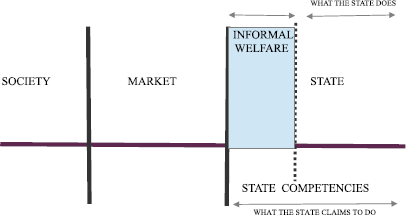
Informal welfare may be forced to plug the gap between what the state and the market provide, occupying a space beyond the de facto protection of state competencies and forming a “grey zone of informal welfare” (Polese et al., 2014).
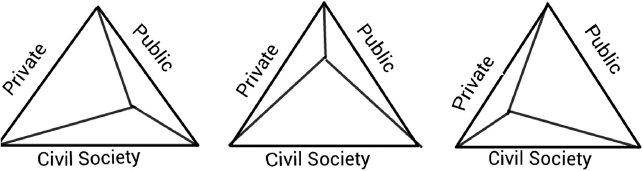
Complementarity of competencies of the private, public and non-profit sectors.
The first one is the transition between public and private services. If a state decides to privatise a service – fully or partially – then it is possible that at the end of the privatisation process, the new system will work better than the preceding public one. However, there is generally an adaptation period during which time gaps in provision may appear, sometimes lasting long enough to be more than just ‘transition’. For instance some competencies might remain “uncovered” because both state and private sectors claim it is the other side's responsibility. In a second case, one can find a gap between a service that has been promised and the way it is actually delivered. This could simply be due to bureaucratic issues, where a need is identified, money to address the need is allocated, but it takes a number of signatures and years, to unblock proper implementation. It could, however, also be due to the third situation, in which the state fails to address a given issue and simply leaves (or never enters) the game. This is the case when providing a service is too costly, or there is little interest or awareness of a given need to be addressed. The case study in this article is most closely related to the last two scenarios (Table 1).
Table showing the causes of welfare ineffectiveness and potential consequences of welfare failure.

In all three situations, citizens might become, or consider themselves ‘abandoned’ because they have access to little or no welfare services. Privatisation is, in some cases, a solution but it also raises questions. What would happen if the private sector provided a service at a price that was too high for a significant number of people? What happens if private sector actors do not see the advantage of occupying that niche, and leave a service tackling a particular social need unprovided?
In the recent past, situations where citizens expected or were promised A, but delivered B have resulted in a conflict that has been solved in different ways. Contestation and contentious politics is one of them, when citizens openly criticise and challenge the state, asking for a change from the status quo (Della Porta, 2009; Tarrow, 2005). Organised criminality and illegal flows are another well-studied field, with some groups taking advantage of the void of power to create a system within the system with its own rules of engagement and different distributions of welfare and benefits (Bruns & Migglebrink, 2012; O'Brien & Penna, 2007; Pinotti, 2012; Van Schendel & Abrahams, 2005). There are also cases where an initiative starts from citizens who organise in a less hierarchical structure than a mafia to provide a service, competing with the state in welfare distribution (such as Time Banks or other alternative currencies). Those actions can either be formally coordinated, such as when civil society organisations or informal groups start providing services, or uncoordinated, but still widely popular within a certain segment of a society (Koven & Michel, 1990; Mollica, 2014). We are clearly indebted to Scott's (1984) works on everyday forms of resistance when framing the approach of this article. Our question, however, starts from the possibility to apply this framework more broadly and see it not only as resistance or a survival strategy, but in a more structural way.
We start from the question of what happens when a state retires, or refrains, from (providing services to) a particular geographic area and what kind of mechanisms, practices and institutions are created to make up for this. We suggest that, in the absence of an entrepreneurial actor, be it the state or a private one, a service that is needed by a given segment of a population might end up being provided informally. To do this, this article takes the region around Chernobyl in north–central Ukraine as a case study to document the way the absence of de facto welfare protection leads to the creation of local informal markets and economic activity. In the Chernobyl region the excluded and abandoned have created a set of informal mechanisms independent from the state. While Harboe (2013) has documented the life of Invisible Citizens, who avoid formal institutional relations with the state due to a general scepticism towards such establishments, we here deal with those that the state has decided to avoid a relationship with. Although the provision of a small state pension paid out each month, tiny food subsidies, or the permission to live in a given place might indicate that the state has ‘not forgotten’ about these people, the amount of benefits received and the way this compares to the rest of the country seem to point to the fact that state support is only nominal, showing little or no difference to those who receive nothing from the state. The post-Chernobyl Ukrainian state offers only a ‘Potemkin village’ of welfare support – a complex web of de jure entitlements but a lived reality of de facto state abandonment.
The choice of this case study is connected to the possibility to position Chernobyl as an example of a ‘state of exception’ (Agamben, 2005), where its affected population uses informal economic activity and non-formal understandings of radiation risk as a way to enact agency and subvert their post-disaster status of ‘bare life’ (Agamben, 1998). The state's failure to ‘see’ into the hidden spaces and processes of informal activity around the Exclusion Zone reveals the non-expert experience of having to cope in a landscape where radioactive danger is invisible. This radioactive landscape reverses the old adage ‘what you can't see won't hurt you’, and blurs the boundary between ‘contaminated and safe’; ‘seen and unseen’; ‘formal and informal’. While acknowledging that formal and informal activity can be viewed as a “multicoloured” (Smith & Stenning, 2006) spectrum, we also conclude that informal activity can be a lens through which to view wider issues, such as how people use informality to renegotiate their vulnerable status of post-nuclear bare life. Informal activities around Chernobyl, which are often enacted through local knowledge and unofficial understandings of the nuclear landscape, cultivate mechanisms of informal welfare that replace or sit alongside the failed and retreating state welfare system.
This research is grounded in long-term ethnographic fieldwork between 2010 and 2013 around the Chernobyl border region, which is a few hours by minibus (marshrutka) north of Kyiv. Food and goods such as scrap metal from within the Exclusion Zone and the wider region are often informally traded within local urban areas, including the capital, linking the Chernobyl landscape to the rest of Ukraine, involving formal business structures, through informal supply chains. Ethnographic methods were employed with over one hundred semi-structured and informal interviews with local residents, border guards, former liquidators, scrap collectors, gatekeepers, returnees, and local elites. Other key research tools included the extensive use of participant observation and a visual methodology involving participant photography, explored in a previous article (Davies, 2013). Given the sensitivity of the material, the identities of all participants are concealed and any information that may be harmful to the research participants has been omitted.
Since Hart's first mention of ‘informal economies’ in 1973, the debate on informality has been enriched by a wide number of empirical and theoretical studies exploring the nature and diversity of alternative, informal, or diverse economies (Escobar, 1995; Gibson-Graham, 1996; Law & Urry, 2004; Spinosa, Flores, & Dreyfus, 1997). It is possible to see the debate on informal economies, and the different positions resulting from it, as an extension of the structure-agency debate. Modernists and transitionalists, in particular, tend to consider the existence of informal economies and related phenomena (informal employment, work and undeclared activities) as mostly depending on structure. According to their position, informality results from temporary, or transitional, adjustments in the path to modernity that are bound to disappear after a country, or a sector, has been modernised (Boeke, 1942; Geertz, 1963; Lewis, 1959). Structural perspectives share, to a different extent, the belief that participation in informal activities is an imposition rather than a choice. They start from the idea that informal economic practices are more spread and important in economic systems where the state is unable to protect its citizens against social risks, a number of which are pushed into informal employment, and unregistered economic activities (Davis, 2006; Gallin, 2001). In both cases the central idea is that it is mostly the marginalised who engage in informal transactions because of lack of alternative options (Castells & Portes, 1989; Hudson, 2005; Sassen, 1997).
Those two positions put emphasis on structure, be these economic and institutional frameworks or structures created by the ensemble of economic and administrative actors that either decide on work conditions or their regulation. Exclusion is sometimes prompted, according to some critics of capitalism, by the lack of need to maintain a reserve army of labour or lack of desire to act as a welfare state for those who have been formally excluded by the economic life of the country (Hudson, 2005). This leads scholars to consider that informal activity is largely involuntary with people just falling into it for the sake of survival (Castells & Portes, 1989; Sassen, 1997) meeting a desire by large actors to reduce costs and maximise profits (Bender, 2004; Hapke, 2004; Ross, 2004) and thereby leaving ‘everyday’ people with no alternatives.
In contrast to the above approach, neoliberal, ultraliberal and some behaviouralists (Gaal & McKee, 2004) argue that non-participation in and non-contribution to an economic system is a matter of choice. Rather than being initiated by an overarching system, lack of participation to the formal economic life of a system largely depends on the fact that people themselves choose not to be part of a system they do not trust, or that they believe is bringing them more damage than benefits. Reasons vary, from high taxation, corruption to lack of formal benefits of acknowledgement for micro economic actors (De Soto, 1989; Harboe, 2014, 2015; London & Hart, 2004), but the general approach is that informality complements the formal economy when economic or administrative hurdles make it more convenient (Cross, 2000; Gerxhani, 2004; Perry & Maloney, 2007) as a result of a micro cost-benefit analysis (e.g. De Soto, 1989; Minc, 1982; Sauvy, 1984).
Recently, however, the above monetary-centred vision has been challenged by a number of works coming from various disciplines. In particular, influences from feminism, new institutionalist economics, and critical empirically grounded studies on the meaning of money in socio-economic systems have informed a relatively new perspective considering monetary and financial transitions as socially embedded (Bourdieu, 2001; Chakrabarty, 2000; Davis, 1992; Escobar, 1995; Gibson-Graham, 1996, 2006; Leyshon, Lee, & Williams, 2003; Zelizer, 2005). Some scholars have insisted on the fact that these transactions are based on work or relations for a circle of friends, kin and acquaintances (Nelson & Smith, 1999; Smith & Stenning, 2006; Williams & Round, 2007). Other studies have focused on social relations and social/redistributive motives (Williams, 2005). This post-structural perspective has proven to be a good interdisciplinary synthesis (e.g. Gurtoo & Williams, 2009; Maloney, 2004) between scholars looking at the market, or economic logic as prevailing over everything else (Egbert, 2006) and those seeing the meaning of every transaction in a social and societal framework with no apparent economic logic (Gudman, 2001).
Our article starts from this perspective and explore the meaning of transactions assuming a logic that transcends the self-interested utility-maximising economic one. We do not deny here the economic gain informal transactions bring or that they are essential to the survival of most of the involved actors. We consider, however, that economic reasoning is embedded in a larger framework that prioritises a long-term logic, and subsequently long-term relationships, interactions and the embeddedness of economic and social life. We draw here from a growing body of literature in anthropology about favour exchanges in different regions of the world (Ledeneva, 1998, 2006; Tlaiss & Kauser, 2011; Yang, 1994) but also the social and cultural significance of economic and social exchanges that Parry and Block (1989) pointed out both for unreciprocated gifts and even for the symbolic function of money that can be social or economic depending on culture (Parry & Block, 1989; Polese, 2014a). We also build on works looking at informal transactions as building respectability, hierarchies and status (Pardo, 1996) that confirm or subvert the social symbolic order of a community or even a society. As White has described, there exists the possibility that social and economic relations become so embedded to be indiscernible so that ‘money makes us relatives’ (1994).
These premises allow us to approach post-structuralist perspectives going beyond the survival logic that sometimes features in scholarly works. We look at the way social and economic functions of informal transactions engender a redistributive system that generates, allocates and allows the sharing of welfare and how this system is based on a balance between economic benefits and the construction of social relations and social facts.
Chernobyl
Whilst mostly explored by scholars from the hard or life sciences, Chernobyl has recently gained popularity in the social sciences across fields such as human geography (Davies, 2013, 2015; Rush-Cooper, 2013), anthropology (Petryna, 2002, 2011; Phillips, 2005, 2012), sociology (Kuchinskaya, 2011, 2012, 2014), history (Kalmbach, 2013), studies of tourism (Goatcher & Brunsden, 2011; Stone, 2013; Yankovska & Hannam, 2013), culture (Falkof, 2013), and visual studies (Bürkner, 2014). What these scholars share is the realisation that the Chernobyl disaster has multiple interpretations and realities, with contested impacts that stretch both within and beyond post-socialist space. For some, the 1986 nuclear disaster has come to embody the demise of the Soviet era – both in the way the accident itself contributed to the sudden implosion of the internally vulnerable Soviet system (Van der Veen, 2013), but also in the way that the Exclusion Zone today has become a frozen microcosm of late-Soviet everyday life (Davies, 2013). For countless people Chernobyl remains an ongoing disaster. Its consequences extend beyond its unknowable death toll, and well past the confines of its official nuclear spaces, penetrating many social, psychological and economic facets of everyday life.
Adriana Petryna (2004: 263) describes how after Chernobyl, a new ‘informal economy of diagnoses and entitlement’ emerged. In a world where radiation risk is invisible to the lay perspective, informal means of overcoming this technological blindness began to surface. Doctors were bribed not simply for preferential medical treatment, but to diagnose a more financially rewarding Chernobyl disability status. Hospitals and sites of healthcare are well-documented arenas of informal exchange (Mæstad & Mwisongo, 2011; Morris & Polese, in press, 2014b, 2006, 2008; Stepurko, Pavlovab, Grygaa, & Grootb, 2013), but Chernobyl presented a situation where an individual's entire bio-political status could be won and lost at the turn of a brown envelope. The new forms of ‘biocitizenship’ (Petryna, 2002) that emerged after Chernobyl, where a higher disability status equalled more social benefits, meant that an individual's biology became bio-capital to be informally traded within the State's healthcare system; ‘bare life’ (Agamben, 1998) could be informally renegotiated.
Here – like in other modern spaces of exception suggested by Giorgio Agamben (2005), such as Nazi concentration camps or Guantanamo Bay – certain people are excluded from the normal protections of the law, and allowed a ‘death without consequences’ (Doty, 2011: 610). We follow calls from human geographers to ‘bring Agamben out from the battlefield’ (Laurie, 2014) and can apply his framework to the nuclear landscape of Chernobyl. We find that in Chernobyl, a permanent state of emergency is enforced geographically through the construction (and performance) of nuclear ‘Exclusion Zones’, and through its governance from Ukraine's ‘Ministry of Emergencies’, thus ensuring that the state of exception persists. As such, those living in Chernobyl-affected territories can be viewed as ‘bare life’ (Agamben, 1998); their lives stripped of the protection of the law, and abandoned through insufficient welfare and compensation protection to an uncertain fate; their potentially damaged biologies are placed outside the responsibility of the state to face the hidden violence of abandonment. To live inside contaminated territory is therefore to live outside the de facto protection of the law.
Chernobyl welfare
After Ukrainian independence in 1991, the baton of responsibility for Chernobyl passed from the USSR to Ukraine, making it one of the least welcome and most toxic inheritances of Soviet collapse. At first, a newly independent Ukraine increased welfare payments and provisions as a method of publically and politically distancing itself from its former Soviet masters, but recent developments have seen a new approach to Chernobyl management. In 2010 the ‘Ministry of Emergencies and Affairs of Population Protection from the Consequences of Chernobyl Catastrophe of Ukraine’ was supplanted by the much pithier ‘State Emergency Service’. 1 The dropping of reference to ‘Chernobyl’ was more than semantic efficiency, but part of a wider move within Ukraine and beyond to rebrand the catastrophe from an ongoing process to a bounded and fixed event in late-Socialism. This move preceded the construction of the EU funded ‘New Safe Confinement’; a huge structure that will envelop the infamous Sarcophagus of Lenin Reactor 4, and thereby attempt to physically and symbolically ‘put a lid’ on Chernobyl as an event.
This ministry was renamed again in 2012 to the similarly succinct ‘Ministry of Emergencies of Ukraine’, with reference to ‘Chernobyl’ being equally absent.
Chernobyl welfare, too, has been constantly threatened with overhaul by successive Kyiv regimes, often met with protests from Liquidators and other Chernobyl victims (Chernobiltsi). With estimates of 5–8% of Ukraine's annual state budget being dedicated to post-Chernobyl management (Danzer & Danzer, 2014; Oughton, Bay-Larsen, & Voigt, 2009; Stan, 2012), it is no wonder that Kyiv has made moves towards reframing the disaster from an open-ended question to a geographic and temporally closed-off ‘certainty’ in late-Soviet history. This shift in Chernobyl management follows calls from the World Bank that describe Chernobyl welfare as a ‘dead weight’ on Ukraine's floundering economy (Petryna, 2011) – a political view that will doubtless increase following Ukraine's dire post-Euromaidan position and stringent IMF loan conditions (Davies, 2014).
Unlike other spheres of state protection in post-Soviet space, the sprawling and underfunded Chernobyl welfare system is not something that the private sector is willing to enter. Referring back to Fig. 1, welfare has remained in a de jure sense entirely within the remit of the state, yet in a real sense informal activity has had to plug the gap that state-welfare has left bare. As the state reduces the size of Chernobyl's welfare and benefit system, which already falls well short of protecting its exposed citizens, it will become even more necessary for informal mechanisms to step in where welfare fails, and circumvent the consequences of de facto state abandonment. As Chernobyl citizens face a ‘double exposure’ from the combination of nuclear pollution and failed governance (Davies, 2013: 116), they increasingly rely upon informal mechanisms to subvert their position as post-nuclear bare life. Chernobyl is, in fact, no case study proper. It is a highly anomalous relationship between the population of an area and the welfare state. Nonetheless, despite its multiple forms of uniqueness, Chernobyl is still a representative element of more generalised state withdrawal.
There are over 2.15 million people in Ukraine who live on territory officially designated as contaminated by Chernobyl (Ministry of Emergencies of Ukraine, 2011, 42) – around 4% of Ukraine's population (State Statistics Committee of Ukraine, 2004). 2 Those who live on this Chernobyl-affected land are entitled to monthly compensation payments designed to help people buy clean food, and thus mitigate the risk of consuming produce grown in polluted soil. However, the lived experience of this welfare system is quite different from its aim, as demonstrated in the following ethnographic vignette.
These statistics were produced before the 2014 annexation of Crimea and continuing crisis in East Ukraine.
For Bogdan – a former Liquidator – and his wife Klara, informal economic activity is vital because it supplements their small formal income and tiny welfare payments they receive as compensation for living with Chernobyl. In 2008 Bogdan was sacked from his job as a driver in Chernobyl after an argument with his boss about not being paid for half a month's work. His wife Klara, now the main breadwinner, works two jobs as a school dinner lady and a carer for the elderly, getting paid around $230 per month. Their combined formal income gives them just enough to get by. On top of this, explains Klara, ‘the government give us 2 Hryvnia and 10 Kopeks a month to buy clean food.’ Many research participants complained about the extremely low level of Chernobyl food compensation, which varies from 1.6 Hryvnia in places with lower levels of radiation, to Klara and Bogdan's case of 2.1 Hryvnia, for those who live with higher recorded radiation levels. At the time of writing, this is just 13 to 16 cents per month – a virtually useless amount in the Ukrainian context, where food prices are comparable to the UK (Round et al., 2010). As Klara rhetorically continued – ‘What the hell can we get with that?’
Although some welfare payments in Ukraine such as pensions or disability subsidies ‘are adjusted periodically according to changes in the national average wage and inflation’ (SSPTW, 2012: 307), this has not been the case with Chernobyl food benefits, which are – as a Ukrainian diplomat explained during an interview – ‘fixed at the same rate since the early 1990s.’ As such, this dismally low rate of compensation only serves to designate a territory as contaminated by nuclear pollution, yet does nothing to alleviate the problem. It reinforces the reality of contamination, reminding people each month when they collect their compensation, yet does nothing in the way of actually helping. This example of welfare failure in Ukraine can be seen as a form of ‘stealthy violence’ (Gilbert & Ponder, 2013), where individuals are exposed as bare life through inadequate compensation and de facto state-abandonment. Chernobyl governance produces lives that can end without consequence – not killed, but not protected from radiation either, effectively ‘kept alive through a state of injury’ (Mbembe & Meintjes, 2003). ‘We couldn't even buy bread with that,’ complained Bogdan, who echoes a sentiment held by many who live within this stigmatised ‘landscape of threat’ (Parkhill, Butler, & Pidgeon, 2013: 1).
As in other post-socialist rural spaces, self-provisioning is an important survival strategy in the post-nuclear context of economic and environmental precarity. The irony of this broken Chernobyl welfare system is highlighted by the fact that most of the food that people eat in contaminated regions around Chernobyl is grown by themselves, in the very soil that the compensation is supposed to protect them from. In the face of a retreating state, many people in this nuclear landscape have developed other mechanisms of social protection that are independent from state welfare, involving informal activity, unofficial understandings of radiation risk, and social networks.
Standing in a small barn by his house, just a few kilometres from the Exclusion Zone fence, Bogdan explained how he intended to exchange surplus sacks of potatoes with members of his social network who lived nearby: ‘I have no money to pay them, only potatoes. If I have the money to pay them then I do.’ The potatoes were stored below the wooden outbuilding where he and Klara keep a few livestock: three pigs and a cow – their chickens roaming around the yard. The smallholding was typical of the parcels of land found in the Chernobyl border region, more ‘household plot’ (Czegledy, 2002: 203) than farm. Between formal employment and looking after their elderly relatives who lived nearby, there was little time for growing surplus cash crops. In the small cool cellar, above the mounds of potatoes grown earlier in the summer, an array of other self-cultivated or foraged foods stood high on shelves, pickled in large jars. Onions, tomatoes, mushrooms, beetroots, berries, gherkins and a variety of other fruit and vegetables sealed in glass. Though a banal and ordinary scene to anyone familiar with post-Soviet rural and urban life, it is one made unusual and distinct by the assertion that radiation's ‘consumption in food products – especially for those living near Chernobyl – is practically unavoidable’ (Phillips, 2005: 288). Yet this array of hard-earned produce in Bogdan's cellar was, for him at least, untarnished by the threat of radiation.
If the jars represented anything, it was not the invisible threat from contamination, but the months of toil it had taken to put the food there in the first place; domestic food production in Ukraine should not be over-romanticised (Round et al., 2010). Like other forms of informality, the self-cultivated and gathered food was an expression of agency – minor victories against the uncertainty of poverty, each jar an ‘economic cushion’ (Czegledy, 2002: 209) that exists beyond the formal economy and failed welfare system.
Wide-scale post-socialist marginalisation has meant many Ukrainians ‘are compelled to worry more about putting food on the table than about the “ecological state” (ekolohichnyi stan) of that food’ (Phillips, 2005: 288). As one elderly woman who lived near the edge of the Exclusion Zone explained, in the confusion and chaos after Chernobyl, she was told to avoid eating various foodstuffs such as berries and mushrooms, or to drink locally produced milk, but:
‘If you are not going to drink or eat everything that they say, then you won't even have the energy to move even your legs … you'll have no power to even move your legs…’
In the wake of a de facto absence of formal welfare protection, many people continue to participate in risky and informal food practices, normalised and reinforced by local social networks. Bogdan took the potatoes to his friend who was sitting in a boat moored at the water's edge very near the border of the Exclusion Zone. Concealed from the road, between a smallholding and the tall reeds that are synonymous with the Pripyat Marches, around thirty men were busily folding fishing nets, repairing their boats, fixing out-board motors, and hauling-in the morning's catch. The number and size of the fish suggested this was not just evidence of ‘the growing commercialisation of rural household production’ (Pallot & Nefedova, 2003: 47), but part of a wider industry of informal (and formal) activity that takes place in this nuclear border region. Dilapidated concrete signs nearby read ‘Fishing is Strictly Forbidden’ as the river here runs past the ‘most contaminated water body in the zone of the Chernobyl accident’ (Kryshev, 1995: 217). The unfixed and ephemeral character of this watercourse that flows through the Exclusion Zone itself adds one more layer of liminality to an already fuzzy nuclear border. While it was not possible to trace the end destination of these prohibited fish via a ‘follow the thing’ (Cook, 2004) approach, respondents suggested the fish were destined to be sold for money in cities such as Kyiv, as opposed to being solely exchanged within localised kin networks – the sheer amount of fish collected in large nets made this monetary outcome inevitable. Environmentally risky foodstuffs from restricted areas such as mushrooms, game, barriers and fish regularly enter the food chain in Ukraine through various informal actions involving trespassing the official borders of the Exclusion Zone (Davies, 2011).
Uncertainty about radiological health, as well as economic insecurity and a lack of adequate welfare support has produced informal understandings of radiation risk in communities that surround Chernobyl. These unofficial nuclear risk perceptions have become a shared welfare resource, allowing abandoned communities to act beyond the official nuclear limits and rules of the Exclusion Zone. The act of exchanging potatoes grown in soil around Chernobyl with illegally caught fish from within the Exclusion Zone, relies on collective risk consciousness that reinforces and reciprocates informal understandings of radiation, and ways of alleviating the lack of welfare provision. In this way, the excluded and abandoned population of Chernobyl have created new mechanisms for social security that are independent from the state's failure to provide ‘clean food’ – by communally and informally redefining what is considered ‘clean’. New ‘social facts’ about radiation risk are demonstrated and reinforced through risky food practices and informal activity. This does not deny that dangerous food activities around Chernobyl are based partly on necessity (of having little practical alternative), but these behaviours are also normalised, reinforced and renegotiated by a local and embedded understandings of radiation risk that is fostered and reproduced informally through social networks.
For example, during a conversation about food, one mother who lives adjacent to the contaminated space of the Zone, compared her home-grown (and gathered) food to shop-bought produce:
‘Everything you buy is full of chemicals and genetically modified stuff. I know this is my food, so I know it is absolutely natural.’
Like many in this region, this opinion that home-grown and gathered food is safe was held inharmoniously with a wider belief that Chernobyl radiation is deadly. To ‘know’ the food, is to grow it yourself, and to toil your own soil ensures its safety. ‘Why should we be afraid of growing our own?’ she continued, ‘The soil is ours’. Others relied upon local informal knowledge, describing how they knew which fields they should avoid cultivating because the potatoes grew black – in their opinion – because of radiation.
These informal risk understandings occur in tandem with ‘normal’ informal economic activity that has been well documented elsewhere (Cassidy, 2011; Morris & Polese, 2015; Round et al. 2010; Williams et al., 2013), and add a new layer of resistance to state abandonment and the lived realities of bare life. The collective risk consciousness that is embedded in these practices and normalised in everyday informal activity around Chernobyl allows people to dwell in a landscape where the state has retreated from its welfare responsibilities.
Rejecting welfare and embracing place
One key welfare provision available for Chernobyl affected citizens is the option to be resettled in non-contaminated space. Beyond the 350,000 forcibly displaced people who were made to leave the ‘Zone of Mandatory resettlement’ (Ministry of Emergencies of Ukraine, 2012), those who still live in areas of high contamination outside the Exclusion Zone in Ukraine have – at least in theory – the option of state-assisted voluntarily relocation. In reality, however, many people reject this welfare provision. This can be only partly explained by the long waiting lists involved in securing alternative housing, which are synonymous with welfare systems inherited from the USSR (Gentile & Sjöberg, 2013). People also reject this relocation welfare because of a reliance on informality that connects people to place. We see the ability to perform informal activity, and the social networks that informality relies upon and reproduces, as key factors that dissuade people from leaving the spaces they inhabit, including Chernobyl's nuclear landscape. This is explored in the following ethnographic vignette, which continues from Bogdan's exchange at the river.
‘All of the men you saw are criminals, you see – it is illegal to fish there. And they are dangerous … ’, said Bogdan that evening over a bowl of soup made from the traded fish ‘ … but I am not afraid of them’. Nor was he afraid of higher levels of radiation that could be found in the food. Bogdan is a well-connected man, his large social network vital to his household survival strategies; allowing him to weave in between the informal and formal. When asked if he was ever tempted to move away from this region to somewhere less contaminated he explained how it would be worse for his health to emigrate from the landscape he knows best:
‘most of the people who left here died very quickly, because they had not been accepted into their surroundings … when they left separately, away from people they knew, they died from stress.’
This is a widely held opinion expressed by those living in this region: that it is better to live with the invisible threat of radiation than to risk the tangible reality of severing social networks, and thus harming the ability to use informal methods of survival and reciprocity. This was not based on an opinion that Chernobyl radiation is risk free, indeed every respondent had personal experiences of bereavement and tragedy associated with the accident, but rather on an understanding that the alternative was much worse.
The significance placed on the agency of informal activity – even in this extreme environment – speaks to the importance of informality throughout Ukraine in general, and across many other spheres of post-Socialist space. Even on the edge of the Chernobyl Exclusion Zone, where radiological risk makes some informal activity dangerous, this ability to act informally is given a very high importance by local inhabitants. The capacity to use social networks, informal activity and local knowledge to survive outside the formal economy and beyond (or alongside) the welfare system is seen as more important than avoiding the risk of contamination. This has parallels with previous research in highly marginalised areas of the former Soviet Union such as Magadan in Russia's Far East. Here, Gulag survivors who faced extreme climatic and economic conditions refused to be relocated to more affluent areas due the risk of severing their social networks and informal survival tactics on which they so completely depended (Round, 2006).
To an outsider, the nuclear borderland around Chernobyl is an anti-‘therapeutic landscape’ (Gesler & Kearns, 2002: 132). However, to marginalised individuals who are able to negotiate everyday life through subverting the Zone's ‘border processes’ (Newman, 2006), as well as through social networks and informal economic activity, the risk from radiation is less of a threat than the reality of migrating elsewhere.
This reliance on a local knowledge of the landscape and on social networks creates an informal pull of place that goes beyond formal techno-scientific understandings of place and radiation risk. The informality of place attachment is a resource that creates spaces where the state can be supplanted by local knowledge. In this case, forms of state welfare (e.g. relocation) are actually rejected in order to ensure the continuation of informal activity and the fostering of social support. Here we can view informality as a logic that not only transcends the formal economic one, but also moves beyond formal understandings of health.
When analysing why individuals keep on living with environmentally dangerous environments such as Chernobyl, the ability to perform informal activities that subvert the official understandings of space and place should not be underestimated. A key example of such informal activity is the prosaic yet illegal, and potentially harmful act of gathering goods from inside the Exclusion Zone (Davies, 2011). For instance the normalised and highly risky activity of collecting, consuming, and exchanging mushrooms and berries from inside the forbidden forests of the Zone. This is an extremely pervasive behaviour, despite these foodstuffs being some of the most harmful produce in a nuclear landscape, with recorded levels of human contamination increasing during foraging season (Botsch, Romantschuk, Beltz, Handl, & Michel, 2001).
Scrap metal collection from within the Exclusion Zone is also key among a spectrum of informal activities that takes place in this marginalised nuclear landscape (see Davies, 2015). This prohibited activity of crossing the nuclear border to salvage (and sell) the abandoned detritus from the Zone, contributes to the informal renegotiation of Chernobyl citizens’ status as post-nuclear bare life. It draws upon local place-knowledge and agency by subverting the official rules of this nuclear ‘space of exception’ (Agamben, 2005). The fence around the Chernobyl Exclusion Zone is the physical embodiment of a failed state-attempt to contain harmful radiation. Low-level radiation is not stopped by it, nor too are the informal ebbs and flows of people and goods from within the Zone – as indicated by the many person-sized holes that can be found all along the border between ‘clean’ and ‘unclean’ space. This informal behaviour is infused with dangers and risks beyond those associated with radiation however:
‘… the militia sometimes wait in the forest and then wait for you to cross the border, then they catch you. It depends on who caught you, you may be able to bribe.’
Several participants described how they remove scrap metal from the Zone, taking it from the many deserted buildings on the other side of the fence. One participant described selling the metal: ‘to different dealers. We take it to the factory where it is crushed, melted down, and mixed with other metals…’ From here it is in the formal economic sphere and ‘ … it is impossible to find or trace it.’ It becomes invisible. The ubiquitous yet unseen presence of informality also dwells within the ‘floating mists’ (Lefebvre, 2000: 98; Round, Williams, & Rodgers, 2008: 172) of Chernobyl's spaces of exception, not threatening the marginalised but helping them negotiate everyday life in the context of de facto state-abandonment.
Conclusion
Despite Chernobyl being a relatively limited geographical area in Ukraine, we would suggest that it is possible to take the micro data used above to extrapolate some lessons that can be applied more widely within post-Soviet space and beyond. Starting from apparently pure monetary transactions that could be considered from a solely economic logic, this article has attempted to provide a more systemic explanation to the series of exchanges happening in the region. The transactions analysed, we suggest, can be considered as a whole, a system that is occupying a vacant welfare niche in an area where the state has unofficially decided not to assert its role.
For many marginalised individuals, despite a belief that Chernobyl has caused widespread sickness, the risk from invisible radiation is considered less of a health threat than the tangible reality of leaving behind social support networks after moving, and the ability to employ local informal economic tactics. From a state perspective, the marginal role the area plays in the economy and politics makes it unattractive or at least not worth the same efforts compared to other regions.
By framing the Chernobyl landscape as a space of exception, this article shows that informal activity provides a key means of subverting the official rules of this space, and the lived realities of ‘bare life’ (Agamben, 1998). These informal behaviours take place against a backdrop of de facto state abandonment that exposes Chernobyl's vulnerable citizens to the stealthy violence of harmful radiation and a retreating state.
This sense of abandonment is matched, however, by an intensification of social networks, unofficial risk understandings, and informal activities, making possible life with this nuclear landscape, that cannot possibly be considered ‘illegal’. Illegal is a term one uses for an activity going against the state, or better the operating of a state. If the state retires from an area, or from providing a service, how can the coping mechanisms possibly be ‘illegal’?
Acknowledgement
This research was funded by a CEELBAS scholarship and would not have been possible without the help of Alexey Furman, Yulia Bodnar and the many research participants in Ukraine. The collaboration was supported by a Marie Curie International Research Staff Exchange Scheme Fellowship within the 7th European Community Framework Programme (grant no: PIRSES-GA-2011-295232 and PIRSES-GA-2012-318961). Thank you to the anonymous referees for their constructive comments. All mistakes are our own.