





Abstract
This paper investigates a possible impact of education corruption on economic growth in Russia. It argues that high levels of education corruption may harm total factor productivity in the long run, primarily through lowering the level of human capital and slowing down the pace of its accumulation. Ethical standards learned in the process of training in universities can also affect the standards of practice in different professions. The growing level of economic productivity is not likely to reduce education corruption in the short run, but can eventually lead to implementation of higher ethical standards in the education sector.
Introduction
The question of the impact of education corruption on economic growth remains in the realm of speculations and some theorizing. There is a lot of research done on human capital, education, economic development, and growth. There is also a substantial bloc of literature on corruption and economic development and growth. This bloc of scholarly literature, however, is represented mostly by theoretical works. Few empirical works have been produced so far, primarily due to the lack of data. Reliability and validity of the existing scarce data on governance and corruption also remain as an issue. In this paper, we target education corruption, human capital, and growth in Russia. More specifically, we look at corruption in education and at its possible implications for economic growth in Russia. We consider specific aspects of education corruption and their probable impact on growth. These aspects include interactions between education corruption and total factor productivity and interactions between corruption and the structure of the national economy.
Education corruption may be harmful for productivity while higher productivity may reduce education corruption. Education corruption may to a certain extent define or influence the structure of the national economy. Corruption in the education sector may be reduced through changes in the economic structure. All of these are mere speculations or hypotheses to be researched rather than definitive statements. The areas to be touched upon are the education sector, labor market, level of concentration of property rights, and distribution of property rights on the means of production. This paper starts with a general overview of the nexus between corruption and economic growth. It then presents specific issues of education corruption in Russia. These two sections form the informative base for the discussion section, in which we consider possible impact of education corruption on economic growth. In conclusion, we offer some policy recommendations in the context of economic transition.
Corruption and economic growth
Corruption is a growing problem in Russia and receives more attention now than ever before. According to some estimates, transition economies are believed to be among the leaders in terms of corruption. The surveys conducted by Transparency International and by the World Bank picture Russia as a very corrupt country. According to the Corruption Perceptions Index (CPI), developed and calculated annually by Transparency International, Russia was 79th out of 91 countries surveyed in 2001. In 2010, Russia was in 154th place, with the score of 2.2, out of 178 countries, sharing the neighborhood with such countries as Cameroon and Zimbabwe (Transparency International, 2010). CPI scores relate to perceptions of the degree of corruption as seen by business people and country analysts, and range between 10 (highly clean) and 0 (highly corrupt). The lower the numerical value of the country's score, the higher the level of corruption in the country.
The All-Russian Center for Research of Public Opinion (VCIOM) conducted a study of corruption perceptions among Russians at the end of 2008. 30 percent of the respondents marked the level of corruption as very high, while another 44 percent as high. 19 percent considered it as average and only 1 percent as low. The most corrupt in people's minds are traffic police (33 percent), local authorities (28 percent), police (26 percent), healthcare (16 percent), and education (15 percent). 52 percent of the respondents had experiences of giving money or gifts to medical professionals, while 36 percent made informal payments to educators (Leonidov, 2009). According to the data, presented by the Attorney General, major categories of corrupt civil servants in Russia are members of college and university faculty, school teachers, policemen, and doctors, but not state bureaucrats.
The number of corrupt civil servants does not correlate directly with their total number or the level of a region's economic development. The number of reported cases of corruption in Russia continues to grow. There were 12,500 cases of bribery reported in 2008. That is a 7.7 percent increase as compared to 2007. The number of recorded abuses of public office in 2008 has reached 43,500, i.e. an 11.4 percent increase since 2007. The number of bribes in business, however, has declined 23.8 percent, down to 1712 cases. Police investigators presented courts with 27.4 percent fewer cases of corruption in 2008, than they did in 2007. For investigators in the prosecutor's department this decline is equal to 4.5 percent in overall cases (Newsru.com, May 5, 2009). Despite all the claims of the authorities on the uncompromising fight against corruption, the real numbers show opposite trends.
Over 80 percent of all of those sentenced for bribery received less than $1000 each in illicit payments. Only 189 court sentences were handed in 2008 to bureaucrats of all levels, including federal, regional, and municipal level bureaucrats. These categories of bureaucrats are prosecuted for bribe receiving. The majority of those prosecuted for bribe giving consists of drivers. They routinely pay bribes to the traffic police officers. However, when the police officers are under watch by their own controllers, they may arrest a driver for the offer of a bribe and send him/her to court. Such a statistic is very surprising since one would expect businessmen to constitute the bulk of those who pay bribes and, under the effective anti-corruption campaign, are prosecuted for bribe giving. Apparently, this is not the case. The chair of the non-governmental organization against corruption, Kirill Kabanov, says that the government only catches those corrupt civil servants who are easy to catch. He also believes that more than half of all the court cases against corrupt civil servants are a result of mere provocation. Street level civil servants are a major target for anti-corruption campaigns, but not even street level bureaucrats (Kornya, Holmogorova, & Nikol'skij, 2009).
Rose-Ackerman (1978) considers corruption as an “allocative mechanism” for scarce resources. The state monopolizes certain allocation functions, be it permissions and licenses, or access to public services. State officials’ profiteering is based on abuse of their discretionary powers and monopolistic positions. Referring to Klitgaard (1988, p. 23) Gong states that corruption: “occurs when an agent betrays the principal's interests in pursuit of his/her own or when the client corrupts the agent ‘if he or she (client) perceives that the likely net benefits from doing so outweigh the likely net costs’” (Gong, 2002, p. 88). According to the “grease-the-wheels” concept of corruption, it helps overcome bureaucratic obstacles that remain from the previous regime. This may be especially true for Russia during the transition period of the 1990s. There are some methodologies that allow approaching the issue of corruption and measuring it (see, for instance, Bellver & Kaufmann, 2005; Besançon, 2003; Kaufmann & Kraay, 2003; Osipian, 2007a, 2009c), including legalistic (Kaufmann & Vicente, 2005; Zimring & Johnson, 2005), quantitative (Heyneman, Anderson, & Nuraliyeva, 2008), and economic ones (Kaufmann, Hellman, Jones, & Schankerman, 2000; Rose-Ackerman, 1978, 1999). Lancaster and Montinola (1997) suggest that studies of corruption should assess rival explanations.
Svensson (2005) notes that it might be true that higher wages for bureaucrats reduce corruption, but there is not enough evidence to support it (pp. 32–33). According to the data analysis, presented by Shleifer and Treisman (2003, pp. 27–28), administrative corruption is very high in the poor countries of the former Soviet Union, such as Uzbekistan, Armenia, and Azerbaijan, lower in the Russian Federation, Bulgaria, and Lithuania, and even lower in relatively wealthy Hungary and Slovenia. Individuals’ perceptions about corruption put Russia lower than Argentina, Brazil, Romania, or Lithuania. Svensson (2005) notes that, “All of the countries with the highest levels of corruption are developing or transition countries. Strikingly, many are governed, or have recently been governed, by socialist governments” (p. 24). Referring to the works of Lipset (1960), Demsetz (1967), and Glaeser, La Porta, Lopez-de-Silanes, and Schleifer (2004), the author points out that higher per capita income and higher levels of human capital reduce corruption.
The Ministry of Justice of the Russian Federation is composing a list of most “corruptible” public offices, first of all those with high discretionary authorities over big funds and projects. These offices will be taken under special control. The Minister of Justice, Aleksandr Konovalov, emphasizes transparency and accountability. He also suggests new organizational technologies and electronic decision-making (Savel'eva, 2008). Russian Prime Minister, Vladimir Putin, signed the order “On the methodology of conducting an expert examination of the projects of laws and other legal documents with the goal of identifying sections and regulations that have a potential to facilitate corruption” (Putin, 2009). Despite governmental efforts, 58 percent of Russians think that it is impossible to annihilate corruption. The major causes of corruption are thought to be greediness and low moral standards (44 percent of the respondents) and ineffective government and legislation (34 percent of the respondents). Only 18 percent of Russians see themselves as the cause of corruption due to their low legal culture and legal nihilism (Newsru.com, April 28, 2009).
The Minister of The Interior, Rashid Nurgaliev, uses some very vague estimates, based on surveys and other small scale sociological studies, to report the annual damage from corruption on a scale of 40 billion rubles, or around $1.5 billion. This sum is not that large for a country with an annual GDP of around $2.2 trillion, as measured in the nominal USD. Over 56 percent of businessmen reported paying bribes to state bureaucrats. According to the representative survey, conducted by the New Russia Barometer in 2007, 86 percent of Russians believe that the police itself are all corrupt from top to bottom, even though only 5 percent of the respondents acknowledged facing corruption in police (Samofalova, 2008).
The National Anticorruption Committee estimates the total corruption market at $300 billion. 40–60 percent of this total consists of kickbacks paid by businesses to public bureaucrats in exchange for governmental contracts and concessions (Newsru.com, March 17, 2009). The numbers are impressive, but the sources and credibility of such estimates are not clear. Russian President Dmitry Medvedev took on corruption seriously: bureaucrats who hide their incomes should be fired immediately (Newsru.com, March 10, 2009). However, Russians are not very interested in their public officials’ incomes, as indicated by 52 percent of the respondents (Newsru.com, April 14, 2009). People are not interested in the income declarations of particular bureaucrats, but 50 percent approve the idea of their publication. 26 percent think that bureaucrats will be able to get around the reporting of their income, while 15 percent consider such measures as political populism on the part of the government (Nikol'skij, 2009).
Quantitatively, corruption remains a black box. No one knows what share of all the corrupt activities are covered in the official statistics. An increase in the number of prosecuted corrupt civil servants may indicate a success in the anti-corruption campaign or an increase of the total number of corrupt civil servants involved in illicit activities. The obverse is true with the decrease in these numbers. The level of sentenced corrupt civil servants is not a good indicator for any measure of corruption or anti-corruption. The police themselves found 25 percent fewer corrupt officers among its people in 2008, compared to 2007. The Attorney General does not believe that this decline indicates higher standards of integrity in the police. Rather, it results from the less active work by the Internal Security Department in the police (Newsru.com, May 5, 2009).
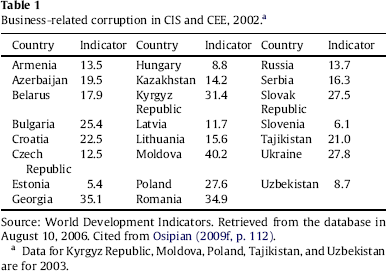
One of the arguments used to support the idea of sharp and significant output decline in the countries of the former Soviet Bloc is that the high level of corruption in transition economies has a negative impact on production and productivity. We will turn to statistical data to test such a statement. The level of business-related corruption in the Commonwealth of Independent States (CIS) and Central and Eastern Europe (CEE) in 2002 is presented in Table 1. The percent of managers who consider corruption the major obstacle for the business and entrepreneurial activities is considered an indicator of the negative impact of corruption on production. The data was obtained during the survey conducted in the NIS and CEE in 2003.
Business-related corruption in CIS and CEE, 2002.
a
Source: World Development Indicators. Retrieved from the database in August 10, 2006. Cited from Osipian (2009f, p. 112).
Data for Kyrgyz Republic, Moldova, Poland, Tajikistan, and Uzbekistan are for 2003.
Business-related corruption in CIS and CEE, 2002. a
Source: World Development Indicators. Retrieved from the database in August 10, 2006. Cited from Osipian (2009f, p. 112).
Data for Kyrgyz Republic, Moldova, Poland, Tajikistan, and Uzbekistan are for 2003.
According to the data presented in Table 1, the level of corruption in business and the relationship between business and state in Russia is at the lower end of the scale for the region overall. Moldova is a leader in corruption, while in Estonia, Slovenia, and Hungary the level of corruption is relatively low as compared to the region's average. Needless to say, data on corruption are always to a large extent subjective, partial, and oftentimes biased. Nevertheless, these data should be taken into consideration when there is a lack of better sources of information.
The issue of whether slowing economic growth results from an increase in corruption is still open. While a positive correlation between the high level of corruption and output decline has been proven theoretically with the help of mathematical modeling, strong systematic empirical evidence has yet to be shown. In the short run, corruption in transition economies may act as both grease for the “rusty” and rigid bureaucratic mechanism or an additional transaction cost for businessmen and entrepreneurs. Correlation of the GDP per capita growth and estimates of corruption made by the businessmen in the NIS and CEE countries of the former socialist bloc in 2002 is presented as a diagram in Fig. 1.
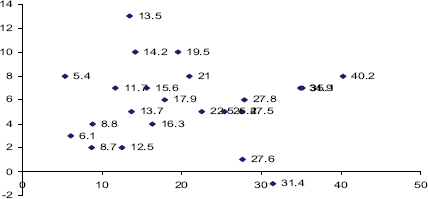
Correlation of the GDP per capita growth and estimates of corruption made by the businessmen in the NIS and CEE countries of the former Socialist Bloc, 2002.
The diagram shows that there is no clear evidence of a positive correlation between the level of corruption and output decline or GDP growth slowdown. In Moldova GDP per capita growth of 8 percent in 2002 was possible with the level of corruption marked at 40.2. In Slovenia during the same year GDP per capita growth was only 3 percent, with the level of corruption at 6.1. In Russia, GDP per capita growth of around 5 percent in 2002 coexisted with the level of corruption of 13.7, while in Ukraine the same level of GDP per capita growth related to a corruption level of 27.5 on the offered scale.
The definition of education corruption includes the abuse of authority for material gain (Anechiarico & Jacobs, 1995a, 1995b). Sayed and Bruce (1998) and Waite and Allen (2003) present a broad social approach to define corruption. Petrov and Temple (2004) apply a narrow definition of corruption that regards corruption as such only if it implies illegality. Corruption in higher education may be defined as a system of informal relations established to regulate unsanctioned access to material and non-material assets through abuse of the office of public or corporate trust (Osipian, 2007a, p. 315). Contrary to the common belief, transparency in the area of education corruption in Russia is of a high level and cases of corruption are reported in the media (Osipian, 2007b, 2008b).
As follows from the extensive media coverage and scholarly works, Russian secondary and higher education suffers from corruption, as do national educational sectors of other former Soviet republics (see, for instance, Heyneman, 2004, 2007, 2010; Osipian, 2009a, 2009e; Round & Rodgers, 2009). The Department of Economic Security of the Ministry of the Interior in Russia conducted the annual operation “Education 2008” with the following results: almost 200 university faculty and administrators are charged with embezzlement and bribery. There are 217 criminal investigations launched out of 3500 crimes registered. Of those 3500 crimes almost 600 are bribery and almost 900 are embezzlement for a total of $3 million (Nazarets, 2008).
Faculty members are prosecuted and sentenced for bribery, but often they receive terms on parole or suspended sentences. They are considered as no threat to the society, since their crimes are non-violent. One such example is the case of a faculty member in Perm State Agricultural Academy, who was sentenced to three years and six month on parole for bribery. He set a price of $100 for the examination and managed to collect $2500 in bribes from 25 students in July of 2008. The court also banned this faculty member from teaching for three years (Ivanova, 2009). In another example, two faculty members were arrested for bribery in Oil and Gas University in Tyumen, a large city in Siberia built around the oil industry. In first case it was an extortion of only $40 in exchange for a positive examination grade. In the second case it was a sum of $1000 collected from several students (Leonidov, 2009).
The demand for bribes from the side of educators is growing, as is the average size of a bribe. According to the survey, conducted by the Center for Public Opinion Research in 2004, diminished accessibility to free education and medical help is pointed out by 23 percent of Russians as the greatest problem; 55 percent consider bureaucracy and corruption among the present political and economic elite as the major contributing factor that prevents Russia from getting out of its socio-economic crisis and achieving economic prosperity (Kofanova & Petukhov, 2006, p. 24). The increasing gap between pay rates in private and public sectors of the economy urges public employees to seek other sources of income (Gorodnichenko & Sabirianova, 2007). Along with the health services industry, higher education in Russia has become one of the industries most affected by corruption. Surprisingly, 54 percent of Russians believe that harsher punishment for bribery may stop faculty members from accepting or extorting bribes (Agranovich, 2008). A rapid development of higher education, its partial privatization and the increasing flow of financial resources have created a base for corruption. University faculty members collect bribes and numerous other illicit benefits and utilize their privileged position and control over the access to higher education.
The higher education sector is not an oasis when it comes to corruption. Educators cannot stay outside the mainstream of development and have to work in rapidly changing socio-economic conditions. They adjust their behavior from ethical and professional to opportunistic, often disregarding codes of conduct in lieu of illicit benefits. Accordingly, corruption becomes part of the education sector, as it is of other sectors of the economy and the government. The evolution of corrupt hierarchies in universities points to changing internal structures shaped by external influences of the market and the government (Osipian, 2008b). In fact, the ruling political regime in Russia may be interested in corrupt universities as objects of blackmail, coercion, and control (Darden, 2008; Osipian, 2010d). The nexus of political graft and education corruption that may be observed in the former Soviet republics includes collusion, compliance, and control (Osipian, 2008a). Underpaid educators are more susceptible to corruption. The regime uses educators’ need for illicit benefits to create the “feed from the service” scheme and to control the agenda in universities (Osipian, 2009a). The regime might be interested in maintaining corruption in education and preserving its functions of financier and regulator of access to higher education.
Corruption in education is more detrimental to the society than typical bureaucratic corruption. Corruption in higher education is detrimental to the society for at least three major reasons. First, it has a negative impact on the economy and society due to lowering the system's efficiency, as does bureaucratic corruption. Second, as distinct from ordinary bureaucratic corruption, corruption in higher education reduces the total social welfare of the society because of its negative effect on the quality of educational programs and qualifications of college graduates. Finally, corruption in education eats away social cohesion, because students learn not only their subject matter, but also pervasive ways and practices of corruption. Corruption in higher education negatively affects access, quality, and equity. Contrary to expectations, development of a substantial private sector in higher education in Russia leads to an increase in corruption. Private universities are as corrupt as their public counterparts, which prove that not only public officials are susceptible to corruption.
There are around two million licensed positions for freshmen in around 1500 colleges and universities in Russia, 80 percent in public colleges and 20 percent in private ones. In addition, there are numerous public community colleges and vocational schools. The projections point out that the number of positions in universities in Russia, licensed and accredited by the government, is already higher than the number of candidates willing to pursue college degrees, including distance learning, correspondence programs, and re-training courses. Almost half of all the students in public colleges and universities are funded by the government. Admissions to governmentally funded positions are corrupt. Course grades can also be bought from faculty members. The presence of such problems in the nation's educational system follows from the numerous media reports (Osipian, 2008a, 2008b). Corruption affects all levels of education, from secondary schools and up to post-graduate studies. Doctoral education is also not free of corruption, and doctoral dissertations and degrees are available for sale (Osipian, 2010a, 2010b, 2011).
Corruption in admissions to governmentally funded positions in public universities and bribery in the academic process may be the most explicit, but certainly not the only forms of corruption in academia. Forms of corruption, typical for just about any industry, are characteristic of the education industry as well. Embezzlement of public funds is committed up the hierarchical ladder, from student dormitory administrators to heads of colleges and universities (Novaya gazeta, May 14, 2009). Cases of embezzlement, fraud, gross waste, misallocation of resources, and other corrupt activities are found in colleges and universities throughout the country.
Bribery, embezzlement, and fraud are not the only dominating forms of corruption in higher education. Logrolling in academia is a typical form of latent corruption. Logrolling, as a form of corruption, may be widespread in Russian universities. A faculty member in the school of journalism can guarantee the admission of a protégé from the school of foreign languages, and the faculty member in the school of foreign languages can admit his/her protégé in exchange. This exchange of favors need not be simultaneous. Placement in a university may be swapped for a job placement. Such an illicit practice in education can be defined as a corrupt education swap. Corrupt education swapping is a form of education corruption that may be more prevalent than monetary transactions, and more preferred too, for the safety reasons. Corrupt education swapping belongs to the section of latent corruption. It is oftentimes difficult to identify such corrupt swaps in universities, and even if identified, they are still difficult to prove and to argue as illegal. In economic sense, however, corrupt education and placement swaps are no less harmful to the economy and society than education corruption where bribes are paid in cash.
Impact of education corruption on economic growth
Impact of education corruption on economic growth in any given nation would normally be measured quantitatively. Such measurements would require finding causality between the level and dynamics of corruption in the nation's secondary and higher education sectors and the rate of economic growth. So far, there is no direct evidence that corruption in higher education has a significant negative impact on Russia's economy or the rate of growth. Nevertheless, some empirical work that was done in other regions points in this direction. According to Klitgaard (1986), elitism and lack of meritocracy in access to higher education and leadership positions in some developing countries lead to a decrease in GNP. This work was done for developing nations, while industrialized nations are normally not in focus when it comes to correlation between levels of corruption and economic growth.
Industrialized nations also experience the problem of education corruption. Thus, new empirical studies are needed to reflect the modern day realities. Only theory and some comparisons on general developmental trends may point to disadvantages that a national economy experiences due to a high level corruption in its educational sector. The discussion of education corruption in Russia, presented above, offers a prediction of possible negative impacts in the long run, when employees with relatively low levels of formal education will occupy the places of more capable individuals. However, this lack of formal education may be partially compensated for by years of working experience.
Corrupt state officials, bureaucrats, and civil servants in Russia are often perceived as indicating certain forms of rent-seeking behavior. Rent in this case is extracted from the monopolistic position based on discretionary powers possessed and exercised by the bureaucrat. The rent is extracted in the form of a bribe from the clientele, be it in a bureaucratic office or a university classroom. The rent-seeking behavior in the Russian society is perceived as a norm, and higher education sector is no exception in this sense. Public officials, bureaucrats, and civil servants attempt to transform their right to regulate public access to material and non-material assets into personal benefits. Educators act in a similar manner. Each corrupt educator acts at the level of his/her authority.
The level and scope of opportunistic behavior as well as the amount of illicit benefits collected depend on formal authority and informal connections of each individual educator. Rectors of public universities rent out university property, including academic and non-academic facilities and land, to businesses in which they often have a share. In some colleges, student dormitories may also be rented out illegally to outsiders. University faculty members collect their “rent” by selling positive grades on examinations and homework assignments. By doing so, they de facto sell academic degrees with no merit. Faculty members collect their rent by abusing their monopolized function of evaluation of academic progress and conferring the degrees.
Unlike in many other societies, the rent-seeking behavior in Russia extends far beyond state bureaucracy, public healthcare and education sectors. The public sector is not the only area of rent extraction by the bureaucrats and civil servants. The entire national economy suffers from a heavy dependency on rent extraction from the rich natural resources. With a significant and continuing increase in prices on oil, gas and other resources, Russians consider rent-seeking not only as a form of bureaucratic behavior, but also as the way the national economy works. This makes the very idea of living of rent a norm, a conceptual base for a new way of thinking.
Education corruption and growth may be linked through human capital, and mechanisms of human capital valuation under different conditions. The transition from the Soviet to post-Soviet reality touches on the higher education sector. During the Soviet era, the major stake for individuals was gaining higher education. On the one hand, the access to higher education was restricted and the admissions were competitive. On the other hand, all students were fully funded by the state and in addition received stipends and free dormitory accommodations. Jobs were available for everyone, and higher education was not a “must” for those seeking placement. There was no unemployment in the country and in fact people were not allowed to be unemployed. Idle people could face criminal persecution under the anti-idleness law.
The state regulated the access to higher education not only directly, through admissions rules and entry examinations, but indirectly as well. There were some disincentives embedded in the system of education and employment that worked as regulators or stabilizers: low salaries for educated people kept many away from universities and lowered the demand for higher education. The state monopoly on all the sectors of the economy meant that wages were set by the government. As a result of low wages for educated professionals, many engineers worked as skilled workers and earned twice as much, plus had better benefits, including faster process of obtaining housing and shorter waiting term for purchasing cars. The state determined the salaries and benefits for all categories of employees. There was no labor market, in its classical understanding, in the country.
In distinction of the Soviet era, the major stake in contemporary Russia is no longer a college degree, but the job. More and more often, education becomes a necessary formality, such as a diploma to occupy a certain job position, and can be bought. Corruption in higher education allows for circumventing formal requirements for gaining a degree. This situation may change only in one case: if a growing competition between firms will make the need for higher economic effectiveness stronger, and employers will start seeking skilled professionals more actively. In the current situation, the existing level of nepotism, cronyism, preferential treatment, and sometimes outright bribery dictate, in part, employment decisions. Such practices result in an undeveloped labor market. In many instances, high level human capital is undervalued and its bearers, i.e. highly skilled and motivated professionals, are underpriced or artificially made low-competitive. Large companies profit from their size and monopolistic position in certain segments of the market instead of relying on better professionals and better organization of labor. As a result, there is a paradox of shortage of highly qualified professionals and low pay rates for such professionals. On one hand, competing firms and the technological processes in each firm require capable high skilled professionals. On the other hand, firms only rarely compete for such professionals and do not offer them competitive pay rates, commensurate with their experience and value to the company. Meritocracy and talent suffer, while low professionalism gains way.
Russian mass education offers plenty of average quality, affordable, and accessible higher education. However, in addition to honest ways, one can obtain diplomas in exchange for bribes. With broader introduction of for-tuition programs, when payments for education are made legally, corruption in admissions will inevitably decline. Such a decline will not mean the surrender of corrupted educators and eradication of corruption in education institutions. Corruption is not limited to admissions to governmentally funded positions, but continues in the academic process through the program of study. Students in for-tuition programs also seek easy ways to pass examinations and faculty members often demonstrate willingness to help students to continue their studies even though their academic performance is below any lax standards, let alone standards established by the state accreditation bodies.
One of the real solutions to academic corruption will be further development of the labor market, when knowledge obtained in universities, whether funded by the government or paid for by tuition, will be valued higher than personal connections, bribes, and other illicit benefits. Russia declares modernization as a major way for its development. Revenues that come from the increasing export of natural resources can form a monetary base for this widely acclaimed modernization, but it should also have the human capital component. Unfortunately, so far Russian higher education sector has failed to provide the national economy with high quality graduates and the national economy has failed to build up a structure of economic incentives that would encourage employment of such college graduates. As a result, a weak undeveloped labor market pulls back the nation's otherwise dynamically developing economy.
In the post-transition market economy, massive renovation of plants, factories, and transport and communication infrastructure is much needed. This renovation requires investment in both principal capital and human capital. The modernizing economy needs professionals who would be able to invent and use new technologies, operate the machines, and manage complex technological processes. It is misleading to assume that during the Soviet era, there were plenty of highly skilled professionals starting in the 1970s. Nevertheless, this assumption was still being made as a result of high unemployment, especially among technical cadres, during the 1990s. As a consequence, the major focus in Russia now is on the future investment in principal capital, including machinery, equipment, and technologies. These elements of principal capital are often imported from abroad. However, human capital is becoming a limited resource, with qualified specialists being in short supply.
The process of economic transformation from planned to market economy is characterized by the transition from full employment to unemployment. In the Soviet era, the planned economy employed the entire available workforce. The predominantly extensive nature of economic growth explained full employment at that period. In the market economies, full employment is rather a continuing goal to be achieved than a reality. Accordingly, market reforms of the 1990s and a decline in production led to economic restructuring and high unemployment. Over the last decade the Russian economy has indicated average to high rates of growth. The unemployment level has declined significantly. However, the illicit ways and corrupt practices of gaining and retaining employment remain virtually intact.
Illicit ways to receive jobs include nepotism, cronyism, personal connections, and bribes. They are similar to the illicit forms of gaining access to publicly funded higher education. There are two consequences of such realities. First, a significant portion of human capital is of unclear value. Second, the high quality human capital is often undervalued and not utilized in societal production at full capacity. Distribution of property rights on production capacities, including plants and mines, is skewed and concentrated in the hands of a few. This uneven distribution is a result of corrupt privatization of public enterprises in the 1990s. Such distribution is especially important because the Russian economy remains industry oriented, rather than predominantly service oriented. This might be a better structure for the national economy. However, low competition between the producers means no need for the best and brightest. Unequal distribution of property rights on production capacities eventually results in undervalued human capital.
Even competition between the employers does not place the real value and the accent on human capital. Employers often seek a diploma holder who can do the job for the lowest possible wage, rather than a high skilled professional. The diploma is needed as a part of the risk aversion strategy of the employers, typical for the job market. It may also be needed in order to satisfy some formal requirements. The result is that employees cannot do the job properly. They are ineffective. Employers no longer rely on diplomas; in addition to degree certificates of prospective employees, they prefer working experience as a guarantee of qualifications. Preferential treatment in higher education and employment may correlate positively. Those with means to buy places in prestigious public universities are likely to obtain better job placements by the same method of bribing and using kinship and personal connection.
The property rights on the principal capital, including plants and factories, are in the hands of a few. These few profit on the size of the enterprise rather than on its effective organization and high level of productivity. They do not need to push for the highest effectiveness and efficiency possible. They accumulate large profits thanks to their size, not to the effectiveness of their work, and can afford lavish lifestyle. The initial monopolistic structure of the economy inherited from the Soviet era, emphasis on machine-building and heavy industry, and poorly designed and implemented privatization resulted in the high degree of monopolization and low competition. A weak need for competitiveness, as well as the strong tradition of non-economic solutions for economic problems, including through mafia and illicit business–government relations, lead to low effectiveness and efficiency.
Policy recommendations
Russia continues to undergo the process of massification of higher education. More youth and mid-career professionals turn to higher education institutions. The process of massification of higher education is driven by two fundamentals: development of production and social development (Dye, 1966; Lindeen & Willis, 1975; Volkwein & Malik, 1997). Firms present demand for the skilled labor, produced in the higher education sector (Marshall & Tucker, 1992). The Russian government represents interests of producers and so its function is to supply skilled labor to firms by maintaining the system of public education. The economy requires human capital at a minimum cost. Hence, the task of the government is to maximize the effectiveness and efficiency of public higher education. It may be done on the basis of three major blocs of the reform. The first bloc includes decentralization dismantling of the vertical axis of subordination to the state. The second bloc includes marketization and commercialization of higher education. Finally, the third bloc anticipates achieving the new balance between university autonomy and level of its accountability to the government. This new balance can only be achieved through further restructuring, privatization, plurality of forms of property and economic activities. We suggest continuing market reforms and lessening governmental control in the Russian higher education sector.
The task of drastically reducing corruption in the education sector is of a paramount importance. The Russian government makes continuous efforts to curb corruption in education. However, little can be done to reduce education corruption in the short run. The measures that target corruption on the functional level, such as an increase in the level of transparency and introduction of the code of conduct for faculty, students, and administrators, are not enough. Structural changes, organizational changes, and institutional changes are needed to resist corruption in education. These changes may be implemented from the top, but only to a limited extent. Structural, organizational, and institutional changes will still be insufficient to oppose corruption. The real structure of corrupt relations in academia is much more complex and often involves rigid hierarchical structures (Osipian, 2009d, 2010c). Fundamental changes are needed. Such changes can only evolve naturally, based on technological changes and demands for societal production.
In Russia, entry examinations for prospective students are sometimes taken by well-prepared students from other universities. Such impersonations are illegal, but there are ways of avoiding prosecution for such misconduct. The standardized test attempts to reduce impersonations on entry examinations, but the recent investigations show that it is not quite successful in this endeavor (LifeNews, June 15, 2011; Newsru.com, June 14, 2011). In addition, the system of academic Olympiads developed and widened significantly as an alternative to the test now becomes rotten with impersonators. Osipian (2009b) reports that the standardized test experiences numerous problems and is unlikely to solve the problem of corruption in higher education even at the entrance stage. Test-based admissions are admissions to universities on a competitive basis, based on the results of independently administered computer graded examinations or standardized tests. These are anticipated to become a major tool in fighting corruption in admissions.
The benefit of introducing the standardized tests in fight with corruption in admissions to publically funded higher education institutions remains arguable. Few years ago, Russian media presented reports on the standardized testing as a tool to curb education corruption; now it reports corruption in standardized testing itself. Even if proven successful in reducing corruption in access to higher education, the standardized national testing does not represent fundamental changes in the education sector. The test-based admissions as replacement for the university-based entry examinations means preservation of the same system when the government retains the distribution function. Under such a system, corruption is unlikely to decline, even in the long run. In addition, the earlier initiative with educational vouchers as replacement for the direct governmental funding of higher education institutions has failed. In order to remove the government as an intermediary and the distributor, direct governmental funding should be replaced almost entirely with direct consumer payments. Income-based inequality in access to higher education should be compensated for with educational loans. Educational loans should come as a combination of governmental student loans and private bank credits.
The reform of education financing alone will not result in the change of the system. The reform should include measures for further privatization of colleges and universities. Privatization of public universities should include privatization of land on which they stand. This type of privatization will allow universities to raise funds for investment in university facilities, equipment, and libraries. In addition, it will allow a much needed increase in faculty salaries, establishment of scholarships for most promising students with low income, and expanding research capabilities. While the issue of property rights delineation is fundamental, the tests are also important for successful reforms (Osipian, 2008c, p. 101). Decentralized educational systems with a large private sector are not entirely free from corruption, but they may better fit modern Russia.
Conclusion
As can be seen from the discussion, high levels of education corruption may harm total factor productivity in the long run, primarily through lowering the level of human capital and slowing the pace of its accumulation. Ethical standards learned in the process of training in universities can also affect the standards of practice in different professions. The growing level of productivity is not likely to reduce education corruption in the short run, but can eventually lead to implementation of higher ethical standards in the education sector. This may happen through the chain of incentives emerging at every stage of the process of creation and utilization of human capital. To simplify, the growing complexity of technological processes will demand higher amounts of human capital, including human capital per capita. This will change the characteristics of the labor force in demand. The labor market will send the signal to the education sector and to future employees. As a result, both producers of educational services and those investing in their human capital will demand high quality education rather than bribe their way to educational certificates.
It is unlikely that education corruption defines or influences the structure of the Russian economy. Such explicit manifestations of corruption in the higher education sector as diploma mills are presented in the form of distant branches of colleges and universities. Their total revenue is insignificant, as are their enrollments, and they do not occupy a significant niche in the sector. Changes in the structure of the national economy can reduce corruption in higher education due to the demand on qualified work force and competitiveness of firms. An increase in competition due to the decreasing concentration of property rights and more even distribution of property rights on principal capital will eventually accentuate human capital over governmentally supported educational certificates.
Decentralization and restructuring of the Russian higher education sector diminish the role of the government. University autonomy may be needed to replace weakening governmental control. Meritocracy and high social prestige of academic profession and university degrees slowly weaken. This indicates the process of erosion of values, common for the transition society overall. The value of forgeries will eventually be annihilated by their overwhelming number. If the situation will develop in an unregulated, unorganized way, the university degree will become absurdist. Reputation of each degree and degree holder will be based on his/her academic merits and reputation of the granting university. The competitive labor market will accent the values of academic degrees and human capital.