



Abstract
An automated process that incorporates Millipore's Plasmid Miniprep96 Montáge™ Kit with the Apogent Discoveries PlateMate Plus® and Tango™ automated high-throughput dispensing systems has been developed for purifying plasmid DNA. To test the efficacy of this process, parameters such as the reproducibility and consistency of the purified DNA quantity and quality as well as the purification speed were analyzed. The purification time for two plates of the Plasmid Miniprep96 Kit (192 samples) was approximately 60 minutes using a PlateMate Plus equipped with 96 disposable tips and the Tango system equipped with 96 RB (resin bead) syringes. High uniformity and consistency in DNA yields (determined by spectrophotometric analysis) and quality (determined by gel electrophoresis analysis) among the different wells were observed. The purified plasmid DNA samples sequenced at an exceptional level with an average PHRED Q> 20 of 819 ± 25.
Introduction
Manual purification of a large number of plasmid DNA samples is time consuming, laborious, and prone to error. These complications can be circumvented through the use of automated high-throughput liquid handling systems for all aspiration and dispensing steps in the purification procedure. Automation increases precision by reducing sample-to-sample variability and also increases the efficiency and the speed of the purification process. Apogent Discoveries and Millipore have developed an automated process that utilizes Millipore's Montáge Plasmid Miniprep96 Kit with the Apogent Discoveries PlateMate Plus or the Tango liquid handling systems.
The Millipore Montáge Plasmid Miniprep96 Kit exercises a unique separation technology that requires only three short filtration steps to obtain a clean DNA sample from a plate. Millipore's proprietary size-exclusion membrane retains plasmid DNA while contaminants are filtered through as waste.
The PlateMate Plus and Tango systems combine precision and speed to facilitate simultaneous aspiration and/or dispensing of up to 384 samples. The Tango system is equipped with 96 or 384, non-disposable precision glass syringes. Its stage is composed of 12 nests. Plates can be stacked in the Tango platetsacker and be removed or placed onto the stage by the plate stacker's rotational gripper arm. The PlateMate Plus system is equipped with 96 or 384 disposable plastic tips, has a four-position microplate deck, and can accommodate up to four removable stacker chimneys. These systems can be used not only for the DNA purification process, but also for automated dispensing tasks in all subsequent downstream DNA applications such as quantification, preparation of polymerase chain reactions (PCR), and sequencing reactions. 1 6
In this study associating the Apogent Discoveries liquid handlers with Millipore's Montáge Plasmid Miniprep96 Kit, we explored a high-throughput method for efficient plasmid DNA purification. Reproducibility, quantity, quality, and speed of plasmid DNA purification were analyzed in depth.
Materials and Methods
Millipore's Montáge Plasmid Miniprep96 Kit (Cat. no. LSKP09604), bacterial cultures (E. coli JM109 containing pLH2 plasmid with a 2 kb insert), and MultiScreen® Resist Vacuum Manifold (Cat. no. MAVM0960R) were provided by Millipore, Danvers, MA. The PlateMate Plus (Apogent Discoveries, New Hampshire, MA) equipped with 250 μl Disposable Automation Research Tips (D.A.R. Ts, Cat. no. 5536) and the Tango system (Apogent Discoveries, Sunnyvale, CA) equipped with 290 μL RB syringes with stainless steel Teflon™ coated needles (Cat. no. 1028–06–0) were used for liquid handling. Centrifugation was performed with the Sorvall® RT6000B refrigerated centrifuge (Kendro Laboratory Products, Newtown, CT). Electrophoresis was performed on the PowerPac 300 by Bio-Rad Laboratories (Hercules, CA), and images were detected using the NucleoVision Imaging Workstation by NucleoTech (San Mateo, CA). DNA quantification was done with a TECAN SPECTRAFluor® Plus fluorescence plate reader (Tecan, NC), using Costar 96-well, flat-bottom UV plates (Cat. no. 3635) from Corning Life Sciences, Acton, MA. The 1 kb DNA ladder (Cat. no. 15615–016) was purchased from Gibco BRL (Carlsbad, CA).
AUTOMATED DISPENSING INTO THE MONTÁGE PLASMID MINIPREP96 KIT BY THE TANGO LIQUID HANDLING SYSTEM AND PLATEMATE PLUS AUTOMATED PIPETTOR
The Montáge Plasmid Miniprep96 Kit protocol was slightly modified for compatibility with the Tango and the PlateMate Plus system. In the procedure, five simple steps were performed:
Bacterial cells were resuspended, lysed by alkaline lysis, and then neutralized. Cell debris was separated using the Montage Clearing plate. Plasmid DNA was captured into a second filter plate, Montage Plasmid plate. Wash buffer was added to remove contaminants. DNA was recovered from the Plasmid plate in resuspension buffer. The protocol (see below) is simple and lends itself to partial or full automation.
CALIBRATION OF TANGO LABWARE
Labware was defined and calibrated using the Tango software. All labware was calibrated in the 96-well format.
CALIBRATION OF PLATEMATE PLUS LABWARE
Labware was defined and calibrated using the ControlMate™ software. All labware was calibrated in the 96-well format. Tips used on the PlateMate Plus were from Apogent Discoveries (Cat. no. 5536). For the transfer of lysate from the 96-well culture block to the Multiscreen lysate clearing plate, tips were hand cut to enlarge the internal diameter from .015′ to .062′. This modification of the standard PlateMate Plus 300 ul tips was needed to facilitate aspiration and dispensing of bacterial lysate.
PROTOCOL (USING THE TANGO AND PLATEMATE PLUS)
Pelleted bacterial cells (E. coli JM109 containing pLH2 plasmid) in the 96-deep well culture block were resuspended by dispensing 150 μL of Solution #1 (cell resuspension solution) in each well. The 96-deep-well culture block was then shaken on a plate shaker until cells were completely resuspended (approximately 1 minute). Tango needles were washed with 2 percent bleach and ddH2O. D.A.R. Ts were changed on the PlateMate Plus. 150 μL of Solution #2 (cell lysis solution) was dispensed into each well of the deep well block and mixed immediately with the plate shaker for 1 minute and incubated for an additional 2 minutes. 150 μL of Solution #3 (neutralization solution) was dispensed into each well of the 96-deep well culture block and mixed with the plate shaker for 2 minutes. On the Tango system, the 96-deep well culture block of the cell lysate was centrifuged at 1900 xg for 5 minutes (this step is not needed on the PlateMate Plus). The bacterial cell lysate was ready to transfer to the Montage lysate clearing plate. D.A.R. Ts were changed on the PlateMate Plus and were replaced with the modified D.A.R. Ts. 200 μL of cell lysate was transferred from the 96-deep well culture block to the Montage lysate clearing plate (pipetting speed was set to “slow” to increase accuracy and precision). With the Montage Plasmid plate inside the vacuum mani fold and the Montage lysate clearing plate on top of the vacuum manifold, vacuum pressure of 8 inches of Hg was applied for 3 minutes. After the lysate was drawn through the Montage lysate clearing plate and into the Montage Plasmid plate, the clearing plate was discarded. Tango needles were washed with 2 percent bleach, 70 percent ethanol, and ddH2O. D.A.R. Ts were changed on the PlateMate Plus. The Montage Plasmid plate was placed on top of the manifold and vacuum was applied for 5 to 7 minutes at 24 inches of Hg. 6. To wash, 200 μL of Solution #4 (wash solution) was added to each well of the Montage Plasmid plate and vacuum was again applied for 3 to 5 minutes at 24 inches of Hg. Tango needles were washed with 2 percent bleach and ddH2O. D.A.R. Ts were changed on the PlateMate Plus. Recovery of the plasmid was accomplished by dispensing 100 μL of Solution #5 (resuspension buffer) to the Montage Plasmid plate and the plate was incubated at room temperature for 30 minutes (optional: 5 minutes on the plate shaker). Tango needles were washed with 2 percent bleach and ddH2O. D.A.R. Ts were changed on the PlateMate Plus. The 80 μL recovered plasmid was transferred from the Montage Plasmid plate into the V-bottom collection plate for storage (pipetting speed was set to “slow” to increase accuracy and precision). Tango needles were washed with 2 percent bleach and ddH2O. D.A.R. Ts were changed on the PlateMate Plus.
Results and Discussion
The PlateMate Plus and the Tango liquid handlers were used to automate the use of Millipore's Montáge Plasmid Miniprep96 Kit for high-throughput plasmid DNA purification. The purified plasmid DNA was quantified by spectrophotometric analysis. The quality of the purified DNA was determined by running the samples on a 1.2% agarose gel and by sequencing analysis on an ABI 3700.
PLATE PROCESSING TIME
Purification of 192 plasmid DNA samples using two plates from Millipore's Montáge Plasmid Miniprep96 Kit with Apogent Discoveries' liquid handlers can be preformed in approximately 60 minutes using a PlateMate Plus equipped with 96 disposable tips or a Tango system equipped with 96 RB non-disposable syringes.
DNA QUANTITY
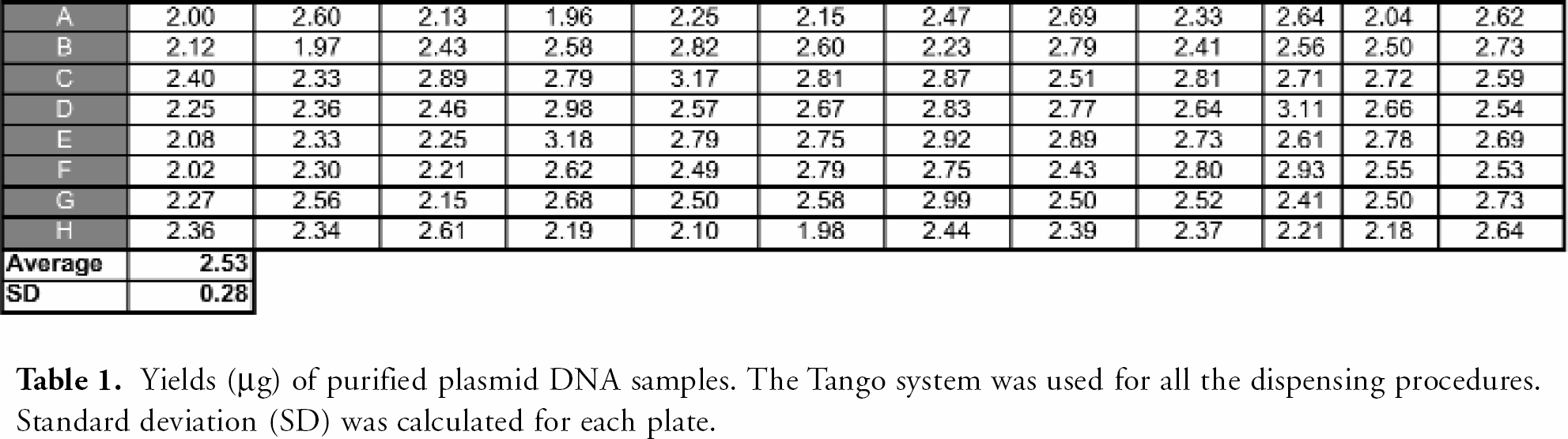
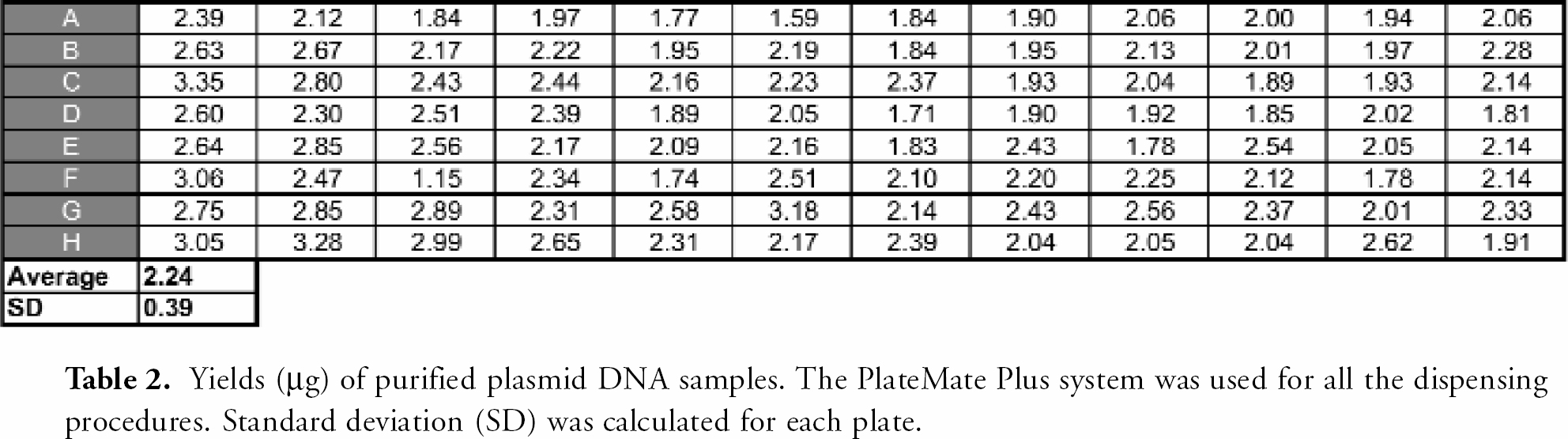
The plasmid DNA was quantified using spectrophotometric analysis. A TECAN SPECTRAFluor Plus equipped with a 260 nm-absorbance filter was used to obtain the A260. The DNA yields after purification were approximately 2.53 μg and 2.25 μg per well using the Tango and the PlateMate Plus systems, respectively (Table 1 Table 2).
Yields (μg) of purified plasmid DNA samples. The Tango system was used for all the dispensing procedures. Standard deviation (SD) was calculated for each plate.
Yields (μg) of purified plasmid DNA samples. The PlateMate Plus system was used for all the dispensing procedures. Standard deviation (SD) was calculated for each plate.
DNA QUALITY
The quality of the purified DNA samples was determined by gel electrophoresis analysis. Plasmid DNA samples (5 μL) were analyzed on a 1.2% agarose gel (Figures 1 and Figures 2). Several representative DNA samples were sequenced on an ABI 3700, resulting in an average PHRED Q>20 of 819 ± 25 (Figures 3). Uniformity and consistency in DNA yields and quality among the different wells indicate that the PlateMate Plus and the Tango systems enable a reproducible method of automated DNA isolation.
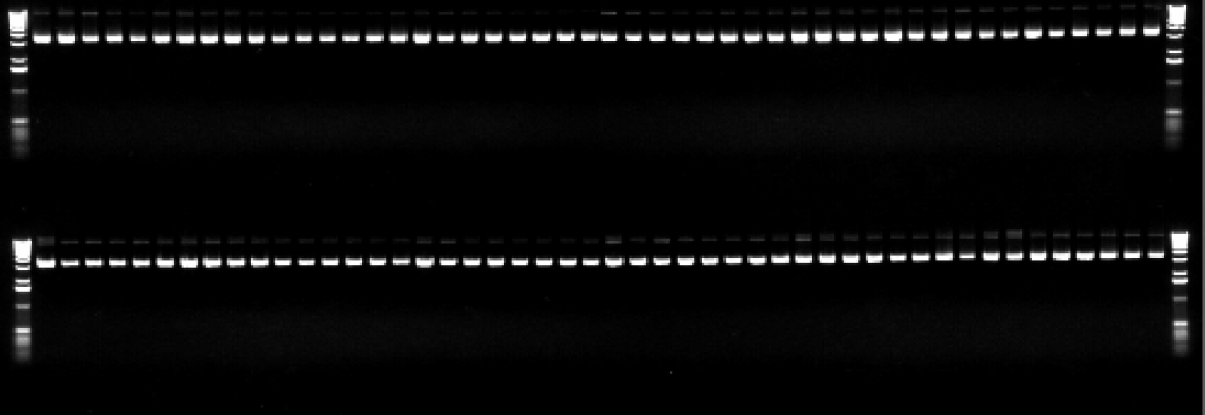
Electrophoresis analysis of purified plasmid DNA processed on the Tango system. A total of 5μL (out of 80) of the purified DNA samples was analyzed on a 1.2% agarose gel. DNA marker: 1.0μg of 1kb DNA ladder. Starting cultures were pooled (same clone grown in individual wells, pooled together and mixed, then redistributed to individual wells of a deep well block) to void variations in growth.
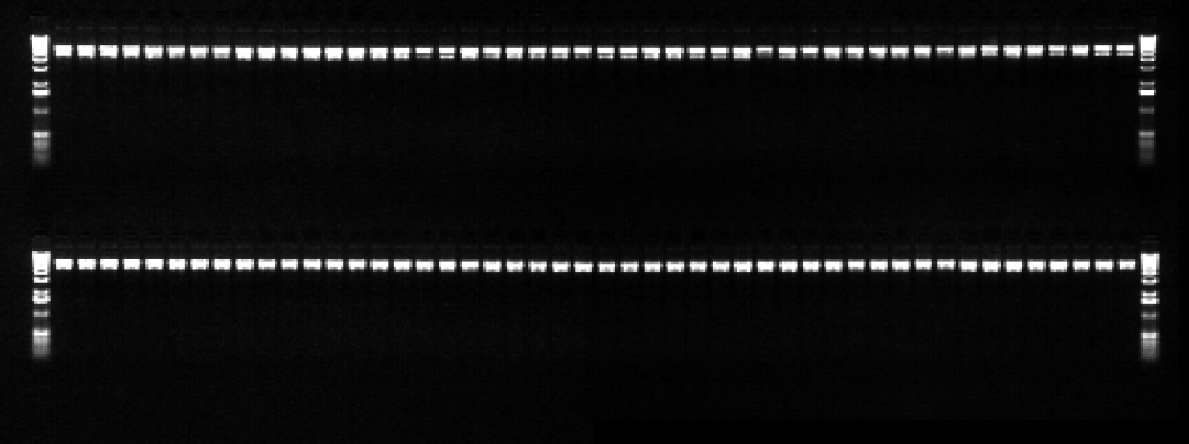
Electrophoresis analysis of purified plasmid DNA processed on the PlateMate Plus system. A total of 5μL (out of 80) of the purified DNA samples was analyzed on a 1.2% agarose gel. DNA marker: 1.0 μg of 1kb DNA ladder.
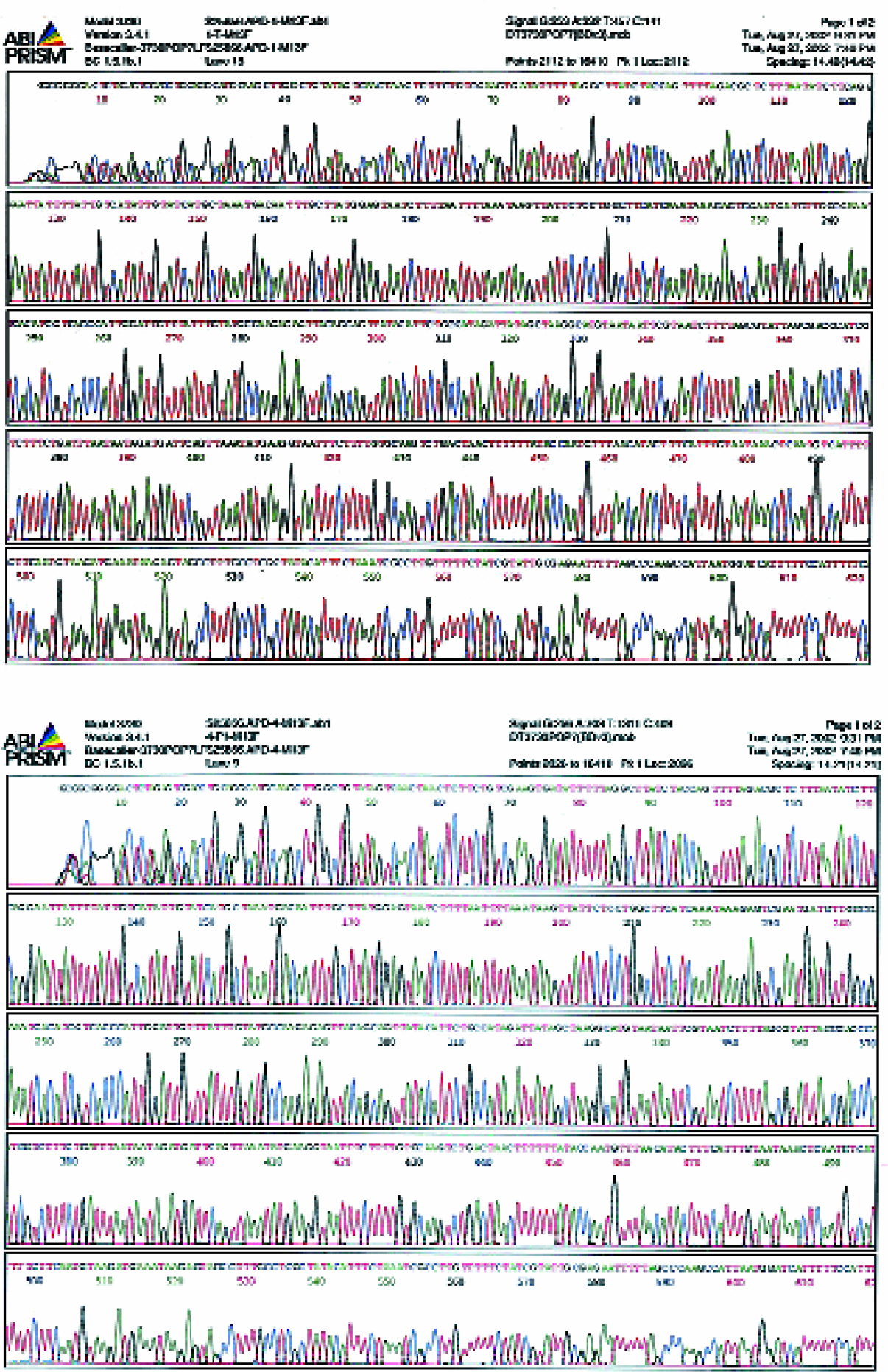
A representative sequencing trace for a Millipore Montáge Plasmid Miniprep96 sample processed on the Tango (A) and the PlateMate Plus (B).
Conclusion
The Montáge Plasmid Miniprep96 Kit processed on Apogent Discoveries' liquid handlers delivered consistently high-quality results. Plasmid DNA purification of 192 samples was expeditiously carried out in less than 60 minutes. Both quality and quantity of plasmid DNA were sustained throughout the automation procedure. The automated dispensing procedures provide maximum precision and reproducibility for the purification protocol.