



Abstract
We have analyzed the detection of microcantilevers utilized in biosensing chips. First, the primary deflection due to the chemical reaction between the analyte molecules and the receptor coating, which produces surface stresses on the receptor side is analyzed. Oscillating flow conditions, which are the main source of turbulence in cantilever based biosensing chips, are found to produce substantial deflections in the microcantilever at relatively large frequency of turbulence. Then mechanical design and optimization of piezoresistive cantilevers for biosensing applications is studied. Models are described for predicting the static behavior of cantilevers with elastic and piezoresistive layers. Chemo-mechanical binding forces have been analyzed to understand issues of saturation over the cantilever surface.
Furthermore, the introduction of stress concentration regions during cantilever fabrication has been discussed which greatly enhances the detection sensitivity through increased surface stress, and novel microcantilever assemblies are presented for the first time that can increase the deflection due to chemical reaction. Finally an experiment was made to demonstrate the shift of resonant frequency of cantilever used as biosensor. The relation between resonant frequency shift and the surface stress was analyzed.
Introduction
The development of silicon microfabrication techniques with surface functionalization makes it possible to make microscopic biomedical devices. Microcantilever has been used as stress sensors for biomolecules adsorption. The bending of cantilever can be detected by several read-out systems. The most commonly used system is optical system. But the optical system has certain disadvantages. A very accurate alignment and adjustment of laser and sensor is necessary for cantilevers. In spite of the distinct superiority of the biochips with mechanical detection systems, they possess few disadvantages such as turbulence in the liquid flow which affects the accuracy of the measurements as shown in Raiteri et. al. (1999) and Fritz et. al. (2000). Also, the primary type of micro-cantilevers used in these detection systems have low sensitivity especially for low analyte concentration and variations in liquid temperature can produce unwanted deflections due to bimaterial effects as discussed by Fritz et. al. (2000). In this work, microcantilever deflections are analyzed in the presence of chemical reaction at the receptor surface and dynamical effect of an oscillating flow representing flow turbulence, on the microcantilever.
The disadvantage can be avoided if we integrate the sensor component into the cantilever. When a piezoresistive material like doped silicon is strained, it will change the electrical conductivity. So piezoresistive microcantilevers are ideal for stress sensing. Piezoresistive elements are always integrated inside microcantilever structure. The resistivity can be easily measured by the wheatstone bridge.
The fractional change in resistance of a piezoresistive cantilever is described by the following expression
Stress Concentration Region (SCR) method is used to enhance piezoresistive displacement and force sensitivities. SCR is the region with a thickness less than that of cantilever, around which stress is raised a lot. It is a good place to place piezoresistive layer. Discontinuity like holes and decrease of thickness near the support are both used to increase the signal sensitivity.
Analysis and Simulation
The deflection (z) of the tip of an ordinary microcantilever can be calculated using Stoney's equation (see Moulin et. al. (2000)). The differential stress is proportional to the number of analytes molecules attached to the receptor surface. A schematic of the biosensor is described in Figure 1. A sample containing an analyte passes through the orifice in the steel plate through a circular inlet port. The bottom surface of the flow cell is a gold-coated glass-slide on which the binding molecules are attached. The one degree of freedom model that can best describe the dynamic behavior of the deflection at the tip of the microcantilever, zd, due to flow turbulences is shown in the following differential equation:

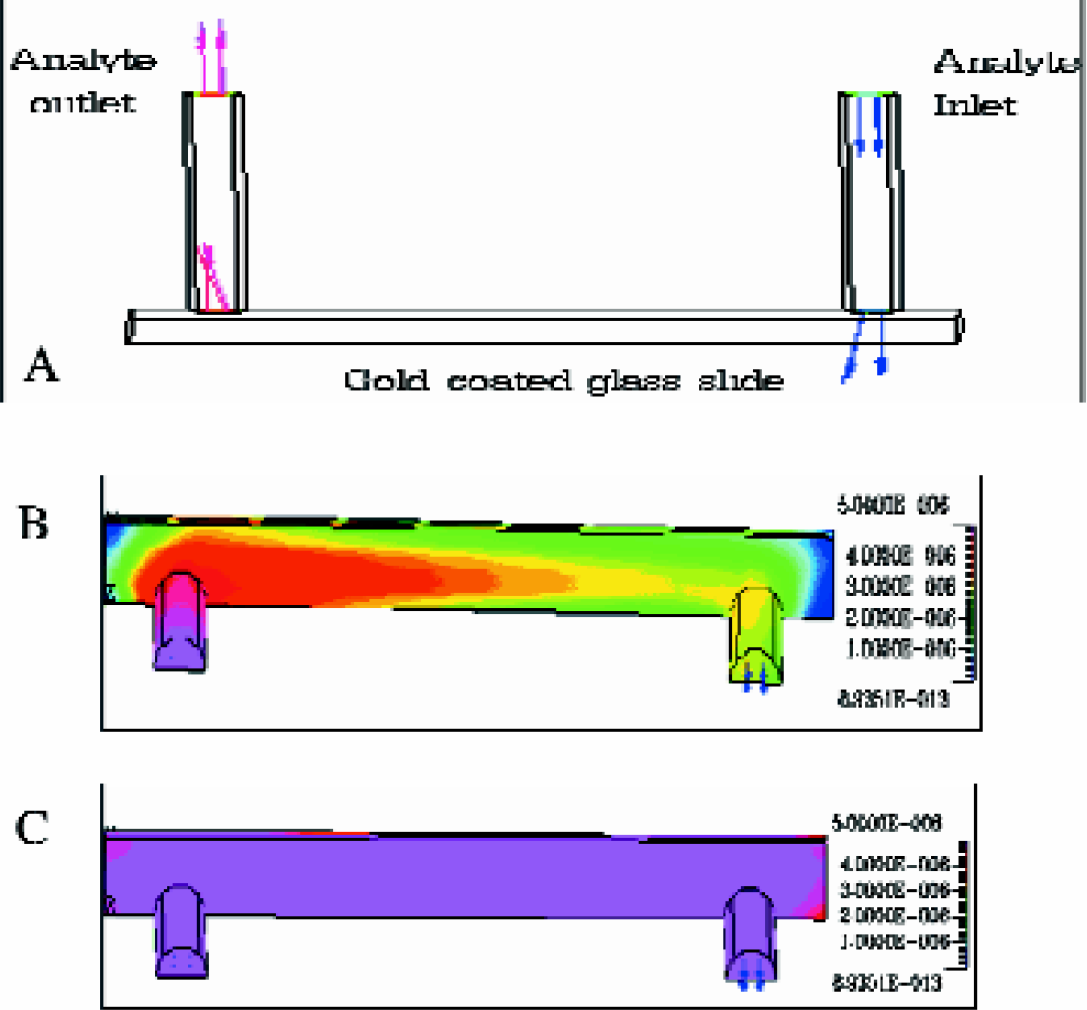
(a) Schematic illustration of the model system used for the analyses of analyte-receptor binding, (b) Distribution of analyte concentration at t = 5 sec, (c) Distribution of analyte concentration at t = 60 sec.
where me, ke, Ae, FV, h0 and ρf are the effective mass of the cantilever, effective stiffness, effective area of the microcantilever that are subject to flow drag, a velocity correction factor which is the ratio between the magnitude of the velocity at the microcantilever to the velocity magnitude at the source of disturbance, characteristic length for the turbulence at its source and the density of the fluid, respectively.
The steady periodic solution is:
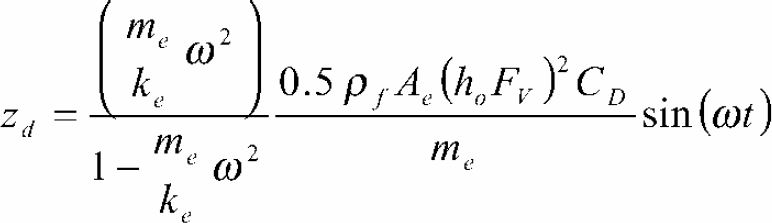
done for flow turbulences that are produced by external noise at the upper plate of the fluidic cell. The lower plate of the fluidic cell is assumed fixed while the vertical motion of the upper plate is assumed to have sinusoidal behavior according to the following relation:
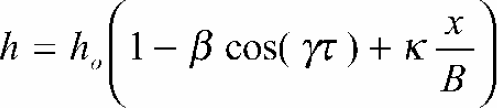
where ho, κ, β, τ and B are the reference thickness of the fluidic cell, dimensionless slope of the thin film, upper plate motion amplitude, dimensionless time and the channel length, respectively. γ is the dimensionless frequency and where ω is a reference vibrational frequency. The ratio of the deflection of the microcantilever due dynamical effects for an inclined channel to that for a flat channel can be approximated by the following for lower amplitudes of the upper plate's vibrations
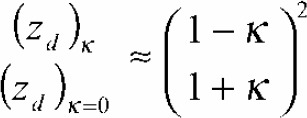
This equation suggests that dynamical effects on the microcantliever deflection can be reduced for divergent fluidic cells. However, this reduction is prominent at κ=1. The plot is shown in Figure 2.
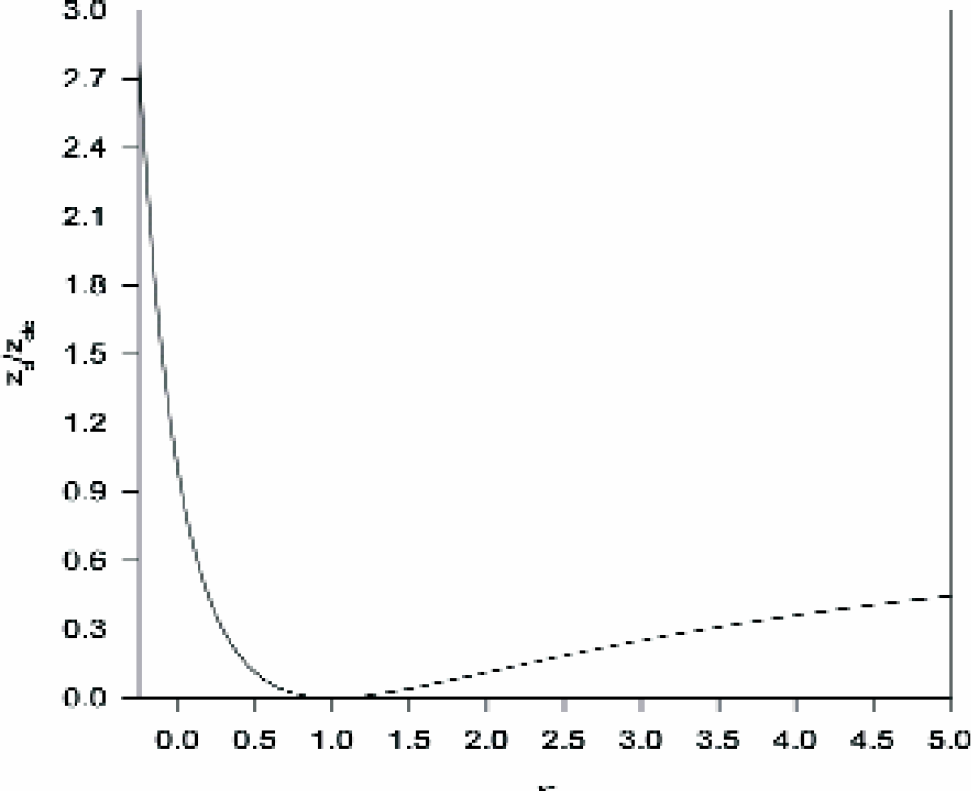
Effects of κ on Dynamical Effects.
In general, the adsorption of molecules to a binding surface causes a change in the surface free energy, which is also called the surface tension. The mechanical response of a biosensing cantilever is caused by a change in the surface stress upon binding and hybridization of biomolecules. The change of relative resistivity is proportional to the differential stress, so the sensitivity of the cantilever can be enhanced by maximizing this differential stress.
We developed a finite element model to simulate the mechanical and electrical properties of piezoresistive cantilevers using CFDRCTM. The cantilever beam is 30 mm wide and 120 mm long and has a depth of 1 mm. The piezoresistive layer has a depth of 0.1mm, which can make the factor close to 1. The length of the piezoresistive layer is 80 mm, which covers the most area near the support. The capture area is located at the top surface of the cantilever.
From the results of the chemo-mechanical analysis, we know the stress is uniformly distributed in the saturated situation. However, for the difference of geometry in longitudinal and transverse directions, i.e. the difference between the width and the length of the cantilever, there is a stress difference between the two directions. In our simulations, it is assumed that the piezoresistor is of p-type. The device sensitivity is defined by
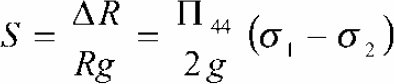
where π44 is the piezoresistive coefficient and g is unit load.
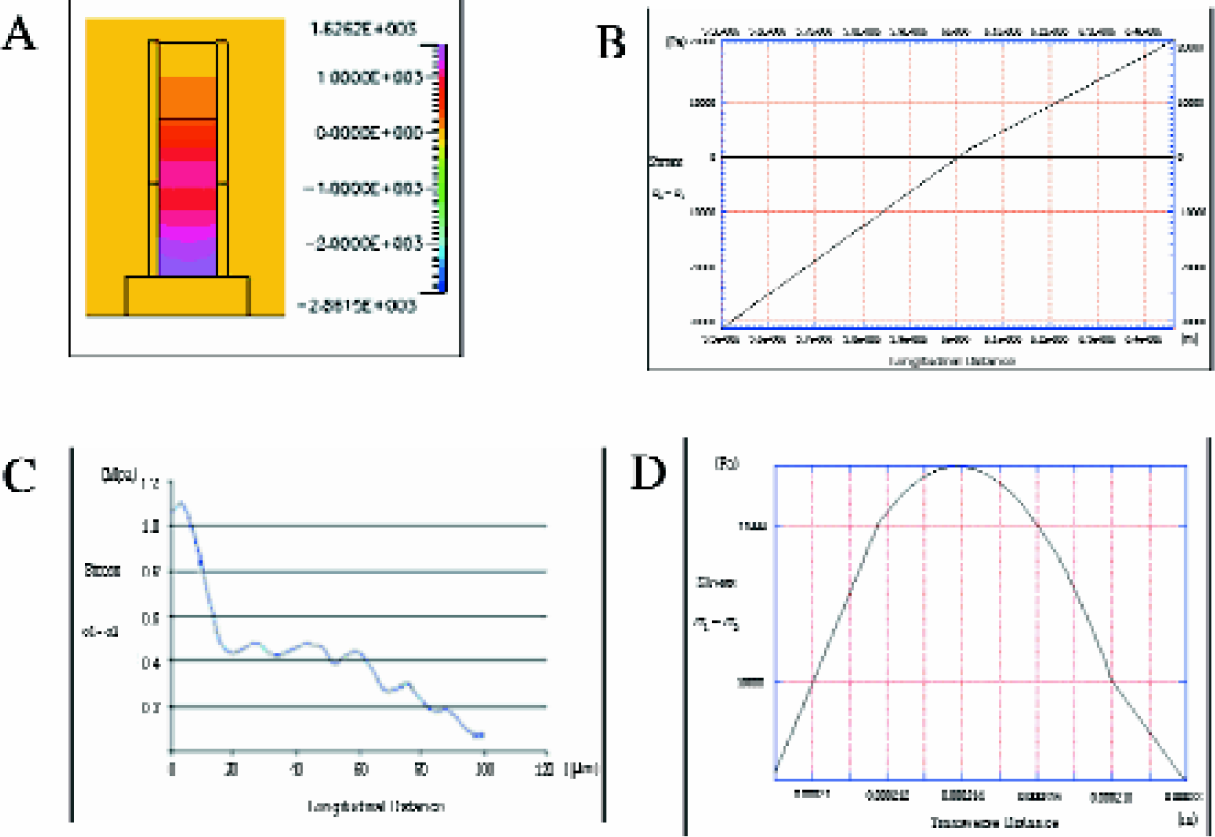
Simulation results for a regular piezoresistive cantilever (a) differential stress distribution, (b) along the neutral axis, (c) the integrated differential stress distribution, (d) the cross section profile of differential stress.
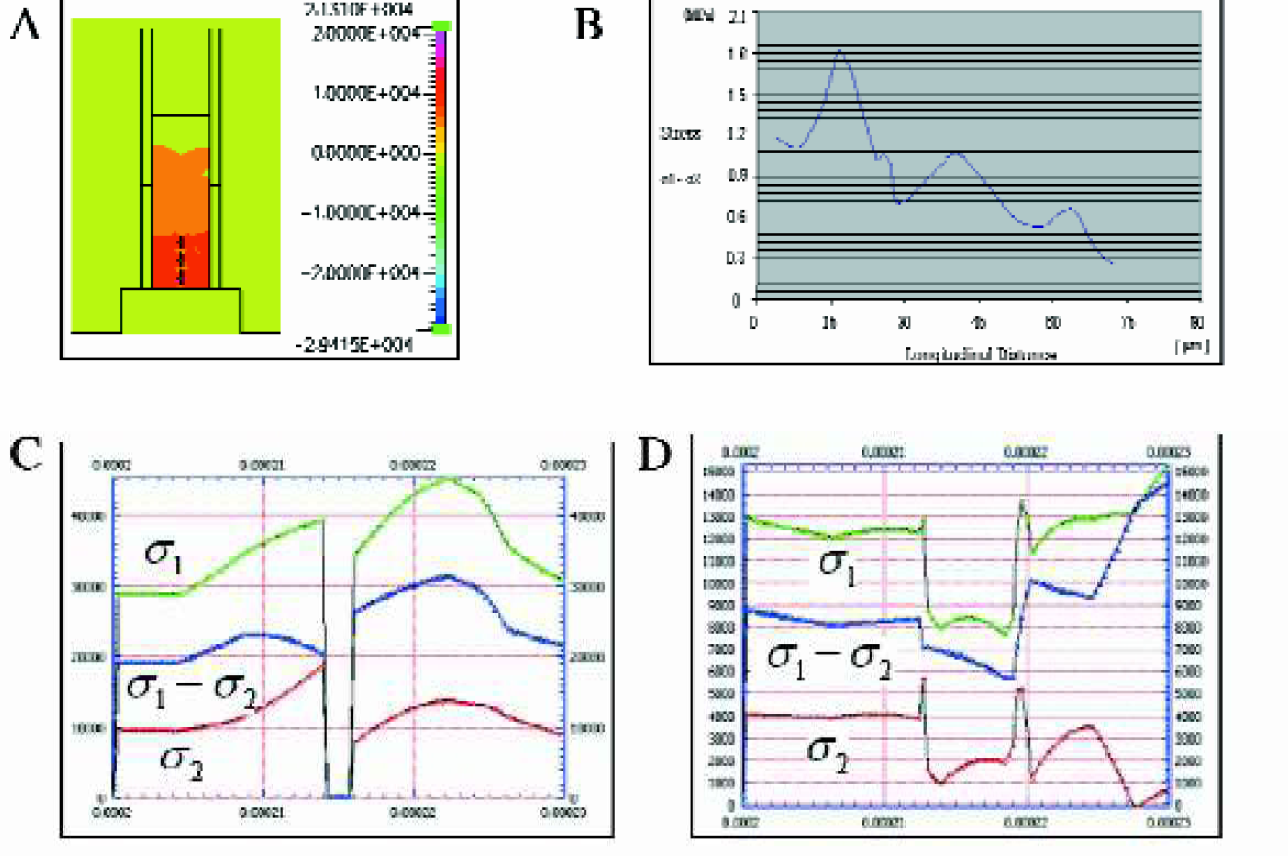
Stress distribution for SCR cantilevers. (a) differential stress distribution, (b) integrated stress along longitudinal axis, (c) cross section of stress in the position of holes, (d) cross section of stress after holes.
Experimental Procedure
Resonance frequency shift of the cantilever for bio sensing was analyzed by experiment. Cantilever can be considered as a long, thin beam with one end fixed and the other end free. After surface modification, the cantilever characteristics change due to the formation of a thin film. The new resonance frequency and the frequency shift are given by the following expression
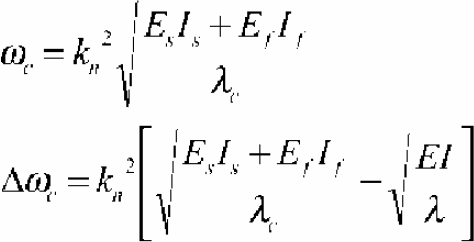
We know both stiffness and mass loading affect the resonance frequency shift. And the last result depends on which one dominates the process.
During our experiment, we use Ultralevers produced by Park Science Instruments which were pure silicone with gold coating on backside. We were using this gold coating to our advantage for chemical modification. Aminoethanethiol and dodecanethiol are selected to modify the cantilevers. They are known as forming self-assembled monolayers. The sulfur group in the thiol has high affinity to gold surface and so on exposure with gold forms well defined monolayers, which are dense and stable.
Before chemical modification, we recorded the blank cantilever's frequency response using the Autoprobe CP AFM produced by Park Scientific Instruments. Then chemical modification was achieved by solution dipping technique in saturated solutions of aminoethanethiol and dodecanethiol. After 12 hours dipping time the cantilever was dried for 24 hours. Again, the modified cantilever's frequency response was taken by AFM.
We also measure the deflection of another group of cantilevers with the AFM Force vs. Distance function under contact mode. The curves of Force (cantilever bending) vs. Distance (scanner extension) reflect the stiffness of the cantilever before and after chemical modification. Figure 5 shows the result of our experiment. Both cantilever resonance frequency shifted definitely. We found an increase of resonance frequency shift for aminoethanethiol coating and a decrease for dodecanethiol coating. Figure 6 shows the change in stiffness. The slope of the curve is reversely proportional to the stiffness. We can see aminoethanethiol coating obviously increased the stiffness, while the effect of dodecanethiol coating is not so significant. So in the case of the dodecanethiol the mass of the dense monolayer rules over the stress introduced on the surface due to modification. This can explain the difference in the frequency shift of these two modifications. When the stiffness change is not so affective, mass load dominates the frequency shift.
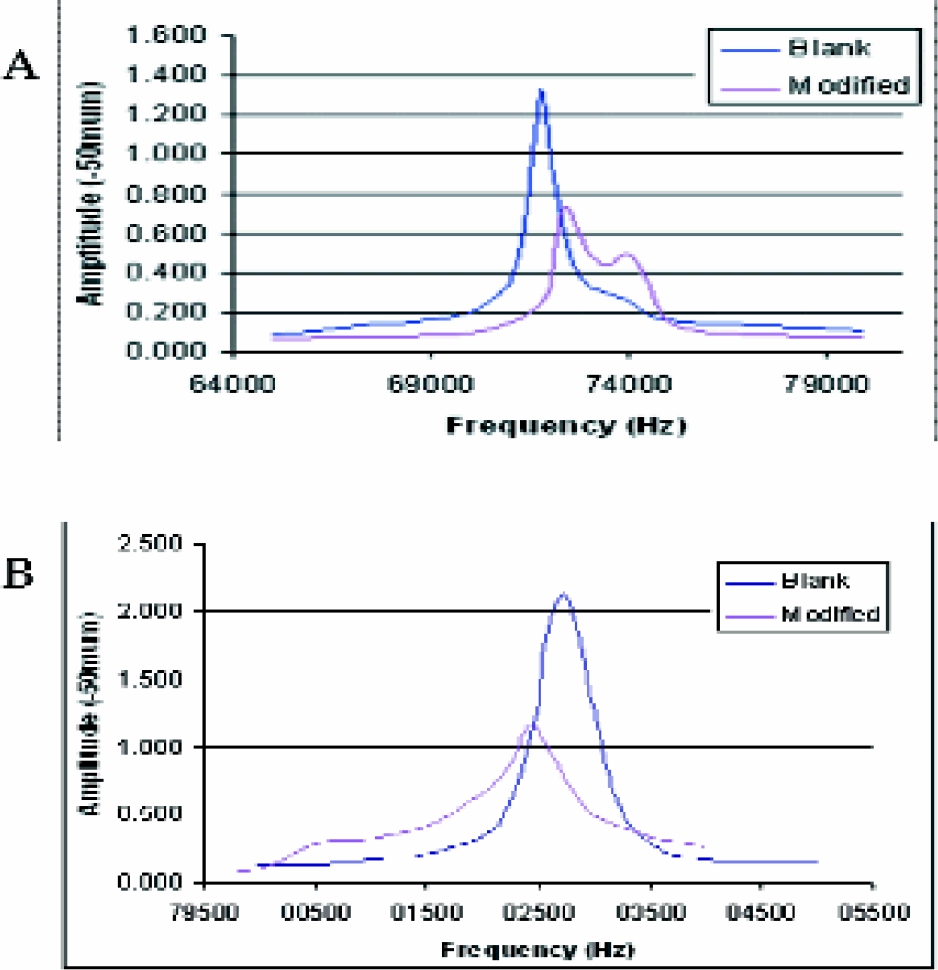
Frequency of response before and after modification (a) aminoethanethiol and (b) dodecanethiol.
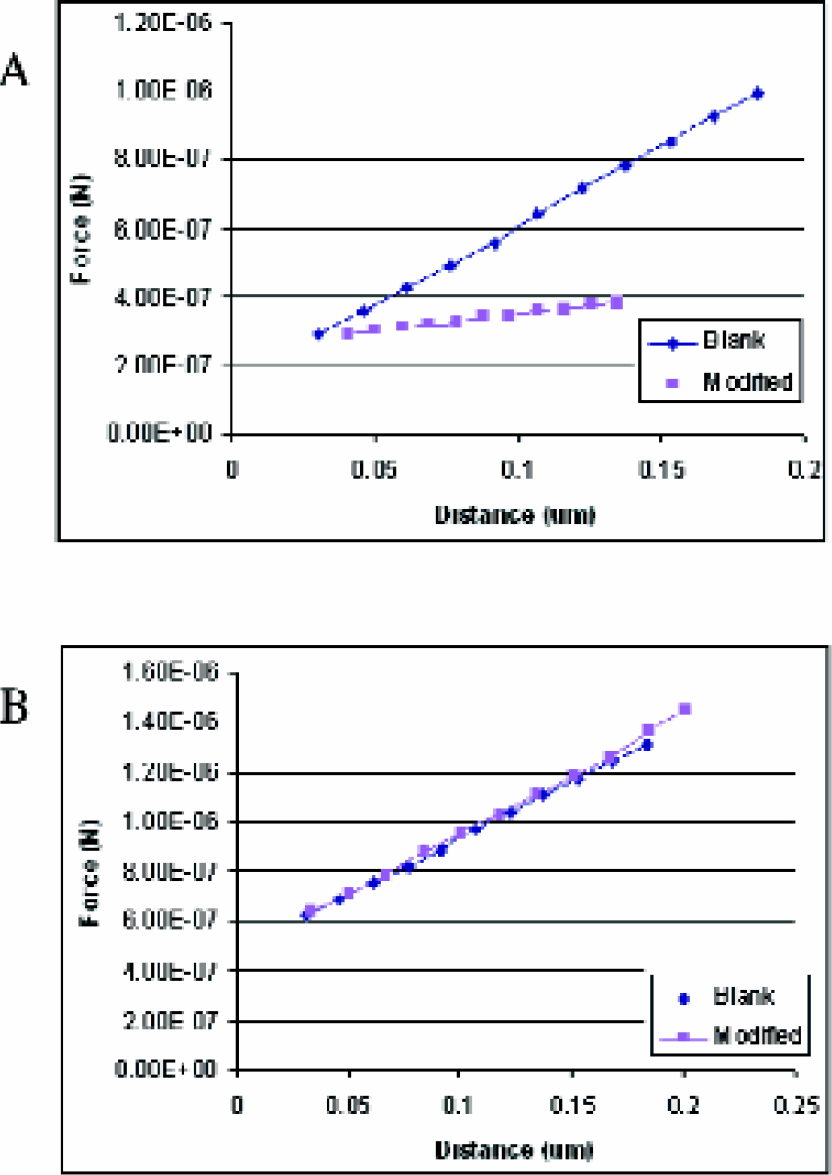
Force versus distance curve (a) aminoethanethiol and (b) dodecanethiol.
Summary and Conclusion
We have developed a finite element computational model for simulating the chemo-mechanical binding of analytes to specific binding molecules on functionalized surfaces. The analyte concentration is uniformly distributed over the reaction surface when the analyte concentration reaches a saturated level. This means that the stable chemo-mechanical binding stress gives rise to a uniform distribution for surface stress which can be utilized for bio-sensing using a cantilevered detection system.
Displacement and uniformly distributed force sensitivity analysis has been carried out to investigate the effects of geometrical factors on the piezoresistive cantilever. Optimization of geometry factors can increase the device sensitivity to the binding and hybridization of biomolecules. Capture area effects are also analyzed. Finally, several novel cantilevers such as variable cross-section cantilevers and SCR modified “C” cantilevers are designed for high piezoresistive sensitivity.
Footnotes
Acknowledgments
We acknowledge support of this work by DOD/DARPA/DMEA under grant number DMEA90-02-2-0216.