



Abstract
BACKGROUND OF DYNACON SYSTEMS
Dynacon was founded over ten years ago and specializes in the aerospace industry with a background in consulting and space projects – an example of this work is the Shuttle Space arm. As a result, they have a detailed understanding of complex control systems and the development of systems with high reliability. The most significant business assets of the company are its accumulation of intellectual property and a highly skilled staff, consisting in part of seven Ph.D.'s, five Master's level engineers and two MBA's.
As an outgrowth in their engineering skills in robotics and camera based controllers, Dynacon has focused on developing products specifically for the Microbiology area of clinical laboratories.
The first prototype of a robotic specimen handling system was developed in 1996/1997 and demonstrated at ASM, the American Society for Microbiology, in 1998. Based on the lessons learned, the system evolved into today's product which is installed in a number of large commercial clinical laboratories in North America.
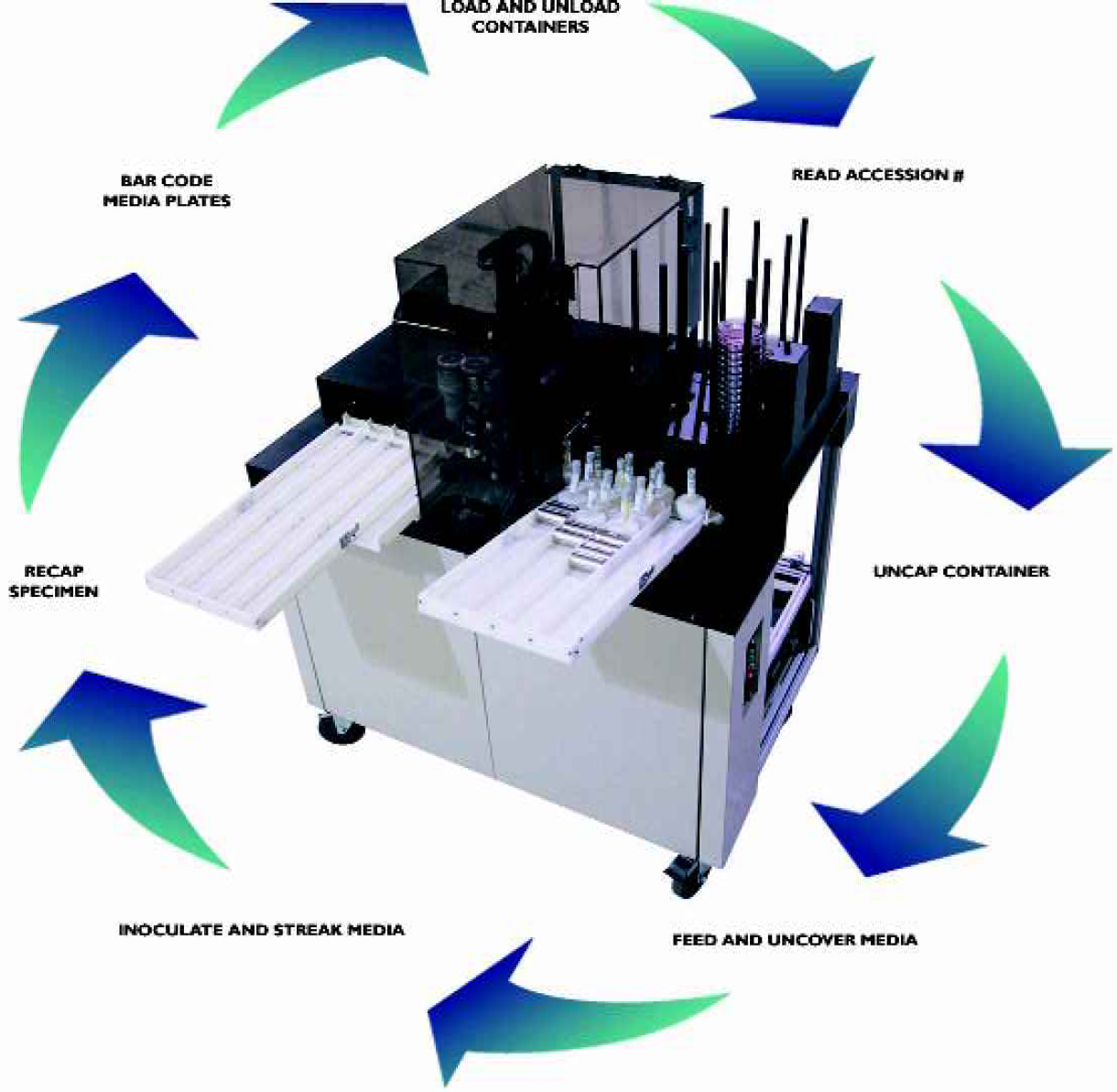
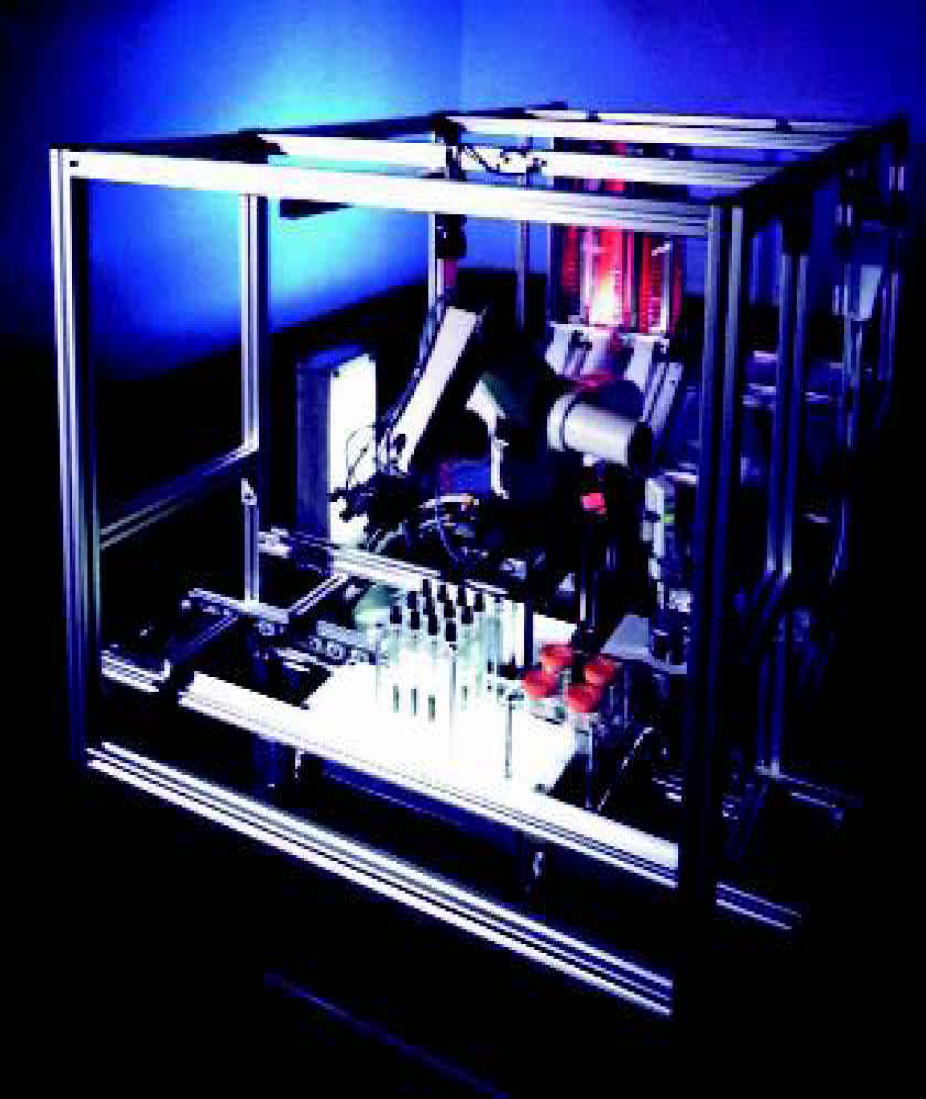
Production version of InocuLab
The system is a fully automated urine specimen media inoculating and streaking system called InocuLab. It is completely hands free, requiring an operator to load and unload the specimen containers and media. InocuLab feeds the containers, removes the cap after reading the barcode label, feeds agar plates, inoculates and streaks them, recaps the specimen and labels the media. The streaking pattern is customer selectable and matches the pattern that lab technologists are familiar with in their current system. InocuLab will process from 80 to 110 urine specimens per hour depending on the number of media plates required.
OVERVIEW OF CURRENT STATUS OF AUTOMATION IN MICROBIOLOGY
In a clinical laboratory, the area included under the umbrella of Microbiology includes the various disciplines of Bacteriology, Mycology, Virology, Parasitology and Mycobacteriology. Few of the tests performed in these areas are automated.
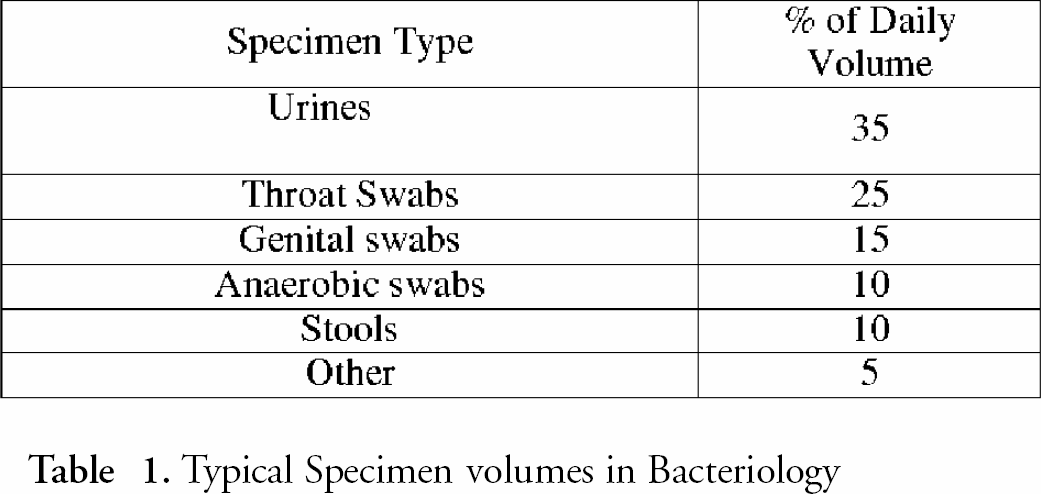
Within the various disciplines of Microbiology, the number of specimens is generally small with the exception of Bacteriology. In a typical commercial laboratory Bacteriology receives the largest volume of two types of specimens, urines and swabs.
Normally these specimens arrive in the laboratory in the late evening, frequently requiring rapid processing into the incubator to meet expected turn around times for results. The most common approach is to manually open the specimen containers and physically inoculate and streak various types of agar plates. There are a small number of installations of mechanical streaking equipment. The streaking operation itself accounts for 15% or less of the labor portion of the “front end” operation. Bar-coding the media plates, opening and closing the containers and inoculating constitute the major portion of the effort.
Typical Specimen volumes in Bacteriology
Typically, after 18 to 24 hours of incubation, the media plates are examined for growth of clinically significant organisms. There is advanced automation available after this stage in the form of susceptibility and identification instruments; Vitek and Microscan are the most common. The completed media are then stored for a period before being discarded.
In summary, the inoculating and streaking of media, which is called the “front end”, is essentially manual. Larger commercial clinical labs will receive anywhere from 1000 to 5000 of these type of specimens on an average night, all of which must be processed by hand. The operation is repetitive, prone to error, causes repetitive strain injuries and has a very high labor cost, especially when compared to the rest of the laboratory. These factors make the operation a very good candidate for automation.
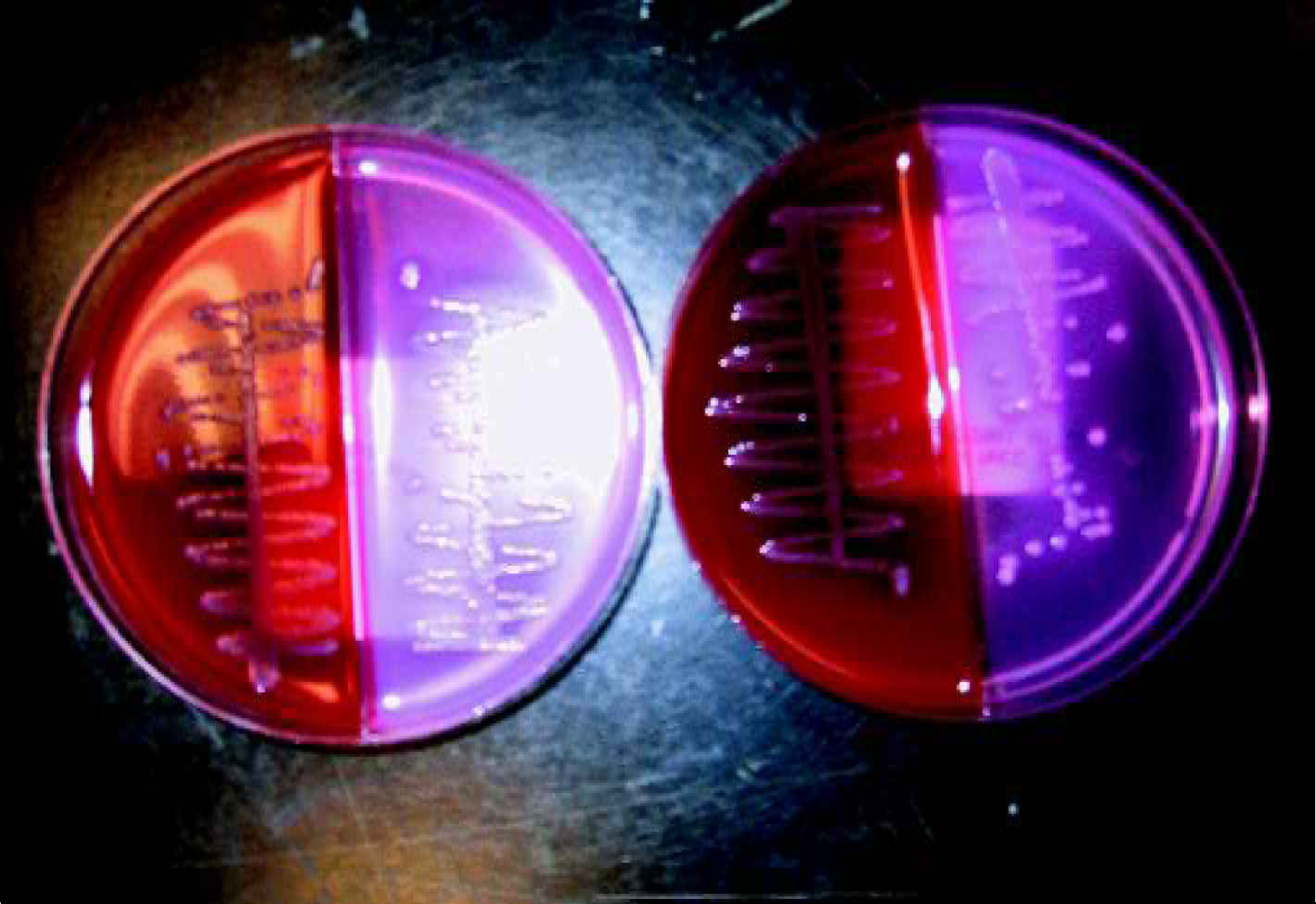
Media bi plates inoculated and streaked by InocuLab
WHY HAS BACTERIOLOGY NOT BEEN AUTOMATED?
The major reason that Microbiology has been left out of the automation cycle is that high volume disciplines of Chemistry and Hematology were the areas focused on by automation companies at the beginning of the Total Lab Automation or TLA concept in the early 1990s. The number of tests conducted in these disciplines is much greater, plus the specimen containers are fairly uniform because of the widespread use of automated analyzers. In addition, the use of these analyzers made the testing itself fairly standardized and the personnel involved knowledgeable and comfortable with automated techniques.
Microbiology, as discussed above, has far less experience in automation. In addition, the testing procedures in the department itself are extremely complex. Specimens arrive in various forms; swabs, fluids, solids, etc., with a variety of container and cap combinations. There is some standardization but it is definitely not universal even within laboratories of the same corporation. Another consideration is that specimens can be processed on many variations of media based on the suspected pathogen – from a biplate to five or six media. The streaking pattern used can also vary, based on the type of specimen and the lab procedures. Automation requires some standardization to work effectively. These factors plus the easier opportunities in the high volume sections of the laboratory resulted in Microbiology being placed at the bottom of the list when automation was originally considered.
THE DYNACON APPROACH
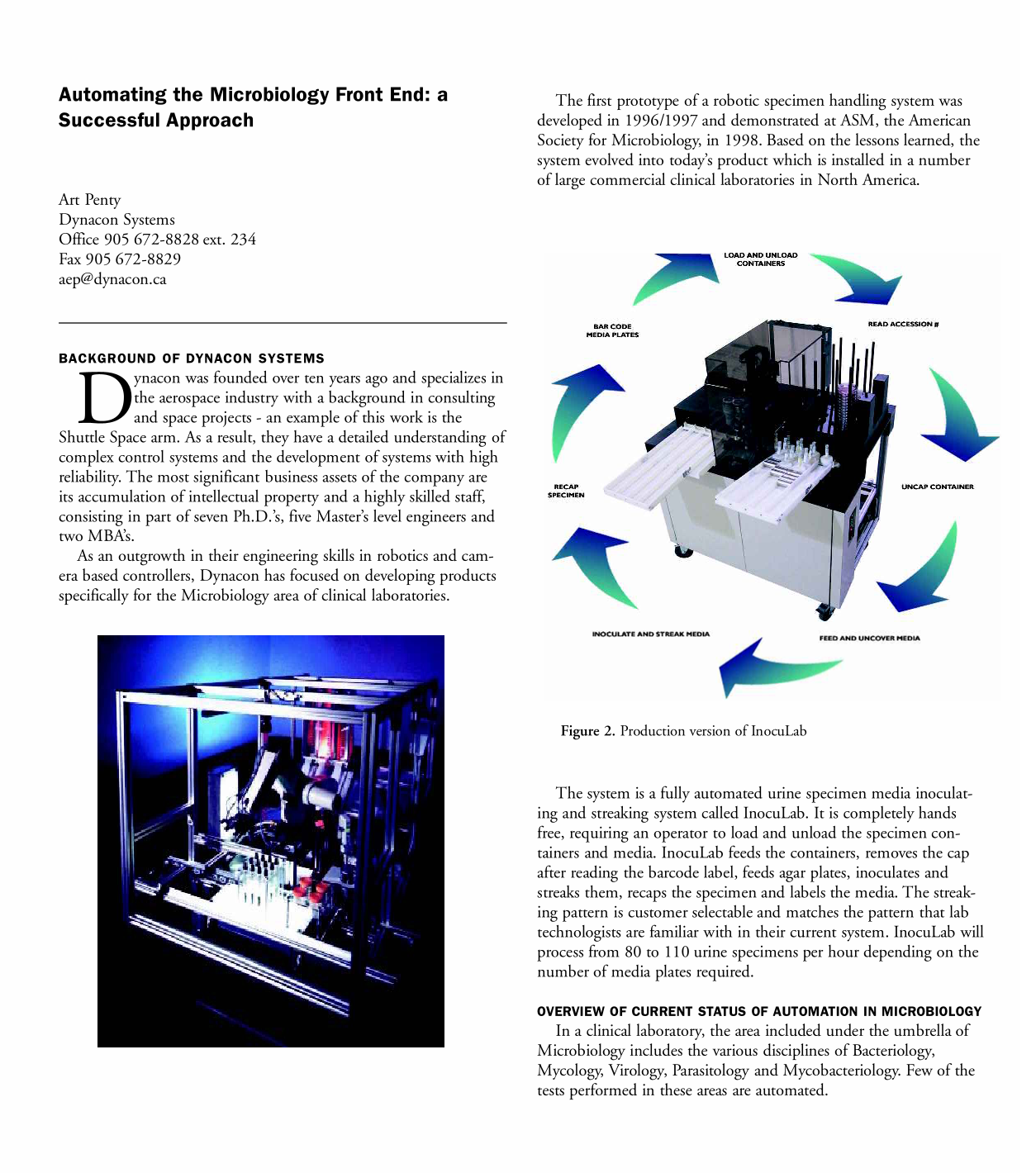
Dynacon was asked to look into this problem by a large Canadian laboratory due to our engineering experience with robotics and camera based controllers. The InocuLab prototype shown in figure 1 used a camera to instruct the robotic system on what type of specimen container was to be processed next. The specimen container for a swab requires two or three types of media to be processed. A urine specimen must be inoculated onto one or two plates. The robotic arm would change grippers automatically to uncap the containers as required, and feed the appropriate agar plates. The camera was also required to position the swab for reinsertion in the container. This itself was a difficult engineering task since the swabs are frequently bent when used by the physician during specimen collection. Overall the prototype worked correctly, but it was very complicated and expensive to build. It was faster and easier to specialize on one specimen type at a time. The first one chosen was urine specimens. The swab unit is under development and will be completed early 2002.
The InocuLab system shown in the schematic figure 4 operates as follows: Urine specimen containers are placed in holders called “pucks” on a conveyer which runs into the enclosed section of the machine. The barcode is read and the Lab Information System (LIS) is optionally queried for the patient name and the validity of the specimen number. The screw cap or rubber stopper is removed and a previously sterilized nichrome loop is inserted into the urine then moved to an agar plate that has been fed and aligned. The medium is first inoculated then streaked. The caps are replaced both on the container and the media plate, the plate is labeled with a barcode, and then stacked in an output column to be manually placed into the incubator.
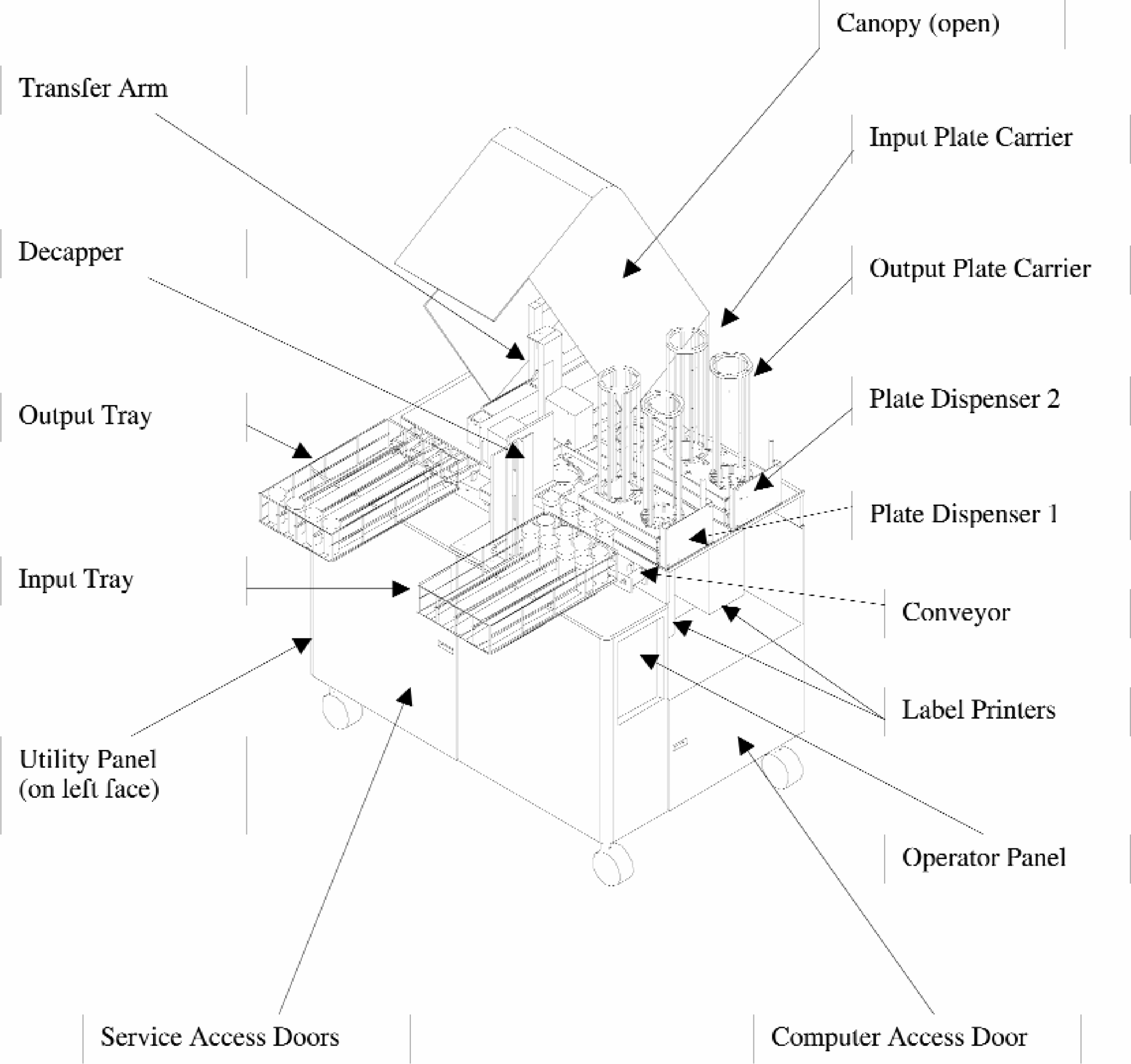
Schematic of InocuLab
One of the critical requirements is the need for numerous sensors to ensure that each step of the operation is working correctly. This proved to be a significant developmental challenge for both the hardware and controller software. For example, the following are some of the sensors active within the system:
A Loop sensor that checks that the shape of the loop is correct and not distorted
Plate sensors that detect that an agar plate has been fed correctly into the dispensing tray
Tab sensors that detect that a plate has been correctly aligned
A Specimen Cap sensor that detects that the cap has been correctly removed and also that it has been replaced after processing.
Print sensors that detect that a label has been printed and that the number printed matches the number read from the specimen container.
Label sensors that detect that the streaked agar plates have a label attached to the bottom of the plate as it is stacked in the output tray.
Conveyor sensors that detect whether there are any specimen containers on the conveyer and that they are in the correct position.
Transfer Arm sensors that ensure that the transfer arm is correctly aligned to place the loop into the specimen container and also into the sterilizer.
A Sterilizer temperature sensor that verifies that the sterilizer is at 800 degrees Fahrenheit.
Each specimen is processed in 40 seconds or less, which is slightly slower than the manual operation, but InocuLab can run continuously all day and it doesn't take lunch breaks or sick days. In addition, the system is walk away, only requiring operator attention every 30 minutes to replenish specimens and media.
RESULTS TO DATE
The system clearly is cost justified in any of the larger laboratories in the world. Payback periods of less than 3 years are normal and an attractive Internal Rate of Return is possible depending on the efficiency of the current operation and the cost of disposable loops; a consumable that is displaced. This does not include the benefit from elimination of overtime to handle peak volumes that occur regularly in a lab and are impossible to predict.
There are a large number of other benefits and savings that accrue from automating the front end of Bacteriology. Repetitive Strain injuries from opening and closing hundreds of containers every day is a significant problem alleviated by automation. In fact, some labs have asked us to apply the uncapping/recapping technology to other areas in the lab because of this issue. Another feature mentioned by lab technologists is that the operation is obviously safer with less exposure to biohazards and the noise associated with working under a biohazard hood. There are savings by eliminating hiring and training costs from staff turnover since the front end is a labour intensive operation.
Mechanically applied streaking patterns are exactly the same on every agar plate. This consistency allow for easier and faster interpretation of organism growth.
There is also evidence of a significant improvement in quality over manual methods. Clinical studies at two labs showed that automation results in zero carryover or cross contamination – both serious concerns in microbiology. In addition, the results have a very high rate of reproducibility: 100% for InocuLab compared to less than 85% for manual. This is a significant difference that will result in a positive impact on patient care. These results are expected to be published next year. They should result in quality of clinical results being recognized as a major reason for automating the front end of this area of the laboratory in the future versus the concentration on labor savings where most front end automation projects focus.
LESSONS LEARNED
First, from a laboratory business perspective, front end automation in Microbiology is a feasible and profitable area to address. Significant Full Time Equivalent (FTE) savings are possible in addition to the many other benefits mentioned previously.
As an engineering challenge, handling Bacteriology specimens is extremely complex, especially when there is a need to pass stringent requirements of zero carryover and exact reproducibility when compared to current methods. Uncapping of specimen containers is relatively straightforward. However, the whole operation of recapping, especially rubber stoppers, was a difficult problem to solve. Another discovery was that most lab supplies such as media plates, specimen containers, and caps have a very wide variation in specification and tolerance: characteristics not conducive to automation. Next, laboratory procedures vary from lab to lab – even within the same corporation. One lab will use one plate, another two, some three, and some four for the same test. Technologists have preferences in streaking patterns. InocuLab had to be able to accommodate all these variations. The engineering required to master these variations all took time to complete but are necessary for the successful automation of the microbiology front end.
The concepts and engineering employed in the current Urine version of InocuLab will work just as well with specimens on swabs, the other high volume test in Microbiology. Different grippers and program logic are required to accommodate the different container but the overall method of streaking and thus the quality of results is essentially the same.
From a Microbiology perspective, the improved quality was the most startling discovery and one that should drive the focus on microbiology automation in the future.