



Abstract
High throughput parallel organic synthesis is now a common practice in discovery chemistry research. Argonaut's modular reaction cassette technology is aimed at parallel synthesis of focused small molecule libraries. The Trident™ automated platform has been designed to perform high throughput organic synthesis using this modular reaction cassette under truly inert conditions and in a robust, reproducible manner. This enables one to generate high quality libraries of small molecules and to access chemistry not normally amenable to automation.
Recently we have introduced a Sample Processing Station (SPS), which enhances the upstream and downstream sample handling capabilities of the Trident™ platform. Enhanced software capabilities also provide the Trident™ synthesizer with powerful reaction development and optimization capabilities. Application of this technology in the synthesis of a small library of 1,2-diarylbenzimidazoles using solution-phase chemistry is presented. A number of product purification and isolation protocols using polymer-bound scavengers are discussed.
INTRODUCTION
The synthesis of focused libraries mostly involves multistep, complex chemistries. The major limitation to automate these syntheses is the requirement of a flexible reaction platform that is capable of handling demanding reaction conditions. The Trident system has been designed to address these issues. The synthesizer has the flexibility to perform high throughput organic synthesis under inert conditions and a wide temperature range in a robust, reproducible manner. We describe herein a multistep solution-phase synthesis of 1,2-diarylbenzimidazoloes on the Trident system that involved purification and isolation of the products of each individual steps.
The 1,2-diarylbenzimidazole scaffold was selected as a target, as it is related to 1-arylbenzimidazoles, which are a pharmacologically active class of compounds. 1 The synthesis of a focused library of 1,2-diarylbenzimidazoles was investigated using a four-step reaction sequence performed on a Trident Automated Synthesizer. The Trident Sample Processing Station (SPS) was used to purify the products.
The synthetic route chosen to prepare benzimidazoles involved:
nucleophilic aromatic substitution (SNAr) of o-haloni-troarenes with aniline derivatives;
stannous chloride reduction of the nitro group;
carbodiimide-mediated acylation of the primary amine;
cyclization to the benzimidazole.
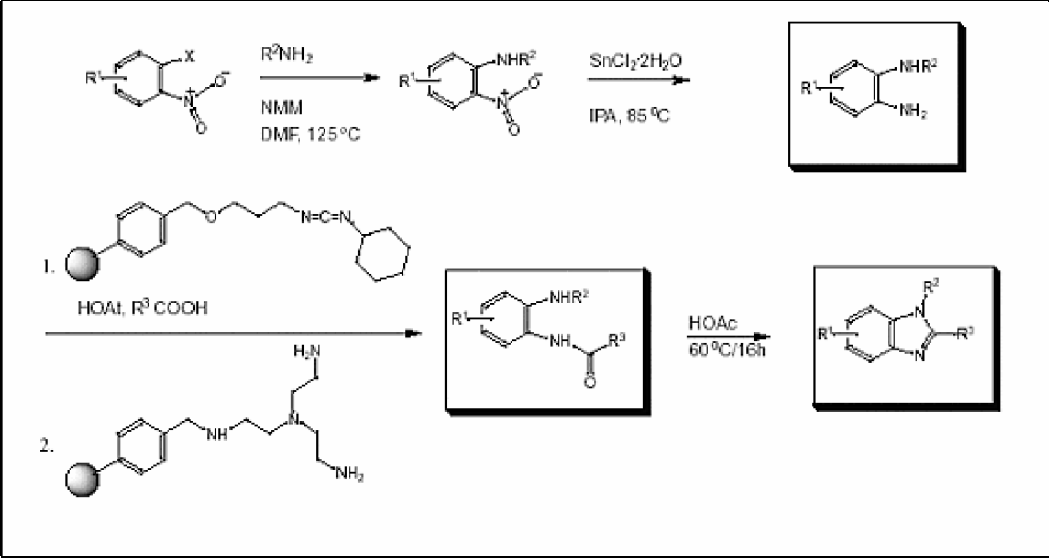
The reaction sequence.
This route provided three elements of diversity, including the nitroarene (benzene or pyridine nucleus), aryl well-suited for automated synthesis of this multistep sequence due to the following capabilities:
Inert reaction environment
Accurate reagent deliveries
Maintenance of reflux temperature for extended periods
Automated liquid-liquid extraction
Automation of scavenger resin use
Automated solid phase extraction
LIBRARY PLAN
A library of 96 benzimidazoles was synthesized using a 2 × 8 × 6 matrix of nitroarenes, aryl amines, and carboxylic acids (
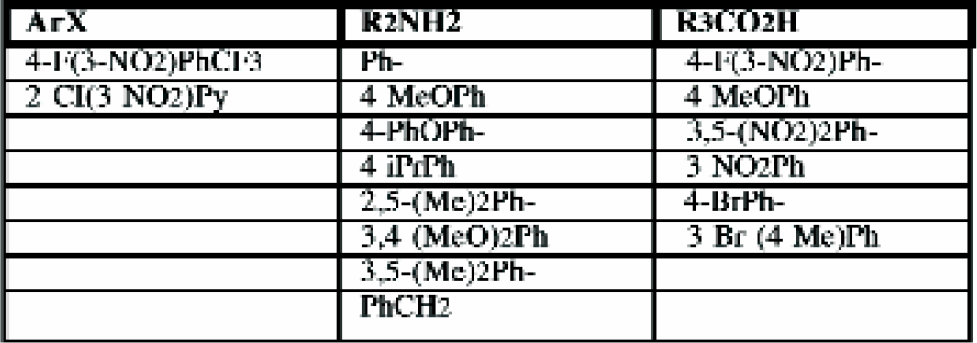
RESULTS AND DISCUSSION
The generation of the 96 compound library of 1,2-diarylbenzimidazoles involved a four-step synthesis using a variety of reaction types and purification procedures. The synthetic scheme was developed using a Quest 210 synthesizer (Figure 2). 3

Quest 210.
Although this type of sequence is challenging for automated synthesis, the Trident Automated Synthesizer and the Sample Processing Station (Figure 3) automated the majority of the process, most notably tedious reagent delivery and purification steps. Manual intervention was limited to instrument setup, Reaction Cassette™ transfer between modules, transfer of racks to the concentrator, and weighing.

The Trident Product Family.
Nucleophilic aromatic substitution of halonitroarenes with aryl amines was performed using N-methylmorpholine (NMM) as a base in DMF at 125°C for 16 h. A slight excess (20%) of aryl amine was used relative to the aryl halide. Liquid-liquid extraction with aqueous acid removed the unreacted aryl amine DMF and NMM, without extracting the product due to the presence of the o-nitro group. Dichloromethane (DCM): Methyl t-butyl ether (MTBE) (1:3) was used as the organic layer. MTBE was used instead of ethyl ether for liquid-liquid extraction because of its lower volatility. The products were isolated in high yield and in > 95% purity for most aryl halide-amine partners.
The nitro reduction step was performed with stannous chloride in isopropanol. The reactions were heated at the boiling point of isopropanol for 16 h without solvent loss, demonstrating the excellent sealing characteristics of the Trident cassette. The reactions were quenched by collecting the reaction mixtures in scintillation vials and adding aqueous sodium carbonate in two aliquots to control the carbon dioxide out-gassing. Due to copious precipitate formation in the aqueous layer, the organic layer was aspirated from the bilayer and transferred to tubes for liquid-liquid extraction. SPE with Florisil® afforded diamines in high purity and modest yield for most substrates. The use of Florisil cartridges was accompanied by some product loss, since a single automated elution protocol was employed for the complete reaction set and was not optimum for all compounds. The effective automated workup and purification of a stannous chloride reduction by the Trident Sample Processing Station is noteworthy in light of the issues associated with quenching the excess stannous chloride (3.5 equiv) and removing tin byproducts.
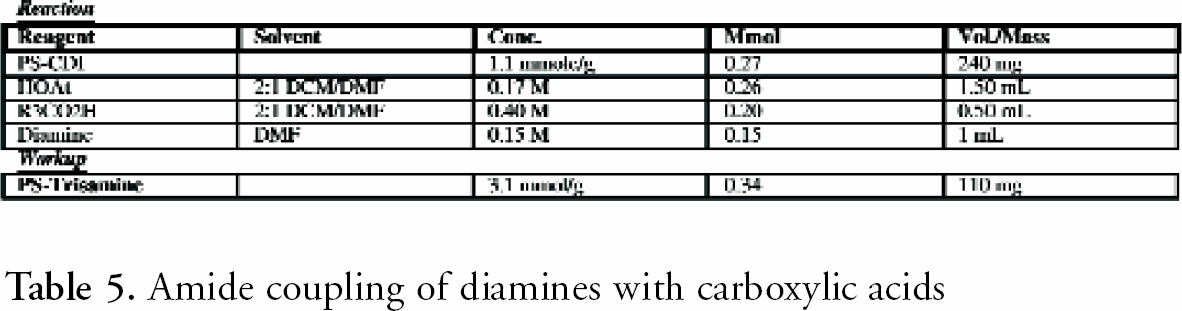
With purified diamines in hand, selective conversion to monoamides was required. After surveying a number of coupling conditions on the Quest 210 it was determined that the use of a resin-bound carbodiimide, (PS-Carbodiimide), with 1-hydroxy − 7-azabenzotriazole, (HOAt), afforded selective conversion to the desired amino-amide. This approach was attractive as it allowed for the use of readily available carboxylic acid, rather than acid chlorides, imidate or thioimidate derivatives. For the library synthesis, the diamines were dispensed as 0.15 M DMF solutions to two reaction cassettes containing the PS-Carbodiimide, carboxylic acid and HOAt. Since the diamines were isolated and weighed after nitro reduction, the 0.15 M solution of diamines could be accurately prepared and split into reaction vessels for amide formation. This allowed proper control of the stoichiometry to assure selective formation of the mono-amide amine. The reactions were purified using a scavenger resin, PS-Trisamine, to remove HOAt. The final step was effected by heating an acetic acid solution of the aminoamides at 60°C for 16 h. After evaporation of acetic acid in vacuo, the 96 benzimidazole products were isolated by SPE through Florisil columns, followed by concentration. This afforded the benzimidazoles in high purity and modest yield for most substrates.
The results for all steps involved in preparing the focused library of 96 1,2-diarylbenzimidazoles are summarized in Table 2. The Trident Automated Synthesizer effectively executed the required precise control of the reagent stoichiometry, specifically for the SNAr reaction and amide formation. Several of the steps involved extended heating with aggressive reagents and solvents, demonstrating the robustness of the Reaction Cassette. Workup and purification were performed in parallel with the Trident SPS, including liquid-liquid extraction, solid phase extraction, scavenger resins, and precipitation. The successful execution of this multistep synthesis of a focussed library of highly pure 1,2-diarylbenzimidazoles exemplifies the capability of the Trident automated Synthesizer and Trident SPS to perform parallel solution phase synthesis with a high level of automation.


EXPERIMENTAL
Figure 4 shows the instrumental workflow used in this multistep synthesis.

Workflow.
SYNTHESIS OF O-NITROARYL AMINES BY NUCLEOPHILIC AROMATIC SUBSTITUTION
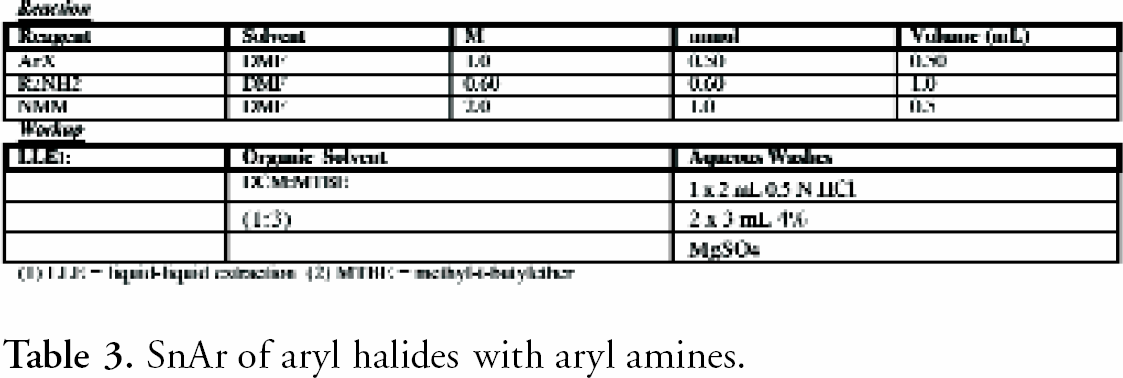
The concentration and delivery volumes of the reagents are given in Table 3. Solutions of activated aryl halide and amines were placed on the autosampler and delivered to two Trident Reaction Cassettes, followed by NMM from a common reagent position. The reaction mixtures were heated to 125 °C for 16 h. After cooling to room temperature, the Trident cassettes were moved to the Trident SPS. The products were transferred from the cassette to 15 mL tubes and the reaction vessels were rinsed with 1 mL of DCM followed by 3 mL of MTBE. The organic layer was worked up by liquid-liquid extraction according to Table 3. The organic layer was concentrated to dryness in tared reaction vessels on a Savant SpeedVac to afford the product nitroaryl amines. The reaction vessels were weighed to determine yield, analyzed by GC, loaded in the reaction cassette and returned to the Trident Synthesizer for the reduction step.
SnAr of aryl halides with aryl amines.

SYNTHESIS OF DIAMINES BY NITRO REDUCTION
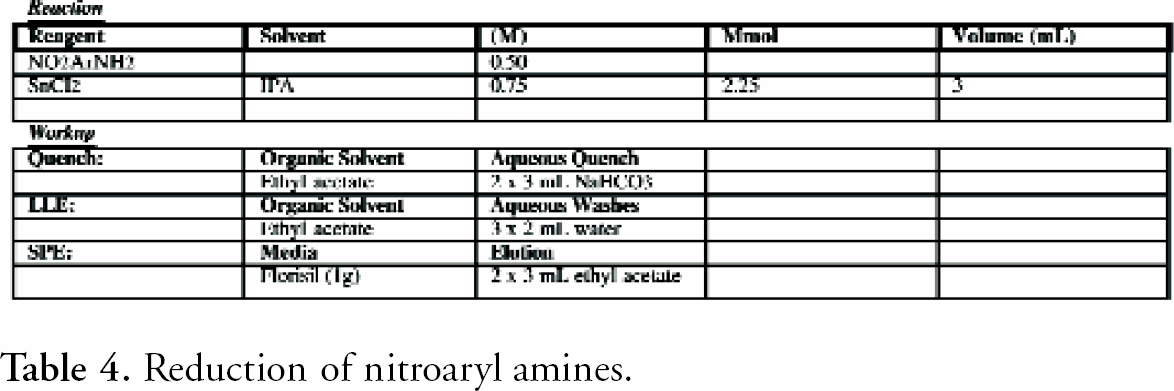
An isopropanol solution of stannous chloride (4.5 equiv) was added to the nitroaryl amines in the reaction cassettes (Table 4). The reactions were heated at 85 °C for 16 h and cooled to room temperature. The reaction mixtures were collected on the Trident SPS in scintillation vials using 2 × 1.5 mL ethyl acetate rinses. The collected solutions were quenched by adding aqueous sodium bicarbonate. The vigor of carbon dioxide out-gassing dictated the addition of the sodium bicarbonate in two portions. The precipitates were allowed to settle and the organic layers, plus approximately 0.7 mL of the aqueous layer, were transferred to liquid liquid extraction tubes using the decant function. The organic layers were further purified by liquid-liquid concentration and weighed to determine the yield for the reduction step.
Reduction of nitroaryl amines.

AMIDE COUPLING
PS-Carbodiimide (1.8 equiv), HOAt (1.7 equiv), and the 6 carboxylic acids (1.3 equiv) were added to the cassettes and agitated for 5 min (
Amide coupling of diamines with carboxylic acids

CYCLIZATION
Glacial acetic acid (2.0 mL) was added to the 96 acylated diamines and the reactions were heated at 60 °C for 16 h. The reaction mixtures were collected using 2 × 2 mL dichloromethane and 1 × 2 mL ethyl acetate washes. The samples were concentrated, dissolved in 1 mL DCM and loaded on a 1g Florisil SPE cartridge. The products were eluted with 3 × 2 mL of dichloromethane into tarred scintillation vials. The samples were concentrated and weighed to determine the yield of 1,2-diarylbenzimidazoles.