



Abstract
In biotechnology there are several basic ways of obtaining separation. One is centrifugation, providing separation based on mass. Another is filtration, providing separation by size. A third is by magnetic flux. Of these, magnetism offers the simplest method for high throughput automation. Centrifugation is essentially an off-line batch process. Filtration is more amenable to inline automation, although complexity is introduced by having to apply and break a vacuum. The cost of filter plates is also a consideration.
Magnetic particles provide an economical alternative for many protocols. Paramagnetic particles are provided by a number of suppliers, with different properties for various applications. Reagent manufacturers apply surface treatments and coatings for specific assay protocols. Most, if not all, are heterogeneous in nature with the reactions taking place on the surface of the particles. A magnetic field congregates the particles allowing excess reactants to be removed. The magnetic field is removed and the free particles may be washed or reacted with another reagent.
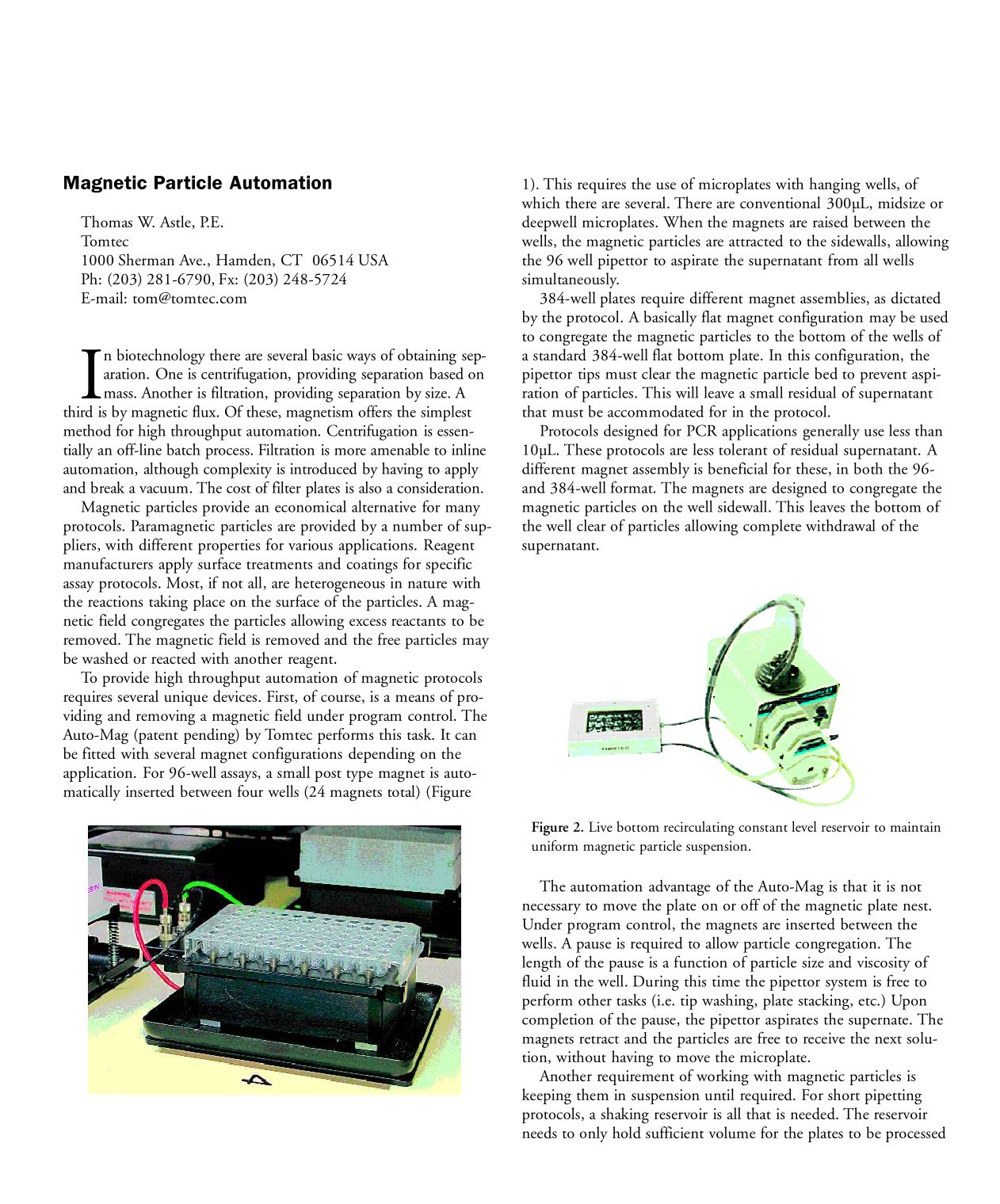
To provide high throughput automation of magnetic protocols requires several unique devices. First, of course, is a means of providing and removing a magnetic field under program control. The Auto-Mag (patent pending) by Tomtec performs this task. It can be fitted with several magnet configurations depending on the application. For 96-well assays, a small post type magnet is automatically inserted between four wells (24 magnets total) (Figure 1). This requires the use of microplates with hanging wells, of which there are several. There are conventional 300μL, midsize or deepwell microplates. When the magnets are raised between the wells, the magnetic particles are attracted to the sidewalls, allowing the 96 well pipettor to aspirate the supernatant from all wells simultaneously.
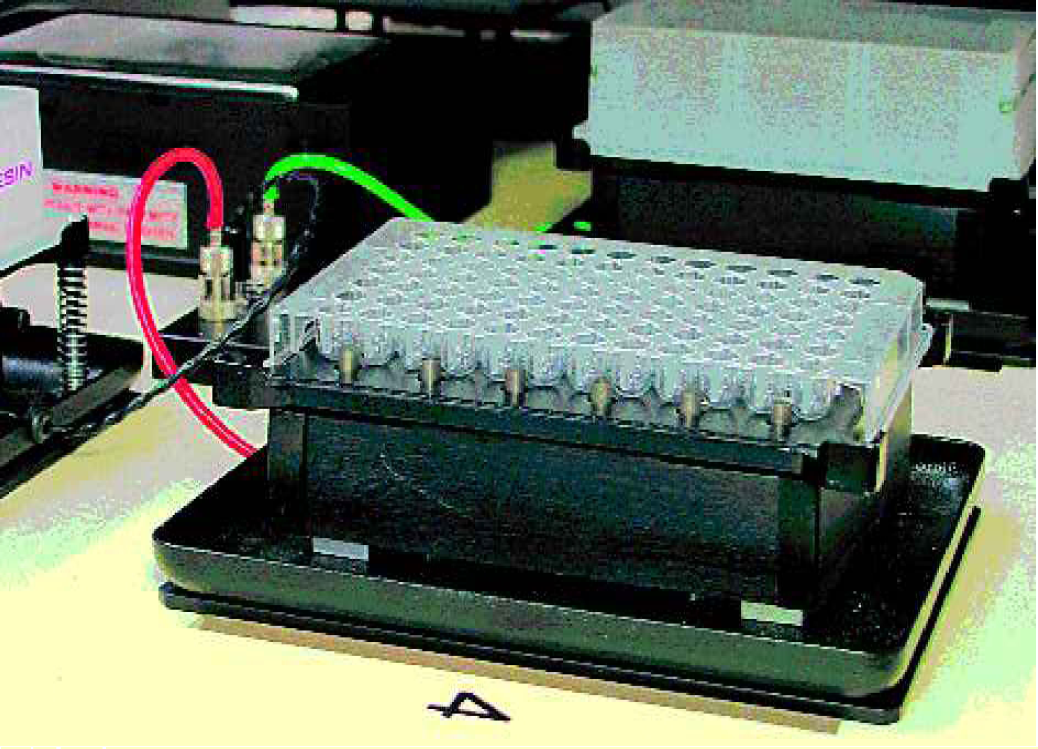
384-well plates require different magnet assemblies, as dictated by the protocol. A basically flat magnet configuration may be used to congregate the magnetic particles to the bottom of the wells of a standard 384-well flat bottom plate. In this configuration, the pipettor tips must clear the magnetic particle bed to prevent aspiration of particles. This will leave a small residual of supernatant that must be accommodated for in the protocol.
Protocols designed for PCR applications generally use less than 10μL. These protocols are less tolerant of residual supernatant. A different magnet assembly is beneficial for these, in both the 96-and 384-well format. The magnets are designed to congregate the magnetic particles on the well sidewall. This leaves the bottom of the well clear of particles allowing complete withdrawal of the supernatant.
The automation advantage of the Auto-Mag is that it is not necessary to move the plate on or off of the magnetic plate nest. Under program control, the magnets are inserted between the wells. A pause is required to allow particle congregation. The length of the pause is a function of particle size and viscosity of fluid in the well. During this time the pipettor system is free to perform other tasks (i.e. tip washing, plate stacking, etc.) Upon completion of the pause, the pipettor aspirates the supernate. The magnets retract and the particles are free to receive the next solution, without having to move the microplate.
Another requirement of working with magnetic particles is keeping them in suspension until required. For short pipetting protocols, a shaking reservoir is all that is needed. The reservoir needs to only hold sufficient volume for the plates to be processed in that run. For longer runs, a new “live bottom” (Tomtec) (Figure 2) reservoir will keep a uniform suspension of particles available for the pipettor all day long. The design utilizes an external reservoir source and a peristaltic pump to feed a constant level reservoir on the pipettor. The reservoir design itself is unique (patent pending) to maintain a live bottom. The result is a uniform suspension of particles throughout the area of the reservoir with no dead spots. This assures that all 96 or 384 pipette tips will aspirate and dispense a uniform quantity of particles to all wells. This is of particular importance since the assay is being performed on the surface of the magnetic particles. A varying quantity of particles, well to well, would have an adverse affect on the assay protocol.
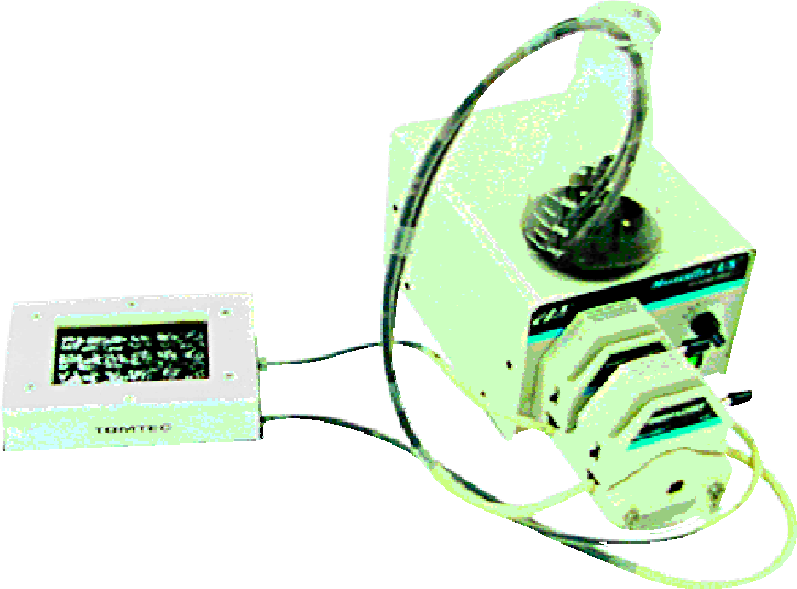
Live bottom recirculating constant level reservoir to maintain uniform magnetic particle suspension.
Magnetic particle assays are heterogeneous, requiring not only multiple steps but in some cases multiple microplates. An example is a plasmid purification protocol. It requires a deepwell cell plate, a clearing plate, a binding plate and an elution plate. In addition to the four microplates there are seven different reagents in reservoirs. This complex protocol was accommodated with a Quadra-Plus (Tomtec).
The Quadra-Plus has eight stations on the moving shuttle (Figure 3). There are infeed and outfeed cassette type stackers on both sides. The twenty-five plate cassettes can be extended to provide fifty plate capacity. They also can infeed and outfeed reservoirs to and from the shuttle. The various plates were stacked in order of use. This, combined with the ability to restack to provide first in first out (FIFO) operation, permits this complex assay to be processed automatically from one push of the start button.
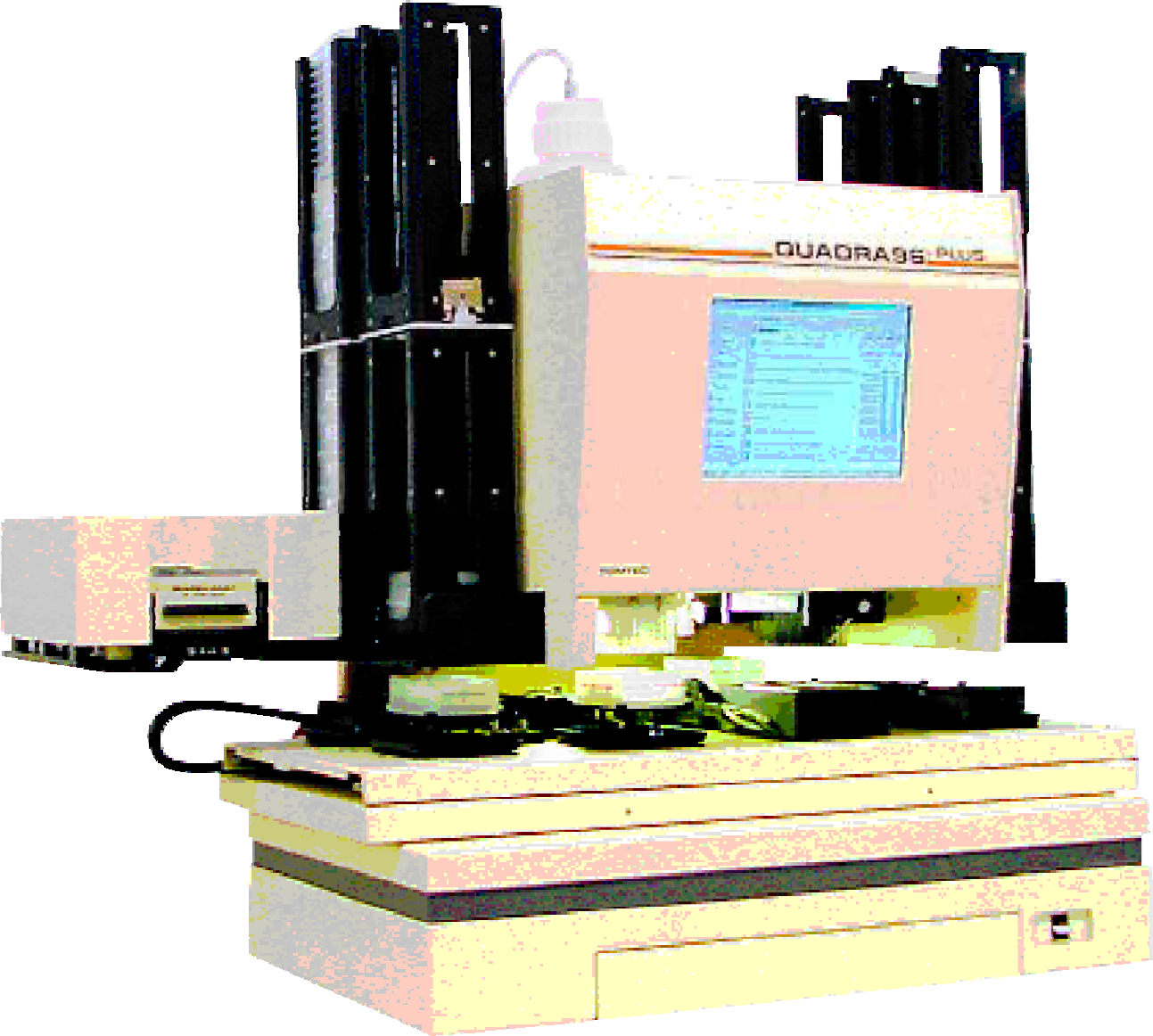
Quadra-Plus multipurpose pipetting workstation for complex heterogeneous assay automation.
In many heterogeneous assays there is an incubation period or time delay required between components. This may be on the order of a few minutes (3–5) or longer (30–60.) For consistent results it is necessary to hold these time lines. This can create scheduling conflicts since it requires batch type processing. The number of plates that can be processed per batch is the longest plate processing sequence divided into the shortest incubation time. If it requires two minutes to add the first set of reagents, and a four minute incubation is required before the next reagent addition, the batch size can only be two plates at a time. If the incubation period is thirty minutes then fifteen plates can be processed before it is necessary to return to the first plate. If the time of incubation is only a minimum time requirement, without a maximum time limit, this batch type restriction does not apply.
The multiple shuttle stations on the Quadra-Plus accommodate the short incubation periods very easily. One or more plates can be placed on the shuttle at a time and moved in sequence to the pipettor. The ability of the stackers to offload from the shuttle and restack facilitates the longer incubation times.
In summary, the objective of this paper is to describe the ease of full automation utilizing magnetic particles as the separation vehicle. With the development of specialized components and pipetting workstations, the economy of magnetic assays may be passed to the end user.