



Abstract
In response to the ever-increasing demand for microplates that facilitate assay miniaturization without compromising assay integrity, Corning's new 384 well Low Volume (384 LV) microplates were evaluated using a homogenous, fluorescence polarization protease assay. Fluorescently labeled casein substrate was incubated over time with dilutions of protease at working volumes that range from 1 to 20 μL and reagent concentrations that range from 0.125 to 50 pg/μL. Four types of plates were evaluated:
Corning 384 well LV black medium bind Corning 384 well LV black non-binding surface (NBS™) Corning 1536 well black medium bind Competitor 384 well small volume
Protease activity was detected as a decrease in polarized fluorescence resulting from substrate degradation over time. Following assay miniaturization to 20 μL working volumes and protease concentration reduction from 25 to 0.25 pg/μL, Corning 384 well LV medium bind and NBS coated assay plates maintained superior signal to noise ratios compared to competitor's 384 well small volume assay plates. At even lower 10 μL working volumes, Corning 384 well LV medium bind assay plates maintained signal to noise ratios comparable to the competitor's assay plates. However as the reagent concentrations were further reduced to 2.5 pg/μL, Corning 384 well LV medium bind and NBS coated assay plates had significantly greater signal to noise ratios compared to the competitor's assay plates. As working volumes were reduced even further to 5 μL and 1 μL, Corning 384 well LV medium bind and NBS coated assay plates had significantly greater signal to noise ratios than the competitor's 384 well small volume assay plates. Furthermore, at 1 μL working volumes, Corning 384 well LV NBS coated assay plates had significantly greater signal to noise ratios than the competitor's assay plates and standard 1536 well assay plates.
These results suggest that Corning 384 well LV medium bind and NBS coated assay plates facilitate assay miniaturization while maintaining assay integrity. Furthermore, as working volumes were significantly reduced to those typically found in 1536 deep well and standard 1536 well assay plates (5 and 1 μL, respectively), Corning's 384 well LV NBS coated assay plates provided superior assay performance.
INTRODUCTION
The trend towards assay miniaturization for high-throughput and ultra-high-throughput screening continues to spur development of homogeneous, fluorescence-based assays in higher density, smaller volume microplate formats. 1 Fluorescence techniques are well suited to high-throughput as they provide increased sensitivity, which allows for assay miniaturization. Assay miniaturization reduces the amount of biological and chemical reagents used per assay and better supports the high-throughput screening industry by reducing costs. However, low signal to noise ratios resulting from assay miniaturization may result in the loss of potential drug candidates during compound screenings, thus negatively impacting the development of delivery of drugs to market.
Fluorescent techniques, such as fluorescence polarization (FP), are among the most widely used detection approaches for high-throughput screening given the industry-wide drive to simplify, miniaturize, and harness the discovery potential of large numbers of compounds efficiently, both by reducing time and cost, and increasing information content. 2 FP assays are highly sensitive and allow one to measure changes in the rotational diffusion coefficient of labeled probes upon binding to substrate molecules and conformational changes in structure. 3
In response to the ever-increasing demand for microplates that facilitate assay miniaturization without compromising assay integrity, Corning now offers its 384 well Low Volume (384 well LV) microplates with their unique square to round well geometry. These plates are available with a choice of two surfaces: the standard medium bind (MB) surface and an enhanced non-binding surface (NBS™) that enables superior performance in miniaturized assays. Corning's patented NBS technology reduces non-specific binding of molecules to the inside surface of the wells, thus maintaining them in solution and enhancing assay performance, as reagent concentrations and working volumes are reduced.
Corning conducted a series of experiments to evaluate these microplates with both different reagent concentrations and assay working volumes. We chose an enzymatic FP assay for these experiments, in which a fluorescently labeled substrate molecule is degraded over time by a protease enzyme. This causes changes in the substrate's molecular rotation that is then reflected by a reduction in FP signal.
MATERIALS AND METHODS
For FP assays, 1X digestion buffer and BODIPY FL casein substrate were diluted according to manufacturer instructions (Molecular Probes, Cat. No. E-6658) and dispensed into the wells of Corning 384 well LV black opaque MB (Cat. No. 3677) and Corning 384 well LV black opaque NBS coated (Cat. No. 3676), competitor 384 well small volume black opaque MB, and Corning 1536 well black opaque MB assay plates (Cat No. 3951) at a final substrate concentration of 100 pg/μL for 10, 5, and 1 μL working volumes. The final substrate concentration for 20 μL working volumes was 10 ng/μL. Dilutions (weight/volume) of Streptomyces griseus protease (Sigma® Cat. No. P-6911) in 1X digestion buffer were added to all but control wells at varying concentrations (50 pg/μL, 25 pg/μL, 2.5 pg/μL, 0.25 pg/μL, 0.125 pg/μL). Protease activity was detected in millipolarization units (mP) using the standard fluorescence polarization protocol in an LJL BioSystems Analyst™ (384 LV plates) and LJL BioSystems Acquest™ (1536 well plates), (Molecular Devices, Sunnyvale, CA) as follows: lamp = continuous, z-height = 1 mm, units = cps, attenuator mode = out, integration time = 100,000 μs, excitation filter = fluorescein 485 nm, emission filter = 530 nm, measurement type = comparator, sensitivity = 2, plate settling time = 150 ms, dynamic polarizer = emission, static polarizer = S, polarizer settling time = 30 ms. Detection instrument was programmed with appropriate plate dimensions for all plates. Corning 384 well Low Volume Plate Dimensions (in mm): length = 127.76, width = 85.47, rows = 16, columns = 24, well depth = 6.58, height = 14.22, row off-set = 8.96, column off-set = 12.11, row spacing = 4.5, column spacing 4.5.
RESULTS
Results from this FP assay for protease activity demonstrate, at 20 μL working volumes, Corning 384 well LV MB and NBS coated assay plates have significantly reduced FP signal (mP) compared to the competitor's plates. This indicates significant enzymatic degradation of the fluorescently labeled substrate by the protease, at each protease concentration tested, at 10 minutes (Figure 1). Similar results were observed at 30 and 60 minutes (data not shown). This suggests that both Corning 384 well LV MB and NBS assay plates maintain assay integrity during working volume reduction to 20 μL as well as reagent concentration reduction from 25 to 0.25 pg/μL.
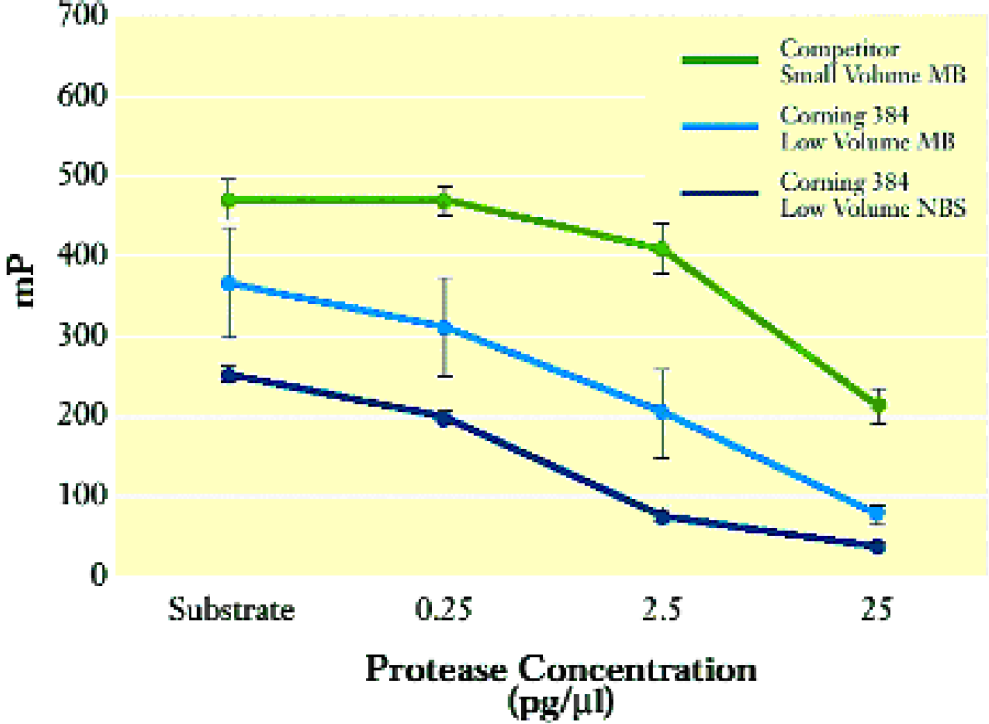
Dilutions of Streptomyces griseus protease was incubated with 10 ng/μl of BODIPY FL casein substrate for 10 minutes at room temperature in 20 μl volumes. Protease activity was detected by an LJL BioSystems Analyst™ as a reduction in mP units over time
When working at either 50 pg/μL or 2.5 pg/μL protease concentrations in 10 μL working volumes, Corning 384 well LV MB assay plates are comparable to the competitor's small volume plates (Figure 2). However, Corning 384 well LV NBS coated assay plates have significantly greater signal to noise ratios than the competitor's plates under these conditions. This indicates that the NBS plates have performance capabilities for working with very low reagent concentrations that the other plates were unable to match.
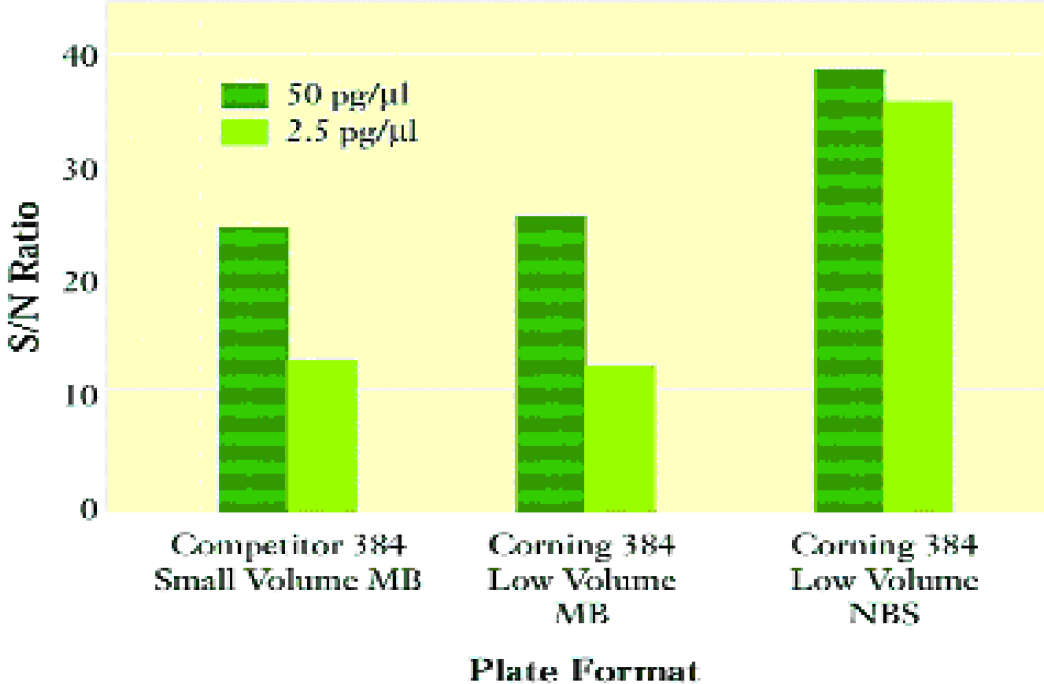
50 pg/μl and 2.5 pg/μl of Streptomyces griseus protease was incubated with 100 pg/μl of BODIPY FL casein substrate in 10 μl volumes for 10 minutes at room temperature. Protease activity was detected by an LJL BioSystems Analyst™ as a reduction in mP units over time. Signal-to-noise ratios represent ÄmP/average standard deviation.
When working at 0.125 pg/μL protease concentrations in 5 μL working volumes, the Corning 384 well LV MB and LV NBS coated assay plates have significantly greater signal to noise ratios than the competitor's plates under these conditions (Figure 3). This indicates that both of the Corning LV plates are superior for working with very low reagent concentrations at volumes (5 μL/well) comparable to those found in 1536 deep well plates.

0.125 pg/μl of Streptomyces griseus protease was incubated with 100 pg/μl of BODIPY FL casein substrate in 5 μl volumes for 10 minutes at room temperature. Protease activity was detected by an LJL BioSystems Analyst™ as a reduction in mP units over time. Signal-to-noise ratios represent ÄmP/average standard deviation.
At working volumes of 1 μL and protease concentrations of 0.125 pg/μL, signal to noise ratios generated from this FP assay were significantly greater at 10 minutes in Corning 384 well LV NBS coated assay plates than Corning 1536 well MB assay plates or the competitor's 384 well small volume MB assay plates (Figure 4). This suggests that the round bottom shape and NBS coated surface of the 384 well LV assay plates are the basis for the superior performance of these plates that outperforms both the competitor's 384 well small volume and Corning's 1536 well assay plates.
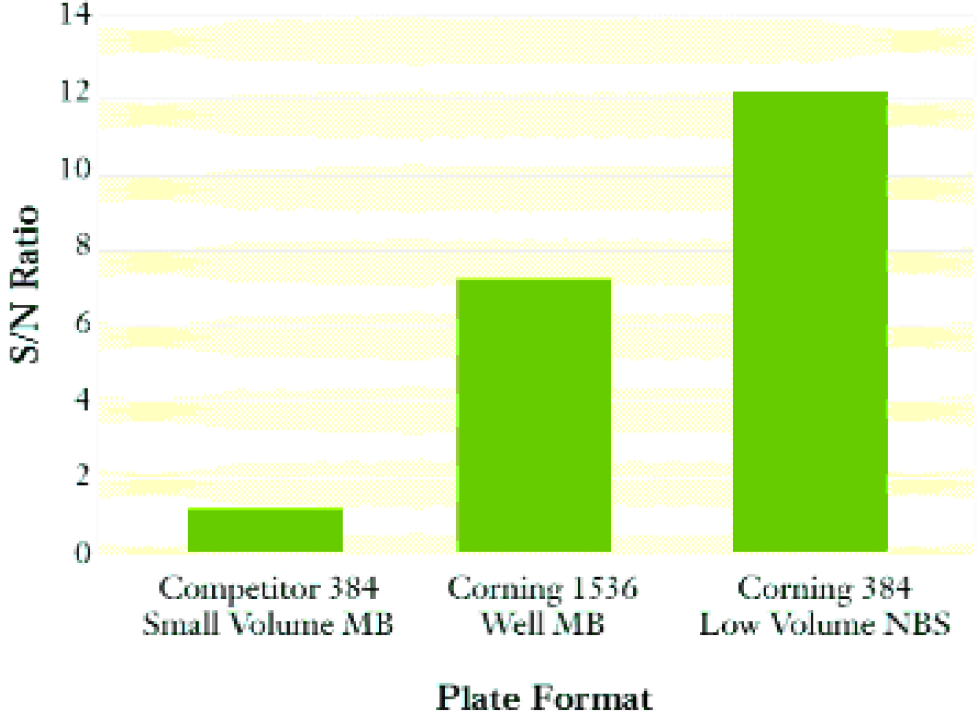
0.125 pg/μl of Streptomyces griseus protease was incubated with 100 pg/μl of BODIPY FL casein substrate in 1 μl volumes for 10 minutes at room temperature. Protease activity was detected by an LJL BioSystems Analyst and LJL BioSystems Acquest™ as a reduction in mP units over time. Signal-to-noise ratios represent ÄmP/average standard deviation.
CONCLUSIONS
These experiments demonstrate:
Corning 384 well LV MB and NBS coated assay plates provide superior assay performance while working in low volumes (5 to 20 μL), as well as low reagent concentrations.
Corning 384 well LV MB and NBS coated assay plates provide an alternative for those who wish to continue to work in the 384 well microplate format while working in very low volumes (1 to 5 μL), as well as very low reagent concentrations.
Corning 384 well LV MB and NBS coated plates outperform the competitor's small volume assay plate while working in low working volumes as well as reduced reagent concentrations, in a miniaturized homogeneous fluorescence polarization assay.
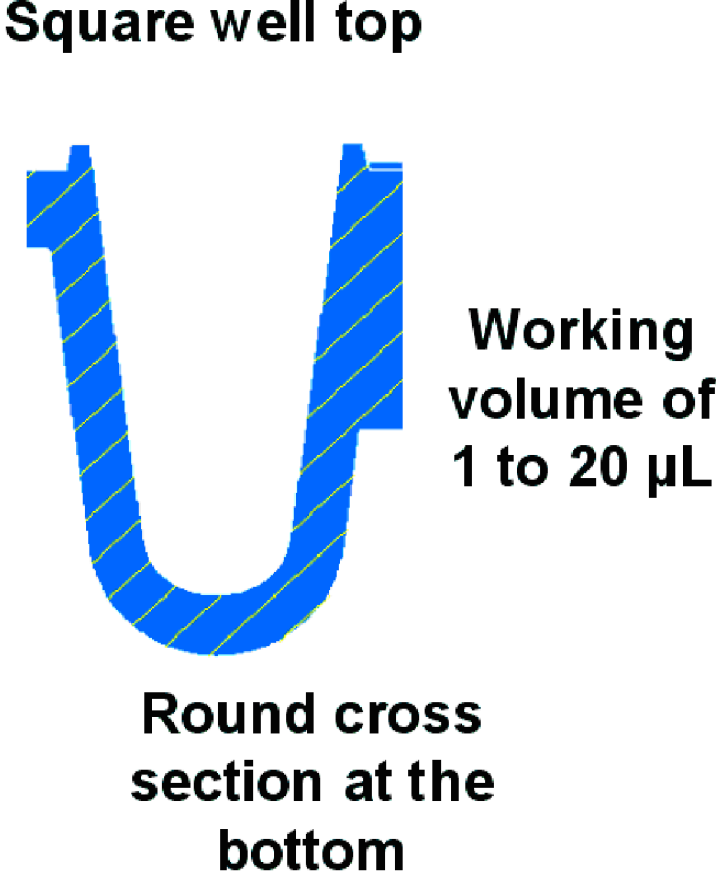
Corning® 384 Well Low Volume plates features a unique square top to round bottom well shape with a 38.5% larger opening area for easier robotic pipetting, reduced air bubble formation, and improved liquid handling. Molded in the shape of a light cone, the conical well shape provides improved assay performance thus facilitating assay miniaturization