



Abstract
Drug discovery today requires the focused use of lab automation and other resources in Combinatorial Chemistry and High-Throughput Screening (HTS). The ultimate value of both Combinatorial Chemistry and High-Throughput Screening technologies and the lasting impact they will have on the drug discovery process is a chapter that remains to be written. Central to their success and impact is how well they are integrated with each other and with the rest of Drug Discovery — and Informatics is key to this success. This presentation will focus on Informatics and the integration of the disciplines of combinatorial chemistry and HTS in modern drug discovery. Examples from experiences at Neurogen from the last five years will be described.
This presentation was given at the 1999 International Symposium for Laboratory Automation and Robotics held in Boston, MA, October 17-20, 1999. The full manuscript is available on CD-Rom and can be acquired by contacting Christine O'Neil, 508-497-2224; email
INTRODUCTION
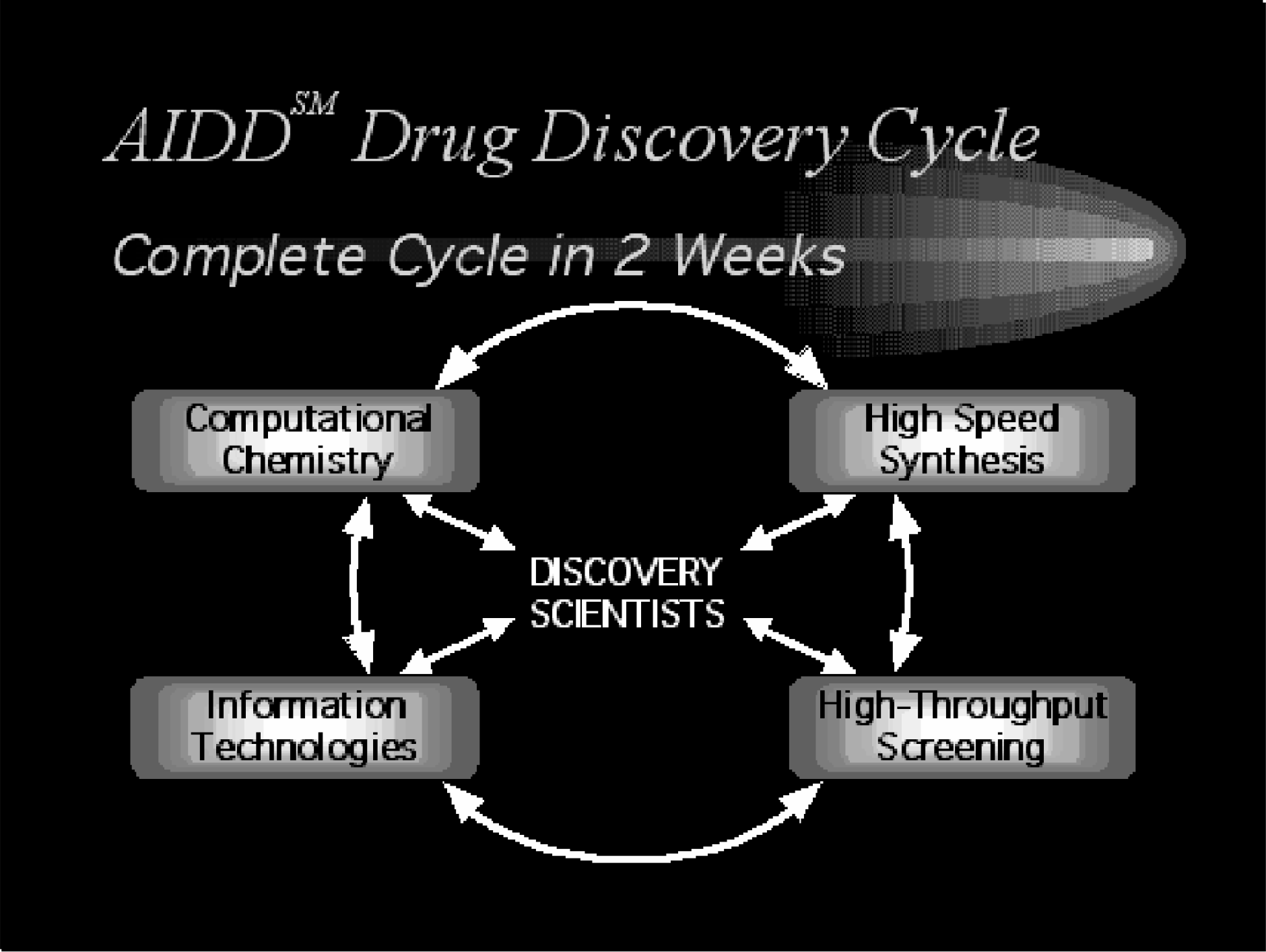
Neurogen Corp. is a pharmaceutical company focusing on CNS disorders. Several years ago, we began to develop methodology, now named “AIDDsm” for “Accelerated Intelligent Drug Discovery”, with the aim of streamlining and optimizing:
The generation of lead series
The exploration and characterization of lead series
The optimization of leads
The optimization of clinical development candidates
AIDDsm accomplishes this through tight integration (via intranet deployed informatics) of combinatorial chemistry, high-throughput pharmacology and computational chemistry.
AIDDsm itself is tightly integrated with the drug discovery effort and especially with medicinal chemistry itself.
The focus of AIDDsm is the ability to greatly enhance the drug discovery cycle: synthesis, data generation, data analysis and modeling, and prioritization of both synthesis and screening — thus completing the cycle — on thousands of compounds every two weeks. Additionally, this is accomplished with:
Very small staff resources (20–25 FTEs)
Ability to synthesize 400,000 samples per year (as either mixtures or individual samples) with purification and quality assessment
Biological data generation of 300,000 samples per month
Cycle time of 2 weeks
Targeted efficiency gains through computational chemistry and data-mining of 10x to well over 50x over random
Ability to prosecute 13–15 programs simultaneously in the above manner.
VIRTUAL LIBRARY
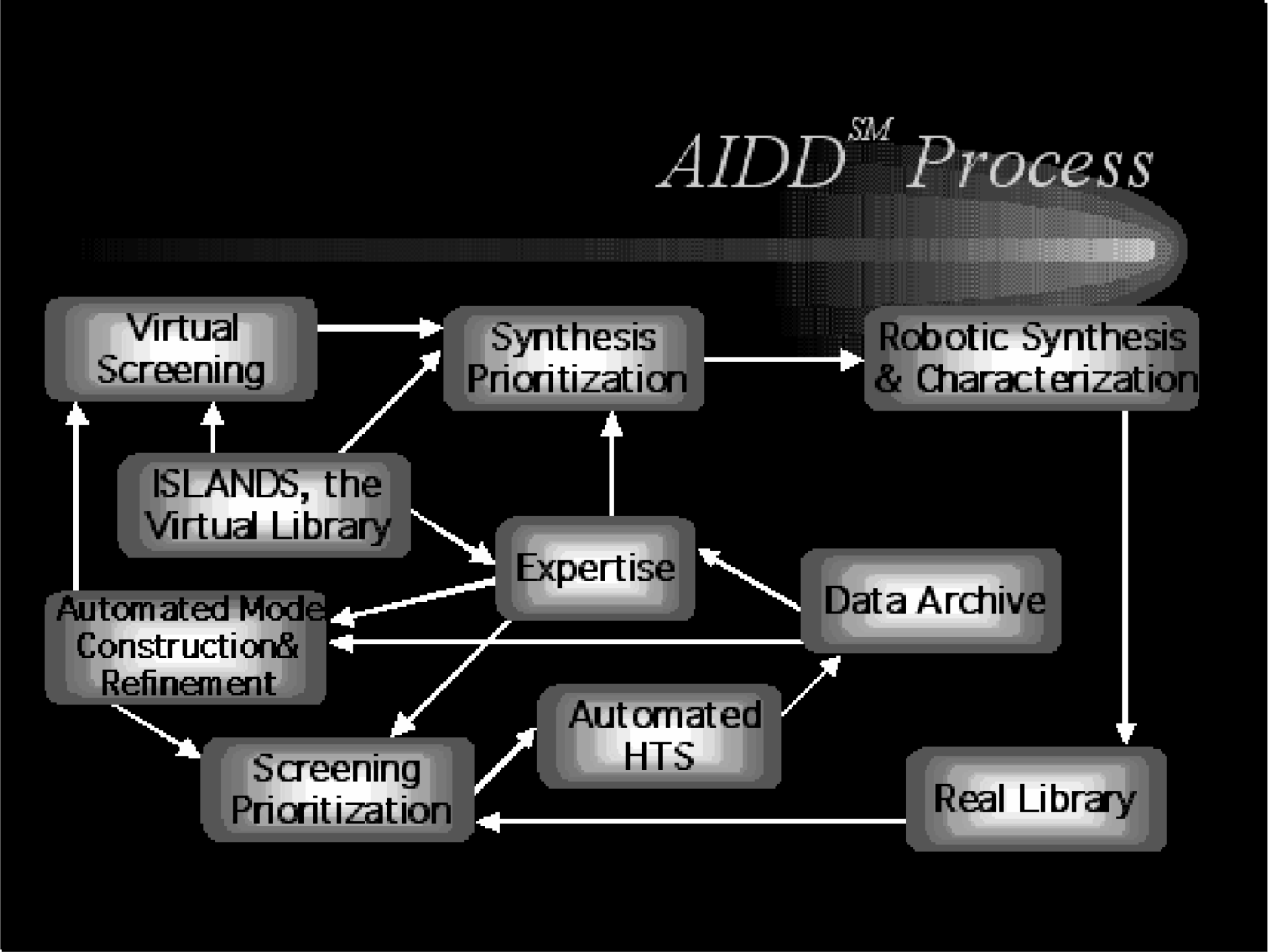
The AIDDsm Virtual Library is managed by Neurogen's ISLANDSsm technology, and is a representation of all compounds that can be made from the existing reactive fragment database and synthesis protocols database. Thus this virtual library is a very specific and dynamic set of compounds that can easily be millions or billions of molecules in size. The ISLANDSsm technology managing the virtual library is key to AIDDsm Virtual Screening processes as well as to workflow operations. The ISLANDSsm software makes it possible to define and register 50,000 compounds from the virtual library easily and quickly (10 minutes). After definition and registration, not only do the compounds exist electronically in databases for use in AIDDsm but also ISLANDSsm has generated all information required in the synthesis itself. The reagents required, the synthesis, reaction workup, and quality control protocols to be used by the synthesis robotics, and all tracking information (sample number, plate number, well locations) have been automatically generated and specified with no further input from the user required.
VIRTUAL SCREENING
A key concept of AIDDsm is the effective prioritization of both synthesis and screening resources through virtual screening. Proprietary, unattended and continuous molecular modeling and data-mining strategies termed “On-Line Continuous Modeling” or “OLCM” provide models for virtual screening of both the virtual library and the archive of actual compounds. These models work in concert with ISLANDSsm for virtual screening of the virtual library.
ON-LINE CONTINUOUS MODELING
From the inception of our work on AIDDsm, we planned to perform computational chemistry modeling with a novel portfolio approach. A portfolio of modeling strategies could be expected to provide useful models in a variety of cases when no one strategy could be expected to perform well in every situation. Compare this to a stock portfolio where the expectation is that the portfolio will increase in value with time even though this cannot be expected of any one particular stock. The AIDDsm portfolio of “On-Line Continuous Modeling” strategies or “OLCM” includes a variety of chemical descriptor types and a variety of modeling methods. Fuzzy methods and machine methods have been very effective. Both artificial neural networks and recursive partitioning methodologies are also used routinely in AIDDsm OLCM studies.
A core principle of AIDDsm and OLCM is the prediction, prioritization and targeting of populations of compounds instead of individual compounds. This makes it possible to routinely achieve significant benefits, by increasing the probability of activity in each two-week cycle. Efficiency gains or targeting enhancements seen in AIDDsm from this approach are routinely 10x to more than 50x enhancement.
RESULTS
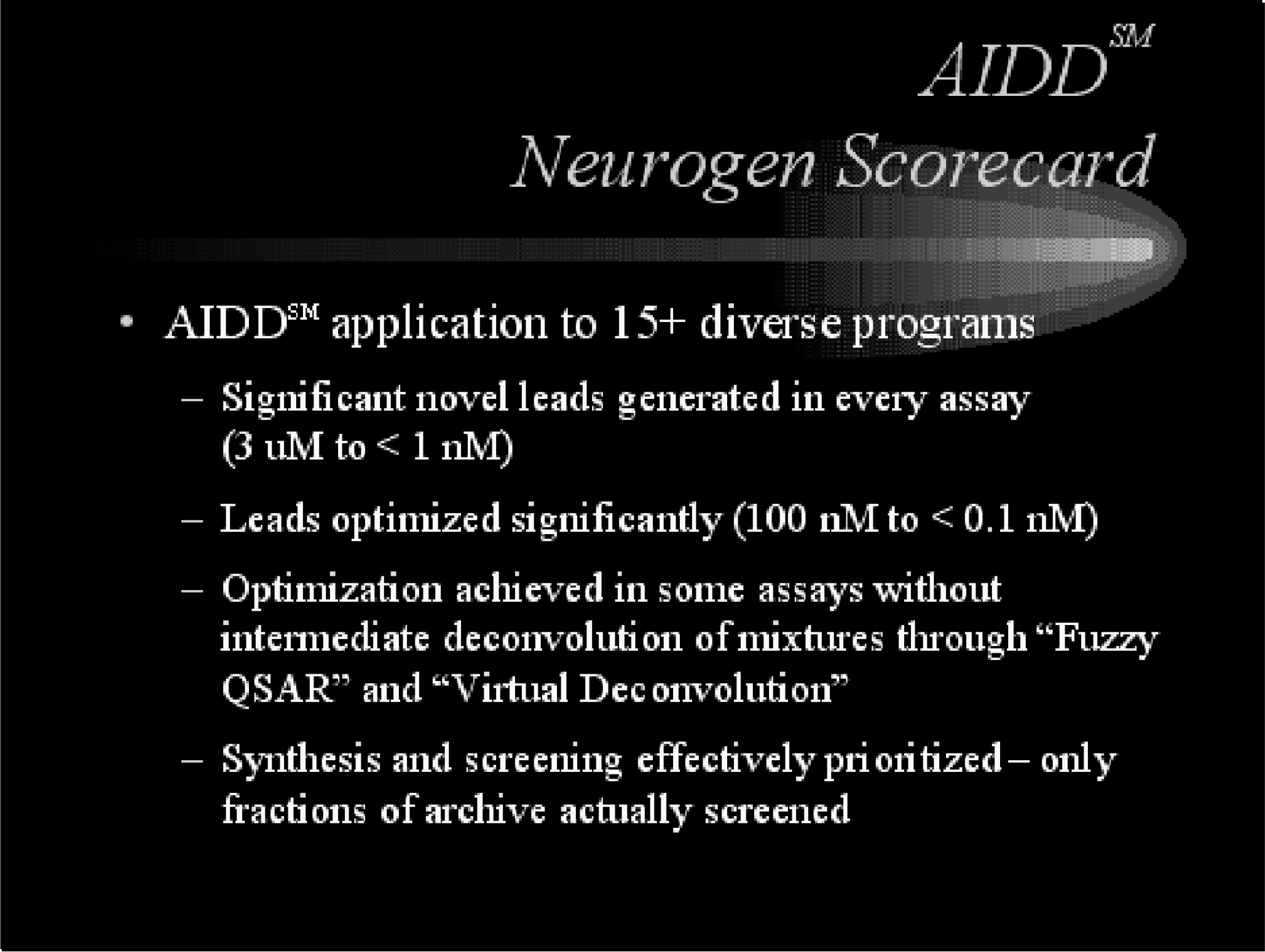
AIDDsm has been applied to over 15 diverse programs at Neurogen. In each program the value of AIDDsm has resulted in novel leads that were readily optimized to significant levels of activity.
For the last few years, Neurogen has been applying AIDDsm technology to the optimization of drug-like properties within projects toward the generation of development candidates. These efforts have resulted in more efficient optimization of candidate ADME and PK properties such as metabolic half-life, Cytochrome P450 activity, and others.
SUMMARY
An overview of the AIDDsm Drug Discovery System at Neurogen has been given. Specific examples from active project areas were presented. The importance of integration of disciplines and of pragmatism in balancing the individual components of drug discovery was stressed.