



Abstract
Cost pressure and rising throughput requirements are important drivers for assay miniaturization. Typical examples for the trend “smaller is better” are found in BioChip applications and in High Throughput Screening (HTS), which is evolving from the 96-well standard to high-density microplates with 384, 864, 1536 or more wells. These applications require the automated pipetting of liquids in the submicroliter volume range, a difficult task for traditional automated liquid handling systems based on syringe pumps.
Tecan developed a new device for the accurate pipetting of volumes in the nanoliter range. Based on ink-jet printer technology, this device allows the exact control of the volume of the ejected droplets via a set of parameters. The integration of this new technology into Tecan's flexible xyz-platforms allows an easy use of this powerful technology for several applications. Results such as volume range, accuracy and precision are discussed.
INTRODUCTION
The past few years have seen a clear trend towards assay miniaturization. New enabling technologies making such assay miniaturization possible are important drivers for this trend. Besides technical feasibility there are mainly rational and economical drivers for miniaturization such as cost pressure, cost and supply of valuable samples and increasing throughput needs. Two main fields of application for miniaturized assays can be seen today: (i) BioChip/array pipetting and (ii) assays in high-density microplates as well as hit picking and direct dilution of samples in the compound discovery process.
Assay miniaturization using high-density microplates or chips requires automated liquid handling of submicroliter volumes. Possible approaches to dispense submicroliter volumes are based on either direct contact with the destination or ink-jet printer technology. Contact-based dispense can be performed using high-resolution syringes, pins, inoculators or pin & ring systems. Contact-based dispense allows good reproducibility, i.e., low CVs, especially when dispensing onto a dry surface. On the other hand, contact-based dispense into plates containing reagents provides a poor volume accuracy and requires tip washing between the dispense steps. Therefore, state-of-the-art submicroliter pipetting must involve non-contact dispensing from the air. Several technical approaches of applying “ink-jet technology” to this application are possible. “Bubble jet technology” (ink-jet technology using thermal actuation, used for example in Canon ink-jet printers) cannot be used for biological samples, which should not be heated. However, solenoid valve technology and piezo-actuation are suitable technologies for submicroliter dispense. Tecan Low Volume Option on Genesis instruments uses solenoid technology and operates reliably down to 500 nl. In the volume range below 500 nl, piezo-actuation was found to be more powerful than solenoid valves.
TECHNOLOGICAL APPROACH
Tecan developed a piezo-actuated microdevice (ActiveTip M) for integration into Tecan xyz platforms. The ActiveTip M consists of a micro-machined part made of glass and silicon equipped with a piezo-electric actuator. This micro-machined device is mounted into a plastic adapter allowing the mechanical and electrical connection with the robotic platform. The ActiveTip M features very sensitive liquid level detection, which was found to clearly improve the reliability of nanoliter pipetting. As illustrated in Figure 1, the ActiveTip M does the dispensing of submicroliter volumes while the aspiration is performed by the syringe pump.
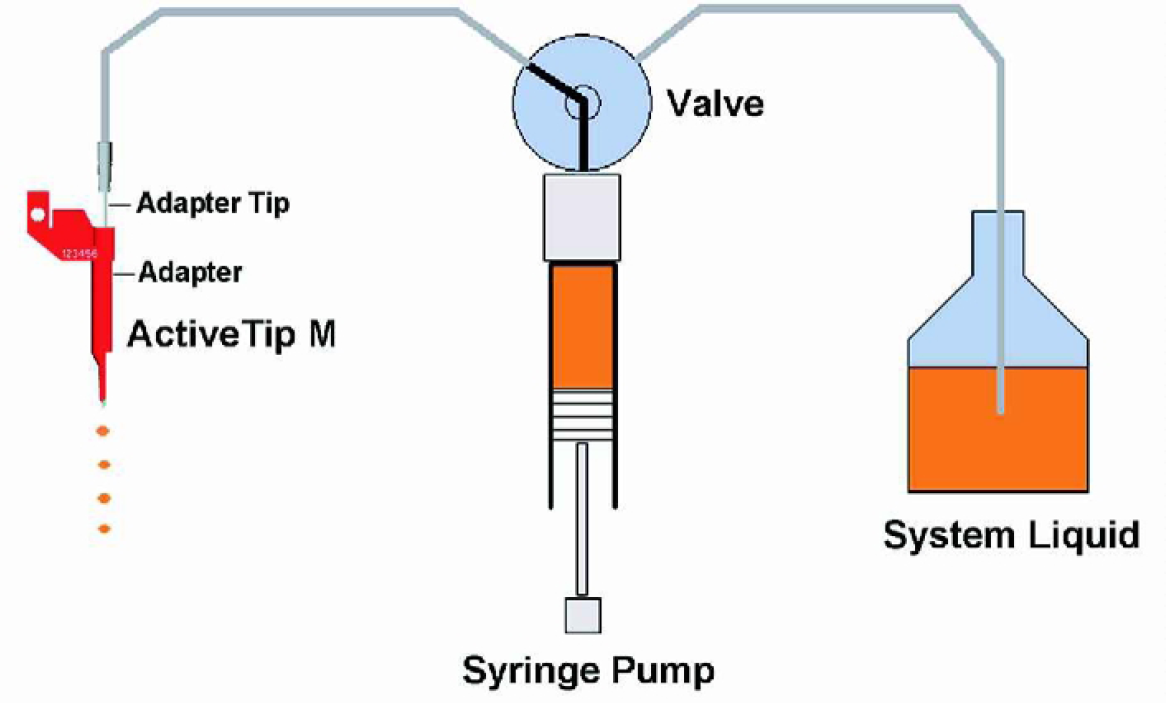
In order to be independent of ambient air pressure changes, a reliable dispense requires a closed liquid system in which dilutor and ActiveTip M are perfectly synchronized during the dispense process. A prerequisite for this synchronization is to know (and to control) the volume of the ejected droplets. Parameters influencing the drop size are the physical properties of the liquid and the electrical parameters (voltage, pulse width and frequency) applied to the piezo actuator. To achieve optimal performance on multichannel instruments, Tecan's Nanopipetting technology allows to adjust the drop size for each channel to the same volume. The advanced liquid class and liquid channel concepts of Gemini Software lead to easy and reliable nanoliter pipetting in daily laboratory work. Furthermore, Gemini allows mixed tip configurations enabling the pipetting of volumes from nanoliters to milliliters on one single instrument.
RESULTS AND DISCUSSION
An important issue for high performance in nanoliter pipetting is a reliable and reproducible production process leading to high quality and low variability of the produced micro-machined devices.
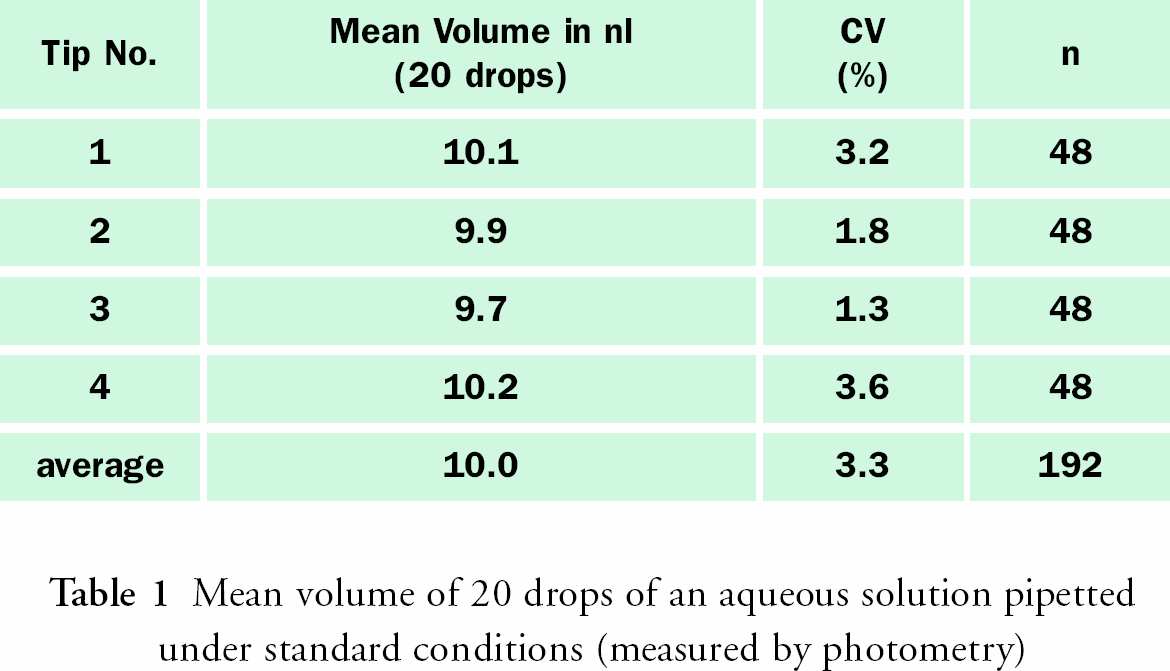
Mean volume of 20 drops of an aqueous solution pipetted under standard conditions (measured by photometry)
Specifications of the Tecan Genesis NPS system operated with degassed water as system liquid
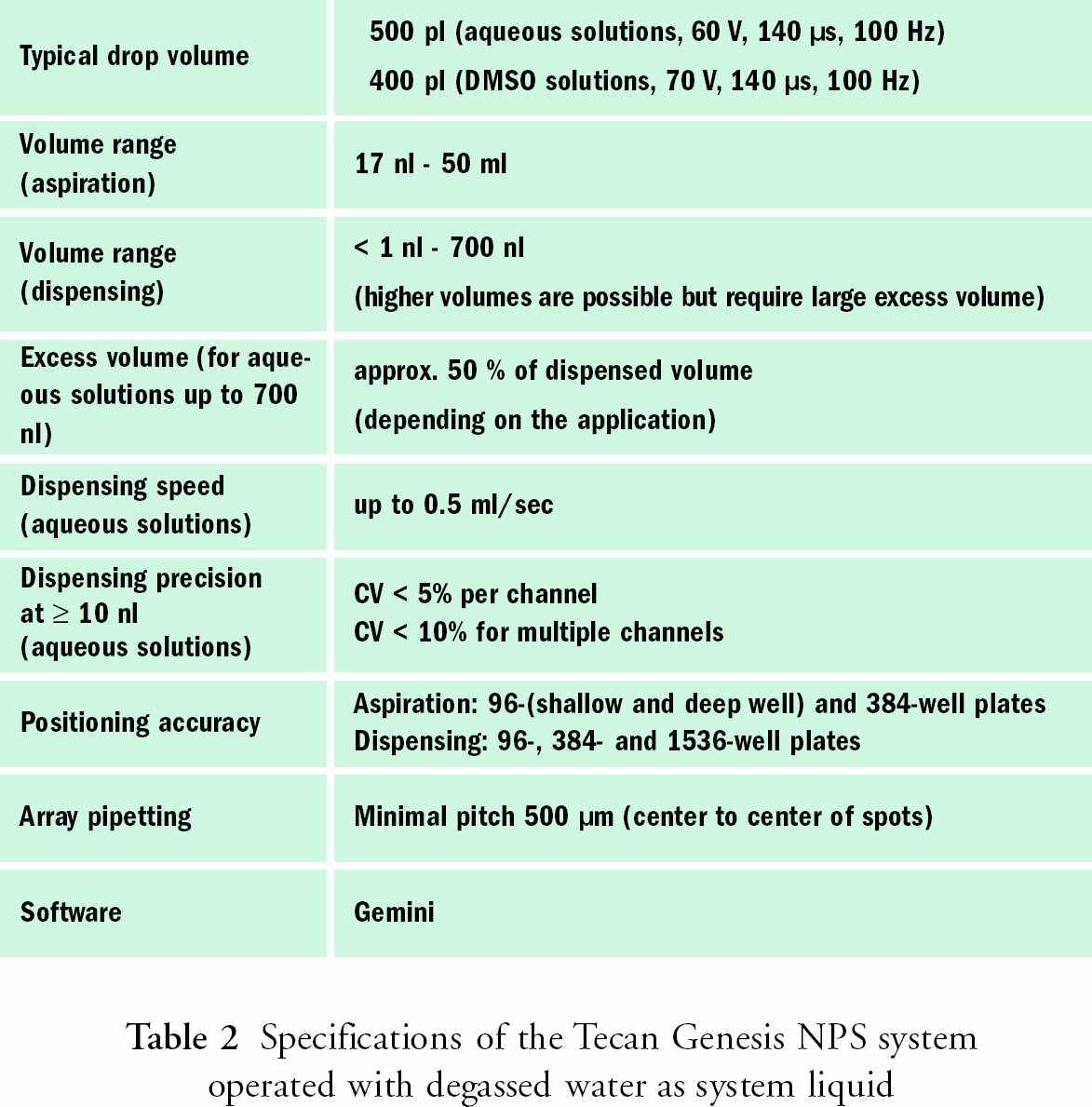
One important goal of miniaturization is saving sample. Current systems for pipetting in the nanoliter range often need large excess volumes. With its small excess volume of only 50% of the dispensed volume (Table 2), the Tecan ActiveTip M is setting a new standard for applications such as BioChip spotting and assays in high-density microplates.
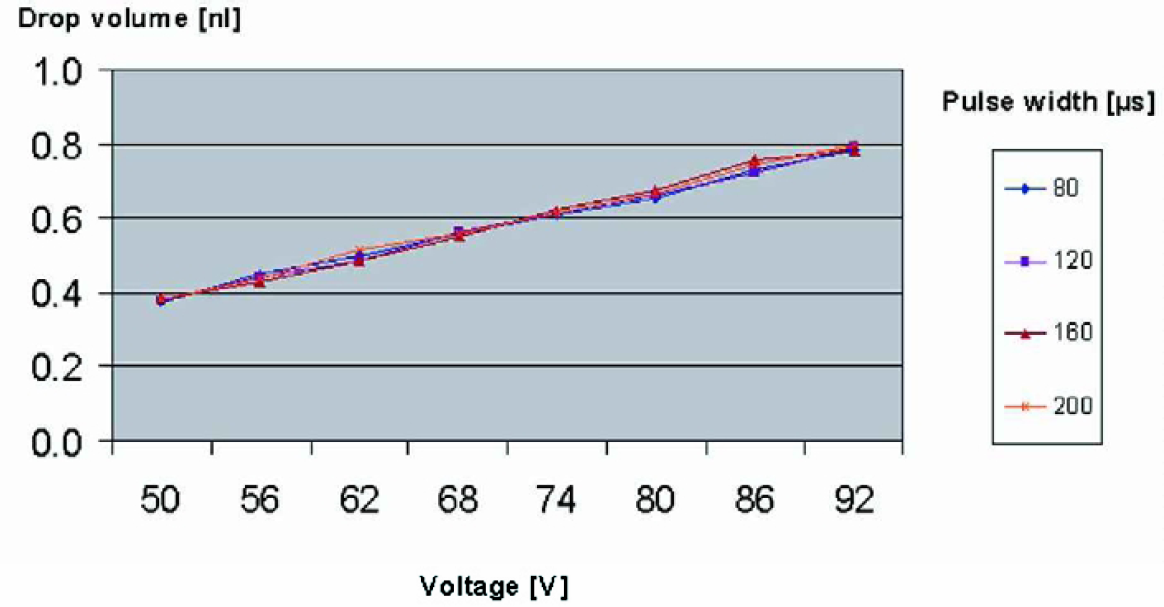
The drop volume is a function of the physical properties of the dispensed liquid and the electrical parameters applied to the ActiveTip M. Using standard parameters, typical drop volumes are approximately 500 pl for aqueous solutions and 400 pl for DMSO solutions (Table 2). Figure 2 shows the highly linear correlation between the applied voltage and the drop volume. This correlation allows an easy “calibration” of the different channels relative to each other, an absolute need for high performance in multi-channel systems. The volume of the expelled drops can be tuned in a broad range from below 400 to 800 pl (aqueous solutions). Figure 2 also shows that for pulse widths ranging from 80 to 200 ms, the dispense is highly reproducible.
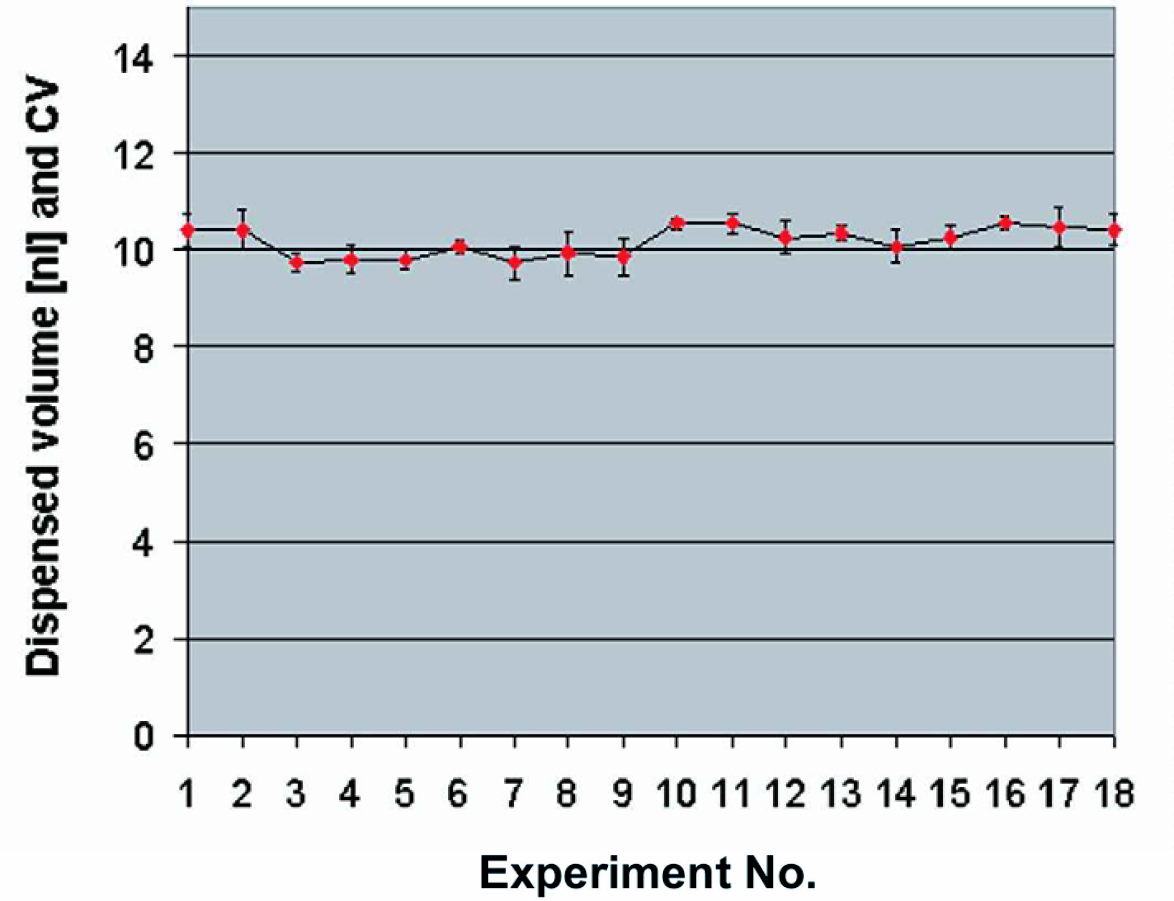
Another important factor for reliable daily laboratory work is stability of the dispense over time. Figure 3 shows the high day-to-day reproducibility (precision and accuracy) of the ActiveTip M. A CV of 5% is shown for 18 experiments run on four different days.
APPLICATIONS TARGETED BY TECAN NANOPIPETTING
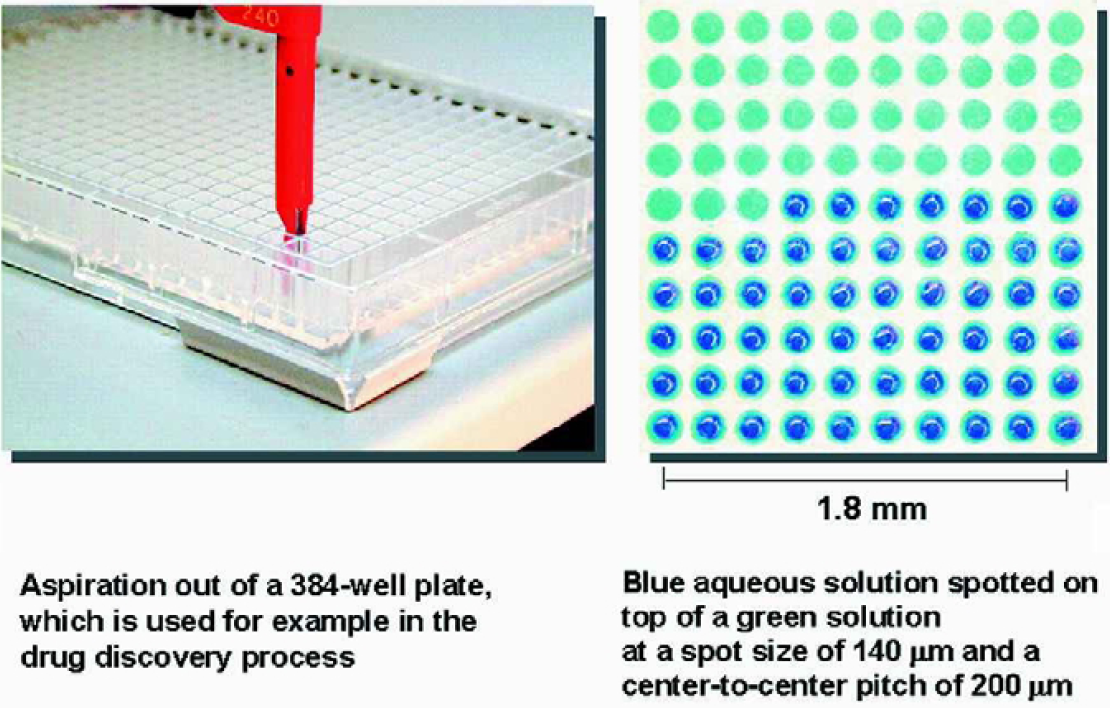
As illustrated in Figure 4, two main application areas are targeted by Tecan's Nanopipetting system: Microplate-based compound discovery and BioChips/Arrays. HTS/uHTS, for example, which is evolving from the 96-well standard to high-density microplates with 384, 864, 1536 or more wells require smaller assay volumes. Therefore, smaller compound volumes need to be transferred in these miniaturized assay formats. Using nanoliter pipetting, the time and sample consuming serial dilutions in the secondary screening process can be replaced by direct dilutions. In the BioChip/Array application field, DNA, proteins or other biomolecules are spotted onto glass slides or “chips”. DNA arrays, for example, can then be used to measure expression patterns of many genes in parallel. The poster presented at LabAutomation 2000 shows that DNA arraying can reliably be done with Tecan's Nanopipetting technology. 1 Figure 4 shows that on a Tecan Genesis NPS system arrays with center to center distances as small as 200 μm can be achieved under optimized conditions.
In summary, nanoliter pipetting by Tecan enables further miniaturization of assays in high-density microplates and on BioChips. Tecan liquid handling and integration know-how led to the design of the ActiveTip M and its sophisticated integration into Tecan xyz platforms, which guarantees high performance and reliability in daily laboratory work. The full integration of the ActiveTip M into Gemini Software makes the setup of pipetting processes in the nanoliter range as easy as in the microliter range.
ACKNOWLEDGMENTS
The author wishes to thank the entire Nanopipetting team at Tecan for their great job, which led to the success of this project. Furthermore, the work of the software team ending with an easy to use powerful software is also gratefully acknowledged.
Joerg Schlegel, Ph.D.
Footnotes
Acknowledgements
If you are interested in seeing more articles like this in JALA, please email