



Abstract
Since the beginning of this decade the use of automated or robotic-systems for analytical purposes has decreased rapidely. Starting from the analysis of agriculturing products or medical samples, these instruments are now more and more common in the pharmaceutical industry. The systems are used for R&D purposes mainly in the area of combinatorial chemistry to analyze the huge amount of synthesis products in the biomedical labs and in chemical-physical laboratories of Quality Contol Units. Extensive stability studies, which have to be perfomed for new drug applications, and the release testing of medicinal products with a very high manufacturing batch-rate per year need highly effective analytical methods. Thus, Byk Gulden has introduced two automated systems based on Zymark products (TPWII and MultiDose), for the stability tests of an enteric-coated tablet. The number of batches, pack types and storage conditions (total number of samples: appr. 40 for the 3- and 6-months timepoints), for this stability study was required automation of the most time consuming test methods for purity, assay and dissolution of the tablets, because of the tight schedule for timepoints in the first year of storage (in general: two weeks). In order to have these automated systems in place for routine testing in a very short time, the method transfer from the manual procedure as well as the optimization and validation work (MTOV), were done completely by the supplier, Zymark. The other system, which is a customer designed robotic system built also by Zymark, is used for the release testing of an x-ray contrast medium with a very high batch-rate per year (approxmimately four batches per day that have to be analyzed). This enormous testing frequency is hardly to be realized by manual methods. Experiences with an already existent robotic systems has shown that the laboratory flow-through times are 30 to 50% decreased compared to manual testing.
INTRODUCTION
Seven years ago Byk Gulden started with laboratory automation by buying two robotic systems and one automated equipment. The systems are used for the routine testing of an x-ray contrast medium and for stability studies of an enteric-coated tablet. The use of automated methods in the QC labs became necessary, due to the very high annual number of samples (lots), of the contrast medium to be released (> 200), and the enormous number of samples to be analyzed for each stability timepoint of the enteric-coated tablets (up to 40). From these first experiences the senior management of Byk Gulden decided to go on with further laboratory automation in the QC labs.
For the investment projects of new instruments the laboratory automation was classified in two kinds of equipments:
Besides this classification the following requirements and prerequisites have been considered:
High annual number of samples (lots),
Limited flow-through time for the time pressure samples,
Methods easy to automate,
Enough laboratory space available,
High personnel capacity available for the time of qualification of the systems according to the current GMP and,
Well skilled technical personnel (robotic systems).
Generally, new implementations of automated systems as well as robotic instruments are done in the QC labs of Byk Gulden following this “decision pathway”.
IMPLEMENTATION OF NEW INSTRUMENTS
Implementation of Automated Systems
Planned long-term stability studies of a new enteric-coated tablet needed efficient analytical methods, because of the large number of samples to be analized for each timepoint. The capacity of the existent automated systems is not high enough for performing these additional stability testings. Thus, new systems should have been introduced in the QC labs. For the descision to buy the most efficient kinds of equipments (in terms of suitability), the manual methods were divided in suitable and not suitable procedures for automation. As a result of this classification, it could be shown that the:
Purity by HPLC,
Assay by HPLC and
Dissolution with in-line UV-detection
are suitable methods to be automated. The following comparison of advantages of the automated versus robotic systems (see
Advantages of automated versus robotic systems
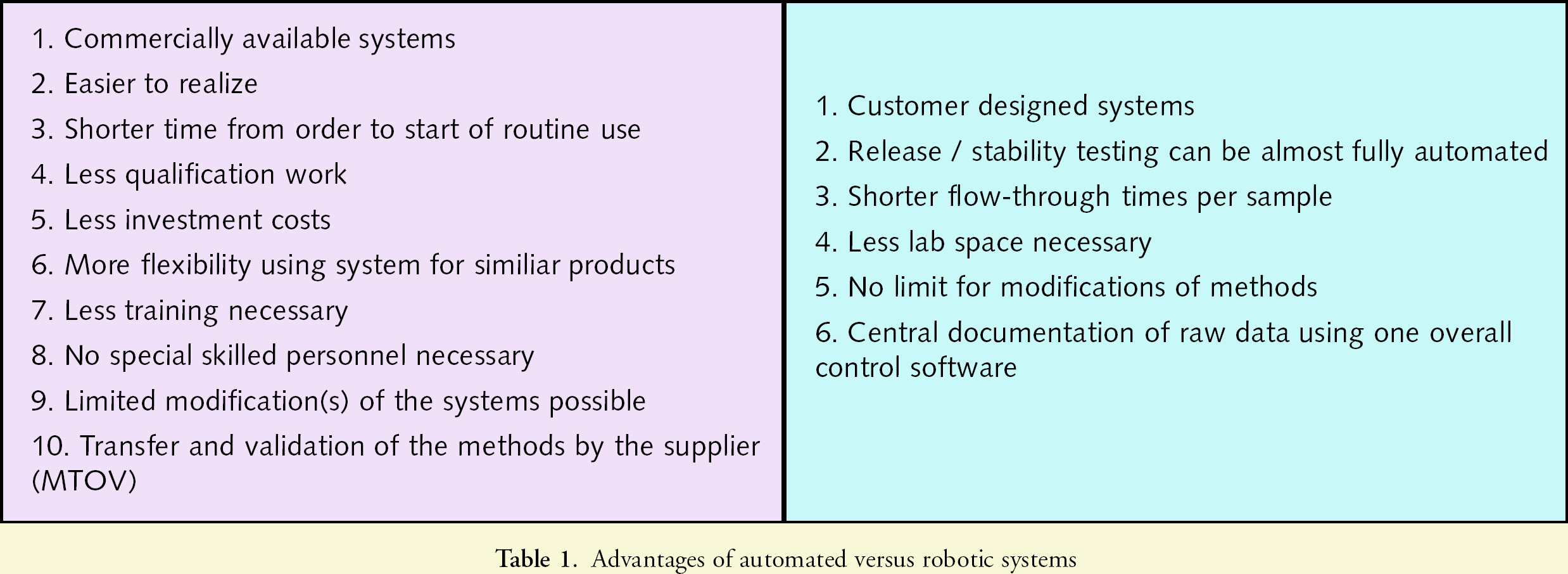
For the methods two automated instruments were ordered from Zymark (Idstein, Germany). One of these eqiupments (TPWI®), is proposed for assay and purity testing, while the other system (MultiDose®), should be applied for the dissolution of the enteric-coated tablet.
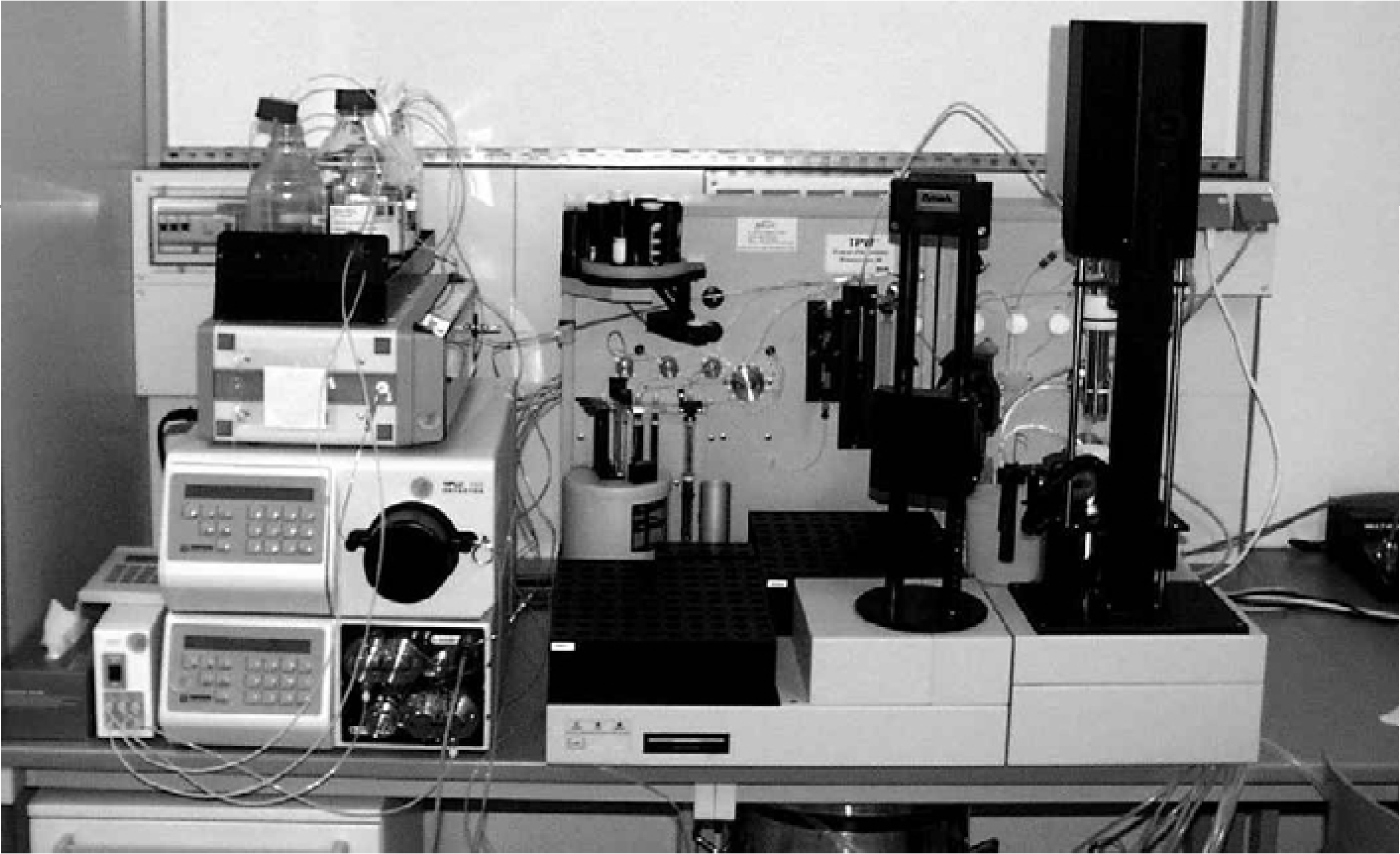
Automated system for purity and assay of the enteric-coated tablet
The transfer of the analytical methods from the manual to the automated equipment as well as the main work of the optimization and validation of the procedures were made by the vendor (Zymark, MTOV). The MTOV was focussed on the critical parameters mainly the different steps of the sample preparation. In the manual procedures the tablets are dispensed in the sample solvent using strong shaker (Vortex®), and an ultrasonic bath. The clearification is done by centrifugation. The corresponding steps of the automated methods are performed using an ultraturax homogenizer and a filtration station.
During the validation of the methods an increase of one known impurity of the active was observed. The following investigation process of the phenomenon led to an oxidation reaction, due to an O2-intake during the homogenizing procedure. A second analytical problem arised analyzing aged enteric-coated tablets. With the optimized procedure for the homogenizer the aged tablets could not be dispensed in the solvent. As an explanation for this fact an increase of the hardness of the enteric coating during storage has been assumed. Due to these analytical problems at the end of the MTOV procedure, additional optimization and validation work have been performed in the QC labs of Byk Gulden. This issue and others like delays in delivery of the instrument from USA and defects in equipment components led to a large increase of the establishing time for the TPWII in the QC labs. The final realization time is by a factor of 3 larger than the planned implementation time (13 instead of 4 months).
For the automation of the dissolution method (based on the USP apparatus 2, paddle), the above mentioned MultiDose® (Zymark), was chosen for routine testing. The commercially available equipment was modified to fulfill the required media exchange as part of the dissolution procedure. This media exchange between the acid (2 h at pH 1.2), and buffer stage (45 min at pH 6.8), without withdrawel of the tablets from the vessels was realized by an auxiliary pump and an additional five valve custom system (see
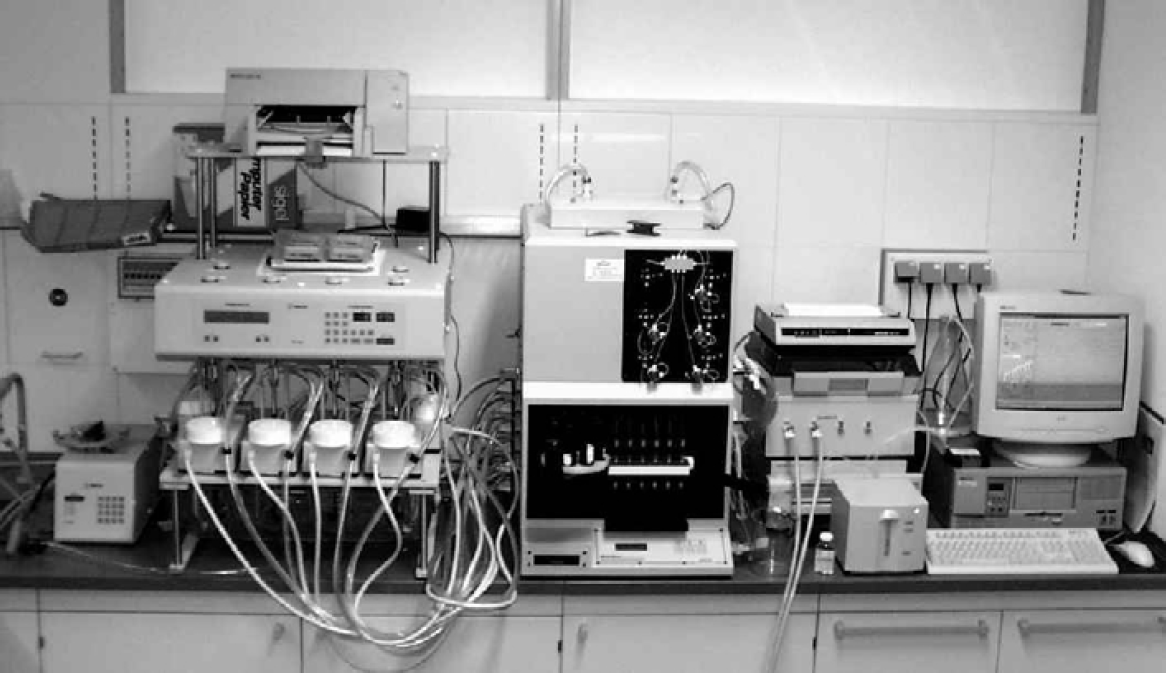
Automated system for the dissolution testing of the enteric-coated tablet.
The transfer of the analytical methods and the following optimization / validation process is made by the vendor (Zymark, MTOV). One of the main focuss of the MTOV was the media exchange step. The realization of this critical step according to the current USP requirement of ± 5% of the dissolution time in buffer stage (corresponding to 2 minutes), was the main reason for the delay of 11 months compared to the scheduled time for implementation (17 instead of 6 months). The first unacceptable modification of the MultiDose led to a refill time for all vessels of 6 min (corresponding to 13% of dissolution time in buffer).
Establishing of a Robotic System
For the release and stability testing of a x-ray contrast medium a customer designed robotic system was bought from Zymark (Zymate XP®, see
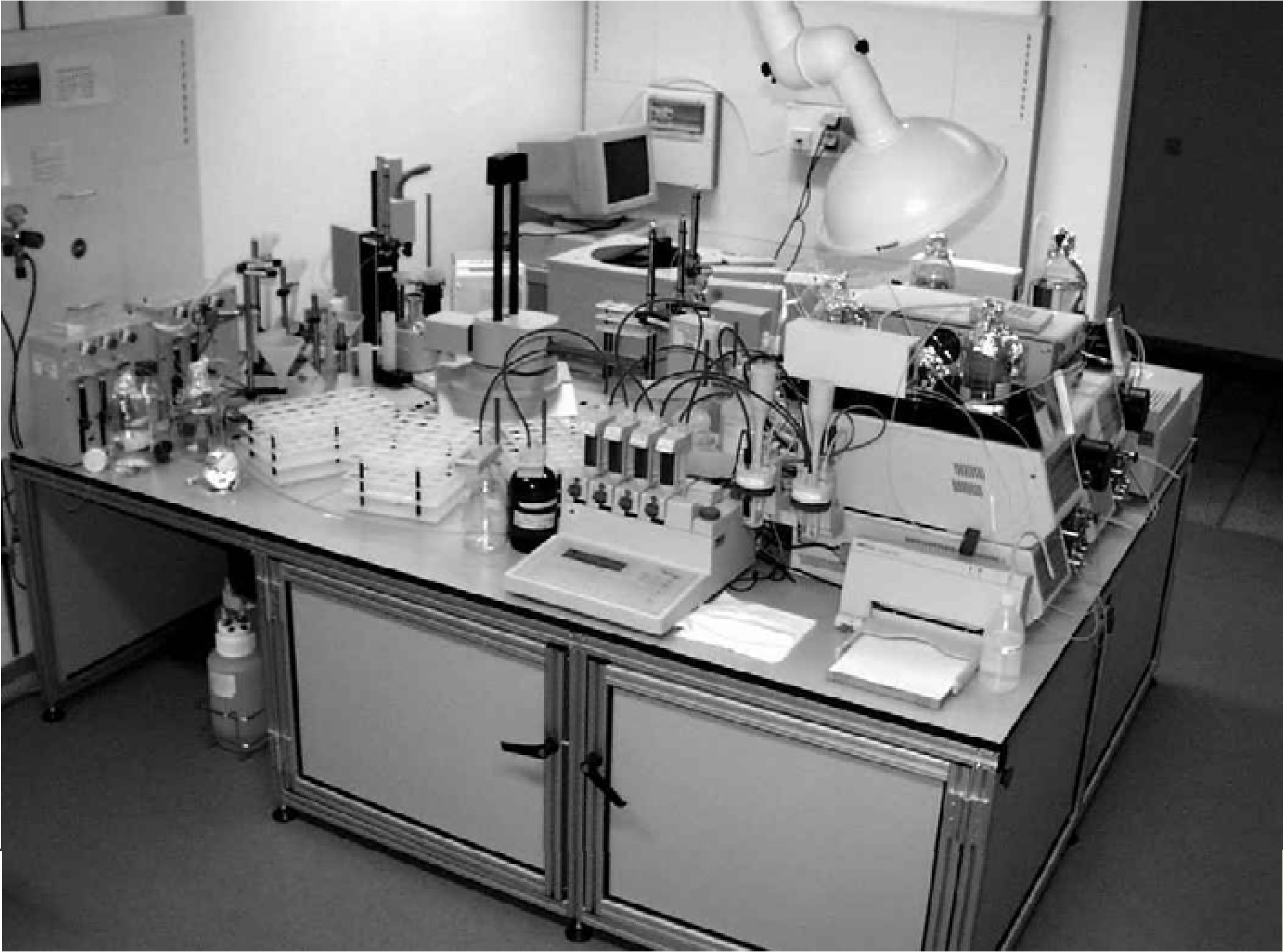
Robotic system for the release and stability tests of an x-ray contrast medium
The following tests are automatically performed by the system:
Assay by UV (release testing),
Assay by HPLC (stability testing),
Purity testing by HPLC,
Determination of inorganic iodide by titration,
Determination of free iodine by UV,
Limit test for copper by UV,
Determination of HCl by titration (optimal),
Determination of tromethamine by titration (excipient) and
Determination of NaCa-edetate by UV (excipient).
The robotic system was built using standard components from Zymark like Capper, Master lab station, Centrifuge, Robotarm, LL-LC-stations etc., and commercially available instruments like spectrophotometer (Perkin-Elmer, Lambda 20®), balance (Mettler, AT261 Delta Range®), two HPLC instruments (BIO-TEK, Kontron 535/522®), and titrator (Mettler, DL 77®).
The transfer of the manual methods to the robotic system and the optimisation / validation procedure are done in the QC labs of Byk Gulden. Some critical points for these processes are the cap / decap station, the dilution system with the central balance, the rinsing volume for the LL-LC tools (all standard components from Zymark), the new titration methods (Mettler), and the UV methods (Perkin-Elmer). The whole validation procedure is a very high capacity consuming process. The overall required time is be summerized to appromimately 700 hours and the validation of the automated methods will be successfully finished by the end of 1999.
The scheduled time line for implementation of 10 months (from equipment order to start of routine use), could not be kept due to the following reasons:
Delays in delivery of the Zymate from the supplier,
Interruption of the qualification process because the instrument did not pass the customer specifications,
Software changes due to new customer specifications,
Titrator (Mettler) did not pass the customer specifications, etc.
After the final validation of the methods the robotic system will be first used for the ongoing suitability studies of the contrast medium from early 2000.
Qualification of Automated and Robotic Systems
The proper qualification of automated equipments according to the current GMP (IQ, OQ, PQ), needs a lot of resources from the performing lab in terms of personnel capacity and costs. The corresponding data for the qualification of the two automated and the robotic systems are shown in
Qualification efforts for the automated and robotic systems
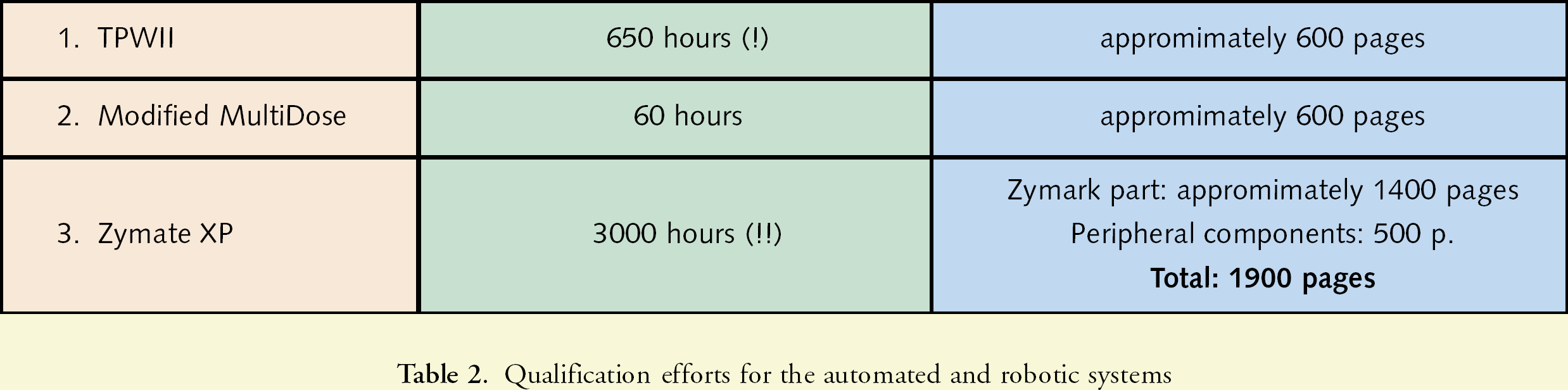
The documentation efforts as well as the capacities needed demonstrate that the qualification is one of the greatest parts of the establishing procedure.
EXPERIENCES WITH A ROBOTIC SYSTEM IN USE
A customer designed robotic system from the former company ISRA is used for 3.5 years for routine testing of an other x-ray contrast medium. The time needed for implementation from order of equipment until starting of routine testing was approximately 3.5 years. The flow-through time using this robotic system could be cut in half compared to the manual analysis of the contrast medium. From the economical point of view the investment of an instrument can be assessed by the break-even point. This point was reached for the existent robotic system after appromimately 4 years. The break-even point is calculated from the whole costs of implementation (investment and qualification: appromimately $500,000), and the saved capacity, due to the reduced flow-through time multiplied by the anaual number of samples (approximately 200).
The corresponding features for the new robotic system from Zymark is shown in
Proposed economical features for the Zymate XP
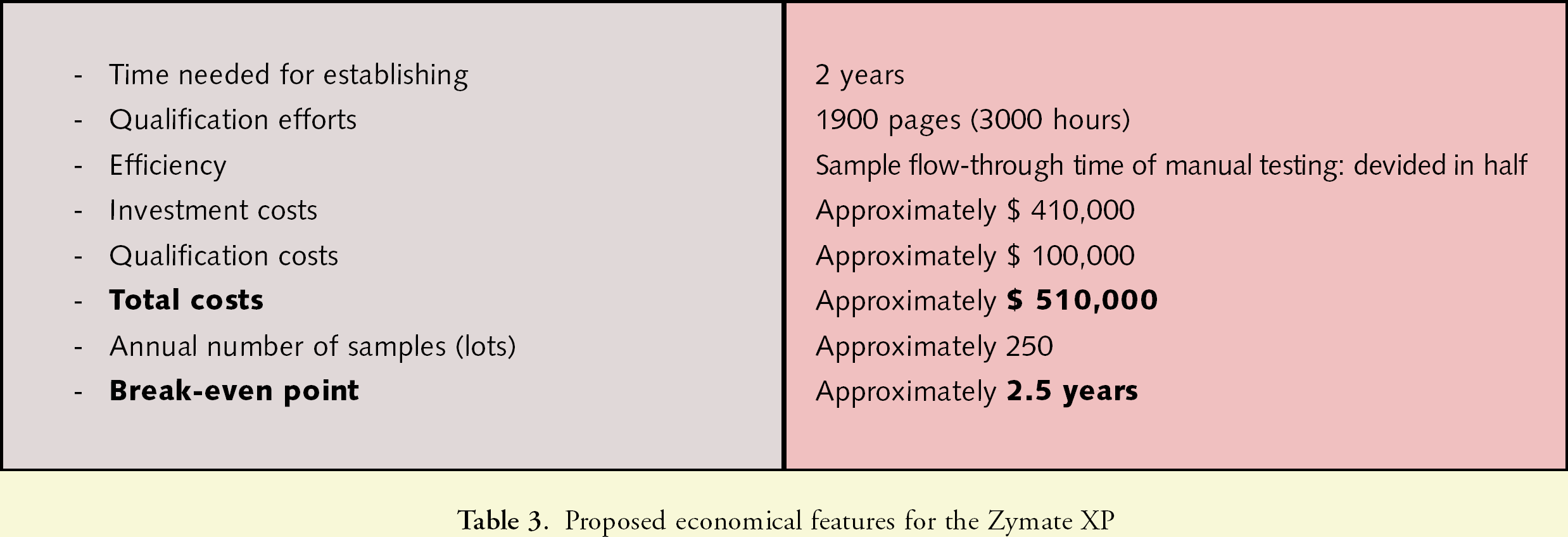
The break-even point for the Zymate is significantly smaller compared to the corresponding value of the existent system. One reason for the increase in efficiency could be explaned with the lot of experiences that exist in the QC labs of Byk Gulden with laboratory automation over a period of seven years.
SUMMARY
The experiences with the actual implementation of three automated / robotic systems as well as the corresponding experiences with existent instruments lead to following statements:
The time, which is needed for the implementation of automated as well as robotic systems, is considerably longer than proposed, e.g.:
TPWII: 13 months versus 4 months,
Modified MultiDose: 17 months versus 6 months and
Very high capacities are required for the equipment qualification according to the current GMP, e.g.:
TPWII: 650 hours (documentation: 600 pages) and
The break-even point of automated and robotic systems (> 2.5 years) is usually greater than accepted for “analytical instruments (n.m.t. 1.5).
The decision for establishing of automated and robotic systems have to be done very carefully in terms of prerequisites (e.g. anual number of samples to be analyzed and required flow-through times for analysis), to achieve acceptable cost / benefit features.
ACKNOWLEDGEMENTS:
I would like to thank the laboratory group for laboratory automation of the QC devision of Byk Gulden for their patient help preparing this article.
TRADEMARKS
TPWII® (Zymark),
MultiDose® (Zymark),
Zymate XP® (Zymark),
Lamda 20® (Perkin-Elmer),
AT 261 Delta Range® (Mettler),
Kontron 535/522® (BIO-TEK) and
Mettler DL 77® (Mettler).