



Abstract
One of the major challenges facing the emerging field of proteomics research is related to the technical difficulties in analyzing protein structure and function on a genomic scale. The routine purification of protein complexes as a means to investigate protein–protein interaction networks is of particularly high interest because of its significant potential to improve overall understanding of protein function and to improve ongoing drug discovery efforts. Automation of currently practiced laboratory procedures has the potential to markedly improve protein purification throughput, but important technical issues remain to be addressed. This paper investigates key bottlenecks in the automation of standard affinity-based procedures for protein complex purification and introduces a promising conceptual design for an automated workcell that would allow for rapid and efficient magnetic bead-based purification of protein complexes from model organisms suitable for a medium-sized research laboratory setting. The design specifications are based on a modular and flexible design that will permit routine, unattended batch isolation and processing of protein complexes from microbes. (JALA 2003;8:101–6)
Keywords
Introduction
Proteomics is a rapidly growing branch of genomics research and is defined as the science of studying the location, molecular interactions, structure, and function of proteins on a genome-wide scale. 1 Most of laboratory procedures in the field of proteomics require a large number of repetitive experimental manipulations typically involving intricate multistep protocols. These procedures are usually labour-intensive and often inefficient to perform manually in a high-throughput setting. 2 Thus, large-scale study of proteomics is plausible only if automated systems become available to proteomics researchers, in much the same way as has become available to genomics researchers.
Among the various different subfields of proteomics, the analysis of protein-protein interactions and protein complexes is considered to be one of the most promising areas of research because it has the potential to provide insight into the possible functions of proteins. 3 Highly purified protein complexes would also be ideal for the synthesis of protein chips, which are likely to have tremendous value in drug discovery. However, because of the general inefficiencies in manually based protein isolation procedures, the isolation of protein complexes from model systems has been restricted to large research groups. Hence, there is growing recognition that automation procedures, which could dramatically increase the throughput and consistency of protein purification procedures, are urgently needed to allow smaller research groups to purify and analyse protein complexes on a large scale. Furthermore, availability of an automated system for protein complex purification should remove a significant barrier against the widespread use of protein microarrays since the greatest barrier is the availability of highly purified and functionally active protein that can be spotted on the chips. 4
Although there are several automated workcells available on the market for high-throughput recombinant protein purification, 5 these are generally not applicable to the purification of protein complexes. For instance, automated work-cells fabricated by PerkinElmer (Boston, MA), Novagen, Inc. (Madison, WI), 6 or QIAGEN GmbH (Hilden, Germany) 7 make use of protocols for the magnetic purification of a target protein that generally disrupt interacting protein partners. To this end, we outline a conceptual design of an automated workcell optimized specifically for the large-scale and efficient magnetic purification of protein complexes from various starting cell sources. The design specifications address several of the major bottlenecks in the affinity purification of affinity-tagged protein complexes by adapting a standardized and efficient laboratory purification protocol to a magnetic workcell environment.
The paper is divided as follows: A brief description of the tandem affinity purification or TAP protocol for isolating protein complex is presented in section 2. Protocol bottlenecks are investigated in section 3. The major design methodology for a high throughput automated magnetic workcell is presented in section 4, while the system requirements and the conceptual design including workcell layout and modules' descriptions are investigated in sections 5 and 6, along with required specifications for the workcell in section 7. Finally, the conclusion of the paper is presented in section 8.
Overview of the Tandem Affinity-Purification Protocol
In the case of protein complex purification, one of the most promising procedures to emerge in recent years makes use of a tandem affinity-purification (TAP) tag. It is based on the fusion of a specific tag (TAP) to the target protein and affinity isolation of fusion protein and associated components using bead chromatography columns. The TAP protocol has shown higher efficiency in the recovery of highly purified protein complexes from a variety of cell types, most typically model microorgansisms such as yeast and bacteria but also human cells as well, as compared to the other types of tags. 8 Briefly, the complete protocol consists of (1) making a DNA cassette that encodes for a TAP.tagged protein; (2) transferring the DNA to the target cell (e.g., a bacterium) that will express the fusion protein; (3) growing the cells; (4) confirming the presence and the appropriate TAP tagged protein; (5) large-scale culture of positive clones confirmed in step 4; (6) cell lysis and bead-based affinity purification of the tagged proteins, and (7) analysis of the isolated TAP tagged protein complexes. 9 The actual purification is usually performed using bead chromatography columns. In this case, special beads, which have the ability to recognize and specifically bind to the tags of protein complexes, are employed. These beads, actually big polymers, can be used to filter out of the solution through filtration columns, allowing the bound protein complexes to be readily isolated from the cell extract solution.
In the case of magnetic isolation, magnetic beads have to be fused to target TAP tagged proteins. These proteins are accompanied with their interacting proteins, making protein complexes. Therefore, in the presence of a magnetic field, the chains of (protein complex) + (tag) + (magnetic bead) are isolated from the solution. Then, protein complexes are released from the tag by adding specific chemical reagents and eluted from the solution for further analysis. Figure 1 shows schematically the rationale of this procedure.
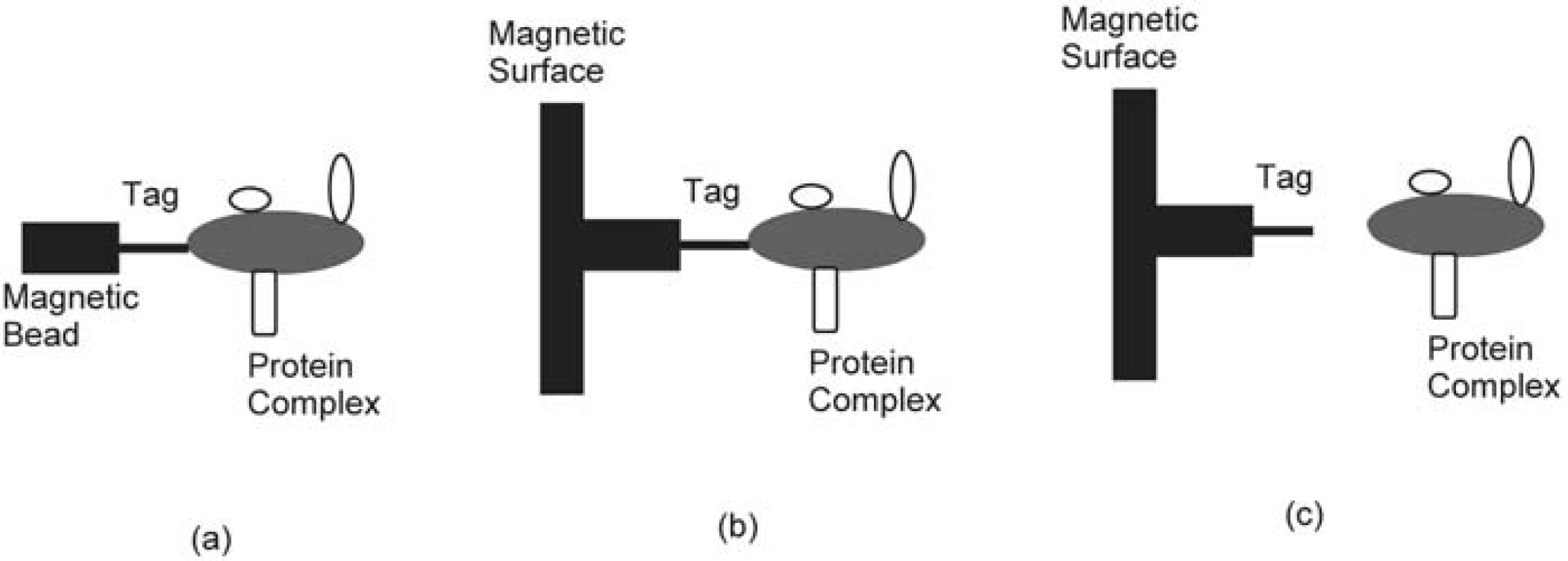
The rationale of the magnetic purification method. (a) The chain of (protein complex) + (tag) + (magnetic bead). (b) Attracting to the magnetic surface. (c) Releasing of the protein complex from the tag.
In the magnetic purification method, magnetic beads have to be derivatized with some proteins or chemicals that can bind selectively to the tag attached to the target protein. In the case of TAP tags, we need to use IgG molecules attached to magnetic beads. TAP tag magnetic purification protocol is a two-round purification procedure, which results in better-purified protein complexes. After the first magnetic isolation and the elution of protein complexes by chemically breaking the tag molecule, the second round of purification is performed by adding a second type of magnetic beads called calmoduline magnetic beads. These beads will bind to the remaining part of tags that are attached to protein complexes; thus they can be isolated from the solution in the presence of a magnetic field. Final elution frees protein complexes from the beads. This is performed by breaking the bond between protein complexes and tags. Thus, the final outcome of the protocol is purified protein complexes for further analysis by mass spectrometry or protein chip analysis.
Automation Justification
Laboratory automation system design starts with a preliminary investigation to find out an automation-demanding protocol and also the bottleneck of the protocol where automation should be employed. 10 Regarding magnetic or non-magnetic (bead chromatography) purification methods, the former is chosen to be analysed for automation. Magnetic purification is a more automation friendly protocol because it does not involve traditional, but hard-to-automate methods of centrifugation and time-consuming column-draining processes. Regarding the entire magnetic TAP-tagged protein complex purification protocol, our justification shows that step 6, cell lysis and bead-based affinity purification of the tagged proteins, is the best candidate for automation. It is well suited to automation for the following reasons:
This step is generic and versatile. It remains the same for the purification of different organisms' protein complexes such as Escherichia coli, yeast, and human. Considering the large number of human proteins (50,000–100,000), the protocol is justified for automation.
Substantial variation in the quality of the manual operation output has been observed. The output of the protocol should be a reliable, reproducible solution containing protein complexes that are then analyzed by standard gel electrophoresis techniques or by mass spectrometry. Poor quality will result in non-interpretable data and a loss of valuable time, effort, and reagents. The dominant factors responsible for the outcome variation are considered to be human errors in tracking tubes, imprecise pipetting, and cross-contamination between samples, potential problems that can all be alleviated by the use of automation.
Most steps of the protocol must be performed in a cold room. This is an unpleasant working environment; therefore, the likelihood of human errors is increased.
Costly reagents are used in this protocol. Most of the laboratories cannot afford inefficiency in the protocol, and they have a low tolerance for human errors.
Contamination-free processes should be maintained. Any kind of contamination destroys the quality of the output. Obviously, manual processes have a higher risk of contamination than automated systems.
There is a high demand for a sufficient throughput. A full-time expert technician can manually provide at most 30 to 40 samples per week, which are subject to human errors. However, laboratories working on protein purification of different organisms require much higher throughputs that can only be met by automated high-throughput systems.
Design Methodology for the High-Throughput Automated Workcell
There are three different approaches to laboratory tasks: (1) fixed automation (high throughput, low flexibility), (2) programmable robotic and modular automation (medium throughput, medium flexibility), and (3) manual operation (high flexibility, low throughput). 11 Deciding on the most appropriate approach for a laboratory depends on the size of laboratory, throughput needs, and anticipated laboratory growth. 12 The trend in laboratory automation is to move away from fixed and total laboratory automation to a modular and robotic approach, mainly to increase flexibility. 13 Flexibility improves the quality of the product and increase productivity while it is in a trade-off with throughput and speed. 14 Figure 2 shows the relationship between protocol flexibility and throughput in the case of using different robotic automated systems. 15
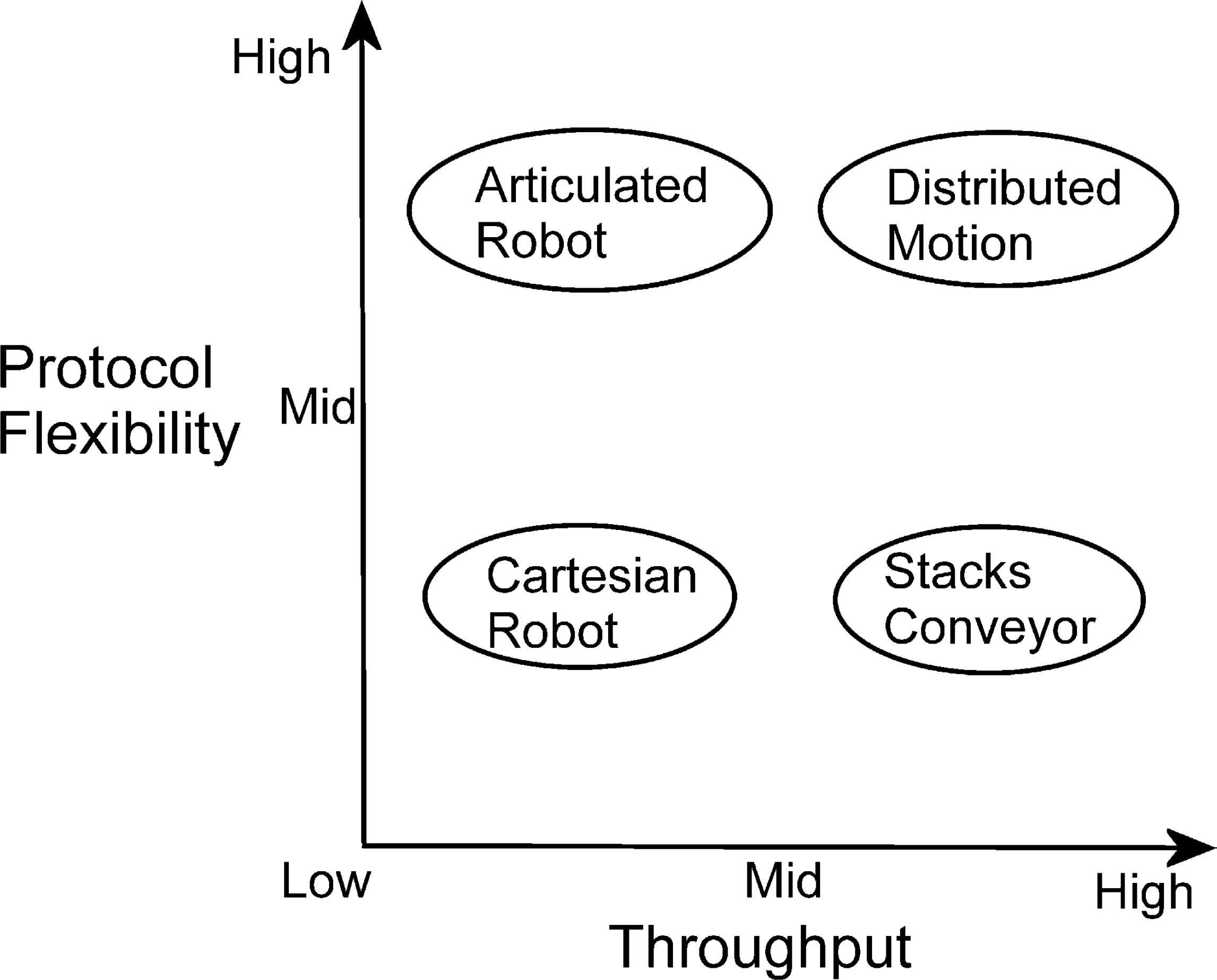
The relationship between protocol flexibility and the throughput of different automation configurations. 15
In order to achieve required flexibility and throughput, the most commonly used configuration for laboratory automated workcells, specifically in medium-sized laboratories, is based on integrating a table-top platform on which laboratory modules/instruments (off-the-shelf and custom-design equipment) are mounted with one or several robotic arms for liquid handling and tube/plate transportations. 16,17
The automated workcell conceptual design for the magnetic protein complex purification protocol is based on the aforementioned approach. It is a table-top integrated system on which required off-the-shelf components are positioned. The system is supported by two Cartesian robotic arms for liquid handling and tubes transportations. Thus, the design involves choosing off-the-shelf components, machine layout design, and investigation of the workcell's specifications.
System Requirements
As described earlier in the Automation Justification section, step 6 of the entire protocol is chosen for automation, which involves two rounds of magnetic purification protocol. The first round starts with the mechanical disruption of harvested cells containing protein complexes in 50-mL tubes and then continues with transferring the supernatant to new 50-mL tubes, adding IgG magnetic beads, incubation, magnetic separation (several times), transferring pellets to new 5-mL tubes, adding protease, incubation, magnetic separation, and transferring supernatants to new 5-mL tubes. The second round of purification starts with adding magnetic calmoduline beads and then continues with incubation, magnetic separation (several times), and finally elution and transferring supernatants (500 μl) to new output tubes or microplates. The main differences between the aforementioned protocol and the magnetic purification of recombinant proteins are (1) cell lysis has to be performed by mechanical disruption in order to not disrupt protein complexes, while in the case of recombinant proteins, this can be performed by adding detergent to harvested cells; (2) volumes of cells typically used in TAP procedure are higher, as the yield in the TAP purification protocol is low. As a result, it is not possible to perform the protocol in 96 deep-well plates as is done in the magnetic purification of recombinant proteins.
Regarding this approach, required off-the-shelf laboratory instruments for performing the protocol include a high-speed vortexer for the mechanical disruption of cells, incubator, magnetic stand, and capping/decapping instrument. Integration of these instruments with robotic liquid handling and tube/plate transportation should provide us an automated workcell for the magnetic TAP-tagged protein complex purification protocol. Moreover, as most parts of the protocol have to be performed in a low ambient temperature (around 4 °C), the automated workcell has to be installed in a cold room.
The input of the protocol is in 50-mL tubes. Each tube is capped and contains harvested cells plus ceramic spheres to be used for the mechanical disruption of cells. In order to achieve required throughput, batches of 50-mL tubes should be incorporated. The final output from each of these tubes is a 500-μL solution containing purified protein complexes. Between these two input and output volumes (50 mL and 0.5 mL), there is one scale down in volume after the first magnetic purification in 50-mL tubes, where pellets containing tagged protein complexes are transferred to 5-mL tubes.
In the following, workcell conceptual design (workcell layout and modules' descriptions) for the automation of magnetic TAP-tagged protein complex purification protocol is presented.
Workcell Layout and Modules' Descriptions
The conceptual sketch of the automated workcell for the magnetic protein complex purification is shown in Figure 3. The required modules are placed on a platform making different stations, and two Cartesian robotic arms for automated liquid handling and transportation of tube racks are incorporated. The input to the automated workcell is four racks of 50-mL tubes each containing 24 tubes (8 × 3 array). The automated system is able to batch process 96 samples at a time. The output of the automated workcell is a 1-mL 96 deep-well plate. Purified protein complexes (500 μL) are transferred to each well of this microplate for further analysis. The workcell can be also equipped with one or several stackers of required tubes/plates to perform around the clock purification. In the following, module descriptions of the main eight-station automated workcell with the capacity for batch processing 96 samples at a time are presented:

Automated workcell conceptual design for magnetic TAP-tagged protein complex purification.
Station 1: Vortexer. This station contains four vortexers. Four input racks, each containing 24 capped impact-resistant 50-mL tubes are placed on vortexers. Each tube contains harvested cells plus ceramic spheres.
Station 2: Magnetic stand for 50-mL tubes. Four magnetic stands for 50-mL tubes are located in this station. Magnetic isolation is performed after racks of 50-mL tubes are positioned on the magnetic stands.
Station 3: 3D shaker. This is the incubation station. Four 3D shakers are located in this station. Racks of 50- or 5-mL tubes are placed on the pans of shakers to perform incubation. Initially, four racks of empty 50-mL tubes are placed on the shakers. After breaking the harvested cells by vortexing, cell extracts are transferred to the new 50-mL tubes located in station 3 for performing incubation with magnetic IgG beads. Then, they are placed on the magnetic stands in station 2 to perform the magnetic isolation process.
Station 4: Magnetic stand for 5-mL tubes. Four magnetic stands for 5-mL tubes are located in this station. Magnetic isolation is performed after racks of 5-mL tubes are positioned on the magnetic stands.
Station 5: Stands for 5-mL tubes. In this station, eight racks of 5-mL tubes each containing 24 tubes are positioned (twice the number of 50-mL input tubes). Solutions are transferred to 5-mL tubes twice during the protocol. After the first magnetic isolation by using magnetic IgG beads, the pellets containing tagged protein complexes are transferred from 50-mL tubes to 5-mL tubes. In addition, protein complexes are transferred to new 5-mL tubes after they are released from magnetic IgG beads for the second round of magnetic purification with magnetic calmoduline beads.
Station 6: Microplate stand. In this station, a 1-mL 96 deep-well plate is placed. The final purified solution (500 μL) is transferred from 5-mL tubes (96 solutions) to the microplate.
Station 7: Capping/decapping. A capper/decapper machine for 50- and 5-mL tubes is located in this station. Tubes are capped before vortexing and incubation processes and decapped afterward.
Station 8: Disposable tips/chute/ reagent reservoir. Racks of disposable tips required for contamination free liquid handling, tip disposal chute, and racks of tubes containing required reagents and beads in the protocol are located in this station.
Required Specifications of the Automated Workcell
The conceptual workcell shown in Figure 3 consists of different off-the-shelf instruments and modules that are available on the market or can be achieved with minor modifications. In the following, required specifications of each module are presented based on the needs of the magnetic protein complex purification protocol and the capacity of the designed workcell.
Table-top Platform
Platform size is 1770 × 1220 mm, suitable for mediumsized laboratories.
Several knobs on the platform for the allocation of plates, tube racks and instruments.
Robotic Liquid Pipettor
Gantry X-Y-Z servo-driven robotic arm with pipettor head.
Ball screw transmission mechanism with the stroke length of X: 1360 mm; Y: 1180 mm; Z: 500 mm.
Positional repeatability: 0.1 mm.
Robotic arm speed: maximum 1000 mm/sec in X and Y axes and 500 mm/sec in Z axis.
Four or eight tip pipettor, using disposable tips.
Capable of liquid handling in the range of 1 μL to 1 mL.
Liquid handling accuracy ≤1%.
Robotic Pick and Place Arm
Gantry X-Y-Z servo-driven robotic arm with pick-and-place head (parallel gripper).
Ball screw transmission mechanism with stroke length of X: 1730 mm; Y: 1180 mm; Z: 500 mm.
Positional repeatability: 0.2 mm.
Robotic arm speed: maximum 1000 mm/sec in all axes.
Electrically driven pick-and-place end effector with 150-mm stroke.
Magnetic Separation Stand
Two types of magnetic stand suitable for 50- and 5-mL tubes.
Fourteen permanent magnetic rods in each magnetic stand for effective magnetic isolation.
Vortexer
High-speed vortexer (2500 rpm).
3D shaker
3D medium-speed shaker (1000 rpm).
Conclusion
Automated proteomics systems would greatly facilitate the scaling up of routine proteomics procedures, thereby increasing the potential impact of proteomics on basic molecular research, drug discovery, and individualized medicine in general. 3 We have outlined a conceptual design and specifications for an automated and modular robotic workcell for large-scale magnetic purification of TAP-tagged protein complexes. The optimal design specification calls for an eight-station platform supported by two gantry robotic arms for liquid handling and transportation of tubes with the capacity for batch processing of 96 samples at a time. Such an automated system has the potential to significantly increase the productivity of researchers in medium-sized proteomics laboratories, allowing them to attain consistent and high-throughput isolation of purified protein complexes suitable for follow-up analysis and production of protein chips.