




Abstract
This paper seeks to shed light upon the foreign policy choices of Armenia today, in particular regarding the recent moves vis-à-vis Russia and the EU. It explains the idea of the policy of complementarity and how this idea was genetically enrooted in the special circumstances of the Republic of Armenia's birth in 1991. Influencing factors in its recent history include its vast diaspora around the world and the conflict with neighbouring Azerbaijan about Nagorno-Karabakh, which strongly intertwines Armenian foreign and economic policy with larger powers outside Armenia. The author analyses the special relationship with Russia and the growing cooperation with the EU. The current geopolitical disputes are occurring between these two large blocs, and they are clearly beyond Armenia's influence. In conclusion, the paper seeks to design a perspective based on rationality, within which the originally sought win-win-win relationship can still be realised for Armenia, Russia and the EU.
Keywords
Introduction: the shock of the September announcement
The shockwaves of the announcement by Armenian President Serzh Sargsyan of 3 September 2013 have rippled long and far. After more than three years of detailed and successful negotiations for an Association Agreement (AA) including a Deep and Comprehensive Free Trade Area (DCFTA) with the EU, and as the final text of more than one thousand pages was agreed upon and ready to be signed, Armenia unexpectedly announced that it would join the Russian-led Customs Union (CU) (Reuters 2013). Given the known incompatibilities of integrating any country's customs in a DCFTA with the EU while transferring its customs sovereignty to the CU, this marked the first clearly visible crack in the EU's European Neighbourhood Policy and its Eastern Partnership (EaP) initiative. At the time, many felt deceived and accused the Armenian government of being unreliable and incomprehensible, which, seen out of context, is a fair assessment. Despite the apparent pressure from the Russian Federation, few understood why this change came so suddenly and why it was communicated so poorly. Critics of Russia finally pushed Armenia into the ‘bad box’, and the omnipresent Azerbaijani lobby was happy to support this process, as anything that weakens their officially hated enemy is in their interests (Aliyev 2012). Today, the perception in Europe has become clearer, partially influenced by the developments between Ukraine and Russia in early 2014, but neither the EU nor Armenia have a clear vision for their future relationship. This paper seeks to untangle the multifaceted dependencies and to clarify the situation at the time of writing (April 2014). The following five sections will explain the idea of the policy of complementarity and how this idea was genetically rooted in the special circumstances of the Republic of Armenia's birth in 1991. It will outline the special roles Russia and the EU play for Armenia and, finally, what triggered the September 2013 announcement.
Complementarity as genetic heritage
Ever since the September announcement, the key question both inside and outside Armenia has been quo vadis?: where does Armenia want to be in a few years? The country has geopolitically always been at the crossroads between Russia, the Middle East, the Far East and the West, while, for centuries, the population has defined its Armenian identity through its Christianity and its European roots, which, during the Armenian Kingdom of Cilicia (1199–1375), stretched to the Mediterranean coast north of Cyprus. This European identity was and is also reinforced by the fact that Armenians do not feel Arabic, Turkic, Russian or Asian, but are and always have been surrounded by all these ethnicities and they have had to ensure throughout history that their culture, language, alphabet and faith prevailed. Modern Armenia, shortly after attaining independence on 21 September 1991, developed its foreign policy based on the concept of complementarity. During the early years, the major focus lay on safeguarding the ethnic Armenian population in Nagorno-Karabakh from attempts at ethnic cleansing by Azerbaijan and overcoming the devastating effects of the Spitak earthquake of December 1988. In this situation, the small, landlocked country needed any support it could find, be it from Russia, Europe or the US. Besides, Armenia was and is connected to all three by large diaspora groups, most of whom were descended from the refugees of the Ottoman genocide against Armenians which reached its peak in 1915. Following a complementary foreign policy was thus conditioned by the situation in which the modern Republic of Armenia was born. It was part of its genetic code and then grew to be a more general part of its identity. The need to obtain support from all three geopolitical directions was further intensified when the ethnic conflict with Azerbaijan slid into open war, with a total breakdown of the formerly vital trade relations between the countries, and the decision thereafter by Turkey to close its border with Armenia in solidarity with the Azeri–Turkic brother nation. Armenia was therefore one of the few former Soviet states which refused to choose any clear geopolitical alignment.
Russia brings security and investments
The Russian part of this complementary policy, however, has always been very strong. In part, this can be explained by factors which also existed in all other countries of the former Soviet space, such as the historically strong trade links and the widespread use of Russian as a scientific, and even everyday, language. But while some countries with the same preconditions sought to move away from Russia as far as possible and as quickly as possible, for example the Baltic states and Armenia's neighbour Georgia, Armenia could not have afforded such a detachment, even if it had wanted it. Consequently, such an option was never seriously discussed. While the Russian military initially supported the Azerbaijani side against any forces that might speed up the disintegration of the Soviet Union (Fearon and Laitin 2006), independent Azerbaijan reoriented its foreign policy away from Russia, especially under President Elchibey (1992–3), and intensified its military efforts to create one large Turkic sphere of influence from Baku to Istanbul. The Azerbaijani forces succeeded in cleansing Nakhichevan of its Armenian minority, but proved unable to realise its military goals in Nagorno-Karabakh, where the vast majority of the population has always been ethnically Armenian. The military conflict ended with the Bishkek ceasefire of 1994, which remains legally binding (Luchterhandt 2012). Russia's military influence in this conflict was not significant, given its own economic and political crisis situation following the coup of August 1991, the dissolution of the Soviet Union, the constitutional crisis of 1993 and the beginning of ethnic cleansing and conflict in Chechnya (Kocho-Williams 2013). However, Russia was a key driver in brokering the Bishkek ceasefire and, after 1994, it gradually became a key pillar in Armenia's new security architecture, as part of the Collective Security Treaty Organization (CSTO) and a number of bilateral agreements. This was vital for the Armenian Republic's survival, given the security threats from its neighbours. Turkey, in line with its one-nation-two-states policy vis-à-vis Azerbaijan, kept its border closed and continues to deny the Ottoman genocide to this day. Furthermore, it supported Azerbaijan militarily then, as it does today (Today's Zaman 2013). The ceasefire with Azerbaijan is fragile, and officials in Baku continue to threaten Armenia with war (EuFoA 2014). It should be noted that Azerbaijan initially also joined the CSTO, but left the organisation in 1999. Arguably, only Russia assisted Armenia significantly in its precarious post-war security situation, during which Armenia was still extremely economically weakened by the collapse of most of the Soviet trade routes, the Spitak earthquake, the Karabakh war and the closed borders to the east and west, while tensions at its border with Azerbaijan remained high and military probes often surpassed the level of skirmishes.
The young Republic of Armenia required vast international investments in order to rebuild its infrastructure and economy. In this aspect, too, the main support came from Russia, whose investors felt comfortable enough to invest or, if they were Russian state-owned companies, were asked to invest for political reasons. Other investments came from the diaspora, with the lion's share again coming from Russia. All this taken together marked a disproportionate share of Russian investments in Armenia, which dwarfed investments by US- or EU-based international corporations. Critics of this development should imagine what the socio-economic situation would have been like in Armenia without these investments and ask their own governments and business leaders why they did not engage in a stronger way.
EaP triggers serious reforms
Politically, successive Armenian governments tried to maintain close ties with almost every country in the world. With its population profoundly sharing European roots and values, the reform programmes launched by the US and the EU to improve governance and the judiciary and to develop civil society were welcomed and implemented with varying degrees of success. In the new millennium, Western state assistance generally moved away from the simple development aid provided in the early 1990s. The most comprehensive of these new programmes was and is the EU's European Neighbourhood Policy. With the launch of the EaP and the planned renegotiation of the old Partnership and Cooperation Agreement, Armenia and the EU started on a path towards a much more comprehensive AA, including the aforementioned DCFTA. On the one hand, Armenia has successfully concluded the negotiations for the AA, which required a number of difficult reforms, including the introduction of technical laws on trade and sanitary issues, ensuring internationally lauded freedom of assembly and expression, the creation of a well-functioning Ombudsman institution, and numerous improvements in the conduct of the last election cycle. On the other hand, shortcomings persist, particularly in the judicial system, market competition and the fight against corruption.
In parallel, the main Armenian political parties joined their respective political families in the EU: the Armenian National Congress (ANC) joined the Alliance of Liberals and Democrats for Europe in 2010; and Heritage, the Republican Party of Armenia (RPA) and Rule of Law (RoL) joined the European People's Party in 2012 (EuFoA 2012). As a result, these parties benefited from logistical and political support during the last election cycle and their representatives gained direct contact with their counterparts in the EU. This established much-needed communication channels and allowed both sides to receive more first-hand information, which was used extensively during the entire election cycle and after Armenia announced that it would be joining the CU.
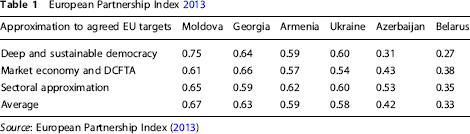
In the context of the EaP, the EU offered financial aid based on the more-for-more principle, that is, on the basis of how far the targeted countries wanted to reform. In September 2012, Armenia and the European Commission signed two financial agreements totalling €42 million, and recently, in December 2013, a further €87 million was allocated to Armenia, Georgia and Moldova to boost reforms. Once again, given the precarious security situation and two closed borders, the Armenian government chose to engage more strongly than, for example, Azerbaijan or Belarus. In fact, the 2013 Integration Index for EaP countries shows Armenia's progress, that is, the approximation to the targets agreed between the countries and the EU, as higher than that of Ukraine (Table 1).
European Partnership Index 2013
Source: European Partnership Index (2013)
In the same years in which Armenia's cooperation with the EU increased to an unprecedented level, military cooperation with Russia and the influx of Russian foreign direct investment (FDI) continued and intensified. The government made both strategic choices to achieve progress in the two most fundamental policy fields of the country, socio-economic development on the one hand and security on the other. These issues are so vital that, if unattended, they would challenge the very power base of any Armenian government. Hence, neither the EU-led reforms nor the alliance with Russia should be interpreted as a decision in favour of one side. Arguably, in the prevailing circumstances, Armenia is trying to endorse any cooperation that genuinely strengthens the country. This is why Armenia increased its cooperation with the EU dramatically when the EU began the EaP, and with that broadened the scope of cooperation available and increased its value.
At the same time, the two issues are interconnected. The precarious security situation has had strong repercussions for the economic development of Armenia and vice versa. The two closed borders to the east and west leave the landlocked country with only two open trading borders, one with Georgia and one with Iran. The latter until now has remained of limited economic use, in light of the international sanctions against Iran. Meanwhile, it is the publicly declared goal of the Azerbaijani government that the blockade of Armenia and its exclusion from regional infrastructure projects should weaken the Armenian economy (News.az 2013), effectively creating a competitive advantage for Baku in the ongoing arms race. In this way, any weakness in the Armenian economy also has a direct effect on the balance of power between the two neighbours. However, the same applies if the situation is reversed. If Armenia manages to implement policies which strengthen its economy, this also improves its security. Besides, the Arab Spring has proven that even without major external security threats, any regime can be challenged by its people if mismanagement and vast economic problems dominate a country.
A strategic choice: Russia for security and Europe for the economy
When Serzh Sargsyan became Armenian president in 2008, he made a very straightforward strategic choice for his country. On the one hand, attention to the security challenge was ensured by continuing and intensifying the strategic security alliance with Russia. After all, Russia is undoubtedly the largest military force in the region and the only one who would and could actually move troops in the event of a military confrontation. On the other hand, he ensured attention to the socio-economic challenge by fostering an ever-closer economic and state-modernisation partnership with the EU. After all, the EU is undoubtedly the largest economic bloc and offered Armenia exactly the kind of modernisation package it was looking for. In fact, the two sides jointly tailored the package to Armenia's needs. One should also bear in mind that 2008 was the year in which the global banking crisis began, which dramatically slowed down growth in Armenia and made addressing economic problems a matter of paramount importance.
Referring back to the policy of complementarity outlined above, these strategic choices by no means meant excluding Russia from the Armenian economy. Nor did they mean excluding the West from its security programmes. The vast majority of large Armenian companies and practically all utility services remain strongly connected to Russia or are simply Russian owned. And in the security field, Armenia participated, for example, in the International Security Assistance Force mission in Afghanistan under German command, and has also become an active member of the NATO Partnership for Peace Programme. The complementarity was plainly apparent in all of these multi-directional cooperations, in particular in the aforementioned choice to ensure security with Russia and economic growth and modern governance with the EU.
The idea behind this was to create a win–win–win situation, whereby all parties involved would profit from each other. Russia was not able to provide what the EU provided, but the EU's EaP strengthened its ally Armenia and allowed the Russian-owned companies in Armenia to send sizeable profits back home every year. Europe was not able to offer the security guarantees that Russia provided, without which the EU's goal of a stable and prospering neighbourhood would have been unachievable. Armenia, between the two giants, profited from both. Yet the September announcement will complicate future complementary profits. Currently Armenia does not even know how much it will be allowed to modernise key economic pillars, such as competition or barrier-free trade.
What triggered the perceived U-turn?
While both Russian and Armenian government representatives initially communicated that the announcement was based on a free and sovereign decision without pressure (Azatutyun 2013), the information available to the public immediately preceding the announcement suggests the opposite. The former Russian ambassador to Armenia stated that initialling the AA with the EU would have terrible consequences for Armenia (Danielyan 2013). Gazprom had already begun to increase the prices for gas delivered to Armenia in 2012 (Karapetyan 2013), putting substantial pressure on the government, which was in the middle of the election cycle. President Sargsyan decided to subsidise the prices for consumers until after the presidential elections in February 2013 (Harutyunyan 2012), effectively disconnecting the pressure from the elections and allowing enough time to finalise the speedily advancing negotiations with the EU over the new AA and the DCFTA. This was successfully achieved in July 2013, in time for the planned initialling at the Eastern Partnership Summit in Vilnius in late November of the same year. But in August 2013, Russian President Vladimir Putin made a remarkable visit to Baku, arriving there at the same time as two large Russian battleships (Muradova 2013). During this visit, President Aliyev publicly hailed his country's military collaboration with Russia, which he claimed amounts to US$4 billion (RIA Novosti 2013). This sudden display of close collaboration with Azerbaijan was in stark contrast to a preceding period of several disputes between Moscow and Baku, including the termination of the Russian lease of the Darial radar station in the Gabala region of Azerbaijan, the termination of the Baku–Novorossiysk oil pipeline agreement, and alleged support from Russia for the oppositional presidential candidate Rustam Ibragimbekov. Many in Armenia interpreted this unexpected pro-Azerbaijani move as a public warning to Armenia, or at least as a display of power. Roughly two weeks later, the Armenian president was asked, arguably summoned, to come to Moscow to discuss Armenia's role in the CU and the question of the DCFTA with the EU. Today, looking at Russia's dispute with Ukraine in early 2014, EU politicians seem to have woken up and realised that Armenia's decision of 3 September 2013 was barely a decision, as realistic alternative options did not exist. It also lacked any decision-making process or profound explanation. It was actually merely an announcement and any other step would have had the aforementioned ‘terrible consequences’ (Danielyan 2013), or would at least have endangered the very peace and stability which the EU seeks to promote with the EaP.
Conclusion: how to bring back rationality and the win–win–win situation
The truth is that Armenian foreign policy did not change in September 2013, as Armenia merely continues to address its two most vital interests, that is, improving both the socio-economic situation and its security environment. Armenia has for many years stated that it is part of the European civilisation, cherishing Christian and other European values, while being a strategic ally of Russia and cherishing their very close current and historical relations, all while trading strongly with both. The game-changing component came from the outside: Russia simply considers it fundamentally contrary to its interests that the EU should take a stronger socio-economic role in its immediate neighbourhood, even if this does not affect Russian military dominance in that space, and even though a stronger Armenian economy would bring more economic dividends for Russia than for the EU. This is a geopolitical conflict between those two large blocs, and it is clearly too big for Armenia to influence substantially. At the time of writing, developments in Ukraine have showcased the scope of that conflict, bringing it into the living rooms of ordinary EU citizens. For a small country like Armenia, the rules of the game are being determined now and over the coming months, potentially for years to come.
Economically, Armenia joining the CU does not pose a major problem for it, Russia or the EU. Russia has already acknowledged that a long list of exceptions and tariff reductions will be needed in order for the Armenian economy to survive the accession, as Armenia relies on imports and could not cope with high-tariff trade barriers. Armenia has, for several years, been implementing reforms to create a more favourable business climate and, today, is a comparatively easy place to start a business and make FDI. If the current geopolitical uncertainties could be overcome, Armenia could offer the most open gateway into the CU for FDI. And if the reforms in the areas of the judiciary, anti-corruption and competition continue, it will be more attractive to invest there than in most of the other CU member states–-at least for services and goods with low transportation costs. The EU could again offer a helping hand in the implementation of these reforms and thus still achieve much of the goal of a stable and prosperous neighbourhood with an improved human rights record. Russia will, irrespective of its geopolitical visions, require its CU partners to survive without permanent costly subsidies, as its economic strength is already strained today, and the outlook is even worse, depending on how the dispute develops with the EU and the US over Ukraine and potentially other neighbours. Whatever is decided in Moscow, Brussels, Berlin or Paris, Armenia should be both included in the process, perhaps even as a bridge builder, and considered part of the solution as regards returning to the formerly established win–win– win situation.
Footnotes