



Abstract
Over the past several centuries, the West has emerged as a global leader economically, militarily, scientifically and technologically. This article explores why it has been so successful in the past in order to determine where its strengths lie at a time when the West's advantage is melting away. This article will argue that the West was the only civilisation that took advantage of the communications revolution involving cheap paper and the printing press in the fifteenth and sixteenth centuries, and could do so because of its values and ethics. Compared to other parts of the world, the West offered more freedom to its peoples, and its societies were the most vertically mobile. This is an important lesson for today when we are in the midst of the digital and Internet communications revolution and another wave of globalisation, and when the whole world seems to be adopting Western values. It is important not to forget where these values originated.
Keywords
Introduction
Jared Diamond's Pulitzer Prize—winning book Guns, Germs, and Steel [1] describes why it was in Eurasia, not Africa or the Americas, that the most advanced civilisations initially emerged. Diamond argues that Eurasia—more precisely, the Fertile Crescent, in what is now more commonly referred to as the Middle East—had the flora and fauna necessary to kick-start the Neolithic agricultural revolution. Eurasian populations also developed greater resistance to germs as a result of living close to animals. Diamond's theories seek to explain world history up to the end of the Middle Ages, until which time there had been few developmental differences among Europe, the Middle East, India and China. However, beginning around 1500, Europe's economies began to outpace those of the rest of the world. Europe's already significant economic advantage then skyrocketed with the industrial revolution of the nineteenth century, as shown in the chart below (Fig. 1).
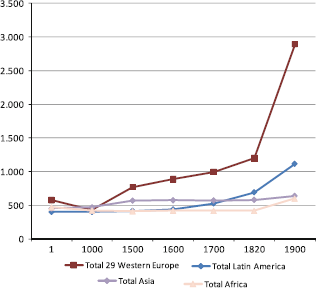
Historic development in per capita GDP in Western Europe, Latin America, Asia and Africa between years 1 and 1900.
This article offers a theory as to why the West—Europe and its colonies, such as the United States, that remained part of the same basic civilisation—has enjoyed global leadership over the past several centuries. Why Europe and not China, India or the Middle East, all of which had access to the same plants and animals and were technologically on a par with Europe through much of early history? The hypothesis presented here is that Western Judaeo-Christian values of respecting and empowering the individual, in combination with new communications techniques, have been decisive for the development and success of Western civilisation over the past 500 years.
The fifteenth-century revolution in communications
As Rodney Stark points out in his [4] book The Victory of Reason: How Christianity Led to Freedom, Capitalism and Western Success, Christianity was an important factor for development in Europe throughout the Middle Ages. Among the more important elements was the relative separation of church and state, which was rooted in Christianity's origins as a religion of the underprivileged in the Roman Empire. In contrast, Islam's prophet Muhammad was not only a religious figure but a political leader as well. Christians believed in the possibility of a better understanding of God through reasoning, reflection and research. Indeed, scholars studied religious topics, but through these activities they also created a methodology of research and reasoning that could later be applied to other areas of learning. First religious study and later the academic exploration of other topics took place in the universities, which were civilian, not religious, institutions. All these achievements throughout what some call ‘the Dark Ages’ set the stage for a revolution in communications in the fifteenth and sixteenth centuries.
For much of history, few means of communication were available to Europeans. Few people knew how to read and write, and parchment was extremely expensive. Printing technology did not exist and copies of books were therefore produced by manual transcription. Reproducing texts was slow and expensive work, and copies were available to just a few. Variety was also limited, with monasteries preserving the works of the ancient Greeks and Romans, along with the Bible and just a few other texts. Towards the end of the Middle Ages, however, the technology to produce cheap paper arrived in Europe via caravan routes from China. These developments enabled the exchange of knowledge and ideas among more people. Indeed, it is by communicating that all social relations are maintained, including within families, in businesses and in political life. The common experiences gained through communication also allow a society to be coherent and to advance. As more people learned to read and write, and more people began to share a recorded discourse, creativity started to blossom. Early engineers like Leonardo used paper for sketches, while scientists like Galileo used it for calculations. Business people began keeping records, commerce expanded and, laws were written. Educational institutions developed and, although school remained a privilege of the elite, over time the reach of education was extended, allowing more people to rise above the level of their birth.
The West embraced the communications revolution
With the advent of paper in Europe came the breakthrough of the printing press, invented by Johannes Gutenberg in the fifteenth century. When this invention first appeared, it undoubtedly posed a challenge to the established order of European society that had, until then, seen less communication and distribution of knowledge. However, Western civilisation's budding values of reason, the power of inquiry and, most importantly, its emerging respect for individual freedom and meritocracy—although not high by today's standards, but significant in comparison to other societies of the time—allowed this process to advance. By the sixteenth century, Europe, more than any other region of the world, was allowing people to learn, write, read and be creative. Based on these factors, Europe (and later the West as a whole) succeeded over the following centuries in creating a global advantage in the areas of technology, science, economics and the military.
The wealth of the Western nations
In his landmark 1776 book The Wealth of Nations, Adam Smith [3] cited two factors in the success of a nation: (1) the free market, which relies on the intelligence of the people when making decisions about the market; and (2) the rule of law that enforces responsibility and ensures that those with the best ideas and products win, not those who are the best at cheating or the most corrupt. Increased access to knowledge, provided by books, equipped individuals to make much better decisions in the economic market. Books also allowed for the publication of laws and regulations, thereby improving the application of the rule of law in a fair and consistent manner.
What Adam Smith did not mention as a factor in success, however, was democracy. Granted, a benevolent dictator can ensure that the market functions and laws are obeyed. History shows this can work for a time. As the British political theorist Lord Acton stated in 1887, however, ‘Power corrupts, and absolute power corrupts absolutely.’ The fact is that even benevolent dictatorships usually become less benevolent over time and evolve into systems that promote the business interests of the oligarchs over equal opportunities for all. The role of democracy, therefore, is to use the political market to ensure that someone takes responsibility for the functioning of the economic market and makes certain the rule of law works.
When we combine Adam Smith's first two factors with the element of democracy, which also first arose in the West, we can see that there are three interacting elements ensuring free and fair competition: (1) the economic market; (2) the rule of law governing that market; and (3) the political market that takes responsibility for the proper functioning of the first two. In order to promote the functioning of these three elements, written (i.e., recordable) communication is essential. Society needs written laws, records, contracts and so on. Information must travel the ladder of subsidiarity from local to national to global levels, and vice versa. And media are needed so that customers of the political market—the voters—are informed enough to make reasonable choices during elections.
Markets in the age of globalisation
Adam Smith did not live in the age of globalisation; his sphere of study was the nation state, which at the time also circumscribed most economies. But today we have a global economic market, which to varying degrees is shaped by nation states agreeing to rules in the form of international standards and free trade agreements. If it is desirable that in the global economy the best nation wins, then there is need for the rule of law for global governance—just as the rule of law is necessary in national economies. Promotion of democracy and the rule of law throughout the world is therefore in the interests of all who participate in the market; promotion of these values is not some imperialist imposition by the dominant players.
Freedom works, both politically and economically. The prominent role of the West in global affairs proves that. By promoting open markets, the rule of law and democracy, the West is giving away its recipe for success. But the West is also confident that it can compete and win in the future if the race is fair. The West should therefore continue to promote these values, while at the same time not forgetting to defend them at home. The West must remain vigilant in upholding the values that made it great—the empowerment of people, the rule of law, democracy, freedom of choice and a commitment to the intellect and talents of the people.
The role of democracy
Today, some are disappointed by the inefficiency of Europe's political structures, in particular with regard to the European Union, and are looking for more efficient alternatives. Sceptics also suggest it is possible to achieve economic progress without democracy and the values of freedom and responsibility. Indeed, it is possible—even in a dictatorship—to succeed by efficiently copying what the most developed societies have done in the past. Industrial development, for instance, can be planned, promoted and carried out by autocratic regimes in their home countries and even abroad. Free, empowered people are not needed for that, as others have already done the thinking. And yes, for a limited time an autocracy can be benevolent and even be a fair judge of what is happening in the markets.
However, those who are at the forefront—those who are pushing the envelope of development beyond what is known, as Europe and the United States are doing today—must continue to do so by empowering every person and making use of every brain. And this activity does not happen in closed, authoritarian societies; it can only happen in societies that unleash freedom, creativity and entrepreneurship. Efficiency on the part of decision-makers is not a core issue of the political system. The core issue for the political market is whether it has responsibility for the working of the market economy and the rule of law. Does the political system empower or does it take power away? That is the central question. The challenge is to bring the political discourse back to the important issues of economic freedom and responsibility, while not being sidetracked by the passionate appeals of those on both the populist left and right.
Conclusion: the twenty-first-century communications revolution
All of this is so much more important because the second Gutenberg moment—the modern incarnation of the printing press—is unfolding as we speak. Thanks to digital communications technologies, access to information, the ability to learn and the opportunity to network with a wide array of people are again increasing by orders of magnitude. Technology empowers those who can avail themselves of it, those with the freedom to use it and those with the capital to translate good ideas into profitable businesses. Not all parts of the West are equally good at this process (the differences between Europe and the United States are striking). But in general, the West has succeeded tremendously in achieving such a system.
During the Gutenberg revolution, Europe's respect for the values of freedom, empowerment and responsibility—minimal by today's standards but nonetheless significant for the time—became a key factor in the forward march of progress. The result was the Enlightenment, the Industrial Revolution and the eventual development of the societies we have today. The West harnessed the paper age to its own benefit, because its values enabled it to do so. Empowering people today, however, is even more important than it was in the past. The West will reap tremendous economic, political and social gains in the digital age if it remembers its values and acts accordingly. Only if the political and economic systems reflect the values of freedom, the rule of law and democracy will the best ones win.