




Abstract
Politicians in their role as information managers and developers could play an important role in leading communities via agreed expectations towards achievable results, thus becoming real leaders for sustainable democracy. The first section of this article focuses on the need for development in Africa and the specific challenges faced by development operations as the foundation for sustainable democracy in Africa. It describes the need for a holistic and integrated information management model as part of the project management body of knowledge aimed at managing the information flow between communities and development teams. It is argued that information, and access to information, is crucial to development projects and can therefore be seen as a critical success factor in any development project, particularly towards sustainable democracy. The second section describes the three information areas of the holistic and integrated information management model. In the final section we suggest roles and actions for information managers to facilitate information processes integral to the model. These processes seek to create a developing information community that aligns itself with the development project and supports and sustains it.
Keywords
Development projects in Africa: introduction and statement of the challenge
For the purpose of this article the authors wish to state that if the development of communities is one of the cornerstones of sustainable democracy, political representatives should inter alia become leaders in that development. They need to become leaders in the development of physical infrastructure, human potential, community relations as well as policies, systems and procedures in order to guide communities and nations towards sustainable growth, civilisation and freedom. Ideally, therefore, the function of political representatives, political parties and policy manifestos managed through the proposed model should include elements of information management and project leadership. The results of trustworthy, transparent information and credible development projects will also lead to the re-election of politicians, long-term careers for government officials, and involved communities—thus contributing towards sustainable democracy.
Both African leaders and international organisations [
The immediacy, relevance, trustworthiness and effective management of the flow of information are critical to the success of development projects [6]. This is especially so since internal and external stakeholders involved in development often have different expectations of development projects and, therefore, will respond differently to the objectives of projects and to the processes and procedures used to realise such expectations. It will, for example, be highly inappropriate for a development agency to build, without prior consultation (sharing of information) with the local community, a shopping complex on a piece of land that is regarded as sacred by this community.
The focus of this paper is therefore to propose an integrated and holistic information management model that can be used in development projects in Africa. The paper, which is primarily based on a literature study, is qualitative in nature and focuses on the description of the model. A minor empirical component is included which is comprised of personal observations and informal interviews with local people that were affected by development projects. One of the authors (Bester) has worked extensively on development projects in Africa for the last several years. The proposed model presented in this article is therefore not only based on a literature study but is also a result of the practical experience gained over the last few years.
The proposed information management model furthermore provides those engaged in development activities with some checklists to monitor and evaluate three areas of information use and their flows during the development process. The three information areas are as follows: (1) information related to the initiation and introduction of the development project, followed by (2) the application of information regarding the management of the development process itself (including strategic information and project management information), and (3) a seventeen-point checklist of community life to monitor the developing community. This re-emphasises the authors’ point of departure that communities are not merely important sources of information, but are also users and evaluators of information during development processes.
Three information areas
The proposed model is divided into three information areas as it relates to the flow and use of information during development projects. Information area 1 deals with information regarding initiating development. Information area 2 focuses on information regarding development management processes, and information area 3 considers information regarding the community life, culture and traditions of the developing community. For the composite model, see Fig. 1. In the following paragraphs the different information areas will be discussed in more detail. The link to development will also be illustrated.
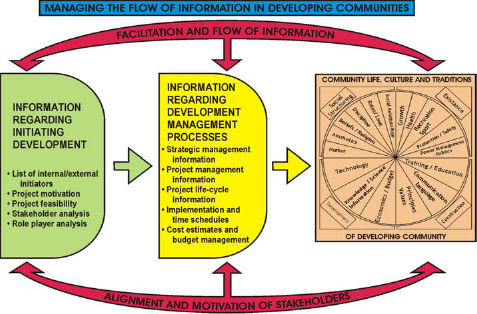
The composite model
Information area 1: Information regarding initiating development (motives, motivation, vision and mission)
In information area 1 of the model a differentiation is made between external and internal initiators of development. External initiators include, for example, international development agencies that initiate development projects in developing communities. The vision and mission statements formulated by the external project initiators, as set out in planning documents, typically reflect the intention, meaning and purpose, aims and general objectives of a development project, whereas specific management objectives provide information on the project strategy and/or methodology.
Bearing this in mind, it seems logical that the project's planning documents serve as the basis for the external and, to a lesser extent, the internal initiators of development to enable the effective management of information pertaining to the development project.
For a number of reasons—for example, different interpretation of information and local customs and culture—it may well happen that there is a marked difference in the interpretation of the vision, mission and expectations of the internal versus the interpretation the external initiators/stakeholders of a development project. Internal initiators/stakeholders, in other words the local leaders, will view the project and its impact from the perspective of the target community, that is, from the inside out, while external initiators/stakeholders view it from the perspective of the development agency, that is, from the outside in [
Based on practical experience and the literature [27], Greig, Hulme and Turner [9, cf.
Information area 2: Information regarding development management processes (project methodology information)
Central to any development project is not only the identification of action plans but also the actual implementation and evaluation of these plans. The Africa Development Bank refers to this as ‘results-based management’ [2]. The internationally renowned Association of Volunteers in International Service, which is involved in many development projects, formulates this as follows: ‘At the heart of project implementation is a human relationship between staff or volunteers and beneficiaries, rather than statistics of project impact or reach’ [4]. Information area 2 of the model focuses therefore on successful development project implementation rather than on the mere rationalisation of the objectives or motives for the project. Central to this information area is the management of project methodology information, that is, the information related to the planning, organising and control mechanisms required for the successful conclusion of a project. The information collected from information area 1 (motives, motivation, vision and mission) form the basis for the implementation strategy.
To identify options and alternatives available to the project manager, the project's viability and its strategy are further tested by an analysis of the project environment based on the information gathered during information area 1—in other words, collecting and analysing information from the local community and integrating it into the aims and objectives of the project. This can be expected to result in relevant planning, organising and control mechanisms. Since budgetary information is vital management information, this is included as an integral element of all other measurable sets of information.
A primary value of this second information area is that it can serve as a set of indicators against which internal and external stakeholders can continuously assess quality, mutual consent and progress, thereby ensuring the credibility of the development project.
The rationale for the inclusion of information regarding development management processes lies in the contribution this makes to both the management of project information and the enhancement of project credibility. In discussions with African leaders at the local government level during the SADC workshops [3], it transpired that when development projects are announced by (inter)national organisations or national leaders, the response of community leaders is often one of ambiguity and distrust, particularly when detailed implementation and management plans are not available. This confirms similar findings by Libasse [16] and Africa Farm [1]. Africa-Farm is an international non-governmental organisation that aims to reduce poverty in eastern and southern Africa and refers to its development projects as participatory management projects [1]. The organisation made it very clear that local communities have to be involved at all levels of development projects. Thus, the management of the implementation phase of a project must be guided, measured and evaluated on the basis of management information that is from the onset available to and shared with the target community.
Information managers can use the information generated in information area 2 as a set of guiding and management indicators to monitor progress and to evaluate the probability of a successful conclusion of the project. It also assists project management teams in the creation of a checklist as a tool to monitor and evaluate the project to ascertain whether it complies with agreed-upon motives, objectives, time schedules and budget allocations.
Information area 3: Information on the community life, culture and traditions of the developing community
A development project can, during its lifespan, be likened to a temporary organisation in which various groupings of stakeholders perform different ‘organisational’ roles. All stakeholders, both external and internal, generate and use information, and contribute to the formulation and realisation of the vision, mission, goals and objectives of the project. Since the community targeted for development is seen as the main beneficiary of the development project, community members, in particular, must be regarded as important stakeholders [23].
The target community, although expected to benefit most from the development project, also stands to lose the most. A development project may bring about ‘progress’ and provide community members with new skills and opportunities for growth; it may also, however, cause the community to sacrifice elements of its traditional ways of living, views of life and humanity, beliefs about what is right and wrong, etc. Eventually, the ‘success’ of the development project, that is, whether it brought joy or unhappiness to the community, will not be determined by the project managers but by the target community, and the community will decide whether or not the sacrifices were worth the benefits.
At the heart of information area 3 is the assumption that societies do not function in discrete categorised areas, but use strategies and integrated activities to adapt to and manage their environments so as to maximally satisfy their fundamental human needs [
Founded on the notion that individuals, groups and institutions exist on four levels of needs, which are thought not to be hierarchical or linear [
Roles and actions for information managers: facilitating the development process
The three information areas described in the previous paragraphs provide a framework to understand and structure the flow of information during development projects. The question arises: How should the information identified within the three areas be managed? This can be referred to as the facilitation process, and aims to align and motivate both internal and external stakeholders. The facilitation process is, in a sense, the vehicle for the management of the information generated in the information areas. Without this process there cannot be any effective management of the information flow related to the development process. If the flow of information between the three different areas is not managed in an effective manner, an environment of distrust or misunderstanding can result that can seriously hamper the implementation of the project plans.
Creating an information community
In this part of the paper the focus is on interaction and exchange of information between the different stakeholders. We refer to this as the development of an information community that evolves around the sharing of information not only to enable mutual understanding, but also to ensure the success of the project. Implicit in this understanding is the notion that an information community refers to an environment where groups of people are aware of the importance of information, and where they interact as a team to access information, which enables them to fulfil their needs, thereby facilitating their development [3].
In development projects, project management teams, and in particular information managers, frequently have the task to create an information community comprising the developing (target) community and the project team. The main focus will be on addressing effectively the information needs of all the stakeholders. For this to happen optimally, an active information flow between the project team and the developing community is necessary. Developing a successful information community depends on a number of factors.
These include the following:
Awareness of the need for information: Information is of no value if its usefulness is not appreciated. Thus, it is imperative that the developing community understands the relationship between its need for information and the achievement of specific goals, such as information needed to solve a problem, to survive or develop or to be educated. Olorunda [24] correctly argues that no development can take place without addressing the information needs of people. The developing community must, therefore, identify its need for information related to the development project, and this must be agreed upon and expressed [
Availability of information sources: Generally, information can be sourced in a number of accessible formats. Unless information sources are available to and accessed by the developing community, they are of no use [8].
Access to information sources: Methods used by developing communities to access, process and use information vary and reflect not only the level of education of members of the community, but also cultural attitudes. Literate community members can access text-based sources of information to find the information they need. It is also important to distinguish between access and accessibility of information. A person might have access to a book, but if the language is foreign and not understandable there is no accessibility of the content [7].
Infrastructural influences on the availability of information: The extent to which developing communities can develop towards the ‘ideal’ of an information community—in other words, to allow the successful exchange of internal and external information—depends largely on the communities’ ability to apply and integrate their customs and traditions with local industrial capabilities and with modern information and communication technologies such as the Internet and computers [29].
The main rationale for information management is the formation of an aligned information community in which the internal and external project goals, processes and procedures are shared as much as possible. Thus, one of the pivotal tasks of information managers that are involved in project management is to facilitate an information flow that addresses, from an information needs perspective, both the community's needs for development and the external development goals of the project. It is, moreover, important that these information managers be aware of existing gaps in the awareness of availability and access to the needed information, and the possible barriers to free information flow. They must inform themselves about existing credible, available, accessible and usable sources of information in the community and be knowledgeable about common methods of communication, such as oral communication through community leaders, newspapers, electronic communication, etc. Where needed they should design strategies for managing information within the constraints and opportunities identified. Information managers could, for instance, begin the communication process at the level of the existing, indigenous knowledge that resides within the local community. Gradually the ‘foreign’ information can be introduced, and how this new external information might benefit the community can be illustrated. In this way mutual trust can be built, and certain community members may be identified to introduce the external/foreign information into the community on the information manager's behalf, since it is more likely that the information will be accepted if it comes from an internal source, particularly if it entails a departure from a traditional practice [11]. If information managers can guide the community towards discovering or uncovering the new information and put it into use, the possibility that the community will accept this new information will be reinforced.
Pertinent questions information managers must answer include the following:
Is there a lack of information relating to the development project amongst the community in terms of content and format?
What information is available, accessible and usable, and is the community aware of its need for this information?
How can the community receive usable, credible and relevant information about the project while keeping in mind the content, sources and format needed to relay the required information?
Knowledge of information and consequences for information management
Human survival and development is inextricably linked to both individual and group knowledge. Knowledge is not only crucial to preserve and maintain what is valued, but is just as important for change. Knowledge is not, however, neutral. The roots of knowledge reside in a particular culture and reflect a particular worldview, a mental map [18]. In developing communities indigenous knowledge plays a pivotal role that needs to be taken into account in any development project. It is constructed over time, with one generation sharing its norms and ideals with the next. In contrast, the information that is imported into the community by development workers is largely foreign and relatively recent [12]. At times this imported information is imposed upon the community, at times it may be borrowed by choice, and, if successful, it may be integrated into indigenous knowledge as an integral part of community development [25]. It seems logical, therefore, to assume that communities might reject, distrust or undermine the introduction of new ideas or information if this is seen as a threat to the continued existence of the community's culture, religion, language and way of life. It can be expected that once the community considers the new information relevant and contextually acceptable, it will more readily engage with the integration process. It is imperative that project leaders, including the information managers, understand this and manage both indigenous and foreign knowledge in ways that promote and enhance the development process.
Motivation is of crucial importance for the sustainability of development projects. Motivation is also more likely to be maintained if applicable information is freely available throughout the project and is credible. Experience gained at workshops with initiators and facilitators in government and community contexts has shown that information sharing is one of the most important elements to motivate communities and to build trust and enhance their sustained acceptance of and commitment to development projects [3].
Based on their knowledge of the developing community, information managers who are involved in project management should ensure that they:
are aware of the ability of the local community to correctly interpret new information;
make the information needed accessible through appropriate and usable formats;
monitor, interpret and address the community's changing needs and feelings towards the project, so that progress can be made in terms of the objectives of the project;
make available to the community the new information needed to fully comprehend the project objectives so that it can become integral to the community's existing knowledge of the development project; and
understand the reasons, if any, for a community's resistance towards the project, and find ways of addressing these issues.
Facilitating information flows
Both the guidelines developed by Pippa Norris [23] and our own experience suggest that when project managers enter a developing community their first priority should be to determine whether the environment of the intended development project is conducive to sustainable development. Once this has been positively established and the project has commenced, the project manager must observe its potential impact on the life and needs of the target community. In order that this be done well, the proposed model encourages an awareness of the different characteristics, needs and existential elements of developing communities. With motivation and commitment depending to a large extent on the provision of timely, credible and usable information, facilitation processes depend on the early compilation of a holistic information map for the development project. The information map reflects the three information areas discussed earlier. It is then possible, based on the information map, to facilitate the information flow between the developing community and the project team. The information manager should be aware of any relevant local or indigenous knowledge that may exist in the community which may impact on the project. With the assistance of information managers, the flow of the local or indigenous information back to the project managers and, possibly to the project initiators, might create a new information base that could be used to inform the project team. From time to time, therefore, information managers should be prepared to resort to the methodology of change management. Some pertinent questions in this respect are the following:
What does the community need to know regarding the envisaged project?
How can new information be integrated into existing local structures of information?
How can the community's traditions, beliefs, norms and values be accommodated without compromising the aims and objectives of the project?
How can the community's traditions, beliefs, norms and values be accommodated in such a way that information is communicated, used and applied by the information manager?
How can differences between existing information and new/foreign information be reconciled? Can the new information be interpreted in terms of the existing knowledge? Is more background knowledge needed? Does the new information clash with existing beliefs?
Based on the answers to the above questions it might be necessary to include change management processes into information and project management.
Given that a project could easily come to a halt because of the lack of community involvement, it cannot be stressed enough that project and information managers must ensure that information about the project and the internal and external needs is freely and readily available. To do so, the following processes are suggested:
Facilitation of the needs analysis and needs prioritisation of the developing community within the holistic approach.
Development and maintainance of networks as information instruments in the process of development.
Facilitation of needs analysis and prioritisation of needs
How, then, can the needs of the developing community be prioritised and addressed? We take as a starting point that all communities are engaged in a range of distinct but often interrelated cultural activities such as health, education, religion, politics and economics (see Fig. 1). The holistic development of the community will be possible only if these activities are integrated into a single, holistic approach. Crucial to the success of such an approach is the information managers’ ability to
see the expressed needs from the point of view of community members;
manipulate specific needs in such a way that different aspects are balanced;
negotiate the feasibility of addressing the community's expressed needs by painting the whole picture for them; and
prioritise different needs in cooperation with the community.
Information managers should, moreover, be aware of different priorities within the developing community and understand the differences between the community's ‘wants’ and the community's ‘needs’. Even though the community might initially not agree, the information manager must motivate and assist the community to prioritise its information needs in terms of the developmental goals as jointly formulated by the information manager and the community at the onset of the project.
Community consultation as a source of information in development projects
As I have argued, it is important to consult the developing community when one intends to launch a development project. This is a complex matter and covers many kinds of information that needs to be gathered. In information area 3 these different kinds of information are presented. It provides for the accommodation of four levels (the quadrants) comprising 17 interrelated components representing specific sociocultural actions with clustered activities and community or appointed leaders to guide the community on related matters. Consulting the community in matters of importance means that one needs to take note of each level and its components, adopt a balanced approach in accommodating the cultural components and base community consultation processes on these.
In the consultation process it is important that project managers should strive to include all community leaders representing the different sociocultural and political spheres. Moreover, the project management team should create strategies to keep all community stakeholders fully informed—sharing both good and bad news—and establish communication channels between the community leadership and the project management team, thus providing opportunities to discuss positive and negative aspects of the project. This should create lasting credibility for the project, build trust and assist in curbing the influence of local politics.
The following checklist for community consultation is suggested:
Description of the envisaged development project.
Objectives for the development project.
Motives and motivation for the project.
Strategy and management plan for the project.
Financial benefits/implications for the project.
Possible information on local knowledge regarding the project.
Possible indigenous knowledge that could influence the project.
Processes used by an information manager to consult the community might include sessions that aim at
informing community leaders of the background to the project and providing them with basic information in this regard;
answering possible questions that the community has and creating opportunities for leaders to report back to their constituencies/interest groups; and
guiding community leaders towards the project objectives and informing them of project progress so that they experience the movement and success of the project.
Conclusion
We have argued that information and access to information are crucial in community consultation for development projects and can, therefore, be seen as a critical success factor in any development project and ultimately also in building sustainable democracy. Based on these premises we argued that there should be a holistic, multidisciplinary and integrated approach to the management of information in development projects. An integrated model was presented that can be used by political leaders, governments and project management teams to provide greater insight into the information needs and the information flow in developing communities.
The successful implementation of this model will benefit not only democracy and development organisations but also individuals, interest groups and local communities. It does not only take into account local customs and culture, but takes also as a starting point the information needs and behaviour of individuals, interest groups and local communities.
Footnotes