




Abstract
Having developed a successful example of cross-border cooperation in public governance, EUREGIO has played and continues to play an important role in cohesion policy in the context of multi-level governance of the European Union. Van Winsen explores the legitimacy of the EUREGIO Council noting that there is still room for improvement in this context. By increasing the competences of the Council and putting in place direct elections, more legitimacy could be achieved. On the other hand, however, Van Winsen praises the 50-year-old initiative, underlining how positively it has been able to serve the interests of citizens in areas such as the labour market, cross-border healthcare and infrastructure across Europe.
Introduction
In 2008, 50 years since the first cross-border region, EUREGIO is special, not only because it is established. Why is EUREGIO so special? Not only because it is considered to be the cross-border association with the longest cross-border experience, or because it has developed a special form of cross-border governance over the years, but especially because it has a political component, the EUREGIO Council. This cross-border regional council consists of political parties on a cross-border level: Dutch and German political parties work together in common factions. In this respect the EUREGIO Council functions as a parliament, with elected, democratically legitimated politicians. Because it is democratic EUREGIO functions close to the citizens in municipalities and districts. This article, after a short description of the main tasks of EUREGIO, will demonstrate that cross-border political cooperation supplies an added value to further development of EUREGIO. This added value can still be strengthened by cooperation on the political party level. A special and unique example of this is the CDA-CDU EUREGIO Association, founded in 2007.
What is EUREGIO?
EUREGIO, founded in 1958, is the oldest regional cross-border organisation in Europe; an association with a bottom-up structure, involving 130 Dutch and German municipalities, towns and administrative districts, situated in parts of three Dutch provinces (Overijssel, Gelderland, Drenthe) and parts of two German states (North Rhine-Westphalia, Lower Saxony), with approximately 3.4 million inhabitants.
The objective of EUREGIO is to stimulate and coordinate cross-border initiatives and cooperation. EUREGIO is especially engaged in
socio-cultural cooperation, through people-to-people contacts;
socio-economic development, stimulated by European INTERREG programmes; and
advisory and information services for the citizens in EUREGIO.
Within EUREGIO, the EUREGIO Council functions as a cross-border parliament.
EUREGIO started as an initiative for cross-border cooperation between local governments in Germany and The Netherlands. Links between these regions were originally formed a long time ago. In 1648, as a result of the Peace of Miinster, national borders were imposed between the Protestant Dutch part on the one hand and the Catholic German part on the other, between the Ems region and the Munsterland. Nevertheless, in everyday life bilateral relations were soon restored as a result of the similarities in language, inevitable economic cooperation and cultural exchange. For example, there were textile industries on both sides of the border and so the region was widely known as the ‘cotton route’. During and immediately after the Second World War, mutual contacts were abruptly broken as a result of deeply rooted distrust, especially on the Dutch side, which was very hard to overcome. But not long after 1945 official contacts started up again rather quickly, even though inhabitants of the border region still avoided meeting each other. In 1954 this resulted in an association, established by local governments on both sides of the border, aimed at improving the infrastructure in the region and, most of all, at promoting mutual contacts between people from both sides of the border.
Moreover, the municipalities near the border started cooperating in order to gain the same benefits that other parts of the countries had already begun to experience. By doing so, they hoped to strengthen the economy in the border region while at the same time improving the region as a whole. Inhabitants of the border communities were themselves also interested in renewing the contacts. After the establishment of EUREGIO in the area Rhine-Ems-Ijssel, which will from now on be referred to as EUREGIO, a number of other ‘Euregio’ regions across the Dutch-German and the Dutch-Belgian border were established. EUREGIO served as an example and role model for these.
EUREGIO can be considered a European region. It is geographically defined as an established organisation that develops plans within the border region. These programmes are based on two principles:
the disappearance of borders in social, cultural and economic terms; and
the principle of ‘one region’.
For the first 20 years of its existence, EUREGIO aimed at fulfilling its desired goals by means of voluntary cooperation. Within this framework, local governments carried the associated costs. Eventually EUREGIO managed to acquire financial support from Brussels. Fifty years later, however, EUREGIO has developed into a body based on political cooperation. Its first and most prominent objective is to promote, support and coordinate cross-border cooperation. Secondly, EUREGIO aims to offer solutions to cross-border problems and stand up for the interests of the border region. Furthermore, EUREGIO has the capacity to initiate activities, programmes and projects in socio-cultural integration, tourism and culture, sports and education, town and country planning, infrastructure, science and technology. The dynamic of supply and demand from citizens as well as from companies, organisations and communities within EUREGIO is taken into account in this process.
EUREGIO has reached many milestones in the last 50 years, but also has faced a wide range of problems.
Priorities of EUREGIO: social cultural integration and social economic development
The most important objective from the beginning was improving contacts and cooperation between citizens by eliminating border blockages in ‘everyday life’. This is still the raison d'etre of EUREGIO and even the motivation for cross-border cooperation, although later on economic development became more and more a priority, thanks to the INTERREG programmes.
Therefore, the first and most important policy topic in which EUREGIO is involved is socio-cultural integration. High priority is given to the promotion of people-to-people contacts in many fields. Through a variety of activities, cross-border contacts and cooperation are encouraged between communities, organisations, schools, sport clubs, music associations, seniors and so on.
The Mozer Commission
In 1971, a committee responsible for this task, the EUREGIO Mozer Commission, was founded. This committee was entrusted with the promotion and coordination of socio-cultural contacts in specific areas, such as youth, senior and family encounters, musical events, education, social contacts, sports and tourism. And, more recently, the promotion of the inter-cultural dialogue as well. The Commission establishes possible contacts and serves as an advisory body for the organisation of innumerable cross-border activities. Another major task of the EUREGIO Mozer Commission involves inter-municipal cooperation and partner towns. In practice, this means that activities are organised between partner communities, such as exchange programmes between community members and their organisations and cooperation in different kinds of community services.
The EUREGIO Mozer Commission is the oldest working group within EUREGIO. It has extensive experience and over the years approximately 100,000 people every year have participated in all kinds of exchanges, sharing their ideas and experiences or simply just taking part in various cross-border activities and events.
Interreg
In 1987 representatives from both sides of the border signed the first ‘Cross-Border Action Programme for EUREGIO’. The most important goal of this cross-border action programme was the stimulation of economic development and internal integration. This programme was established because of the fact that The Netherlands and Germany had to deal with the same communal problems in several fields, such as agriculture, ecology, and regional and economic development. Besides these issues, the programme also paid attention to the organisation of meetings and exchanges, the possibilities for stimulating the labour market, the service sector, tourism, infrastructure, nature and the environment.
Through the establishment of this Cross-Border Action Programme EUREGIO in fact laid the foundations for the later INTERREG, the subsidy programme for border regions initiated by the EU. While EUREGIO cannot be considered the ‘inventor’ of INTERREG, it was, however, the starting point of the successful EU subsidy programme for border regions. This can be seen, for example, in the fact that both apply similar methods of analysis, based on the strength/weakness analysis of EUREGIO. Once more, this proves that EUREGIO was one of the first organisations to foresee the profitable opportunities for cross-border cooperation. Meanwhile, three INTERREG programmes have been successfully implemented and another, INTERREG IV, began recently.
INTERREG is the best-known subsidy initiative of the European Union to support and stimulate European border regions. The goals of INTERREG are twofold:
the improvement of the regional economy and the increase in living standards of the inhabitants of those regions;
support for cross-border integration in the regions.
INTERREG programmes:
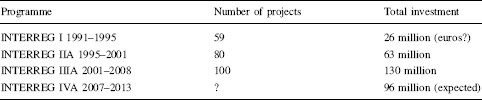
Through the European subsidy programme INTERREG, the EU killed three birds with one stone: first, its goals are better integrated within the policies of the Member States; second, economic incentives are created for the border regions; and, finally, socio-economic and cultural integration are promoted, through which Europe can become ‘one’ more than ever. EUREGIO has contributed to this by being the first to initiate a cross-border programme. As stated earlier, the policy formed by EUREGIO has laid the basis for the successor programme INTERREG. In turn, INTERREG has created added value for EUREGIO. INTERREG shifted attention from socio-cultural initiatives–-the EUREGIO Mozer Commission–-to socio-economic projects that are financed by INTERREG, although the high priority given to socio-cultural work has never disappeared. Because of its large financial contributions we can state that the EU does attach value to cross-border relations between border regions because, in the end, the entire EU benefits from these relations. From the point of view of the EU the added value of cross-border cooperation is evident.
Political Cooperation in the Border Region: The EUREGIO Council
In 2003 festivities took place to commemorate the 25th anniversary of political cooperation within EUREGIO. In 1978 the EUREGIO Council, the first cross-border regional parliamentary assembly in Europe, was established with competences that were formulated by the Council itself. However, most decisions were of an advisory character. The Council can be referred to as a ‘little European Parliament’ aimed at realising the activities of the EUREGIO in a transparent and democratic way. However, EUREGIO is primarily an administrative body engaged in implementing the principle goals within the framework of regional, cross-border cooperation.
In 1978, the EUREGIO Council started with Dutch members and 25 German members, who are primarily indirectly chosen representatives from villages, towns and districts (called Kreisen in Germany). In the meantime, the EUREGIO Council has been extended to 82 members: 41 Dutch and 41 German. Representatives on the Council are chosen by means of indirect elections. The results of the municipal council elections determine the distribution of political parties in the Council, since the members of the EUREGIO Council are chosen by the municipal councils. By establishing the EUREGIO Council, EUREGIO was able to realise a broader-based legitimacy. Although it has, as a ‘para-parliamentary body’, no formal legislative competences, it is the most authoritative among the Euregio bodies.
The representatives from the diverse political parties on the Dutch and German sides form cross-border political parties, just as in the European Parliament. The difference is that a ‘pan-Euregional party’ such as, for instance, the European People's Party in the European Parliament, does not exist. However, such a possibility seems likely in the future, a prerequisite being that direct elections should be held. The phenomenon of cross-border political groups is still rather unique for border regions.
The EUREGIO Council will play an important role in the future of EUREGIO. This will not only depend on the question of more competences and legitimacy. Having roots in municipalities and districts, and therefore working with and close to the citizens in their municipalities and districts, the Council's role is growing, because local politicians in their municipalities are often confronted with cross-border problems. ‘Euregional’ matters on border problems will become more frequent on the political agenda. The Council's responsibilities could become an actual part of the set of tasks of every municipality, while at the same time the broader coordinating tasks could be delegated to EUREGIO as an extension of local government. The EUREGIO Council was founded simply to supply EUREGIO with a certain level of democratic legitimacy and, ideally, to be a ‘think tank’ which engages citizens in their municipalities and assists in removing barriers by finding practical solutions.
How can the EUREGIO Council function in the future under new circumstances after 2013? It is clear that the Council should concentrate on and specialise in certain issues that are of high importance for the development of EUREGIO and respond to the needs and wishes of the participating members. Its geographic position on the European East-West transport axis, for example, means that infrastructure is an important priority; but issues such as the cross-border labour market, health care or cultural cooperation must also be taken seriously into consideration. For such a new approach, EUREGIO and the EUREGIO Council have to develop more expertise. And, certainly, to reach the perceived goals and objectives, the lack of competences should be dealt with so that the Council can take over all cross-border tasks. The desire to acquire new competences will subsequently give a positive impulse to the drive for democratic legitimacy and the democratic dimension of EUREGIO.
Competences and democratic legitimacy
Ideally, democratic legitimacy could be enhanced by giving the Council a direct mandate from citizens through direct elections, possibly in combination with municipal elections. The commitment of the citizens will improve because of the more direct engagement, through their representatives, with cross-border concerns, which are becoming more and more visible in the living environment of each citizen. At the same time, the political programmes should acquire a set of tasks that are close to the perceived needs of the municipalities, where, as already stated, cross-border subjects appear more and more often on the local political agenda. Moreover, such a system could enable stronger participation by citizens. But such a system requires that the exact role and activities of the elected EUREGIO Council be clarified. That means a set of competences. And of course party politics will become more important with direct elections. But without acquired competences from the different governmental levels, it will remain–-for the moment–-only desirable. The EUREGIO Council should meanwhile make better use of all its instruments in order to function as the democratic institution of EUREGIO. As a result, for EUREGIO to achieve its goals means that it has to use all persuasive means when convincing European, national and local government and parliaments to align their policies with Euregional objectives.
Even so, some studies and observers have argued that the lack of competences, which would force local and other authorities to cooperate, has in fact contributed to the success of EUREGIO. In the long run, the need to persuade and convince will probably lead to cooperation with these authorities. In this situation the chances of success are considerably higher. As a result, EUREGIO can be considered as a political organisation–-perhaps without many competences–-but with broad support from administrative levels, from both sides of the border.
The largest cross-border faction within the EUREGIO Council is the CDA-CDU. The unique element in this example of political cooperation, compared to other factions in the EUREGIO Council, is that this faction formalised cooperation very early through protocols, a common vision and joint activities. We reflect below on the origin of the cooperation, the general goals and the points of action of the last few years. We will first show how this cooperation grew out of comprehensive political party cooperation: the forming of the CDA-CDU EUREGIO Association.
Party political cooperation: the CDA-CDU EUREGIO Association
When the EUREGIO Council celebrated its fifth anniversary in 1982, the CDA and CDU decided to further enhance their cooperation on the Council by setting down the prerequisites and goals of the Council in a political programme. In this way, cross-border cooperation among Christian Democrats within EUREGIO could be better institutionalised, including more and more outside of party meetings. The underlying idea behind the political cooperation between both political parties was the conviction that the CDA and CDU could together better serve the well-being of the EUREGIO area and its residents. The basis for cooperation was the statutes and political programmes of the CDA and CDU. The documents that set out the cooperation between the political parties show that the CDA-CDU faction was at first focused on the stimulation of socio-cultural contacts and programmes. With the rise of INTERREG, attention shifted to predominantly socio-economic subjects, although the cultural aspects remained high on the agenda of the faction. Building on cooperation within the faction in the EUREGIO Council, steps were taken in 1988 to establish broader party cooperation between the CDA and CDU in EUREGIO. These led first to the establishment of the CDA EUREGIO Association on the Dutch side, an initiative of the CDA departments in Overijssel, Gelderland, Drenthe and (till then) Twente.
The goals of the CDA EUREGIO Association could be divided into general and special goals. The general goals were the goals of all Christian Democrats, as recognised on a national (CDA) and European level (EPP). Of interest are the special goals that are specific to EUREGIO: through implementing six concrete goals–-in which the relationship with the CDU is referred to–-the CDA EUREGIO Association hoped to serve the interest of EUREGIO with support from provincial, national and European governments and parliaments. By involving their German colleagues upfront the CDA seemed to have created a template for future political cooperation. Although officially there were no talks at that time on cooperation between the CDA and CDU, the documents suggest that such talks did in fact take place. The last and probably decisive step to complete party political cooperation was taken in April 2006. During a meeting of the CDA EUREGIO Association, to which the German CDU partners were invited, a manifesto for intensive cooperation between the CDA and CDU was unanimously adopted. It signified the decisive step to the establishment of the CDA-CDU EUREGIO Association. Furthermore, on 23 November 2007 actual cooperation was accomplished.
After the agreeing on the broad political basis, the next concern was to lay out the party political cooperation of the CDA and the CDU for the future. Although in practice the CDA and CDU were already engaged in intensive cooperation, formal establishment of the cooperative relation was realised in 2007. The fact that this cooperative relation did not exist before can be attributed to the differences in the structure and organisation of the parties: the CDU did not have a structure comparable to the CDA EUREGIO Association; personal contacts between members of the parties weren't institutionalised; and, finally, due to the fact that cooperation which took place through other channels was satisfactory, no new institutionalised contacts between the parties were necessary at first.
The CDA and CDU have always been forerunners and innovators with respect to party political cooperation, not only in the sessions of the EUREGIO Council meetings. Several contacts existed, many meetings, congresses and seminars have been organised since the early 1970s and common goals were formulated. Now Christian Democratic cooperation has led to a new and prolonged initiative with the creation of the CDA-CDU EUREGIO Association. By extending and improving political cooperation on a party political level it is possible to make better use of existing networks. Moreover, cooperation on the party level creates the opportunity to influence complicated processes of decision-making on the national and European level on both sides of the border. Specific EU regional themes can be part of the political programmes and policies. This means that choices can be made about which political issues should get priority. CDA and CDU politicians from different levels should agree on a common agenda or even on a common CDA-CDU cross-border
political programme. Such common programmes would enable the CDA-CDU EUREGIO Association to tighten bonds with politicians on different levels and to promote cross-border issues in parliaments and within governments. The composition of the association, with members from the European Parliament, German Bundestag and Dutch Parliament, Lander, Kreisen and Provinces, is a guarantee for close contacts, to better promote the interests of EUREGIO and its citizens.
Finally, the long experience of Christian Democrats in EUREGIO and the step-by-step approach to creating well-functioning cross-border party political cooperation could be helpful as an example and guide for political parties in other cross-border regions which are at various earlier stages of development.
Conclusions
In the 50 years since it began, EUREGIO has been able to develop a successful model for cross-border cooperation in public governance, by creating a structure among municipalities and districts in EUREGIO that served the interests of their citizens. It gave impetus to other initiatives and new types of cross-border cooperation in Europe. In fact, EUREGIO as a pioneer has played an important role in the cohesion policy of the European Commission in the context of multi-level governance. It anticipated the initiative of the Council of Europe (1980), which defined in the Madrid Convention a juridical framework for cross-border cooperation.
The EUREGIO Council has proved to function as a parliamentary body. Its members represent the municipalities and districts in EUREGIO. This provides EUREGIO with a democratic dimension, but this democratic legitimacy is still limited because of the lack of competences and the absence of direct elections. Nevertheless, the EUREGIO Council's role will improve because of the continual linkage to the local activities of the municipalities and districts from which it obtains legitimation and on the condition that this ‘little European Parliament’ make use of all its available instruments and networks.
The added value of political cooperation within EUREGIO has been proved over the past decades. The prospect of strengthening this cooperation on a party political level seems quite promising. By establishing the CDA-CDU EUREGIO Association, the CDA and CDU in EUREGIO have succeeded in finding new, innovative ways to deal with new challenges in the further development of cross-border cooperation in EUREGIO.
Footnotes