




Abstract
This article provides an overall survey of Europe's demographic patterns and statistics. It identifies economic progress, institutional modernisation, and development of the welfare state as factors contributing to fertility shifts and particularly to postponement of childbearing. The authors suggest Europe needs policies aimed at demographic renewal which focus first on diminishing direct costs borne by both parents and second, on diminishing indirect costs born predominantly by women. If Europe can effect the necessary paradigm shifts in gender roles and society it will prepare the way for holistic solutions.
Keywords
Low birth rates and fertility: a matter of concern
Over the past 50 years, the population of the European Union (27 countries) has increased by 94.5 million, from almost 403 million in 1960 to 497.5 million in 2008 (as of 1 January). The pace of population growth in Europe has changed over time. 1 In the 1960s the average annual growth equalled 3.5 million persons (0.8%) annually; this rate declined until it reached a level of 1.1 million (0.3%) per year in the 1990s. During the past decade the rate of population growth in the EU has risen again: between 1998 and 2008 the European population increased annually by 1.7 million (0.45%) on average.
Throughout this article, ‘Europe’ refers to the EU-27.
This growth is a result of both natural increase (i.e. a surplus number of births over deaths) and net migration (i.e. the difference between the number of immigrants and emigrants). Until 1992, natural change constituted a more significant part of the population increase. Now, however, population growth is due mostly to migration, which accounts for about 80% of the total population increase in Europe.
Such a shift between the components of European population dynamics results from two trends: growing net migration, which started in the mid-1980s, and at the same time, lessening natural increase, that is, a decline in the number of births (at least until 2002-2003) together with a increase in the number of deaths (with a slight decline in recent years).
Natural population change reached its lowest level of 104 thousand persons in 2003, while the highest level was observed in 1964, amounting to 3.6 million.
Both natural increase and total population change are unevenly distributed across Europe. In 2007, nine of the EU-27 countries witnessed a negative natural increase (natural decrease in population: six are the new Member States Bulgaria, Estonia, Latvia, Lithuania, Hungary, Romania, and the remaining three are Germany, Italy and Portugal). In the case of Portugal, 2007 was the first year of population decrease, while the remaining countries had dealt with this situation since the early 1990s. Another eight countries have periodically experienced a natural decrease of different scale during the past decade (Czech Republic, Germany, Greece, Austria, Poland, Slovenia, Slovakia, Sweden). Some countries have compensated for their natural losses in population by immigration. Considering the contribution of natural change (increase or decrease) and net migration to population growth or decline in 2007, one can divide the EU-27 countries into the following groups [12]:
growth due primarily to net migration–-19 countries (including Belgium, Czech Republic, Denmark, Ireland, Greece, Spain, Cyprus, Luxembourg, Malta, Austria, Slovenia, Slovakia, Finland, Sweden)
growth due primarily to natural change–-two countries (France, United Kingdom)
growth due only to natural change–-one country (Netherlands)
growth due only to net migration–-two countries (Italy, Portugal)
decline due only to natural change–-four countries (Germany, Estonia, Hungary, Romania)
decline due primarily to natural change–-three countries (Bulgaria, Latvia, Lithuania) • decline due primarily to net migration–-one country (Poland).
In the first two groups, both the rate of natural increase and the rate of net migration were positive; however, in the first group the net migration was significantly higher than the natural increase rate, contrary to the second group. In the third group, natural increase was positive and significantly higher in absolute value than negative net migration.
The fourth and the fifth groups are characterised by negative natural increase accompanied by positive net migration. In the former case, however, the natural population losses were compensated for by migration, while in the latter, the net migration rate was too low to offset the natural decrease. In the sixth group both rates were negative, with a greater contribution from natural decrease due to declining population size than to net migration. And in the last group, negative net migration cancelled any positive natural change and brought about population decline.
As has already been mentioned, births, one of the two components of natural change, are the main driver of population growth. In Europe, the number of births has been declining from the mid-1960s (7.8 million live births in 1964) until the beginning of the 21st century, reaching the lowest level of 4.99 million live births in 2002. Recently, a slight but visible increase can be observed (Fig. 1).
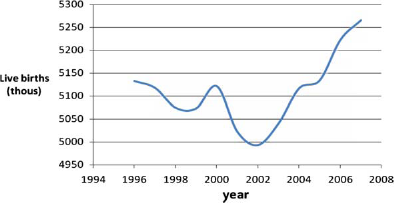
Number of live births, EU-27, 1996-2007.
Again, the increase in the number of births is not uniform at the country level: only 14 countries of the EU-27 experienced this recent increase.
To a large extent, the number of births depends on population size (which is also the case for the crude birth rate per thousand persons) and on the population age structure, especially on the number and age composition of women of reproductive age. The most common indicator used to analyse number (or intensity) of births in a given year is the total fertility rate, or TFR. The TFR stands for the mean number of children that will be born to a woman during her life span (assuming age-specific fertility will remain unchanged in the future). The TFR is a so-called period measure and depends both on the number of children born (quantum) and the timing of childbirth (tempo). The TFR equals about 2.1 when fertility is at replacement level; that is, when consecutive generations of parents and children are of the same size.
In the 1960s, fertility in Europe was well above the replacement level in both in old and new Member States (Fig. 2), and only two countries (Italy and Lithuania) witnessed below replacement fertility. Since the 1960s, the TFR in the EU-27 has fallen by more than 40%.
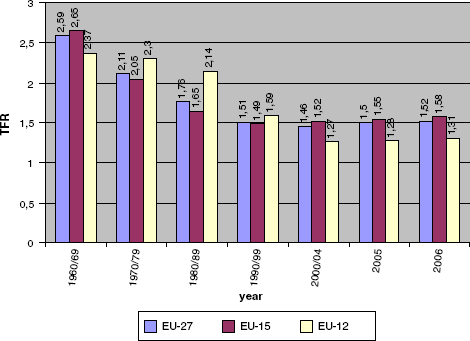
Total fertility rate for EU-27, EU-15 and EU-12, 1960-2006.
After this period, fertility levels throughout Europe steadily declined–-first due to the decrease of fertility in the ‘Old Europe’ (EU-15), and then, from the beginning of the 1990s, due to a rapid and steep decline of fertility in Central and Eastern Europe as well as in Southern Europe. In the EU-15 fertility rates dropped below the replacement level already in the mid-1970s, and nine of the EU-15 countries experienced a TFR lower than 2 during these years. In the 1990s, the TFR exceeded a value of 2 (2.09) in only one country (Cyprus).
This period saw the European average fertility rates reach the level defined as ‘very low’, that is, less than 1.5 children per woman. Moreover, in countries of Southern, Central and Eastern Europe the so-called lowest-low fertility rate (below 1.3) has emerged. Particularly in the late 1990s, this lowest-low fertility reached extreme values in several countries: Bulgaria 1.09 in 1997, Latvia 1.12 in 1998, Czech Republic 1.13 in 1999, Spain 1.16 in 1996 and 1998, and Italy 1.19 in 1995.
In recent years, and especially after 2002, signs of fertility recovery can be observed. In 2006 and 2007, the TFR was slightly higher in the majority of countries than it was in 2000. However, in 2007 there were still 10 countries that could be classified as low fertility countries and five as having lowest-low fertility [12]. Malta and Portugal are newcomers in the latter group. In 2007 Slovakia had the lowest TFR, at 1.25 children per woman. On average, Europe as a whole and the EU-15 specifically can be considered as a low fertility region (with a TFR of about 1.5), while the EU-12 countries create a lowest-low fertility area (a TFR of about 1.3).
From the point of view of replacement, low fertility means that the next generation of newly born Europeans would be roughly one-fourth smaller than the generation that currently has children. In case of the EU-12, the size of the offspring generation would be about one-third smaller than the parent generation.
Analysis of the data reveals two processes. First, on average European women currently give birth to around one child less than in the 1960s. Second, there is a visible convergence of fertility levels in European countries: the difference now between the highest and the lowest TFR in European countries is around 0.7, while in the 1960s this difference amounted to around 2.0.
Though the differences are smaller and the TFR varies across European countries within a narrower range, both maximum and the minimum values of the TFR remain below replacement level. As a consequence, the relatively small differences in the TFR make a huge difference for future demographic renewal.
First, it should be noted that one of results of low fertility, which is of critical importance to Europe's demographic development, is the negative momentum of Europe's population. The negative momentum means a built-in tendency in the current population age structure to decline, caused by small-size cohorts of young people (the effect of low fertility over the past several decades), and consequently, an increasing proportion of the elderly. The older population will produce smaller numbers of offspring, not enough to replace the generation of parents, which in turn will lead to further population decline. In Europe, this transition from positive to negative momentum occurred around the year 2000 [21]. Hence a long-term decrease in fertility to the level of 1.5 or less may bring about an almost irreversible population decline.
Besides, one should keep in mind that the difference between low fertility (TFR about 1.5) and lowest-low fertility (TFR less than 1.3) means that in the latter case, 20% of women have one child less than in the former one. Of course, between fertility at a TFR level of 1.98 (the highest European level in 2007, in France) and a TFR of 1.3, the ‘losses’ are much higher.
Taking into account the impact of low fertility on population renewal, one can conclude that maintaining fertility at a level higher than 1.6 children per woman should be a very important policy goal. At the same time, the negative momentum effect suggests that it may be easier to keep fertility at the level of around 1.6 children per woman than to raise it to this level from lowest-low fertility rates.
In this context, Lutz, Skirbekk and Testa [22] point out the risk of a ‘low fertility trap’. Their hypothesis describes a reinforcing mechanism consisting of three components: demographic, social and economic. The demographic component refers to negative population momentum. The social component says that there exists a kind of social feedback in which persons with fewer siblings are more likely to have fewer offspring. The economic component means that the desired number of children may be reduced when young adults with high aspirations are confronted with a decline in potential income (due to the rising costs of population ageing), and the actual observed fertility will be lower than expected. The low fertility-trap hypothesis shows that the process of decreasing fertility may be amplified by interactions between social, economic and demographic (structural) factors.
The TFR is the period indicator of fertility in a given year but, as already mentioned, its value depends not only on the number or intensity of births (quantum) but also on the timing of births (tempo). Changes in the age at which women give birth are reflected in the TFR. The postponement of childbirth brings about fewer births and a lower TFR value in a given year, even though the number of children that women will have over their lifespan may not change. To eliminate the tempo effect on the value of the TFR, the ‘tempo-adjusted TFR’ (ATFR) was developed (by Bongaarts and Feeney in [3]). Since the timing of birth does not affect the ATFR, it can be considered a better indicator of the real level of fertility in a given year than the TFR.
Calculations recently published by the Vienna Institute of Demography and others [32] show visible differences in the values of these two rates, which indicate that the tempo of childbearing has a significant influence on period fertility. In 2006 the ATFR in the European Union equalled 1.72 children per woman (compared to a TFR of 1.52), in the EU-15 the ATFR was 1.73 (TFR of 1.58) and in the EU-12 the ATFR was 1.67 (TFR of 1.31). The difference is especially apparent in the latter case. In EU-12 countries, the postponement of childbearing reduced period fertility by 0.36 children per woman in 2006. Such a difference is of great significance for future demographic renewal, as noted earlier. However, recuperation in the number of births in the years to come (or, from an individual perspective, at a later stage in a woman's life) can also be expected.
A basic indicator of postponement is the mean age at first birth; this has increased in all European countries, without exception, over the past decades. In 2006 the mean age at first birth equalled 27.7 years in the EU-27, 28.4 years in the EU-15 and 25.9 years in the EU-12 [32]. The difference in the age at childbearing between old and new EU countries may suggest that there is still space for an increase in the mean age at birth in the EU-12 (taking into account the tendency of demographic processes in the old and new EU to converge). Consequently, postponement of childbearing in these countries may persist longer and signs of recuperation may appear later in time.
It is worth emphasising that the increasing age of mothers at childbirth is a significant contribution to population change, and that curtailing this increase would bring about an apparent rise in the fertility level [21].
Explanatory factors
There exists no single explanation for fertility decline in advanced societies. Rather, the literature indicates many possible factors of a social, economic and cultural nature that may underlie changes in childbearing and family formation in advanced societies. According to one economic concept of fertility determinants, individual decisions and behaviour regarding family formation are related to an individual's position in the labour market and to his or her educational attainment [1,20]. In short, the process of family formation is driven by two mechanisms, called ‘income effect’ and ‘price effect’. The income effect implies that better-educated individuals usually have better job prospects and a higher income, which increases their attractiveness on the ‘marriage market’. Hence, they should be able to raise more children and the income effect should result in a positive impact of education on family formation.
At the same time, the price effect involves opportunity costs related to the possibility of reconciling family and work. In particular, when a woman has to reduce (or withdraw) her labour force participation, the better educated she is, the higher the opportunity costs of this reduction will be. The price effect results in a negative impact of education on the number of children. An interplay between the two mechanisms of income effect and price effect gives grounds for a rational choice and eventual decision on the number of children.
Another economic concept explains decisions on having children with the notion of ‘relative’ income, which is the relationship between earning potential and material aspirations or relative changes in the income of an individual in comparison with his or her parents’ income: ‘As the relative income of young adults rises, they will feel less economic pressure and hence freer to marry and have children; as their relative income falls, they will feel increasing economic stress and fertility will decline’ [6].
One additional economic approach based on rational choice relates fertility decline to the welfare state and social security arrangements [10]. According to this concept, people have children to receive support and reduce future economic uncertainty. In modern societies, however, the responsibility for the reduction of this uncertainty was taken over by social security systems, and the economic reasons for having a large number of children have diminished.
The economic explanations for fertility decline take into account the following influences on fertility and family formation patterns: education, labour market, material aspirations and social security arrangements. With the concept of the ‘second demographic transition’ (which is rooted in sociology and demography), all these elements are considered (in different forms) and arranged within a conceptual framework which covers social, cultural and structural contexts.
According to authors of the second demographic transition theory [19,30], changes in family formation patterns and the underlying decision-making process can be explained and understood as shifts in individual values with respect to family and fertility behaviour and related changes in living arrangements.
The transition in fertility behaviour (which has been taking place since the 1960s in Western and Northern Europe and since the 1990s in Central and Southern Europe) is part of the changing structural context of economic growth, institutional modernisation and the development of the welfare state. These structural factors were behind a widespread growth in standards of living and educational attainment, especially for women. This, in turn, increased women's participation in social and economic life and, generally speaking, in roles formerly assigned to men. At the same time, these same factors have reduced the economic role of the family, which is now primarily a means of satisfying emotional needs.
Having explained the long-term process of changes in fertility behaviour within the framework of the second demographic transition, our focus must turn to one of the most important elements (from the perspective of this analysis) of the transition, namely, the decline in fertility due to the postponement of childbearing and structural below replacement fertility levels.
As already mentioned, postponement of childbearing is one of the main drivers of fertility decline in Europe. Generally, a significant shift in the timing of key demographic events leading to postponement of the transition to adulthood (leaving the parental home, first union formation, entering the labour market) occurred in Europe at the turn of 20th and 21st centuries. Lesthaeghe lists the following general factors contributing to postponement and the emergence of the new patterns of family formation:
increased female education and female economic autonomy;
rising and high consumption aspirations that created a need for a second income in households and, equally, fostered increased female labour force participation;
increased investments in career development by both sexes, in tandem with increased competition in the workplace;
rising ‘post-materialist’ traits such as self-actualisation, ethical autonomy, freedom of choice and tolerance for the non-conventional;
a greater stress on the quality of life with a rising taste for leisure as well;
a retreat from irreversible commitments and a desire for maintaining an ‘open future’;
rising probabilities of separation and divorce, and hence more cautious ‘investment in identity’ [19].
A conclusion can be drawn from the above list of factors that to a large extent, postponement is attributable to a greater number of competing activities (family, job, education, etc.) and a greater availability of choices.
It is obvious that although postponement is one driver of fertility decline, it is not the only one. In particular, lowest-low fertility emerges as a simultaneous combination of the high rate of postponing parenthood and the low level of progression to the second and higher-ordinal births [16]. That is, in order to increase fertility it is more important that women have more than one child than it is to reduce the overall proportion of childlessness.
Education and labour force participation (especially of women) seem to have an important impact on fertility decisions and behaviour. First of all, women with different educational attainments increasingly differ in the timing of childbearing; participation in education contributes to fertility postponement. Yet due to their better position in the labour market and better income situation, women with higher education seem to be less sensitive to economic uncertainty–-although their opportunity costs of having children are higher. Besides, despite the late timing of childbearing, highly educated women are better able to realise their fertility intentions later in life [28].
The contemporary relationship between fertility and the labour force participation of women in Europe differs from that which existed previously when fertility decline was associated with an increase in women's economic activity rates, and periods of economic prosperity and low unemployment were simultaneously periods of low fertility. Since the mid-1980s, in some European countries, fertility has been positively correlated with women's growing labour force participation (e.g. [5,7,15]. In the era of the lowest-low fertility, fertility is higher in less traditional countries, where female labour force participation is higher [2].
At the same time, fertility is negatively associated with unemployment, and the occurrence of high unemployment may influence fertility decisions and reduce the number of births. However, the effect of unemployment on family formation and childbearing is ambiguous. For men, in practice, unemployment reduces the propensity for parenthood (as compared to working men). For women this relationship is not that clear because many factors, such as a system of family allowances, parental leaves, unemployment benefits, and so on, may modify fertility decisions under unemployment. On the one hand, since the opportunity costs of having children are lower for non-working women than they are for working women, nonworking women should be more willing to become mothers. On the other hand, however, unemployed women differ in their reproductive behaviour from economically inactive women. Inactive women have children at younger ages than those participating in labour market. Women who face difficulties in finding a job and experience unemployment at the early stage of marriage (union) will delay the birth of their first child [24].
Undoubtedly, unemployment is one of the factors which increases economic uncertainty and discourages men and women from parenthood. Of course, uncertainty strongly depends on individual status and may affect (first) birth timing in many complex ways. However, labour market developments and, even more so, the economic situation generally seem to play a significant role in decisions on the timing of childbearing.
Sobotka [28] indicates two possible strategies for coordinating job and family careers: having children first and postponing entry into the labour market, or entering the labour market first and postponing childbirth. In advanced societies the norm of accumulating resources before having a family prevails, and hence the majority of individuals accumulate work experience before making the transition to parenthood. In this context, facilitating compatibility between childbearing, employment and a career, and creating possibilities to reconcile family and work, especially in the case of women, are of great importance for childbearing decisions.
Billari [2] suggests that the compatibility question is more general and argues that fertility decisions are compatible with an individual's subjective well-being. Billari shows that in advanced societies fertility is positively related to development and that today in such societies ‘socioeconomic development is the most fertility-friendly factor’.
Policy measures for demographic renewal in Europe
As has been already mentioned, a declining birth rate in Europe has been firmly associated with changes in family-related behaviour that have been triggered by changes in socioeconomic and cultural contexts imposed by modernisation processes. Fundamental changes of values (shifts towards high-order needs, individualisation, the changed value of family and children) along with increasing access to better-quality schooling and improvements in education levels determine life aspirations both in economic and non-economic terms. These value changes also concern the family and are manifested by higher expectations about a partner, the quality of partnership and children. These shifts in life aspirations are especially remarkable for women due to their increasing participation in education and the labour market. The changing role of women is ‘the core revolutionary impulse behind ongoing social change’ [8].
However, values and norms concerning the role of women in society are not adequately reflected by changes in their position in society. That incompatibility is manifested, among other ways, in strong pressure on mothers to withdraw from the labour market when caring for small children and in women's high acceptance of the traditional share of household duties despite their involvement in paid work. Moreover, institutional settings (employment-related regulations, legal provisions for working mothers and childcare services) and labour market structures that do not adequately account for the dual role of women (as economic providers and as caregivers) constitute the structural source of incompatibility between work and family [20].
There is another rationale for discussing possibilities for increasing the number of births in Europe from the perspective of reconciling work and family, which is a core component of the work-life balance approach. To counteract the shrinking labour force, as well as the rapid ageing of the population and workforce, an increase in employment levels is strongly recommended. And a rise in women's employment is considered as one of the primary targets (Lisbon Strategy; see [9]). Therefore, one can expect an upward trend in women's labour force participation. Moreover, there are other factors stimulating that trend: transformations of the contemporary labour market, old-age pension reforms and the increasing instability of couple unions. Unstable and discontinuous employment prompts couples to become dual earners in order to diversify risks related to a deterioration of family welfare. At the same time, the growing educational attainment of women makes them better prepared to satisfy increasing labour market requirements. Old-age pension reforms strengthen interrelations between labour market careers and retirement benefit levels. Hence, one can expect women to be more reluctant to accept job breaks related to motherhood. And, finally, de-institutionalisation and destabilisation of the family encourages women towards economic independence in order to minimise the threat of poverty.
In addition, developments in the contemporary labour market are essentially not conducive to family life: workers are expected to be highly available and mobile. To get a job and remain employed requires more individual effort and more time management skills. Altogether, it has become increasingly difficult to reconcile the demands of family, life and employment.
The processes described above strongly affect childbearing decisions and cannot be neglected in discussions about policy measures aimed at demographic renewal in Europe. However, the question about a remedy for the birth decrease needs to be reformulated as follows: how can a rising birth rate be achieved in the context of women's increasing involvement in the labour market, and how can an upward trend be maintained in the coming years? How can women's employment and fertility increases be combined?
The number of children desired by Europeans has decreased significantly; however, their fertility intentions are higher than observed fertility levels [29]. These discrepancies between desired and realised fertility lead to conclusions about constraints couples face which make it difficult to achieve fertility plans. Many studies show that the rising costs (in a broad sense, both direct and indirect costs 2 ) of having children underlie the curtailment of planned fertility. In the context of concerns about the low number of births in Europe the main issue is how to lower these costs in order to relax the constraints that limit the realisation of fertility.
Direct costs are the additional costs incurred by households when children are present (e.g. food, clothing, childcare, education, housing etc.). Indirect costs refer to the loss of income incurred by parents as a consequence of the presence of children (job breaks, reduced working hours, decline in career prospects due to childrearing) (see [4].
In the authors’ opinion, policies aimed at demographic renewal in Europe should focus on two issues: how to diminish direct costs born by both parents and how to diminish indirect costs born predominantly by women. The former could be achieved primarily by direct (family and childcare benefits) and indirect monetary transfers (tax reductions), as well as by developing accessible and affordable childcare and educational services of adequate quality.
Policies focusing on the reduction of indirect costs of having children need to be more comprehensive. Indirect costs are mainly related to women's labour market participation. They are incurred almost exclusively by women. Many studies in this field show that the presence of children positively affects employment of males while reducing the labour force participation of women in terms of both employment incidence and working time [14,17]–-see Fig. 3).
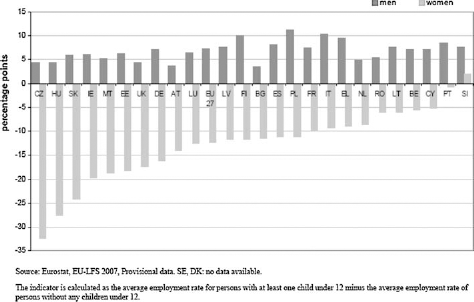
Employment impact of parenthood for women and men aged 25-39, 2007.
The negative impact of motherhood on women's employment is influenced by cultural and structural incompatibilities between work and family. Therefore, the issue of how to reduce the indirect costs of having children is strictly related to diminishing these incompatibilities.
Usually, relevant policy measures defined as work-family reconciliation measures include childcare provision, maternity and parental leaves as well as economic support during the leave and work-related measures like part-time work and flexible work patterns. However, reconciling work and family is primarily considered as a women's issue rather than a parent-oriented policy [17,18,27]. In addition, even if relevant regulations on parental leaves and work-related measures are established for both men and women, their use strongly depends on perceived gender roles. For instance, despite gender-neutral regulations on parental leave in many countries, their use by fathers is very low. Therefore, diminishing the indirect costs of having children depends on progress in childcare provision, leave schemes and income compensation for parents on leave, and flexible work patterns. Redistributing indirect costs among men and women is strongly linked to redefinition of gender roles.
Analyses of fertility differentials in Europe have shown that higher social approval for women's work and lower structural incompatibility are associated with lower opportunity costs and higher fertility levels [23,25]. Policies promoting equality between men and women are assumed to strengthen reconciliation measures already implemented (e.g. by encouraging fathers to use existing regulations on parental leave and to take advantage of flexible working hours or part-time work when caring for small children, etc.) and positively affect childbearing [13,26].
A relatively low level of voluntary childlessness in Europe, along with discrepancies between the expected number of children and actual number of children, indicates that a decision on the second child is crucial for demographic renewal in Europe. Therefore, one can expect that diminishing both direct and indirect costs of having children could result in higher rates of childbirth.
European countries differ remarkably in terms of their family policies and support for different types of family models. However, reforms of family policies implemented in recent years reveal ‘paradigm shifts’, particularly with regard to the state's responsibility towards children's and mothers’ welfare and, to a lesser degree, fathers’ roles [27]. The dual-earner family model is increasingly supported. Mothers are more frequently defined as both (paid) workers and (unpaid) caregivers. Correspondingly, although to a much lesser degree, fathers are also being redefined as being caregivers.
A changing awareness of the significance of demographic processes for the future of Europe implies that children must be increasingly perceived to be a collective good and their quality of life must be increasingly a collective concern [8,33]. Saraceno [27] attributes a focus on children as a public good to multiple reasons (child poverty, fertility, equal opportunities among children, investment in future human capital, increased employment of mothers), whose importance may differ across countries. Irrespective of the reasons, two issues need to be considered: who bears the cost of children, and who cares for them. The countries that seem the most successful–-and with positive outcomes regarding fertility levels–-are those which adopt a broad range of measures and policies aimed at strengthening equal opportunities and choices for men and women and relaxing tensions between family and employment opportunities.
Footnotes