




Abstract
Demographic changes will drastically alter the societal balance between active and inactive individuals. As a result, Europe will shortly face substantial shortages in the labour market. This article looks at The Netherlands as a case study to demonstrate the need for close cooperation in finding solutions. The author identifies two specific untapped participant groups: the elderly (‘silver participation’), and women part-timers, which must both be encouraged to join in the workforce. There must be cooperation among governments, social partners, companies, civil society and individual citizens to have a lasting and effective impact.
An ageing population: a shared challenge towards participation
Is Europe on its way to becoming the world's open-air museum? What will our future look like? We have to compete in an ever-younger world while the European population is ageing rapidly. In countries in Africa and the Middle East, but also in China and India–- that count for almost half of the world's population–-the populations are becoming younger. Although this trend will also halt eventually, these global changes call for a responsible approach. Almost every EU Member State is confronted with the effects of these demographic changes ahead of us. It is our common European future that requires us to adapt ourselves to ageing populations and take the necessary measures. The Netherlands has put the issue of solidarity between generations high on the agenda. This decade we have been taking many necessary steps to make sure we can continue to deal with those challenges of demographic change with a positive and confident attitude.
In the globalised world of today, we are confronted with the consequences of many new economic challenges: climate change, migration, terrorism and food and energy shortages.
Europe is confronted with rapidly growing populations and growing economies in countries not only in Asia, but also in North Africa and the Middle East. Hundreds of millions of young, energetic and ever better-educated people in those regions are expected to join the international labour market in the coming years. In Europe another trend is under way. The large baby boom generation born in the decade after the Second World War will soon retire. The diminishing rates of childbirth in Europe have an impact on our societies. What will this imply? How do we deal with the demographic change on the European continent? How will we be able to keep our social welfare system and health care affordable and accessible in the future? Labour markets will have to adapt. Our governments are learning how to deal with the economic consequences. The ageing population is an issue not only of costs; the social and economic well being of our societies will require a different approach from governments and societies at large. In The Netherlands, since the start of 2002, the Balkenende I and II governments have been implementing tough but necessary measures to prepare Dutch society for these future developments. The fundamentals of our policy on demographic change have been laid out and we are now improving our responses. The focus is on the participation of and investment in people. In this essay I will introduce our approach to the anticipated demographic change in The Netherlands. The role of families and strong communities is fundamental. The strength of Christian Democracy is in combining our commitment to the family and community, but also in helping the younger generations to strike the right balance between work and private life, between family and career. It is clear that the challenge of ageing populations affects the whole of the European continent. The results will be felt in all EU Member States. The percentage of elderly people will increase in our societies and the responsibilities for (health) care will, both financially and with respect to labour, be placed more and more upon the younger generations. These consequences raise important questions and require responsible decisions from the whole society.
The consequences of the ageing population in the Netherlands
The consequences of the foreseen demographic changes are diverse, but it is clear that the current balance in society will change drastically. The balance between the active and the inactive will change. Compared to the number of inactive people, the number of active–- and working–-people will decrease. Fewer people will contribute to the economy and society when it comes to social contributions and economic input. A heavy burden will fall on those who work. First, it is crucial to answer the question of how to keep and allow more people to remain active longer. Second, we need to involve the working population in this process. If we fail we will be confronted with substantial shortages in the labour market.
The labour market
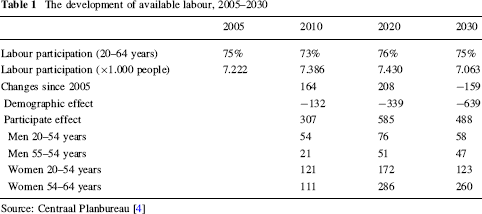
The impact of the fact that a growing part of society will be comprised of people above the age of 55 is also leading to difficulties in the labour market. The implications of shortages for the labour market are serious. This development should be stopped as soon as possible. The most important solution is to invest in getting inactive people into the labour market to an appropriate job and provide them with a career opportunity. In The Netherlands, there is a group of 900,000 people who could work, but lack the education, motivation or opportunities to join our workforce. This labour potential in The Netherlands is found mostly among women (part-time workers), elderly people and former immigrants. From our perspective the focus needs to be on People's possibilities rather than on allowing them to remain outside of our society. The consequences of an ageing society include not only the rising costs but also the dilemma of how to cope with the impact of these changes in our society. For the first time in history, there will be structurally more jobs available than people. The globalised world also demands a commitment to life-long learning to maintain the competitive position of our labour force in the world economy. In addition, we encourage the desire of younger generations to raise a family. Governments should set the right example by allowing for maximally creative and innovative solutions in combining work and private life. At the same time, the innovative strength of society should not be underestimated. The government should not be the single leading actor in shaping such policies. The private sector has an immense responsibility to take steps to allow their employees to better combine work and private life Table 1.
The development of available labour, 2005-2030
Source: Centraal Planbureau [4]
The foundation of solidarity can survive only if we are ready to share the burden of the ageing population with more than only the younger generation. Transferring responsibilities in a society to a new generation that can also benefit from our well-developed social systems is the common responsibility of all. The challenge for The Netherlands and many other countries is to reward, stimulate and prioritise work. In The Netherlands, we realise this through a ‘carrot and stick’ approach. The carrots and sticks must be aimed specifically at the labour potential that exists: primarily the older part of our labour market and those of the part-time workers willing to work additional hours. First, I will address the goal of increasing the participation of older workers.
‘Silver’ participation
The question is how society will develop in light of the ageing population. Solidarity between generations is built on the responsibility of all generations to take care of our society in the short and long term. Research shows that more and more people suffer from stress and burnout because the pressure of combining work and private life is too high. The burden should not be put only on the shoulders of the younger generation. It is also necessary that the older generation remain actively involved in society. More than a wish of society as a whole, this has proved to be the wish of the older generation. Our communities thrive on the activities of the older generations. Ageing people should, therefore, be approached from the perspective of participation. How can we support those people to stay involved? In the same way that we are creating possibilities for people to combine different aspects of life, this participation should be approached with creativity and innovation as well. Creativity must be interpreted in the sense that we should not stick to the old model of work, in which people remain in the same job for over 20 years. Diversity and flexibility in shaping a career is something we need to invest in.
Ageing should be seen as a positive perspective of what has been called the ‘silver economy’. Silver participation aims at keeping the expertise and labour productivity of the elderly generation in the labour market. Their role in society is crucial. In the past, the labour policies of companies and governments were too focused on redundancy of elderly employees. The changes that have been made in the Dutch social system aim to removing barriers to silver participation. Already we can see that the participation rate of those above 55 is rising. There is also an aspect of investing in keeping work attractive for this group. By offering enough and sufficient training and ensuring the right social circumstances, it can be attractive for the older generation to stay active longer. From this perspective, active ageing should be facilitated. Supporting, advising or contributing to the workforce should be made possible and easier to realise. A creative possibility might be to remain active on the labour market for shorter periods and on short notice. These roles typically fit projects or positions such as adviser or expert. It is possible also to link someone as a mentor to a younger employee. The flexibility and financial consequences should be positive for the older generations. They can still be involved in society by sharing their knowledge and experience without demanding full labour market involvement. A concrete proposal from the Balkenende IV government is that elderly people who turn 65 in 2011 and beyond and already have a large pension accumulated will contribute to the old-age pension. Beginning in 2009, we will create a bonus for working longer for those employees who continue to work after the age of 62. This work bonus is a supplement to the current elderly reduction. For those who continue working after the age of 65 the bonus will naturally also continue to be handed out. This will offer a stimulus to stay active for a longer period. It needs to be socially acceptable to continue working after the age of 65. Employers will receive tax credits for employing older people. People will have the possibility to postpone their pension and by doing so to earn an increased pension.
Part-time workers
In The Netherlands, many jobs are performed by part-time workers, mainly women. The positive aspect of these part-time jobs is the high percentage of women active in the labour market. The hurdle of entering the labour market has already been taken. In light of the labour shortages due to the demographic change, increasing the labour force participation of these part-time workers is crucial. Many part-time workers indicate that they are willing to work more hours if the possibility exists. There is a need to act upon these signals. Making it possible for people to work more hours per week needs to be a priority. Working at home should be facilitated and flexible working hours allowed. This will make possible a better combination of work and care in family life. Fiscal measures must stimulate the participation of women. At the moment, much of the energy devoted to increasing labour participation is aimed at work in general. Measures taken are often fiscal ones, such as decreasing the transferability of the tariff reduction, the income-dependent combination discount and the childcare allowances. The government recently increased the budget for childcare.
Another European-wide possibility related to participation is immigration as a solution to deal with growing gaps in the labour market.
Labour migration and integration
From our perspective labour migration cannot be the solution to the problems resulting from an ageing society, but neglecting this issue within the context of demographic change is also not the solution. There is not sufficient labour potential now to maintain the balance between active and inactive people, let alone in the future. This problem exists in almost every EU Member State. The Netherlands is still dealing with the aftermath and partially problematic impact of the labour immigration during the 1970s. Integration is an essential part of making labour migration work and not the easiest responsibility for both the immigrants and the society to which they migrate. For The Netherlands, another large wave of immigrants would be impossible to cope with, due to the large social and cultural consequences. Even on a smaller scale such problems are already observed with regard to the free movement of labour within the EU. Free movement is a fundamental right within the EU and delivers economic benefits. At the same time, we cannot neglect the need to deal with the side effects in some Member States. If people are making use of their right to move between countries they should also be aware of their obligations. Ad hoc and seasonal workers are different from people who migrate for a longer period. In particular, parents with children who are migrating for a long period to another EU Member State should take seriously their responsibility to invest in participating in that society and the local community. This means more than earning money. If children attend school and are involved in society, migrants should take notice of the local language and culture. Balancing these rights and obligations should be further discussed within the EU.
European responsibility
To deal with the bottlenecks of the demographic change is a common European challenge. The question is whether this also requires a common European social policy. It is the Dutch opinion that social policy and pensions are a case of subsidiarity. The way a society creates its social model and deals with its elderly are often also social-cultural traditions. For instance, the Dutch pension system is a unique hybrid system of savings and taxes. In this way the Dutch society has built a pension system that is sustainable and will provide sufficient savings in anticipation of the demographic change. In the European context we should focus on sharing positive examples (‘best practices’) and creative ideas, as well as on investing in good cooperation in specific areas. A successful example is cross-border care that could benefit from more European cooperation.
The challenge is to make the European market competitive and innovative. Demographic challenges can best be addressed by a strong and flexible economy in combination with a society where generations show solidarity with and commitment to each other. If countries fail to adapt to that necessary change, they will be confronted with the negative consequences. The goals set out in the renewed Lisbon Agenda 2010 must be accomplished, as they are the preconditions for a prosperous Europe. Only through investing in innovation is it possible for the EU to compete in a global context. Our societies have to be prepared and transformed in such a way that this can be realised.
Europe should further work on its ambition to attract highly skilled knowledge migrants. Knowledge workers can make a difference in creating economic growth, and often bring important qualities much needed in the field of research and development. Increased job flexibility within the EU should be further promoted. Flexibility in work should be linked to stability and predictability. The focus is on ‘flexicurity’. Flexibility and security must be realised through combining the two. The purpose is to transform the approach from job security to employability security. Our economies have changed. Fewer and fewer people will remain in the same job their entire working lives; most prefer to change jobs regularly. In The Netherlands, we aim to bring about this change in mentality in close cooperation with our social partners. The major challenge is to ensure the greater interest of employers in the employability and training of their staff and the workforce in general. Our workforce is preparing itself for life-long learning in order to be competitive in the globalised world.
In The Netherlands, these policies are being discussed extensively within the context of our ‘Polder model’, a partnership of the private sector and government. Solutions are being put forward, discussed and realised within this model. The government is expected not to allow labour potential to be lost to social welfare if it can be prevented. At the local level, the Work First project obliges welfare beneficiaries to contribute to society in one way or another. The experiences gained are valuable once these people return to a regular job. People who are younger than 27 cannot apply for social welfare, but can now be forced to study and/or work for an income. Municipalities are obliged to offer them opportunities for work or education. Handicapped young people are supported to find suitable jobs if possible. The possibilities of people instead of their limitations drive these policies.
These policy measures can function only if the government takes on its responsibility to reduce the national debt. Without healthy government finances, it is impossible to deal with demographic changes. This demands a European priority for responsible public finances.
The Stability and Growth Pact must be the basis of solid financial policy within the EU. National debt should be reduced to achieve a balanced budget. It would be even better to work towards a budget with a surplus. Such a starting position offers a buffer during more difficult economic circumstances. All eurozone members should proceed in that direction. This policy is needed because there is a direct link between balanced national spending and the healthy functioning of the economy and the labour markets. In connection with the ageing population, a solid financial and fiscal policy is essential. If the criteria of the Pact are not kept by the individual Member States, this will have a negative impact on the eurozone as a whole. Indirectly, the countries that are taking the necessary steps and reforms will be punished by those who are lagging behind.
Conclusions
Demographic change will drastically alter the balance between the active and inactive people in society. Solutions related to demographic change will be found in the close cooperation between government, social partners, companies, civil society and individual citizens. We all have to adapt to the changes in society. Not acting will not solve the problems that are ahead of us. Dutch society from 2001 onwards has been preparing for demographic change by implementing substantial social reforms. This has not always been easy. The crucial assignment for us is to increase labour participation. Participation must be altered through involving the elderly (‘silver participation’) and women (part-timers). Especially through fiscal incentives, work can be made attractive. The involvement of the silver generation is an aspect of dealing with demographic change. Keeping the elderly actively involved in society is essential–-first of all, in light of the solidarity between generations, but also because of the social and economic role of this generation.
The possibilities of people instead of their limitations drive these policies. Making work more attractive is a combination of fiscal measures and work bonuses. People on social welfare can be helped to return to the labour market. The young and unemployed are offered training and job opportunities. The handicapped are helped to find jobs in keeping with their possibilities. Another aspect is labour migration, but attracting immigrants from outside the EU is not seen as the solution to solving the shortages in the labour market. Nonetheless, to enhance the innovation and level of knowledge in the European economies, specific knowledge workers must be attracted to the EU. Life-long learning must prepare our own workforce for the changes in our economies. The pillar of financial solidity is needed to make sure that the eurozone remains stable and that the Stability and Growth Pact is kept by the eurozone members. By a solid financial budget focusing on the long term, the costs at the national level related to pensions and care can be covered. It is clear that we cannot do it by ourselves. Successful policies are a national priority and should be based on the principle of subsidiarity. The system of solidarity between generations must be kept through welfare systems that can work in an ageing society. Within the European framework an innovative and competitive economy must provide the possibilities to establish such policies. Dealing with demographic change is a case of solidarity between generations. All share the responsibility to deal with the changes in society. In The Netherlands we are working on this change with confidence together with our social partners and Dutch employers.
Footnotes