



Abstract
This article utilises large-N panel data to compare two theories of referendum voting behaviour in order to understand the ‘for’ or ‘against’ vote in the 2016 Dutch referendum on the EU-Ukraine Association Agreement. It studies the extent to which voting behaviour was predicted by Eurosceptic attitudes and fear of upsetting Russia (issue-based theory), versus dissatisfaction with the Dutch government and general political discontent (second-order theory). Our findings indicate that issue-based determinants predict the referendum vote better than second-order predictors. However, Eurosceptic attitudes and government satisfaction both outperform concerns about the relationship with Russia as a predictor. We thus provide evidence that the issue-based and second-order approaches to explain voting in EU referendums are complementary, but not equal in explanatory strength.
Introduction
Since the early nineties, the ‘permissive consensus’ about the European project has gradually waned across Europe, culminating in a ‘constraining dissensus’ in more recent years (Hooghe and Marks, 2009). This is best illustrated by the ‘Brexit’ vote in the UK, the vast electoral support for Euro-critical parties across the continent, and the increasing public disenchantment with European integration (Hobolt and de Vries, 2016). The Netherlands – one of the six founding member states of the European Union (EU) – is a crucial case-study in this sense. While the country has historically been characterised by overall positive public attitudes towards the EU, Euroscepticism prominently reared its head as early as 2005 in the national referendum on the ratification of the European Constitution, which was rejected by a majority of voters (Aarts and van der Kolk, 2006). Subsequent opinion polls and elections continued to indicate growing discontent with the European project (Lubbers and Jaspers, 2011), resulting in another national referendum in April 2016 initiated by grassroots anti-EU movements. While this referendum concerned a specific association treaty between the EU and Ukraine (the EU-Ukraine Association Agreement), the campaign focused more broadly on economic, cultural, geopolitical, and sovereignty issues, with opponents of the treaty emphasising potential job losses, mass-immigration, threats to national identity, provoking the President of Russia Vladimir Putin, as well as the erosion of national sovereignty and self-determination – issues that typically shape the pro/anti-EU debate (Hendriks et al., 2017).
This campaign's framing allowed anti-EU political protagonists to tap into both generalized feelings of resentment and anti-EU attitudes. While both government parties (the Party for Freedom and Democracy, VVD, and the Labour Party, PvdA), as well as most major opposition parties in the political centre and on the left (Democrats 66, D66, the Christian Democratic Appeal, CDA, Christian Union, CU, and Green-left, GL) were in favour of the treaty, both the radical right (Party for Freedom, PVV) and radical left (Socialist Party, SP, and Animal Party, PvdD) campaigned against the treaty. Their outspoken anti-elitist rhetoric placed particular emphasis on what they called the excessive powers of the ‘bureaucratic’ supranational EU-institutions and ‘corrupt’ establishment elites as well as on the negative impact of a potential free movement of labour from Ukraine on the Dutch job market and social security. Moreover, the low salience of the referendum's technical content allowed the Eurosceptic parties to appeal beyond their core electorates, as voters relied on party cues (van der Brug et al., 2018). In addition to political parties, a bottom-up dynamic gave shape to the campaign, injecting arguments that did not neatly line up with party positions. Organisations like Burgercomité-EU, the Geenstijl blog and think tank Forum voor Democratie, which soon after the referendum became a prominent political party, joined the campaign against the EU-Ukraine Association Agreement (Hendriks et al., 2017). Lastly, aside from focusing on the legitimacy of the EU and economic considerations as a central rationale in the campaign, the ‘no’-camp argued that a positive referendum outcome would provoke Putin, a fear that has only grown since (Deen et al., 2020). These campaign arguments demonstrate that the vote in EU referendums is not only driven by deep-rooted views towards the EU itself and its policies (de Vries and Tillman, 2011; Hobolt, 2009), but also reflects citizens’ concerns ascribed to domestic policies (Anderson, 1998; van der Eijk and Franklin, 1996). Comparing the EU-issue voting approach and the second-order approach, we investigate to what extent the ‘against’ vote in a referendum on a specific association treaty is an expression of sentiments about the EU, European integration, and treaty-specific concerns about the EU's relationship with Ukraine and Russia on the one hand, or rather a display of dissatisfaction with the national government and democracy. Rather than seeing dissatisfaction with domestic issues and EU politics as competing alternatives for explaining referendum votes, we examine their relative importance, positing that the issue-based theory and the second-order election theory should be seen as complementary to each other.
For each of the theories, corresponding independent variables are included in logistic regression models with the aim of testing each theory and comparing their explanatory power. In addition, we have also included treaty knowledge, economic dissatisfaction and anti-immigrant sentiments – which can be understood both as integral aspects of EU policy (issue-voting) and as national grievances (second-order) – into the model, allowing for a more accurate interpretation of the referendum vote's drivers. After presenting more in-depth theoretical explanations for each of these underlying processes, we analyse large-N survey data comprising Dutch citizens who had previously used a Voting Advice Application (VAA).
Our article makes two important contributions. First, although scholars agree that both issue-based and second-order concerns predict EU referendum votes, it is still unclear how and to what extent they explain a referendum on a specific association treaty. Our results provide evidence that both approaches are complementary in explaining an EU referendum vote, but are not equal in explanatory strength. Second, although issue-based determinants predict the referendum vote better than second-order factors, Eurosceptic attitudes and dissatisfaction with national government both outperform concerns about the relationship between the EU, Ukraine, and Russia. This is exactly what the electoral campaign against the treaty was mobilized by: framing the EU-Ukraine Association Agreement referendum primarily as a vote about the EU and further European integration, rather than as a matter of strengthening economic and political ties with Ukraine and its potential impact on EU-Russia relations. Nevertheless, the study of the driving forces behind this particular referendum provides a potentially meaningful framework for examining European support and opposition to the granting of EU member candidate status to Ukraine.
Theory
Referendums constitute a fitting institutional arrangement for the ‘us versus them’ frame of populist parties (Jacobs et al., 2018). Conceptualising populism as ‘an ideology which pits a virtuous and homogeneous people against a set of elites and dangerous “others” who are together depicted as depriving (or attempting to deprive) the sovereign people of their rights, values, prosperity, identity, and voice’ (Albertazzi and McDonnell, 2008: 3), the binary structure of referendum campaigns may help populists to portray themselves as representing ‘the deprived, homogeneous and sovereign people’ against the mainstream elites (Abts and Rummens, 2007; Mudde, 2007).
Two distinct theories address voting behaviour in EU referendums. The first contends that individual attitudes towards the EU itself determine such electoral behaviour. According to this ‘issue-voting’ approach, citizens generally opposed to the EU will reject EU treaties, regardless of the specific issue at stake (Pierce et al., 1983; Svensson, 2002). While voters may express their view on the European policy issue at hand, i.e., the association treaty, European integration and EU democracy more broadly underlie such voting behaviour. This gives the ‘against’ camp the opportunity to tap into the reservoir of public Euroscepticism (see Hobolt, 2009).
On the other hand, the so-called ‘second-order approach’ (Reif and Schmitt, 1980) posits that public concerns ascribed to domestic policy are the main vote determinants in EU referendums (Anderson, 1998; van der Eijk et al., 1996). In this view, these referendums serve as second-order elections in which citizens voice their approval or discontent towards incumbent governments. Vote choice is therefore driven by national, first-order concerns (Ferrara and Weishaupt, 2004; Franklin, 2003). Following this logic, such elections are used by voters to punish or reward national parties. Voters may ‘use EU referendums as opportunities to signal their general discontent’ (Opperman, 2017: 249–251) with both the domestic government and political establishment, with immigration, and with economic governance.
The issue-based approach: Treaty specific concerns drive the referendum vote
The issue-based approach argues that EU referendums have increasingly become contests over different visions of the EU (de Vries and Tillman, 2011; Hobolt et al., 2009). If voters consider the specific issues at stake (Hobolt, 2009), then the ‘against’ vote cannot be dismissed as a mere protest vote driven by domestic issues, but rather as a protest against the EU and its policies, reflecting voters’ underlying attitudes towards supranational policies, European integration and EU democracy (Treib, 2014).
Loss of sovereignty and anti-Eu attitudes (EU)
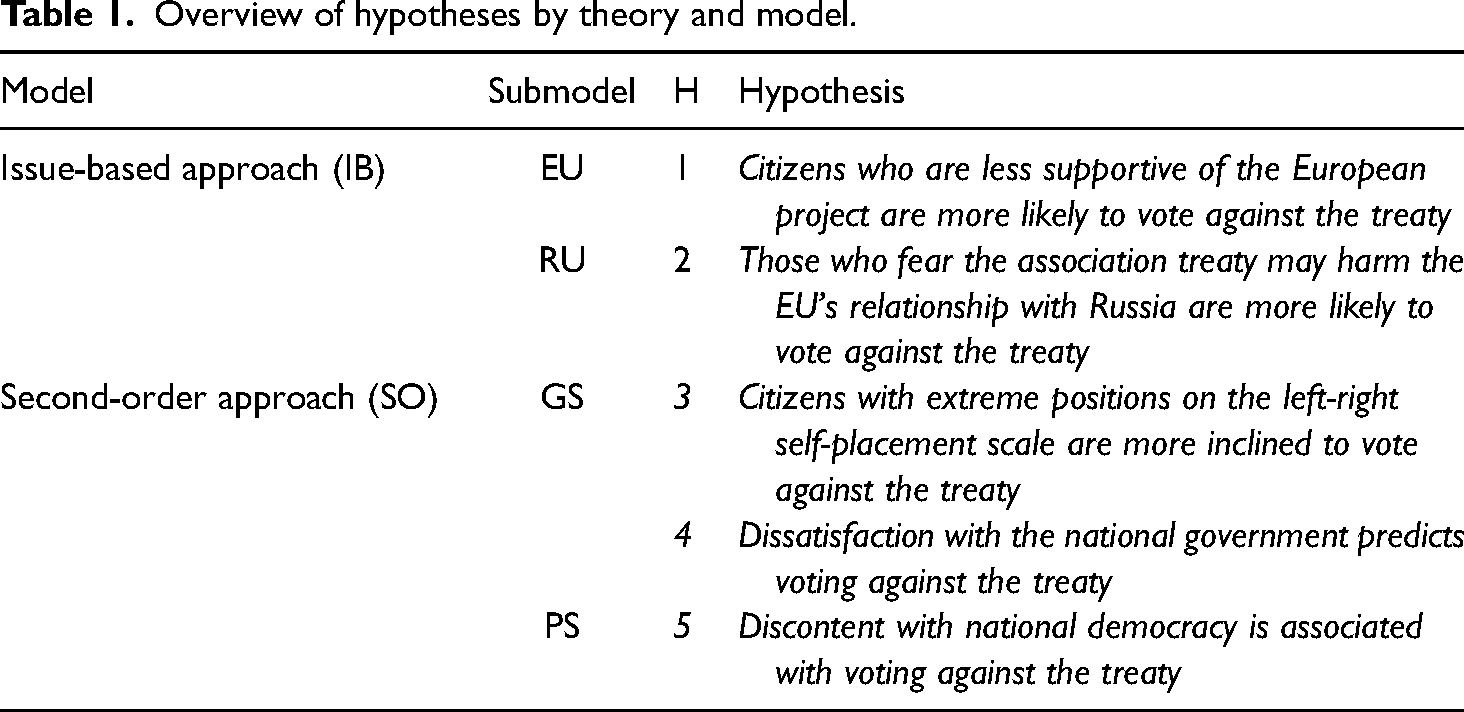
Such attitudes can stem from diffuse opposition to a loss of national sovereignty and disapproval of the general project of European integration, as well as from specific opposition towards EU decision-making and dissatisfaction with the current policies and functioning of the EU (Krouwel and Abts, 2007). Accordingly, this ‘sovereignty’ thesis links the rejection of the treaty to the incompatibility of European integration with national community and sovereignty, while the ‘democratic deficit’ thesis links it with a lack of democratic legitimacy (see Kratochvíl and Sychra (2019) for an overview of arguments in favour and against the democratic deficit theory). Consequently, this approach yields that citizens less supportive of the European project are more likely to vote against the treaty (H1).
Relationship with Russia (RU)
While fear of escalation with Russia has proven warranted after the country's invasion of Ukraine in February 2022, the effect of the eventual association of the EU with Ukraine was more opaque back in 2016. However, Russia desired Ukraine to remain as a neutral barrier between the West and Russia (Lange-Ionatamišvili, 2015), and it clearly communicated its opposition against the treaty (Gärtner and Janik, 2021). This aversion took the shape of misinformation campaigns both in Ukraine and in EU member states (Erlich and Garner, 2021; Jankowicz, 2021). Similar conceptions took shape in the referendum campaign, as illustrated by this excerpt of the SP's position: ‘This treaty brings Ukraine into the sphere of influence of the European Union, thus exacerbating the contradictions between Ukraine and Russia and the EU and Russia’ (Socialistische Partij, 2016). We therefore expect that those who fear the association treaty may harm the EU's relationship with Russia are less likely to vote in favour of the treaty (H2).
The second-order approach: Domestic issues drive the referendum vote
According to the second-order approach, sentiment towards the EU is subordinate to satisfaction with the ruling parties as well as to generic discontent with the national political system. This approach expects the referendum vote to be explained by deprivation of political control and discontent with government actions (government satisfaction) as well as by generalised political cynicism and public dissatisfaction with how democracy works at the domestic level (political discontent). This logic prominently found its way into the referendum campaign, as illustrated by a flyer distributed by Geert Wilders’ PVV: ‘This referendum is about more than just the EU treaty with Ukraine and enlargement of the European Union. It is an opportunity for the Dutch people to voice a dissenting voice. A vote against the treaty also means a vote against [Dutch prime minister] Rutte and against the Brussels elite’ (PVV, 2016).
Government satisfaction (GS)
Since the left-right cleavage can be perceived both in terms of economic distribution (state intervention and austerity policies) and culture-lifestyle divisions with economic repercussions (such as immigration), voters with radical left and right ideology might both oppose Europeanisation for different reasons (Anderson, 1998; de Vries and Edwards, 2009; Hix, 1999). ‘Whereas left-wing Eurosceptic parties mobilize economic anxieties and anti-austerity concerns against the European project, right-wing Eurosceptic parties rally opposition by highlighting national identity considerations and feelings of cultural threats’ (Hobolt and de Vries, 2016: 422). As a result, it is more reasonable to assume a curvilinear U-shaped relationship between voters’ left-right ideology and opposition against the EU (van Elsas and van der Brug, 2014), where both ideological extremes simultaneously correlate with anti-establishment voting (Kutiyski et al., 2020). Thus, we hypothesise that citizens with extreme positions on the left-right self-placement scale are more inclined to vote against the treaty (H3).
The second-order political discontent logic argues that EU-related referendums are not about Europe, but about national issues where voters use their vote as a sign of protest against domestic governments and as a means of signalling their dissatisfaction with national democracy (de Vreese and Boomgaarden, 2005; Hobolt, 2006; McLaren, 2002). The rationale is that the mass public is largely uninformed about EU-related issues, and therefore citizens tie their support for the EU to their more crystallised opinions about national government performance and domestic concerns (Clarke et al., 2004). ‘Hence a mechanism of institutional proxy is at work: national institutions provide citizens with a cognitive short cut towards trust in EU institutions’ (Serricchio et al., 2012: 54). Thus, we expect that dissatisfaction with the national government will predict voting against the treaty (H4).
Discontent with the domestic political system (PS)
Finally, political cynicism – a condition of lost belief in the integrity of the entire elite as well as the responsiveness of the political bodies as such – may be also an important driver of the ‘against’ vote (Balch, 1974; Krouwel and Abts, 2007). Appealing to the absolute sovereign will of the homogeneous people pitted antagonistically against the ‘incompetent’, ‘self-serving’ and ‘perverted’ political elite (Abts and Rummens, 2007), populists may be able to capitalise on generalised anti-establishment feelings in their anti-EU agitation by cultivating an image of political outsiders and promoting an antagonistic ‘us’ versus ‘them’ divide in the binary structure of EU referendum choices (Opperman, 2017). In particular, since the EU is perceived by populists as an elitist project of the political establishment unresponsive to the popular will, political inefficacy and cynicism may be one of the strongest predictors of the referendum vote (Krouwel and Abts, 2007; McEvoy, 2016).
In addition, animosity towards European integration can be associated with distrust in domestic political institutions, rather than sceptical attitudes towards the EU as such (Anderson, 1998; Franklin et al., 1994). Although Sanchez-Cuenca (2000) argues, by contrast, that low levels of trust in domestic institutions result in stronger public support for the EU, we nevertheless hypothesise that discontent with national democracy is associated with voting against the treaty (H5). For an overview of all hypotheses, see Table 1.
Overview of hypotheses by theory and model.
The distinction and overlap between both theories
Presented above is an attempt to clearly delineate two theories that are often presented as distinct in our discipline. However, in practice, it is a complex task to attribute specific sentiments to only one of these theories. We compare the issue-based and second-order voting argumentation, to investigate to what extent the against vote expresses discontent with the institutional set-up of the EU integration project, or general political discontent (Treib, 2014). Following Schuck and De Vreese (2008: 102), rather than seeing both approaches as competing alternatives for explanation of referendum voting, we hypothesise these attitudes as being complementary to each other.
Two additional concepts can be used to explain Eurosceptic voting behaviour that do not neatly fall within a single theory as they refer potentially to both national grievances and EU policies. First, domestic feelings of economic deprivation may be attributed to the European free labour market (Jeannet, 2020). In that sense, rather than a vote against the EU, the vote would be mainly driven by utilitarian concerns over national economic performance within the EU and the perceived personal and collective costs and benefits from EU membership and integration (economic dissatisfaction) (Eichenberg and Dalton, 1993; Gabel, 1998). Secondly, the experience of immigration as a threat to national culture may be perceived to be driven by European enlargement (McLaren, 2015). Cultural anxieties and anti-immigrant sentiments stemming from within-EU free movement and open borders (cultural threat) (McLaren, 2002, 2007) can thus be utilised to shed light on Euroscepticism (Hobolt and de Vries, 2016; Hooghe and Marks, 2005; Lubbers, 2008; Semetko and de Vreese, 2006).
Economic dissatisfaction (ED)
First, the economic dissatisfaction approach focuses on voters’ positions regarding economic interests and cost-benefit calculations of European integration. Some scholars argue that Euroscepticism is best explained by the socio-economic position of individuals and by what they would gain and lose from further European integration (Gabel, 1998). In this regard, those who possess high levels of cultural and economic capital have more opportunities to take advantage of the opening up of national boundaries, while individuals with poor educational qualifications and less financial resources tend to feel more disadvantaged and are more likely to perceive European integration as a threat to their jobs, social status, life chances and cultural identity (Hix, 1999; Kriesi et al., 2008; Tucker et al., 2002).
Most studies have shown that both unskilled and lower-educated voters are more likely to oppose European integration compared to higher-skilled and educated individuals (Lubbers, 2008; Lubbers and Jaspers, 2011). Moreover, recent research suggests that education has an increasing effect on Euroscepticism, particularly after the signing of the Maastricht Treaty (Hakhverdian et al., 2013).
In addition, scholars posit that utilitarian calculations of the costs and benefits of European integration are more decisive for understanding individual attitudes towards the EU (Foster and Frieden, 2021). People who evaluate their own economic situation positively will be more likely to vote ‘for’ in the referendum (Gabel, 1998). In contrast to these personal evaluations (egocentric utilitarianism), other scholars assume that support for the EU is much more related to perceptions that the national economy and the country is collectively benefiting from EU membership (socio-tropic utilitarianism) (de Vreese and Boomgaarden, 2005; Gabel, 1998; McLaren, 2002).
Cultural threat (CT)
We should not expect to explain voting against European integration exclusively through a cost-benefit lens. Following the cultural threat approach, Hooghe and Marks (2004) argue that national identity appears to be more powerful than economic calculations when it comes to shaping attitudes about EU integration. Similarly, Goodwin and Milazzo (2015: 5) argue that ‘anxieties over European integration are less about trade, regulation and economics than about a pooling of national sovereignty and communities’. This explanation focuses on cultural discontent related to the perceived loss of national culture, integrity, and sovereignty, since European integration pools sovereignty and reduces national self-determination in a deliberate effort to blur boundaries between nation-states (Hooghe and Marks, 2005). In this regard, anxieties related to immigration and perceived threats to national culture and unity may promote identity-based hostility towards the EU and European integration (Goodwin and Milazzo, 2017; McLaren, 2002). In particular, Lubbers (2008: 81) concludes that ‘the “no” vote in the Dutch 2005 referendum was to a large extent related to attitudes towards immigrants’. Similarly, public concerns over immigration were central to explaining the leave vote in the recent Brexit referendum (Goodwin and Milazzo, 2017).
Knowledge of treaty (TK)
Additionally, cognitive mobilisation theory contends that the actual knowledge of an issue at stake can influence voter decisions. Misinformation regarding crucial issues on the ballot paper might also influence the vote. Therefore, we also test whether knowledge of the EU-Ukraine Association Agreement itself has influenced citizens’ vote choice. In a sense, this theory thus relates to both the issue-based approach and to the second-order approach.
Differences in cognitive mobilisation may explain degrees of support for European integration: ‘those who are more cognitively mobilised – that is, capable of digesting complex political events and who actually take the time to do so – are more likely to be less fearful of the EU simply as a result of more exposure to it’ (Inglehart, 1970). Empirical evidence indicates that those who are more politically interested and more knowledgeable about the EU are indeed less hostile towards the European project (Hobolt, 2006; Karp et al., 2003; McLaren, 2002).
In the months preceding the referendum, campaigners opposed to the treaty spread information that its ratification would result in an ‘inevitable’ accession of Ukraine to the EU, although no such clauses were included in the treaty. In fact, most of the treaty was laid out in purely economic articles (Hendriks et al., 2017).
Since information intake affects attitudes towards political issues and voting behaviour (Alvarez and Brehm, 2002), treaty knowledge may mitigate effects of economic dissatisfaction as well as of cultural threat in predicting the referendum vote. It may furthermore affect the role discontent with the governing parties and with the political system plays in doing so, through the effect that content matter knowledge has on coalition support (Hug and Sciarini, 2000; Schneider and Weitsman, 1996).
Methods
Data
We employ a large-N non-probability data set collected online in the months leading up to the Dutch referendum. The data were collected by Kieskompas (Election compass), a Dutch political research organisation that coordinates large research panels and develops voting advice applications (VAAs). Kieskompas complies with EU privacy (GDPR) regulations, is closely monitored by the Dutch privacy authority, and adheres to the ethical norms of Free University Amsterdam. The data consists of four survey waves – three collected prior to the referendum, as well as a post-election wave. The variables included in the analyses were asked in different waves, although all dependent variables stem from the waves preceding the referendum.
A sample of 3580 respondents provided answers to all the variables included in the analyses. For all analyses below, we make use of this sample. Since VAA opt-in samples tend to be non-representative of the general voting population, and are more likely to consist of male, higher educated and politically interested respondents from urban areas (van de Pol et al., 2018) and to mitigate differential nonparticipation patterns in nonprobability sampling (Etienne, 2021), the data is weighted using iterative proportional fitting (IPF) and poststratification procedures on both demographic (age, sex and education) and political variables (self-reported vote recall during the national elections in March 2012), using benchmarks of the Dutch CBS Golden Standard as well as official national election results. Inclusion of political variables in weighting procedures has been shown to be able to cut bias in half (Mercer et al., 2018). A comparison of the demographic distribution of the sample and the population benchmarks can be found in the Online appendix.
Method and variable measurements
This study assesses to what extent issue-based concerns comprised of anti-EU attitudes (EU) and concerns about the relationship with Russia (RU), and second-order concerns comprised of government satisfaction (GS) and discontent with politics in general (PS) determine vote choice in the referendum. For each of the two theories, corresponding independent variables are included in separate regression models with the aim of assessing and comparing their explanatory power. A full model is comprised of all variables simultaneously. Most variables have been standardised for more meaningful interpretation across models. For a detailed overview of how each variable was constructed, see the Online appendix. The dependent variable – respondents’ self-reported vote choice in the 2016 referendum – was measured as follows: voting ‘against’ the association treaty is coded as ‘0’ and voting ‘for’ is coded as ‘1’. Because the dependent variable is binary, we estimate logistic regression models. All models include demographic control variables measuring respondents’ background characteristics (age, gender and education), two measures of economic dissatisfaction (ED), an index representing feelings of cultural threat (CT), as well as an index measuring knowledge of the treaty's content (TK). All theoretical concepts are furthermore included in separate submodels to allow for comparison between their contribution to the model's explanatory power.
Issue-based model
To test the hypothesis that negative attitudes towards the EU will result in rejection of the treaty, the first submodel – EU – includes respondents’ perceptions towards EU democracy and European integration. Satisfaction with democracy at the EU-level is measured with a four-point scale item ranging from 1 = ‘very bad’ to 4 = ‘very good’. Support for European integration is measured on an eleven-point scale, where higher scores measure higher support for European integration.
The second submodel – RU – includes two variables with answer options ranging from 1 = ‘strongly disagree’ to 5 = ‘strongly agree’. The first posited that ‘the treaty puts pressure on the EU's relationship with Russia’, whereas the second posited that ‘Ukraine needs to take a neutral position between the EU and Russia’.
Second-order model
The first submodel – GS – includes self-reported political ideology, whether respondents belonged to the electorate of a coalition or opposition party, and how they rate the government. Left-right ideology is measured on a scale from 0 to 10 where 0 indicates left-wing and 10 indicates right-wing. The opposition predictor relies on the item asking about vote intention (which party would you vote for if the election was held today). If that question was not answered, we included answers on the vote recall question (which party did respondents vote for in the last national election of 2012). Opposition electorates are made up of those not intending to vote for (or if missing, those who didn’t vote for) VVD or PvdA. The government rating consists of three items, where respondents rated the government, the VVD party and the PvdA party on a scale from 0 to 10. These items were averaged into an index (Cronbach's α=.89).
In the second submodel – PS – we include satisfaction with Dutch democracy and political cynicism. The evaluation of domestic democracy is measured on a four-point scale, where respondents reported their assessment of how well democracy in the Netherlands works, ranging from 1 = ‘very bad’ to 4 = ‘very good’. Political inefficacy is comprised of four items employing a five-point scale, where 1 = ‘completely disagree’ and 5 = ‘completely agree’ (Cronbach's α=.87).
Controls
Three demographic variables are included in all models, namely age (which is also included in quadratic form), gender, and whether respondents had completed higher education.
We measure socio-tropic economic evaluations – ED – with a question asking respondents to rate the general economic situation in the Netherlands ranging from 1 = ‘very bad' to 5 = ‘very good'. Egocentric economic evaluation is measured by respondents' assessment of how they cope with their monthly income ranging from 1 = ‘very dificult' to 4 = ‘very easy'.
We include an index measuring anti-immigration sentiments – CT. The anti-immigration index is comprised of three items employing a five point scale, where 1 = ‘completely disagree' and 5 = ‘completely agree' (Cronbach's α=.83).
Finally, we employ an index ranging from 0 to 1, constructed through eight dichotomous variables asking respondents whether various areas of cooperation were part of the treaty between Ukraine and the EU – TK. We construct an additional model where the relevant predictors are interacted with treaty knowledge. These results can be found in the Online appendix.
Limitations
This study has limitations that should be noted. While representativeness is less crucial for modelling than for description, our data does stem from a unique kind of nonprobability sample that comes with specific and relatively pronounced biases. Our weighting techniques serve to compensate for those biases but will never offset their effects completely. As mentioned previously, while the distinction between the issue-based and the second-order approach is theoretically valid, its operationalisation where various factors are assigned to belong to either is somewhat arbitrary, and it could be argued that the economic and cultural predictors belong more under one theory than the other. Moreover, many additional factors have been proven in literature to contribute to referendum voting or to voting behaviour in general, and our models are thus not exhaustive. Additionally, due to the nature of the dataset where each item has been asked only once, our models do not account for temporality.
Results
Table 2 shows the logistic regression results from the two theoretical approaches, as well as a full model combining both 1 . Coefficient estimates are plotted in Figure 1. Across all models, we find education to be a strong predictor, showing that respondents with a higher education are more likely to vote in favour of the treaty, while lower-educated citizens are more likely to vote against. Knowledge of the treaty is a significantly positive predictor, meaning that respondents with more knowledge of the treaty's contents are more inclined to vote in favour. Socio-tropic evaluations do not significantly affect respondents’ vote choice in the full model, but do so significantly in the two theory-based models. On the other hand, respondents’ personal economic situation consistently matters: voters for whom it is easier to cope with their income are more likely to vote for the treaty. This suggests that many ‘against’ voters were economically dissatisfied. The strong, negative effect of the cultural threat index reveals that citizens who oppose immigration are much more likely to vote against the treaty compared to those more favourable towards immigration.
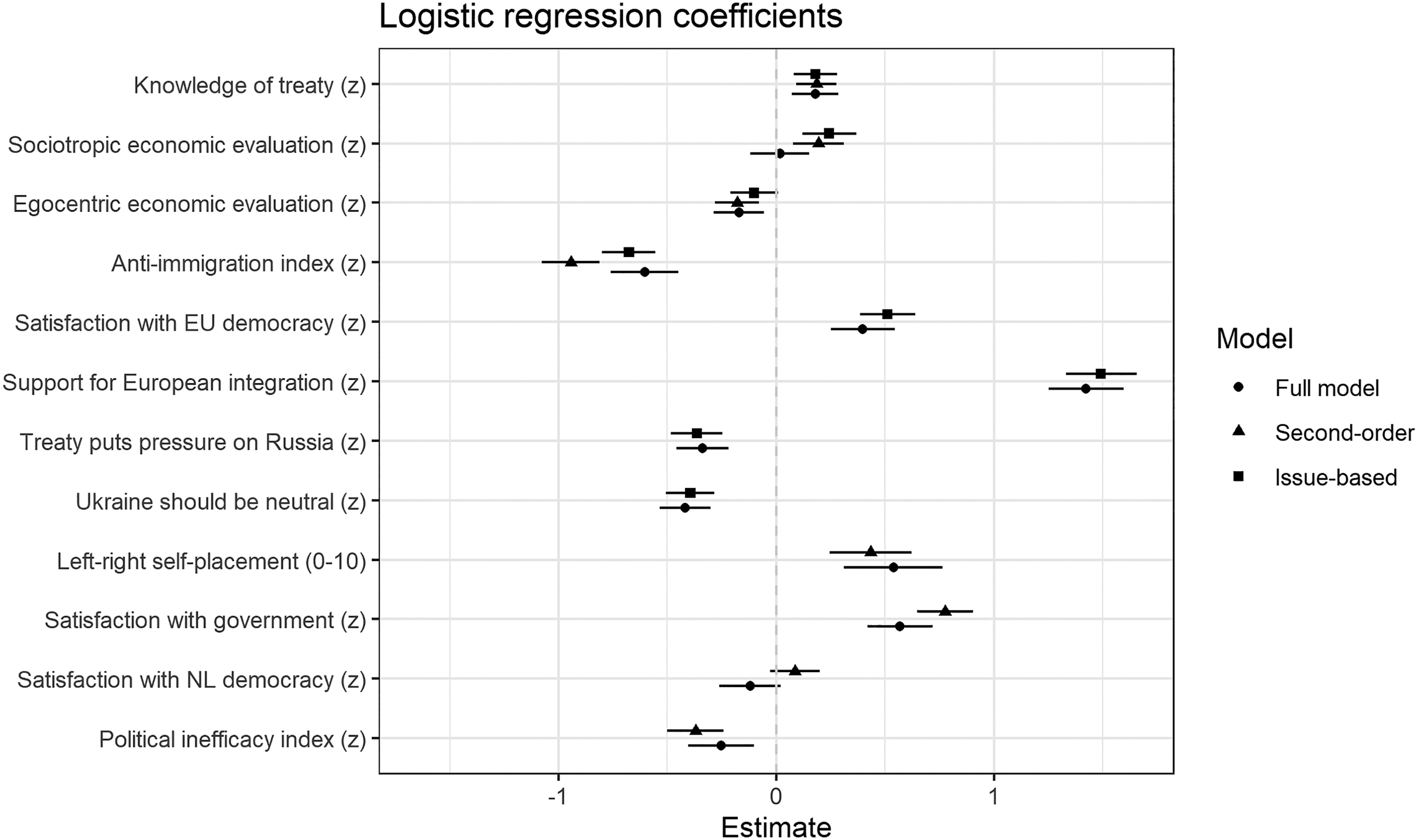
Coefficient plot of the issue-based model, the second-order model and the full model.
Regression coefficients for the issue-based model, the second-order model, and the combined full model.
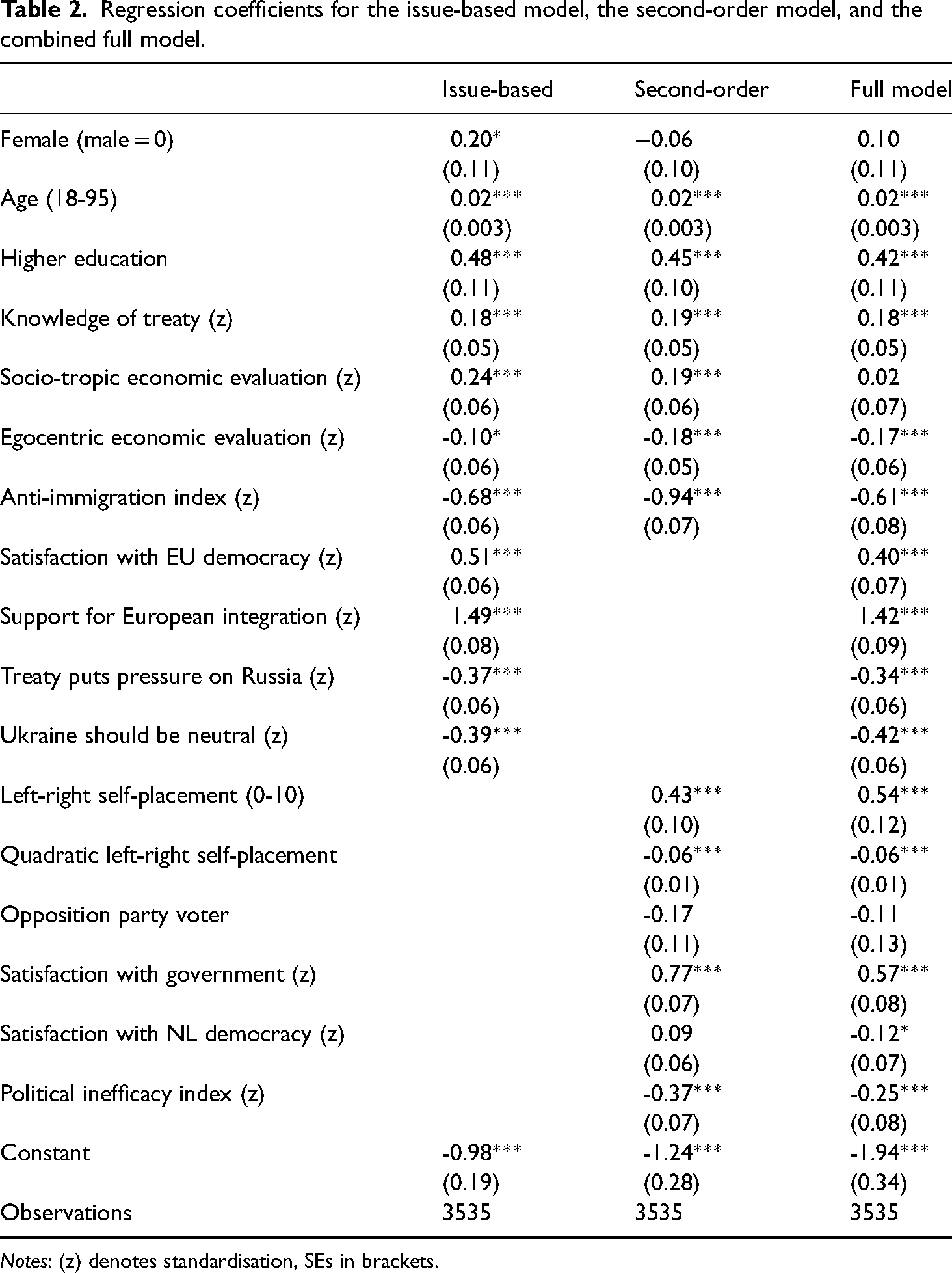
Notes: (z) denotes standardisation, SEs in brackets.
The issue-based model has the larger explanatory power (Nagelkerke R2 = 0.67, Table 3), compared to the second-order model (Nagelkerke R2 = 0.57, Table 3). A likelihood ratio test shows that the former explains significantly more variation than the latter (χ2 = 409.4***, see the Online appendix). Table 3 shows the pseudo R2, the area under the curve (AUC) values, and the proportional reduction in error (PRE) for each model and submodel (see the Online appendix), which include only their respective variables in addition to those from the control model. All values serve as alternative goodness of fit statistics for a more comprehensive understanding of the models’ predictive power 2 .
Goodness of fit statistics for all models and submodels.
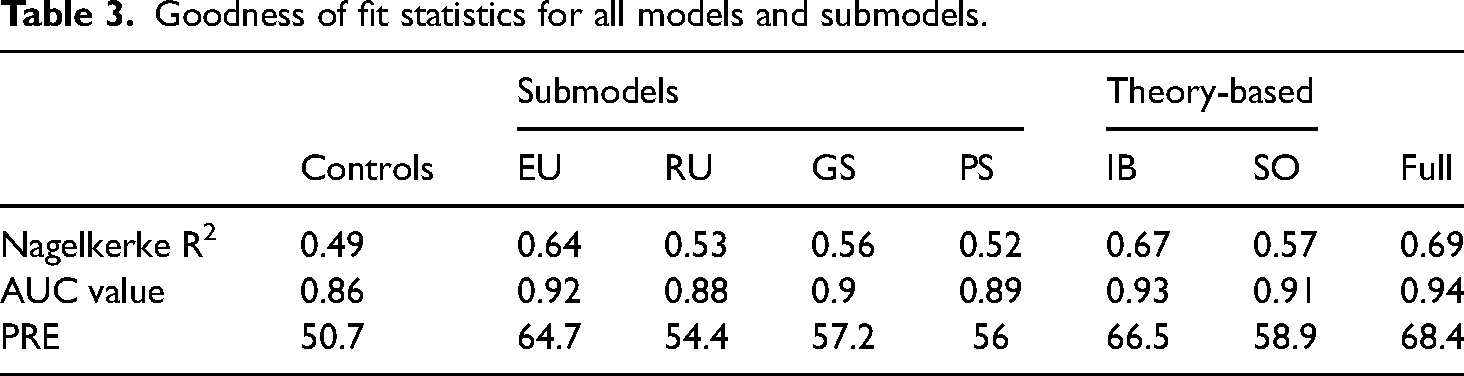
While the full model has the largest predictive power across the board, it is closely followed by the issue-based model. However, it is clear that the EU submodel explains most of the variation, with diagnostics consistently higher than even the second-order model. The other issue-based RU submodel has the lowest predictive power, together with the submodel about discontent with national democracy (PS). Nevertheless, as shown in the Online appendix, both still significantly predict the referendum vote better than a null-model (χRU2 = 1571.13***, χPS2 = 1557.57***) or the control model (χRU2 = 134.22***, χPS2 = 120.67).
Before proceeding to the discussion of the issue-based and second-order models, we briefly address how knowledge about the treaty's content interacts with certain other predictors (see the Online appendix). Most notably, even though socio-tropic evaluations do not significantly predict voting behaviour in the full model, they do have a significant effect when interacted with treaty knowledge. Citizens with below average knowledge of the treaty's contents are more likely to vote in favour as they believe the Dutch economy is doing better, whereas those with above average knowledge are more inclined to vote in favour as they believe the economy is doing worse. Belief that the treaty puts pressure on the EU's relationship with Russia is negatively correlated with voting ‘for’ the treaty for all knowledge levels, except for the lowest ones. While these effects provide a more in-depth understanding of the dynamics behind certain voting behaviour drivers, they do not substantially alter the interpretation of the model.
In the following section, we refer to the coefficients and odds ratios of the full model. References to the pseudo R2 refer to the submodels, as to be able to distinguish between their respective contributions.
Issue-based model
The EU submodel has the strongest explanatory power (Nagelkerke R2 = 0.64) of all submodels, indicating that EU-related attitudes are among the strongest drivers of the treaty rejection. In particular, those least satisfied with the functioning of democracy at the EU level and those least in favour of European integration were most likely to vote ‘against’. These results provide evidence for H1, as well as for the issue-based theoretical approach: referendums on EU treaties are to a large extent decided by voters’ attitudes towards the EU (see Figure 2).
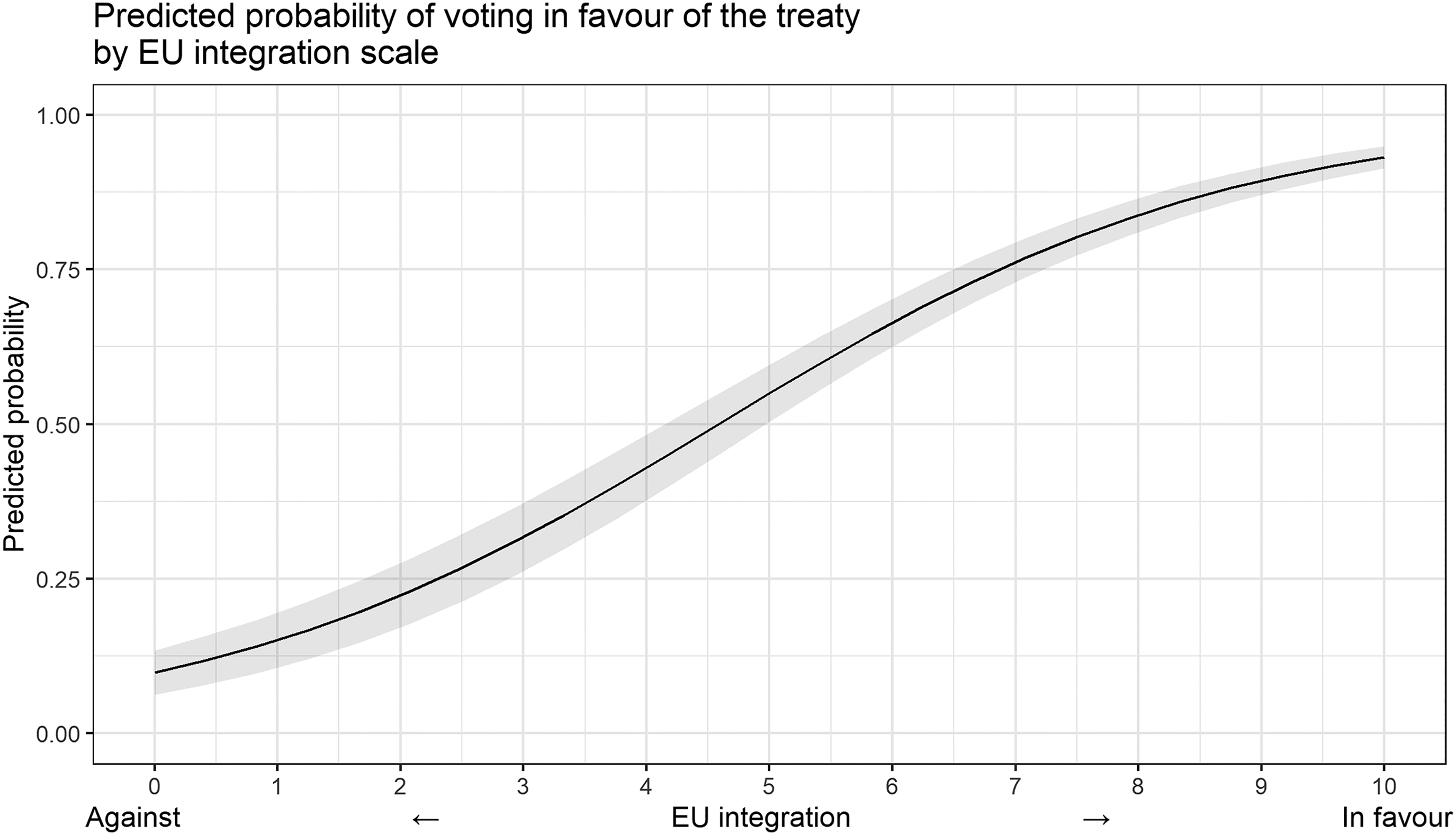
Effect plot of the European integration predictor.
On the other hand, the RU submodel has a relatively low explanatory power (Nagelkerke R2 = 0.53). People who score one standard deviation higher than average on the belief that the treaty puts the EU's relationship with Russia under pressure are 29% less likely to vote in favour of the treaty. Those who believe Ukraine should remain a neutral state between the EU and Russia are 34% less likely to vote in favour of the treaty. These findings support H2: those who fear that the treaty may harm the EU's relationship with Russia are less likely to vote in favour of the treaty.
Second-order model
The inclusion of political positions and control deprivation in the GS submodel explains a substantial proportion of the vote choice variance (Nagelkerke R2 = 0.56). The results reveal that ideology has a curvilinear, negative effect on vote choice as shown in Figure 3: radicals on both the far-left and far-right of the political spectrum were more likely to vote ‘against’ the EU-Ukraine Association Agreement, confirming H3. This suggests that both left-wing and right-wing Eurosceptic parties have successfully mobilised their supporters against the treaty.
While the predictor that separates opposition party voters from coalition party voters is insignificantly negative, satisfaction with the government is significantly positive, providing evidence for H4. Voters who evaluate the government's actions a standard deviation higher than average are 76% more inclined to vote for the treaty (see Figure 4).
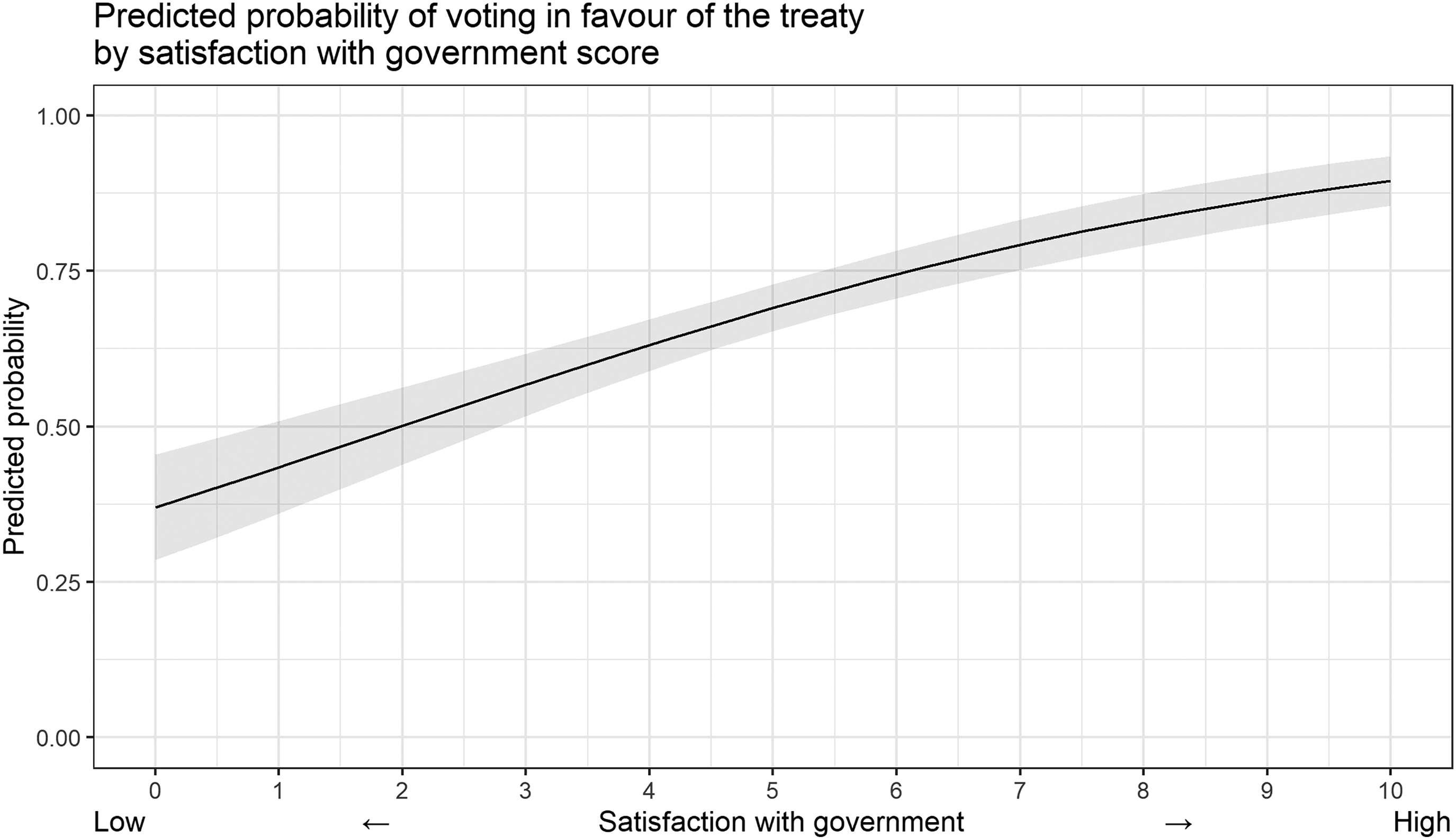
Effect plot of satisfaction with the national government.
In the submodel that includes variables about discontent with the domestic political system, satisfaction with Dutch democracy is a significantly negative predictor of the ‘for’ vote in the full model, which goes against expectations. However, in its respective submodel (PS), the coefficient changes to insignificantly positive. Furthermore, there is a strong and consistent effect of political inefficacy on voting against the treaty: citizens who feel that mainstream politics is unresponsive to their interests and concerns were more likely to oppose the treaty. This finding suggests that the political forces campaigning against the EU-Ukraine Association Agreement managed to speak to citizens’ more general dissatisfaction with domestic politics. Taken together, the PS submodel provide mixed evidence that dissatisfaction with the national government predicts opposition against the treaty (H5).
Overall, these findings indicate that citizens see the referendum as an opportunity to voice their discontent with their national government, as well as – but less clearly so – with the political system in general, providing evidence that animosity towards domestic political dynamics fuels anti-EU electoral behaviour. This constitutes evidence largely supportive of the second-order approach.
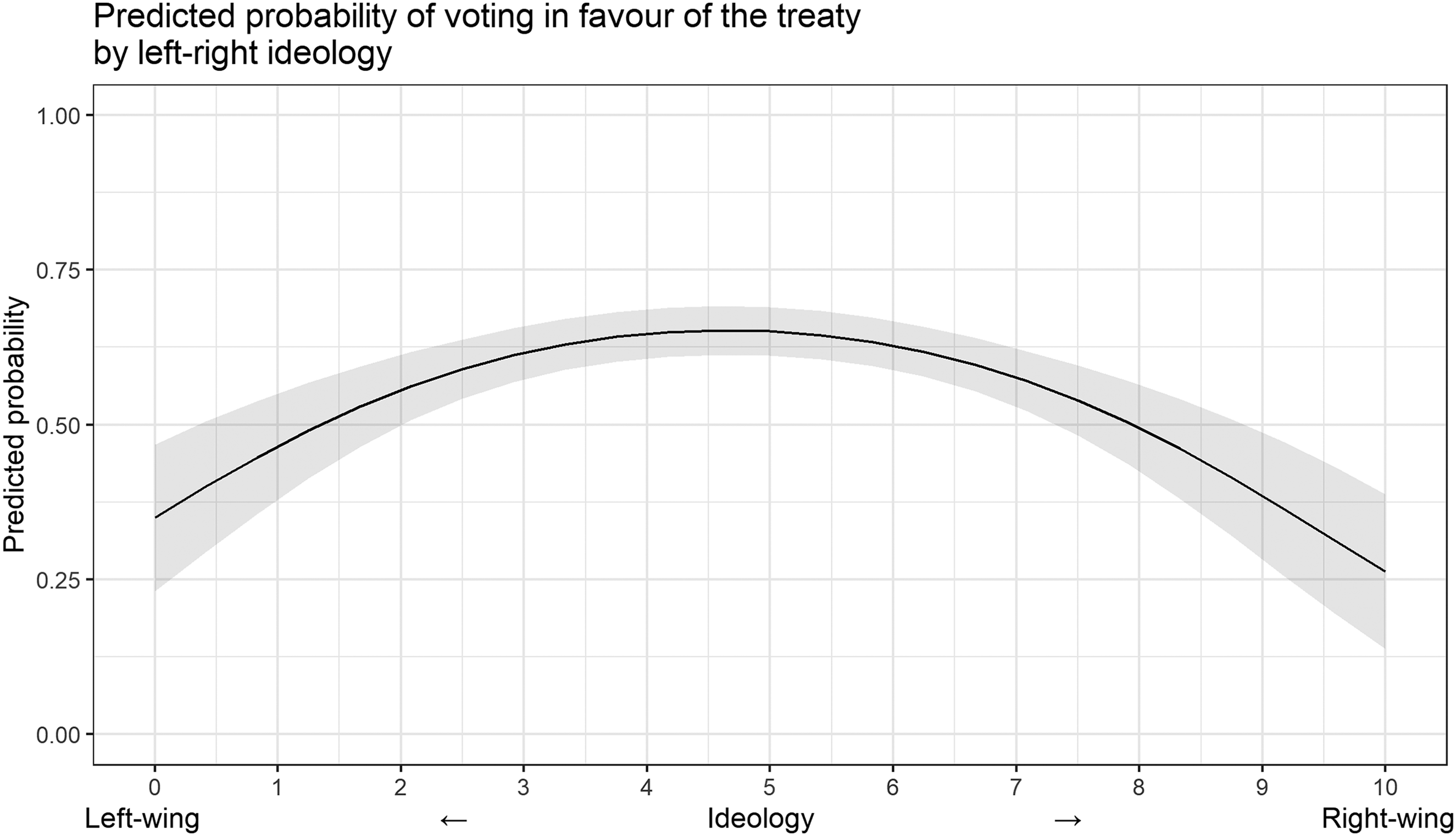
Effect plot of respondent ideology.
Comparison of models
In terms of the issue-based versus the second-order approach, our results provide evidence for both approaches simultaneously interplaying when it comes to the referendum outcome. Nevertheless, the support for EU integration coefficient is significantly larger than all other predictors (see the Online appendix). Apart from that, the coefficient on satisfaction with EU democracy is significantly larger than almost all other (standardised) predictors, with the exceptions of thinking Ukraine should be neutral and satisfaction with the national government 3 . This strongly suggests that opposition to the treaty was driven more by issue-based concerns than by domestic political evaluations. This finding is in line with previous research (Schuck and de Vreese, 2008; van der Brug et al., 2018).
Furthermore, there is a substantial difference, in terms of explanatory power, between the issue-based and second-order approaches. The IB model does perform significantly better than the SO model. Based on our findings, we therefore argue that the referendum vote was less affected by domestic political evaluations than by EU-related concerns, supporting first and foremost the ‘EU issue voting’ interpretation.
Conclusion
In this article, we show that both the issue-based approach and the second-order approach simultaneously explain Dutch opposition towards the EU-Ukraine Association Agreement. However, while differences in economic, cultural, and political outlook do carry explanatory power overall, confirming previous findings used to account for public Euroscepticism (Abts et al., 2009; Hobolt and de Vries, 2016; Hooghe and Marks, 2005; Lubbers, 2008), a stronger link is found between anti-EU attitudes and the referendum vote choice than between concerns about Russia, treaty knowledge, or a range of second-order concerns, indicating that perceptions towards the EU were indeed at the heart of what motivated citizens’ vote choice (Schuck and de Vreese, 2008; van der Brug et al., 2018). This suggests that referendums, regardless of whether they are concerned with the legal framework of the EU or other specific EU-related issues, such as the association with third countries, can be used to undermine the European project by means of mobilising its opponents.
Nevertheless, numerous determinants of the ‘against’ vote pertain to national grievances. By appealing to concerns such as economic dissatisfaction, fear of cultural threat or domestic political discontent, the European project can be further eroded through such referendums. Those who think the state of the economy is intractable, those who feel that the political system is unresponsive to their values and interests, and those who oppose further immigration were particularly opposed to the treaty. Personal economic evaluations did not have a significant effect on the referendum outcome, indicating that the ‘against’ vote could not be restricted to the so-called ‘left-behinds’ (Antonucci et al., 2017; Goodwin and Heath, 2016) united by a general sense of income insecurity.
In addition, ideology matters in the sense that increasing polarisation and opposition to European integration go hand in hand. We find that the more radical voters on both sides of the political spectrum rejected the treaty (and with it more generally European integration), while moderate and well-informed voters supported the treaty. This could suggest that there is an increasing divide and polarisation in terms of political knowledge and education, where low interest and lower-educated voters may be more susceptible to misinformation during the campaign.
These combined results may indicate that the education divide (between higher- and lower-educated and better and less informed voters), as well as an ideological divide (between the radicals and the moderates) and a third salient political divide (between those with cynical, negative, and distrustful political evaluations against those with more positive political evaluations) have all intersected during the campaign with general attitudes towards the EU, Russia, and immigration (the globalisation divide).
Regardless of the answer to what the referendum outcome means, our article clearly challenges the dichotomy between the issue-based theory and the second-order election theory of referendums. As shown, national political considerations contributed to the referendum vote choice to a smaller extent than did EU attitudes, but issue-specific variables did not predict the vote more strongly than the second-order variables. This is precisely what the campaign against the treaty understood very well: treaty opponents framed the EU-Ukraine Association Agreement referendum primarily as a vote about the EU and further European integration, rather than a matter of strengthening economic and political ties with Ukraine. This suggests that specific issues regarding the European integration project can easily be confounded to the wider question of the legitimacy of the overall project of European integration. However, it is also too simplistic to suggest that the rejection of the treaty was simply the effect of strong Eurosceptic attitudes, as these seem to be embedded within a broader emerging political conflict related to the issues of economic outlook, culture and identity as well as power and representation. In this regard, our results indicate that the ‘against’ campaign has not only mobilised anti-EU feelings but has also effectively primed fear of escalation with Russia, as well as political cynicism and cultural anxieties – not always directly connected to the substance of the EU-Ukraine Association Agreement referendum – that ultimately became important to the vote choice.
Consequently, rather than seeing issue-specific considerations and general feelings of economic, cultural and political discontent as competing alternatives for the explanation of voting behaviour in EU referendums, future studies should expand on the link between resentment, Euroscepticism and vote choice (see e.g., Abts and Baute, 2021), as well as consider changes in opinion towards the EU's relationship with Ukraine and Russia over time, especially in light of the 2022 Russian war in Ukraine.
Supplemental Material
sj-pdf-1-eup-10.1177_14651165231157612 - Supplemental material for EU-sentiment predicts the 2016 Dutch referendum vote on the EU’s association with Ukraine better than concerns about Russia or national discontent
Supplemental material, sj-pdf-1-eup-10.1177_14651165231157612 for EU-sentiment predicts the 2016 Dutch referendum vote on the EU’s association with Ukraine better than concerns about Russia or national discontent by Koen Abts, Tom Etienne, Yordan Kutiyski and André Krouwel in European Union Politics
Supplemental Material
sj-rmd-2-eup-10.1177_14651165231157612 - Supplemental material for EU-sentiment predicts the 2016 Dutch referendum vote on the EU’s association with Ukraine better than concerns about Russia or national discontent
Supplemental material, sj-rmd-2-eup-10.1177_14651165231157612 for EU-sentiment predicts the 2016 Dutch referendum vote on the EU’s association with Ukraine better than concerns about Russia or national discontent by Koen Abts, Tom Etienne, Yordan Kutiyski and André Krouwel in European Union Politics
Supplemental Material
sj-csv-3-eup-10.1177_14651165231157612 - Supplemental material for EU-sentiment predicts the 2016 Dutch referendum vote on the EU’s association with Ukraine better than concerns about Russia or national discontent
Supplemental material, sj-csv-3-eup-10.1177_14651165231157612 for EU-sentiment predicts the 2016 Dutch referendum vote on the EU’s association with Ukraine better than concerns about Russia or national discontent by Koen Abts, Tom Etienne, Yordan Kutiyski and André Krouwel in European Union Politics
Footnotes
Author contributions
The authors contributed equally to the article.
Funding
The author(s) received no financial support for the research, authorship, and/or publication of this article.

Supplemental material
Supplemental material for this article is available online.
Notes
References
Supplementary Material
Please find the following supplemental material available below.
For Open Access articles published under a Creative Commons License, all supplemental material carries the same license as the article it is associated with.
For non-Open Access articles published, all supplemental material carries a non-exclusive license, and permission requests for re-use of supplemental material or any part of supplemental material shall be sent directly to the copyright owner as specified in the copyright notice associated with the article.
