






Abstract
Vocational interests are traditionally conceived as stable preferences for different activities. However, recent theorizing suggests their intraindividual variability. This preregistered experience sampling study examined intraindividual variation in selected vocational interests states and related situation and person factors (N = 237). Results indicate that the three interest dimensions Investigative, Artistic, and Social interests did vary intraindividually but less so than other phenomena’s dimensions (e.g., personality and happiness). At the within-person level, the focused interest states were related to specific situation characteristics, also after controlling for related personality dimensions and happiness. These relations were either specified a priori, based on the concept of congruence or person-environment fit, and tested in a strictly confirmatory manner, or identified using a more exploratory approach. Furthermore, aggregated states of the three selected interest dimensions mainly varied below their corresponding trait levels. This suggests that interest trait levels could represent an upper limit for aggregated interest states that could be due to method-related or construct-related reasons. The results demonstrate the situational character of interests and provide novel approaches for studying vocational interest in daily life.
Keywords
Introduction
Imagine you have strong interests in helping other people, and—fortunately—you work as a social worker. Sometimes, however, you do not feel inclined towards helping others—you are less interested in that activity than you normally are. Conversely, in other moments, you might experience interest in activities you are generally not interested in. To what extent does such intraindividual variation in the manifestation of interests actually exist? And if it does, which further situation and person variables are related to this variation? The overarching research question of this study specifies these matters and is whether certain situation characteristics are related to selected interest states. This paper contributes to answering this question by examining interest states and untangling their relations to situation perception using an experience sampling (ESM) design.
Traits and states of (vocational) interests
Interests are positively connoted phenomena: They guide career decisions (Holland, 1997; Lent et al., 2018), are accompanied by activation and positive feelings (Knogler, 2017; Renninger & Hidi, 2011; Silvia, 2008), or direct (cognitive) energy (Ackerman, 1996; Ziegler, Schroeter, Ludtke, & Roemer, 2018). Interests influence long-term decisions, life outcomes, and organizational performance (Nye, Su, Rounds, & Drasgow, 2012; Stoll et al., 2017).
However, despite their prominent role in many different areas of life, interests are conceptualized differently in different research fields within psychology (for an integrative review, see Su, 2020). Yet one common characteristic of all these definitions is the relational nature of interests: One is always interested in something. Broadly speaking, interests can be studied from both a trait and a state perspective. Within the first perspective, vocational interests are conceived as an individual’s stable preferences for different work activities. The most prominent conceptualization of these stable interests is Holland’s (1997) theory of vocational personalities. This theory assumes that every person has a stable level on six interest dimensions: Realistic, Investigative, Artistic, Social, Enterprising, and Conventional interests (together referred to using the acronym RIASEC). During adulthood, vocational interests are rather stable (Hoff, Song, Einarsdottir, Briley, & Rounds, 2020) and exhibit even higher stability coefficients than personality (Low, Yoon, Roberts, & Rounds, 2005). Thus, similar to the conceptualization of personality traits (Funder, 2001), vocational interests are considered dispositional interindividual differences (Rounds & Su, 2014).
Rather distinct from this stable perspective on interests—interests as traits—is a large body of research that takes a momentary perspective on interests. Within this perspective, interests are studied as states. Here, interests are conceptualized as momentary experiences involving emotions of curiosity and enjoyment (e.g. Hidi & Renninger, 2006; Silvia, 2008; Ziegler et al., 2018), cognitive appraisals (e.g. Silvia, 2005), and elevated or sustained attention (e.g. Ainley, Hidi, & Berndorff, 2002; Rotgans & Schmidt, 2014). Interest states are largely studied in educational contexts, where they have been referred to as ‘an ideal state, and one to strive for whenever possible’ (Harackiewicz & Knogler, 2017, p. 336).
Until now, research combining the trait and state perspectives on interests is rare, although such integrated examinations are now rather common and have proven fruitful in other areas of psychology (e.g. Baumert et al., 2017; Dejonckheere et al., 2019; Endler & Kocovski, 2001; Fleeson & Jayawickreme, 2015; Sherman, Rauthmann, Brown, Serfass, & Jones, 2015). A recent conceptual framework that integrates both perspectives is the Trait–State Interest Dynamics (TSID) framework by Su, Stoll, and Rounds (2019). Su et al. conceptualized interests at two levels: the trait and state level. At the trait level, they conceptualized interests as relatively stable preferences, organized as abstract representations of classes of homogenous activities and objects, and having motivational functions. At the state level, they defined situational interests—also known as interest states—as momentary experiences. According to the TSID framework, these momentary experiences entail three interwoven layers: (i) affective reactions towards the object of interest (‘Do I like/feel attracted to this object?’), (ii) cognitive appraisals regarding the value of the object of interest (‘Is this object intriguing?’), and (iii) cognitive appraisals regarding the compatibility of the object with one’s self-concept (‘Is this object meaningful to me?’). These three layers are not uniquely distinguishable (Su, 2020). That is, interest states are experienced as a collection of joint affective and cognitive reactions/evaluations (see also Mischel & Shoda, 1995). In this sense, intraindividual variability in interest states could be conceptualized by fluctuations in these cognitive-affective experiences. Furthermore, within TSID, the trait and state level of interests should exist in concert with one another—just as it is the case for other person characteristics (e.g. Endler & Kocovski, 2001; Fleeson & Jayawickreme, 2015). That is, as to TSID, interest traits provide a general tendency for experiencing interest states: Interest states result from interactions of this general tendency with external stimuli and contribute, over time, to developing interest traits. With the present study, we examine parts of this theorized interplay in detail. Specifically, based on the reasoning that interest states result from interactions with external cues, this study examines whether certain situation characteristics are related to selected interest states. To do so, we employ Su et al.’s (2019) definition for interest states and traits and focus on the RIASEC taxonomy as a comprehensive framework to measure interests.
A precondition to examine the relations between vocational interest states and situation characteristics is the existence of intraindividual variations in momentary levels of interests. In addition to the theoretical support just summarized (Su et al., 2019), recent empirical evidence also supports the assumption that vocational interests exist both at the trait and state level and thus vary within individuals. Using ESM data, Ziegler et al. (2018) identified considerable within-person variability in interest states (ICCs: .40–.48), which were conceptualized based on the RIASEC taxonomy. About 40–48% of the variance was explained by between-person differences (i.e. ICCs) and about 52–60% by within-person differences (i.e. 1 − ICC). This amount of within-person variability is lower than, for example, the within-person variability in personality states, which are defined parallel to personality traits and differ only in that they apply to a shorter timeframe (Baumert, Schmitt, et al., 2017). Personality states usually exhibit smaller ICCs and thus more within-person variability (e.g. mean ICC = .35; Sherman et al., 2015). Compared with this, interests seem to reveal more stability—both at the within-person level and at the between-person level (Low et al., 2005). This could be explained with the relational nature of interests (i.e. interests always refer to the same objects/activities). The existence of intraindividual variability in interests is necessary to examine the within-person relations between interest states and certain situation characteristics, though. Therefore, we preregistered research objective (RO) 1 and corresponding hypotheses: RO1: Can the previous findings concerning the intraindividual variance in the state expressions of RIASEC interests be replicated? H1.1: The mean ICC for interest states is larger than the mean ICC for situation perceptions and personality states. H1.2: The mean ICC for interest states ranges from .40 to .60.
Situational influences on interest states
Central to Holland’s (1997) theory is the assumption that the RIASEC framework is useful for categorizing not only an individual’s interests but also (work) environments. That is, the workplace of the social worker from the previous example could most likely be characterized by predominantly social and some enterprising activities. 1 Furthermore, Holland postulated that people strive towards environments that match their interests. In other words, individuals try to achieve a high degree of congruence between their stable interests and the characteristics of a specific environment—which should lead to higher performance and satisfaction (Holland, 1997). The concept of congruence or person-environment fit at the between-person level is supported by substantive research: People self-select into environments that suit their interests (e.g. Wille, Tracey, Feys, & De Fruyt, 2014). Also, interest congruence was meta-analytically found to be a stronger predictor of job performance than interest scores alone (Nye, Su, Rounds, & Drasgow, 2017). One can thus conclude that interest traits are related to specific environmental aspects at the between-person level; especially when the latter are congruent to the interest traits.
This assumption of relations between specific environmental aspects and interests (Holland, 1997) seems—based on the propositions of TSID—also plausible at a narrower time scale: Specific situational influences could relate to the momentary experience of interest states. Hereafter, we elaborate on that proposition in more detail. Importantly, when looking at relations between situation and person factors as interests, it is vital to consider the level of abstraction (Kretzschmar, Spengler, Schubert, Steinmayr, & Ziegler, 2018). In a recent target paper, Rauthmann, Sherman, and Funder (2015) defined three levels of situational information: objective cues, subjective characteristics, and subsuming classes. Whereas cues refer to the objective stimuli in a situation, characteristics are defined as psychologically meaningful interpretations of objective cues. Most prior research on the interplay of interests and situations is located at a macrolevel: It focuses on an individual’s general interests and the general characterization of their environment. The so-called environment is, according to Rauthmann, Sherman, and Funder, equivalent to situation classes. In fact, those authors state all workplace situations as an example for a situation class (p. 364). The same authors also argue that situation characteristics are much more relevant for the study of how traits manifest in states. Thus, in order to look at the relations between situation features and interest states, the environment as defined by Holland most likely is the wrong level of abstraction. A more promising research avenue would therefore be to explore the relations between situation characteristics and interest states.
Such within-person relations between certain occasion-specific situation characteristics and an individual’s interest state can be expected for empirical and theoretical reasons: First and generally speaking, relations between situation characteristics and interest states seem reasonable because similar within-person relations have been established for related phenomena. For instance, Parrigon, Woo, Tay, and Wang (2017) could show that specific situation characteristics predicted momentary intrinsic motivation—a construct closely linked to interests (e.g. Renninger & Hidi, 2011; Su et al., 2019). Relatedly, Sherman et al. (2015) and Horstmann, Rauthmann, Sherman, and Ziegler (in press) could show that intraindividual variations in situation characteristics were associated with meaningful variability in specific personality states. For example, when persons perceived that close interactions were especially important in a given situation (i.e. Sociality), they tended to express higher degrees of Extraversion. The theoretical background for such specific relations was extensively described by de Vries, Tybur, Pollet, and van Vugt (2016). Considering that personality and interest dimensions share substantial amounts of common variance (Mount, Barrick, Scullen, & Rounds, 2005), comparable specific within-person relations also seem plausible for interest states.
Second, the phenomenon of situation-specific interest states is established in other psychological disciplines, such as educational psychology. Research from this field has recognized the concept of situational interest for a long time (e.g. Hidi & Baird, 1988; Mitchell, 1993). In addition, numerous studies focused on occasion-specific factors influencing interest states in specific topics (e.g. interest in science). Several situation and task characteristics, such as social involvement, content-personalization, puzzles, hands-on activities, or seductive details, have been found to increase interest states in these educational topics (e.g. Bernacki & Walkington, 2018; Høgheim & Reber, 2015; Palmer, 2009). In that sense, the existence of within-person relations between situation cues and interest states rests on substantial empirical support. However, based on Rauthmann et al. (2015), these relations should be even stronger when considering situation characteristics.
And third, Ziegler et al. (2018) explored within-person relations between interests states and personality states. They proposed that situation perception acts as a moderator of these relations, specifically with respect to Openness and, for instance, Investigative interests. As such, the authors expected an intra-individual interplay between situation perception, interest states, and personality states.
To conclude, relations between external influences and interest states seem plausible at the within-person level. However, as we argued previously, much research concerning situational influences on interest states has examined very narrow, specific situations and hence allows only limited generalizability. Other research focused on environments or situation classes—and might therefore aim at the wrong level of abstraction when it comes to interest states. We therefore argue that the most promising approach seems to consist in exploring the within-person relations between situation characteristics and interest states. This, though, requires psychometrically tested measurement approaches to situation characteristics.
Situation characteristics and interest states
Over the last few years, a number of situation perception taxonomies and related questionnaires have been suggested (Horstmann, Rauthmann, & Sherman, 2018; Parrigon et al., 2017; Ziegler, Horstmann, & Ziegler, 2019). The DIAMONDS taxonomy proposed by Rauthmann et al. (2014) describes everyday situations on eight dimensions: Duty (Does a job need to be done?), Intellect (Is cognitive processing required?), Adversity (Is someone threatened?), Mating (Are potential partners present?), pOsitivity (Is the situation pleasant?), Negativity (Is the situation stressful?), Deception (Is someone being deceitful?), and Sociality (Is close social interaction possible or expected?).
Through which mechanism could these situation characteristics relate to interest states? A general approach to describe such a mechanism would be to assume a main effect of situation characteristics on interest states: Certain situation characteristics have the potential to specifically relate to the cognitive-affective experiences making up a specific interest state (Su et al., 2019; see also Mischel & Shoda, 1995). Such a main effect of situation characteristics on interest states could be explained by certain situation characteristics reflecting specific goal affordances, motives, or self-concept relevancies (e.g. Argyle, Furnham, & Graham, 1981; de Vries et al., 2016; Oyserman, Elmore, & Smith, 2012; Rauthmann et al., 2014). The importance of motives, goals, or self-concept aspects thus varies as a function of the situation. This variation in the importance of motives, goals, or self-concept aspects could in turn lead to variation in the cognitive-affective experiences of interest states. In other words, a given situation characteristic would relate to the overall experience of interest states. Likewise, similar processes have been proposed and empirically supported for the relation between situation characteristics and personality states (e.g. de Vries et al., 2016; Sherman et al., 2015). However, not every situation is expected to have the potential to reflect specific goal affordances, motives, or self-concept relevancies (e.g. Oyserman et al., 2012). Hence, we argue that certain situation characteristics should meaningfully relate to specific interest states, whereas for other pairs of situation characteristics and interest states, no such relations should emerge.
Hypotheses derivation
This study is the first to examine within-person relations between selected interest states and situation characteristics. Therefore, we could not build on an extensive body of literature to derive specific hypotheses regarding the large amount of possible links between momentary situation characteristics (e.g. eight DIAMONDS dimensions) and interest states (e.g. six RIASEC dimensions). Nevertheless, based on Holland’s (1997) concept of congruence, two specific relations can be expected straightforwardly 2 : (i) the situation characteristic Intellect should be positively related to Investigative interest state; and (ii) the situation characteristic Sociality should relate to Social interest states. Both hypothesized relations are based on the close similarity of the definitions of the involved constructs: Situations characterized by perceived Intellect entail the necessity to deeply process information (Rauthmann et al., 2014). Correspondingly, Investigative interests describe preferences for activities involving the systematic investigation of different phenomena (Holland, 1997). Situations characterized by Sociality involve opportunities to closely interact with others (Rauthmann et al., 2014). Similarly, Social interests refer to a preference for social activities and helping others (Holland, 1997). In that sense, the concept of congruence provides an elaboration for the mechanism how these situation characteristics should relate to the experience of similar interests at state level. If a person perceives a situation in a specific way, the striving for congruence or fit could explain that congruent affiliated goals, motives, or self-aspects are actualized and consequently affiliated cognitive-affective reactions are elicited. For example, if a person perceives high degrees of Sociality in a given situation, this could have similar effects as a so-called strong situation (Mischel, 1977). In that sense, most persons would actualize their cognitive-affective reaction towards social activities—independent of their trait levels of Social interests. In order to achieve higher degrees of congruence, a person would temporarily upgrade the relevance of social activities for themselves. In other words, this person would experience more Social interest states than in most other situations and a perceived situation characteristic would have a main effect on a related interest state.
In contrast to the two relations based on the concept of congruence, the remaining within-person relations between situation characteristics and interest state are not clear-cut. For instance, perceiving a situation high on Mating could on the one hand relate to increased cognitive-affective reactions towards helping other people. That is, if potential partners are present, the importance of being a kind, helping person could be emphasized in order to appear as a responsible partner (e.g. Brown, Neel, & Sherman, 2015)—resulting in above-average Social interest states. On the other hand, also a negative within-person relation seems plausible. That is, if potential partners are present, the cognitive-affective reactions towards helping other people could decrease due to the stronger focus on the potential partner (e.g. Maner, Gailliot, Rouby, & Miller, 2007)—participants could only have ‘one thing’ on their minds. Finally, the third option of a null relation is also plausible. In that case, the cognitive-affective reactions towards helping other people remain unaffected by the perceived presence of potential partners. Therefore, we examine the remaining relations between situation characteristics and interest states exploratively to derive hypotheses for later testing.
Furthermore, although we have elaborated the relations implicitly suggesting directionality, the current design does not allow testing causality at the state level. Thus, we examine the covariation between the variables, which is an important prerequisite for any causal relations. In that sense, we preregistered: RO2: How are situation characteristics related to state expressions of selected vocational interests at the within-person level? H2.1: Perceived Intellect is positively related to Investigative interests. H2.2: Perceived Sociality is positively related to Social interests.
In contrast to these two hypotheses, we did not preregister specific expectations regarding the direction or size of the other relations between the situation characteristics and interest states.
Influence of further relevant constructs
If relations between perceived situation characteristics and interest states exist, they should be controlled for the influence of other constructs, which have been shown to be related to the two phenomena. So when examining the main effects of specific situation characteristics on interest states, one should ensure that these effects do not merely emerge from the overlap with other constructs. Situation perception shares substantial amounts of variance with in situ positive and negative affects (Horstmann & Ziegler, 2019; Parrigon et al., 2017). Hence, affect (or happiness as a proxy; Horstmann et al., in press) should be considered to establish evidence for the specific relations between situation characteristics and interest states. Likewise, (positive) affective reactions also compose the experience of interest states (Hidi & Renninger, 2006; Su et al., 2019). Therefore, in order to exclusively consider the affective reactions towards the object of interests, one should control for the influence of momentary happiness. Furthermore, the overlap between interests and personality should be taken into account. In their meta-analysis, Mount et al. (2005) found moderate relations between several dimensions of RIASEC interests and Big Five personality at trait level. Similarly, several dimensions of situation perception are also related to Big Five/Six personality (e.g. Horstmann et al., in press; Parrigon et al., 2017; Rauthmann et al., 2014), both at the trait and the state level. This shared variance should be controlled for in order to investigate the actual relations between situation perception and interest states as such. The two relations specified previously should exist also after controlling for construct overlap. This leads to the third preregistered research objective and corresponding hypotheses: RO3: How are situation characteristics related to selected vocational interest states at the within-person level, when considering the overlap with personality and happiness? H3.1: The positive relation between perceived Intellect and Investigative interests exists also after controlling for the relevant personality dimensions and happiness. H3.2: The positive relation between perceived Sociality and Social interests exists also after controlling for the relevant personality dimensions and happiness.
Here again, all other relations between situation characteristics and the selected interest states were preregistered to be examined exploratorily. Furthermore, due to the expected shared variance between interest states, situation characteristics, and the control variables, we expected the pattern of results to change when including the control variables. Psychologically meaningful relations between situation characteristics and selected interest states should remain significant also after including the control variables (see Horstmann et al., in press). However, the remaining relations between situation characteristics and interest states should be weakened such that they are no longer significant. We therefore hypothesized: H3.3: In the models analysed for RO3, fewer within-person relations between situation characteristics and the selected interest states are significant compared with respective relations from the models analysed for RO2.
Interindividual differences in the within-person relations
Finally, the proposed main effect of situation characteristics on interest states could also be subject to moderating influences from the stable interest trait. In other words, the within-person relations between situation characteristics and interest states (which should be controlled for construct overlap) would not be the same across all persons but differ interindividually as a function of the stable interest trait. Such a moderating effect is suggested in the literature from both personality and educational psychology (e.g. Hidi & Renninger, 2006; Tett & Burnett, 2003). In that sense, the previously stated mechanism needed be refined in a way that the relations between situation characteristics and the cognitive-affective experiences of interest states depend on the interest trait.
In personality psychology, a moderating effect has been proposed in which the personality trait positively moderates the within-person relations between situation characteristics and personality states (Tett & Burnett, 2003). That is, the personality trait would activate or strengthen/weaken the relations between situation characteristics and interest states. However, when put to the empirical test, Sherman et al. (2015) found ‘very little support for interactions between personality traits and situation characteristics’ (p. 884).
Conversely, and even closer related to the current study’s topic, in educational psychology, a negative moderating effect of the interest trait on the within-person relations between specific external aspects and interest states has been found: For example, Høgheim and Reber (2015) could show that an educational intervention’s effect on interest state was different for students with higher versus lower interest traits. Specifically, the effect of content-personalization—i.e. increasing the material’s personal relevance for the learner—on interest states was weaker for those students with higher interest traits compared with those with lower interest traits. The four-phase model of interest development (Hidi & Renninger, 2006) is in line with this finding. That model describes how learners’ interests develop from triggered situational interests to well-developed individual interests in four phases (1: triggered situational interest, 2: maintained situational interest, 3: emerging individual interest, and 4: well-developed individual interest). It posits that the effect of a given situation on the experience of interest becomes weaker as the interest develops further. For instance, an inspiring documentary could trigger momentary interest in quantum physics—particularly among laypersons. In contrast, a professor of quantum physics (assumed to have a high trait interest in physics) does not need such a situational trigger to experience interest. However, this does not mean that someone with stable interest traits is not able to experience corresponding situational interests. It does mean that for someone with well-developed stable interest traits, the current situation has a less important influence on the interest state. Thus, building on ideas from the four-phase model (Hidi & Renninger, 2006), we expected the relations between the situation characteristics and selected interest states to be weaker for people with high trait interests. Here, interest trait scores were interpreted as proxies for stable well-developed interests (see Renninger & Hidi, 2011). Thus, we preregistered: RO4: Do the relations between situation characteristics and interest states at the within-person level differ as a function of stable individual interest differences? H4: The interest trait score (Level 2) negatively influences the covariations between situation characteristics and interest states (Level 1; i.e. cross-level interaction effects).
Selection of interest dimensions
The RIASEC model assumes six interest dimensions (Holland, 1997). However, for several reasons, we limited the number of selected dimensions to three. To preserve the state character of the questionnaire and to reduce participant burden, we wanted to keep the state questionnaire at a reasonable length (see, e.g. Myin-Germeys et al., 2018; Silvia, Kwapil, Walsh, & Myin-Germeys, 2014). Therefore, we restricted the study to three interest dimensions. We chose Investigative, Artistic, and Social interests based on characteristics of the expected sample. We assumed the sample to be mainly composed of psychology students: a population well-researched in situation research (e.g. Horstmann et al., in press; Rauthmann et al., 2014; Sherman et al., 2015). Using a sample similar to previous research ensures the comparability of the results and therefore allows to examine the current study’s internal validity. The interest dimensions that describe psychologists best are Investigative, Artistic, and Social interests. 3 Thus, these three dimensions can be expected to have the highest relevance for the expected participants’ daily lives.
Method
Participants
We conducted an a priori power analysis using a Monte Carlo simulation to determine the required sample size at both Level 1 (L1; at the level of measurements within persons) and Level 2 (L2; at the level of persons; Mathieu, Aguinis, Culpepper, & Chen, 2012). A sample of 230 participants with 35 measurements each was indicated to be necessary to detect the smallest effect of interest (the fixed L1 effect of situation perception on interest states, which we assumed to be β = .09 based on a pilot study) with a power of at least .85 and an alpha level of .05. More information on the power analysis (e.g. further parameter estimates, effects of their variation, the analysis code, and information on the pilot study) can be found in the preregistration and the folder on the Open Science Framework (OSF). 4
A total of 237 participants (83.5% female participants, 16.0% male participants, and 0.4% other) fulfilled our preregistered inclusion criteria and delivered a final data set of 5865 measurement occasions (i.e. reports; Mreports = 24.75, SDreports = 10.44). As preregistered, participants who (i) did not complete the entire questionnaire in the initial phase (n = 14), (ii) provided the same response to more than 80% of the trait items (before recoding; n = 0), or (iii) filled in fewer than five reports during the ESM phase (n = 60, with on average each nreports < 2) were excluded. Furthermore and similar to data cleaning strategies in other ESM studies (e.g. Wilson, Thompson, & Vazire, 2017), we excluded single reports if (i) they had response times < 20 s (nreports = 0), (ii) the participant gave the same response in more than 80% of the items (nreports = 3), or (iii) had more than 25% missing values (nreports = 6). The average age of the final sample was 28.90 years (SD = 10.40); 54% were students, and 34% were working full-time or part-time. The participants were recruited via mailing lists for German psychology students and social networks. Specifically, students from Humboldt university were invited via internal mailing lists or corresponding groups from a large international social network to participate in the study. Furthermore, during the course of 3 months, invitations to participate in the study were posted repeatedly in openly accessible groups in the same social network. As an incentive, participants could obtain feedback on their personality and interests upon ending the study. In addition, psychology students received course credit.
Procedure
We preregistered this study prior to any data collection. The study was conducted online using the software formr (Arslan, Tata, & Walther, 2017). Data were collected in two phases. The first consisted of a questionnaire on trait measures. The ESM phase started on the next day. The ESM phase consisted of three periods of three consecutive days each. The periods were separated by pauses of 6 days. If a participant had filled in fewer than 35 reports after the third period, the ESM phase was extended by up to six more days, without further pauses. Thus, the study covered a total of up to 28 days, with 9 to 15 ESM days depending on the participant’s response behaviour. On average, participants responded on 10.09 ESM days (SD = 3.34 days). On each ESM day, participants received a variable number of report prompts via e-mail, distributed from ≈9 a.m. to ≈10 p.m. Participants could adjust this timeframe by choosing a start time from 7 to 10 a.m. and an end time from 9 to 12 p.m., leading to an average daily timeframe in which participants received report prompts of 13:06 h (SD = 1:02 h). The reports were prompted pseudo-randomly, on average 3 h after reacting to the preceding report request (range 2.5–3.5 h). Participants had a timeframe of 2 h to react to each report request. If this timeframe was missed, the participants automatically entered the pseudo-random pause prior to the next report request. On average, participants reacted to 2.43 report prompts per ESM day (SD = 1.18). At the end of the ESM phase, participants received feedback on their personality and interests.
Measures
The codebook for all measures and items, the data, and all materials required for the reproduction of results and replication of the study can be found in the OSF folder.
Trait measures
All reported trait measures had 5-point rating scales. We used the O*NET Interest Profiler short form (Rounds, Su, Lewis, & Rivkin, 2010) to assess RIASEC interests. The items were (back-)translated into German by bilingual speakers. The scale’s anchors were 1 = not at all interested and 5 = strongly interested. Each interest dimension consisted of 10 items. We estimated internal consistency with McDonald’s omega using the R package MBESS (Kelley, 2018). Omega ranged from ω = .79 (Enterprising) to ω = .89 (Artistic). To assess personality, we used the German version of the HEXACO-60 (Moshagen, Hilbig, & Zettler, 2014). The scale’s anchors were 1 = strongly disagree and 5 = strongly agree. Internal consistencies for the six scale scores ranged from ω = .68 (Honesty/Humility) to ω = .83 (Extraversion). Furthermore, we included the German version of the Subjective Happiness Scale (Swami et al., 2009). Scores on this 4-item scale had an internal consistency estimate of ω = .83.
State measures
To assess the participants’ momentary situation perception, we used the original German version of the S8-I (Rauthmann & Sherman, 2016b). The S8-I measures the eight dimensions of the DIAMONDS taxonomy with one item each. Additionally, as suggested by recent integrative research on situational taxonomies (Horstmann et al., 2018; Rauthmann, Horstmann, & Sherman, 2020), we added a ninth item—addressing Typicality—to assess mundane, typical characteristics of the situation (‘the situation is ordinary’). Participants indicated on an 8-point rating scale (1 = applies not at all; 8 = applies totally) to what extent each of the nine characteristics applied to their current situation (e.g. Duty: ‘work has to be done’).
We measured interest states with the (back-)translated items from the O*NET Mini-IP (Rounds, Ming, Cao, Song, & Lewis, 2016). We adjusted the original instructions by adding ‘right now/in this very moment’. Hence, participants indicated on an 8-point rating scale the extent to which they were interested in (doing) certain activities at the moment (1 = not at all interested; 8 = strongly interested). To balance participant burden and content validity, we applied a planned missingness design (e.g. Silvia et al., 2014). We measured each interest dimension with three (out of the original five) items at each measurement point, which were then averaged to form three interest state composites. Two anchor items per dimension were presented in every report. The third item was chosen randomly from the remaining three scale items. The anchor items were ‘develop a new medicine’ and ‘examine bloodsamples using a microscope’ for Investigative interests; ‘paint sets for plays’ and ‘write scripts for movies or television shows’ for Artistic interests; and ‘give career guidance to people’ and ‘do volunteer work at a non-profit organization’ for Social interests. These six anchor items were chosen based on the results of a pilot study and because they best reflected the constructs’ core content as gauged by the first and last author of this paper. More information on this pilot study is presented in the OSF folder.
To assess personality states, we followed the procedure presented by Sherman et al. (2015) and Horstmann et al. (in press). For each dimension of the Big Six, participants indicated with one item how they saw themselves in that very moment. Items had an 8-point bipolar rating scale. The anchors were marked with two adjectives (e.g, for Openness state: 1 = intelligent, creative; 8 = unintelligent, uncreative). Similarly, to assess Happiness state, participants indicated on one item with an 8-point bipolar rating scale how happy they were in that very moment (1 = happy, positive; 8 = sad, negative).
Data analysis
All data analyses were conducted with R (R Core Team, 2018). Due to the nested structure of the data (i.e. reports nested in persons), we employed multilevel regression models (Raudenbush & Bryk, 2002). 5 All models were specified and tested with the package lme4 (Bates, Maechler, Bolker, & Walker, 2015) using the maximum likelihood estimation method. We followed the typical step-up procedure (Snijders & Bosker, 2012) to address our research objectives. Model extensions were tested against the corresponding more parsimonious models with deviance tests (e.g. Snijders & Bosker, 2012).
First, we modelled separate unconditional random intercept models for all state measures (Models I: Empty). These models decompose the variance into within-person and between-person components. Dividing the within-person variance by the total variance yielded ICCs for constructs assessed at L1. Hence, these models address RO1. Second, we focused on the three models predicting interest states. For each interest model separately, we entered the corresponding interest trait scores as a grand-mean centred predictor at L2 to account for the influence of interest traits on interest states (Models II: Interest Trait). Third, we included situation characteristics (Models III: Situation Characteristics Fixed). These and all following models were analysed for each combination of interest dimensions and situation characteristics separately (i.e. 3 × 9). Like all other predictors at the within-person level, we centred the situation characteristic variables at the individual means (i.e. within-person centring) and entered the individual means as a further, grand-mean centred L2 predictor. This procedure allows to disentangle the within-person and between-person variance of L1 predictors (Enders & Tofighi, 2007). In that sense, the within-person centred values are the deviations from the individual means of situation perception—and thus, represent the within-person component of an L1 predictor’s variance. Conversely, the individual averages are the between-level components of an L1 predictor’s variance. Fourth, random effects for the fixed L1 effect of situation characteristics were added to allow for person-specific deviations (Barr, Levy, Scheepers, & Tily, 2013; Models IV: Situation Characteristics Random). The resulting
6
multilevel model was thus

The first equation shows that interest state ymi of person i in occasion m is equal to the person-specific intercept β0
i
, plus a person-specific slope β1
i
, which is multiplied by the within-person centred value for situation perception (Sitmi –
Results
Preliminary analysis and descriptive statistics
Descriptive statistics and correlations for trait measures
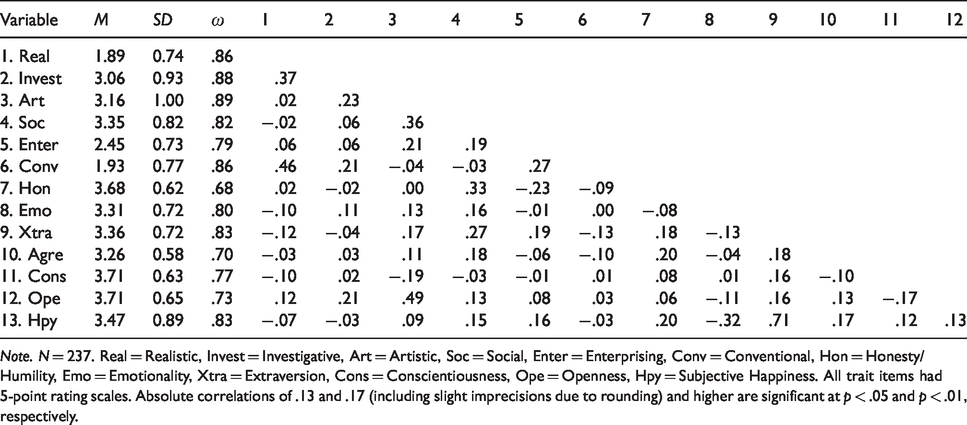
Note. N = 237. Real = Realistic, Invest = Investigative, Art = Artistic, Soc = Social, Enter = Enterprising, Conv = Conventional, Hon = Honesty/Humility, Emo = Emotionality, Xtra = Extraversion, Cons = Conscientiousness, Ope = Openness, Hpy = Subjective Happiness. All trait items had 5-point rating scales. Absolute correlations of .13 and .17 (including slight imprecisions due to rounding) and higher are significant at p < .05 and p < .01, respectively.
Descriptive statistics for aggregated and non-aggregated state measures
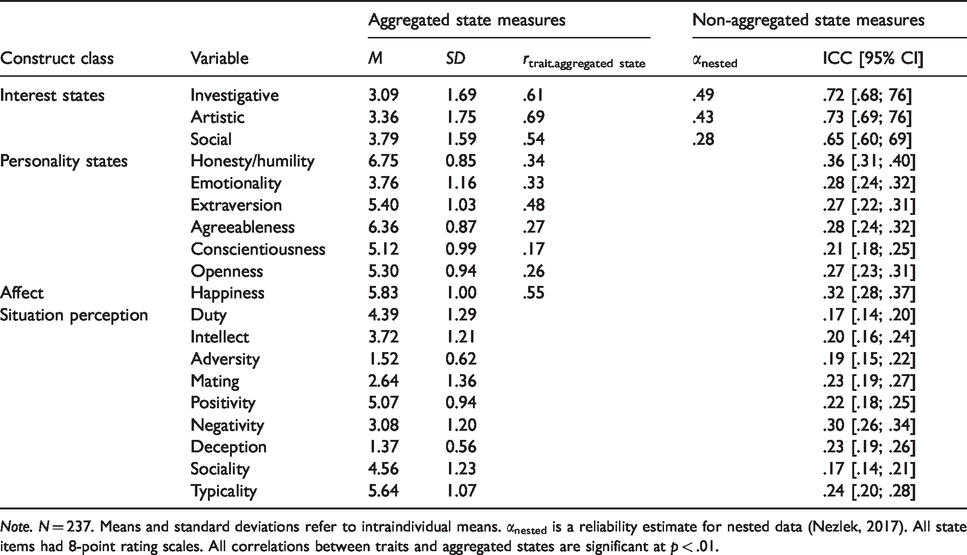
Note. N = 237. Means and standard deviations refer to intraindividual means. αnested is a reliability estimate for nested data (Nezlek, 2017). All state items had 8-point rating scales. All correlations between traits and aggregated states are significant at p < .01.
Correlations between traits and corresponding aggregated states were higher for interests (mean r = .62) than for personality (mean r = .31, mean r were calculated by z transforming, averaging, and back-transforming the values). The relations between traits, aggregated states, and non-aggregated states are graphically displayed in Figure 1
Correlations between traits and corresponding aggregated states. Bold black dots indicate person-aggregated states, and thin grey dots indicate single, non-aggregated state reports. Axes are rescaled so that angle bisectors represent r = 1.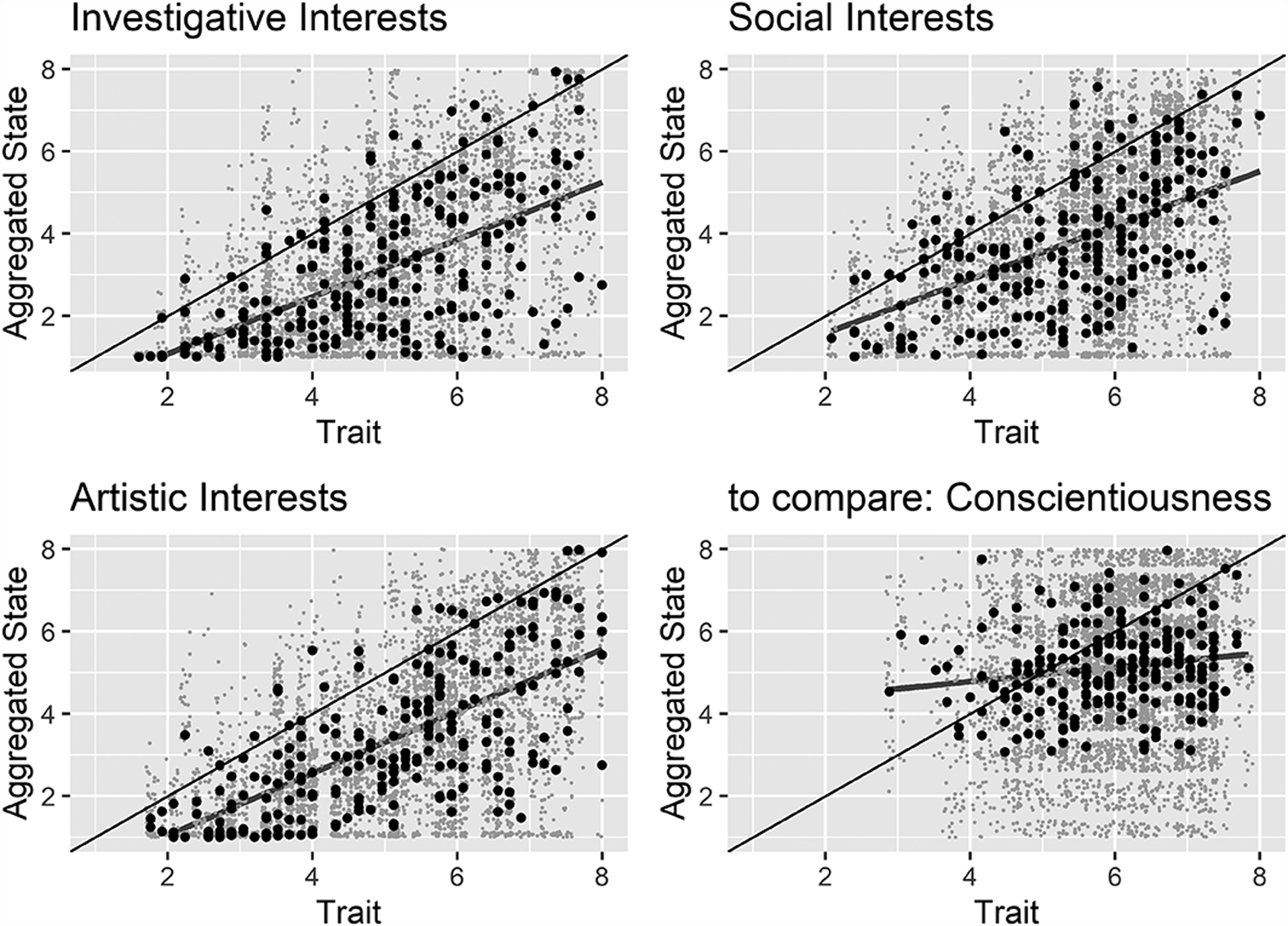
Research objective 1: Variance decomposition
As displayed in Table 2, we computed ICCs to answer the question of how much variance in the state measures is located within and between persons. Consistent with H1.1, ICCs were higher for the three selected interest states (mean ICC = .70) than for personality states (mean ICC = .28) and situation perception (mean ICC = .22). No 95% CI around the three interest states’ ICCs overlapped with a 95% CI around the personality states’ or situation characteristics’ ICCs. Although this pattern matched our expectations, the amount of within-person variance in interest states was less than we had predicted. That is, inconsistent with H1.2, about 30% of interest state variance fluctuated within persons across situations, whereas we expected this amount to range between 40% and 60% (i.e. 1 – ICC = .40–.60).
Research objectives 2 to 4: Predicting interest states
Comparing the gradually built-up models (Models I-V) indicated significantly better model fits for almost all model extensions compared with the more parsimonious models. Details on model fits and deviance tests are shown in Table S2 in the OSM. Although the inclusion of fixed slopes for situation characteristics (Models III) did not enhance model fit significantly in 8 out of the 27 models, adding corresponding random slopes (Models IV) improved all models significantly. The additional inclusion of personality and happiness (Models V) significantly increased the fit in all models. Thus, because Models V explained the interest states variance best, we chose these models to interpret the relations between situation characteristics and interest states. Finally, in 4 out of 27 cases, a cross-level interaction between interest at L2 and within-person centred situation characteristics (Models VI) improved model fit significantly.
RO2: Relations between situation characteristics and interest states
To address the focal question on how situation characteristics and interest states are related at the within-person level, we first interpreted the parameters from Model IV (‘Situation Characteristics Random’). The two specifically hypothesized relations H2.1 and H2.2 were supported by the data: Deviations from the individual means’ of perceived Intellect (i.e. within-person centred perceived Intellect) had a positive fixed L1 relation to Investigate interest states b = 0.06, SE = 0.01, one-tailed pholm-adj. < .001, 95% CI [0.04; 0.08],
9
The more exploratory analyses of the remaining relations between within-person centred situation characteristics and the selected interest states revealed several additional statistically significant fixed L1 effects. In total, 12 out of the remaining 25 relations were statistically significant at pholm-adj. < .10; three for Investigative interests, three for Artistic interests, and six for Social interests. Detailed information regarding these models can be found in Tables S3 and S4 in the OSF folder.
RO3: Controlling for construct overlap
Unstandardized fixed L1 effects of within-person centered situation characteristics on interest states
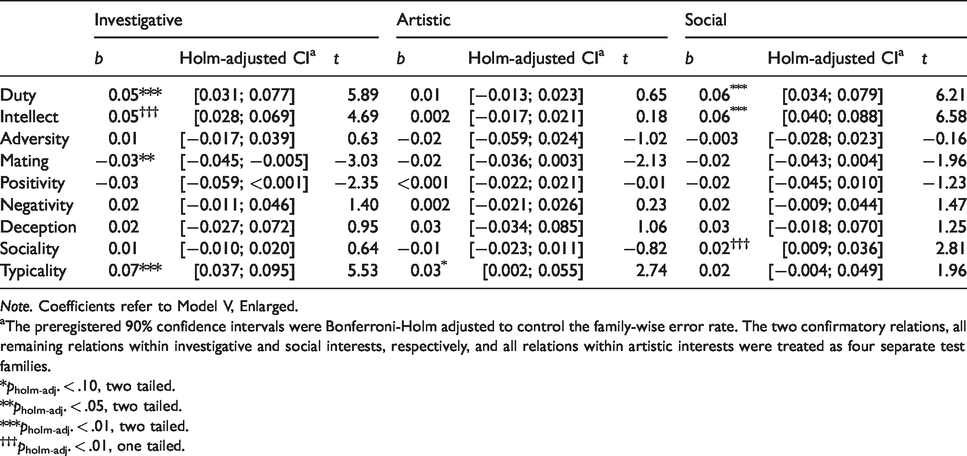
Note. Coefficients refer to Model V, Enlarged.
The preregistered 90% confidence intervals were Bonferroni-Holm adjusted to control the family-wise error rate. The two confirmatory relations, all remaining relations within investigative and social interests, respectively, and all relations within artistic interests were treated as four separate test families.
*pholm-adj. < .10, two tailed.
**pholm-adj. < .05, two tailed.
***pholm-adj. < .01, two tailed.
pholm-adj. < .01, one tailed.
As hypothesized, the fixed L1 relations between perceived within-person centred Intellect and Investigative interests (H3.1) and between perceived within-person centred Sociality and Social interests (H3.2) remained statistically significant after controlling for relevant personality dimensions and happiness. Spaghetti plots for these relations can be found in Figure S1 in the OSF folder. Supporting H3.3, the inclusion of the control variables into Model V reduced the amount of significant within-person relations between within-person centred situation characteristics and the selected interest states compared with respective relations from Model IV. Specifically, the inclusion of the control variables diminished seven previously significant relations (see Table S3) between situation perception and the selected interest states such that they were no longer significant. In other words, whereas in the more parsimonious models 14 relations between within-person centred situation characteristics and selected interests were significant, this amount reduced to eight such—specific—relations when considering construct overlap. Note that the difference to the number of seven significant relations resulted from a suppression effect for perceived within-person centred Mating and Investigative interests that emerged when including the control variables. On average, the variance explained by the fixed components of Model V was
To gain a better impression of the most likely values of the relations between within-person centred situation characteristics and interest states among participants, we computed plausible value ranges for these fixed L1 effects (Raudenbush & Bryk, 2002). 10 The plausible value ranges were rather broad (see Table S9)—both for within-person relations that were statistically significant and for those that were not. The ranges in which 95% of the within-person relations fell varied from [−0.09; 0.14], a relatively narrow range, for the relations between perceived within-person centred Sociality and Social interests; to [−0.33; 0.38], a rather broad range, for perceived within-person centred Deception and Artistic interests. The broad ranges indicate heterogeneity across participants in the strength of the within-person associations between situation perception and interest states—and thus most likely the presence of moderator variables.
RO4: Interindividual differences in the situation characteristics-interest states relations
To answer the question of whether the L1 relations between the within-person centred situation characteristics and interest states differed as a function of interest trait scores, we added cross-level interaction effects (Model VI). Inconsistent with H4, none of the 27 cross-level interaction effects was significantly negative after Bonferroni-Holm correcting the family-wise error rate (see Tables S10-S13). Note, however, that, contrary to our expectations, two significant positive cross-level interaction effects emerged. Both interaction effects emerged in the models for investigative interests; for Duty: b = 0.04, SE = 0.01, pholm-adj. < .001, 99.44% CI [0.01; 0.06] and for Intellect: b = 0.03, SE = 0.01, pholm-adj. = .024, 99.38% CI [0.003; 0.06].
Further Analyses
Due to the rather exploratory nature of some of the previous analyses, we conducted additional checks to explore the robustness of the results. Like in the previous analyses, significance was assessed with Bonferroni-Holm adjusted p values. First, we analysed whether the planned missingness design influenced the results. Here, we examined whether the relations between the within-person centred situation characteristics and the selected interest states depended on item selection. Specifically, we remodelled the interest state criterion variables to consist only of the anchor items and reran all Model V (‘Enlarged’). Most relations between situation characteristics and interest states at within-person level revealed the same pattern of significance (25 out of 27). As exceptions, the effect between perceived within-person centred Typicality and Artistic interests could not be replicated when using the differently formed criterion variable; and a further statistically significant relation emerged between within-person centred Positivity and Investigative interests. Note that although Social interests had the lowest internal consistency estimate, the results for this interest dimension did not depend strongly on item selection. Second, we investigated whether the relations between the deviations from the individual means of situation characteristics and the focused interest states depended on job status. When entering job status into the models as a dichotomous variable created post-hoc (0 = student and other, n = 157; 1 = working full-time or part-time, n = 80), in most models (25 out of 27), no statistically significant interaction effects between job status and within-person centred situation characteristics were found. This indicates that the focal relations in this study between the within-person centred situation characteristics and selected interest states did not vary substantially as a function of the participants’ employment status. 11 Interestingly, we found negative a main effect for job status in all nine models for Artistic interests. This means that employed persons experienced lower levels of Artistic interests in their daily lives, compared with students, all else being equal. Furthermore, we examined potential shared variance among the dimensions of situation perception by analysing models that included all nine dimensions simultaneously. All statistically significant within-person relations between within-person centred situation characteristics and the selected interest states identified in Model V remained significant. Additionally, two further suppression effects could be observed: A negative within-person relation between within-person centred Mating and Artistic interests and a positive within-person relation between within-person centred Typicality and Social interests. This suggests that, although the nine situation characteristics might share some degree of variance, their specific relations to interest states seem to be largely unaffected by this overlap. Finally, we examined the pattern of interest states mainly varying below their trait levels in more detail. Besides the correlations between the trait scores and aggregated states (see Table 2, Figure 1), we correlated the traits with the persons’ maximum state scores. Again, these correlations were higher for interests (mean r = .67) than for personality (mean r = .17; mean r were calculated by z transforming, averaging, and back-transforming the values). Next, we compared these correlations with the correlations between traits and aggregated states. Therefore, the correlations were z transformed, subtracted, averaged, and back-transformed. For interests, the correlations between traits and maximum states increased slightly, on average by r = .08, 95% CI [−.04; .21]. For personality, the correlations decreased on average by r = −.15, 95% CI [−.27; −.03]. This indicates that for interests, both person’s maximum state and average state were similarly related to the trait level. Contrarily, for personality, the average state was more representative for the trait scores than the maximum state. Put differently, for interests, the rank order of the maximum and average states were more similar to one another than it was the case for personality.
Discussion
This preregistered ESM study examined within-person variations in selected vocational interests as well as the relation of other variables to intraindividual variations of interest states. Main focus was the question whether certain situation characteristics are related to Investigative, Artistic, or Social interest states at the within-person level. Consistent with the hypotheses, the selected interests varied at the within-person level, and they did so less than personality and happiness states. However, the selected interests varied even less than we had expected. This seemed mainly due to the relative lack of within-person variation among persons with scores at the lower tail of interest traits. With regard to our main question on the relations between situation characteristics and interest states, data supported the two specifically hypothesized within-person relations between perceiving specific situation characteristics and experiencing congruent interest states. Besides that, we also found further, potentially meaningful within-person relations between situation characteristics and interest states. These relations were investigated exploratorily, as a means to inform new hypotheses, to be formally tested in future studies. Furthermore, the results did not support the hypothesis that the relations between momentary situation characteristics and the focused interest states were weaker for people with higher interest traits. Finally, aggregated states of the focused interest dimensions mainly varied below the corresponding trait levels. This suggests that the situational expression of interests was potentially restricted. We will elaborate potential explanations for this later.
Intraindividual variations in vocational interests
Consistent with recent theorizing (Su et al., 2019) and previous approaches from other fields (e.g. Fleeson & Jayawickreme, 2015), the present results suggest that the momentary experience of interests consists of both stable and situational factors. According to the results, about 30% of interest state variance lied within persons. This amount of within-person variability was, as expected, less than for personality states or situation perception. The within-person variability in personality states, happiness state, and situation perception was comparable with earlier results (e.g. Sherman et al., 2015), supporting the credibility of our data. However, the amount of within-person variability for interest states was even lower than we had expected. Still, the intraindividual variability in interests was substantially greater than zero. Moreover, both the specific relations to situation perception and the different pattern of within-person variability in interests compared with the pattern in, for example, personality indicate that the within-person variability in interests reflected meaningful psychological processes rather than mere measurement error. Consequently, we argue that the intraindividual variability in interests nevertheless reflected substantial fluctuations in the cognitive-affective experiences that make up interest states. As for other traits, such momentary states represent how the trait manifests itself in daily life and leads to consequential outcomes (Horstmann & Ziegler, 2020).
The within-person variability in interest states was also lower compared with previous results (Ziegler et al., 2018). Variability in such estimates across studies is consistent with results from a recent meta-analysis. In their analysis of 222 studies, Podsakoff, Spoelma, Chawla, and Gabriel (2019) examined the within-person variance for numerous constructs. They concluded that the amount of within-person variance depended (i) on measurement related or methodological reasons and (ii) on the construct being examined. In the following, we discuss how these two reasons may have impacted the current findings.
On the one hand, the estimated within-person variability in interests might have been influenced by methodological aspects, such as the operationalization of interest states. The hypothetical nature of assessing interests (i.e. participants were not doing the activities but rather thinking about doing them) differed from the assessment of personality or happiness. Most interest items used in the current study referred to activities that might not be feasible in typical everyday situations, such as developing a new medicine. Some people might have had difficulties imagining these activities in this very moment. Therefore, they might have based the assessment of their momentary interest in these activities even more on their general evaluation; i.e. on their interest traits (Robinson & Clore, 2002), which could then lead to more stability and an increased ICC. This explanation also addresses why the given within variability of interest states was lower than in Ziegler et al. (2018). The one-item measures used by those authors referred to activities that were, generally speaking, more feasible in the participants’ daily lives. In that sense, these items might have been easier to momentarily imagine and could thus have provided an easier access to the more fluctuating episodic knowledge (Robinson & Clore, 2002), resulting in higher within-person variability.
The methodological explanation would be further corroborated if other constructs from the nomological net of interests varied more strongly when they were similarly feasible, i.e. less hypothetically conceptualized. Indeed, constructs focusing on intrinsic motivation and intrinsic goals, which are closely related to interests (Su et al., 2019), showed between 50% and 71% of within-person variance (Benedetti, Diefendorff, Gabriel, & Chandler, 2015; Harper, Eddington, Lunsford, & Hoet, 2019; Judge, Simon, Hurst, & Kelley, 2014). Importantly, in these studies, the items referred to enacted activities or to relevant daily goals. Thus, those items could have provided an easier access to the fluctuating episodic knowledge.
On the other hand, further reasons for the lower within-person variability in interests might be construct dependent (Podsakoff et al., 2019). This means, the reduced within-person variability could also depend on characteristics of the construct of interests (states) itself. For example, vocational interests could be less sensitive to situational influences due to their specific relational nature: As the assessments of interest states always refer to the same very specific objects, the stable evaluations of these objects could be a more important, also at state level. Interestingly, other relational constructs that refer to very specific objects have also shown reduced within-person variability. For example, self-esteem and self-efficacy—both included in the nomological network of interests (Rottinghaus, Larson, & Borgen, 2003; Su et al., 2019)—have a meta-analytically reported average proportion of within-person variance of 39% (Podsakoff et al., 2019). 12 Note that this does not mean that interests are not expressed in states—they are merely more stable compared with some other constructs (see Baumert, Halmburger, Rothmund, & Schemer, 2017 for another example).
Furthermore, and in our view most relevant for explaining the reduced within-person variability in interest states, our data suggest that the interest trait level could have functioned as a ‘ceiling’ for the experience of interest states. As shown in Figure 1, aggregated states mainly varied below their corresponding trait levels. That is, the trait level could be interpreted as a potential upper boundary from which interest states mostly deviated downwards. On the one hand, this pattern could be due to the fact that interest states were measured on an 8-point rating scale and the traits on a 5-point rating scale. However, personality states and traits were also assessed on different scales—but for personality, an upper boundary did not occur. Thus, on the other hand, the pattern could also indicate that there might be more factors that restrict the situational expression of interests and fewer factors that cause people to experience higher interests at the state level than at trait level. This would be different to personality states (e.g. Fleeson & Jayawickreme, 2015), for which it is assumed that they form a distribution around the trait level and thus vary both below and above the trait level. For instance, even for people with low levels of Conscientiousness, it might be adaptive to exhibit highly conscientious behaviour in some situations to reach specific goals (Denissen & Penke, 2008). The same cannot be said for interests. Why should someone with a low stable interest feel momentarily interested in a corresponding activity? A person with a low interest trait is not expected to have strong related goals, values, or compatibility of the corresponding activity with the self-concept (Stoll et al., 2020; Su et al., 2019). Thus, when these goals, values, or the self-concept compatibility are not present at the trait level, the motivational value of the corresponding interest at the state level could also be reduced. Hence, people would only rarely experience stronger interest at state level than at trait level. This proposition could be supported by the notion that interest states do not necessarily involve a behavioural component (Su et al., 2019): Even when a person must do a given activity to reach a specific goal (e.g. painting sets for stages for an assignment), this goal could be reached even without momentary interest to do so. Furthermore, the proposition of a specific dependency between an interest trait level and its state manifestation can be supported by the results of additionally conducted analyses described earlier. For interests, the trait was similarly related to both a person’s average and maximum state; which was not the case for personality. This indicates that both the average and the maximum ‘ceiling’ scores in interest states were associated with the interest trait scores. Put differently, the maximum interest state scores seem to have conveyed substantial psychological meaning in terms of interindividual differences—which, as we argue, could be due to the motivational function of interests.
In sum, the construct-focused explanation suggests that the reduced variability in interest states could be due to trait evaluations being more important when assessing relational constructs at state level. The reduced variability of interest states could furthermore reveal a specific dependency between interest states and traits: Due to their motivational function, the (maximum) level of interest states might depend more strongly on the trait level—compared with what is known from personality traits.
To conclude, both the methodological and the construct-focused explanation can draw on empirical and theoretical support. Most likely, and consistent with results reported in the meta-analysis by Podsakoff et al. (2019), both explanations jointly contributed to the reduced within-person variability in the three interest state dimensions and the specific pattern of state variability observed here. For example, because of their explanatory breadth, the methodological reasons could have generally reduced the within-person variability. Additionally, the construct-focused reasons could have contributed to the pattern of states mostly varying below the trait level because of the specificity with which this explanation addresses this distinct pattern of within-person variation.
Situational influences on interest states
As the overarching question, we examined whether situation characteristics and selected interest states were specifically associated at the within-person level. Without controlling for other constructs, most situation characteristics were related to at least one of the three interest dimensions. However, as expected due to the shared variance with personality dimensions and happiness (Horstmann et al., in press; Mount et al., 2005), several of these within-person relations disappeared after controlling for said construct overlap. By controlling for additional variables, certain relations between situation characteristics and interests states remained significant, showing specific and theoretically plausible links. Thus, this study provides first empirical evidence for the proposed within-person relations between situation perception and interest states.
The results for the two relations examined with confirmatory analyses (H2.1, H2.2; and H3.1, H3.2) supported the assumption that Holland’s (1997) concept of congruence also exists at state level: People reported stronger relations between specific situation characteristics and congruent, theoretically related interest states (Parrigon et al., 2017; Rauthmann et al., 2014; Su, 2020). That is, there was a fit between situations characterized by perceived above-average Intellect and Investigative interests and similarly for Sociality and Social interests. As this study does not allow making causal claims, one can only speculate about the possible direction of these relations. On the one hand—and in accordance with ideas from educational psychology (e.g. Mitchell, 1993)—the situation could serve as a ‘trigger’ for interest states. Thus, pronouncedly perceiving certain situation characteristics could directly influence the experience of interest states. As outlined previously, such a main effect could result from the potential of the situation to relate to the cognitive-affective experiences that make up interest states. At the same time, the within-person relations between situation characteristics and interest states could be interpreted as an example of situation selection (Buss, 1987; Rauthmann & Sherman, 2016a). That is, people could self-select into specific situations according to their momentary interests. In this case, the momentary interests would lead to associated situation perceptions. Also, further external or internal variables could influence the experience of momentary interests, which could then change the situation perception. For instance, the stable affordances of the exemplary social worker’s job could at a certain point saturate their Social interests. As a result, they could experience less Social interest states—and perceive the same situation differently. That is, after being obliged to help others all day long, their momentary interests in doing this activity could have decreased. This could then result in them perceiving less Duty or Sociality in a given moment during work.
In contrast to the two relations between the situation characteristics and interest states stated in the confirmatory hypotheses, one should be cautious when drawing conclusions based on the more exploratory results. Because suppression effects rarely replicate (e.g. Paulhus, Robins, Trzesniewski, & Tracy, 2004), one should be even more cautious in interpreting the present suppression effect between perceived Mating and Investigative interests. The exploratory relations should rather be seen as a base for deriving hypotheses. Still, most relations dovetail nicely with previous literature. For example, perceived Typicality was positively related to Investigative and Artistic interests. That is, people experienced greater interest in investigative or artistic activities in situations they perceived as more boring than usual. Thus, participants might have perceived these activities as novel stimuli and as a means of ending the monotony (e.g. Fisher, 1993; Silvia, 2005).
Both perceived Duty and Intellect were positively related to Investigative and Social interests at the within-person level. In this comparatively educated sample, it is likely that many vocational situations comprised Duty and Intellect. Hence, these within-person relations can be interpreted as evidence of a general fit, that is, a high degree of similarity between certain characteristics of work situations and situational vocational interests: When participants perceived work-related situation characteristics, on average, they also experienced more work-related interest states. However, this was not true for Artistic interests. Artistic interest states were not related to Duty or Intellect. This could also have been due to the sample: As most participants were not professional artists, the activities used to assess Artistic interests (e.g. ‘compose or arrange music’) might have resembled leisure rather than vocational activities. Thus, this kind of fit between characteristics of work situations and vocational interests did not emerge for Artistic activities.
To sum up, this study provides first evidence for specific within-person associations between situation characteristics and interest states. The relations could be explained by certain situation characteristics being associated with the distinct cognitive-affective experiences that together compose interest states.
Further influences on interest states and their relation to situation perception
The within-person relations between situation characteristics and the three selected interest states were not negatively moderated by the interest trait. Building on the four-phase model of interest development (Hidi & Renninger, 2006), we had hypothesized weaker relations between situation perception and interest states among persons with higher interest traits. However, the present data did not support this idea. There are three potential explanations for this. First, there are differences between the two research approaches. Hidi and Renninger’s (2006) model focuses on interest development, whereas our study focused on the momentary experience of vocational interests while taking into account the effect of respective interest traits (as proxies for well-developed interests; Renninger & Hidi, 2011). Second, and consistent with ideas proposed by trait activation theory (Tett & Burnett, 2003; Ziegler et al., 2014), positive cross-level interaction effects are also plausible: The higher the interest trait level, the stronger the impact of certain situation characteristics on the trait manifestations might be. For example, the higher a person’s Social interest trait, the ‘easier’ it could be for a given situation—e.g. seeing an elderly person crossing the street—to activate that trait. Indeed, exploratory analyses of the present data revealed three positive cross-level interaction effects; which, however, implies only weak evidence. Thus, a third explanation focuses on independent effects of interest traits and situation characteristics on interest states. In fact, the current data suggest that the relations between situation characteristics and the three selected interest dimensions did not differ as a function of stable interest traits. This is comparable with results from Sherman et al. (2015) and Horstmann et al. (in press) who found similarly independent effects of situation perception and personality traits on personality states.
Because the data did not support the expected negative cross-level interaction effects, one could assume the potential existence of further interest state ‘blockers’. These potential blockers would be any person or situation variable that, when present, inhibits the experience of interest states. This assumption follows from two observations. First, the scatter pattern of interest traits and aggregated interest states (see Figure 1) suggests that in many instances, the situational expression of interests was potentially restricted. The construct-related explanation on the reduced variability mentioned previously explicitly addresses this pattern and could therefore also apply here. Besides that, further influences could have generally, i.e. independent of the individual trait scores, reduced an activity’s potential to elicit interest states. For instance, the items’ activities’ low feasibility could have inhibited the experience of interest states. A further potential interest blocker could have been a person’s reduced momentary activation or energy level (e.g. Russell, Weiss, & Mendelsohn, 1989; Thayer, 1978). In situations when a person had a low energy level, the cognitive-affective experience of interest states could have been reduced compared with moments with a high energy level (see also Converse, Juarez, & Hennecke, 2019). Second, the within-person relations between situation perception and interest states exhibited broad plausible value ranges (see Table S9), i.e. heterogeneity in the way interest states were related to situation characteristics. This indicates the presence of moderators for the within-person associations. A plausible candidate for a moderator is domain-specific self-efficacy (Bandura, 1986; Lent, Brown, & Hackett, 1994; Rottinghaus et al., 2003; Silvia, 2003). As such, in an exemplary situation containing social cues, a person with a high interest trait but low social self-efficacy beliefs could plausibly experience first and foremost stress, rather than situational Social interests.
Theoretical contributions
Our study contributes to the literature in three ways. First, this study provides a new take on Holland’s seminal theory of vocational personalities. Interests and environments can be viewed not only globally at the between-person level but also intraindividually at the within-person level. As such, the present study establishes a link between vocational research and situation research (e.g. Buss, 1987; Rauthmann et al., 2015). This intraindividual approach to interests could contribute to addressing current inconsistencies in the literature. For example, although congruence has been meta-analytically shown to predict work performance, the relations between congruence and job satisfaction remain less clear (see Nye et al., 2017): Large confidence-intervals, which sometimes included zero (Assouline & Meir, 1987; Tranberg, Slane, & Ekeberg, 1993; Tsabari, Tziner, & Meir, 2005), suggest heterogeneity in the relation between interest congruence and job satisfaction. This heterogeneity might be due to differences in congruence at the between-person versus within-person level. For instance, the social worker introduced previously works in a social context—which is congruent at the between-person level. Yet, in many working hours, the social worker might encounter administrative tasks. In these situations, they could perceive less congruence at the within-person level—which, in the long run, might affect their job satisfaction.
Second, the results contribute to a more nuanced understanding of vocational interests and potentially have implications for the further development of the TSID framework (Su et al., 2019). In this study, we could show that vocational interests—traditionally conceptualized as highly stable preferences for certain activities—also varied at the within-person level. Further, we established specific within-person links between situation characteristics and interest states. Similar links have proven fruitful in the field of personality research (de Vries et al., 2016; Horstmann et al., in press; Sherman et al., 2015). In that sense, the study supports Su’s (2020) assumption that situational interests are ‘the consequence of engaging in and interacting with the external world’ (p. 7). Notably, the data also showed that interest states were more than the interplay of situation perception, personality, and happiness states. This suggests that the conceptualization of interest states as done in the TSID framework (Su et al., 2019) could be refined. TSID posits that interest states result from interactional processes of the interest traits with external cues. Our data underlined the importance of relatively stable factors that also specifically influence the emergence of interest states. In other words, although the present study only operationalized parts of TSID framework, the results suggest that further—potentially moderating—influences might have to be considered in the model. As discussed previously, potential candidates could be domain-specific self-efficacy, the person’s energy level, the potential ceiling effect of interest traits, or characteristics of the given activity such as its feasibility in daily life. Put differently, the results call for a more detailed process model of interest states (Baumert, Schmitt, et al., 2017) that outlines how, when, and which constructs contribute to the genesis of interest states. Third, the exploration of situation-interest relations at the within-person level represents a means of assessing the interaction processes between person and environment proposed by Holland (1997) and the TSID framework (Su et al., 2019). Empirical studies on reciprocal effects between person and environment are currently scarce (cf. Wille & De Fruyt, 2014). Hence, our study contributes to closing this empirical gap by examining parts of this theorized interplay at the state level. The specific within-person relations between situation perception and interest states revealed in this study might represent a short-term mechanism through which the long-term reciprocal processes are made manifest. Future research is needed for a deeper understanding of this interplay.
Limitations and suggestions for further research
Several limitations should be considered when interpreting the present results. First, despite the preregistration, some analyses were rather exploratory in nature. Still, most relations between situation perception and the focused interest dimensions passed the robustness checks we applied and suggested no significant differences across demographic and methodological variables (e.g. job status, gender, and item selection). Nevertheless, in future replications, a more diverse sample, particularly with respect to gender and age, should be considered. Also, in future studies, different situation taxonomies should be considered in order to assess the generalizability of the reported findings across different types of situational information.
A second set of potential limitations addresses the operationalization of interest states. The interest state items used in this study referred to very specific activities that might be difficult to realize in daily-life situations. However, as the momentary experience of interest does not entail a behavioural component (e.g. Su et al., 2019), we assume that these measures are valid for capturing interest state variance. Still, the hypothetical and specifically relational nature of the items could have reduced their state variability (see Ziegler et al., 2018)—and, consequently, reduced the corresponding relations to situation perception. Therefore, future studies should focus on exploring the maximum within-person variability in interests, for example, by developing items that relate to activities that are more relevant in everyday situations. Relatedly, the observed relations between situation perception and interest states could also have been attenuated due to measurement error. The nested reliability estimates for the three interest state scales indicate that the observed relations most likely underestimated the true effects. Furthermore, the focus on three out of the six interest dimensions proposed by Holland (1997) limits the current findings to these three dimensions. Future research should examine the within-person variability in the remaining three interest dimensions and their specific relations to situation characteristics. However, the present results within the three focused interest dimensions were to a certain extent similar—especially when comparing the results with personality traits. Therefore, the results could be interpreted as a proof of concept of the general principle that vocational interests (i) vary intraindividually and (ii) are specifically related to certain situation characteristics at the within-person level.
Finally, all conducted analyses were correlational and did not consider effects of time, such as cross-lagged or autoregressive effects. That is, the relations between situation perception and interest states should not be interpreted causally. However, before proceeding to experimental designs that would allow testing causal hypotheses, future research should start by investigating the longitudinally dynamic nature of this interplay. Researchers should explore cross-lagged and autoregressive influences of and between situation characteristics and interest states to form hypotheses for causal effects to be examined in the future.
Conclusion
The overarching goal of the present study was to examine intraindividual variations in vocational interests and how they are related to situation characteristics. We conclude that vocational interests vary substantially within persons: In their daily and working lives, people are sometimes more interested in certain kinds of activities and sometimes less so. Thus, similar to recent conceptualizations of personality traits, we established within-person variations in a construct that was, prior to this study, mostly assumed to be stable. At the within-person level, interest states were related to several dimensions of situation perception. After controlling for the influence of related personality dimensions and happiness, specific, theoretical plausible relations remained. Finally, although most within-person relations between situation characteristics and interest states were positive, the data also indicated potentially blocking influences of other—unassessed or methodological—factors on interest states. We suggest that examining the varying, situation-related aspect of vocational interests can contribute to a deeper understanding of the comprehensive nature of vocational interests.
Footnotes
Notes
Data accessiblity statement
This article earned Open Data, Open Materials and Preregistered + Analysis Plan badges through Open Practices Disclosure from the Center for Open Science: https://osf.io/tvyxz/wiki. The data and materials are permanently and openly accessible at https://osf.io/npzmr/. The permanent path to the registration is openly accessible at  .
.