




Abstract
Recent contributions propose to integrate a state perspective into the conceptualization of vocational interests. Such integration addresses in-the-moment expressions of interests and allows to track relations to distal outcomes of vocational interests more closely. To further the trait-state integration of vocational interests, insights into the nomological network of state vocational interests are necessary. In this preregistered experience sampling study of 217 university students, we studied state investigative interest in daily life and the relations with theory-derived person- and situation-related constructs. Results from 5631 observations across 3.5 weeks showed that specific situation characteristics, openness, happiness, and current social student role were associated with state investigative interest. Furthermore, person-aggregated state investigative interest and the reactivity of investigative interest in situations related with their academic studies predicted individuals’ overall academic engagement in some cases. Generally, the relations in the nomological network were stronger when state investigative interest and hypothesized constructs were more closely aligned. Overall, the results underline the systematic nature and psychological relevance of state vocational interests. We discuss how integrating a state perspective into research on vocational interests implies novel approaches for capitalizing on the power of vocational interests.
Keywords
Introduction
Vocational interests describe important aspects of human individuality (Holland, 1997; Lubinski, 2000; Roberts & Nickel, 2017; Strong, 1943). They are defined as relatively stable preferences for broad classes of activities, which serve motivational functions (Rounds & Su, 2014; Su et al., 2019). Vocational interests can predict choice of educational major and occupation (e.g., Golle et al., 2019; Hanna & Rounds, 2020), job satisfaction and performance (e.g., Hoff et al., 2020; Nye et al., 2012; Nye et al., 2021), and even broad life outcomes, such as marriage or having children (e.g., Banov et al., 2022; Stoll et al., 2017). However, despite much evidence on positive outcomes of vocational interests, little is known about the processes that link an individual’s relatively stable interests to distal outcomes.
To examine how the nature and power of interests unfold, recent theoretical (Su et al., 2019) and empirical contributions (Nye et al., 2021; Roemer et al., 2021) suggest to consider interests at a state level in addition to the trait level. With the current study, we seek to further the integrated understanding of vocational interests as relatively stable traits manifesting as momentary states. Our study replicates and extends prior findings on the nomological net of state vocational interests and is the first to test whether state vocational interests can shape differences in academic engagement as a psychological outcome. Results on potential antecedents and consequences of state vocational interests offer finer-grained insights into the processes that may lead to momentary levels of interest and that underlie interest-outcome links (Nye et al., 2021; Su et al., 2019). Such insights are theoretically relevant and may imply novel approaches for capitalizing on the power of vocational interests.
Complementing research on interest traits with a state perspective
Vocational interests are commonly studied as Holland’s (1997) interest types. Persons have relatively stable levels in six interest domains: Realistic, Investigative, Artistic, Social, Enterprising, and Conventional interests. To integrate a state perspective into the conceptualization of vocational interests, the Trait State Interest Dynamics Framework (TSID; Su et al., 2019) provides a theoretical basis. TSID posits that trait interests are relatively stable individual differences, which manifest as momentary states. State interests are cognitive-affective experiences, resulting from individuals’ interactions with their environment, varying within persons across situations. Hence, state interests are in-the-moment manifestations of the trait that also reflect interpretations of the current situations individuals encounter. Over time, states can be repeatedly experienced, potentially accumulate, and contribute to trait interest development. Hence, TSID suggests that to better explain and predict (or even utilize) the functioning of vocational interests, it is crucial to understand how trait interests manifest as states in the moment, which contextual variables give rise to state interests, and whether state interests may lead to long-term outcomes (see also Fleeson & Jayawickreme, 2015). In other words, insights into the nomological net of state vocational interests are necessary.
Antecedents and consequences of state interests have been studied in educational psychology. Numerous studies document (situation- or task-related) correlates and (learning) outcomes of momentary interest in educational topics (e.g., Hidi, 2001; Linnenbrink-Garcia et al., 2013; Renninger & Hidi, 2011). While this research already offers insights into the nomological net of state interests, it does not address how interests as relatively stable individual differences unfold in the moment to predict more distal outcomes.
Recent studies have begun to address this gap and explored how trait vocational interests manifest as states in daily life (Phan, 2018; Roemer et al., 2021, Roemer, Stoll, et al., 2023; Ziegler et al., 2018). Using experience sampling methodology (ESM), these studies assessed state vocational interests with items from established trait questionnaires (e.g., Rounds et al., 2010), adapted such that participants repeatedly indicated their interest in different activities “right now, at this very moment.” This research provides three major insights, which are schematically depicted in Figure 1. First, vocational interests varied within persons across situations (see Panel A). Second, vocational interests varied systematically as a function of perceived situation characteristics (see Panel A and B). Hence, perceived situation characteristics can be considered as potential antecedents of individuals’ interest at a given moment. And third, people differed in their associations between perceived situation characteristics and state interests (see Panel B and A). In other words, people differed in how reactive their state interest was in specific situations. Schematic Display of Variability in State Interests, Associations with Potential Antecedents, and Individual Differences Therein Note. Panel A schematically shows the variability in state interest over time for two individuals; Panel B depicts the resulting associations between the proposed antecedent and state interest for these individuals. The solid line represents an individual with stronger reactivity (i.e., whose state interest strongly increases in situations with high levels of the proposed antecedent) and the dashed-line represents an individual with weaker reactivity (i.e., no pronounced association between the proposed antecedent and state interest).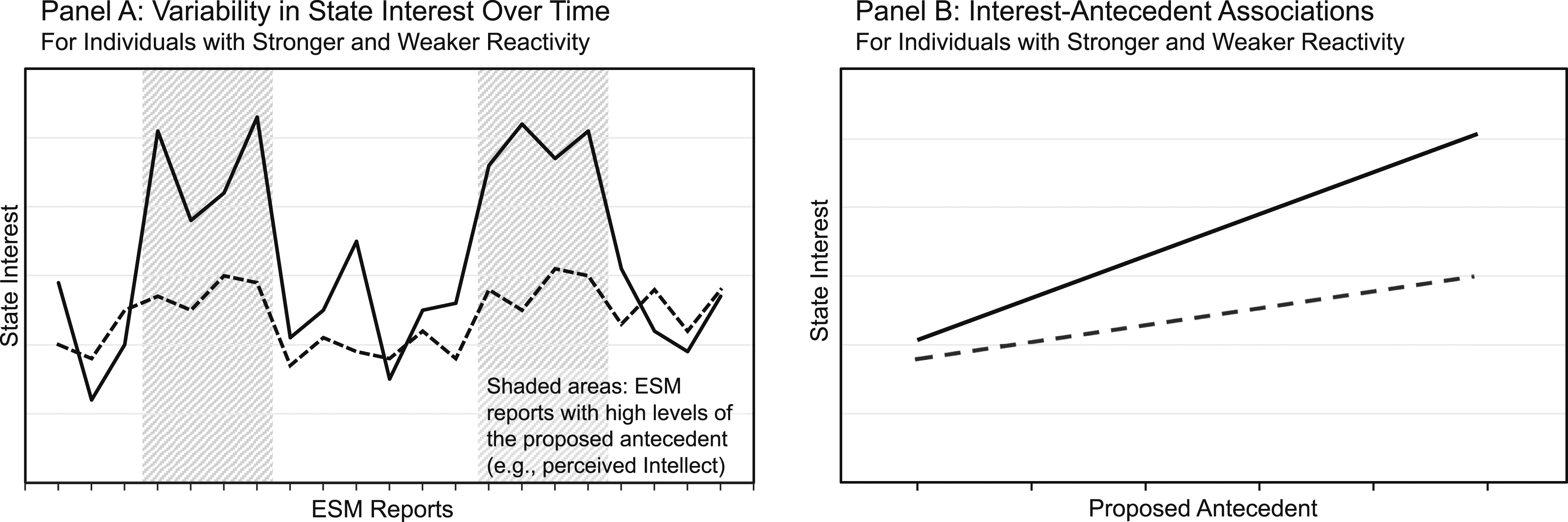
These findings clearly indicate that vocational interests should be conceptualized at both the trait and state level. The results also demonstrate two gaps in the research on the nomological net of state vocational interests. First, potential antecedents of state vocational interests need further elaboration. The systematic relations between state vocational interests and situation characteristics (Roemer et al., 2021) require replication and extension for a robust and more exhaustive identification of potential antecedents of state interests. Second, consequences of state vocational interests remain an open question. The predictive power of vocational interests is posited to unfold via momentary experiences (Rounds et al., 2014; Su et al., 2019), but this claim has not been empirically tested. The aim of the current study is to address these gaps. As depicted in Figure 2, we seek (1) to replicate and extend potential antecedents of state vocational interests and (2) examine whether state vocational interests can predict a psychological outcome. Nomological Network of State Vocational Interests Proposed and Tested in This Study Note. Dashed boxes denote the mechanisms assumed to underlie the links with the proposed antecedents. These mechanisms informed hypothesis generation but were not empirically tested. While hypotheses H1-H3 refer to variables we seek to replicate as potential antecedents of state interests, H4-H8 are proposed and tested for the first time in this study.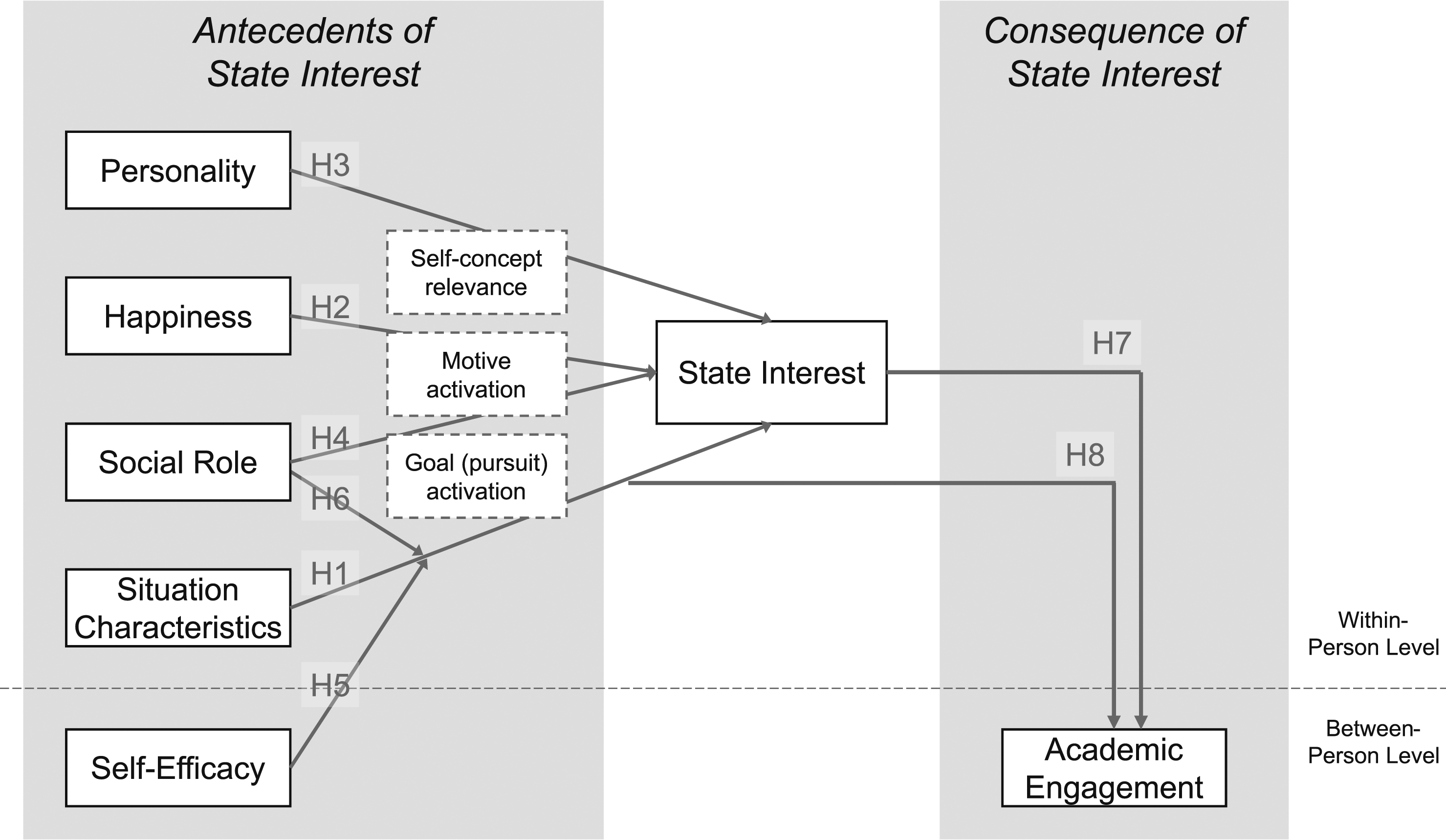
Potential antecedents of state vocational interest
The first part of our research question concerns potential antecedents of state vocational interests. That is, and coming back to Figure 1, we seek to identify the constructs that help to explain the ebb and flow of state interest in daily life. As a general mechanism for why certain constructs are associated with state vocational interests, we propose that these antecedents reflect or activate specific motives, appraisals, or self-concept relevancies (de Vries et al., 2016; Oyserman et al., 2012; Rauthmann et al., 2014), that then trigger the cognitive-affective experience of state interest (Silvia, 2005; Su et al., 2019; see also Roemer et al., 2021). In the following, we provide specific (1) context-related phenomena, (2) interactions with context-related phenomena, and (3) person-related phenomena that we seek to test or replicate as potential antecedents of state vocational interests.
Context-related phenomena as potential antecedents
Situation characteristics
In terms of potential context-related antecedents of state vocational interests, we seek to replicate specific relations with perceived situation characteristics. Situation characteristics are psychological interpretations of situations (Rauthmann et al., 2015), relevant for individuals’ in-the-moment thoughts, feelings, and behaviors (e.g., Hogan, 2009; Horstmann et al., 2021). A recent taxonomy proposes eight situation characteristics to describe perceptions of everyday situations: Duty, Intellect, Adversity, Mating, Positivity, Negativity, Deceptions, and Sociality (Rauthmann et al., 2014). These perceived situation characteristics have been shown to be specifically related with selected domains of vocational interests at state level (Roemer et al., 2021). For example, in situations perceived to require deep thinking (i.e., the situation characteristic intellect), individuals reported increases in investigative but not in artistic state interest. The specificity in the relations between situation characteristics and state vocational interests could be explained with the concept of congruence—people seek a fit between themselves and the environment (Holland, 1997; Su & Nye, 2017). To fit with their current situation, a person who, for example, perceives that deep thinking is required could update certain aspects of their self-concept (e.g., seeing oneself as a studious person), which are then reflected in increases in state investigative, but not artistic interest (Roemer et al., 2021). Overall, to build robust knowledge on potential antecedents of state vocational interests we seek to replicate specific associations between perceived situation characteristics (e.g., intellect) and conceptually related interest domains (e.g., investigative interest).
Social roles
We further propose the current social role to be a potential antecedent of state vocational interests. Social roles are a “set of behavioural expectations attached to a position in an organized set of social relationships” (Stryker, 2007; p. 1083). Social roles are close to a person’s self-concept (Lodi-Smith & Roberts, 2010) and reflect rules that define how individuals relate to their context. Assuming specific associations between current social roles and state interest is consistent with role congruity theory (Diekman & Eagly, 2008). This theory proposes that social role expectations influence the expression of congruent interests. Hence, a person’s current social role may affect the momentary, subjective relevance of different activities, and thereby shape the momentary experience of vocational interests (see also Slot et al., 2019). Overall, we propose that the current social role one occupies (e.g., as a student) is related with conceptually fitting state vocational interest domains (e.g., investigative interest).
Differences in the interest reactivity to situation characteristics as potential antecedents
As mentioned above and depicted in Figure 1(b), the relations between perceived situation characteristics and state vocational interests differed between persons (Roemer et al., 2021). While, for example, for some persons, state investigative interest strongly increased in situations with perceived intellect, for others, state investigative interest was not or even negatively related with these situations. Hence, people differed in their interest reactivity in specific situations. Such differences in interest reactivity are in fact consistent with TSID (Su et al., 2019): State interest is assumed to result from interactions between the person and the environment, such that other (person) characteristics may impact how associations between the situation and state interest play out. Thus, we propose that the relations between situation characteristics and state vocational interests are moderated by two types of interaction effects.
Interaction with self-efficacy beliefs
We propose domain-specific self-efficacy beliefs to moderate the relations between situation characteristics and state vocational interests. Self-efficacy beliefs are judgments about what persons believe they can do regarding narrowly defined activities (e.g., Bandura, 1986; Marsh et al., 2019). Self-efficacy beliefs have also been suggested to reflect a person’s sensitivity to contextual cues that signal opportunities to perform the given activity (Orth & Volmer, 2017). Accordingly, self-efficacy beliefs may also serve as a lens through which situational cues related to specific interest domains are perceived. Highly self-efficacious persons could interpret specific situations (e.g., situations described by the situation characteristic intellect) as clearer signals for anticipating the positive experience of state interest, such that for these persons and in these situations, state vocational interests should be more strongly activated. Coming back to Figure 1, we argue that the greater reactivity of the person represented by the solid line could be explained by this person having high levels of domain-specific self-efficacy beliefs. In sum, we assume that domain-specific self-efficacy beliefs moderate the proposed associations between perceived situation characteristics and state vocational interests.
Interaction with social roles
We also propose the current social role to moderate the relations between situation characteristics and state vocational interests. Situation characteristics are at a rather high level of abstraction (Parrigon et al., 2017; Rauthmann et al., 2014), which could blur their relations with state interests. For example, a student could perceive that “a job needs to be done” (i.e., the situation characteristic duty; Rauthmann et al., 2014) when thinking through intellectually challenging homework or when doing the dishes. Building on role congruity theory (Diekman & Eagly, 2008), the relation between investigative interest and perceived duty should be stronger when a person currently occupies the social role of a student. Hence, the social role could further specify the relations between situation characteristics and state interests and can thus be assumed to interact with these associations. We therefore expect the current social role to moderate the proposed relations between situation characteristics and state vocational interests.
Momentary person-related phenomena as potential antecedents
Happiness
In terms of momentary person-related antecedents of state vocational interests, we seek to replicate an association with happiness. Since positive affect toward the target activity is a constituent component of state interest (e.g., Renninger & Hidi, 2011; Su et al., 2019), momentary happiness might be an antecedent of state vocational interests. Individuals who are currently happy might perceive more positive affect towards the target activity (e.g., Hidi, 2016; Murayama et al., 2019), increasing the probability to experience related state vocational interest. In fact, momentary happiness was already shown to be related to state vocational interests (Roemer et al., 2021), and replication could further corroborate this relation.
Personality states
We lastly seek to replicate specific associations between state Big Five personality and state vocational interests. At trait level, specific pairs of personality and interest domains count on similar psychological processes (Ackerman & Heggestad, 1997; Mount et al., 2005). The conceptual closeness of these processes could also explain associations at state level. For example, consider the relation between openness to experience and investigative interest. Open people enjoy complex, novel, or difficult information (e.g., Fayn et al., 2019). Momentary openness is most likely tied to a momentary self-concept of being driven to investigative activities such as examining new problems, which could, in turn, trigger the cognitive-affective experience of state investigative interest. In fact, selected personality states were shown to be specifically related to state vocational interests (Roemer et al., 2021; Ziegler et al., 2018). We seek to replicate this finding to test state personality as a potential antecedent of state vocational interests.
Academic engagement as an outcome of state vocational interest
The second part of our research question relates to potential outcomes of state vocational interests (see also right part of Figure 2). Currently, there is a lack of research on the outcomes of state vocational interests. Convincing evidence exists that state interest in educational contexts predicts learning outcomes, or trait vocational interests predict distal job-and life related outcomes (e.g., Hidi, 1990; Linnenbrink-Garcia et al., 2013; Stoll et al., 2017). For state vocational interests scores, however, the criterion-related validity is a largely open question (cf. Bradburn, 2020). Therefore, we seek to explore whether momentary experiences of vocational interests may contribute to shaping distal outcomes.
Academic engagement
We focus on academic engagement as a potential outcome of state vocational interests because academic or job engagement are established outcomes of vocational interests at trait level (e.g., Rounds & Su, 2014). Given the interest domain fits the area of the academic major (e.g., as for artistic interest and art studies or investigative interest and psychology studies), more interested individuals are more engaged, energized, and satisfied with their studies than less interested individuals (Hoff et al., 2020; Holland, 1997; Nye et al., 2017, 2021). If state vocational interests also matter for psychological functioning, then differences in how interested individuals are across different situations in their daily life should also relate to differences in how engaged they are with their studies. Like at the trait level, a prediction of academic engagement with state vocational interest requires that the focal interest domain fits the area of the academic major. Given such a fit—for example, as for investigative interest and psychology studies—the relation may play out in two ways.
Aggregated interest states
First, we propose that between-person differences in state vocational interests predict between-person differences in academic engagement. Repeated instantiation of state interest in daily life could cumulate and over time shape individual differences in relevant outcomes (Su et al., 2019; see also Funder & Ozer, 2019; Neubauer et al., 2022; Wrzus & Roberts, 2017). Hence, people who are more frequently and strongly interested across situations in their daily lives—as exemplified by the solid-line individual in Figure 1—should end up being more engaged and satisfied with their academic studies than the less interested—as illustrated by the dashed-line individual in Figure 1. We therefore expect aggregated state vocational interests to predict overall academic engagement.
Interest reactivity in specific situations
Second, we propose that interest reactivity in specific situations also predicts academic engagement. Individuals’ whose vocational interest is easily triggered by study-related situations 1 are particularly interested when study-related situations “call” for it. Such a strong interest reactivity in study-related situations might be perceived as aligning one’s interests with situational affordances, and this patterning of situation-specific state interest could foster academic engagement (see also Ziegler et al., 2018). Illustrated with Figure 1, when considering study-related situations as the proposed antecedent, we expect that the stronger reactivity of the solid-line individual reflects a reaction pattern that relates to higher academic engagement, while the weaker reactivity of the dashed-line individual is a reaction pattern related to lower engagement. It is important to note that interest reactivity in specific situations does not represent fit as the (current) match between the profiles of a person’s interests and their situation (e.g., Rauthmann & Sherman, 2022). Yet, the reactivities may be considered a more dynamic type of interest-situation fit: They indicate how individuals’ momentary interest relates to certain—conceptually fitting—situations. The notion that such reactivities (or contingencies) are psychologically relevant is moreover consistent with theory proposing that patterns of situation-specific reactions reflect personality (Mischel & Shoda, 1995; see also Beckmann et al., 2021; Kuper et al., 2022). Hence, an individual’s interplay between the perceived situation and state vocational interest might reflect consequential reaction patterns and give rise to relevant outcomes. Overall, we expect interest reactivities in study-related situations to predict academic engagement.
The current study
Our study follows recent calls to integrate state-level findings into research on vocational interests. We seek to replicate and extend knowledge about the nomological network of state vocational interests. To this end, we focus on the domain of investigative interest. Specifying the reasoning above, we delineated eight hypotheses for the antecedents and consequence of state investigative interest. In terms of the antecedents, we seek to replicate that state investigative interest is associated with the situation characteristics duty (H1a), intellect (H1b), mating (H1c), and typicality (H1d), with momentary happiness (H2), and with state openness (H3). Furthermore, we hypothesize that state investigative interest is associated with the current social role as a student (H4). We also hypothesize cross-level interaction effects between self-efficacy and the four delineated situation characteristics (H5a-d) and within-level interaction effects between student role and the four delineated situation characteristics (H6a-d). In terms of the consequence, we propose that aggregated state investigative interest predicts academic engagement (H7) and that interest reactivity in study-related situations—that is, in situation with high duty, intellect, and student role (H8a-c)—predicts academic engagement. Table S1 gives a detailed overview on these preregistered hypotheses (see also Figure 2).
Method
The preregistration and materials required for reproducing the study results can be found on the Open Science Framework (OSF). 2 The data have been used to examine the variability of state interest (Roemer, Stoll, et al., 2023); however, the data on the potential antecedents or outcome have not been previously reported.
Procedure
The study obtained ethics committee approval (Proposal 2019–40, Humboldt-Universität zu Berlin) and was preregistered prior to data collection. The study was conducted online using the software formr (Arslan et al., 2020). Participants first completed a baseline trait questionnaire, then a protocol using experience sampling methodology (ESM), and lastly a questionnaire on their academic engagement. The ESM protocol started the day after the baseline questionnaire and spanned three waves of three consecutive ESM days each. Six-day breaks were included between waves. We had scheduled the break days without ESM assessments to maintain participants’ motivation and compliance (but see Wrzus & Neubauer, 2023). If a participant filled in fewer than 35 reports after the third wave, their ESM phase was extended by up to six more ESM days. We had scheduled the potential extensions to obtain a sufficient number of assessments per participant. Upon the last ESM report, participants filled in the academic engagement questionnaire. In total, the study lasted up to 3.5 weeks and every weekday was ESM day at least once. On the ESM days, participants received report prompts from ≈9 a.m. to ≈10 p.m. Participants could adjust this time in the baseline questionnaire. Prompts were sent via email and scheduled pseudo-randomly, on average 3 h after reacting to the preceding prompt. On average, participants reacted to 2.44 prompts per ESM day (SD = 1.16).
Participants
To study academic engagement as a meaningful outcome, we collected a student sample. More specifically, to achieve a fit between our focal interest domain (investigative interest) and participant’s study area, we focused on psychology students. 3
We conducted an a-priori power simulation to determine the required sample size (Mathieu et al., 2012). A sample of 260 participants with 35 measurements each was indicated necessary to detect the smallest within-person main effect of interest (assumed for mating; |b| = .03) with power of ≈.80 and an alpha level of .10. All else being equal, 170 participants would yield power of >.80 to detect the second smallest main effect of interest (for intellect; b = .04). We preregistered to stop data collection after a period of six months at the latest.
In total, 249 participants provided 5808 ESM reports. As preregistered, we excluded participants who did not finish the trait questionnaire (n = 11) or responded to fewer than five ESM reports (n = 21, with on average n reports = 1.5 each). Furthermore, we excluded single reports if the participant provided the same response to more than 80% of the items (n reports = 37), or if the reports had more than 25% missing values (n reports = 7). The final data set comprised 217 participants with 5631 reports; of which n = 158 filled out the academic engagement questionnaire. On average, participants responded to M = 25.95 reports (SD = 10.01, range 5–36). The average age of the final sample was 25.4 years (SD = 6.7), 81% were female (18% male, 1 other), and 86% indicated psychology as their field of studies.
Participants were recruited via mailing lists and social media groups for psychology students at several German universities. 4 As an incentive, participants received course credit and feedback on their personality and interest results. Five percent of participants reported working full-time and 17% to have a part-time job or side job.
Measures
All state measures had 8-point rating scales; all trait measures had 5-point rating scales. Descriptive statistics are listed in Table S2 and S3, respectively.
Investigative interest
State level
In the current study, we operationalized investigative interest in two ways. For the non-tailored assessment of state investigative interest, we used the five items from the O*NET Mini-IP (Rounds et al., 2016) and added “right now, at this very moment” to the instructions. Participants indicated the extent to which they were interested in (doing) the activities at that moment (1 = not at all interested; 8 = strongly interested). The five target activities were “develop a new medicine,” “examine blood samples using a microscope,” “study ways to reduce water pollution,” “conduct chemical experiments,” and “develop a way to better predict the weather.”
For the tailored assessment of state investigative interest, we used items with activities that were tailored to the daily life of the participants. The five activities were “think about which (psychological) questions have not yet been sufficiently researched,” “look for everyday examples of theoretical assumptions,” “think through a theory from a lecture carefully,” “read scientific articles,” and “critically deal with seminar content” (a pre-study testing these items is described on the OSF). The same instructions, item stem, and anchors as for the non-tailored state items were used. The scale scores’ internal consistency estimates were αnested = .72 for non-tailored and .84 for the tailored state interest items (Nezlek, 2017).
The two operationalizations differed in the degree to which the items were tailored to the participants’ daily lives. Hence, they varied in the degree of fit between investigative interest and the proposed antecedents/consequence. While the non-tailored interest assessment was less closely aligned with the hypothesized constructs, the tailored assessment was more closely aligned. By consequence, this two-fold operationalization allows to examine whether the relations vary as a function of the conceptual fit between the variables.
The state interest items were presented with a planned missingness design using an anchor design (e.g., Silvia et al., 2014) in order to balance participant burden (Eisele et al., 2022) and content validity. Per ESM report, non-tailored and tailored state interests were measured with three (out of five) items each per occasion, which we averaged to a composite. Two anchor items per operationalization were presented in every report (the first two items stated above); the third item was chosen randomly from the remaining three scale items.
Trait level
We assessed investigative interest at trait level parallel to the two state operationalizations. For the non-tailored trait assessment, we used the German O*NET Interest Profiler Short Form (Roemer, Lewis, et al., 2023; see also Rounds et al., 2021). The score’s internal consistency score was ω = .91 (calculated with the package MBESS; Kelley, 2018). For the tailored trait assessment, we used the items mentioned above in a trait phrasing. The score’s internal consistency was ω = .89. All interest items at trait level were presented with the stem, instructions, and anchors (1 = not at all interested; 5 = strongly interested) of the O*NET IP (Rounds et al., 2010).
Potential antecedents
Situation characteristics
We used the S8-I (Rauthmann & Sherman, 2016) to assess momentary situation characteristics. To shorten the ESM reports, we assessed only situation characteristics we had specific hypotheses for, namely, duty, intellect, and mating. 5 Each dimension was assessed with one item. We added an item to assess the typicality of the situation (“the situation is ordinary”; see Parrigon et al., 2017). Participants rated the extent to which the characteristics applied to their current situation (1 = applies not at all; 8 = applies totally).
Social role
To assess the current social role as a student, participants indicated the degree (1 = applies not at all; 8 = applies totally) to which they perceived themselves as students in this moment (”Right now, I see myself as a student”; see, e.g., Bleidorn, 2009).
Openness
We measured openness at state level following previous studies (e.g., Horstmann et al., 2021; Sherman et al., 2015). Participants indicated how they saw themselves in that very moment on one item with an eight-point bipolar rating scale. Two adjectives marked the anchors (1 = intelligent, creative; 8 = unintelligent, uncreative). To assess openness at trait level, we used the HEXACO-60 (Moshagen et al., 2014). The scale’s anchors were 1 = strongly disagree and 5 = strongly agree. Internal consistency for the openness scale score was ω = .69.
Subjective happiness
To assess current happiness, participants indicated how happy they were in the moment (1 = happy, positive; 8 = sad, negative; see Horstmann et al., 2021). To measure subjective happiness at trait level, we included the four-item Subjective Happiness Scale (Swami et al., 2009); the internal consistency estimate was ω = .80.
Domain-specific self-Efficacy beliefs
We assessed domain-specific self-efficacy beliefs for investigative activities at the trait level. We also operationalized self-efficacy beliefs in two ways. For the non-tailored assessment, the five investigative activities from the O*NET Mini-IP (Rounds et al., 2016) were presented with a self-efficacy beliefs item stem; for the tailored assessment, the five tailored activities were used. The self-efficacy beliefs item stem was “I am confident in my ability to accomplish the following tasks or activities” (based on, e.g., Betz et al., 2003; Gerecht et al., 2007). The scales’ anchors were 1 = not at all confident and 5 = strongly confident. The scores had internal consistency estimates of ω = .88 for non-tailored and ω = .82 for tailored self-efficacy beliefs.
Outcome
Our outcome was academic engagement, measured with the Utrecht Work Engagement Scale-9 Student Version (UWES-9S; Schaufeli et al., 2006), which was administered after the last ESM assessment. The UWES-9S assesses self-reported academic engagement with nine items, which are grouped into an overall score, and into three three-item subscales (vigor, e.g., “When I’m doing my work as a student, I feel bursting with energy”; dedication, e.g., “My studies inspire me”; absorption, e.g., “I am immersed in my studies”). As preregistered, we focused on the overall score, ω = .94.
Data analysis
To examine the potential antecedents of state investigative interest, we analyzed a series of multilevel models (Raudenbush & Bryk, 2002) using the R package lme4 (Bates et al., 2015). Multilevel models address the nested data structure (with reports at Level 1 nested in persons at Level 2) and allow to model both average within-person relations (i.e., fixed effects) and individual differences in these within-person relations (i.e., random effects). We ran separate models to test the separate hypotheses. Generally, we regressed state investigative interest on the hypothesized predictor. We included trait interest as a predictor to consider the influence of the trait on the state. To account for the within- and between-person variance in Level-1 predictors we also entered a Level-2 predictor of the respective construct (Enders & Tofighi, 2007). Individuals could vary in their intercepts and slopes (Barr et al., 2013). Level-1 predictors were within-person centered, and Level-2 predictors were grand-mean centered. In these models, the fixed effects of the hypothesized predictors reflect the average within-person relations between the hypothesized construct (e.g., openness) and state investigative interest, testing the hypotheses on within-person main effects. To test the interaction effects, we included cross-level interactions between self-efficacy and situation characteristics; or within-person interactions between the student role and situation characteristics.
We examined consequences of state interest in two ways. First, we analyzed linear regressions predicting academic engagement with person-aggregated state interest scores. We also controlled this relation for the trait interest score, to test whether and how the aggregation of momentary experiences of interest bears any incremental effects beyond the global interest trait score. Second, we examined whether the interest reactivity in specific situations was associated with academic engagement. To operationalize the reactivities, we extracted the within-person relations of state investigative interest to study-related situation characteristics (i.e., perceived duty, intellect, and student role) for each participant from the models described above (i.e., the random slopes). These slopes reflect individual differences in interest reactivity in study-related situations and were used to predict academic engagement in a linear regression model. In addition, we again controlled for the trait interest score. We preregistered to test our hypotheses with one-sided tests and an alpha level of .05.
Results
Potential antecedents of interest states
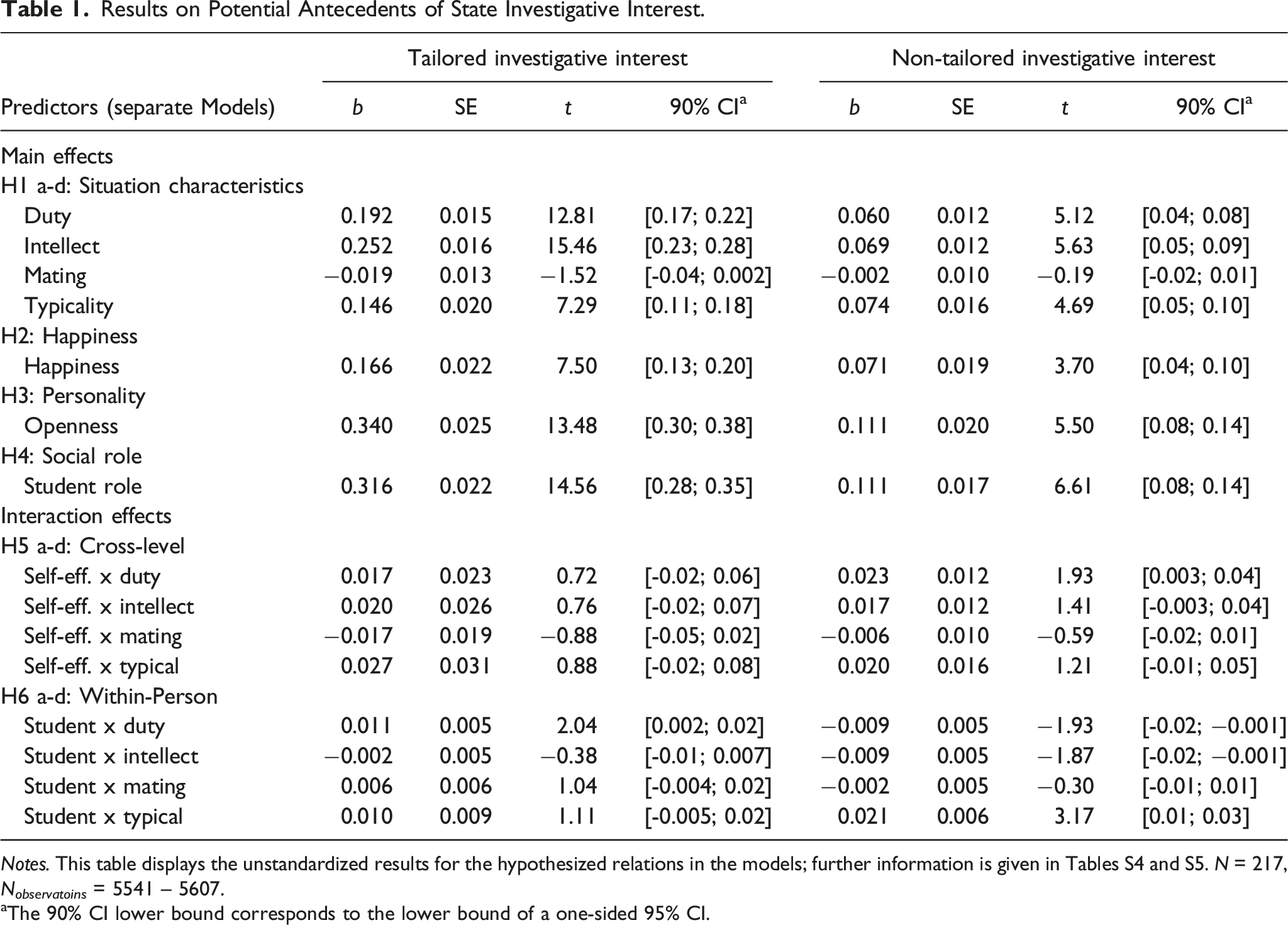
Results on Potential Antecedents of State Investigative Interest.
Notes. This table displays the unstandardized results for the hypothesized relations in the models; further information is given in Tables S4 and S5. N = 217, N observatoins = 5541 – 5607.
aThe 90% CI lower bound corresponds to the lower bound of a one-sided 95% CI.
The interaction hypotheses (i.e., H5–H6) were only weakly supported. Only one out of 2 × 4 cross-level interaction effects of self-efficacy beliefs on situation characteristics—state interest relations was significant; and two out of 2 × 4 within-person interaction effects of student role. These effects indicate, for example, that for non-tailored interest, self-efficacy beliefs moderated the relation between duty and state interest, b = 0.023, SE = 0.012, 90% CI [0.003; 0.04]; such that in situations with high perceived duty, more self-efficacious persons had stronger increases in investigative interest assessed with non-tailored items. When Bonferroni-Holm correcting the parameter estimates’ p-values for multiple testing (correcting for k = 8 for H5 and k = 8 for H6), only a single interaction effect—the within-person interaction for non-tailored items—remained significant. Overall, the proposed interactions did not convincingly explain or moderate the relations between situation characteristics and state interests.
To further inform the interaction results, we ran post-hoc sensitivity analyses to determine the smallest interactions the current sample was 80% powered to detect. Using the sample-specific estimates, these analyses (conducted with the package SIMR; Green & MacLeod, 2016) indicated that for the cross-level interaction models, the smallest interactions that could be detected with 80% power were effects of ≈0.06 for tailored and ≈0.03 for non-tailored items. For the within-person interaction models, these estimates were ≈0.015 for tailored and ≈0.012 for non-tailored items. For better contextualization, these unstandardized estimates can be pseudo-standardized in terms of the variance components in the outcome relevant for the focal effect (i.e., random slope variance for the cross-level interactions; and Level-1 outcome variance for the within-person interactions; see, e.g., Arend & Schäfer, 2019; Hoffman, 2015). 6 Such standardization indicated that the current sample was 80% powered to detect cross-level interactions corresponding to standardized effect sizes of ≈.23; and within-person interactions corresponding to standardized effect sizes of ≈.04. Thus, these analyses indicate that if there are true interaction effects, they are unlikely to exceed these effect sizes.
Further analyses: Probing the antecedents
To explore whether the conceptual fit between the predictors and state interest affected the results, we examined how the results converged across the two operationalizations of investigative interest. Generally, the estimated relations were nearly identical across the two item types in terms of their significance but differed in terms of their strength. For 7 out of 15 relations, the confidence intervals of the estimates did not overlap across the two item types. Relations were stronger for tailored than for non-tailored investigative interest state. This suggests that a closer conceptual fit between the interest operationalization and the proposed antecedents increased the strength of the relations (see also Schmit et al., 1995).
To determine potential construct overlap among the proposed antecedents, we analyzed overarching models that simultaneously included all significant predictors from the bivariate models (see Tables 1, S6). For tailored items, six out of the seven significant relations in the bivariate models remained significant in the overarching model. As an exception, the within-person interaction effect of student role no longer emerged. For non-tailored items, five out of eight formerly significant effects remained significant. The main effects of duty and intellect and the cross-level interaction effect of self-efficacy were no longer significant. A highly similar pattern of results emerged with Bonferroni-Holm corrected p-values; only the main effect of duty for tailored items was no longer significant (p adjusted = .228). Altogether, the two overarching models (1) lend even less support to the interaction effects and (2) indicated that the main effects tended to explain largely unique parts of the variance in tailored and non-tailored items for state investigative interest.
Predicting academic engagement
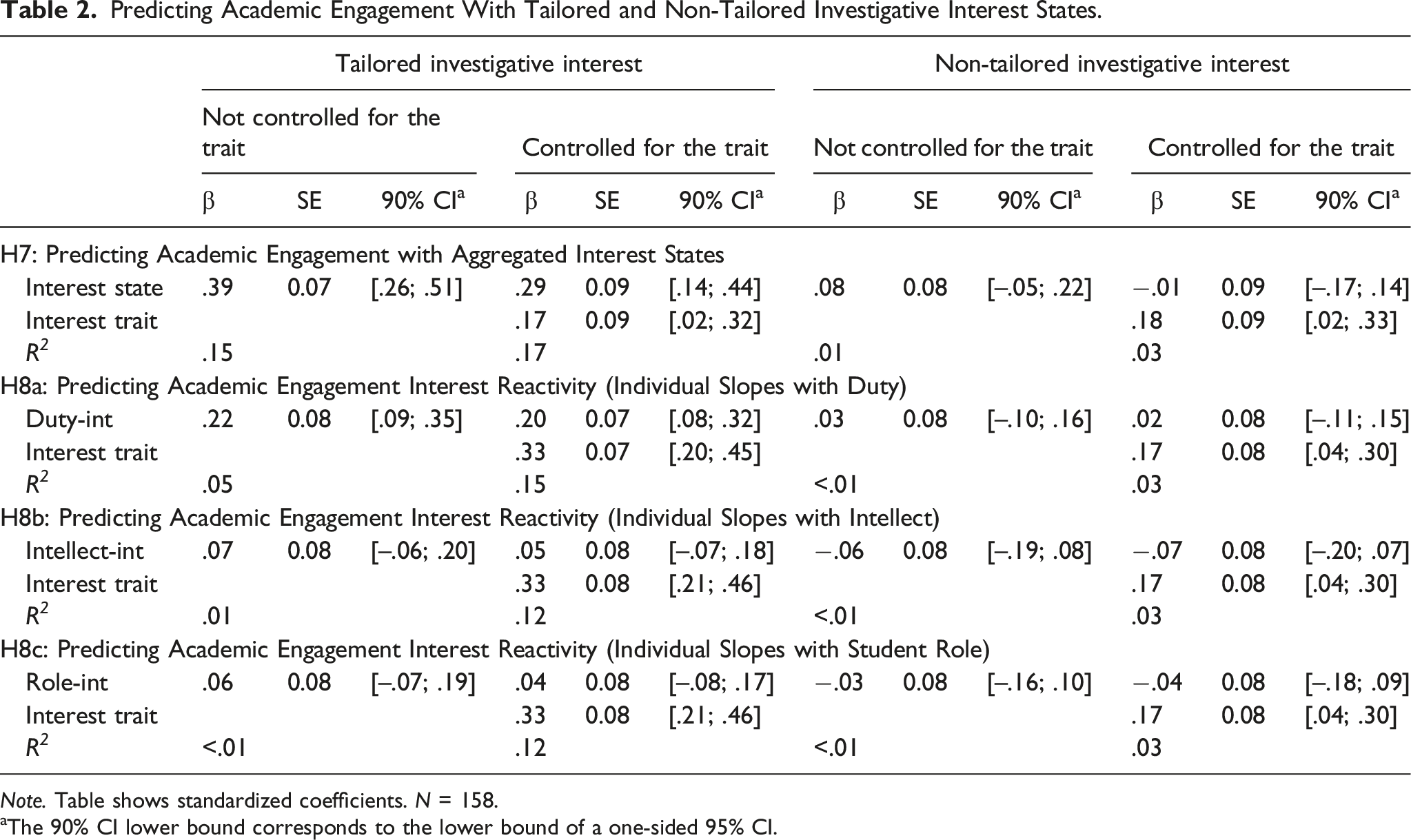
Predicting Academic Engagement With Tailored and Non-Tailored Investigative Interest States.
Note. Table shows standardized coefficients. N = 158.
aThe 90% CI lower bound corresponds to the lower bound of a one-sided 95% CI.
Table 2 also shows the results for hypothesis H8a-c, on the degree to which interest reactivity in study-related situations predicted academic engagement. As a preliminary step, we analyzed the average reliabilities of the interest reactivities, using the formula provided by Neubauer et al. (2020). Average reliability was estimated .64, .65, and .69 for the reactivities of tailored interest to duty-, intellect-, and student-role related situations; and .61, .58, and .66 for non-tailored interest, respectively. These values are higher than commonly reported (e.g., Kuper et al., 2022; Neubauer et al., 2020). Similar to the preceding results, effects of interest reactivities on academic engagement were larger for tailored interest. However, only partly fulfilling our expectations, interest reactivity in study-related situations predicted academic engagement only for tailored items, and only for one of the three study-related situations. People whose investigative interest was closely linked with perceived duty reported higher academic engagement (β = .22, SE = 0.08, 90% CI [.09; .35], R 2 = .05); also when controlling for the trait interest score. In that case, differences in the interplay between study-related situations and state investigative interest seem to have shaped differences in academic engagement. For the other interest reactivities—with perceived intellect and with the social role as a student—this was not the case. Bonferroni-Holm corrected p-values (k = 6) yielded the same interpretation of the results.
Further analyses: Probing the prediction of academic engagement
In not-preregistered analyses, we further explored the predictive power of state investigative interest. First, we separately examined the three academic engagement facets vigor, dedication, and absorption. The pattern of results was generally similar to the results reported above (see Tables S7, S8). The most noteworthy difference occurred for vigor, which was also predicted by individuals’ reactivity in intellect-related situations. Moreover, when applying a strict Bonferroni-Holm correction (k = 18), vigor was the single facet of academic engagement to be incrementally predicted by interest reactivity in duty-related situations. Overall, this suggests that the predictive power of interest reactivity might increase for facet-level outcomes; potentially because the facet-level outcomes increase the conceptual fit between state interests and the outcome.
Second, we explored whether the relevance of interest reactivity remained beyond other, theoretically relevant processes. If reacting with more investigative interest in specific situations is a meaningful person-situation dynamic, then its effect on academic engagement should go beyond the effect of reacting with more openness in these situations (Ziegler et al., 2018). In an additional model, we predicted academic engagement with interest reactivity in duty-situations while controlling for openness-reactivity in duty-situations. Both reactivities remained significantly related with academic engagement, also when controlling for respective trait scores (see Table S9). Hence, the cognitive-affective interest reactivity in a specific situation and a more behavioral-based openness-reactivity describe unique processes, both related with academic engagement as a psychological outcome (see also Zhang & Ziegler, 2022).
Discussion
Our study aimed to further the understanding of vocational interests as dynamically varying phenomena and examined the nomological net of state investigative interest. Our preregistered experience sampling study showed that state investigative interest was associated with several person- and situation-related variables in meaningful and theoretically consistent ways. By indicating that state investigative interest can predict individual differences in academic engagement, our study is the first to show that state vocational interests might shape psychological outcomes. The results demonstrate that state investigative interest is literally situational, systematically related, and psychologically meaningful, and thereby help to better understand what state vocational interests are, how they are located in the nomological net, and why they matter. This opens the stage for more integrative research on vocational interests as traits and as states and how they may operate together in shaping behavioral outcomes. We discuss potential applications of such integration.
The nomological net of state vocational interests
State vocational interests are associated with person- and situation-related constructs
Our examination of the (momentary) associations of state investigative interest with other constructs in daily life revealed four main findings. First, the proposed within-person main effects were largely confirmed. When, for example, individuals perceived more duty in a situation than usual, were happy, or saw themselves as a student, they tended to report higher investigative interest. This replicates and extends previous research (e.g., Roemer et al., 2021; Slot et al., 2019; Ziegler et al., 2018). The important point is that state interest is not experienced in isolation, but in relation to theoretically relevant person- and situation-constructs (Su et al., 2019).
Second, people differed in their reactivities of state investigative interest to situation characteristics, but these within-person relations were hardly influenced by other proposed variables. We see two lines of argumentation for why neither self-efficacy beliefs nor the current social role influenced these relations. From a methodological viewpoint, the true interaction effects were potentially smaller than the effect size for interaction that our post-hoc sensitivity analyses suggested the current sample was 80% powered to detect. This applies in particular to the cross-level interactions with self-efficacy. More substantively, domain-specific self-efficacy beliefs might have shared too much variance with trait interest (Armstrong & Vogel, 2009; Milner et al., 2013; Rottinghaus et al., 2003); and the self-reported current social role could have been too close to self-reported situation characteristics to interact with the relations between situation characteristics and state interest. The absence of sizable interactions (see also Murphy & Russell, 2017; Rohrer & Arslan, 2021) emphasizes that implications from the associations of state investigative interest should—at least initially—be derived from the more robust main effects.
Third, the significance of the proposed antecedents was similar across the tailored and non-tailored operationalization of investigative interest. In fact, for the main effects, the pattern of significance was identical. This similarity in the within-person dynamics suggests that both operationalizations of investigative interest were closely neighbored in the nomological net, reflecting a general psychological process (see also Roemer, Stoll, et al., 2023). By consequence, state investigative interest can be validly assessed both with items that are and that are not tailored to participants’ daily lives.
Fourth, relations were stronger for tailored than for non-tailored items. In the current study, the tailored interest items and the proposed antecedents referred to activities, characteristics, or states common in the daily life of the psychology students sampled here, but this was not the case for non-tailored interest items. Hence, the closer the conceptual fit between the interest operationalization and the proposed constructs, the stronger were their relations. This is consistent with the idea that a predictor’s validity-related evidence depends on its conceptual match with the criterion (e.g., Sackett & Lievens, 2008; Schmit et al., 1995). Therefore, when seeking to effectively predict and explain vocational interests in daily life, attention should be paid to a close fit with daily life conditions.
State vocational interests can predict academic engagement
Our study was the first to explore a somewhat distal psychological consequence of state vocational interest. The data showed that vocational interest experienced in daily life can matter for psychological outcomes. Individuals with higher state investigate interest reported higher overall academic engagement. This suggests that effects of state vocational interest can accumulate and matter for psychological outcomes (Su et al., 2019). For non-tailored interest items, however, no such relation emerged. Non-tailored investigative activities matched the content of psychology study less closely, such that being interested in these activities might matter less for engagement in psychology study. Overall, state investigative interest predicted academic engagement, and dovetailing with the earlier conclusion, this prediction depended on the conceptual fit with the outcome (e.g., Lievens et al., 2008; Schmit et al., 1995).
The results moreover showed that interest reactivity in study-related situations could predict academic engagement. For tailored items, people who strongly reacted with investigative interest in situations with perceived duty reported higher academic engagement. Hence, flexibly adjusting one’s interests to situational circumstances may foster psychological outcomes. This implies that the situation in which persons are interested also matter. However, effects of interest reactivity in study-related situations on academic engagement were weaker than expected. No effects emerged for non-tailored items; nor for interest reactivity in situations with perceived intellect and student role (or did so only in exploratory analyses). Potentially, these interest reactivities were only weakly related with academic engagement because they did not match the study context closely enough (e.g., a student role could be fulfilled when having beers with fellow students). Also, the power considerations mentioned earlier might as well apply here. In addition, error in the reactivities could have attenuated the relations. While such an attenuation seems plausible, it should be noted that the reliabilities of our focal within-person reactivities were higher than commonly reported (e.g., ≈.65 vs. ≈ .45, see, e.g., Kuper et al., 2022), which speaks for their theory relevance. Given these limitations, the results of the interest reactivity in specific situations may be considered conservative estimates, worthy to be explored in future studies.
Major implications
We see several implications from our insights into the nomological net of state vocational interests. Crucially, the results provide empirical support for the assumption that the predictive power of vocational interests can unfold at a momentary level (Su et al., 2019). Investigative interest manifested as momentary states, and accumulation of these states appeared to shape a psychological outcome. This finding strengthens the trait-state conceptualization of interests and implies theoretical and applied research potential for state vocational interest. For instance, state vocational interest can be used to track the prediction of distal outcomes more closely. As such, heterogeneity in interest-outcome links (see, e.g., Hoff et al., 2020) might be explained with (differences in) state interests. Relatedly, being associated with volatile daily life circumstances, state vocational interests might imply new, probably more accessible ways for fostering the positive outcomes of vocational interests. That is, rather than targeting relatively stable trait vocational interests, positive outcomes might be promoted by targeting momentary experiences of vocational interests.
Also, the finding that state vocational interests mattered beyond the global trait interest implies that state interests are more than the trait at a short time scale (see also Roemer, Stoll, et al., 2023). Instead, state vocational interests seem to be—at least in parts—literally situational (Knogler et al., 2015). State interests appear to also reflect interpretations of and reactions to individuals’ current situational conditions (Fleeson & Jayawickreme, 2021; Su et al., 2019), that might not be included in the global interest trait score. A similar conclusion was implied by our findings on the interest reactivity: The interplay between the situation and state interest can predict a relevant outcome. By consequence, the situational conditions of state vocational interests seem crucial. They define the when and why of state vocational interest, such that, over time, situation-interest dynamics contribute to shaping distal outcomes. Future research on state interest should keep track of the environmental conditions in which interests are experienced.
Relatedly, the results imply that different research traditions can and should complement each other to identify potential antecedents of state interests. Earlier research has mainly focused on school or lab settings and showed internally valid associations between clearly defined predictors (e.g., specific text features) and interest in clearly defined objects (e.g., text on geothermic energy; random ploygons; the current lesson; see, e.g., Ainley et al., 2002; Knogler et al., 2015; Palmer, 2009; Rotgans & Schmidt, 2017; Silvia, 2005). In the current study, we focused on peoples’ natural surroundings and interest in broad domains of vocational activities. The resulting relations are of higher external validity. Thus, different research traditions seem to provide complementary information on the antecedents of state interest. The psychological processes underlying findings established in the lab or school might exist in daily life in modified forms. A systematic integration of different research traditions could serve to better identify and understand the antecedents of state interests.
Lastly, our results contribute to clarifying the processes that may explain momentary interest. We argued that specific antecedents trigger affective and cognitive reactions, which then lead to state interests (Diekman & Eagly, 2008; Holland, 1997; Oyserman et al., 2012; Silvia, 2005). This assumption might guide future studies explicitly testing the underlying causal mechanisms. Repeated standardized test situations or approaches as within-person encouragement designs (Schmiedek & Neubauer, 2020) might prove useful for this aim. Then, solid evidence on causal antecedents of state interests could guide intervention studies. For instance, to keep students and employees motivated, participants could be trained to recognize specific situation characteristics related to a given interest domain.
Limitations and directions for further research
Our study has several strengths such as being preregistered and replicating and extending research on the nomological net of vocational interests in everyday life. However, several limitations should be considered. First, we focused on investigative interest in psychology students and therefore do not know how the results generalize to other populations or other interest domains. However, our results passed several robustness checks and the proposed antecedents replicated results from a more diverse sample (Roemer et al., 2021). Future studies using more diverse samples and other/multiple interest domains can extend the generalizability of our findings. Yet, when assessing multiple interest domains within the same study, these future studies need to consider the space and time constraints inherent to ESM designs (e.g., Eisele et al., 2022). Sophisticated planned missingness designs or ideographically tailored items may offer ESM studies a promising means to validly inform about multiple RIASEC domains within the same study.
Relatedly, we proposed relatively broad phenomena (e.g., situation characteristics) as antecedents of state interests and focused on the domain of investigative interest to derive and test specific hypotheses (e.g., perceived duty). For other interest domains, specific hypotheses for the antecedents remain to be derived and tested. Our study can be regarded as a starting point to distill special cases of the proposed broader antecedents.
A further limitation pertains to the power of our study for detecting interaction effects. For true interaction effects smaller than those indicated by our post-hoc sensitivity analyses, our study was underpowered and does not allow to draw specific conclusions. Future studies with larger sample sizes enable to reliably capture more subtle interaction effects.
Next, our study provided initial evidence for the psychological relevance of state vocational interest, but we did not exhaustively examine its predictive power. Several follow-up questions emerged. On the one side, additional outcome measures should be included. Associations of state vocational interests to more objective outcomes, such as achievement, grades, or income would test the relevance of state interest even more strictly. On the other side, momentary, within-person consequences of state interests should be studied. State interests were shown to have positive momentary consequences in educational fields (e.g., Renninger & Hidi, 2017), such that momentary motivational functions of state vocational interests seem also worth to be studied in daily and organizational life (Bradburn, 2020).
Lastly, although more specific than expected, our results provide a proof of concept that interest reactivities in specific situations predicted a psychological outcome. Recent studies provide recommendations for studying within-person contingencies (Beckmann et al., 2021; Kuper et al., 2022; Neubauer et al., 2020). For example, using event-contingent sampling, closely following theoretically relevant situations, and ensuring enough variance in the focal variables helps to clearly identify within-person contingencies. Since our data did not meet all these criteria, our results most likely reflect conservative estimates. Future studies following these design considerations can be useful to extend the study of interest reactivity.
Conclusion
Our study examined the nomological network of investigative interest in daily life and thereby furthered an integration of a state perspective into research on vocational interests. Overall, the results showed that state investigative interest varied systematically as a function of theory-derived person- and situation-related constructs, and both state investigative interest and its reactivity to situation characteristics could predict academic engagement. The insights into the potential antecedents and a consequence of state investigative interest showcase the systematic and psychologically relevant nature of state vocational interests. Including a state perspective into research on vocational interests can help to understand and potentially foster how the power of vocational interests unfolds in real life. We look forward to future studies leveraging this potential.
Supplemental Material
Supplemental Material - State investigative interest varies across daily life and predicts academic engagement: Replication and extension of the nomological network
Supplemental Material for State investigative interest varies across daily life and predicts academic engagement: Replication and extension of the nomological network by Lena Roemer, Gundula Stoll, James Rounds, and Matthias Ziegler in European Journal of Personality
Footnotes
Declaration of conflicting interests
The author(s) declared no potential conflicts of interest with respect to the research, authorship, and/or publication of this article.
Funding
The author(s) disclosed receipt of the following financial support for the research, authorship, and/or publication of this article: Open access publication was enabled by the Deutsche Forschungsgemeinschaft (DFG, German Research Foundation) – Project number 491156185.
Open science statement
The data, preregistration, and materials required for reproducing the study results can be found on the OSF: https://osf.io/t7z6q for data, code, and material; and https://osf.io/he57g and  for the preregistration of the antecedents and the consequence, respectively.
Supplemental Material
Supplemental material for this article is available online.
Notes
References
Supplementary Material
Please find the following supplemental material available below.
For Open Access articles published under a Creative Commons License, all supplemental material carries the same license as the article it is associated with.
For non-Open Access articles published, all supplemental material carries a non-exclusive license, and permission requests for re-use of supplemental material or any part of supplemental material shall be sent directly to the copyright owner as specified in the copyright notice associated with the article.
