






Abstract
This paper offers an explanation of the link between grandiose narcissism and support for radical right parties. Drawing on representative data of the GESIS Panel (
Keywords
Introduction
In the last two decades, radical right populist parties (RRP) have emerged in many countries in Western Europe (Golder, 2016). These parties are now part of most parliaments, are in several governments and often dominate the political and public debate. Members of this diverse family of parties, such as the French Rassemblement National (previously the Front National) or the Dutch Forum for Democracy, share several features. They are on the radical right due to their ideological orientations: Nativism denotes a combination of nationalism and xenophobia which results in the preference, often aggressively phrased, for an ethnically or culturally homogenous population that is fearful of being threatened by non–native elements. Authoritarianism leads to their preference for a strictly ordered society with traditional values, in which those who deviate from norms should be punished (Mudde, 2007; Rydgren, 2007). As part of the populist element of these parties, the members also perceive politics mainly as a morality–based antagonism towards a corrupt elite versus the pure people, the latter represented (only) by themselves (Arzheimer, 2018; Mudde, 2007; Spier, 2006).
So far, a lot of studies have analysed the main determinants of RRP support and found the vote choices for RRPs to be mostly motivated by anti–immigrant sentiments (AISs) and group–threat perceptions (Arzheimer, 2008, 2018; Bakker, Rooduijn, & Schumacher, 2016; Berning & Ziller, 2017; Lucassen & Lubbers, 2012; Norris, 2005; Rydgren, 2008; van der Brug, Fennema, & Tillie, 2000). To understand the psychological, long–standing roots of RRP support, previous studies have focused on the five factor model (Costa & McCrae, 1976; Costa & McCrae, 1992), which emphasises that specific personality traits, particularly low levels of agreeableness and openness to experience, and sometimes also a high level of conscientiousness and neuroticism, are indirectly related to vote choices for RRPs (Aichholzer & Zandonella, 2016; Bakker et al., 2016; Schimpf & Schoen, 2017; Schoen & Schumann, 2007; Ziller & Berning, 2019). Grandiose narcissism (Raskin & Hall, 1979) represents another personality aspect whose important connection to interpersonal relations, as well as political ideology and prejudice, has been shown before (Bardeen & Michel, 2019; Cichocka, Dhont, & Makwana, 2017; Hatemi & Fazekas, 2018; Hodson, Hogg, & MacInnis, 2009; Marchlewska, Castellanos, Lewczuk, Kofta, & Cichocka, 2019; Schnieders & Gore, 2011). Grandiose narcissism is the form of narcissism that is most central to studies of the general population. Thus, we focus only on this form in our article. We do not address vulnerable narcissism, which is more important for pathological forms of narcissism (e.g. Cain, Pincus, & Ansell, 2008).
Furthermore, we focus on individual narcissism as a personality trait. Other studies, such as Golec de Zavala, Cichocka, Eidelson, and Jayawickreme (2009), also introduce the concept of ‘collective narcissism’, an emotionalised sub–facet of national identification alongside hostile reactions to in–group image threats. Political attitudes and orientations have been explored through the lens of both individual (Cichocka et al., 2017; Hatemi & Fazekas, 2018; Marchlewska et al., 2019) and collective narcissism (Golec de Zavala, Cichocka, & Iskra–Golec, 2013; Marchlewska, Cichocka, Panayiotou, Castellanos, & Batayneh, 2018). Both concepts focus on different points of explanation and were found mostly to be positive but moderately correlated (Golec de Zavala et al., 2013). As we are interested in the relationship of underlying personality structures with right–wing voting, we focus on narcissism as a personality trait and refer to individual narcissism in the following when using the term
Most of the previous studies on political ideology and prejudice have treated the concept of narcissism as one–dimensional. Prior research found narcissism to be positively related to prejudice (Cichocka et al., 2017; Hodson et al., 2009), social dominance orientation (SDO) (Cichocka et al., 2017; Hodson et al., 2009), immigrant threat perceptions (Hodson et al., 2009), conservativism, the rejection of immigrants and refugees (Hatemi & Fazekas, 2018), and negatively associated with democratic support (Marchlewska et al., 2019) and right–wing authoritarianism (RWA) (Cichocka et al., 2017).
However, research indicates that narcissism as a whole (e.g. Krizan & Herlache, 2018; Miller et al., 2016) and grandiose narcissism in particular (e.g. Ackerman et al., 2011) are multidimensional concepts. This strand of research distinguishes two dimensions of grandiose narcissism, denoting different strategies to maintain the grandiose self: agentic narcissism, characterised by feelings of superiority, grandiosity and charm, on the one hand, and antagonistic narcissism, characterised by exploitative behaviours in the interpersonal domain, aggressiveness and a lack of empathy, on the other (Brown, Budzek, & Tamborski, 2009; Wurst et al., 2017).
Accordingly, the narcissistic admiration and rivalry concept (NARC) was introduced to account for these two dimensions (Back et al., 2013). The NARC distinguishes between two distinct pathways for gaining and maintaining a grandiose self–view: narcissistic admiration (i.e. an adaptive way: assertive self–promotion) and rivalry 1 (i.e. a maladaptive way: antagonistic self–protection). These pathways are moderately positively correlated and share the same goal, but they differ in their social strategies and interpersonal consequences. While admiration is characterised by assertive actions that result in social potency, which is associated with ego boosts, rivalry is motivated by self–defence mechanisms to protect oneself, leading to social conflict and ego threats.
The relationship between narcissism and RRP support has not been analysed before, even though key facets of narcissism, especially antagonistic facets such as striving for supremacy and key elements of RRP, match closely. Thus, we analyse the relationship between grandiose narcissism and RRP support in order to explore thoroughly the personality roots of RRP support. We investigate the general mechanism that relates narcissism to support for the Alternative for Germany (AfD), a relatively new radical right party in the German party system, by focusing on the indirect effects of narcissism mediated by political ideology and anti–immigrant attitudes. As political ideology and anti–immigration attitudes are two of the most important predictors for RRP support (e.g. Arzheimer, 2018), our research design allows for an encompassing analysis of the underlying mechanisms. Furthermore, we distinguish between the dimensions of narcissistic admiration and rivalry based on the NARC by using a validated two–dimensional measure of grandiose narcissism (Narcissistic Admiration and Rivalry Questionnaire [NARQ], Back et al., 2013; Leckelt, Küfner, Nestler, & Back, 2015; Leckelt et al., 2018). In doing so, we are able to show how the two narcissistic pathways and their social strategies relate to RRP support. We argue that, on the one hand, RRPs focus on exclusionist, aggressive stances against out–groups. This approach appeals to individuals who exhibit a high level of narcissistic rivalry and strive for supremacy by the devaluation of others and by engaging in aggressive and hostile behaviour. On the other hand, the RRPs’ view of the nation is fundamentally collectivist, and their preferences are for a traditional society that punishes deviations from the norm (Mudde, 2007, p. 17). These stances repel individuals who have a high level of admiration, who are motivated by striving for uniqueness and who perceive themselves as nonconforming (Raskin & Hall, 1979; Zeigler–Hill et al., 2019).
In this paper, we show that voters who exhibit a high level of narcissistic rivalry tend to support RRPs, whereas narcissistic admiration is negatively related. This link, however, is mediated by stable ideological belief systems and attitudinal orientations, such as SDO, RWA and AIS. All in all, our results reveal a stable pattern of RRP support that takes personality and ideology into account and enhances the understanding of the socio–political consequences of grandiose narcissism. We test our hypotheses with data from the German GESIS Panel (GESIS, 2017)—a representative survey of the German population.
A closer look at grandiose narcissism
The concept of narcissism has fascinated scholars and the general public for decades. It is one of the few personality traits that is very present in the current political debate, for example, mainstream media and popular science magazines use it to characterise a specific group of political leaders (Barber, 2016; Lyons, 2018). Grandiose narcissism is a personality trait in the general population that varies on a continuum (Back et al., 2013; Paulhus, 2001; Raskin & Hall, 1979). It is usually described, among other descriptions, as ‘entitled self–interest’ (Krizan & Herlache, 2018) with a pattern of grandiosity, a need for admiration, a heightened sense of uniqueness and self–importance, as well as a lack of empathy for others (Campbell & Miller, 2013). Regarding its relationship with the five factor model, grandiose narcissism was generally found to be closely related to other personality traits, such as agreeableness and extraversion. Grandiose narcissists are described as hostile, indifferent, self–centred and jealous and also as relatively sociable, active, dominant and competitive (Campbell & Miller, 2013; Furnham & Crump, 2014; Paulhus, 2001; Paulhus & Williams, 2002). Accordingly, they can be labelled as ‘disagreeable extroverts’ (Paulhus, 2001: 229). However, newer studies show that narcissism is more than being related to only agreeableness and extraversion, as it is also related to conscientiousness, openness and neuroticism, as well as being related to different concepts such as impulsivity (Rogoza, Żemojtel–Piotrowska, Rogoza, Piotrowski, & Wyszyńska, 2016).
In order to measure narcissism in the general population, Raskin and Hall (1979) introduced the Narcissistic Personality Inventory (NPI), developed on the basis of diagnostic criteria and originally including 220 items. The derived 40–item version is commonly used in research (NPI–40, Raskin & Terry, 1988). As narcissism is a multidimensional concept (e.g. Krizan & Herlache, 2018), the dimensionality of the NPI–40 has previously been the subject of critical discussion. Its subdimensions were hardly well embedded in a sound theoretical framework (Back et al., 2013). Lately, Ackerman et al. (2011) reported a two–dimensional model that fit best. This model distinguishes between an adaptive (leadership/authority) and a maladaptive (exhibitionism/entitlement) dimension. The latter dimension can be further divided into grandiose exhibitionism as well as entitlement exploitativeness, which is related to the socially toxic aspects of narcissism. The entitlement exploitativeness facet is most closely related to the narcissistic rivalry dimension, whereas the other two facets are related to narcissistic admiration (Back et al., 2013; Leckelt et al., 2018). The NPI focuses on the adaptive pathway and only includes three items for the entitlement exploitativeness subscale, which previously showed low reliability (Ackerman et al., 2011). This makes analyses using these items imprecise, as the outcome of the maladaptive side cannot be captured adequately. Furthermore, total score analyses of the NPI might conflate the consequences of adaptive and maladaptive features.
Previous studies relying on the NPI, often without distinguishing sub–facets, provided mixed results concerning its social consequences: Some findings suggest that the grandiose view of the narcissistic self is positively associated with self–esteem and social boldness, implying that narcissistic people can be described as partially adaptive, while other findings indicate that grandiose narcissism goes hand in hand with aggression and impulsiveness, implying that narcissistic people are maladjusted (Brown & Zeigler–Hill, 2004; Grijalva, Harms, Newman, Gaddis, & Fraley, 2015; Zeigler–Hill, 2006). Another inconsistent finding was that narcissism is positively associated with successful interactions in the emerging stage of interpersonal relations, such as zero–contact situations, early–stage relationships and leadership emergence, but is negatively associated with the durability of relationships and leadership effectiveness (Brown & Zeigler–Hill, 2004; Campbell, Foster, & Finkel, 2002; Grijalva et al., 2015; Paulhus, 1998).
These somewhat contradictory findings were disentangled by Back et al. (2013) with the introduction of the NARC, which relies on two distinct dimensions of narcissism: admiration and rivalry. These trait dimensions are strategies to maintain the grandiose self through a set of distinct affective, cognitive and behavioural dynamics. Narcissistic admiration, the adaptive pathway, refers to the process of assertive self–promotion by seeking social admiration. It relies on a quest for uniqueness, fantasies about one own's grandiosity, and self–assured and charming behaviour.
Narcissistic rivalry, the maladjusted pathway, is characterised by antagonistic orientations to protect oneself from a negative self–view. It relies on a quest for supremacy by devaluing others, often through aggressive, hostile and selfish behaviour, which often leads to negative social consequences, such as social conflict (Back et al., 2013). Moderate narcissists can mainly be defined as those who rely on the agentic pathway (successful narcissists) and those who, in addition, rely on the antagonistic pathway (failed narcissists)—admiration is, thus, the standard way to self–maintenance, but rivalry as a form of self–defence is employed when self–promotion fails (Wetzel, Leckelt, Gerlach, & Back, 2016). Furthermore, whereas admiration is connected to stable and high self–esteem, rivalry is related to fragile, that is, highly variable, self–esteem (Geukes et al., 2017). The conceptual understanding and empirical claim of Back et al. (2013) has already been successfully replicated and validated in subsequent research (Grosz et al., 2019; Leckelt et al., 2015; Leckelt et al., 2018; Rogoza, Żemojtel–Piotrowska, et al., 2016; Wetzel et al., 2016; Zeigler–Hill et al., 2019). 2
The distinction between adaptive and maladaptive pathways allows us to learn more about the interplay between grandiose narcissism and other characteristics. For example, by distinguishing between the two pathways, it has been shown that extraversion strongly predicts narcissistic admiration, whereas low levels of agreeableness strongly predict narcissistic rivalry. In addition, openness to experience is positively associated with narcissistic admiration but is negatively associated with narcissistic rivalry (Back et al., 2013; Wetzel et al., 2016). Finally, the basic value dimension—openness to change, consisting of self–direction and stimulation (i.e. creativity, curiosity, independence and novelty)—has been found to be a positive predictor of narcissistic admiration but does not seem to predict narcissistic rivalry (Rogoza, Wyszyńska, Maćkiewicz, & Cieciuch, 2016). By relying on a two–dimensional concept of narcissism, we are thus able to elaborate more thoroughly on the link between grandiose narcissism and the support for RRPs.
The link between grandiose narcissism and support for radical right populist parties
As stated before, the populist radical right party family is rather diverse, but its members have several features in common (Arzheimer, 2018). They can be defined by the ideological notion of nativism, which divides a society into an in–group (the native nation) and an out–group (the non–native nation), based on ethnicity, race and religion. This division threatens the otherwise homogenous nation state (Mudde, 2007; Rydgren, 2007). In addition, a set of authoritarian beliefs is important for the populist radical right; ‘order is the basis of freedom’ as Mudde (2007, p. 145) phrases it. This also encompasses the belief in a hierarchically ordered society where deviation from the norm and infringement of authority are strictly punished (Backes, 2018). It thus heavily favours law–and–order policies, as well as maintaining conservative social norms (e.g. Lewandowsky, Giebler, & Wagner, 2016).
Furthermore, a populist dimension is also a necessary feature of the RRP family, defined as an ideological, thin–centred component (Mudde, 2007). This refers to the fundamental and moral distinction between two antagonistic groups in society—the pure people, on the one hand, and the corrupt and selfish political elites, on the other—and is therefore anti–elitist and people–centric (Berbuir, Lewandowsky, & Siri, 2015). The
For a long time, post–war Germany seemed to be an exception to the rise of RRPs because right–wing politics were largely stigmatised (Berbuir et al., 2015). Recently, however, the AfD, initially a soft Eurosceptic party founded in 2013, transformed into an almost stereotypical RRP and is now the third–largest party in the German parliament. Their electorate seems to have followed the party's transition, and AfD votes are now mainly motivated by preferences for restrictive immigration policies and general right–wing ideology (Arzheimer & Berning, 2019).
Previous studies on the link between narcissism and political ideology only mostly analysed narcissism using the NPI–40. They indicate a tendency of narcissism to be related to right–wing ideologies but rarely distinguish between NPI facets (e.g. Hodson et al., 2009). Furthermore, research reports diverging findings for subscales, but often as part of the supplementary information only (e.g. Cichocka et al., 2017; Marchlewska et al., 2019).
Previously, Hatemi and Fazekas (2018) found the entitlement facet of narcissism to be mainly related to conservatism and the rejection of refugees and immigrants, while grandiose exhibitionism was positively related to an approval of immigrants and refugees and liberalism. Cichocka et al. (2017) report a positive relationship between all three subscales of narcissism and SDO, but a negative relationship of especially grandiose exhibitionism with RWA; both are important predictors of RRP support (Aichholzer & Zandonella, 2016). Lately, Marchlewska et al. (2019) show that narcissistic rivalry, but not admiration, is significantly negatively related to democratic support.
How does support for a RRP now relate to the two pathways of narcissism? The studies discussed above indicate that different outcomes might be expected from the two pathways of narcissism, with adaptive features more related to liberalism and rejection of RWA and maladaptive features more related to leaning towards right–wing ideologies. Relating this to the NARC, on the one hand, narcissistic rivalry is mainly a self–defence mechanism to secure social (superior) status as a reaction to threats to the ego. We argue that individuals with high levels of rivalry are motivated to devaluate others by their desire for supremacy, which can be linked especially to both nativism and its exclusionist stance towards out–groups, and to populism and its exclusive mandate to represent the pure people. Rivalry's behavioural consequences of hostility and aggressiveness closely match the RRP features of nativism and authoritarianism, with the demand/approval to punish outsiders for deviating behaviour. If narcissistic admiration is a way of assertive self–promotion by seeking social admiration (Leckelt et al., 2015), two components of RRP parties might affect their relationship with admiration. First, the status of the party might matter. In cases where the party has become established in mainstream politics, such as the FPÖ in Austria, associating oneself with the party by openly supporting it, or covertly voting for it, will be different from cases such as Germany, where supporting right–wing parties has been, and probably still is, more stigmatised (Aichholzer & Zandonella, 2016; Lewandowsky et al., 2016). Associating oneself with an RRP would, in the latter case, not be suitable for self–promotion and assertion by others. Second, nativism as a collectivist notion within the nation, authoritarianism with the preference for a society that adheres to traditional values and punishes deviations from social norms and populism with its morality–based antagonistic dichotomy of pure people and the political elite (Mudde, 2007) all go against the motivation, cognition and behavioural intentions of individuals with high levels of admiration. These individuals strive for uniqueness and nonconformity (Raskin & Hall, 1979; Zeigler–Hill et al., 2019), have fantasies about their own (and non–group–based) grandiosity (Hodson et al., 2009) and do not care as much about morality as they do about status (Cichocka et al., 2017).
We thus argue that RRPs appeal especially to those with high levels of narcissistic rivalry, whereas those with high levels of narcissistic admiration, especially in countries where RRPs are not part of the political mainstream, should feel repelled.
Right–wing authoritarianism and social dominance orientation as mediating factors
Previous studies have shown that the ideological orientations of individuals are mainly affected by basic cognitive motivation goals that are supposed to reduce uncertainty and threat (Aichholzer & Zandonella, 2016; Cichocka et al., 2017). Two central, related, but distinctly right–wing belief systems are right–wing authoritarianism (RWA), with its motivational goal to resist social change, and SDO, with its goal to support social inequality (Altemeyer, 1998; Duckitt & Sibley, 2009; Jost, Glaser, Kruglanski, & Sulloway, 2003). RWA is characterised by a rather passive submission to existing authorities and norms, an aggressive stance towards others who deviate from these norms and support for traditional social norms and values (conventionalism). Right–wing authoritarians are driven by the fear that changing conventions may lead to societal collapse, and they thus view the world as a dangerous place. Hence, they wish to maintain traditional norms and values, social order and stability (Altemeyer, 1998).
For maintaining order in the social environment, individuals rely on social groups and categorisations to define their own social identities. Social groups that people perceive themselves to be part of define an in–group, whereas those groups with which people do not identify and which are used for comparisons with the in–group are called ‘out–groups’ (Tajfel & Turner, 1979). Individuals scoring high on SDO want to maintain a social hierarchy and accept inequality between social groups (Duckitt & Sibley, 2009; Jost et al., 2003). SDO is thus closely associated with an active stance to punish out–group members and a desire to be at the upper end of the order with an inherent desire to ‘become the alpha animal’ (Altemeyer, 1998, p. 87). Hence, citizens scoring high on SDO tend to structure their social environment according to a hierarchical order (Pratto, Sidanius, Stallworth, & Malle, 1994). SDO is also associated with the support of policies that structure group relations in a fixed hierarchy (Duckitt & Sibley, 2009).
The relationships of SDO and RWA with prejudice are the core of Duckitt's (2001) dual–process motivational model of ideology and prejudice. Previously, studies on narcissism and other personality factors and prejudice have shown that both SDO and RWA mediate the relationship between personality and prejudice (e.g. Cichocka et al., 2017; Hodson et al., 2009; McFarland, 2010). Cichocka et al. (2017) found a positive relationship between narcissism and SDO but a negative correlation between narcissism, especially the sub–facet grandiose exhibitionism, and RWA. This negative relationship is explained by the endorsement of social norms and cohesion which is typical for RWA but does not fit the rebellious and nonconforming self–perception of narcissists. However, relying on the NARC to distinguish between the dimensions of admiration and rivalry can help us to disentangle the relationship between right–wing belief systems and narcissism.
Narcissistic rivalry, which focuses on self–protection from (imagined) threats and failures based on a desire to reinstate/keep their own superior status compared to their social rivals (Back et al., 2013), fits the RWA's goal of resisting change and its subdimensions of authoritarian submission and aggression well. Consequently, narcissistic rivalry should be positively related to RWA. However, its aspiration for stability of the social order and social conformity contradicts its desire for uniqueness and grandiosity, and thus, narcissistic admiration should be negatively related to RWA.
Previous studies found narcissism, both admiration and rivalry, to be positively associated with dominance–based status strategies (Zeigler–Hill et al., 2019). We thus suppose that narcissistic rivalry, with its desire for supremacy by devaluing others, fits well with SDO: SDO compensates for the belief that members of the out–group are less deserving and about to take down one's in–group by attributing a low status to others, which allows temporary self–protection. The need to defend the ego by controlling the environment is matched with the motivational goal to accept and maintain social inequality. People scoring high on narcissistic admiration are convinced of their own grandiosity and their desire for uniqueness. This belief in individual uniqueness by using the pathway of assertive self–promotion does not match the group–based belief of the fixed hierarchy and status of SDO. We thus expect to find a negative relationship between narcissistic admiration and the desire to maintain a social hierarchy.
Concerning their relationship with RRP support, we assume a positive relationship for both SDO and RWA. SDO is related positively to the dimension of group issues, as these RRPs support law–and–order policies, as well as to structuring the population into clearly defined in–groups and out–groups. RWA is related positively because its motivation goals of maintaining social order and stability closely matches the RRPs’ belief in traditional values and the importance of social order.
Anti–immigrant sentiment as mediating factor
Previous research has also highlighted the importance of AIS in explanations of RRP support. These sentiments are a set of hostile attitudes towards immigrants that stem from group–threat perceptions, that is, the majority group feels its well–being threatened by immigrants, and therefore, it devalues immigrants (Stephan, Renfro, & Davis, 2009). The underlying perceived threats of the majority group's well–being are more often ‘symbolic’ or cultural threats rather than material threats such as about economic issues (Lucassen & Lubbers, 2012; Oesch, 2008; Rydgren, 2008). In the concept itself, AIS already contains an inherent devaluation of ethnically and/or culturally different out–group members. Hence, we assume a positive relationship between narcissistic rivalry and AIS, as AIS easily fits the goal of narcissistic rivalry to strive for supremacy and devaluate others to maintain the grandiose self. For narcissistic admiration, we assume that individuals who are (often successfully) charming to strangers would rather not partake in group–based devaluation processes. We thus assume a negative relationship between AIS and narcissistic admiration. Because part of the nativism feature of RRPs already includes xenophobic attitudes and the rejection of out–groups, we suppose a positive relationship between AIS and RRP support.
Certainly, the general ideological tendency to support hierarchy and retain social status offers fertile ground for AIS (Duckitt & Sibley, 2009). Thus, it is no surprise that group–threat perceptions and, more generally, anti–immigration attitudes are the most prominent determinants for RRP support in terms of both the number of publications as well as the effect size (Arzheimer, 2008; Mughan & Paxton, 2006). Previous studies on the effects of personality on vote choice suggest an indirect link through political ideology and attitudes (Aichholzer & Zandonella, 2016; Caprara, Schwartz, Capanna, Vecchione, & Barbaranelli, 2006). Specifically, ideological belief systems are mainly shaped by cognitive motivations for reducing threat and uncertainty (Jost et al., 2003).
A path model
We incorporate the perspectives described above into a path model containing our hypotheses (Figure 1). 3 Based on the proposed negative relation between narcissistic admiration and RWA and the positive relation between RWA and RRP support, we expect to find a negative, indirect connection between narcissistic admiration and RRP support, mediated by RWA. In turn, since the correlation between narcissistic rivalry and RWA is supposed to be positive, we assume narcissistic rivalry to be positively and indirectly related to RRP support, mediated by RWA. Turning to the indirect effects via SDO, narcissistic admiration is negatively related and narcissistic rivalry is positively related with RRP support. Moreover, in accordance with a previous study on the link between RWA/SDO and RRP support (Aichholzer & Zandonella, 2016), we suppose that the relationship between RWA and SDO, on the one hand, and RRP support, on the other hand, is at least partly mediated by AIS. RWA in particular makes people more prone to perceived social threat (Duckitt & Sibley, 2009), thus leading to higher levels of AIS. Lastly, we also include the direct effects of narcissism on AIS. We expect narcissistic admiration to be negatively related to the RRP vote via AIS and narcissistic rivalry to be positively related to AIS, and thus to the RRP vote.
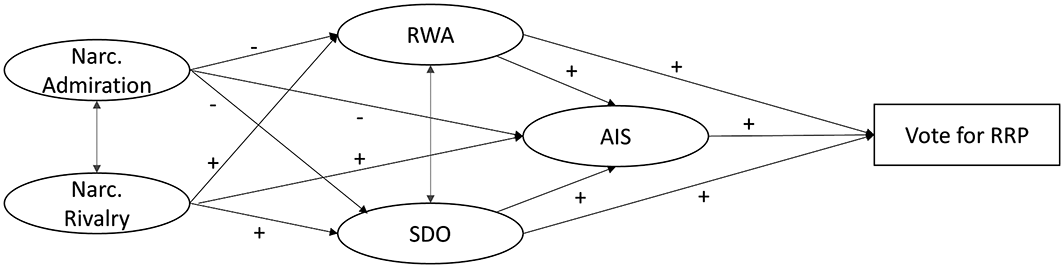
Theoretical model.
All constructs, except for the RRP vote, are measured as latent variables. The indirect links between narcissism and vote for RRP are the products of the direct paths, for example, the link between admiration and RWA multiplied by the link between RWA and vote for RRP. Next to the directional links, we also include the covariance between RWA and SDO in our model.
Data and Methods
Data
Our study draws on several waves of the GESIS Panel (Bosnjak et al., 2018; GESIS, 2017).
4
The initial recruitment of the respondents was carried out in February 2014 and was based on a random sample of about 22 000 people between 18 and 70 years of age. The data were collected in 2015 and 2016 using a mixed–mode access panel design. The respondents were interviewed face to face (GESIS, 2016). About 3800 panellists (65% online and 35% paper–based) participated in waves that were conducted every 2 months. The response rate was very high. For example, the response rate of Wave 16 (including grandiose narcissism) was 92% (see GESIS, 2017, for an overview of the response rates of the various panel waves). Because of the representative nature of the survey, we are able to draw substantial conclusions about distributions and relationships for the whole German population. Panellists who have missing values for any of our dependent variables are excluded from the analyses. Hence, our analyses are based on
Measures
The measures used in this study are pooled from several waves of the GESIS Panel (Table 7).
Preference to vote for an RRP was measured with a single item. Respondents were asked in the autumn of 2016: ‘If there were a general election next Sunday, which party would you vote for?’ We coded all respondents with a vote intention for the AfD with 1; respondents with intentions to vote for any other party were coded with 0. 5 The result was that 12.7% of the respondents indicated that they would vote for the AfD.
To measure narcissism, we used a validated short scale of the NARQ (Back et al., 2013). The NARQ short scale (NARQ–S) consists of six items: three items for each dimension. To measure narcissistic admiration, respondents were asked to evaluate the following three statements on a 6–point Likert–type scale: ‘I earned being viewed as a great personality’; ‘I gain a lot of strength from knowing that I am a very special person’; and ‘Due to my extraordinary contributions I successfully become the center of attention’. To measure narcissistic rivalry, we used the respondents’ answers to the following three statements: ‘I react annoyed if another person steals the show from me’; ‘I want my rivals to fail’; and ‘Most people are somehow losers’. The answer options ranged from 1 (does not apply at all) to 6 (fully applies) (see Table 7 for summary statistics).
As mediators, we include RWA, SDO, and AIS. 6 RWA was measured with three items asking respondents to indicate to what extent they agreed with the following statements: ‘We should take strong action against misfits and slackers in society’; ‘Well–established behavior should not be questioned’; and ‘We need strong leaders in order to live a safe life in society’. These items reflect three aspects of RWA: aggression, submission and conventionalism (Altemeyer, 1998).
SDO was measured by the participants’ responses to the following two statements: ‘All population groups should be treated equally’ and ‘All population groups should have the same amount of influence in society’. These items capture the key characteristics of SDO: dominance and anti–egalitarianism (Ho et al., 2015). All items were measured on a 4–point Likert scale, ranging from 1 (fully disagree) to 4 (fully agree). We recoded all SDO measures in such a way that higher values indicated higher SDO.
We used four items to measure AISs. Respondents were asked to rate their appraisal of different foreign ethnic and religious groups in Germany. Specifically, respondents were asked how they would generally assess Muslims, foreigners, refugees, and Sinti and Roma in Germany. Answer categories ranged from 1 (very negative) to 5 (very positive). All items were rescaled so that a higher value indicated higher AISs.
In order to control for the effects of confounding factors, we included several variables that correlate with our constructs of interest. We included a dichotomous measure for gender, coded with 1 if the respondents were male and coded with 0 if they were female. We also controlled for the respondents’ age measured in years. We accounted for educational attainment with a measure ranging from 1 (low) to 3 (high). To account for regional differences of RRP support, we included a dichotomous item coded with 1 if the respondents lived in East Germany and coded with 0 if they lived in West Germany. Finally, we included respondents’ left–right self–placement as an indicator of their political ideology. The measure was based on the question: ‘In politics, people sometimes talk of left and right. Where would you place yourself on this scale, where 0 means left and 10 means right?’
Methods
To test our hypotheses, we employed structural equation modelling. First, we conducted confirmatory factor analysis to evaluate the latent structure of our measures. Second, we evaluated the mediation relationships in a structural model. Our analyses use full information and robust weighted least squares estimates based on raw data conducted in the Mplus 8 statistical package (Muthén & Muthén, 1998). We consider measurement models with RMSEA < .06, CFI and TLI > .95, and SRMR < .08 to have a good fit to the data (Hu & Bentler, 1999). The mediation relationships combine linear correlations between narcissism, RWA, SDO, and AIS with logit links to RRP support. The underlying continuous latent response variable of RRP support is used to estimate indirect effects (Muthén & Asparouhov, 2015).
Results
Zero–order correlations
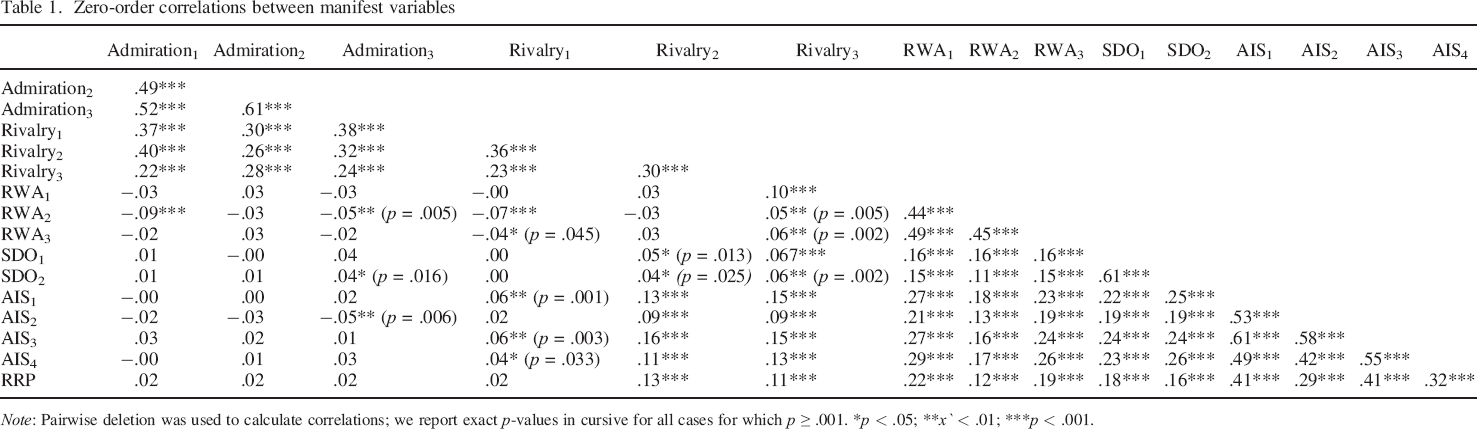
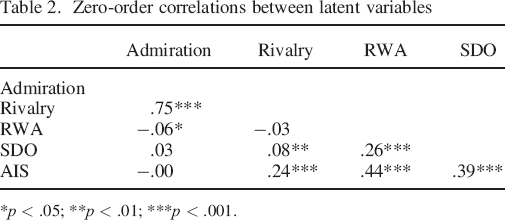
The zero–order correlations show high intercorrelations between the different measures of narcissism, RWA, SDO and AISs (Tables 1 and 2). The correlation of admiration with other constructs is weak or negligible. We find that rivalry is weakly to moderately correlated with the other constructs, especially AISs. RWA and SDO are moderately correlated with AISs and RRP preference, and lastly, AISs have a moderate to high correlation with RRP preferences.
Zero–order correlations between manifest variables
Zero–order correlations between latent variables
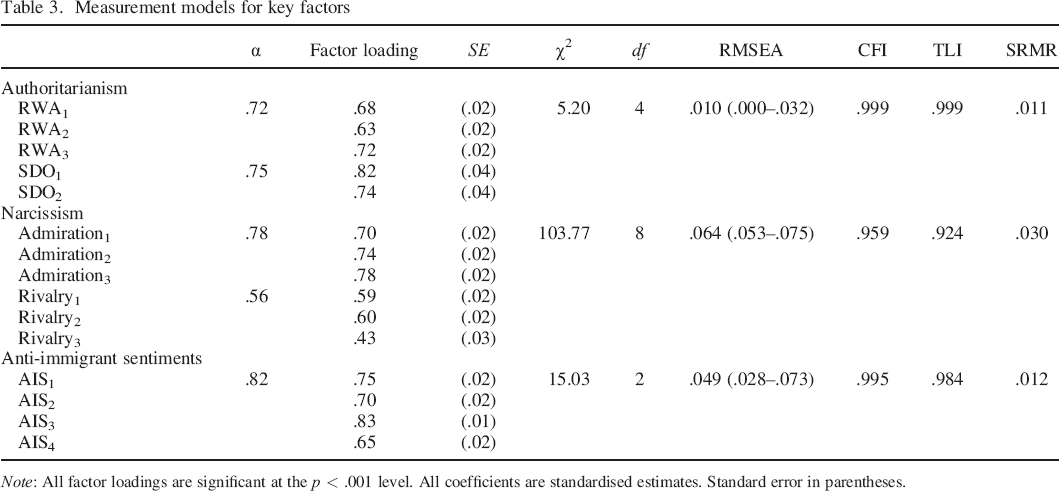
Measurement model
Before we turn to the results for the structural relationships, we present the results of our measurement models in Table 3. We ran a series of latent variable models to evaluate the operationalisation of our multi–indicator measures. For authoritarianism, we specified a two–factor solution, with SDO and RWA as correlated factors. The model fit statistics indicate an excellent fit to the data (χ2 = 5.20,
Measurement models for key factors
Structural model
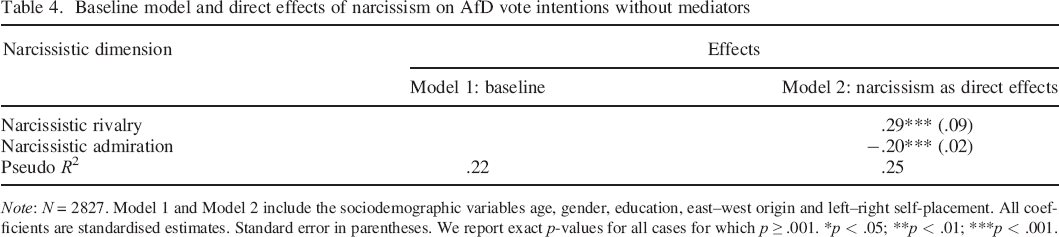
Next, we turn to the results of the structural equation models, testing the indirect relationship between narcissism and preferences for RRPs more specifically. Before we present the results of the full structural model, we show a model without any mediators, to evaluate the contribution of narcissism to RRP preferences. We report standardised estimates for all effects.
The results of our baseline models are presented in Table 4. We find that about 22% of the variance in RRP preferences are explained by sociodemographic differences. Thus, individual resources, such as education, are very important for vote intentions. Adding narcissism to the model increases the explained variance by three percentage points. In support for our expectations, we find a significantly positive effect of rivalry and a significantly negative effect of admiration.
Baseline model and direct effects of narcissism on AfD vote intentions without mediators
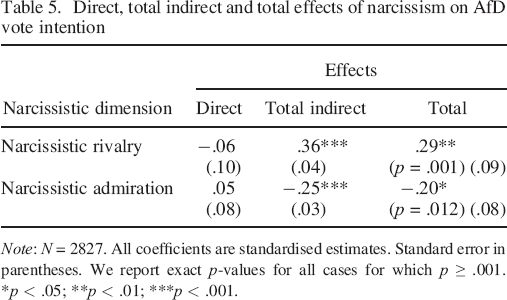
We now turn to the full structural model with the effects of SDO, RWA and AIS as mediating factors. Overall, the model fit statistics indicate an adequate fit to the data (χ2 = 785.88,
Direct, total indirect and total effects of narcissism on AfD vote intention
Specific indirect effects of narcissism on AfD vote intention
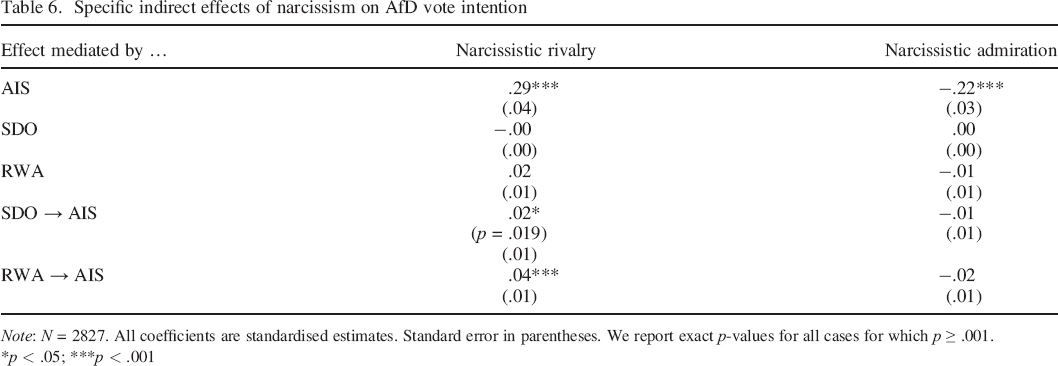
Table 6 presents the specific indirect effects. We find that the effect of narcissistic rivalry on RRP support is effectively mediated by AIS. We find no statistically significant link between SDO and RRP support and no statistically significant link between RWA and RRP support. Thus, the indirect paths via political ideology (SDO and RWA) are both mediated by AIS. Regarding narcissistic admiration, we only find a statistically significant indirect effect to RRP support via AIS. The results show no significant link between narcissistic admiration and either dimension of political ideology. The findings are summarised in Figure 2.
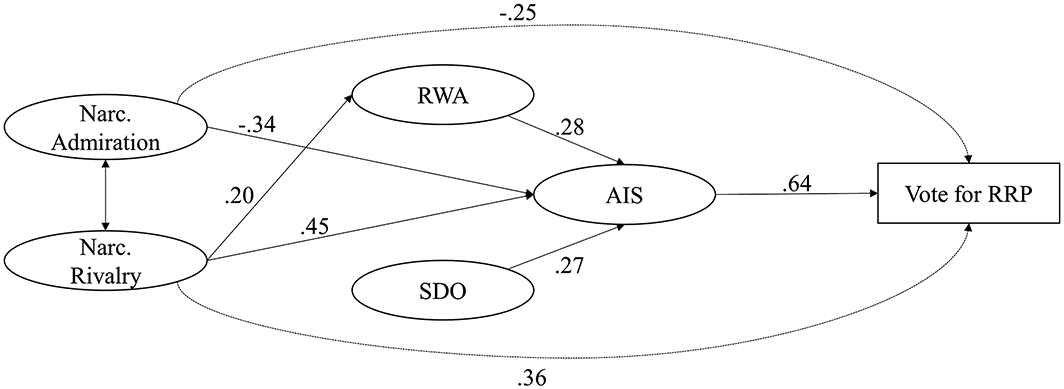
Path diagram with standardised estimates including only paths with
For a robustness check, we also estimated the models by additionally including the Big Five traits. For this, we used the German Big Five Inventory (BFI–10), a validated German short scale (Rammstedt, Kemper, Klein, Beierlein, & Kovaleva, 2017), also available in the GESIS Panel data set. When considering the BFI–10 as controls for AIS, SDO, RWA and AfD vote intention, the direction of the relationships in Tables 3 and 4 does not change (Tables 11). Only two paths become insignificant: the path from narcissistic rivalry through SDO and AIS on RRP, and the total effect of narcissistic admiration on RRP. In other words, conventional personality traits might mediate the protecting effect of admiration on RRP support, but they do not mediate the positive relationship between narcissistic rivalry and RRP support. Furthermore, we estimated models without RWA and SDO, as well as a model without AIS, to test whether the results presented above were related to the variables included in the model. The robustness checks revealed substantially identical results (Tables 12 and 13). The findings presented above are based on estimations with all control variables introduced in the measurement section. We reran the model without these potentially confounding factors and found no substantive changes of the results pattern.
Discussion
Investigating the link between personality and support for authoritarian politics has a long tradition (Adorno, Frenkel–Brunswik, Levinson, & Sanford, 1950). However, to date, no study has empirically explored the (indirect) effects of grandiose narcissism on RRP support. In this study, we argue that narcissism should be treated as a two–dimensional concept—narcissistic admiration and narcissistic rivalry—and that it is predominantly narcissistic rivalry which is positively related to RRP support, whereas high levels of narcissistic admiration are negatively related to RRP support. Our findings are consistent with previous studies that showed that narcissism is not per se positively related to right–wing political orientations but that this relationship varies by subscales—a positive relationship is more likely for the facet connected to maladaptive aspects (e.g. Cichocka et al., 2017; Hatemi & Fazekas, 2018). Moreover, we propose that the effects of grandiose narcissism are mediated by RWA, SDO and AIS, as previous studies have suggested (Aichholzer & Zandonella, 2016; Caprara et al., 2006). In doing so, we focused on the AfD, a newly founded German party that gained entrance to the German Bundestag for the first time in 2017.
Drawing on data from the GESIS Panel, we were able to make generalisations about the whole population. Our findings suggest that it is indeed mainly narcissistic rivalry, the maladaptive pathway of narcissism, that accounts for RRP support, implying another negative outcome of narcissistic rivalry (for other outcomes, see, e.g. Lange, Crusius, & Hagemeyer, 2016; Martin, Jin, O'Connor, & Hughes, 2019; Wurst et al., 2017; Zeigler–Hill & Trombly, 2018). Furthermore, as expected, our results show that the effects of grandiose narcissism on RRP support are indirect rather than direct. This finding adds to the discussion on how models that aim to explain vote choice with voters’ personality should be conceptualised. Not considering mediation through political ideology, such as RWA and SDO, involves concealing the complex pathways which indicate how voter personality affects vote choices (Schimpf & Schoen, 2017). Finally, our results indicate that the indirect effects of narcissistic rivalry on RRP support via RWA and SDO, respectively, are mediated by AIS. As AIS was found to be the most important determinant of RRP support, our results fit closely with previous literature (Aichholzer & Zandonella, 2016; Arzheimer, 2008; van der Brug et al., 2000).
Comparing our findings with the literature on personality, our results reveal that Back et al. (2013) and others are right in differentiating two dimensions of grandiose narcissism. The distinction between narcissistic admiration and narcissistic rivalry allows us to understand better the interplay of grandiose narcissism and other characteristics such as political ideology, AIS and RRP support.
Relating our findings to the literature on voting behaviour, it appears that research on voting behaviour, and in particular on RRP support, does not sufficiently consider the personality of voters. Since voter personality proved to be important not only for the voters’ attitudes but also for their voting behaviour, we suggest that future research on voting behaviour and RRP support should regularly incorporate voters’ personality traits, thus enabling an adequate analysis of the general mechanisms behind RRP support.
Implications
Overall, our findings contribute to understanding the psychological roots of the support for RRPs. These results extend beyond studies on the personality basis of RRP support: By employing the two–dimensional concept of narcissism proposed by Back et al. (2013), we are able to show that rivalry narcissism and admiration narcissism have distinct and opposing (indirect) effects on RWA, SDO and RRP support. Hence, treating narcissism as one–dimensional in studies on ideological orientations and voting behaviour, respectively, is inadequate and would, in turn, inevitably underestimate or overestimate the effects of grandiose narcissism. Our findings corroborate the importance of the NARC by showing that it is narcissistic rivalry in particular which is positively associated with RRP support, while admiration shows a negative relationship.
Moreover, we demonstrated that the effects of grandiose narcissism should incorporate mediation in order to analyse the general patterns of RRP support. However, to analyse current trends and within–campaign developments, these patterns can be further mediated by political preferences. To analyse fully the interplay of short–term and long–term mechanisms of RRP voter mobilisation, it would also be desirable if future research focused on the relationship between personality, ideology and political preferences during election campaigns.
Limitations and future directions
Using survey data to investigate the effects of personality and other psychological concepts has specific drawbacks. Due to the limited survey time of this study, the major psychological concepts could only be operationalised with small or partial scales that encompassed just a few indicators. Hence, we possibly did not capture these concepts to their full extent. It is also possible that we did not measure certain subdimensions due to missing items, although our operationalisations still allowed us to achieve robust results that did not rely on single items. For future analyses, using a convenience sample for measuring all concepts with full, validated scales, as well as RRP support, would allow us further to strengthen our findings. However, as the share of RRP supporters is lowest among the young, women and the better educated (Arzheimer, 2018), we recommend using access panels rather than student samples. We have to add two additional caveats for the measurement of the NARQ. First, social desirability might affect the responses, especially for the rivalry dimension. However, we use data that were not gathered in a face–to–face situation with an interviewer present, but in written form, which thus minimises the potential bias. In addition, all items of the NARQ are worded in a positive way, which makes them prone to
Furthermore, the narcissistic rivalry dimension correlates highly with other constructs, such as the Machiavellian tactics subscale by Monaghan, Bizumic, and Sellbom (2016), with its focus on the manipulation and exploitation of others in a strategic way, as well as Duckitt's (2001) competitive–jungle worldview scale that sees the world as a moral struggle for power and resources that has to be won. Previous research on the Dark Triad/Tetrad, as well as the competitive–jungle worldview scale, showed their positive relationship with SDO, as well as right–wing political attitudes and beliefs (e.g. Bardeen & Michel, 2019; Duckitt, 2001). It is thus necessary for future research to study the distinction between these concepts. In the present state, we think the NARC enables researchers to look more precisely at the consequences and correlates of narcissism within a concise theoretical framework, which, for example, narcissistic admiration and Machiavellianism would not allow.
We also could only analyse RWA, SDO and AIS as mediating concepts. Even though these are the most prominently discussed concepts in the literature on mediation of personality traits and right–wing orientations (e.g. Cichocka & Dhont, 2018), using other mediators, such as threat perceptions, would add to our understanding of the complex mechanisms for the transfer from personality traits to vote choice.
Furthermore, our data are cross–sectional and from a single country, meaning that we cannot test whether our results are time–invariant or country–invariant. In order to investigate the time invariance, it would be necessary for an RRP to exist in a country's party system and to analyse real vote choices rather than the hypothetical question of whether voters would vote for such a party. However, the AfD was only founded in 2013, and no other RRP existed in Germany before that point in time. In addition, the AfD can only be categorised as an RRP from 2015, and thus, we could not use previous vote–choice questions. As the GESIS Panel includes the question for vote choice in almost every year, future work could focus on the stability of the link between personality and RRP support. This could also clarify the question of whether AIS, and immigration per se, are meaningful mediators all the time, or whether the extreme salience of immigration in 2015 and 2016 (Dennison & Geddes, 2018) leads to the overestimation of the mediation effects of AIS. As for the question of country invariance, it could be argued that Germany, because of its past, is an extreme case to use for analysing the support for the radical right—support that was historically lower than in other countries such as Austria and France (Berbuir et al., 2015). However, recent results for the 2017 German federal election show that the AfD can be regarded as an established RRP in the German political system (Arzheimer & Berning, 2019). Previous research also demonstrated that Germany is not an exception in Europe with regard to AIS (Semyonov, Raijman, & Gorodzeisky, 2006). In addition, the relationship between the two dimensions of narcissism and political parties could also vary over time, as demonstrated by ideological changes for the two major parties in the United States, for example (e.g. Bakker et al., 2016).
Conclusion
By investigating the relationship between the two dimensions of narcissism and radical right party support, we add further to the understanding of the psychological underpinnings of RRP support. Our results reveal that both dimensions of narcissism—admiration and rivalry—have to be taken into account when analysing the relationship of narcissism with political ideology and voter choice. Furthermore, it is narcissistic rivalry in particular that is positively associated with RRP support, indirectly through SDO, RWA and AIS.
Recent media reports suggest that support for RRPs is ascribed in particular to current developments, such as the refugee crisis (e.g. Heimbach, 2018). However, this explanation falls too short. Our results imply that one part of the electorate is constantly more conducive to the appeal of populist right–wing parties because of its personality dispositions. Some citizens might generally be more likely to employ self–defence as a social strategy and are also more prone to quick changes in self–esteem, which is reflected in a higher probability of RRP support. In other words, the success of RRPs might also be an expression of personality for some parts of the electorate (Adorno et al., 1950; Malka, Lelkes, & Soto, 2019). If new political parties (inter alia) cater for people with narcissistic personality dispositions, as it is currently the case in Germany, it is no surprise that these parties are successful.
Acknowledgements
We thank Julian Aichholzer, Kai Arzheimer, Marcel Lewandowsky, Kathrin Thomas, Magdalena Wischnewski, the three anonymous reviewers, and the editors for helpful comments. We also thank Manuel Diaz Garcia, Sarah Kluth, and René Selbach for research assistance as well as Brian Cooper for proofreading. An earlier version was presented at the 2019 EPSA Annual Conference in Belfast. Sabrina Mayer was funded by the German Research Foundation, grant number GO 1833/5–1.
Supporting info item
Supporting info item, per2228-sup-0001-Open_Practices_Disclosure_Form - The Two Dimensions of Narcissistic Personality and Support for the Radical Right: The Role of Right–Wing Authoritarianism, Social Dominance Orientation and Anti–Immigrant Sentiment
Supporting info item, per2228-sup-0001-Open_Practices_Disclosure_Form for The Two Dimensions of Narcissistic Personality and Support for the Radical Right: The Role of Right–Wing Authoritarianism, Social Dominance Orientation and Anti–Immigrant Sentiment by Mayer Sabrina J.,Berning Carl C., Johann David and Lönnqvist Jan–Erik in European Journal of Personality
Footnotes
Notes
Appendix
References
Supplementary Material
Please find the following supplemental material available below.
For Open Access articles published under a Creative Commons License, all supplemental material carries the same license as the article it is associated with.
For non-Open Access articles published, all supplemental material carries a non-exclusive license, and permission requests for re-use of supplemental material or any part of supplemental material shall be sent directly to the copyright owner as specified in the copyright notice associated with the article.
